Network Analysis using GIS Techniques
BAKHAT ALI
Institute of Geoinformatics and Earth Observation,
Pir Mehr Ali Shah Arid Agriculture University Rawalpindi , Punjab, Pakistan
bakhtali21uaar@gmail.com
Semester:
Semester 4th
Couse name:
Navigation system
Couse code :
RSG-408 3(2-1)
SUBMITTED TO:
Mr. Abdul-Basit
SUBMITTED BY:
BAKHT ALI
REG.NO:22-Arid-2818
1 Introduction:
Geographic Information System (GIS) integrates spatial and non-spatial data for
comprehensive analysis, supporting urban planning and transportation
management. The ArcGIS Network Analyst extension provides advanced network-
based spatial analysis, facilitating efficient travel routing, service area
definition, and resource allocation.
1.1 Aim:
To conduct a comprehensive network analysis of Muzaffargarh city utilizing
advanced GIS techniques to enhance urban planning and service delivery.
1.2 Objective:
 To identify the most efficient travel routes within Muzaffargarh.
 To define optimal service areas for different facilities such as hospitals,
schools, etc.
2 Methodology
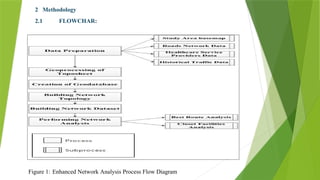
2.1 FLOWCHAR:
Figure 1: Enhanced Network Analysis Process Flow Diagram
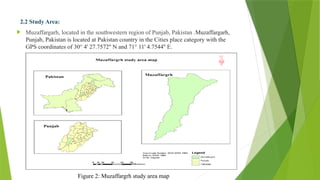
2.2 Study Area:
 Muzaffargarh, located in the southwestern region of Punjab, Pakistan .Muzaffargarh,
Punjab, Pakistan is located at Pakistan country in the Cities place category with the
GPS coordinates of 30° 4' 27.7572'' N and 71° 11' 4.7544'' E.
Figure 2: Muzaffargrh study area map
3 Material and Methods
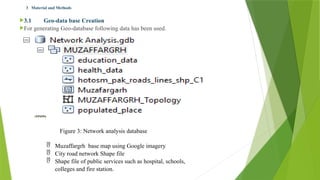
3.1 Geo-data base Creation
For generating Geo-database following data has been used.
Figure 3: Network analysis database
 Muzaffargrh base map using Google imagery
 City road network Shape file
 Shape file of public services such as hospital, schools,
colleges and fire station.
2 .3 Datasets:
Data acquisition for this study
involved the collection of satellite
imagery, road network data, and point
data for facilities such as hospitals,
education data , and popular place
Muzaffargarh. High-resolution
satellite imagery from sources like
Google Earth was obtained and geo-
referenced to ensure accuracy in
spatial analysis. Road network data,
including information on road types,
traffic flow, and connectivity, were
sourced from local government
agencies and digital maps.

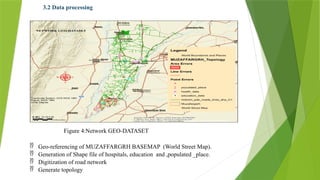
3.2 Data processing
Figure 4:Network GEO-DATASET
 Geo-referencing of MUZAFFARGRH BASEMAP (World Street Map).
 Generation of Shape file of hospitals, education and ,populated _place.
 Digitization of road network
 Generate topology
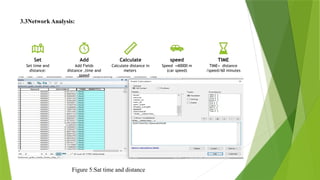
3.3Network Analysis:
Set
Set time and
distance:
Add
Add Fields
distance ,time and
speed
Calculate
Calculate distance in
meters
speed
Speed =40000 m
(car speed)
TIME
TIME= distance
/speed/60 minutes
Figure 5:Sat time and distance
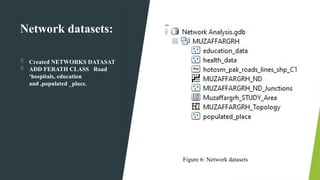
Network datasets:
 Created NETWORKS DATASAT
 ADD FERATH CLASS Road
‘hospitals, education
and ,populated _place.
Figure 6: Network datasets
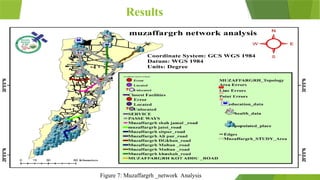
Results
Figure 7: Muzaffargrh _network Analysis
A network analysis using GIS can optimize travel routes in Muzaffargarh District by
calculating time and cost, considering shortest distances and various routes,
including key Chenab River crossings like Head Sulaiman Bridge and Rangpur
Head. The analysis rates routes between Muzaffargarh City and neighboring towns
by distance, traffic, and tolls, identifying optimal routes like the fastest route to
Multan via Head Sulaiman Bridge and the quickest route to Alipur via Ali Pur Head.
A survey assessed infrastructure and utilities services, evaluating school, college, and
university accessibility, hospital emergency response times, and community
engagement in congested areas like parks, markets, and cultural hubs. This analysis
can inform infrastructure development to enhance service delivery, community
accessibility, and overall quality of life in Muzaffargarh District.
Discussion
6 Conclusion:
Defined the network analysis using GIS techniques has provided valuable insights into
the efficiency of services and transportation (short routing )infrastructure in
Muzaffargarh. By identifying areas located in for improvement and optimization, this
study can inform urban planning decisions aimed at enhancing service delivery and
improving the overall quality of life for residents.
References:
I. http://chandigarh.gov.in/knowchd_general.htm
II. Facility, Closest, and Service Area Analysis. “ArcGIS Network
Analyst.”
III. Fang, Kun, Polygon Based Model, and Xu Yiqin. “Gis Network
Analysis in Rescue of Coal Mine.” (2001)
IV. http://help.arcgis.com/en/arcgisdesktop/10.0/pdf/network-
analyst-tutorial.pdf
V. Smith, Richard C, David L Harkey, and Bobby Harris.
“Implementation of GIS-Based Highway Safety Analyses:
Bridging the Gap.” January (2001)
VI. http://webhelp.esri.com/arcgisdesktop/9.2/pdf/Network_A
nalyst_Tutorial.pdf
ppt networks analysis GIS and Remote Sensing.pptx

ppt networks analysis GIS and Remote Sensing.pptx

  • 1.
    Network Analysis usingGIS Techniques BAKHAT ALI Institute of Geoinformatics and Earth Observation, Pir Mehr Ali Shah Arid Agriculture University Rawalpindi , Punjab, Pakistan bakhtali21uaar@gmail.com Semester: Semester 4th Couse name: Navigation system Couse code : RSG-408 3(2-1) SUBMITTED TO: Mr. Abdul-Basit SUBMITTED BY: BAKHT ALI REG.NO:22-Arid-2818
  • 2.
    1 Introduction: Geographic InformationSystem (GIS) integrates spatial and non-spatial data for comprehensive analysis, supporting urban planning and transportation management. The ArcGIS Network Analyst extension provides advanced network- based spatial analysis, facilitating efficient travel routing, service area definition, and resource allocation. 1.1 Aim: To conduct a comprehensive network analysis of Muzaffargarh city utilizing advanced GIS techniques to enhance urban planning and service delivery. 1.2 Objective:  To identify the most efficient travel routes within Muzaffargarh.  To define optimal service areas for different facilities such as hospitals, schools, etc.
  • 3.
    2 Methodology 2.1 FLOWCHAR: Figure1: Enhanced Network Analysis Process Flow Diagram
  • 4.
    2.2 Study Area: Muzaffargarh, located in the southwestern region of Punjab, Pakistan .Muzaffargarh, Punjab, Pakistan is located at Pakistan country in the Cities place category with the GPS coordinates of 30° 4' 27.7572'' N and 71° 11' 4.7544'' E. Figure 2: Muzaffargrh study area map
  • 5.
    3 Material andMethods 3.1 Geo-data base Creation For generating Geo-database following data has been used. Figure 3: Network analysis database  Muzaffargrh base map using Google imagery  City road network Shape file  Shape file of public services such as hospital, schools, colleges and fire station.
  • 6.
    2 .3 Datasets: Dataacquisition for this study involved the collection of satellite imagery, road network data, and point data for facilities such as hospitals, education data , and popular place Muzaffargarh. High-resolution satellite imagery from sources like Google Earth was obtained and geo- referenced to ensure accuracy in spatial analysis. Road network data, including information on road types, traffic flow, and connectivity, were sourced from local government agencies and digital maps. 
  • 7.
    3.2 Data processing Figure4:Network GEO-DATASET  Geo-referencing of MUZAFFARGRH BASEMAP (World Street Map).  Generation of Shape file of hospitals, education and ,populated _place.  Digitization of road network  Generate topology
  • 8.
    3.3Network Analysis: Set Set timeand distance: Add Add Fields distance ,time and speed Calculate Calculate distance in meters speed Speed =40000 m (car speed) TIME TIME= distance /speed/60 minutes Figure 5:Sat time and distance
  • 9.
    Network datasets:  CreatedNETWORKS DATASAT  ADD FERATH CLASS Road ‘hospitals, education and ,populated _place. Figure 6: Network datasets
  • 10.
  • 11.
    A network analysisusing GIS can optimize travel routes in Muzaffargarh District by calculating time and cost, considering shortest distances and various routes, including key Chenab River crossings like Head Sulaiman Bridge and Rangpur Head. The analysis rates routes between Muzaffargarh City and neighboring towns by distance, traffic, and tolls, identifying optimal routes like the fastest route to Multan via Head Sulaiman Bridge and the quickest route to Alipur via Ali Pur Head. A survey assessed infrastructure and utilities services, evaluating school, college, and university accessibility, hospital emergency response times, and community engagement in congested areas like parks, markets, and cultural hubs. This analysis can inform infrastructure development to enhance service delivery, community accessibility, and overall quality of life in Muzaffargarh District. Discussion
  • 12.
    6 Conclusion: Defined thenetwork analysis using GIS techniques has provided valuable insights into the efficiency of services and transportation (short routing )infrastructure in Muzaffargarh. By identifying areas located in for improvement and optimization, this study can inform urban planning decisions aimed at enhancing service delivery and improving the overall quality of life for residents. References: I. http://chandigarh.gov.in/knowchd_general.htm II. Facility, Closest, and Service Area Analysis. “ArcGIS Network Analyst.” III. Fang, Kun, Polygon Based Model, and Xu Yiqin. “Gis Network Analysis in Rescue of Coal Mine.” (2001) IV. http://help.arcgis.com/en/arcgisdesktop/10.0/pdf/network- analyst-tutorial.pdf V. Smith, Richard C, David L Harkey, and Bobby Harris. “Implementation of GIS-Based Highway Safety Analyses: Bridging the Gap.” January (2001) VI. http://webhelp.esri.com/arcgisdesktop/9.2/pdf/Network_A nalyst_Tutorial.pdf