SPATIAL DATABASE
&
DATABASE MANAGEMENT SYSTEM
PRESENTED BY -
LAL MOHAMMAD
SAMRAT BASUMATARY
SUSHANTA PATRA
MOU DEY
SHRADDHA MAITY
Master of Science
Dept. of Remote Sensing & GIS
Vidyasagar University
Midnapure-721102
DATA
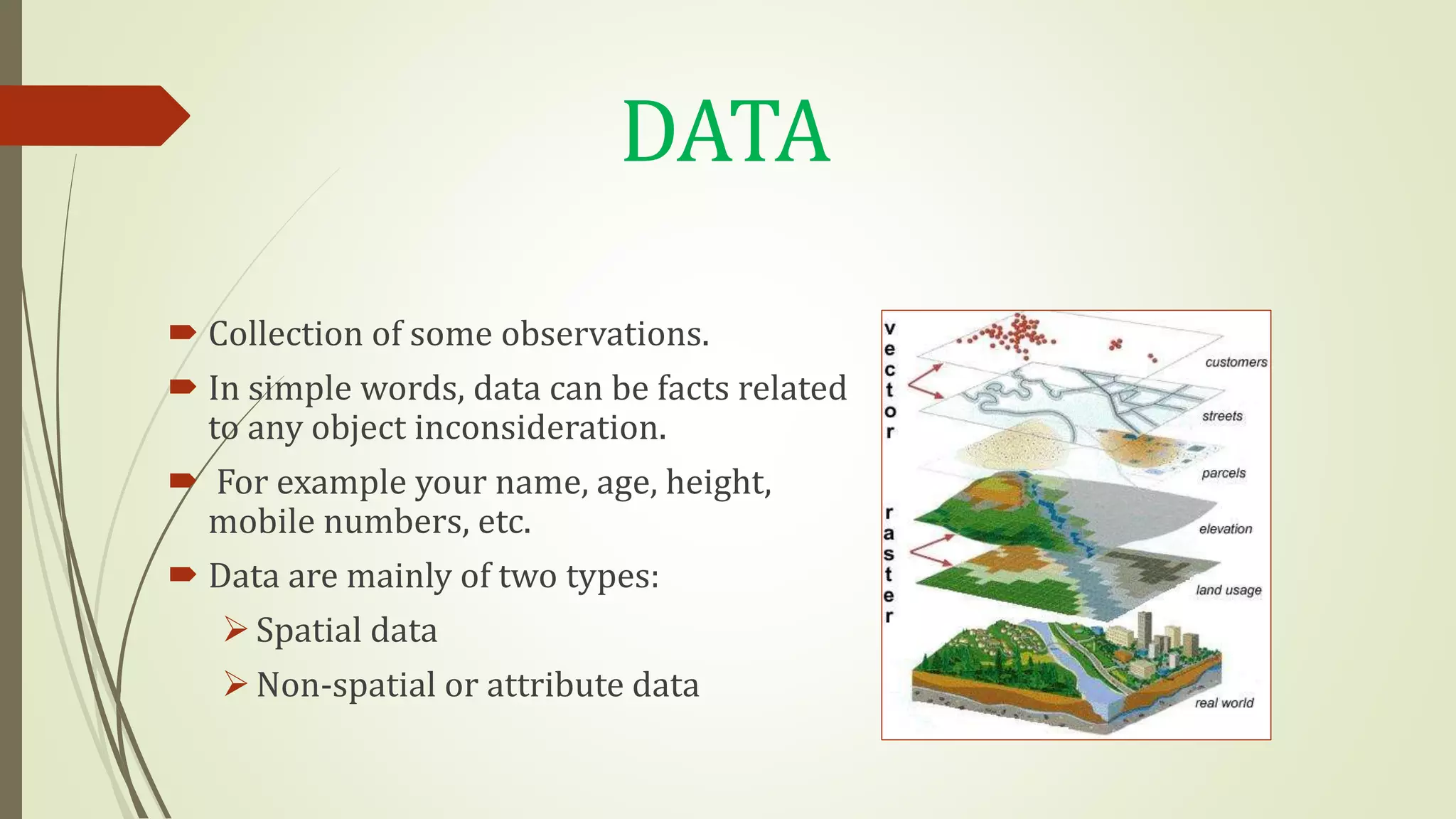
 Collection of some observations.
 In simple words, data can be facts related
to any object inconsideration.
 For example your name, age, height,
mobile numbers, etc.
 Data are mainly of two types:
Spatial data
Non-spatial or attribute data
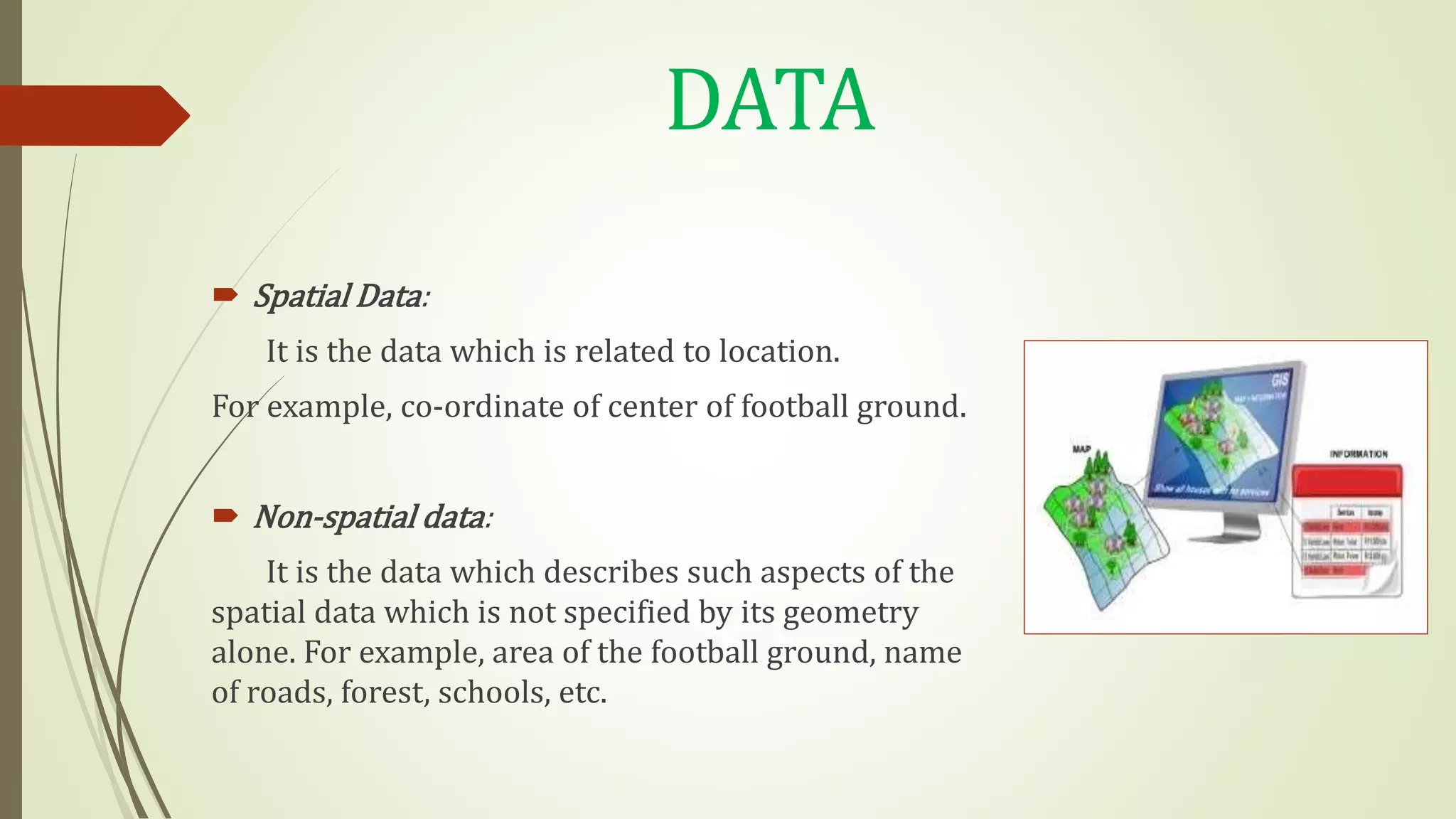
 Spatial Data:
It is the data which is related to location.
For example, co-ordinate of center of football ground.
 Non-spatial data:
It is the data which describes such aspects of the
spatial data which is not specified by its geometry
alone. For example, area of the football ground, name
of roads, forest, schools, etc.
DATA
DATABASE
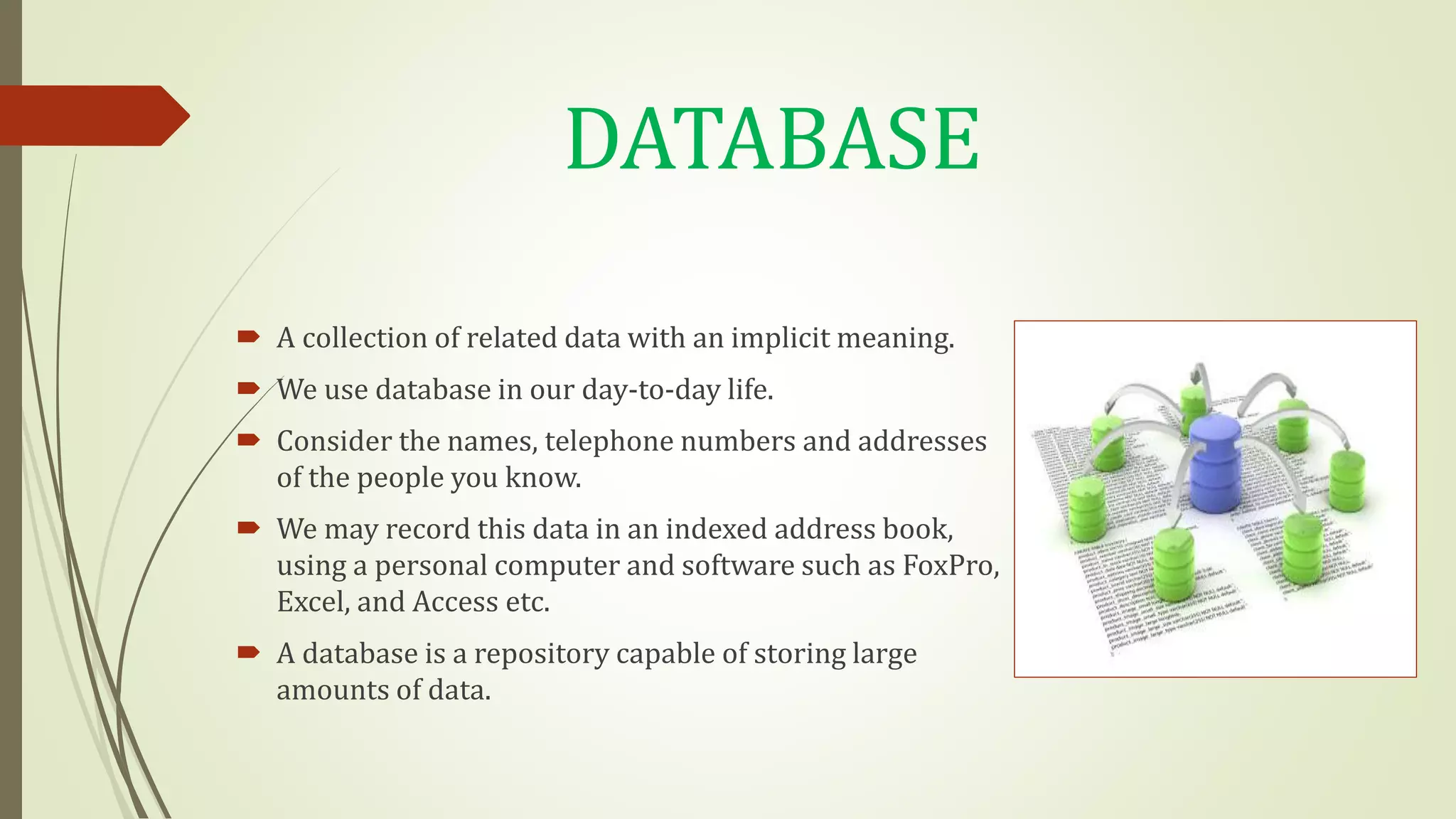
 A collection of related data with an implicit meaning.
 We use database in our day-to-day life.
 Consider the names, telephone numbers and addresses
of the people you know.
 We may record this data in an indexed address book,
using a personal computer and software such as FoxPro,
Excel, and Access etc.
 A database is a repository capable of storing large
amounts of data.
PROPERTIES:
1) A database represents some aspect of the real world, sometimes called the
mini world. Changes to the mini world are reflected in the database.
2) A database is logically coherent collection of data with some inherent
meaning. A random assortment of data cannot correctly be referred to as a
database.
3) A database is designed, built and populated with data for a specific
purpose. It has an intended group of users and some preconvinced
applications in which these users are interested.
DATABASE
Thus Database is -
 Collection of interrelated data
 Set of programs to access the data
 Database Applications:
• Banking: all transactions
• Airlines: reservations, schedules
• Universities: registration, grades
• Sales: customers, products, purchases
• Manufacturing: production, inventory, orders, supply chain
• Human resources: employee records, salaries, tax deductions
 Databases touches all aspects of our lives
DATABASE
SPATIAL DATABASE
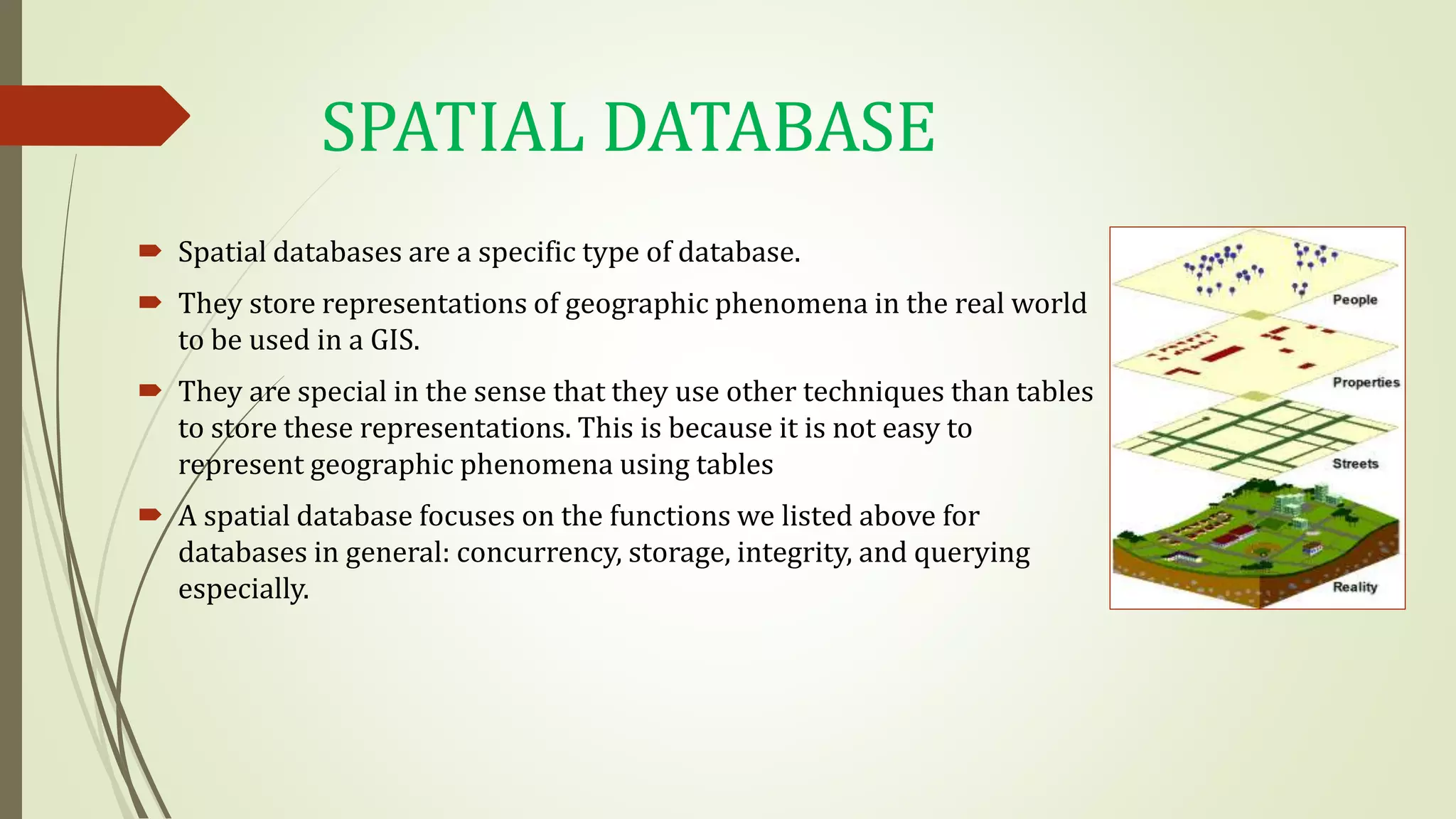
 Spatial databases are a specific type of database.
 They store representations of geographic phenomena in the real world
to be used in a GIS.
 They are special in the sense that they use other techniques than tables
to store these representations. This is because it is not easy to
represent geographic phenomena using tables
 A spatial database focuses on the functions we listed above for
databases in general: concurrency, storage, integrity, and querying
especially.
SPATIAL DATABASE
 The assumption for the design of a spatial database schema is that the
relevant spatial phenomena exist in a two- or three-dimensional Euclidean
space.
 Euclidean space can be informally defined as a model of space in which
locations are represented as coordinates—(x, y) in 2D; (x, y, z) in 3D—and
notions like distance and direction have been defined, with the usual
formulas. In 2D, we also talk about the Euclidean plane.
SPATIAL DATABASE
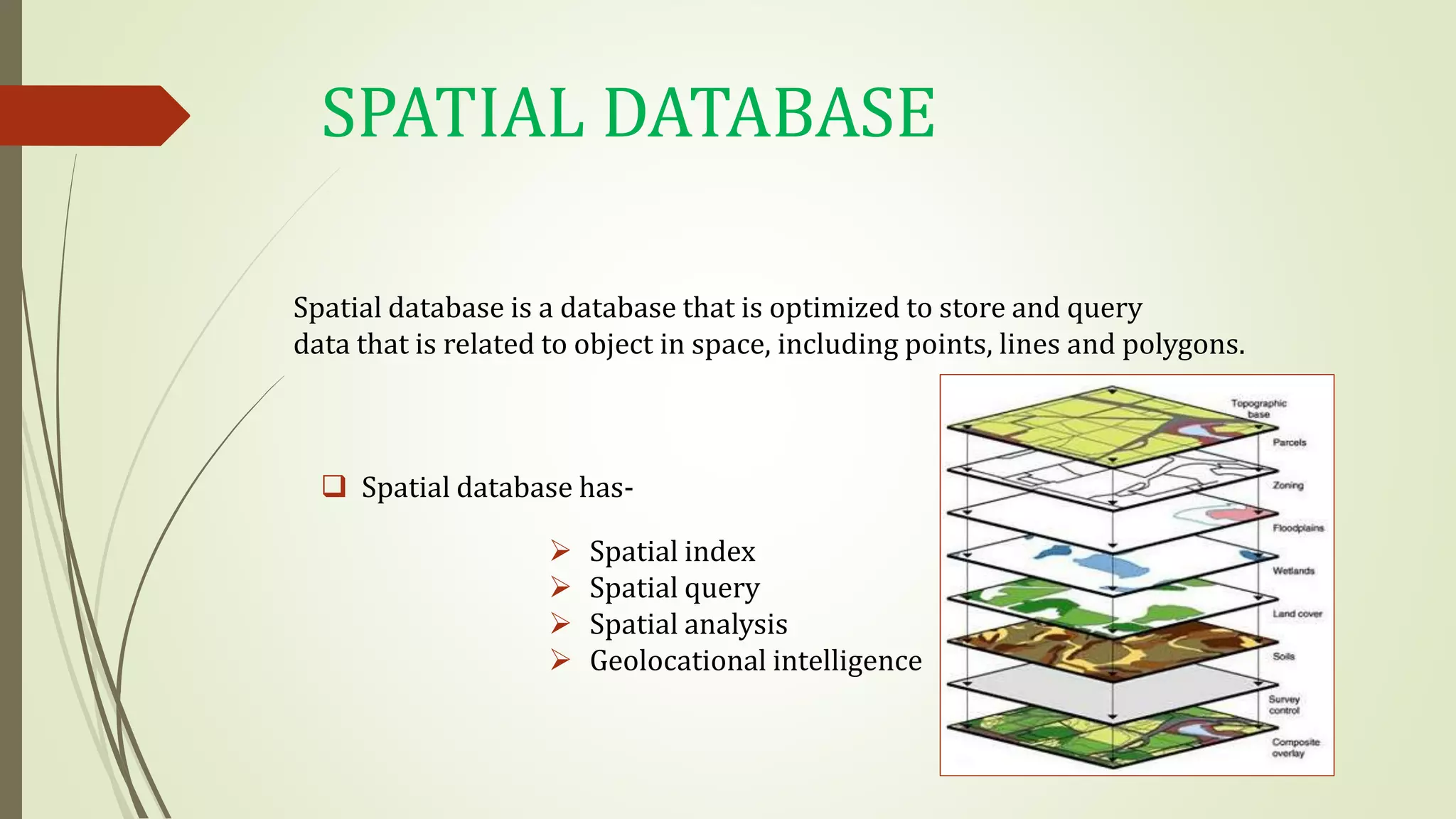
Spatial database is a database that is optimized to store and query
data that is related to object in space, including points, lines and polygons.
 Spatial database has-
 Spatial index
 Spatial query
 Spatial analysis
 Geolocational intelligence
DATABASE MANAGEMENT SYSTEM
 A DBMS is a collection of programs that enables users to create and
maintain a database. A DBMS is hence a general purpose s/w system
that facilitates the process of Defining, Constructing and Manipulating
databases for various applications.
 A database management system (DBMS) is a software package that
allows the users to set up, use, maintain and manipulating a database
for various application.
 Like a GIS allows to set up a GIS application, a DBMS offers generic
functionality for database organization and data handling.
 It is a collection of programs that enables users to create and maintain a
database.
COMPONENT OF DBMS
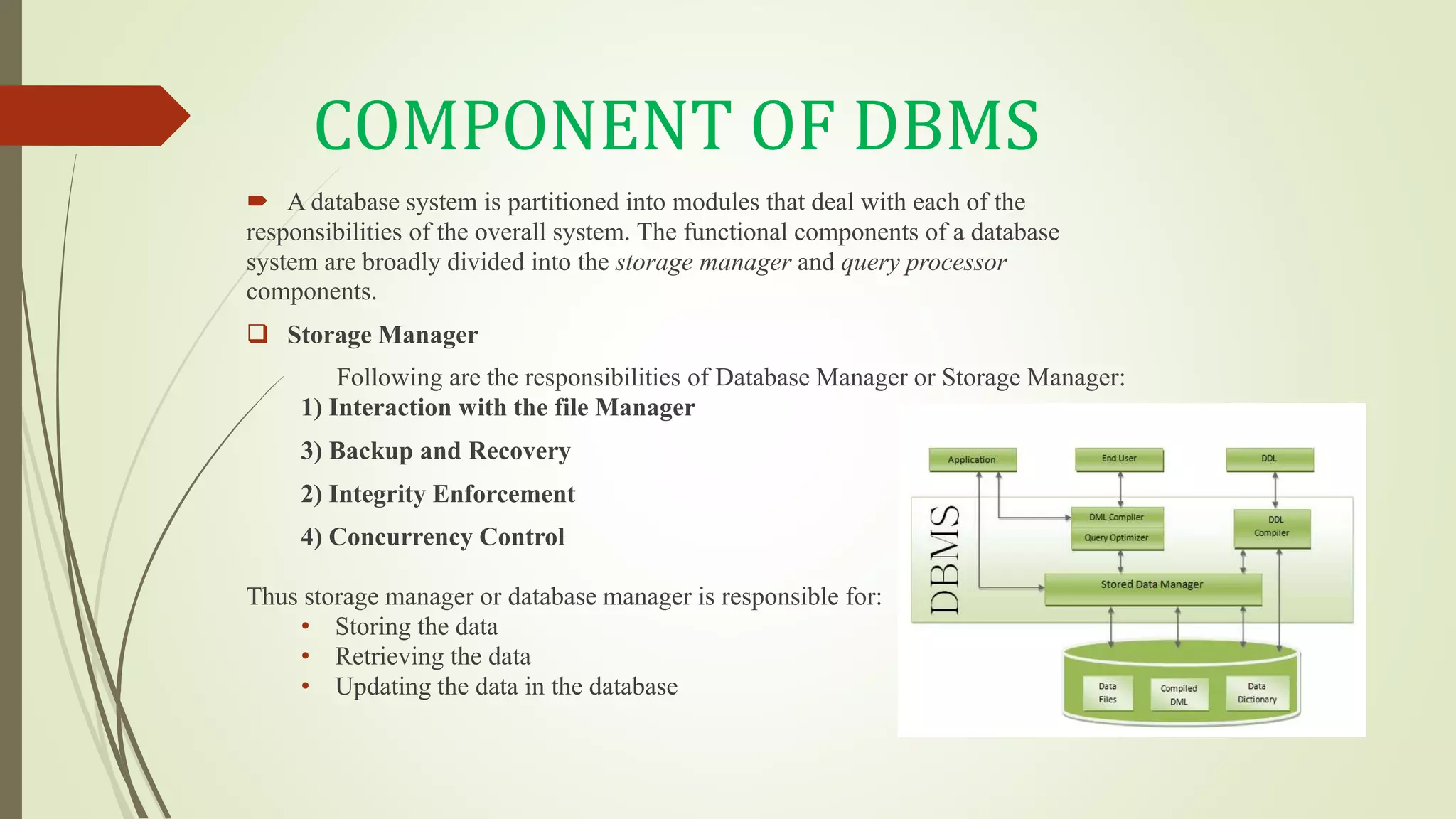
 A database system is partitioned into modules that deal with each of the
responsibilities of the overall system. The functional components of a database
system are broadly divided into the storage manager and query processor
components.
 Storage Manager
Following are the responsibilities of Database Manager or Storage Manager:
1) Interaction with the file Manager
3) Backup and Recovery
2) Integrity Enforcement
4) Concurrency Control
Thus storage manager or database manager is responsible for:
• Storing the data
• Retrieving the data
• Updating the data in the database
COMPONENT OF DBMS
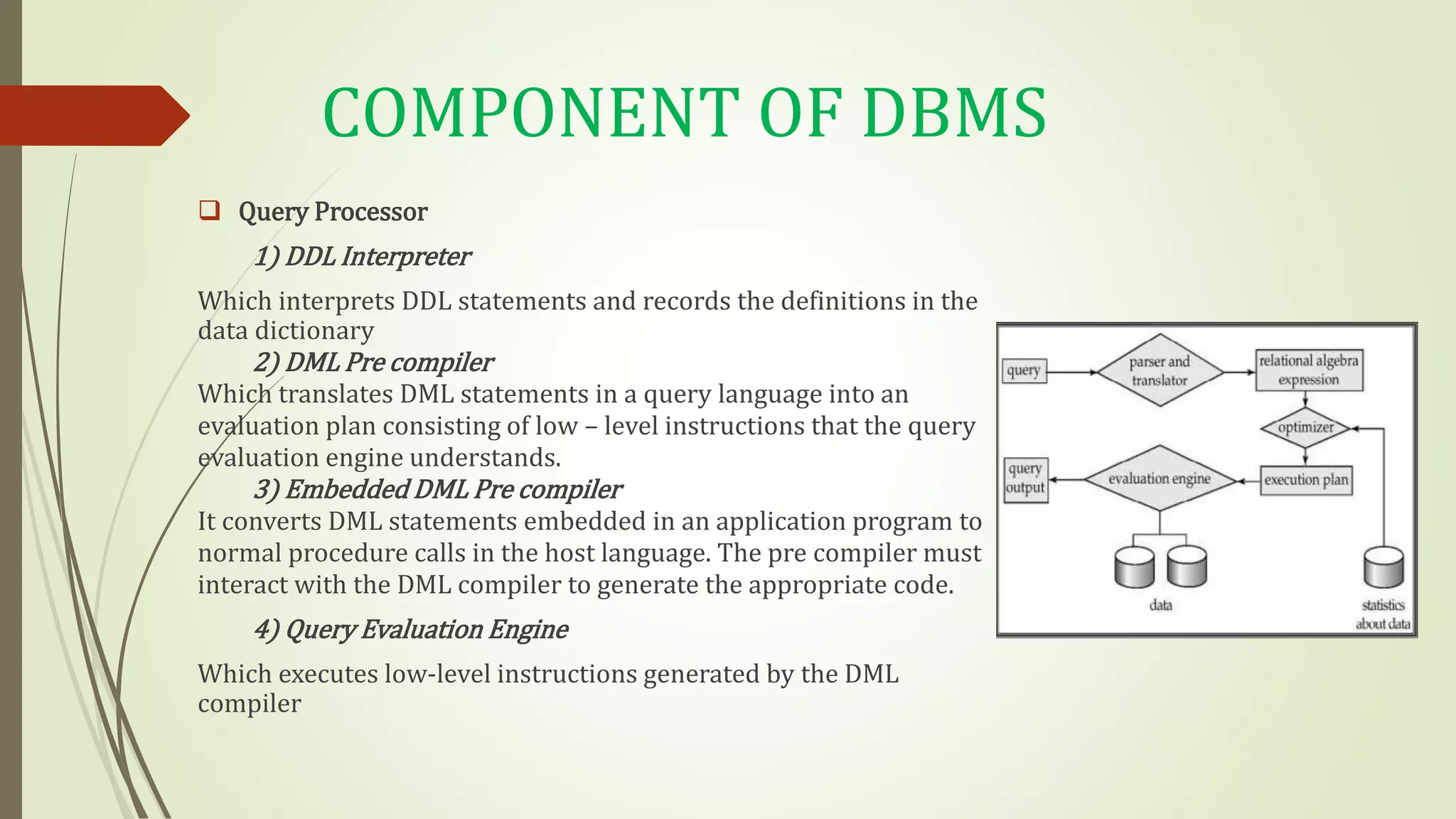
 Query Processor
1) DDL Interpreter
Which interprets DDL statements and records the definitions in the
data dictionary
2) DML Pre compiler
Which translates DML statements in a query language into an
evaluation plan consisting of low – level instructions that the query
evaluation engine understands.
3) Embedded DML Pre compiler
It converts DML statements embedded in an application program to
normal procedure calls in the host language. The pre compiler must
interact with the DML compiler to generate the appropriate code.
4) Query Evaluation Engine
Which executes low-level instructions generated by the DML
compiler
TYPES OF DBMS
 A model is an abstraction process that hides superfluous details while highlighting details important to
the application in hand.
 A data model is a mechanism that provides this abstraction for database applications.
 Data modeling is used for representing entities of interest and their relationships in the database.
 It allow the conceptualization of the association between various entities and their attributes.
There are different type of Database Management System-
Hierarchical
Network
Relational
Object oriented
HIERARCHICAL DBMS
 It uses records and pointers or links to represent entities and the relationships
among them. Here data structure used is a rooted tree with a strict parent to
child ordering (PCR).
 A tree may be defined as a set of nodes such that there is one specially
designated nodes called the root(node) and the remaining nodes are partitioned
into disjoint sets ,each of which in turn is a tree the sub trees of a root. If relative
order of the sub trees is significant, the tree is an ordered tree.
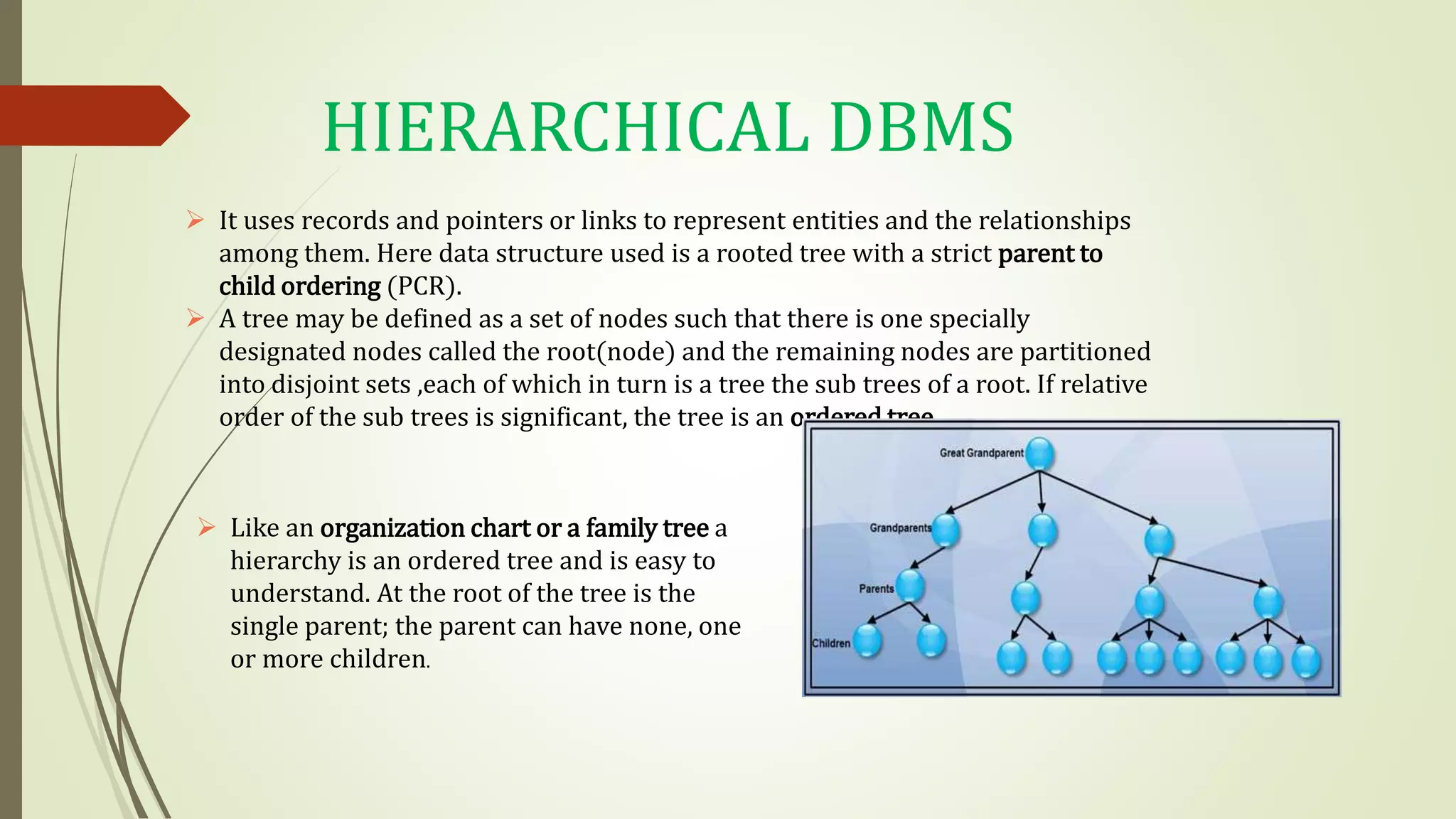
 Like an organization chart or a family tree a
hierarchy is an ordered tree and is easy to
understand. At the root of the tree is the
single parent; the parent can have none, one
or more children.
HIERARCHICAL DBMS
 The HDBMS has following constraints:
1. The hierarchical tree can have only one root record type and this record type
does not have a parent record type.
2. The root can have any number of child record types each of which can itself be a
root of hierarchical sub tree.
3. Each child record type can have only one parent record type, thus many-to-many
relationship cannot be directly expressed between two record types.
4. Data in a parent record applies to all its children records.
5. Each occurrence of a record type can have any number of occurrences of each of
its child record types.
6. A child record occurrence must have a parent record occurrence, deleting a parent
record occurrence requires deleting all its children record occurrences.
7. A hierarchical tree can have any number of record occurrences for each record
type at each level of the hierarchical tree.
NETWORKBASE DBMS
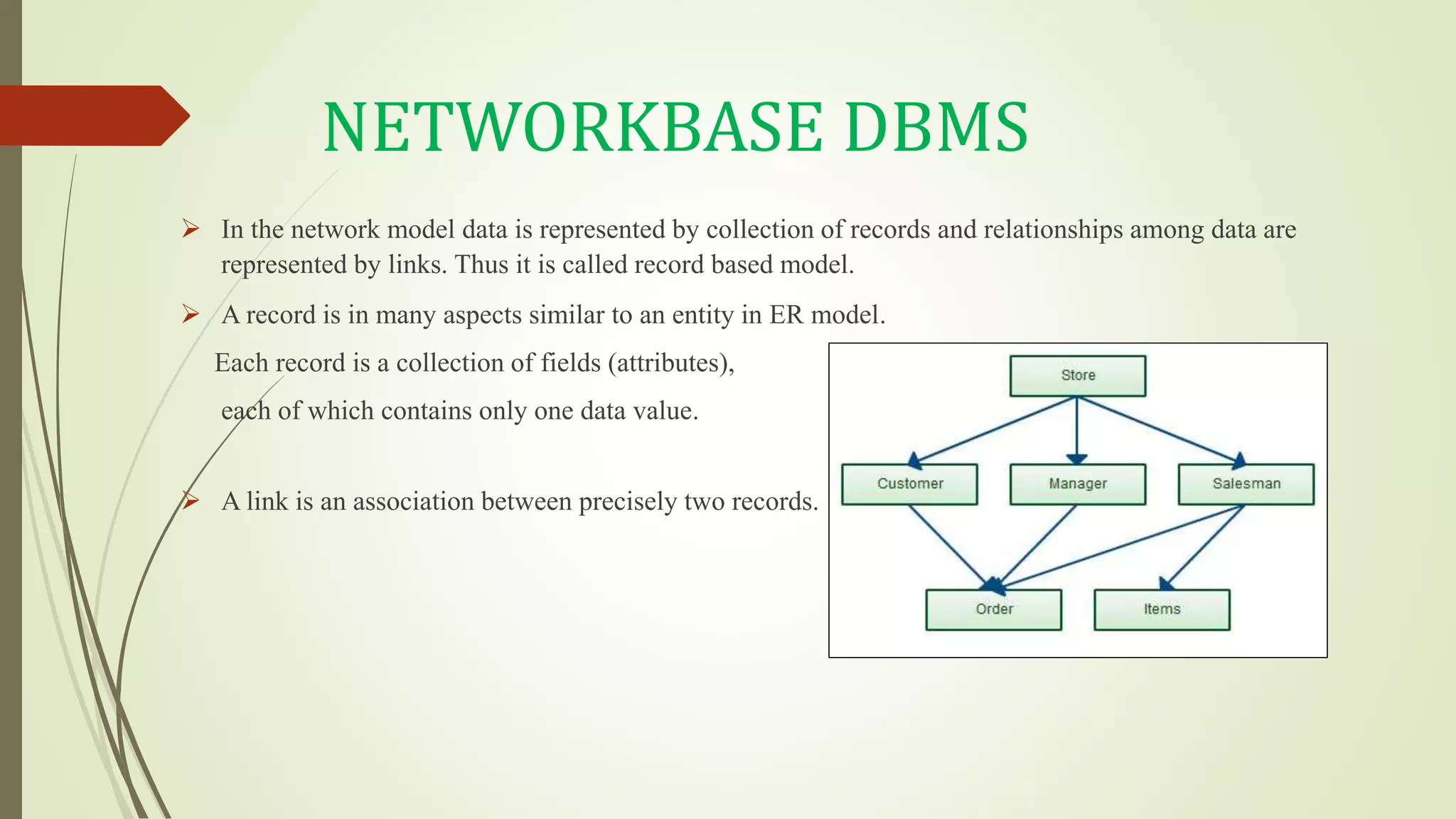
 In the network model data is represented by collection of records and relationships among data are
represented by links. Thus it is called record based model.
 A record is in many aspects similar to an entity in ER model.
Each record is a collection of fields (attributes),
each of which contains only one data value.
 A link is an association between precisely two records.
ADVANTAGES OF NDBMS
1)Handles more relationship types.
2) Data duplication is avoided
3) ER to network mapping is easier than in HDM
4)promoting design simplicity.
5) Data access flexibility
6) Promotes data integrity
7) Data Independence
8) Conformance to standards
DISADVANTAGE OF NDMBS
1) System complexity
Database integrity control and the efficiency with which the network model manages
relationship are sometimes short circuited by the system complexity.
2) Lacks of structural independence
Some structural changes are impossible to make in a network database. If changes are
made to the database structure, all application programs must be revalidated before they
can access the database. In short although the network model achieves data independence,
it still does not produce structural independence.
RELATIONAL DBMS
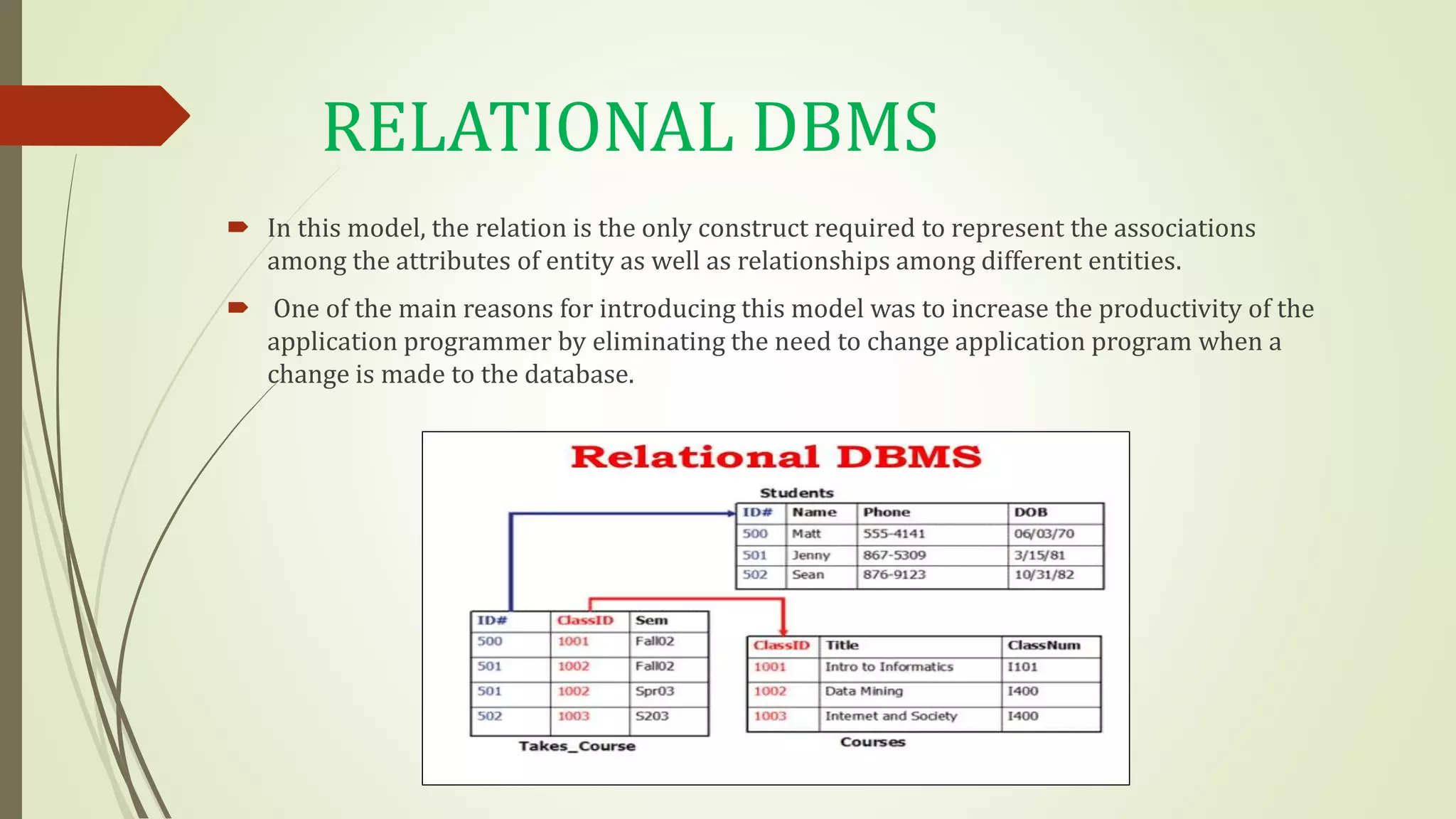
 In this model, the relation is the only construct required to represent the associations
among the attributes of entity as well as relationships among different entities.
 One of the main reasons for introducing this model was to increase the productivity of the
application programmer by eliminating the need to change application program when a
change is made to the database.
RELATIONAL DBMS
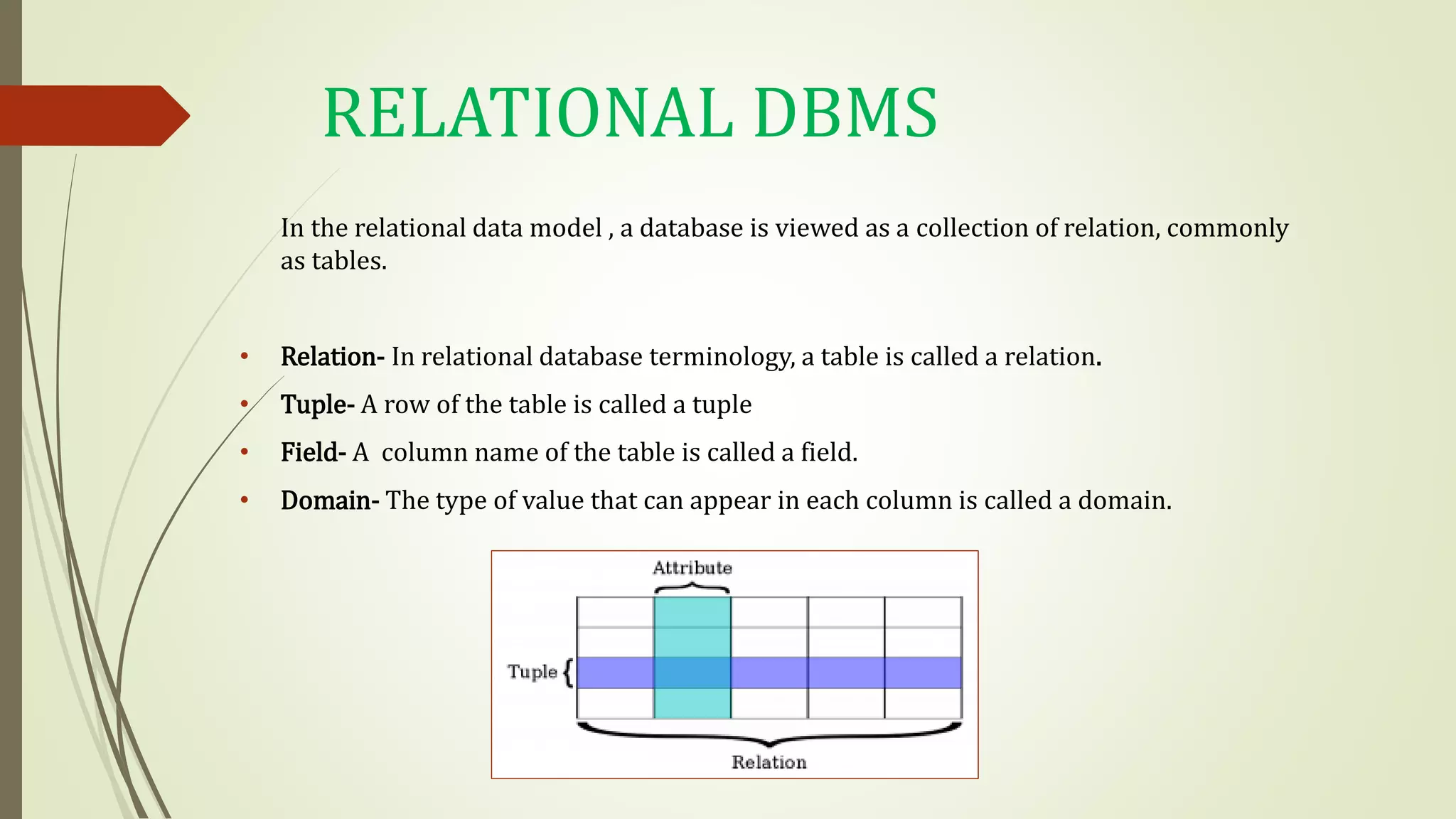
In the relational data model , a database is viewed as a collection of relation, commonly
as tables.
• Relation- In relational database terminology, a table is called a relation.
• Tuple- A row of the table is called a tuple
• Field- A column name of the table is called a field.
• Domain- The type of value that can appear in each column is called a domain.
OBJECT ORIENTED DBMS
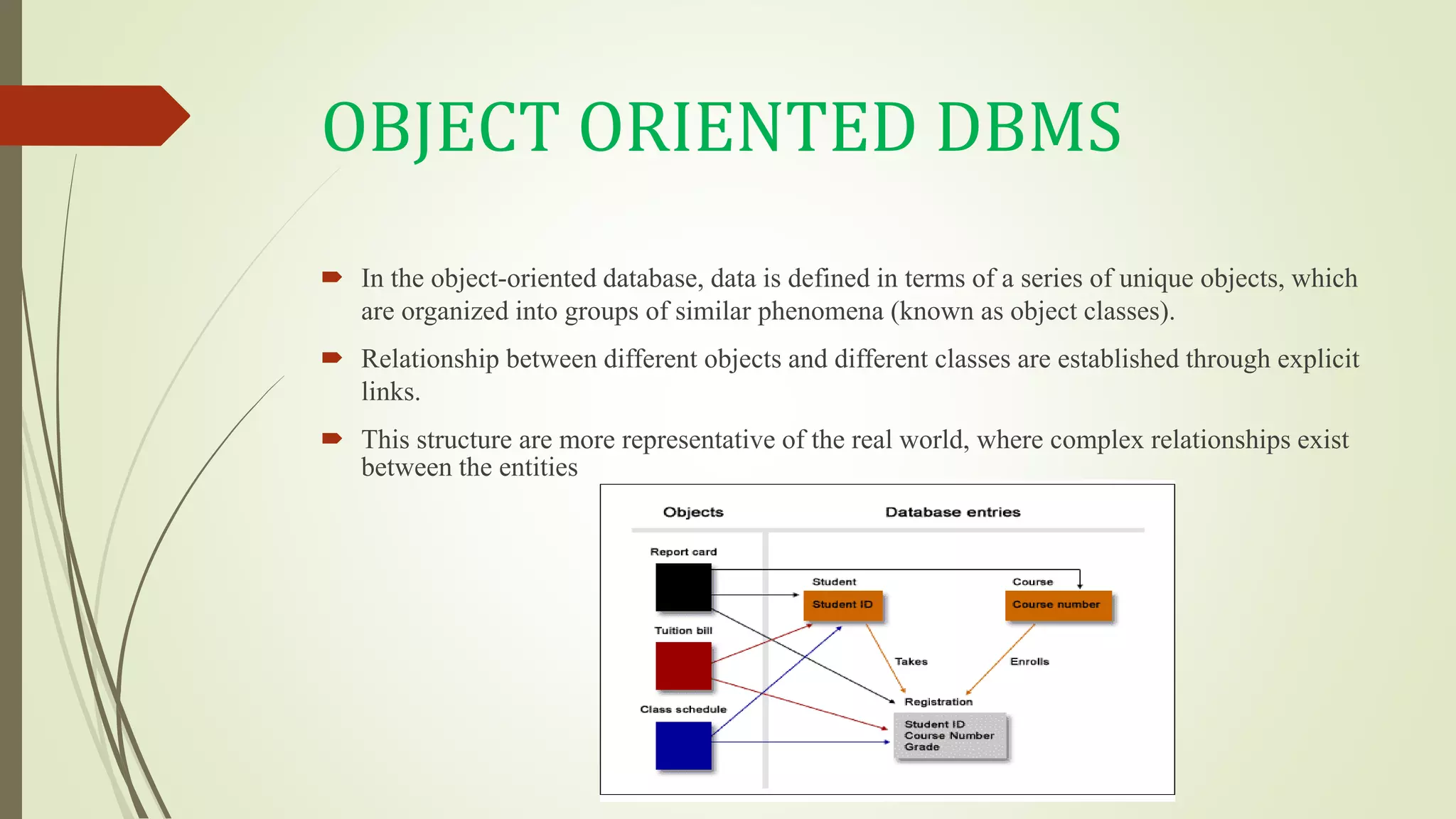
 In the object-oriented database, data is defined in terms of a series of unique objects, which
are organized into groups of similar phenomena (known as object classes).
 Relationship between different objects and different classes are established through explicit
links.
 This structure are more representative of the real world, where complex relationships exist
between the entities
OBJECT ORIENTED DBMS
 Object-oriented data modeling, used in conceptual design, is becoming
increasingly popular because of its ability-
 To represent complex relationship.
 To represent data and data processing in a consistent notation.
 This data model includes many concepts similar to those used in ER model,
and other modeling facility.
 An object-oriented model is built around objects, just as the ER model is
built around entities. An object encapsulates both data and behavior.
CONCLUSION
 It must be enhanced with additional capabilities regarding data
representation, organization, query processing and optimization.
 Due to the complexity and volume of spatial datasets, access methods are
required to guarantee acceptable query processing performance.
 Several commercial systems have already enhanced their products with
spatial data manipulation capabilities, enabling the support of geographical
information systems and related applications.
THANK YOU


Spatial Database and Database Management System

  • 1.
    SPATIAL DATABASE & DATABASE MANAGEMENTSYSTEM PRESENTED BY - LAL MOHAMMAD SAMRAT BASUMATARY SUSHANTA PATRA MOU DEY SHRADDHA MAITY Master of Science Dept. of Remote Sensing & GIS Vidyasagar University Midnapure-721102
  • 2.
    DATA  Collection ofsome observations.  In simple words, data can be facts related to any object inconsideration.  For example your name, age, height, mobile numbers, etc.  Data are mainly of two types: Spatial data Non-spatial or attribute data
  • 3.
     Spatial Data: Itis the data which is related to location. For example, co-ordinate of center of football ground.  Non-spatial data: It is the data which describes such aspects of the spatial data which is not specified by its geometry alone. For example, area of the football ground, name of roads, forest, schools, etc. DATA
  • 4.
    DATABASE  A collectionof related data with an implicit meaning.  We use database in our day-to-day life.  Consider the names, telephone numbers and addresses of the people you know.  We may record this data in an indexed address book, using a personal computer and software such as FoxPro, Excel, and Access etc.  A database is a repository capable of storing large amounts of data.
  • 5.
    PROPERTIES: 1) A databaserepresents some aspect of the real world, sometimes called the mini world. Changes to the mini world are reflected in the database. 2) A database is logically coherent collection of data with some inherent meaning. A random assortment of data cannot correctly be referred to as a database. 3) A database is designed, built and populated with data for a specific purpose. It has an intended group of users and some preconvinced applications in which these users are interested. DATABASE
  • 6.
    Thus Database is-  Collection of interrelated data  Set of programs to access the data  Database Applications: • Banking: all transactions • Airlines: reservations, schedules • Universities: registration, grades • Sales: customers, products, purchases • Manufacturing: production, inventory, orders, supply chain • Human resources: employee records, salaries, tax deductions  Databases touches all aspects of our lives DATABASE
  • 7.
    SPATIAL DATABASE  Spatialdatabases are a specific type of database.  They store representations of geographic phenomena in the real world to be used in a GIS.  They are special in the sense that they use other techniques than tables to store these representations. This is because it is not easy to represent geographic phenomena using tables  A spatial database focuses on the functions we listed above for databases in general: concurrency, storage, integrity, and querying especially.
  • 8.
    SPATIAL DATABASE  Theassumption for the design of a spatial database schema is that the relevant spatial phenomena exist in a two- or three-dimensional Euclidean space.  Euclidean space can be informally defined as a model of space in which locations are represented as coordinates—(x, y) in 2D; (x, y, z) in 3D—and notions like distance and direction have been defined, with the usual formulas. In 2D, we also talk about the Euclidean plane.
  • 9.
    SPATIAL DATABASE Spatial databaseis a database that is optimized to store and query data that is related to object in space, including points, lines and polygons.  Spatial database has-  Spatial index  Spatial query  Spatial analysis  Geolocational intelligence
  • 10.
    DATABASE MANAGEMENT SYSTEM A DBMS is a collection of programs that enables users to create and maintain a database. A DBMS is hence a general purpose s/w system that facilitates the process of Defining, Constructing and Manipulating databases for various applications.  A database management system (DBMS) is a software package that allows the users to set up, use, maintain and manipulating a database for various application.  Like a GIS allows to set up a GIS application, a DBMS offers generic functionality for database organization and data handling.  It is a collection of programs that enables users to create and maintain a database.
  • 11.
    COMPONENT OF DBMS A database system is partitioned into modules that deal with each of the responsibilities of the overall system. The functional components of a database system are broadly divided into the storage manager and query processor components.  Storage Manager Following are the responsibilities of Database Manager or Storage Manager: 1) Interaction with the file Manager 3) Backup and Recovery 2) Integrity Enforcement 4) Concurrency Control Thus storage manager or database manager is responsible for: • Storing the data • Retrieving the data • Updating the data in the database
  • 12.
    COMPONENT OF DBMS Query Processor 1) DDL Interpreter Which interprets DDL statements and records the definitions in the data dictionary 2) DML Pre compiler Which translates DML statements in a query language into an evaluation plan consisting of low – level instructions that the query evaluation engine understands. 3) Embedded DML Pre compiler It converts DML statements embedded in an application program to normal procedure calls in the host language. The pre compiler must interact with the DML compiler to generate the appropriate code. 4) Query Evaluation Engine Which executes low-level instructions generated by the DML compiler
  • 13.
    TYPES OF DBMS A model is an abstraction process that hides superfluous details while highlighting details important to the application in hand.  A data model is a mechanism that provides this abstraction for database applications.  Data modeling is used for representing entities of interest and their relationships in the database.  It allow the conceptualization of the association between various entities and their attributes. There are different type of Database Management System- Hierarchical Network Relational Object oriented
  • 14.
    HIERARCHICAL DBMS  Ituses records and pointers or links to represent entities and the relationships among them. Here data structure used is a rooted tree with a strict parent to child ordering (PCR).  A tree may be defined as a set of nodes such that there is one specially designated nodes called the root(node) and the remaining nodes are partitioned into disjoint sets ,each of which in turn is a tree the sub trees of a root. If relative order of the sub trees is significant, the tree is an ordered tree.  Like an organization chart or a family tree a hierarchy is an ordered tree and is easy to understand. At the root of the tree is the single parent; the parent can have none, one or more children.
  • 15.
    HIERARCHICAL DBMS  TheHDBMS has following constraints: 1. The hierarchical tree can have only one root record type and this record type does not have a parent record type. 2. The root can have any number of child record types each of which can itself be a root of hierarchical sub tree. 3. Each child record type can have only one parent record type, thus many-to-many relationship cannot be directly expressed between two record types. 4. Data in a parent record applies to all its children records. 5. Each occurrence of a record type can have any number of occurrences of each of its child record types. 6. A child record occurrence must have a parent record occurrence, deleting a parent record occurrence requires deleting all its children record occurrences. 7. A hierarchical tree can have any number of record occurrences for each record type at each level of the hierarchical tree.
  • 16.
    NETWORKBASE DBMS  Inthe network model data is represented by collection of records and relationships among data are represented by links. Thus it is called record based model.  A record is in many aspects similar to an entity in ER model. Each record is a collection of fields (attributes), each of which contains only one data value.  A link is an association between precisely two records.
  • 17.
    ADVANTAGES OF NDBMS 1)Handlesmore relationship types. 2) Data duplication is avoided 3) ER to network mapping is easier than in HDM 4)promoting design simplicity. 5) Data access flexibility 6) Promotes data integrity 7) Data Independence 8) Conformance to standards
  • 18.
    DISADVANTAGE OF NDMBS 1)System complexity Database integrity control and the efficiency with which the network model manages relationship are sometimes short circuited by the system complexity. 2) Lacks of structural independence Some structural changes are impossible to make in a network database. If changes are made to the database structure, all application programs must be revalidated before they can access the database. In short although the network model achieves data independence, it still does not produce structural independence.
  • 19.
    RELATIONAL DBMS  Inthis model, the relation is the only construct required to represent the associations among the attributes of entity as well as relationships among different entities.  One of the main reasons for introducing this model was to increase the productivity of the application programmer by eliminating the need to change application program when a change is made to the database.
  • 20.
    RELATIONAL DBMS In therelational data model , a database is viewed as a collection of relation, commonly as tables. • Relation- In relational database terminology, a table is called a relation. • Tuple- A row of the table is called a tuple • Field- A column name of the table is called a field. • Domain- The type of value that can appear in each column is called a domain.
  • 21.
    OBJECT ORIENTED DBMS In the object-oriented database, data is defined in terms of a series of unique objects, which are organized into groups of similar phenomena (known as object classes).  Relationship between different objects and different classes are established through explicit links.  This structure are more representative of the real world, where complex relationships exist between the entities
  • 22.
    OBJECT ORIENTED DBMS Object-oriented data modeling, used in conceptual design, is becoming increasingly popular because of its ability-  To represent complex relationship.  To represent data and data processing in a consistent notation.  This data model includes many concepts similar to those used in ER model, and other modeling facility.  An object-oriented model is built around objects, just as the ER model is built around entities. An object encapsulates both data and behavior.
  • 23.
    CONCLUSION  It mustbe enhanced with additional capabilities regarding data representation, organization, query processing and optimization.  Due to the complexity and volume of spatial datasets, access methods are required to guarantee acceptable query processing performance.  Several commercial systems have already enhanced their products with spatial data manipulation capabilities, enabling the support of geographical information systems and related applications.
  • 24.