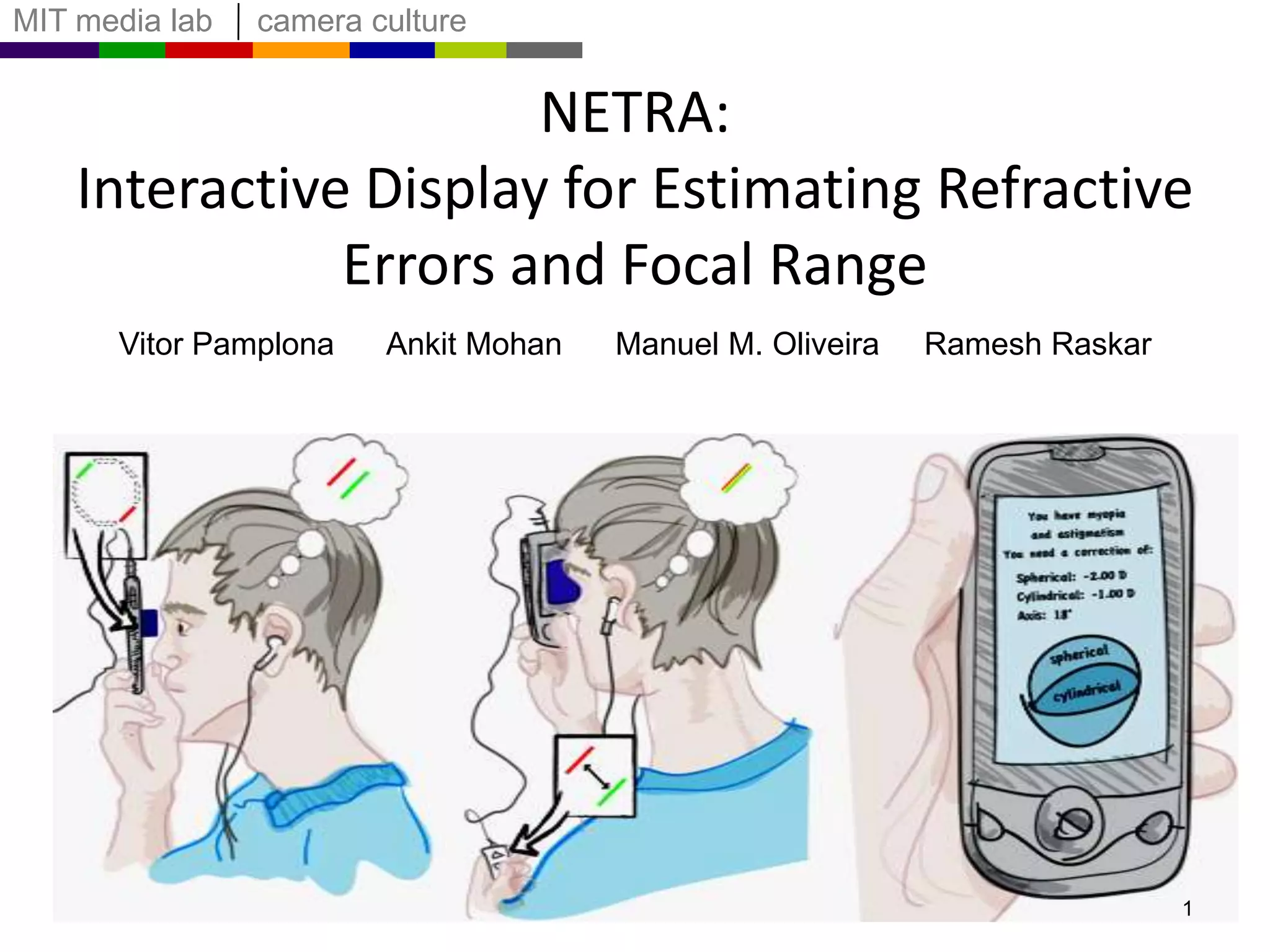
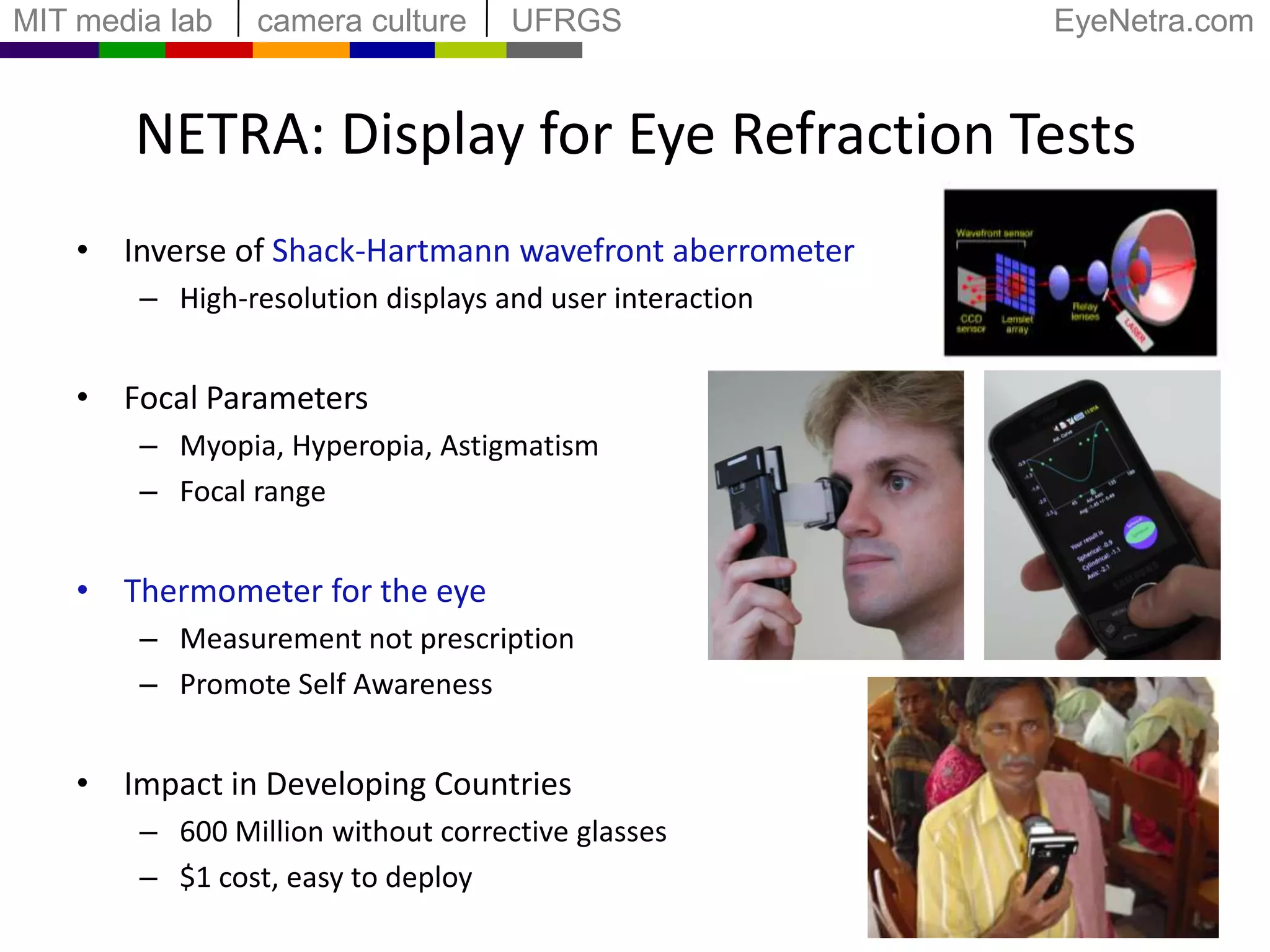
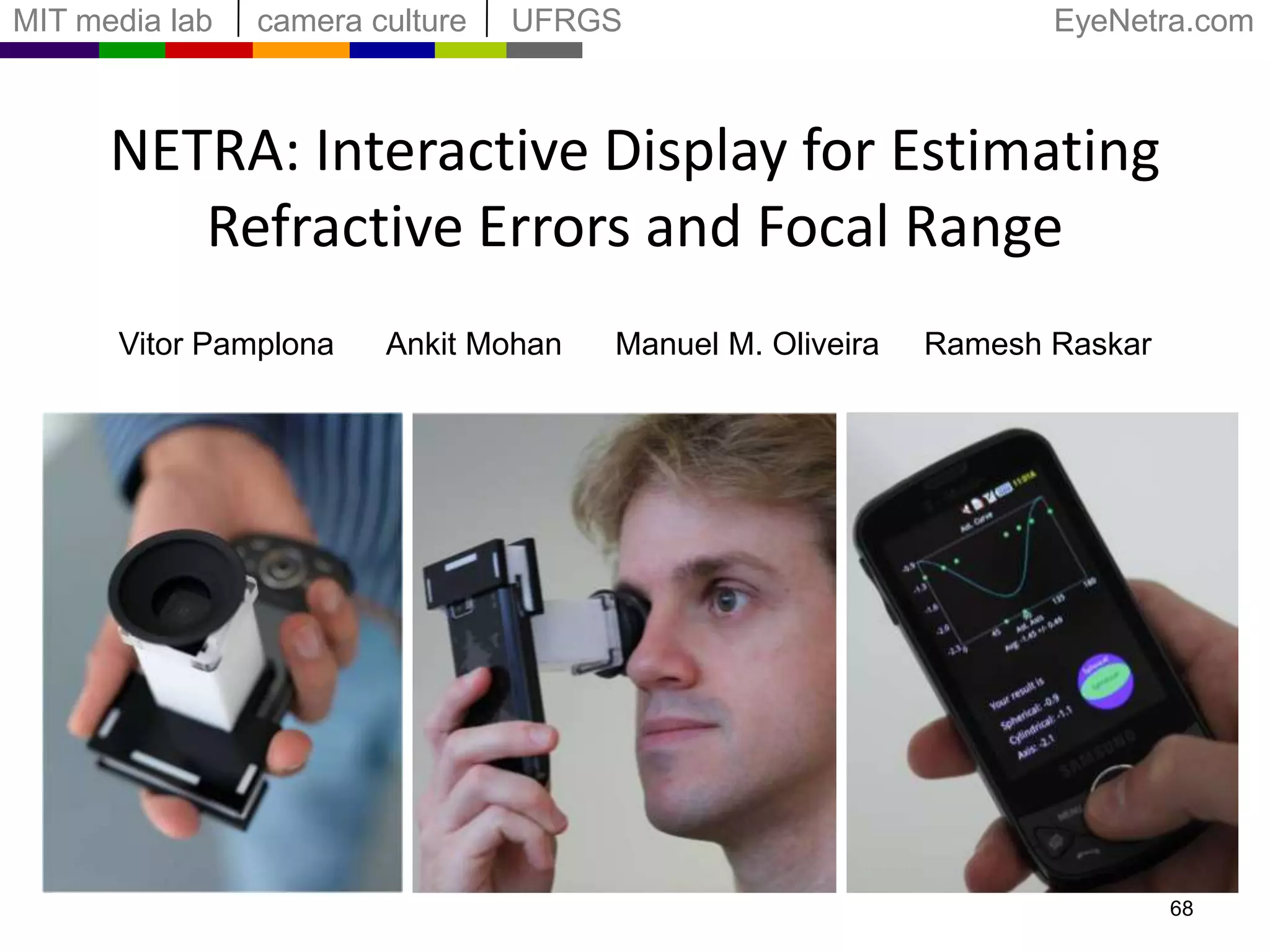
NETRA: Interactive Display for Estimating Refractive Errors and Focal RangeVitor Pamplona      Ankit Mohan      Manuel M. Oliveira     RameshRaskar1
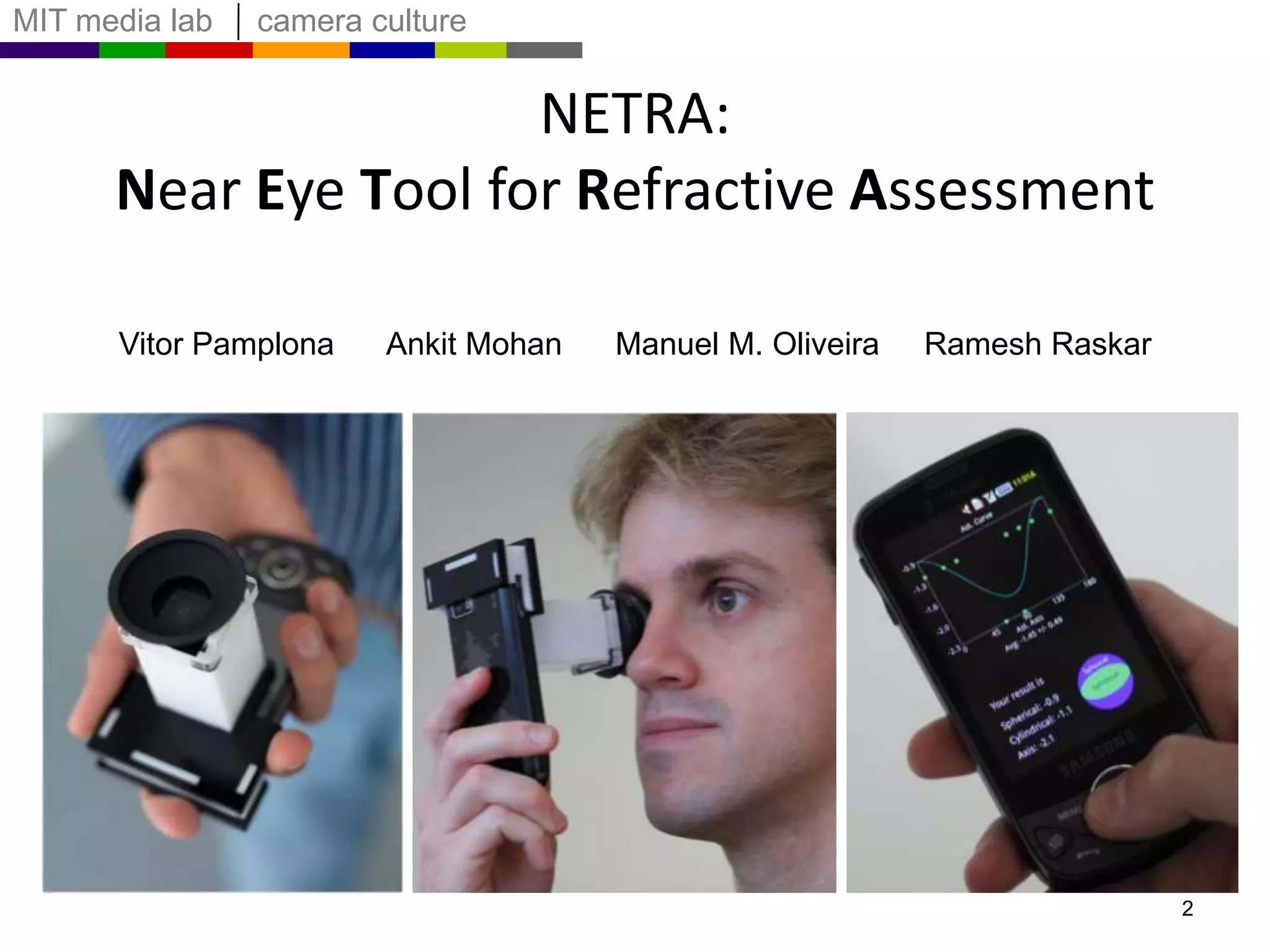
2NETRA: Near Eye Tool for Refractive AssessmentVitor Pamplona      Ankit Mohan      Manuel M. Oliveira     RameshRaskar
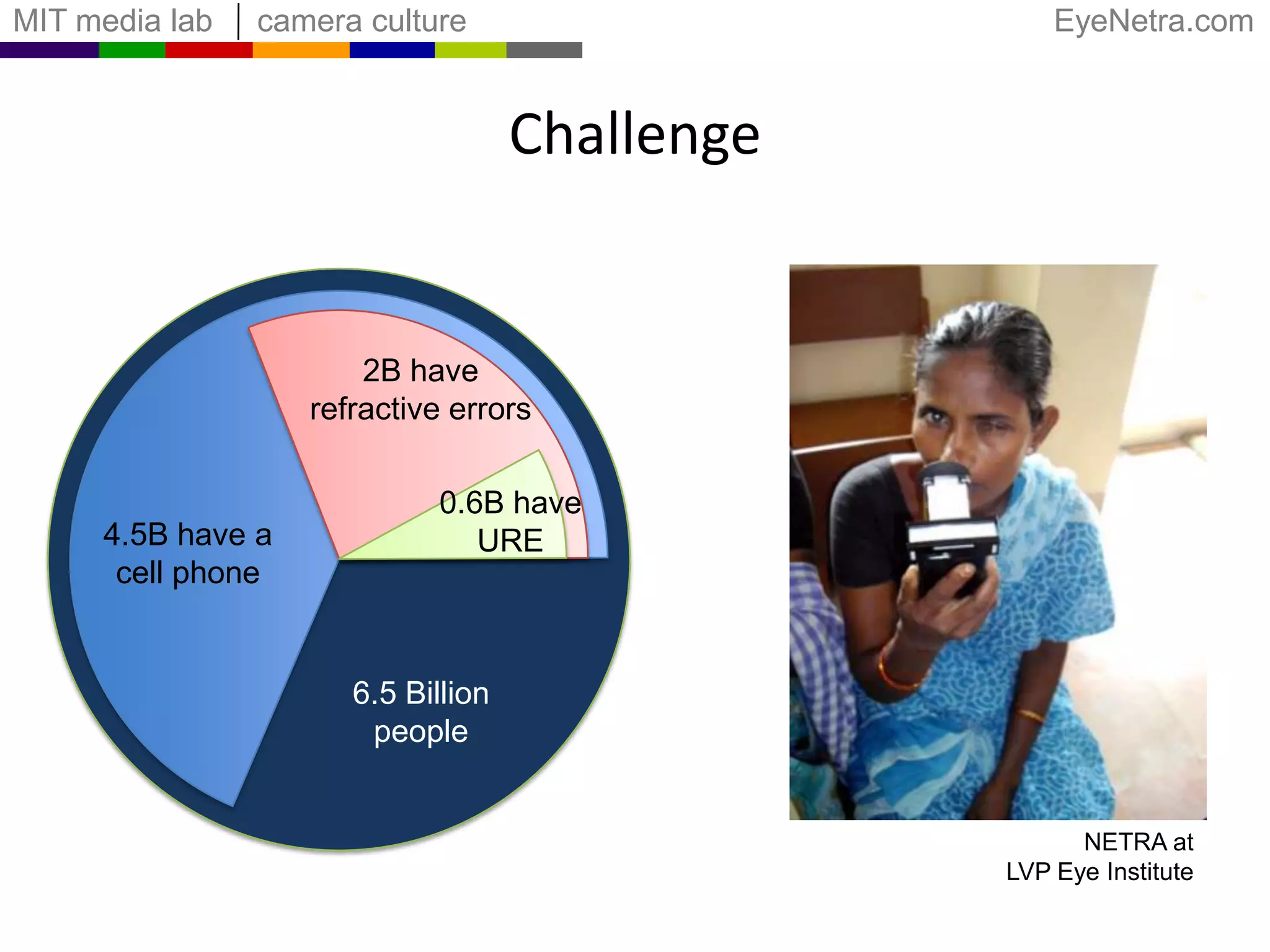
Challenge2B haverefractive errors0.6B have URE4.5B have a cell phone6.5 Billion peopleNETRA at LVP Eye Institute3
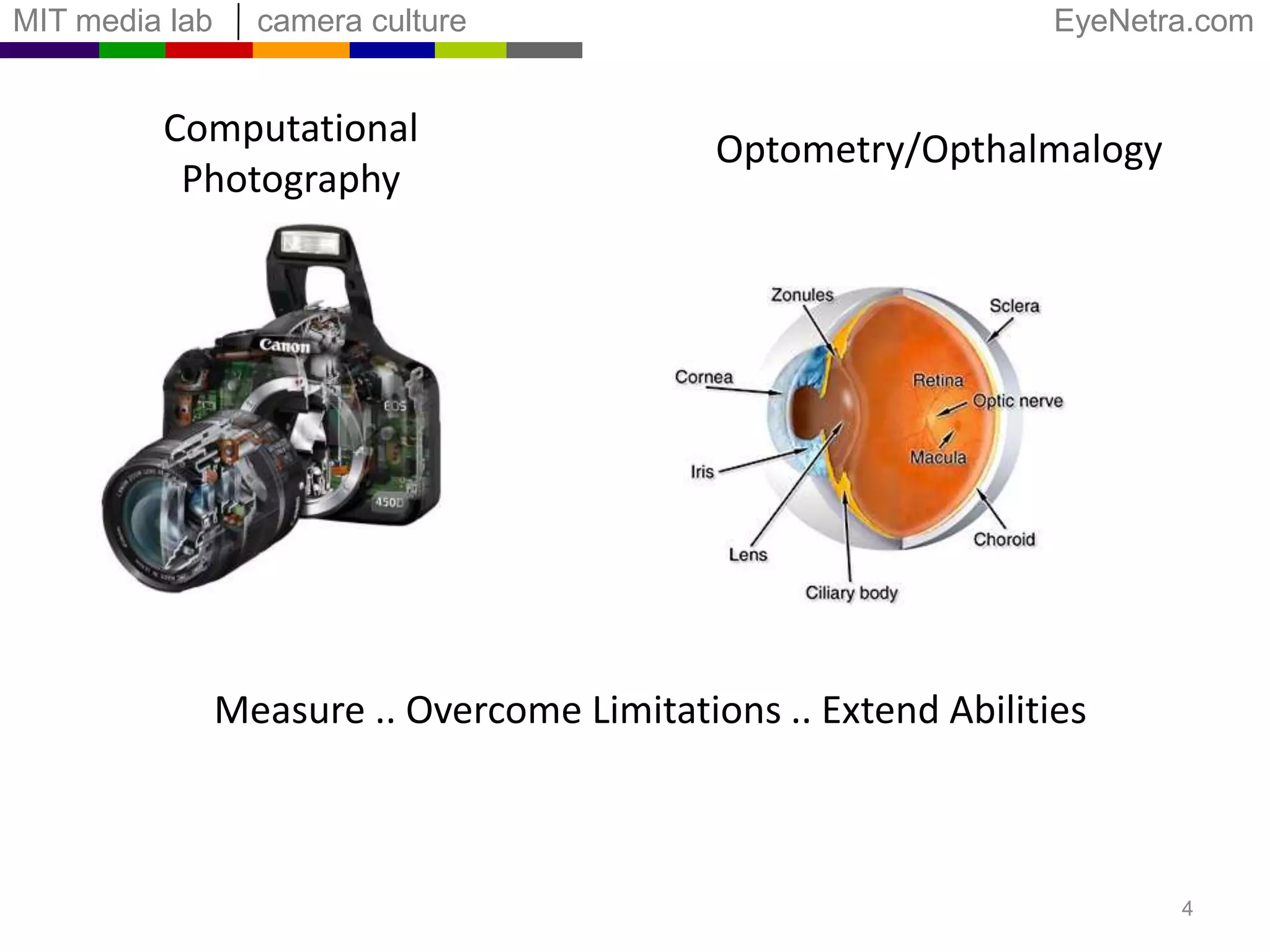
4Computational PhotographyOptometry/OpthalmalogyMeasure .. Overcome Limitations .. Extend Abilities
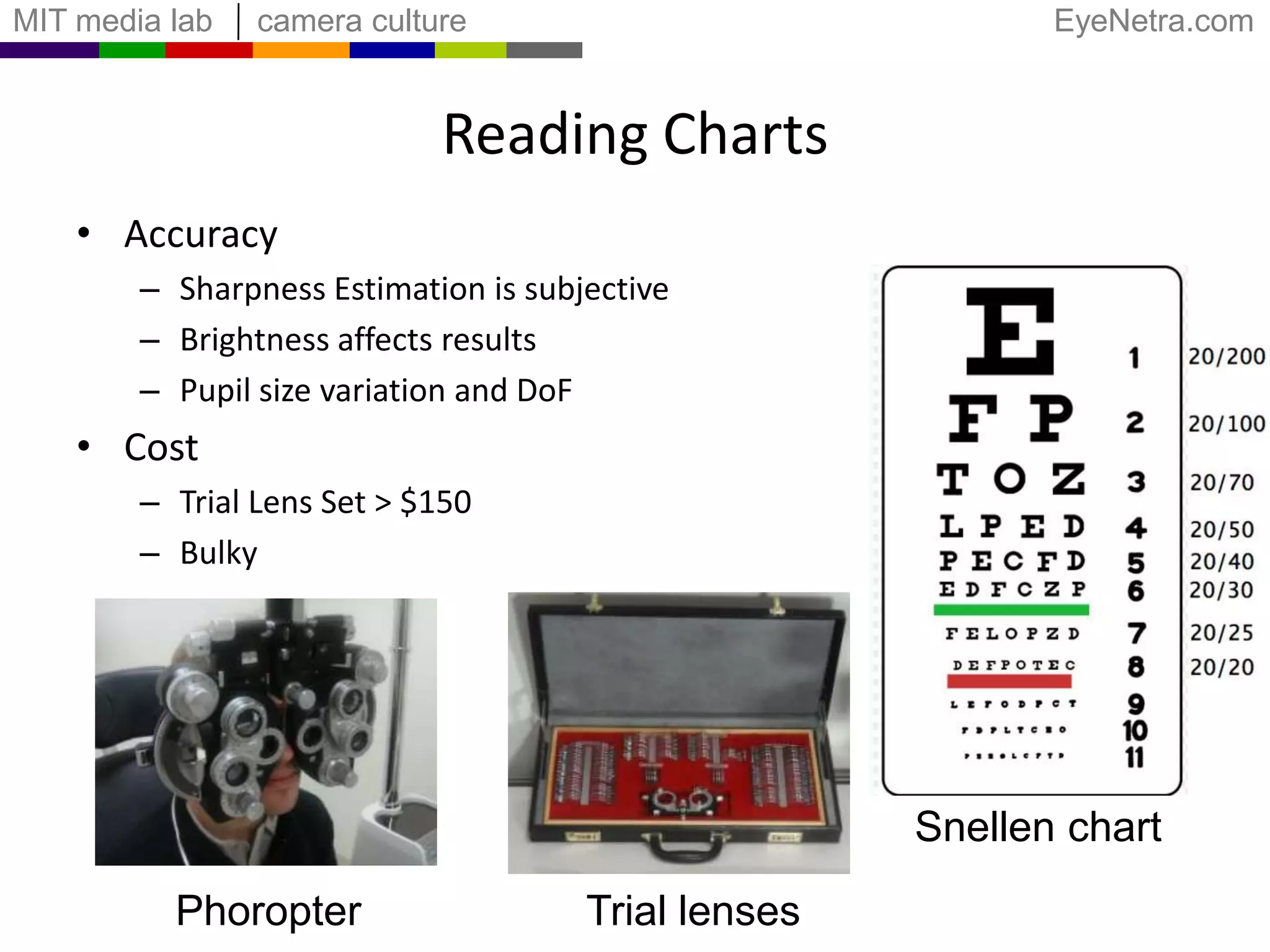
AccuracySharpness Estimation is subjectiveBrightness affects resultsPupil size variation and DoFCostTrial Lens Set > $150BulkySnellen chartPhoropterTrial lensesReading Charts
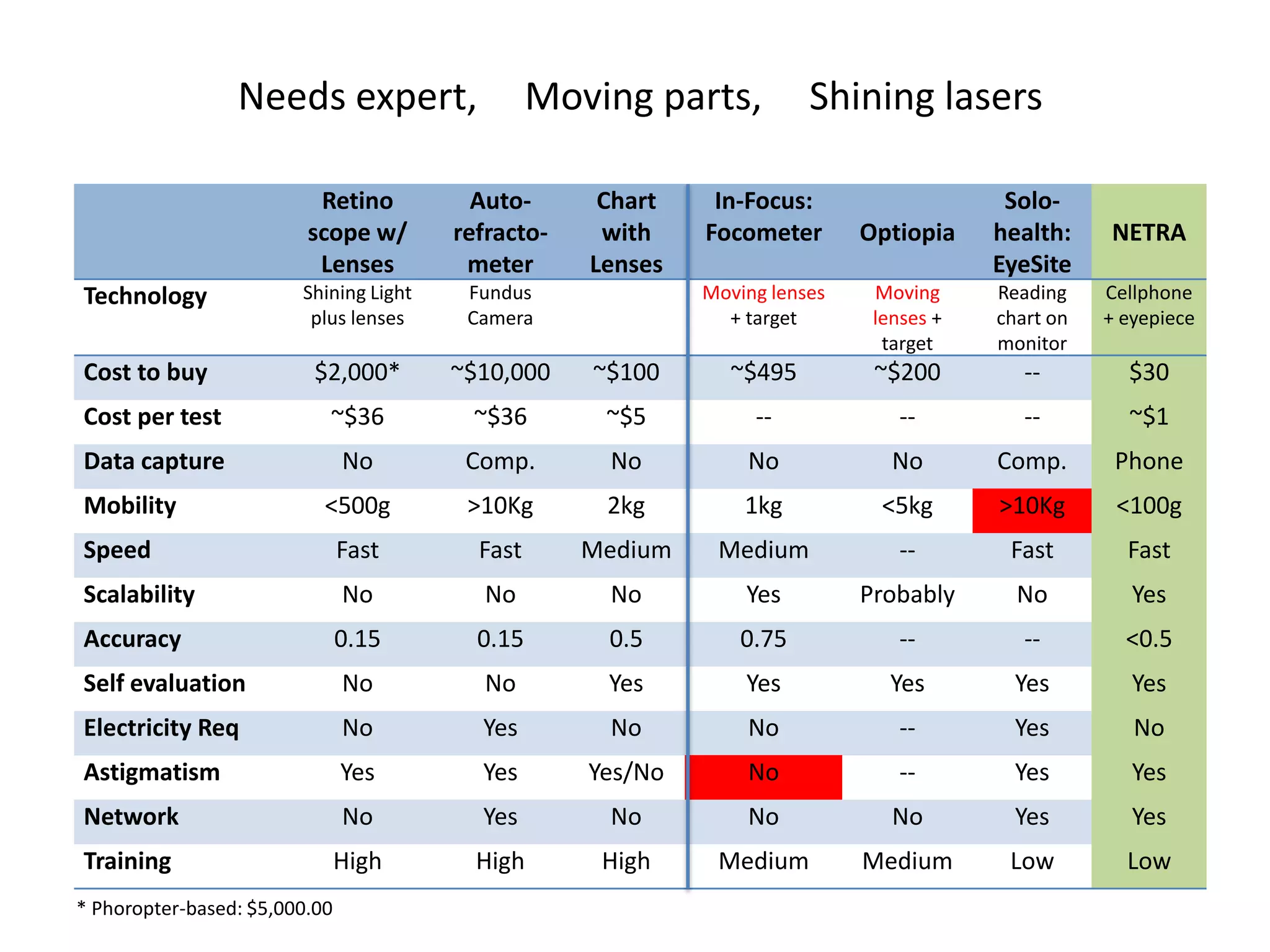
Needs expert,     Moving parts,     Shining lasers* Phoropter-based: $5,000.00
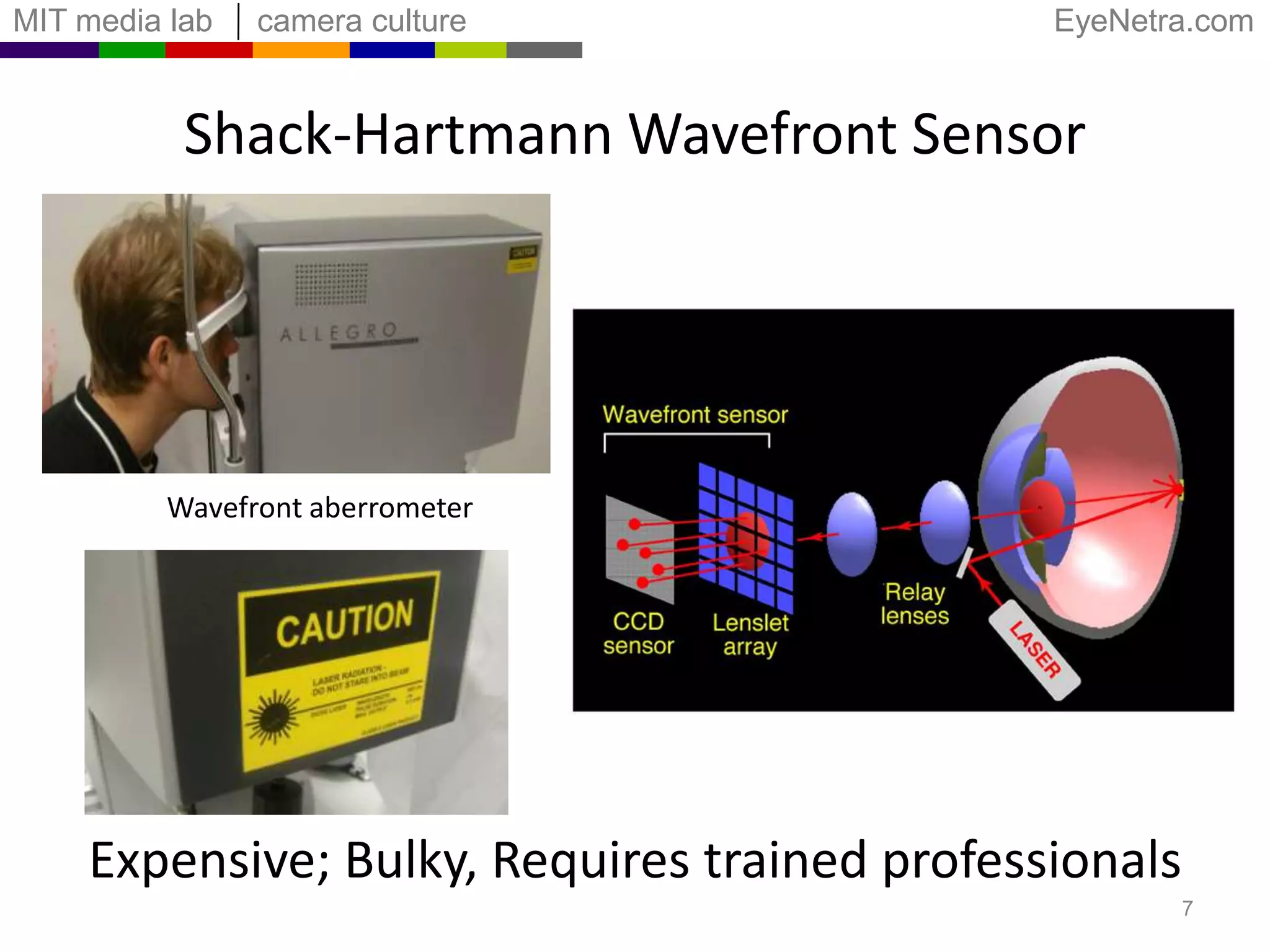
Shack-Hartmann Wavefront SensorWavefrontaberrometerExpensive; Bulky, Requires trained professionals7
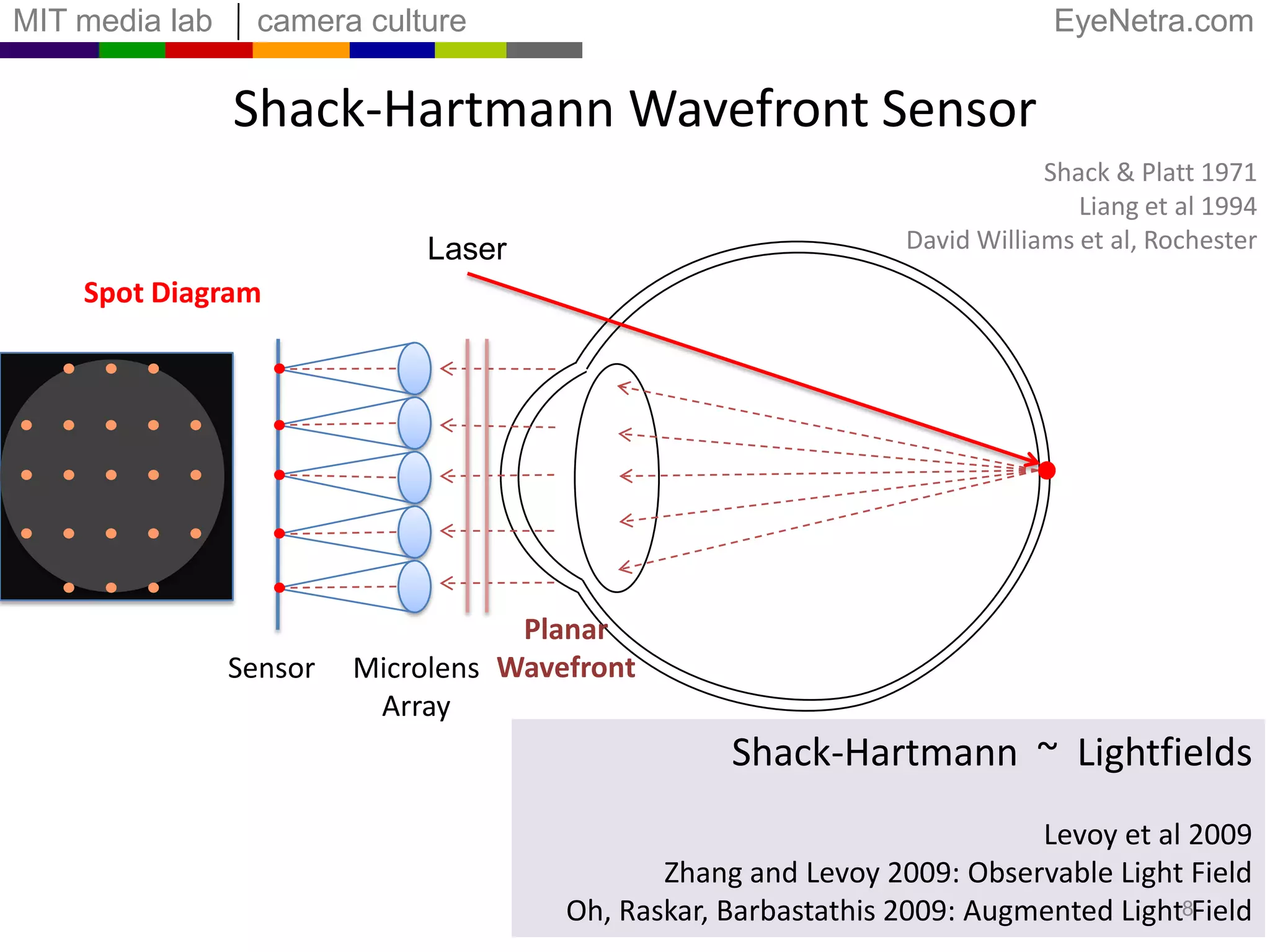
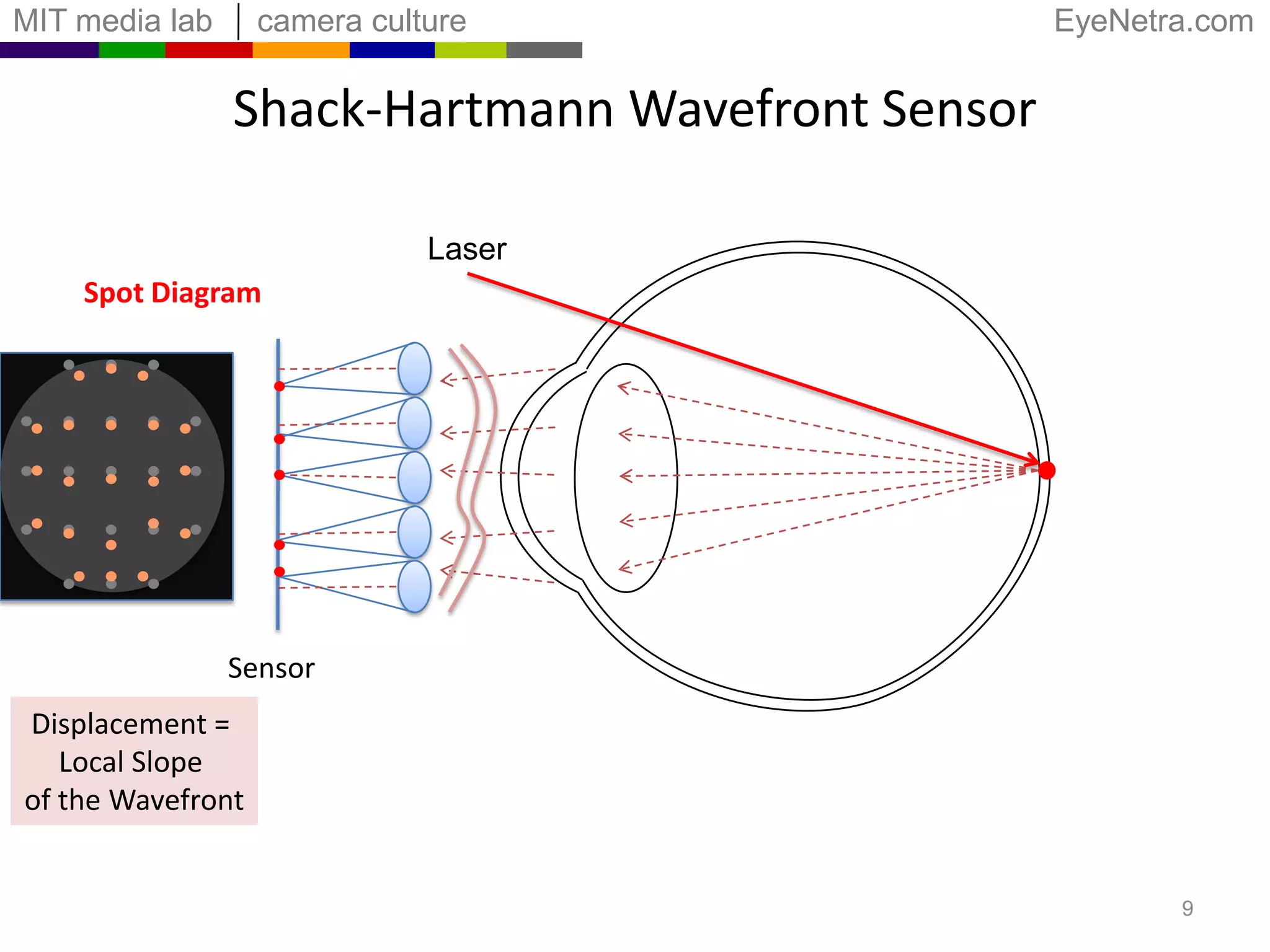
Shack-Hartmann Wavefront SensorLaserSensor8Shack & Platt 1971Liang et al 1994David Williams et al, RochesterSpot DiagramPlanar WavefrontMicrolens ArrayShack-Hartmann  ~  LightfieldsLevoy et al 2009 Zhang and Levoy 2009: Observable Light FieldOh, Raskar, Barbastathis 2009: Augmented Light Field
Shack-Hartmann Wavefront SensorLaserSpot Diagram9SensorDisplacement = Local Slope of the Wavefront
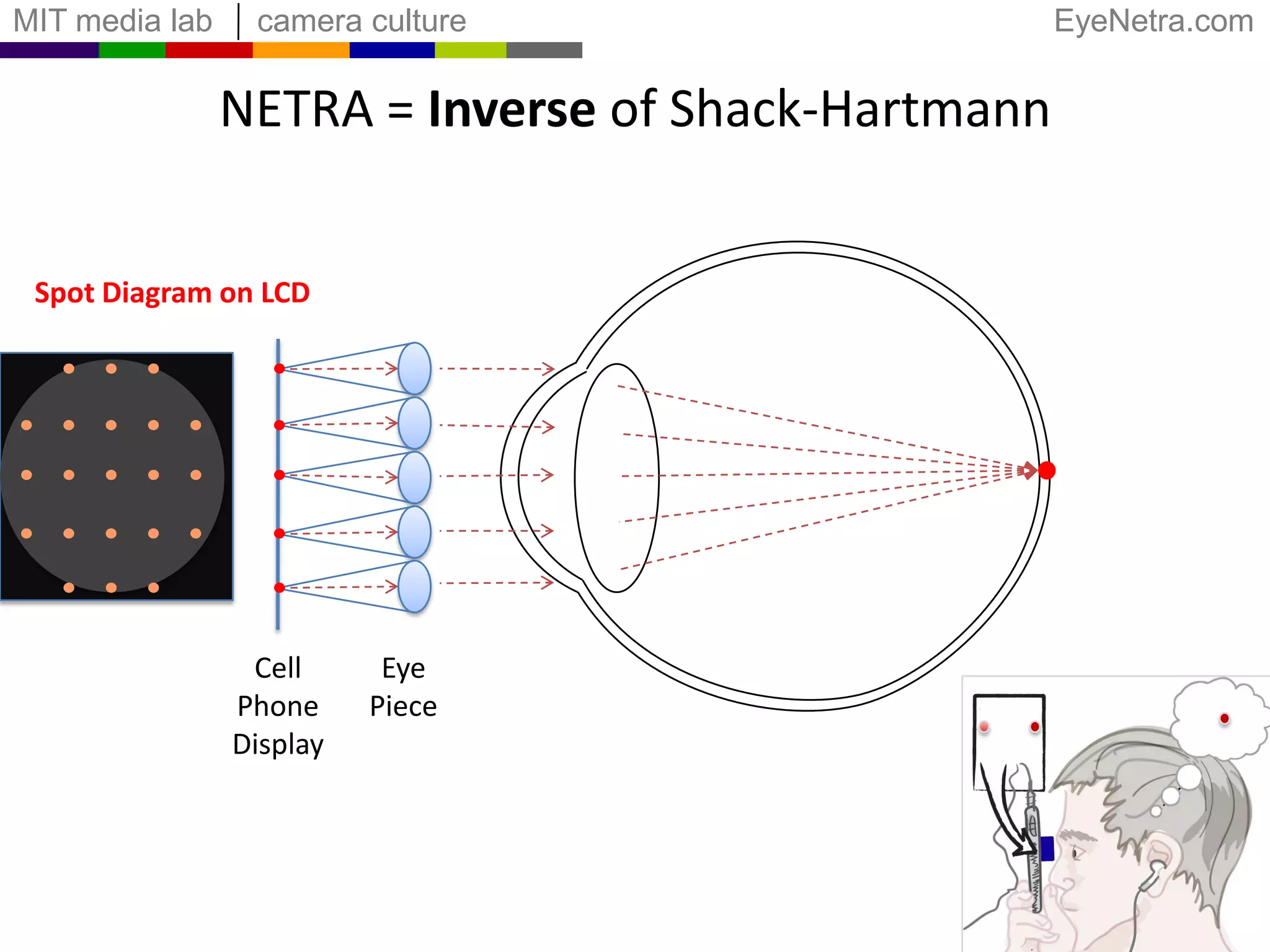
NETRA= Inverse of Shack-Hartmann10Spot Diagram on LCDCell Phone DisplayEye Piece
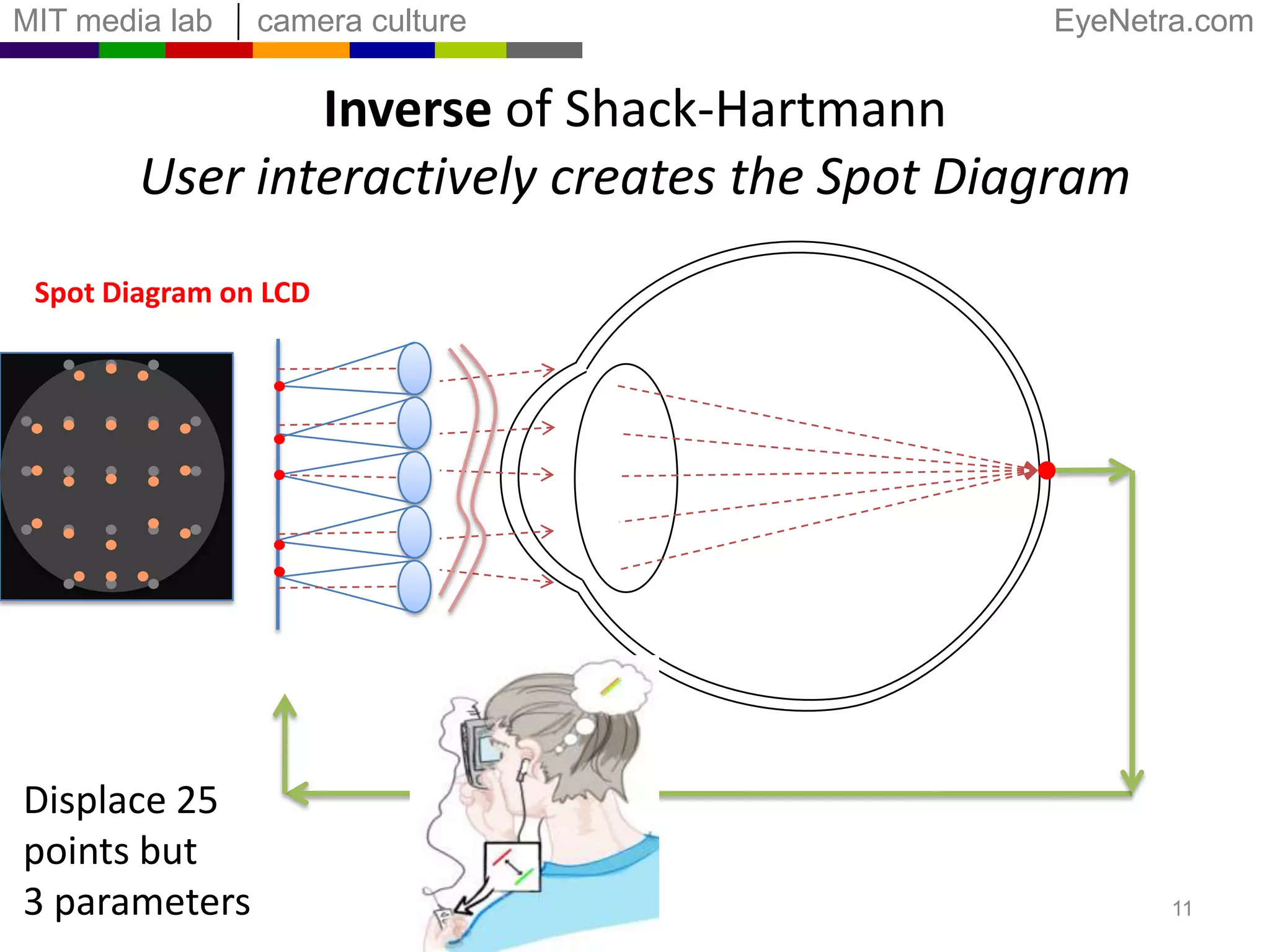
11Inverse of Shack-HartmannUser interactively creates the Spot DiagramSpot Diagram on LCDDisplace 25 points but 3 parameters
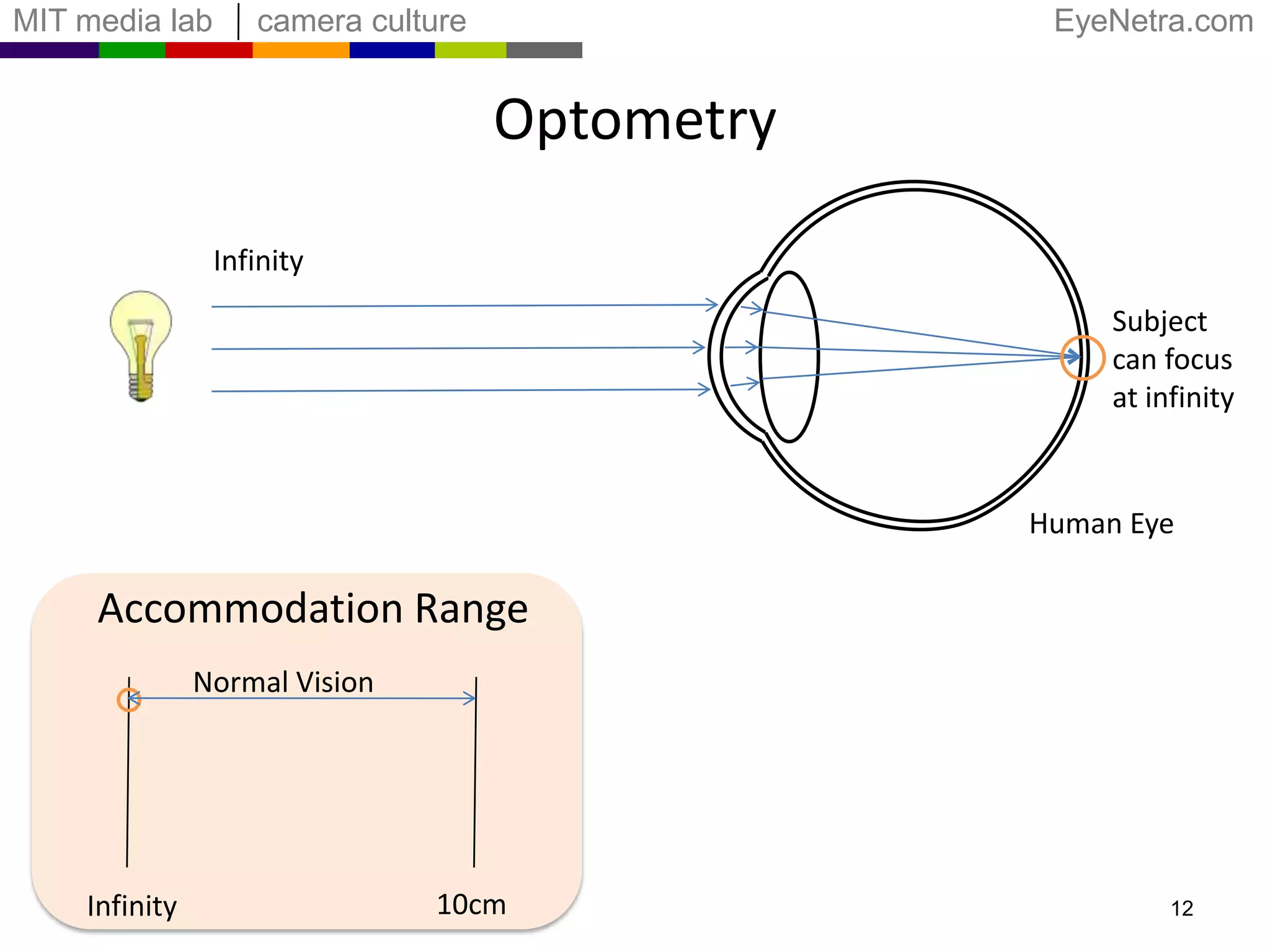
OptometryInfinitySubject can focusat infinityHuman EyeAccommodation RangeNormal Vision10cmInfinity12
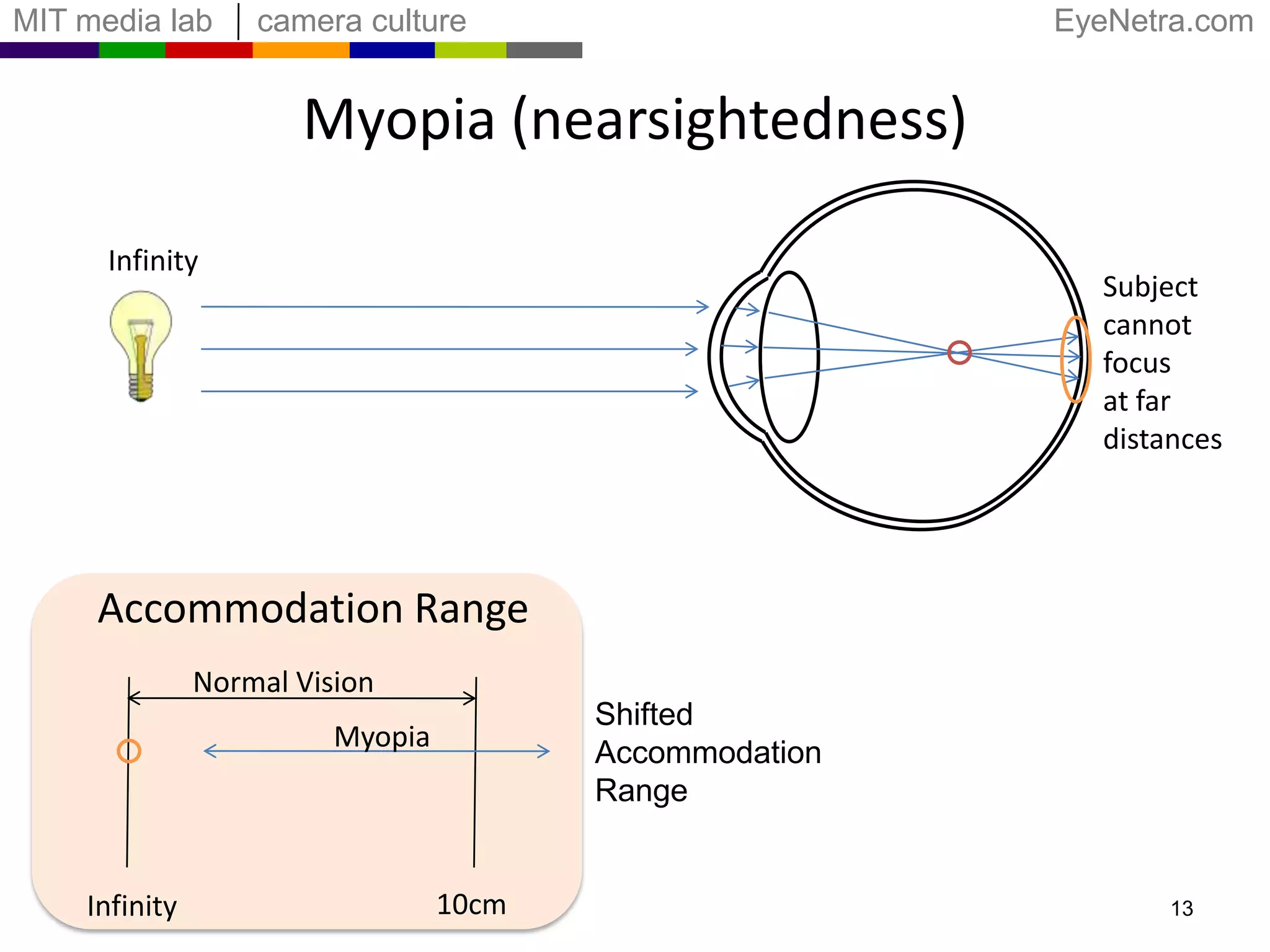
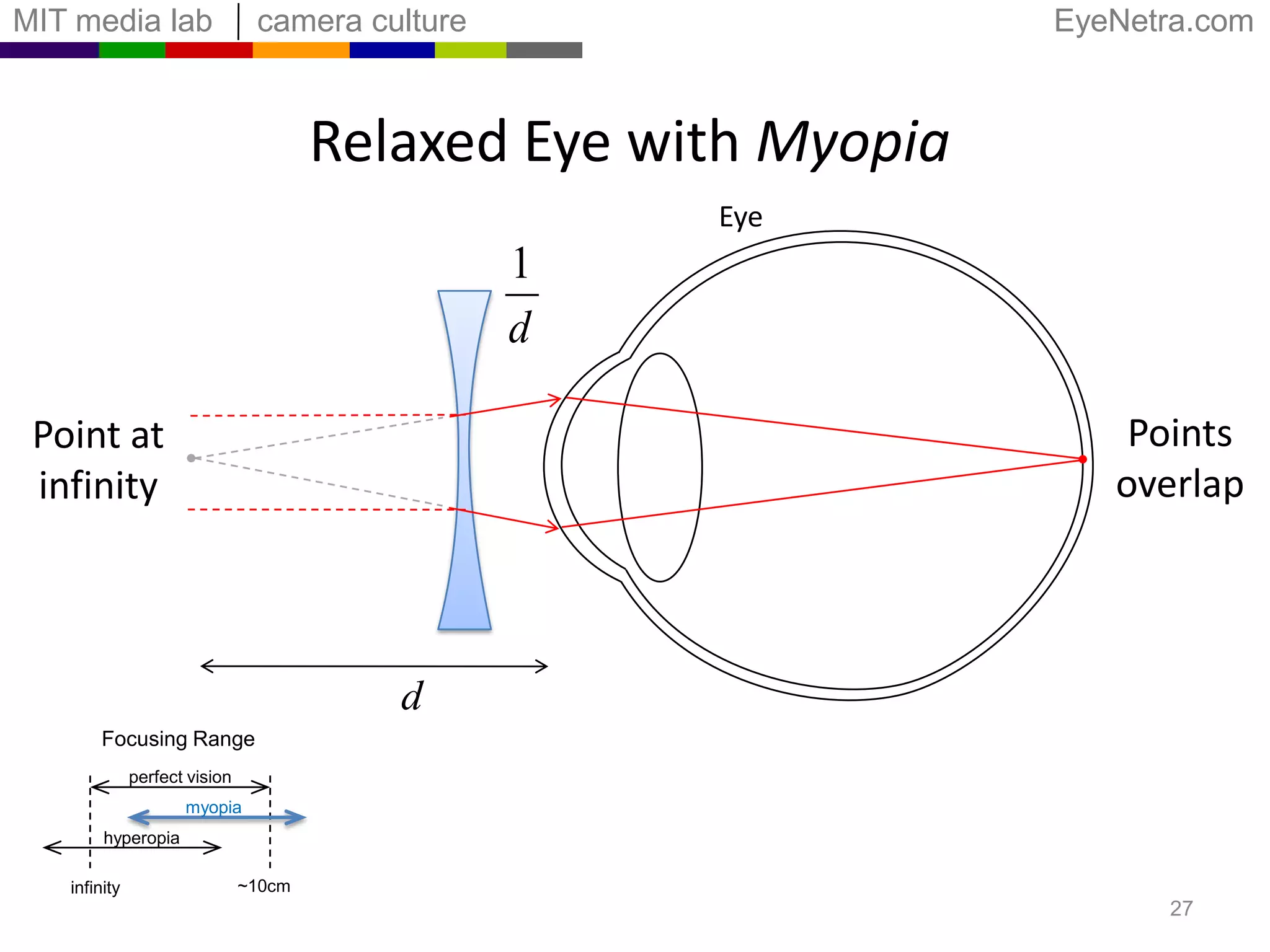
Myopia (nearsightedness)InfinitySubject cannot focusat far distancesAccommodation RangeNormal VisionShifted Accommodation RangeMyopia10cmInfinity13
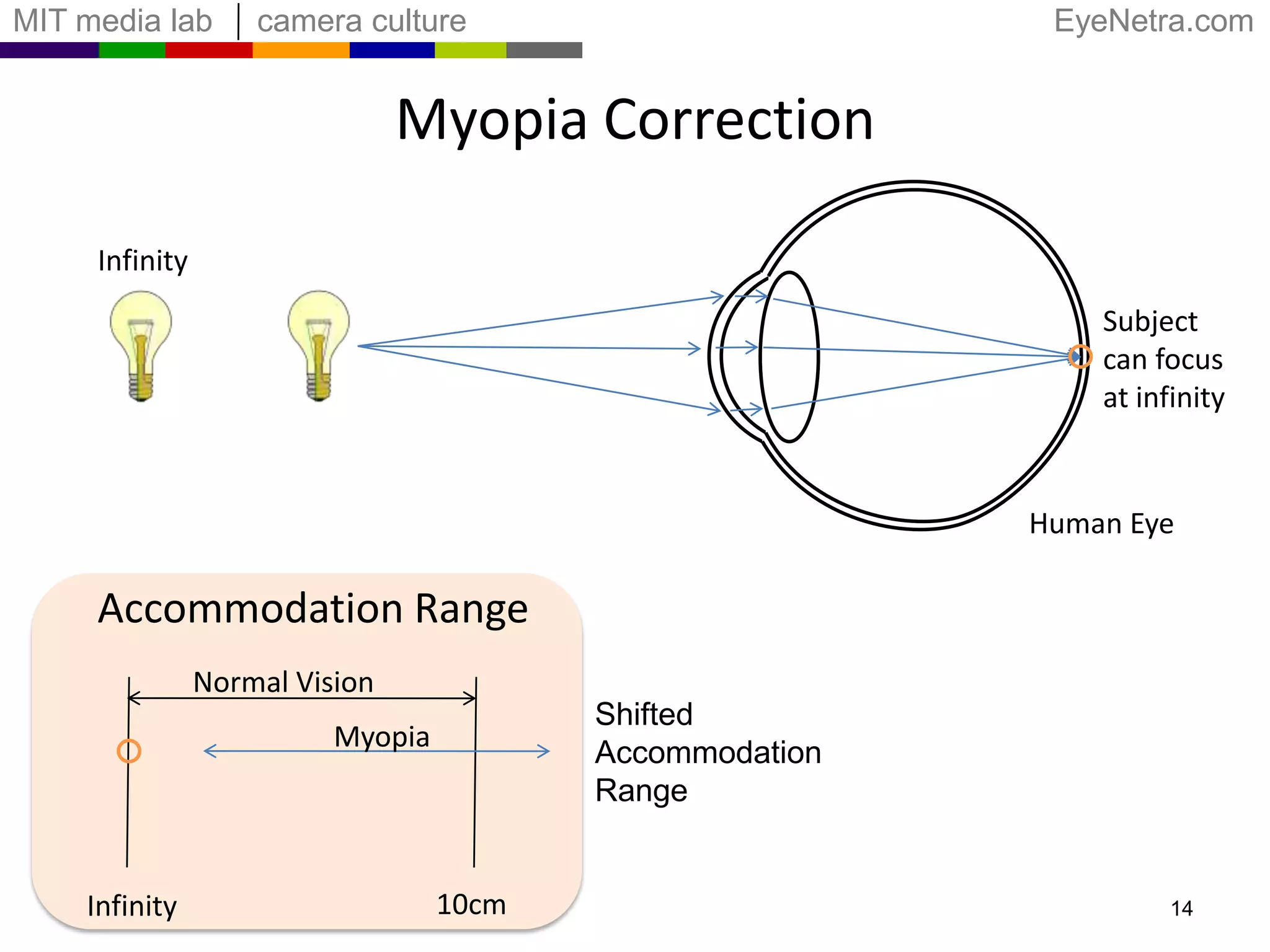
Myopia CorrectionInfinitySubject can focusat infinityHuman EyeAccommodation RangeNormal VisionShifted Accommodation RangeMyopia10cmInfinity14
Myopia CorrectionInfinitySubject can focusat infinityDivergent LensHuman EyeAccommodation RangeNormal VisionCorrected MyopiaMyopia10cmInfinity15
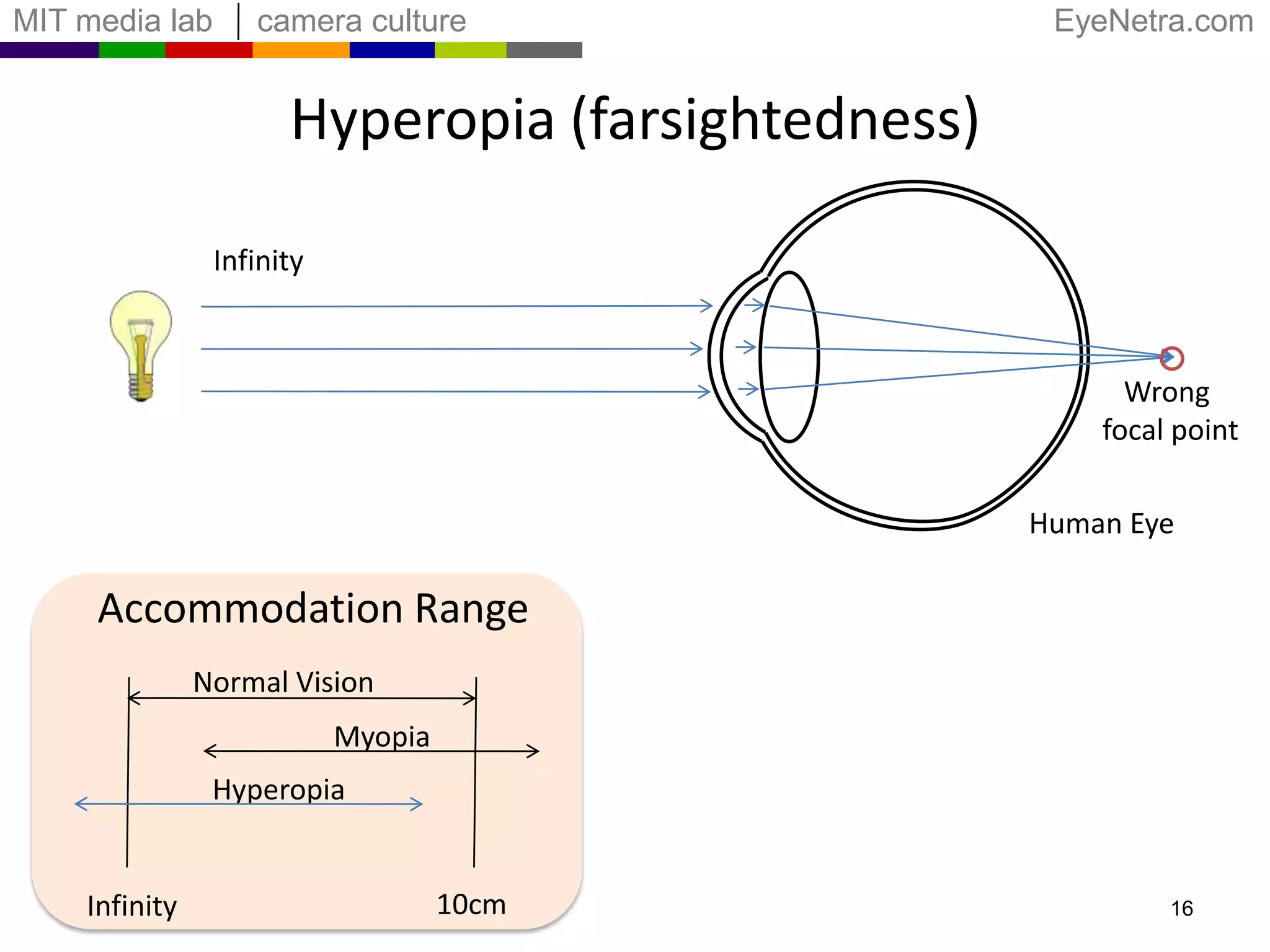
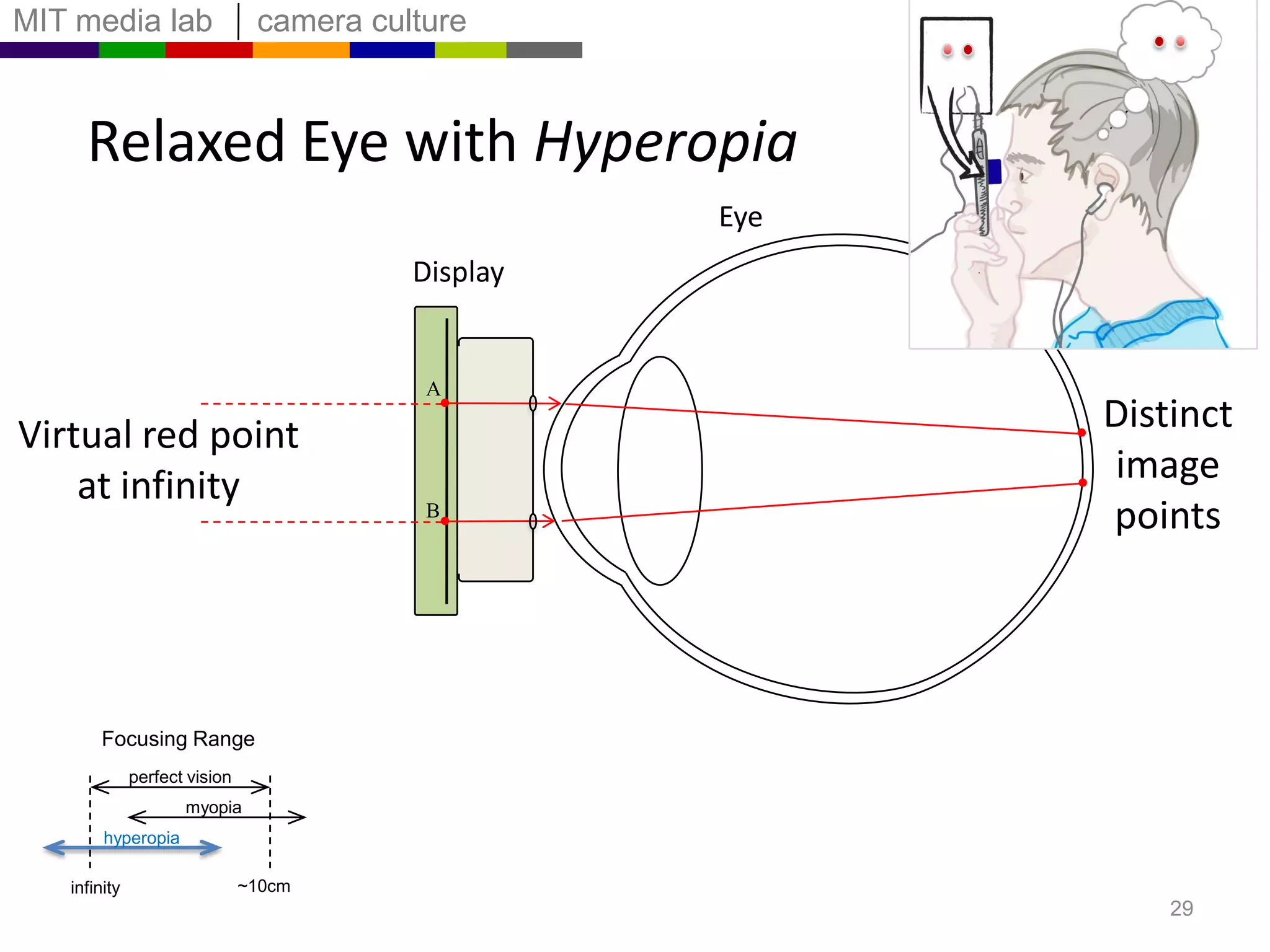
Hyperopia (farsightedness)InfinityWrong focal pointHuman EyeAccommodation RangeNormal VisionMyopiaHyperopia10cmInfinity16
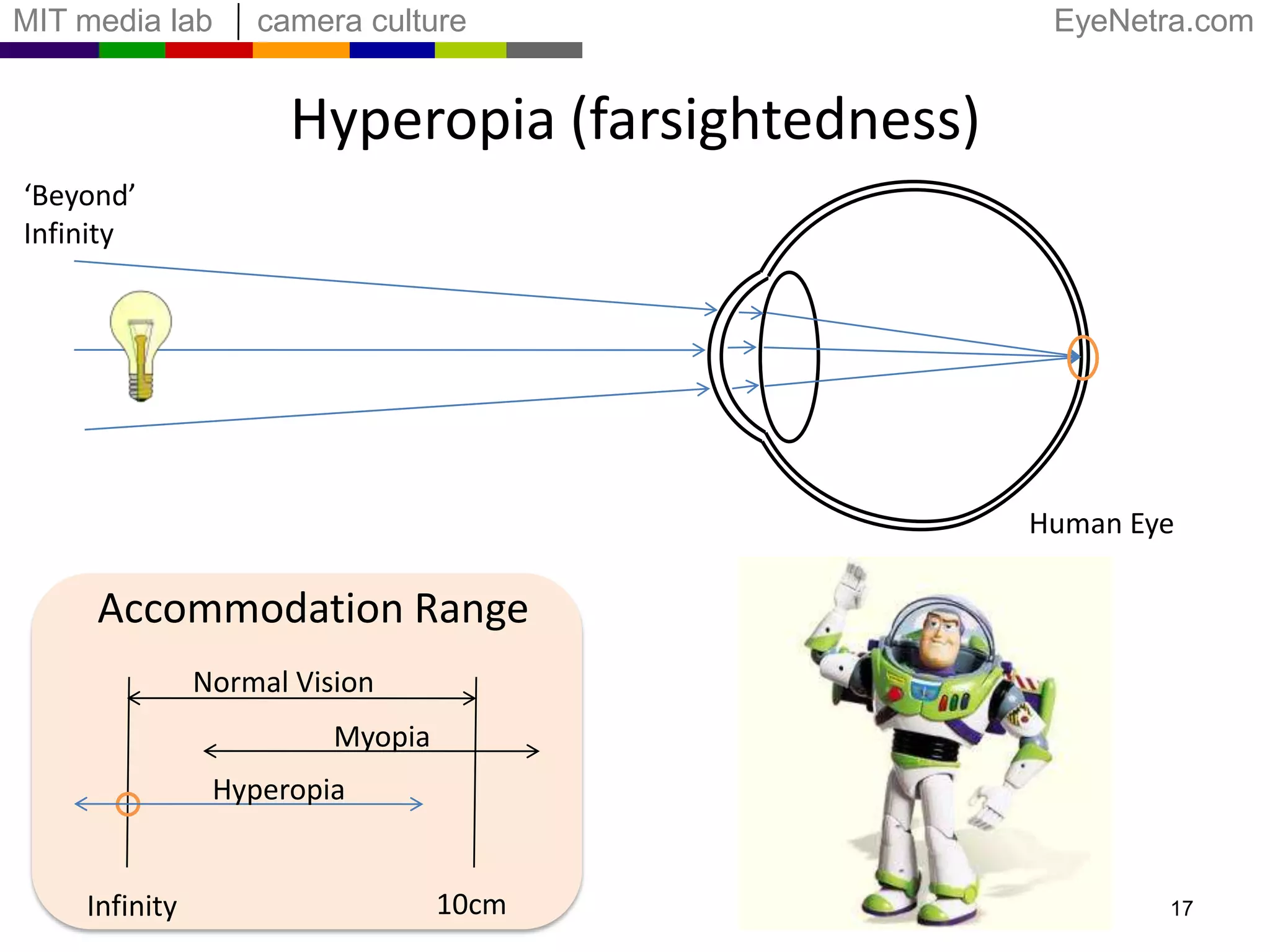
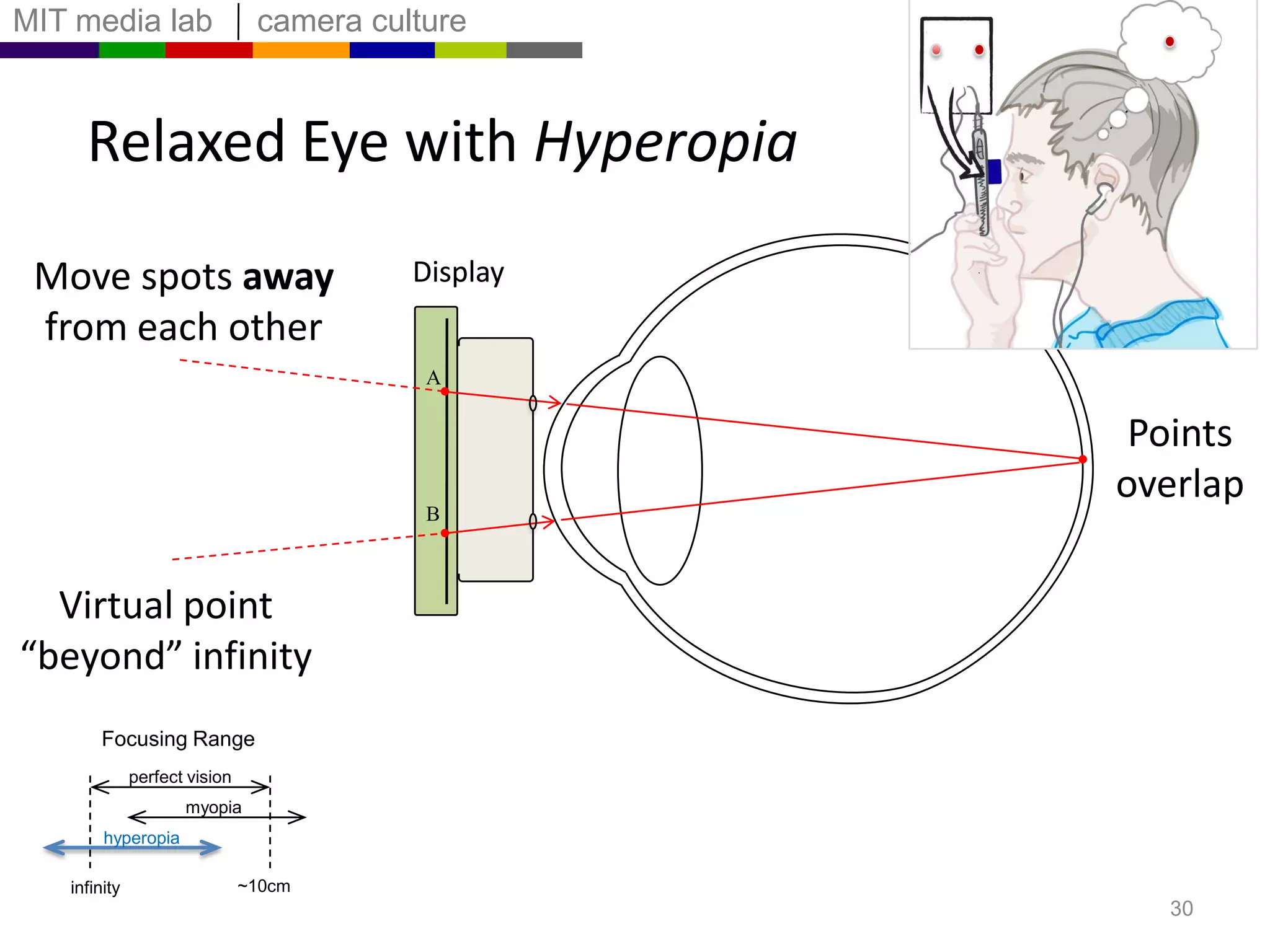
Hyperopia (farsightedness)‘Beyond’InfinityHuman EyeAccommodation RangeNormal VisionMyopiaHyperopia10cmInfinity17
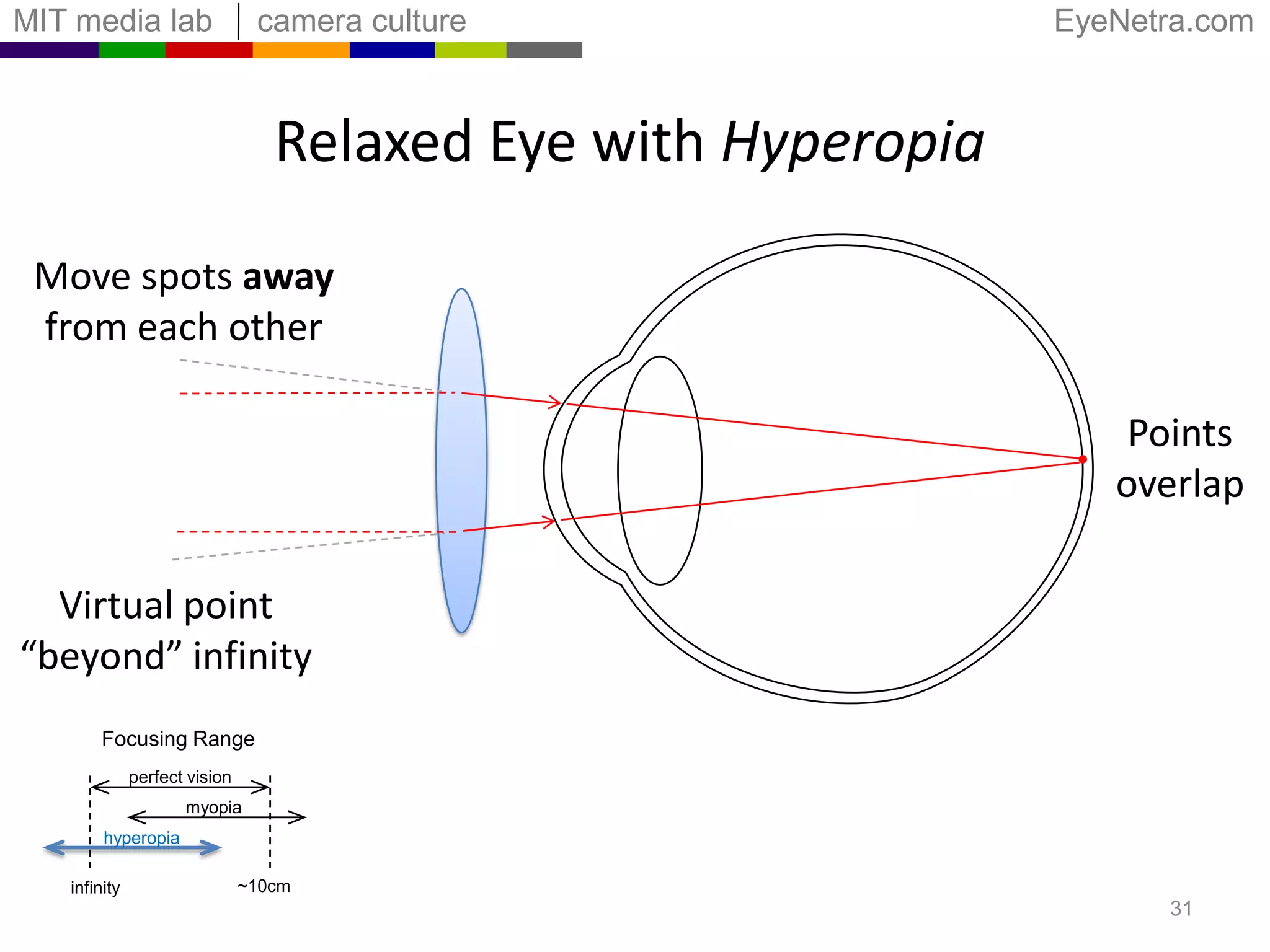
Hyperopia CorrectionInfinityConvergent LensHuman EyeAccommodation RangeNormal VisionMyopiaHyperopia10cmInfinity18Corrected Hyperopia
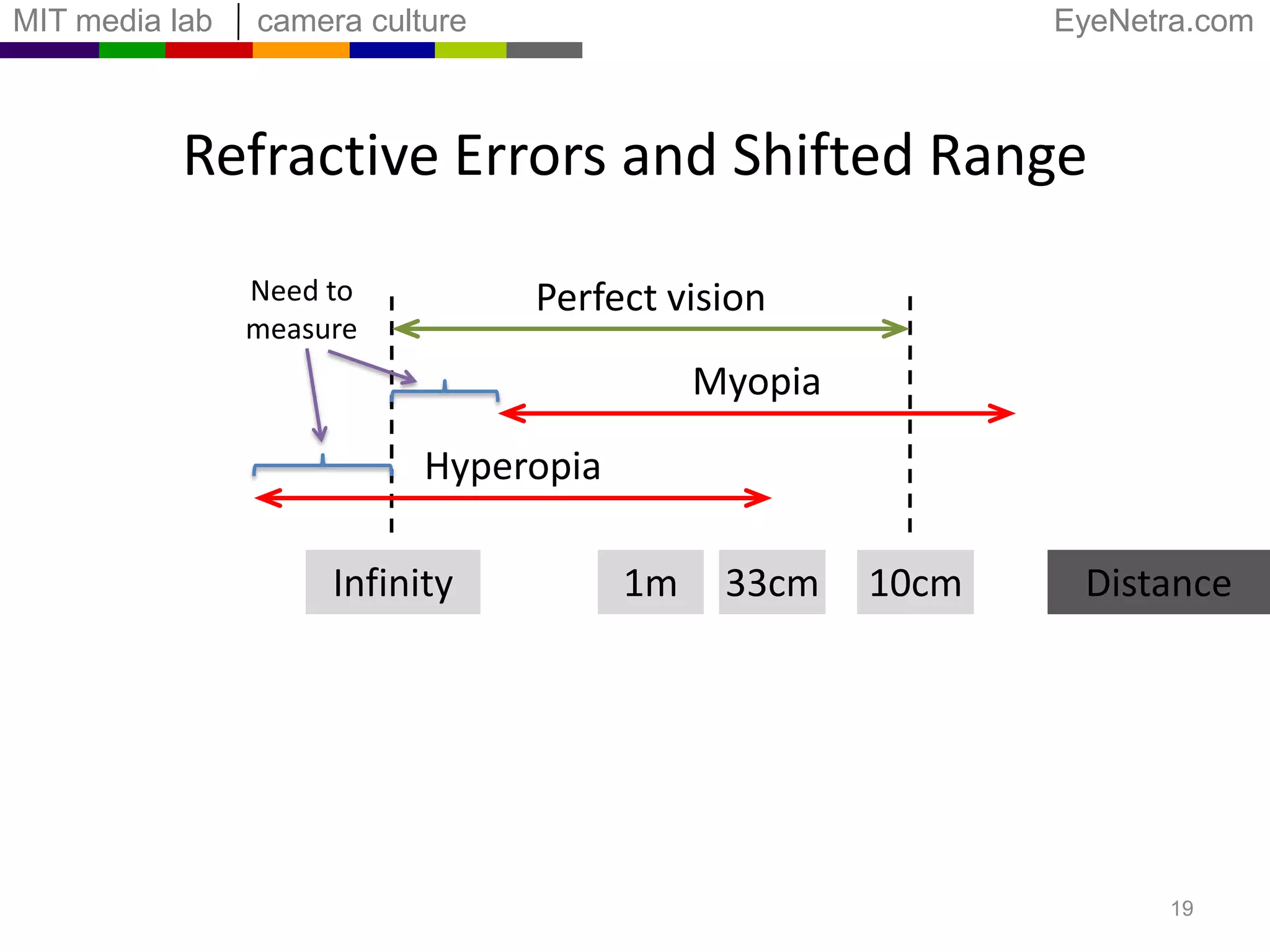
Refractive Errors and Shifted RangePerfect visionNeed to measureMyopiaHyperopia10cmInfinity191m33cmDistance
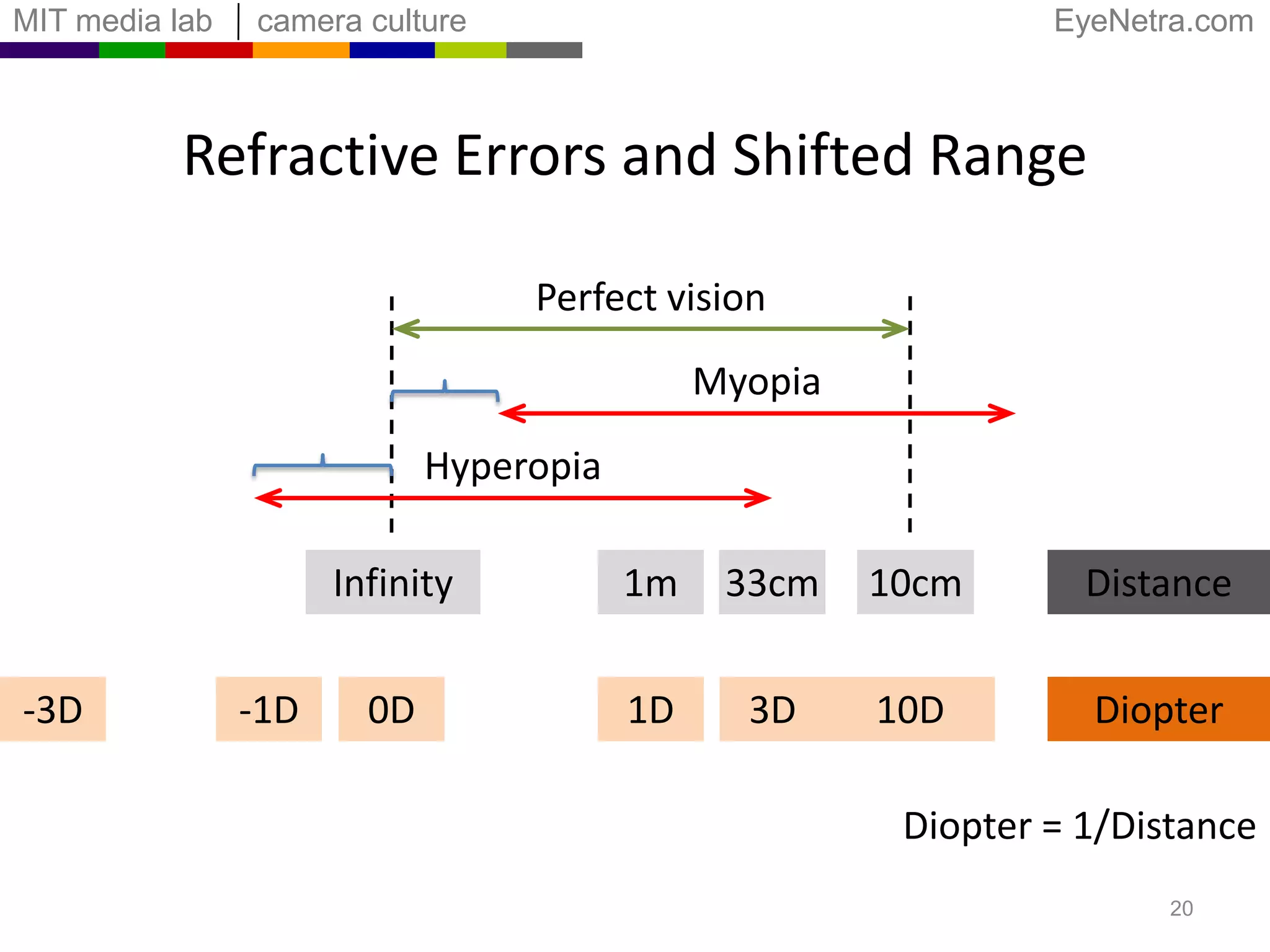
Refractive Errors and Shifted RangePerfect visionMyopiaHyperopia10cmInfinity201m33cmDistance10D0D3D1D-1D-3DDiopterDiopter = 1/Distance
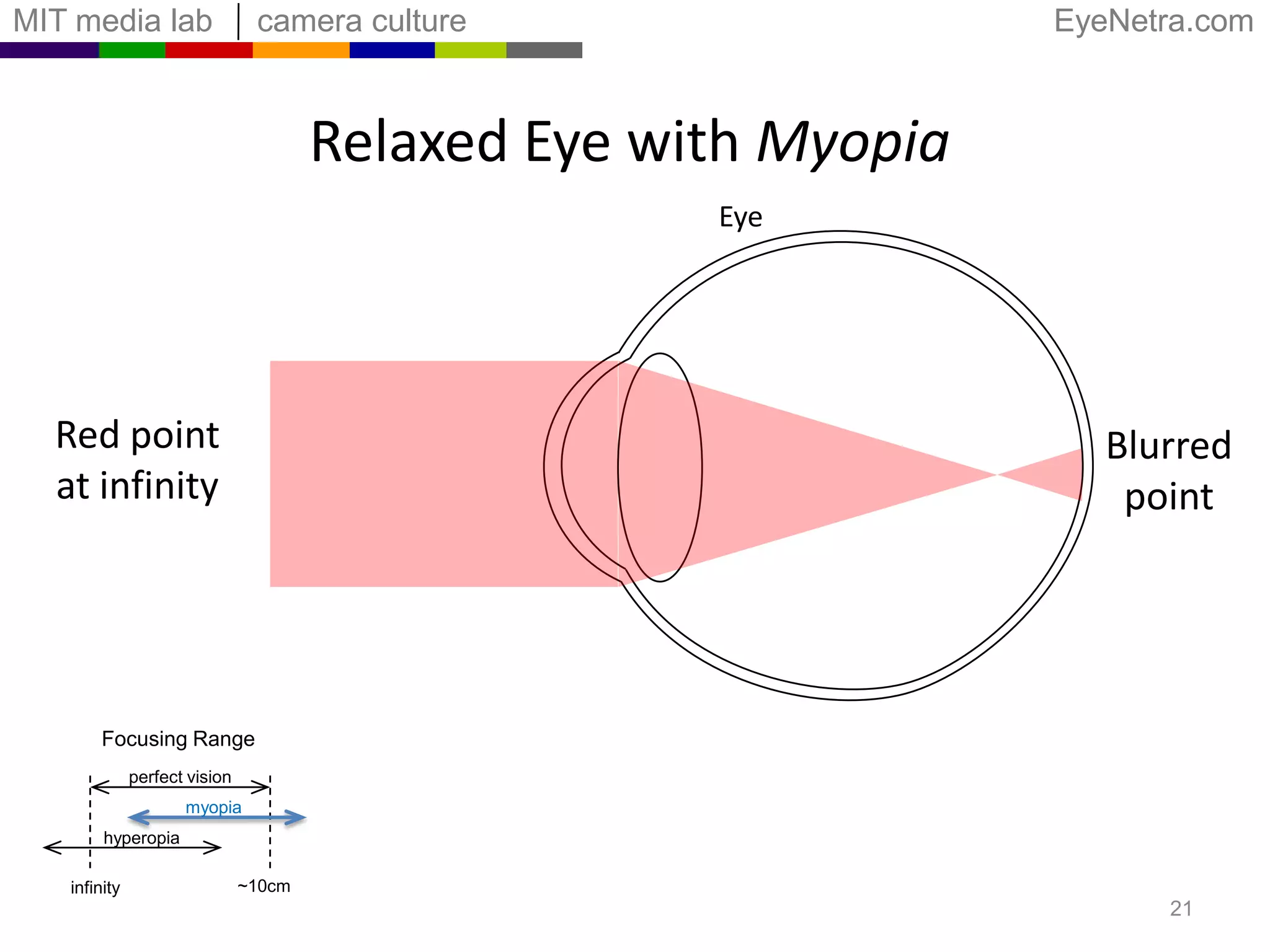
Relaxed Eye with MyopiaEyeRed pointat infinityBlurred pointFocusing Rangeperfect visionmyopiahyperopia~10cminfinity21
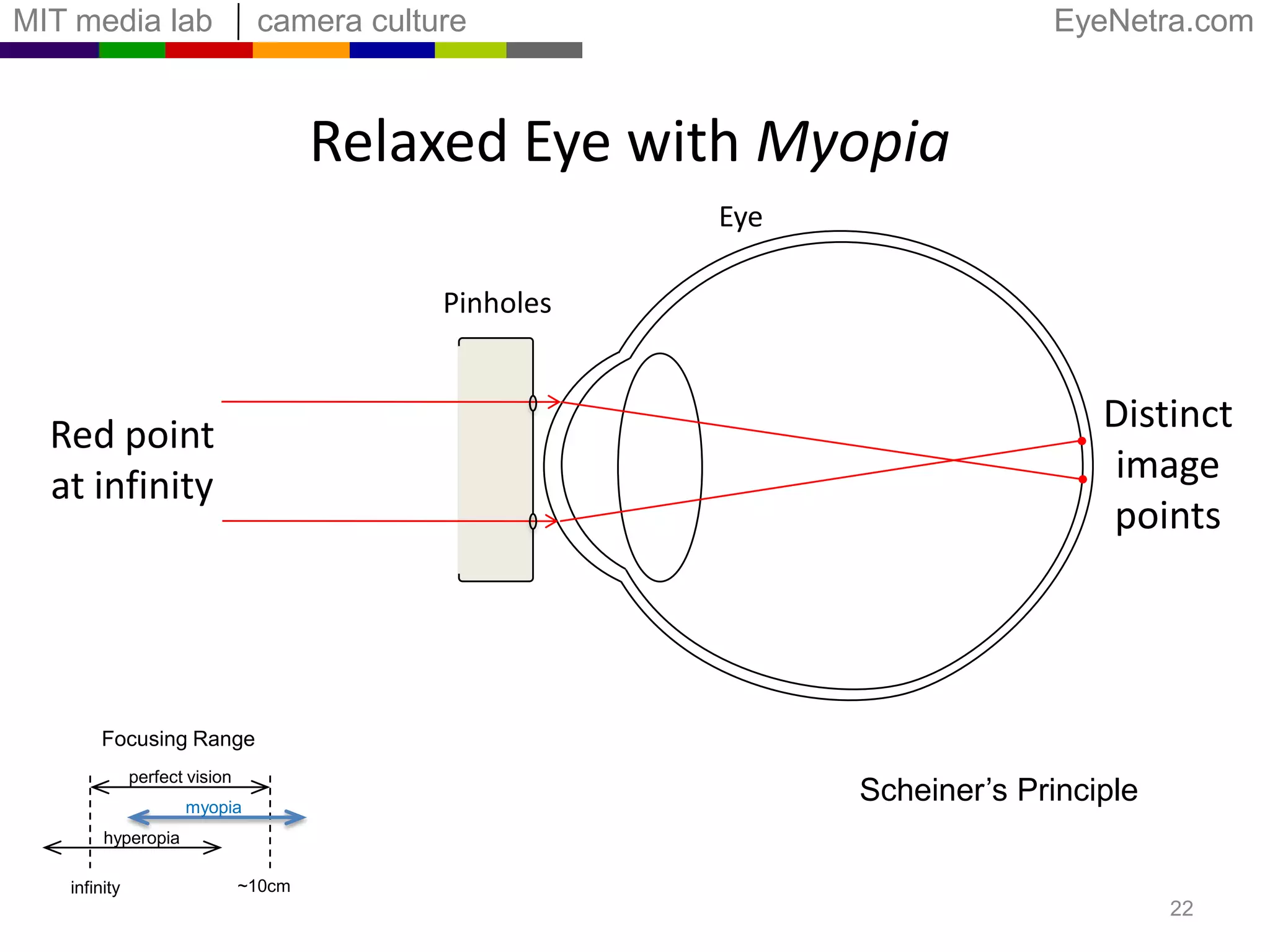
Relaxed Eye with MyopiaEyePinholesDistinctimage pointsRed pointat infinityFocusing Rangeperfect visionScheiner’s Principlemyopiahyperopia~10cminfinity22
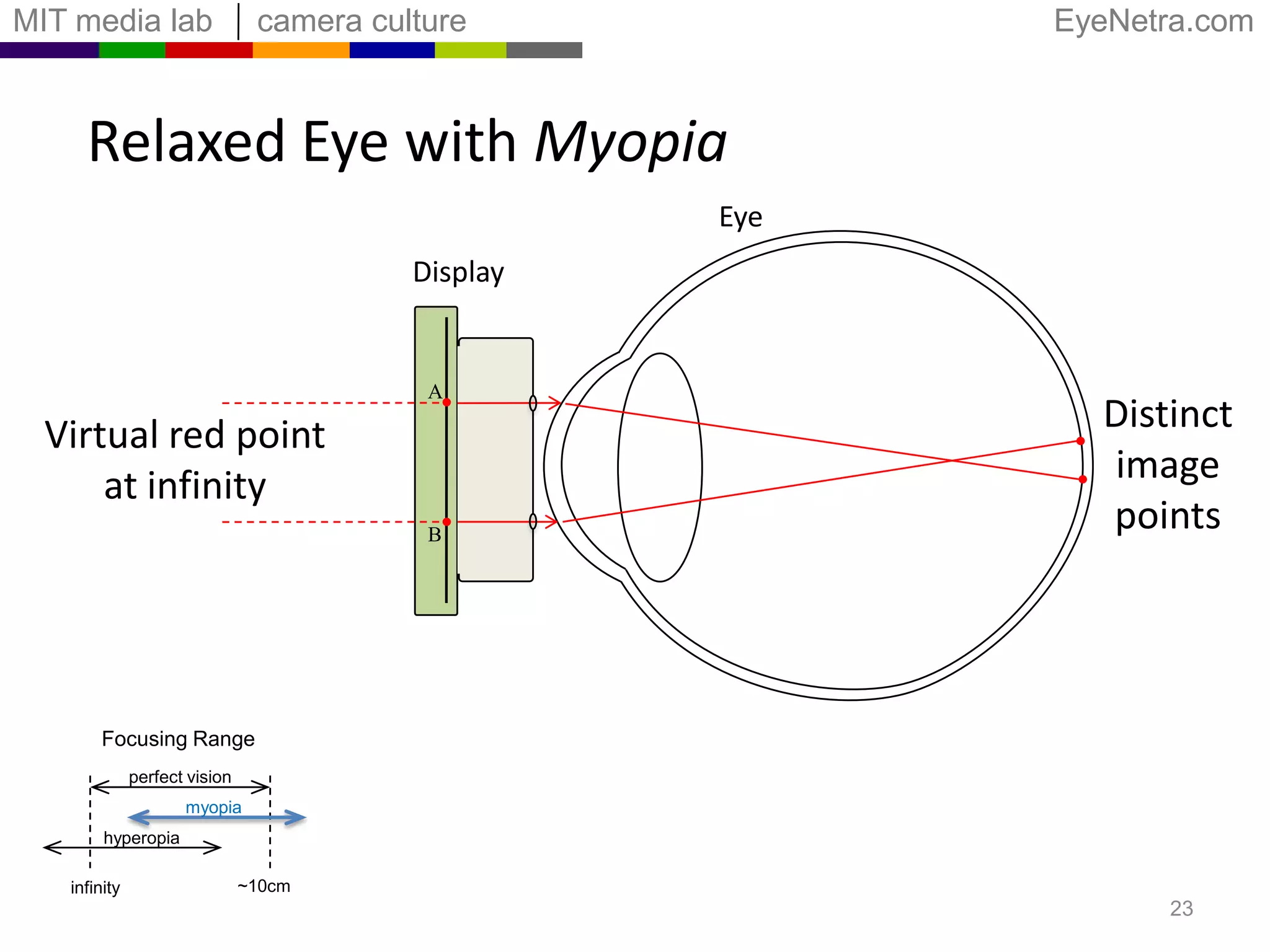
Relaxed Eye with MyopiaEyeDisplayADistinctimage pointsVirtual red pointat infinityBFocusing Rangeperfect visionmyopiahyperopia~10cminfinity23
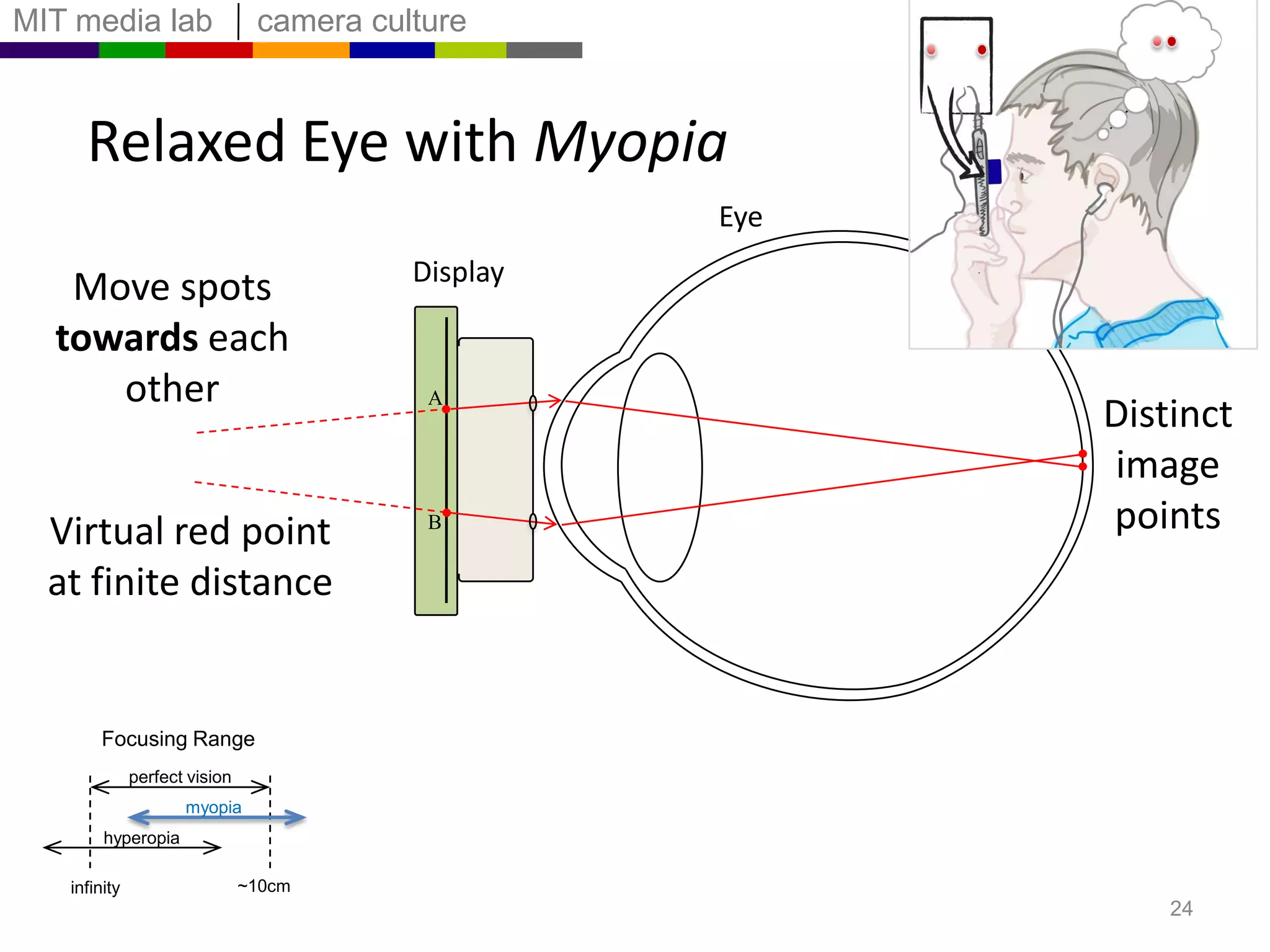
Relaxed Eye with MyopiaEyeDisplayMove spots towardseach otherADistinctimage pointsVirtual red pointat finite distanceBFocusing Rangeperfect visionmyopiahyperopia~10cminfinity24
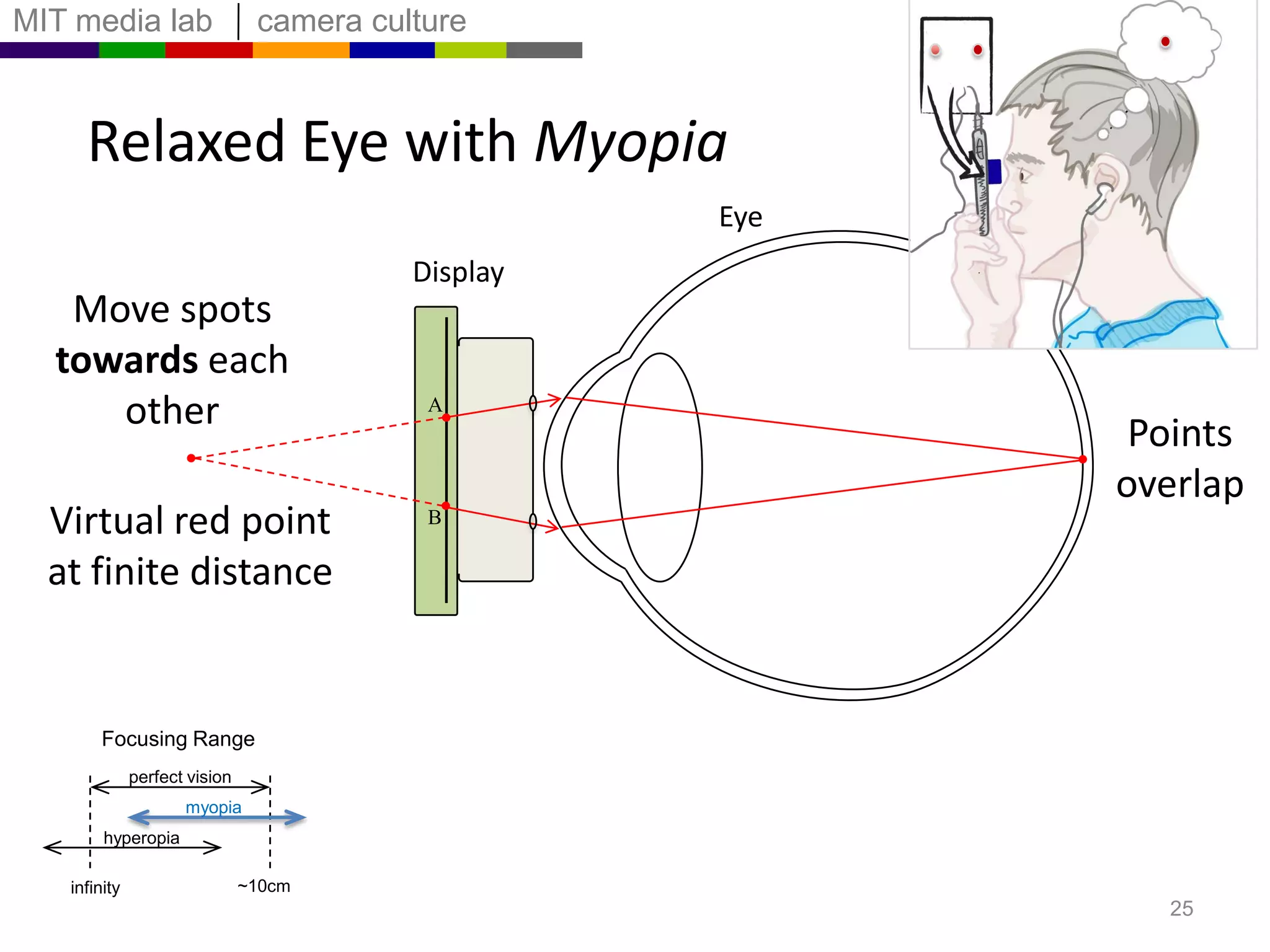
Relaxed Eye with MyopiaEyeDisplayMove spots towardseach otherAPoints overlapVirtual red pointat finite distanceBFocusing Rangeperfect visionmyopiahyperopia~10cminfinity25
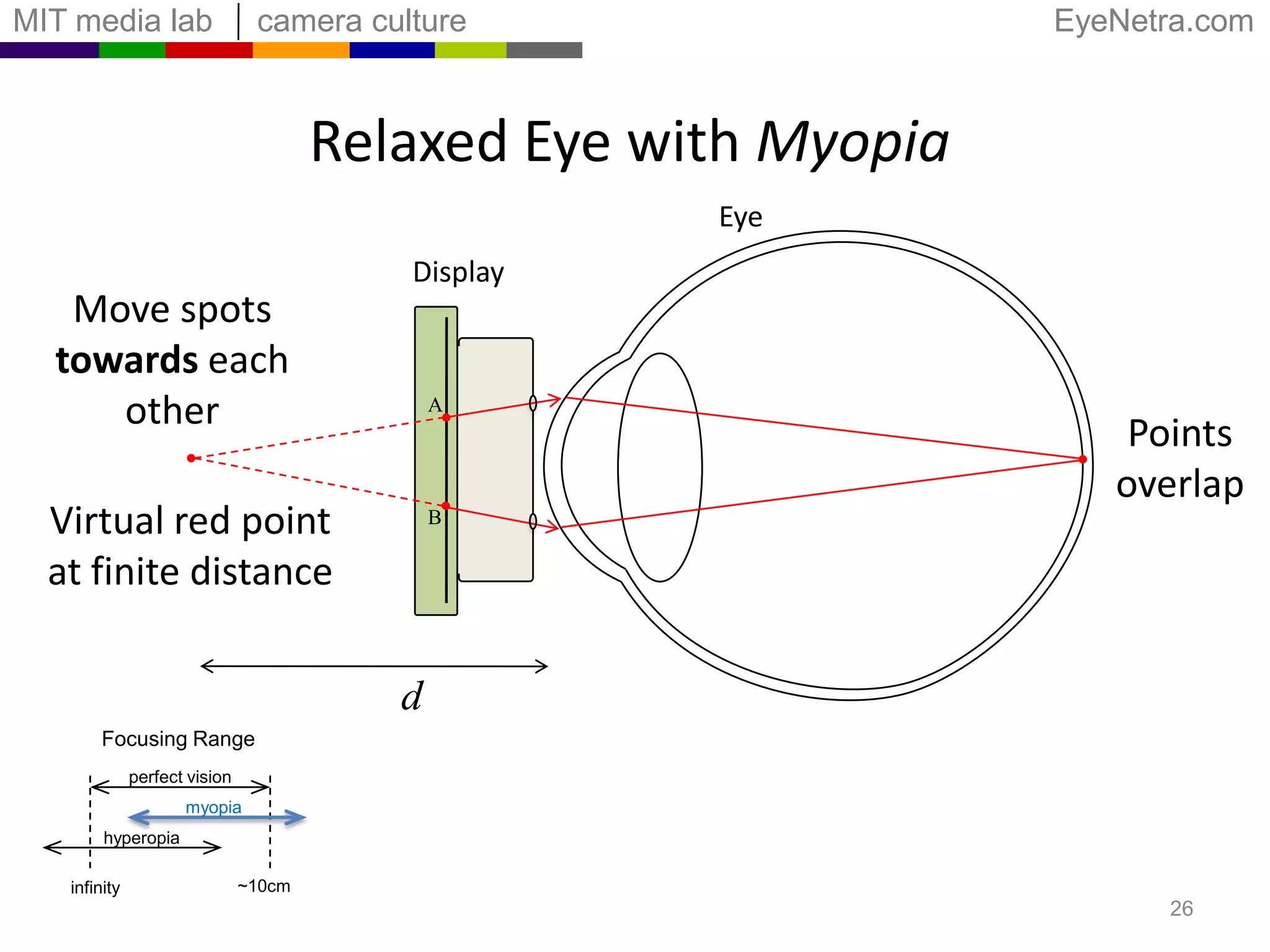
Relaxed Eye with MyopiaEyeDisplayMove spots towardseach otherAPoints overlapVirtual red pointat finite distanceBFocusing Rangeperfect visionmyopiahyperopia~10cminfinity26
Relaxed Eye with MyopiaEyePoints overlapPoint at infinityFocusing Rangeperfect visionmyopiahyperopia~10cminfinity27
Relaxed Perfect Eye DisplayAPoints overlapVirtual red pointat infinityBFocusing Rangeperfect visionmyopiahyperopia~10cminfinity28
Relaxed Eye with Hyperopia29EyeDisplayADistinctimage pointsVirtual red pointat infinityBFocusing Rangeperfect visionmyopiahyperopia~10cminfinity
Relaxed Eye with HyperopiaMove spots awayfrom each otherDisplayDisplayAPoints overlapBVirtual point“beyond” infinityFocusing Rangeperfect visionmyopiahyperopia~10cminfinity30
Relaxed Eye with HyperopiaMove spots awayfrom each otherPoints overlapVirtual point“beyond” infinityFocusing Rangeperfect visionmyopiahyperopia~10cminfinity31
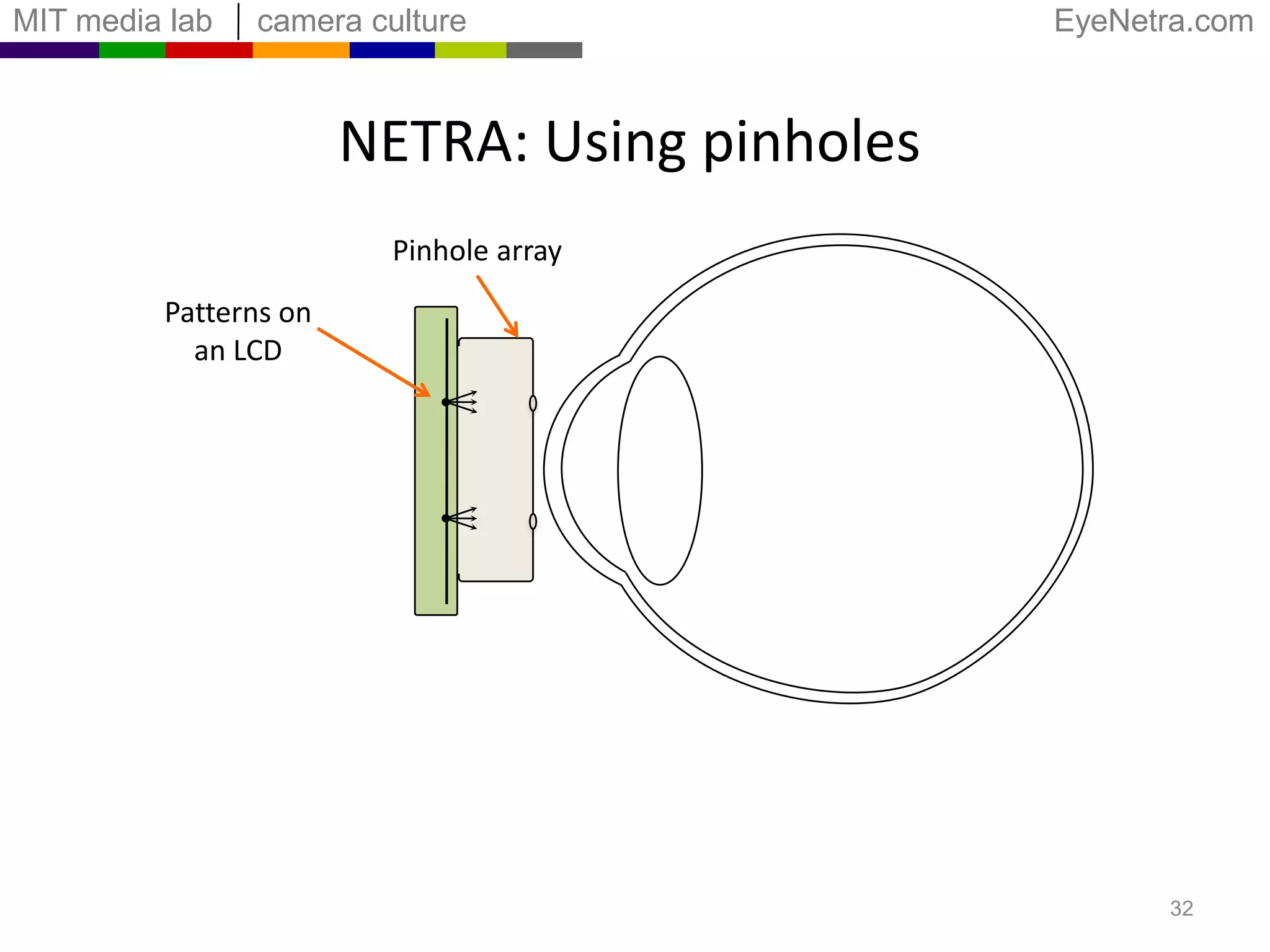
NETRA: Using pinholes32Pinhole arrayPatterns on an LCD
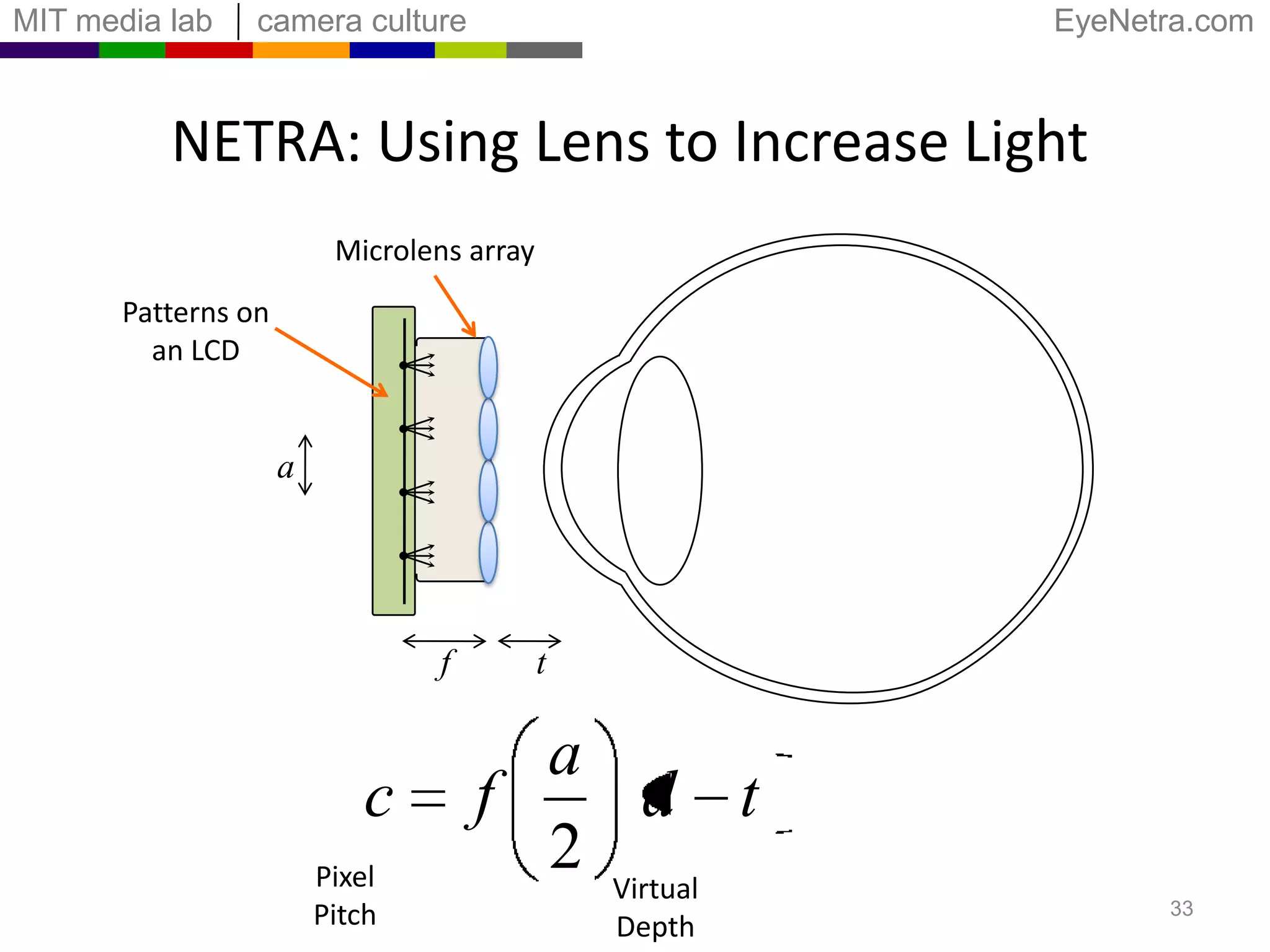
NETRA: Using Lens to Increase LightMicrolensarrayPatterns on an LCDaf33tPixel PitchVirtual Depth
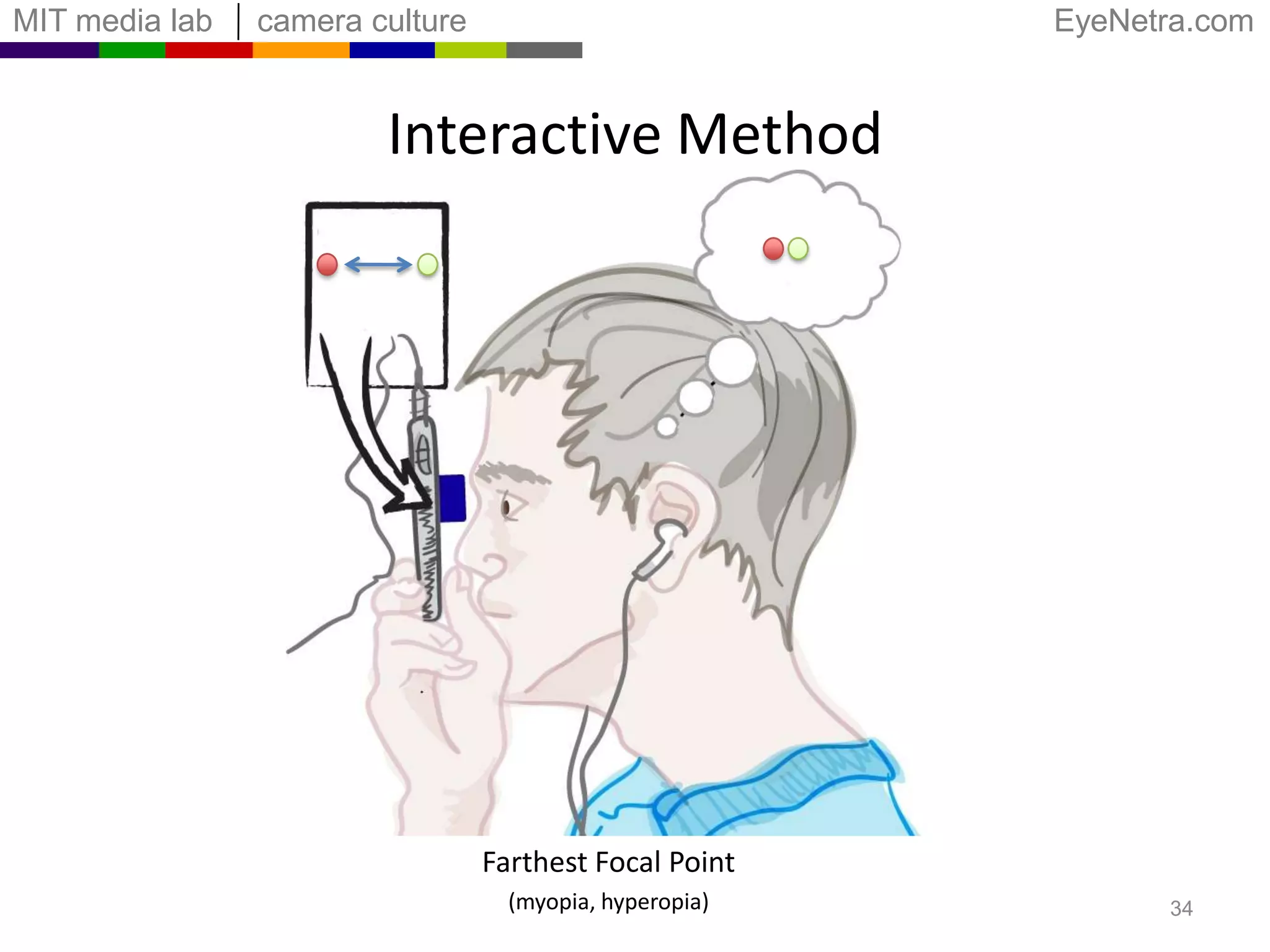
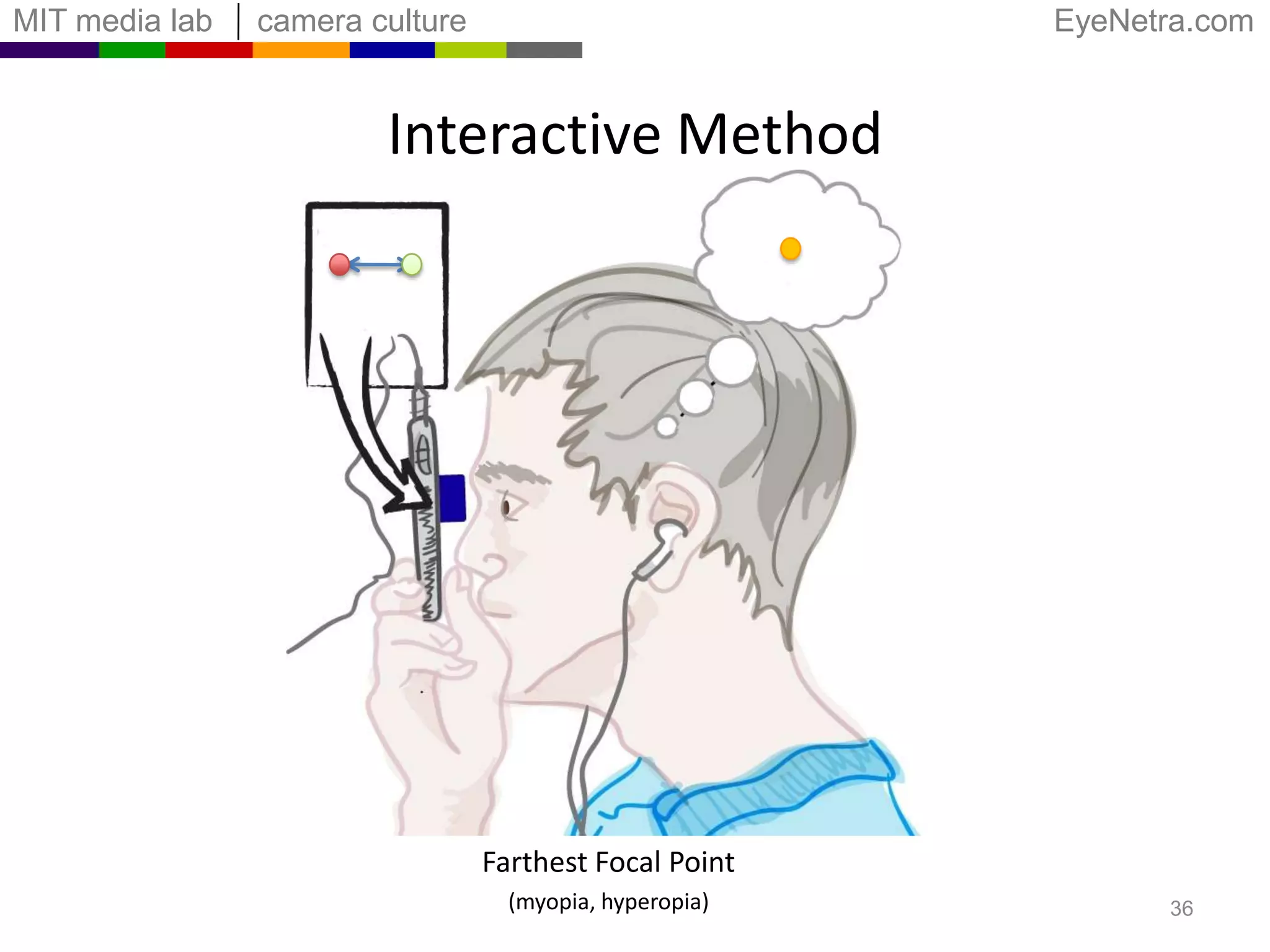
Interactive MethodFarthest Focal Point(myopia, hyperopia)34
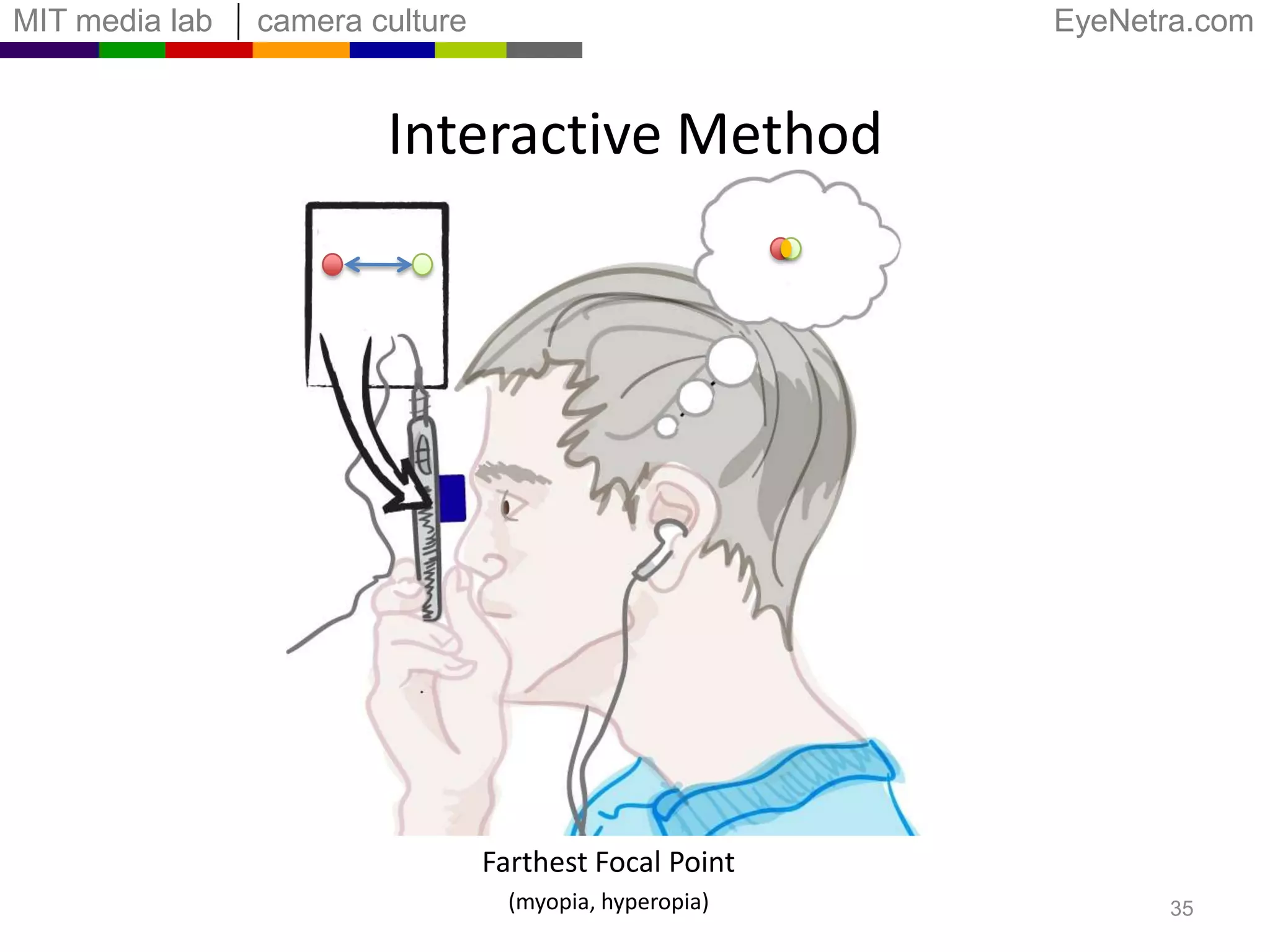
Interactive Method35Farthest Focal Point(myopia, hyperopia)
Interactive MethodFarthest Focal Point(myopia, hyperopia)36
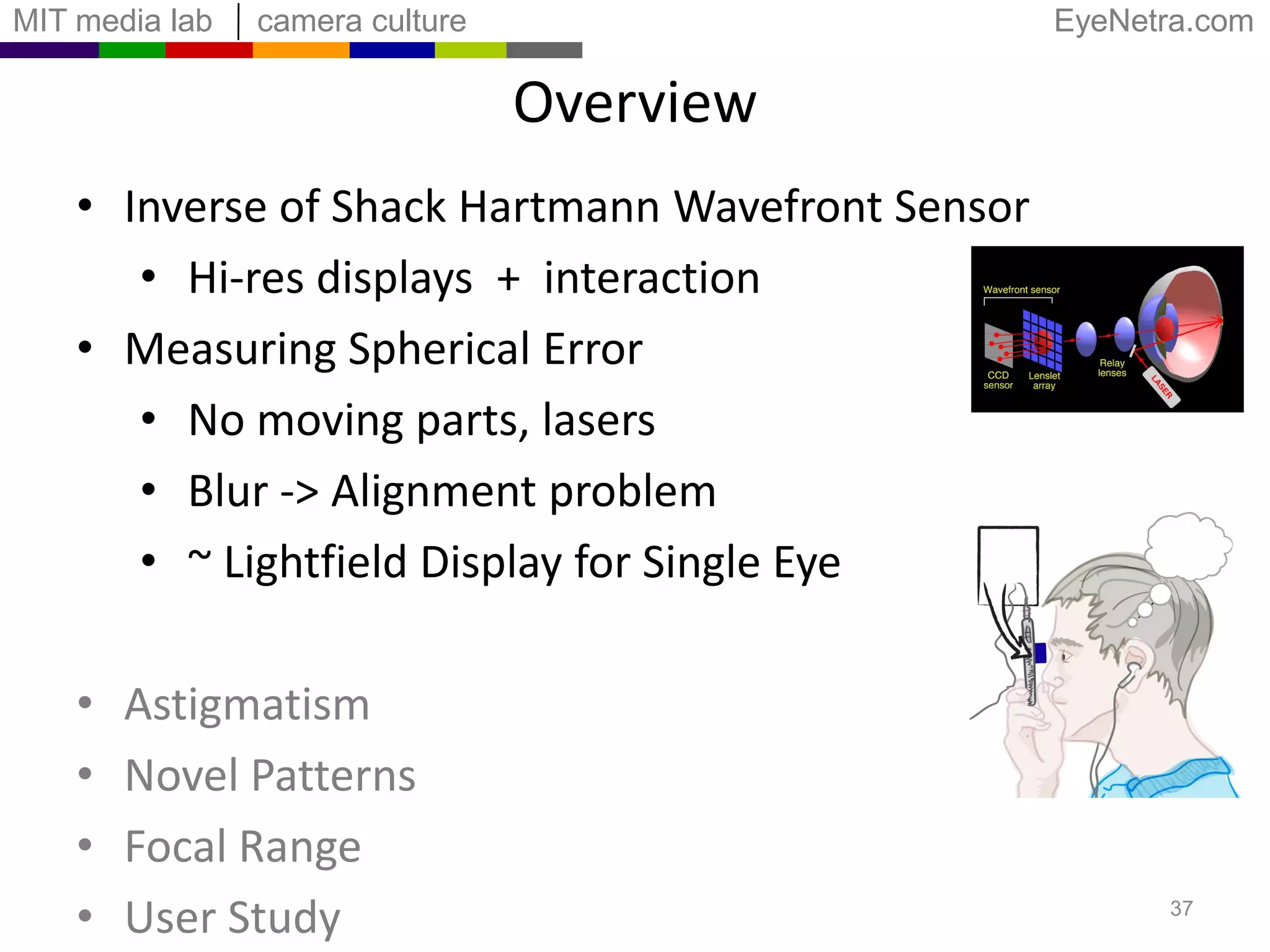
Overview37Inverse of Shack Hartmann Wavefront Sensor
Hi-res displays  +  interaction
Measuring Spherical Error
No moving parts, lasers
Blur -> Alignment problem
~ Lightfield Display for Single Eye
Astigmatism
Novel Patterns
Focal Range
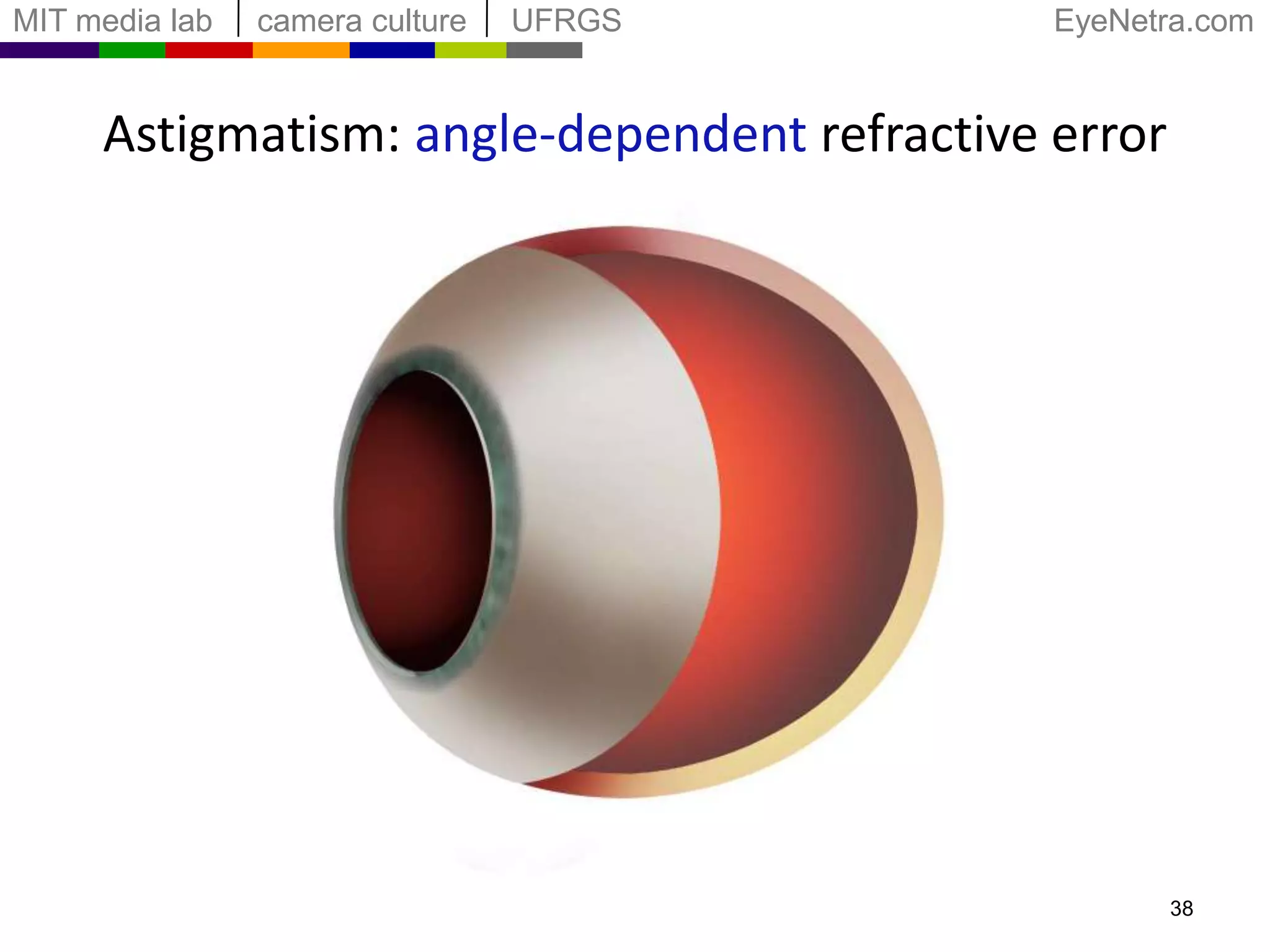
User StudyAstigmatism: angle-dependent refractive errorhttp://www.elizabethpope.co.uk/eyeinfo/astigmatism.html38
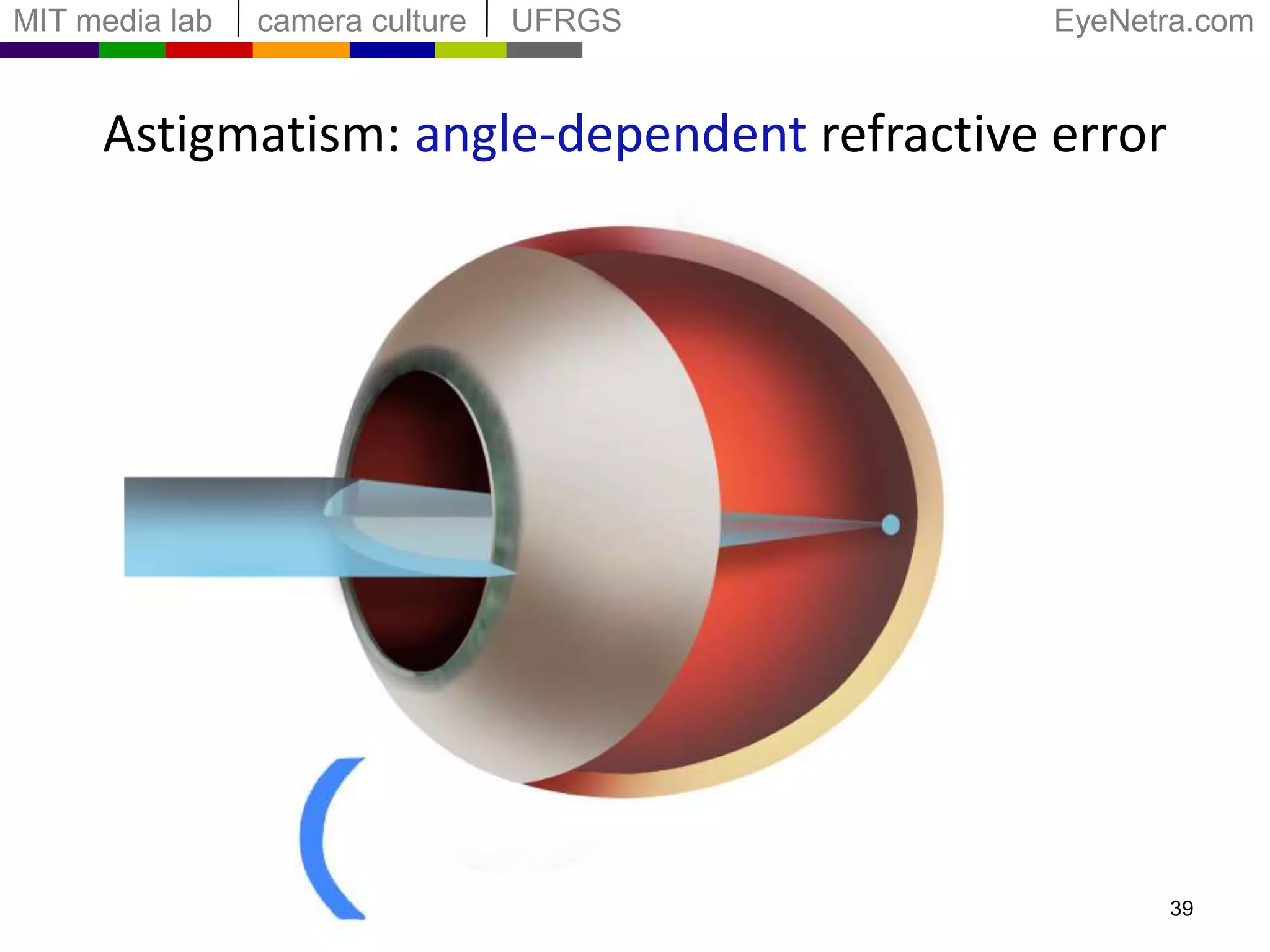
Astigmatism: angle-dependent refractive errorhttp://www.elizabethpope.co.uk/eyeinfo/astigmatism.html39
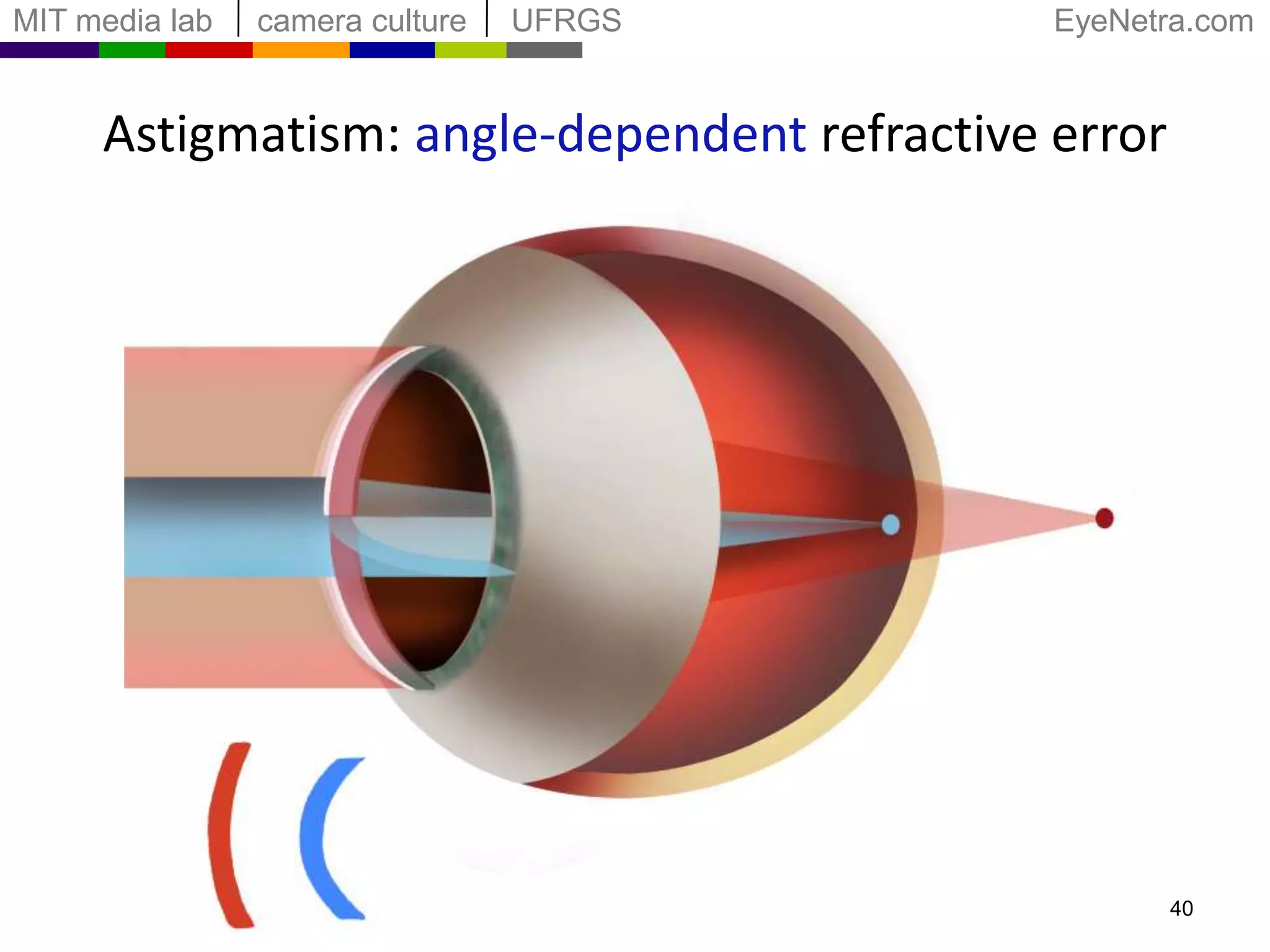
Astigmatism: angle-dependent refractive errorhttp://www.elizabethpope.co.uk/eyeinfo/astigmatism.html40
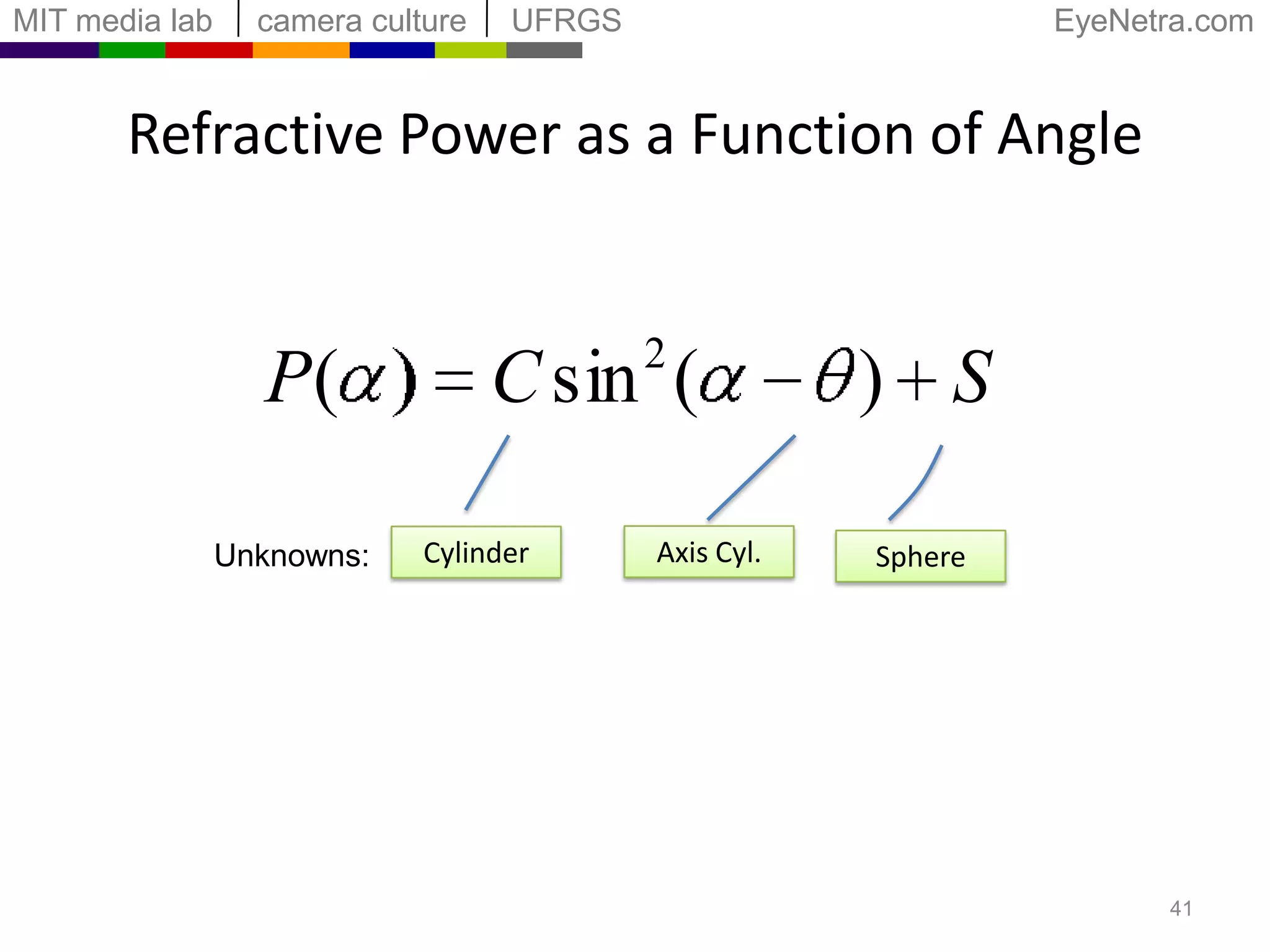
Refractive Power as a Function of Angle41Axis Cyl.CylinderUnknowns:Sphere
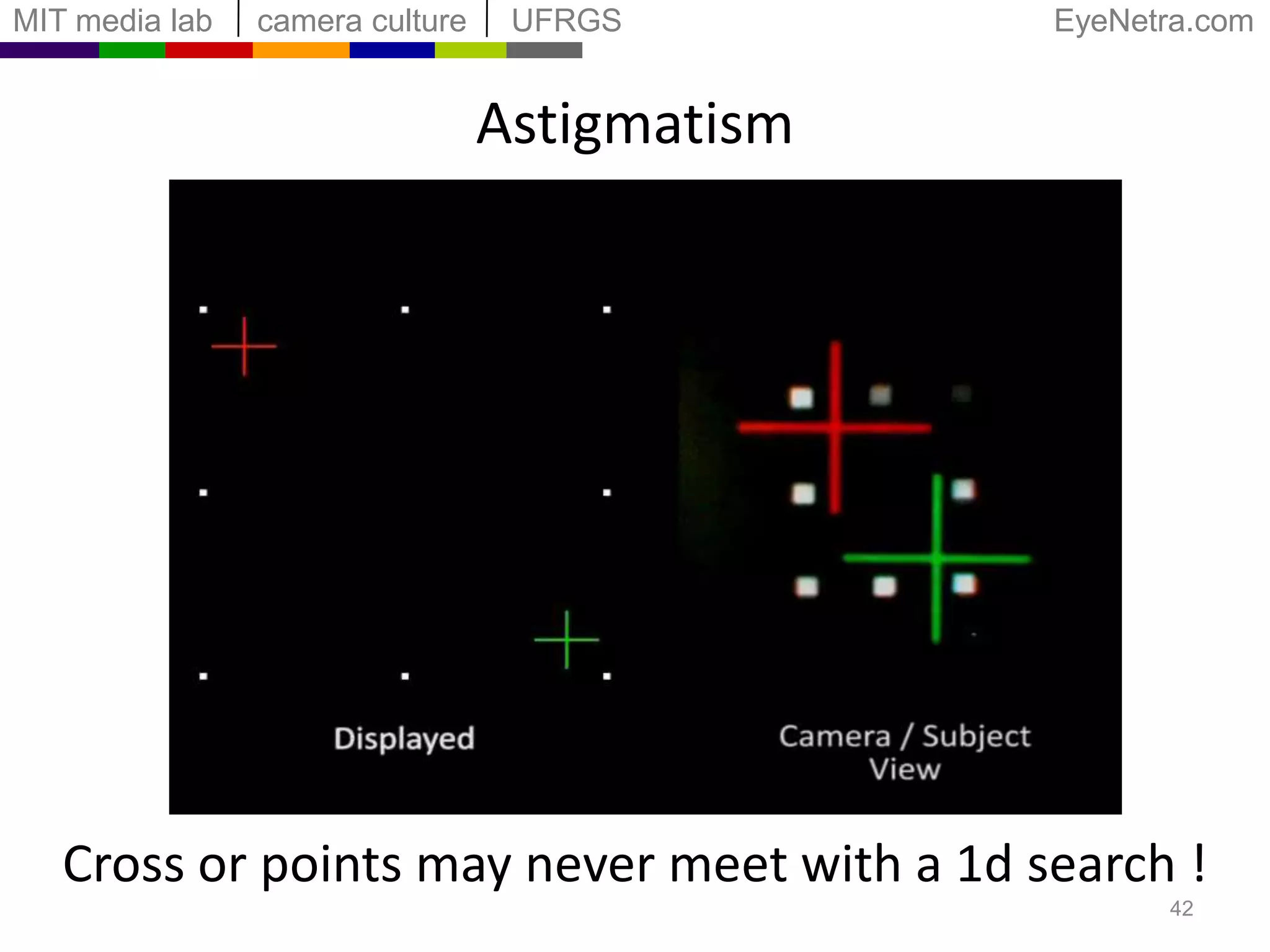
AstigmatismCross or points may never meet with a 1d search !42
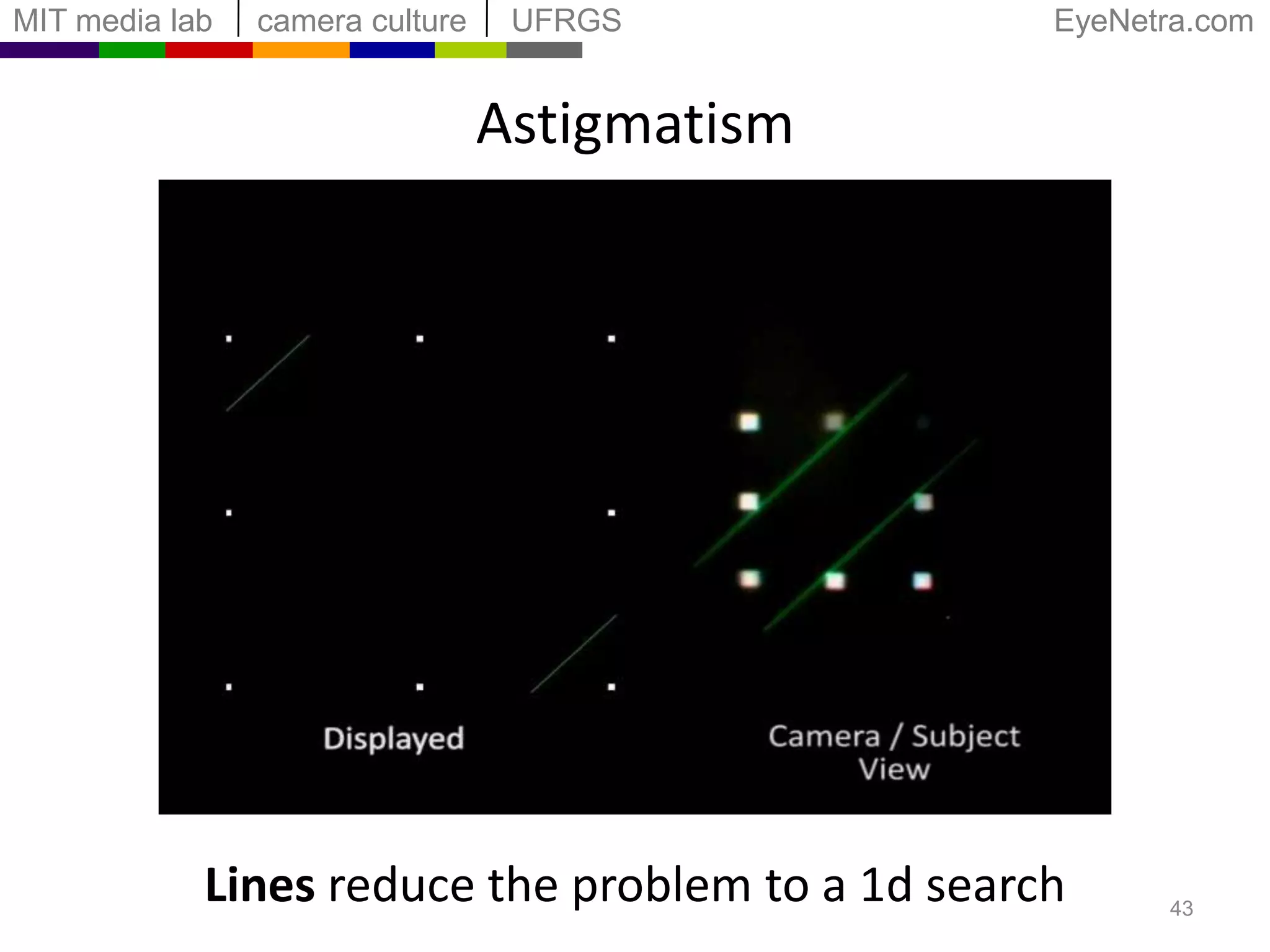
AstigmatismLines reduce the problem to a 1d search43
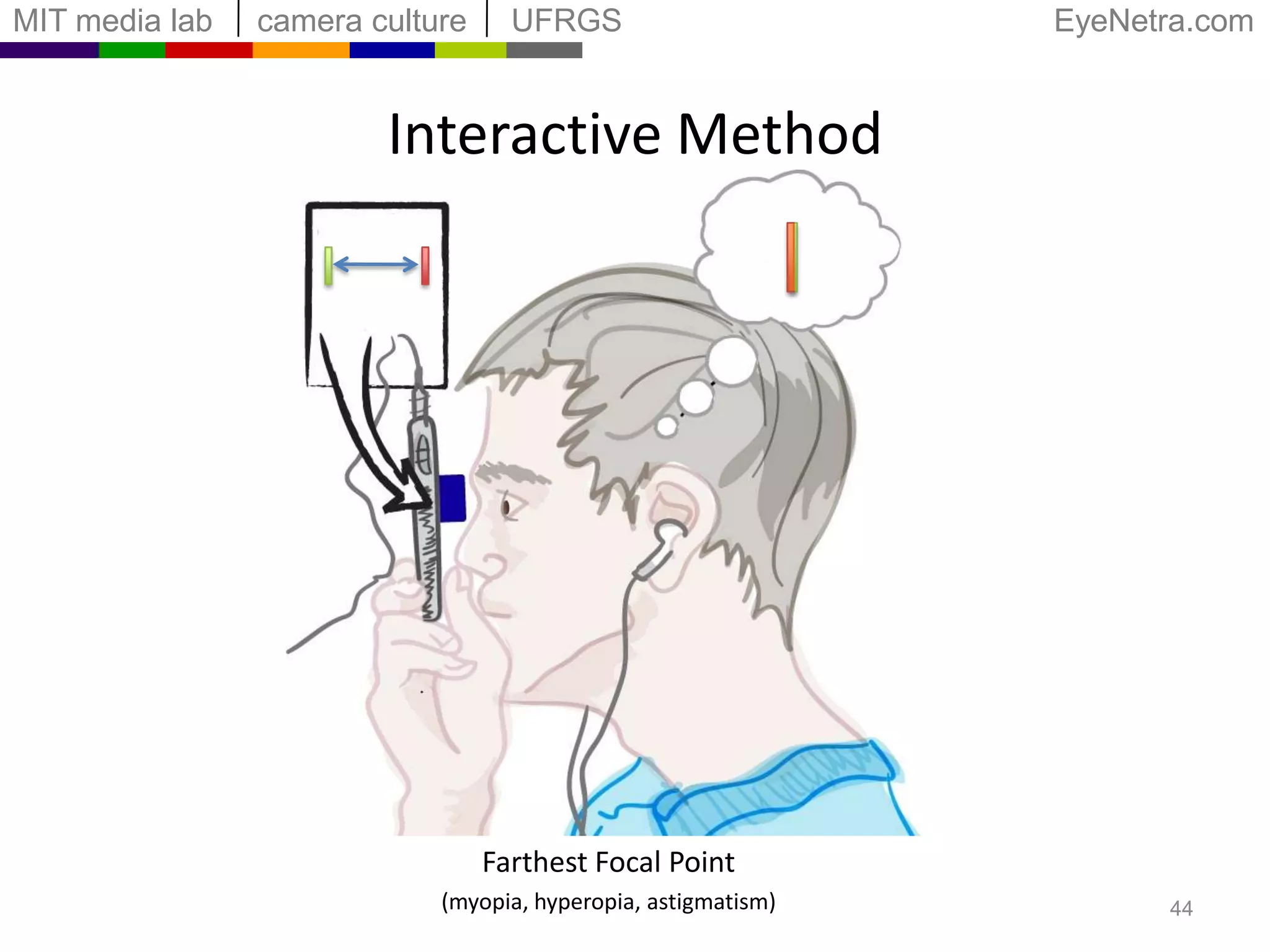
Interactive MethodFarthest Focal Point(myopia, hyperopia, astigmatism)44
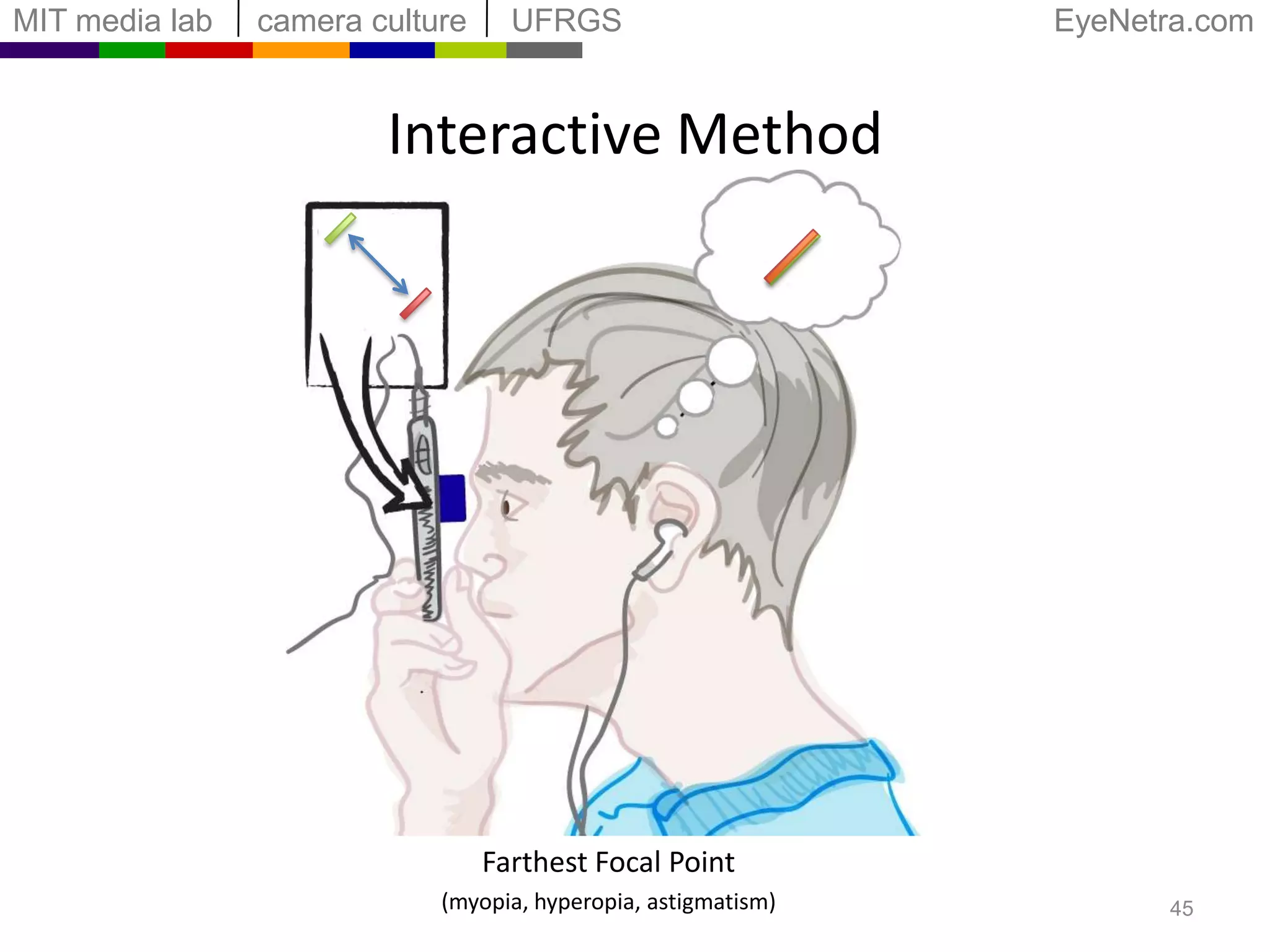
Interactive MethodFarthest Focal Point(myopia, hyperopia, astigmatism)45
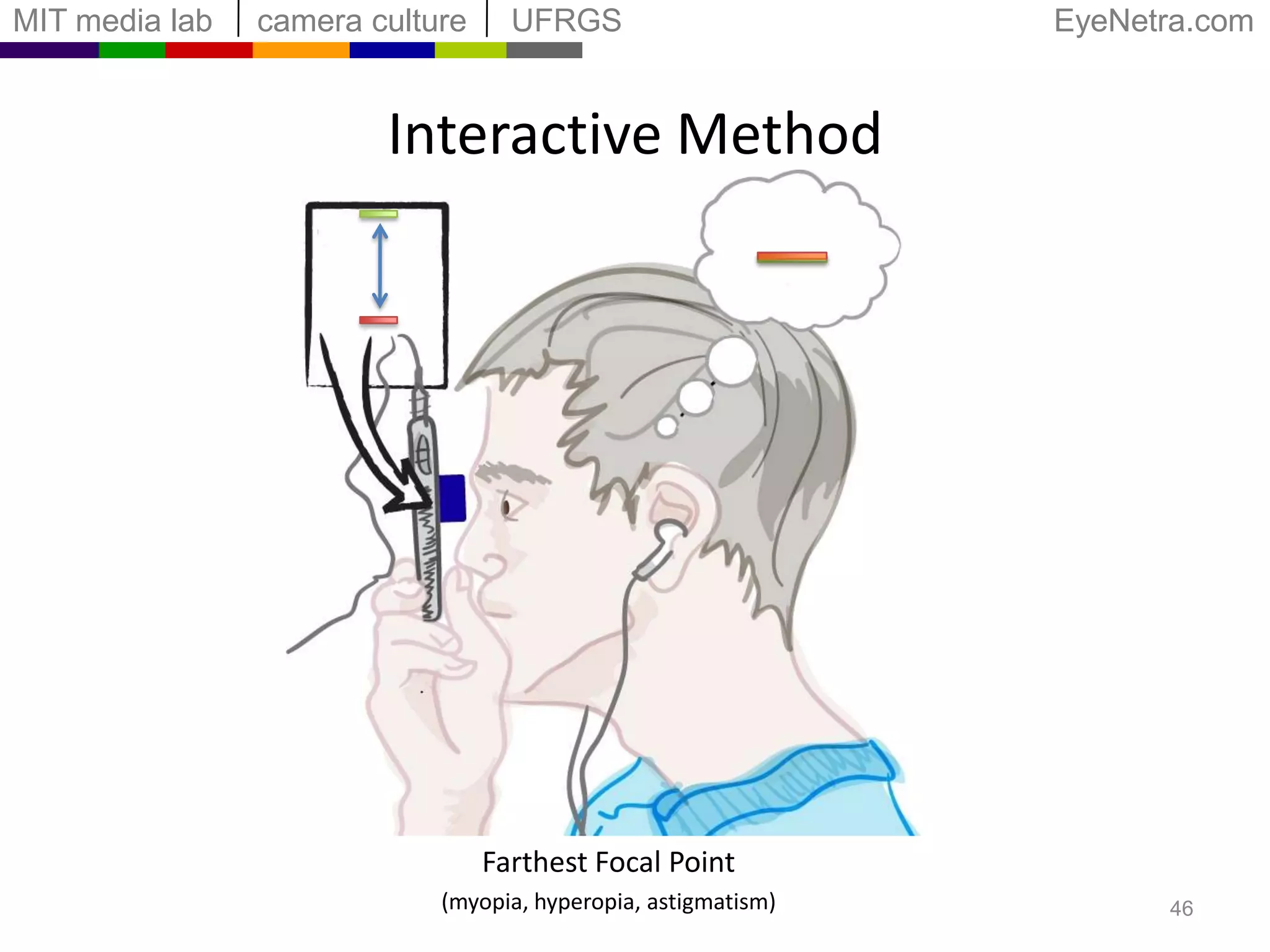
Interactive MethodFarthest Focal Point(myopia, hyperopia, astigmatism)46
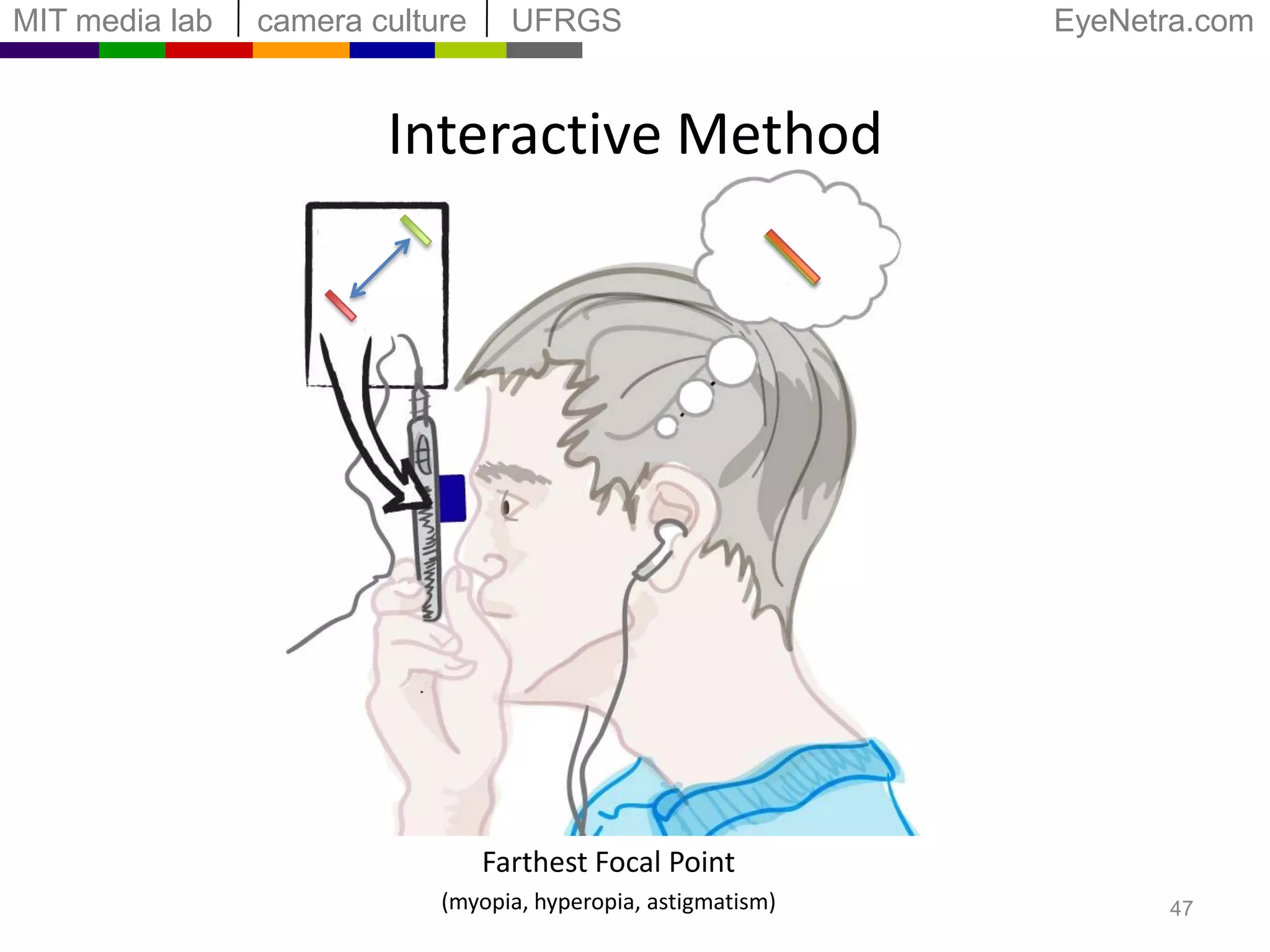
Interactive MethodFarthest Focal Point(myopia, hyperopia, astigmatism)47
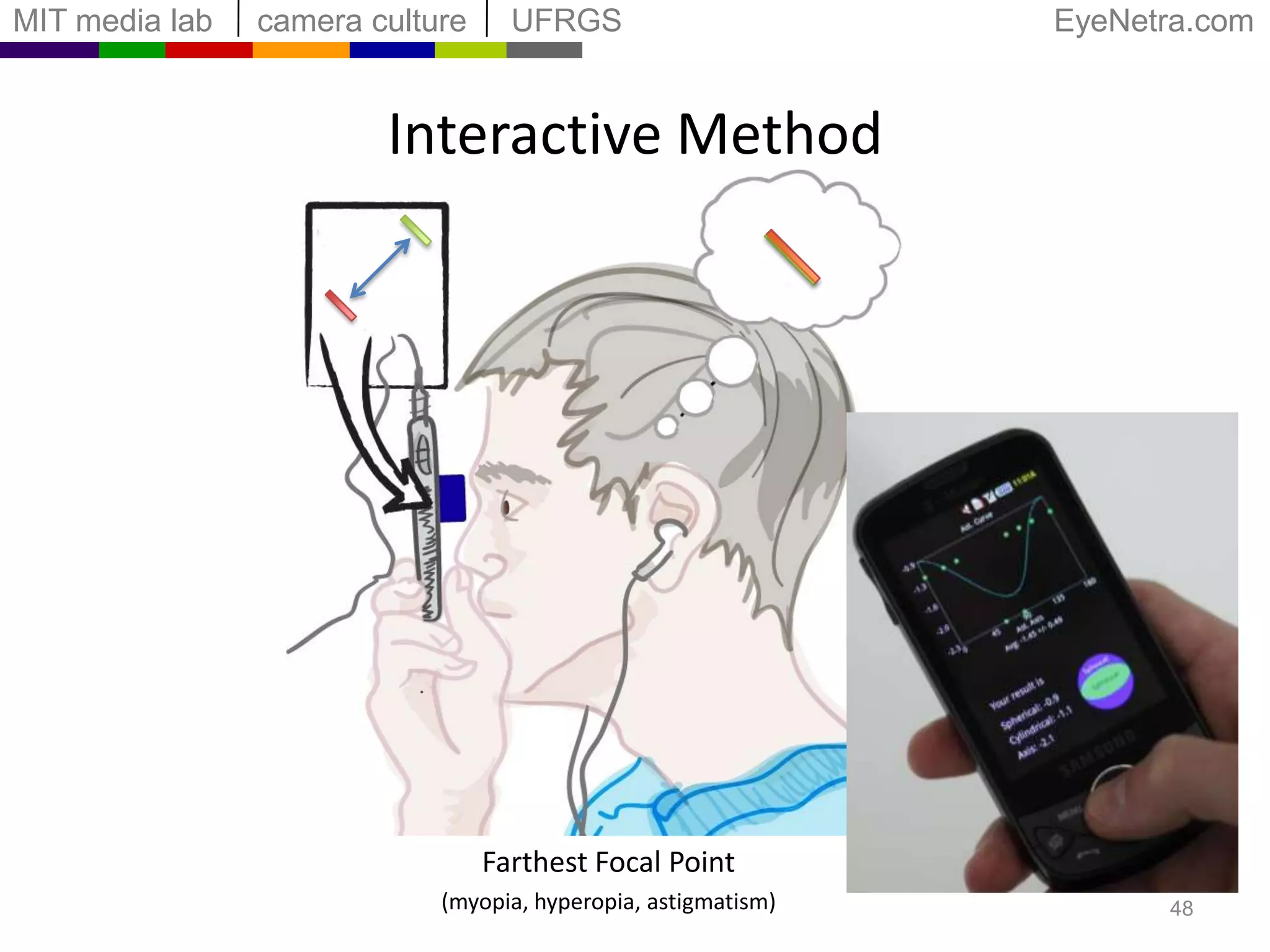
Interactive MethodFarthest Focal Point(myopia, hyperopia, astigmatism)48
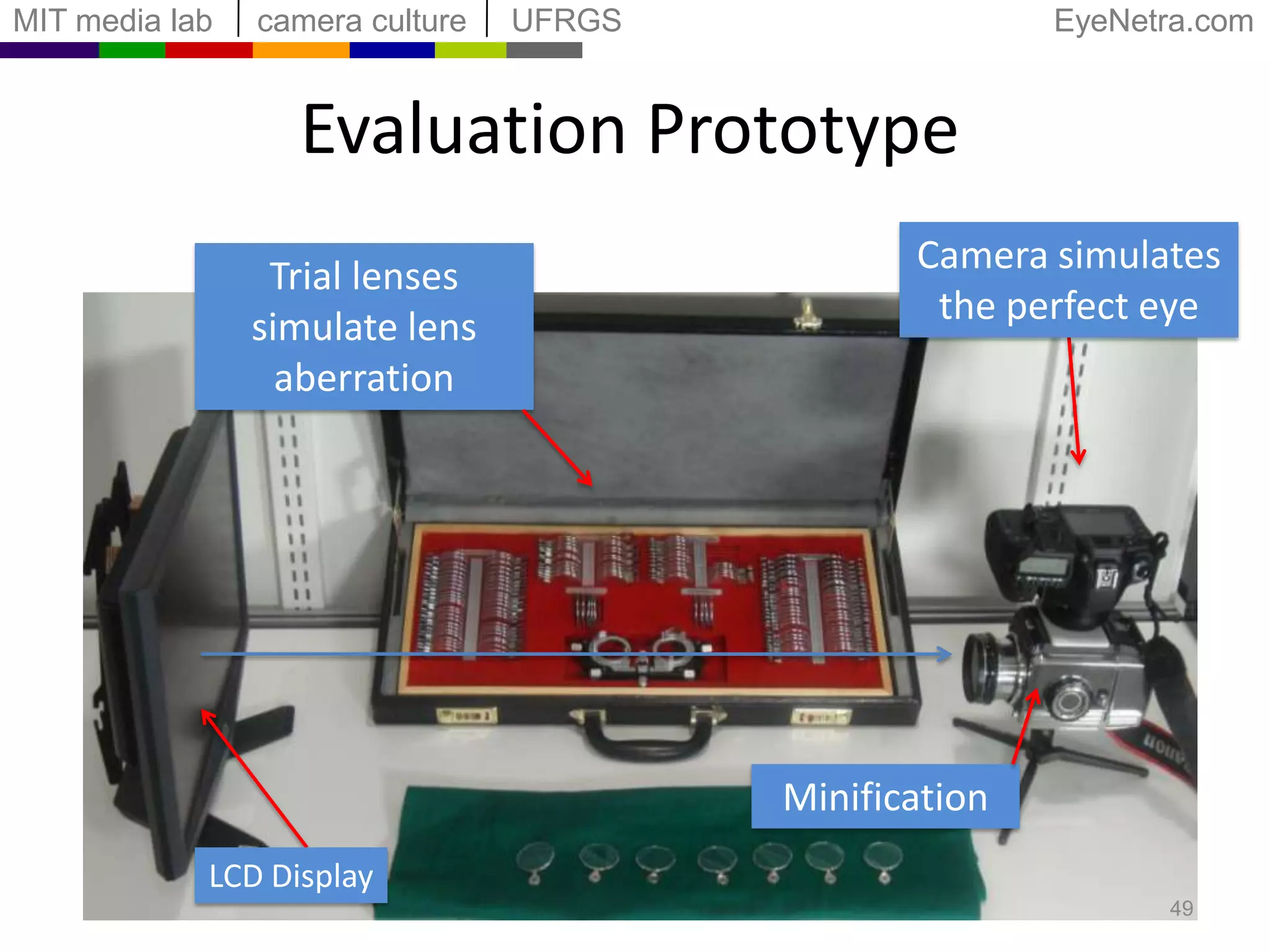
Evaluation PrototypeCamera simulatesthe perfect eyeTrial lenses simulate lens aberrationMinificationLCD Display49
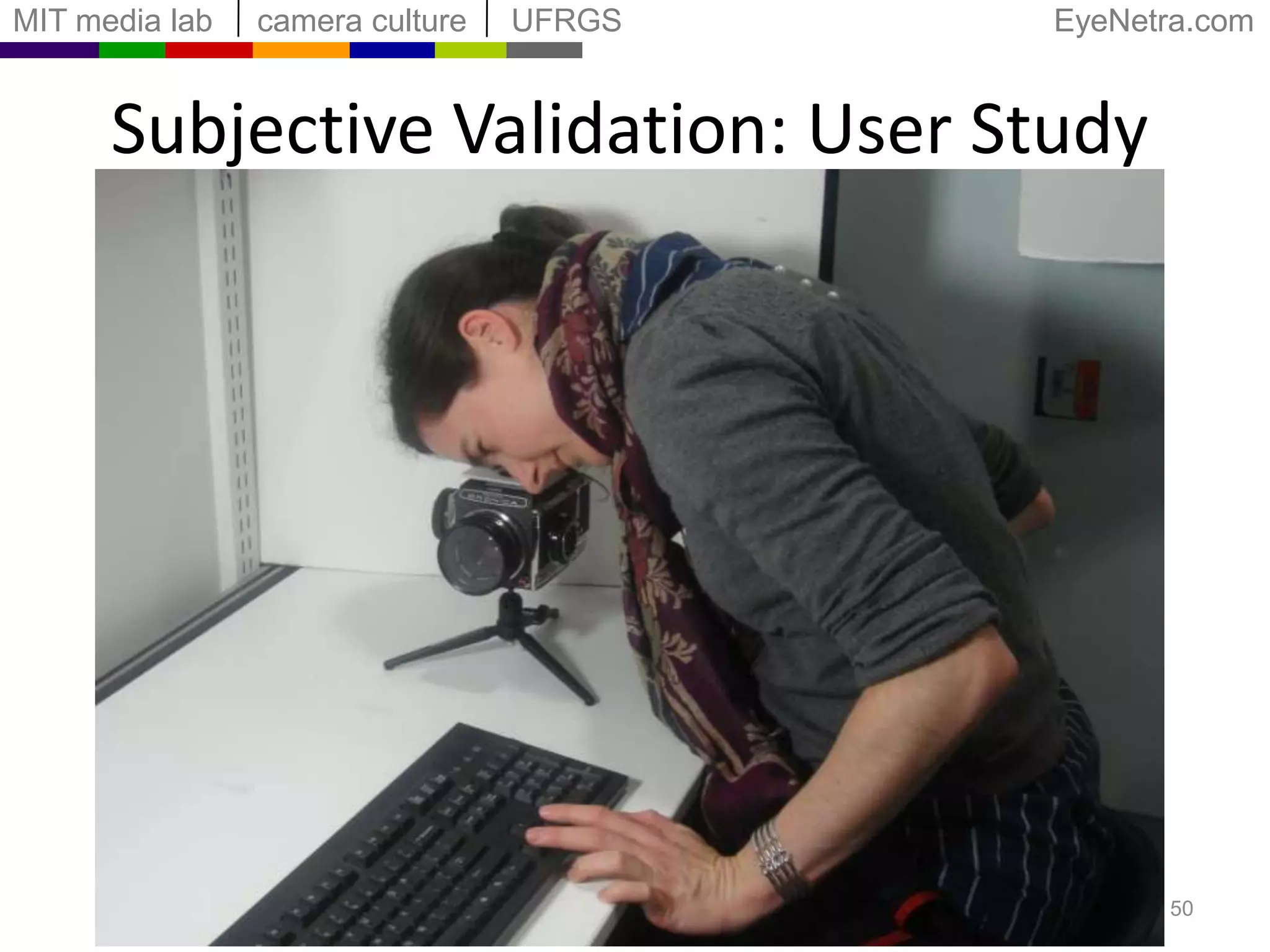
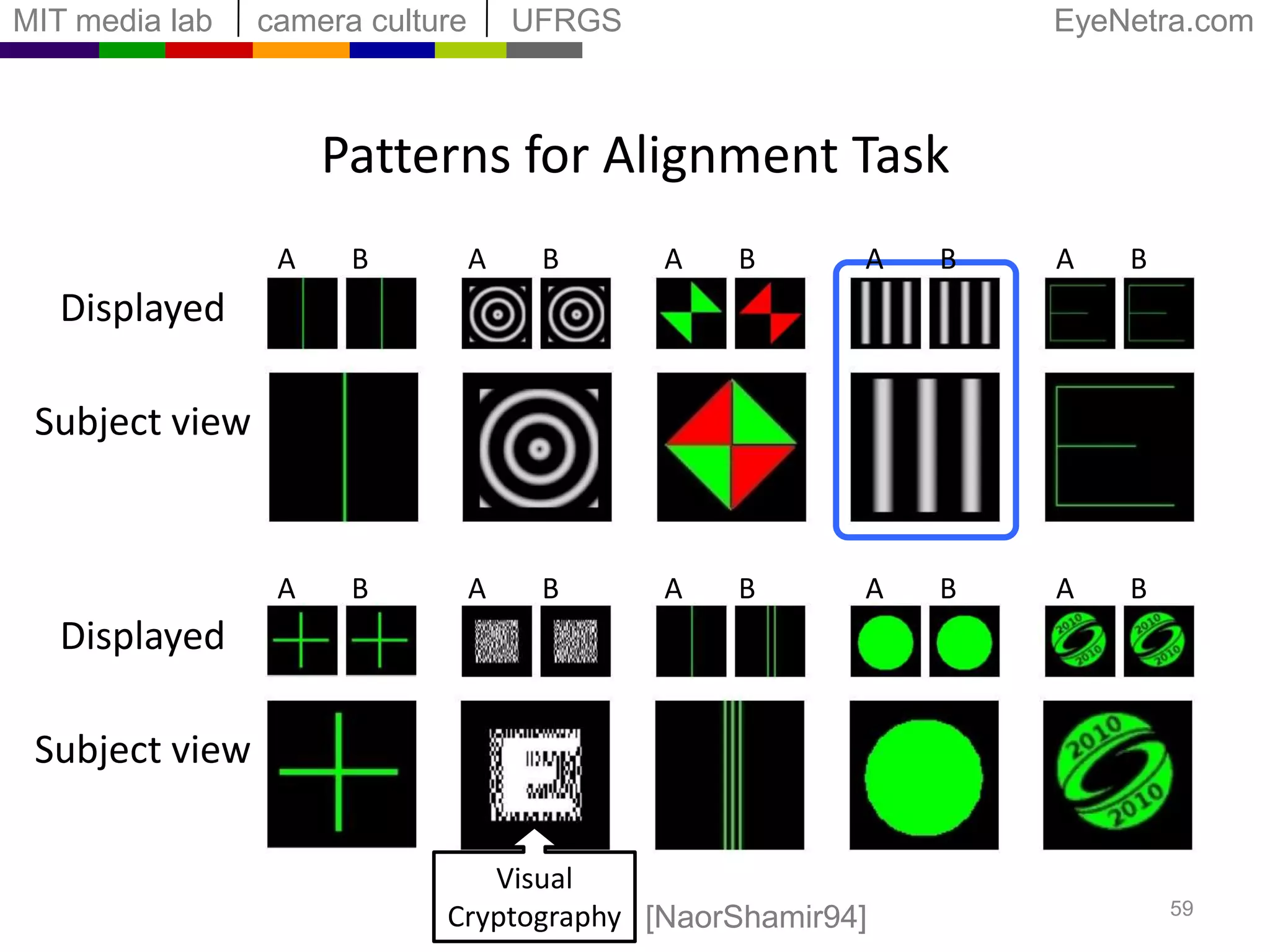
Subjective Validation: User Study50
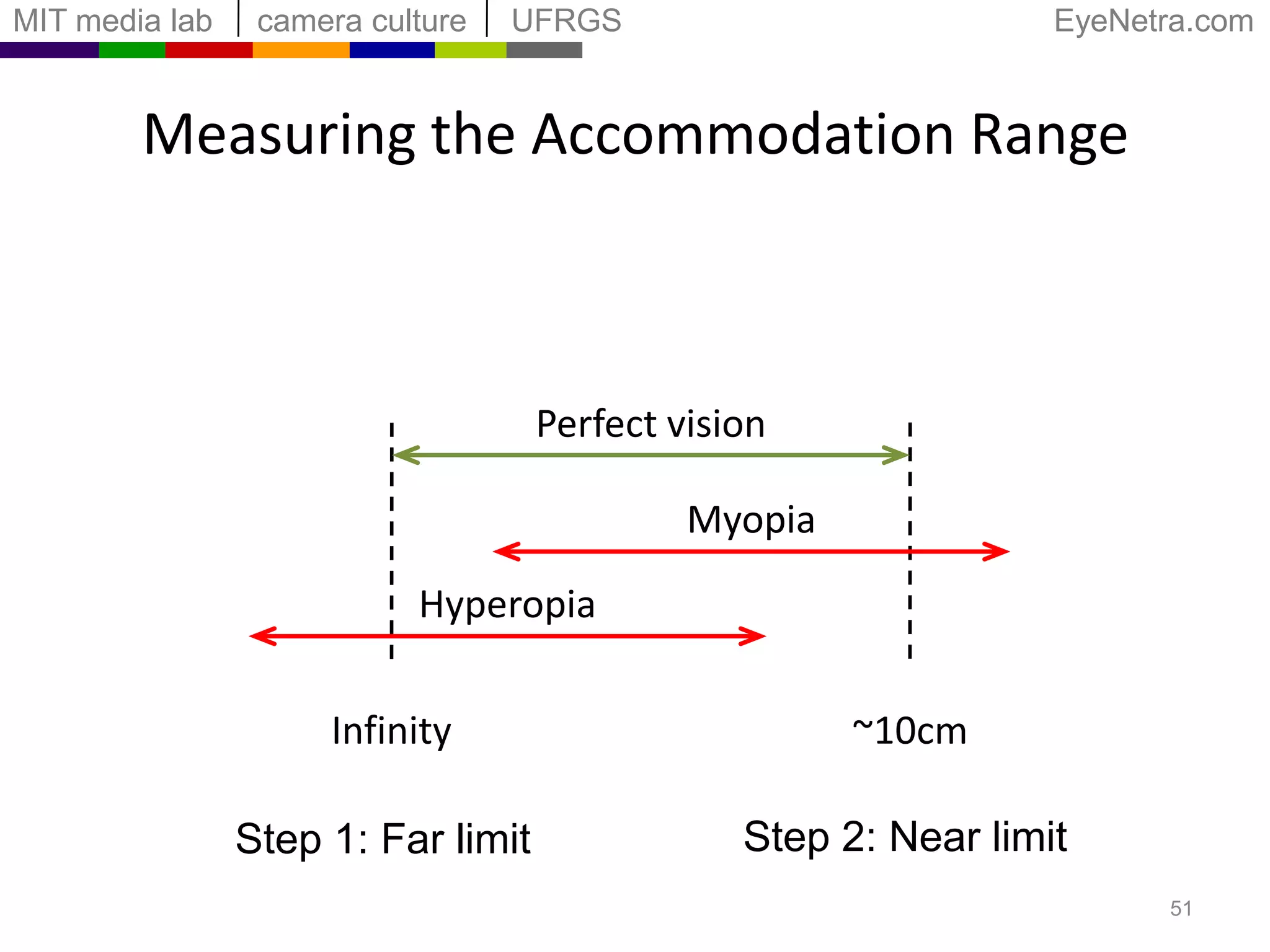
Measuring the Accommodation Range51MyopiaPerfect visionHyperopia~10cmInfinityStep 2: Near limitStep 1: Far limit
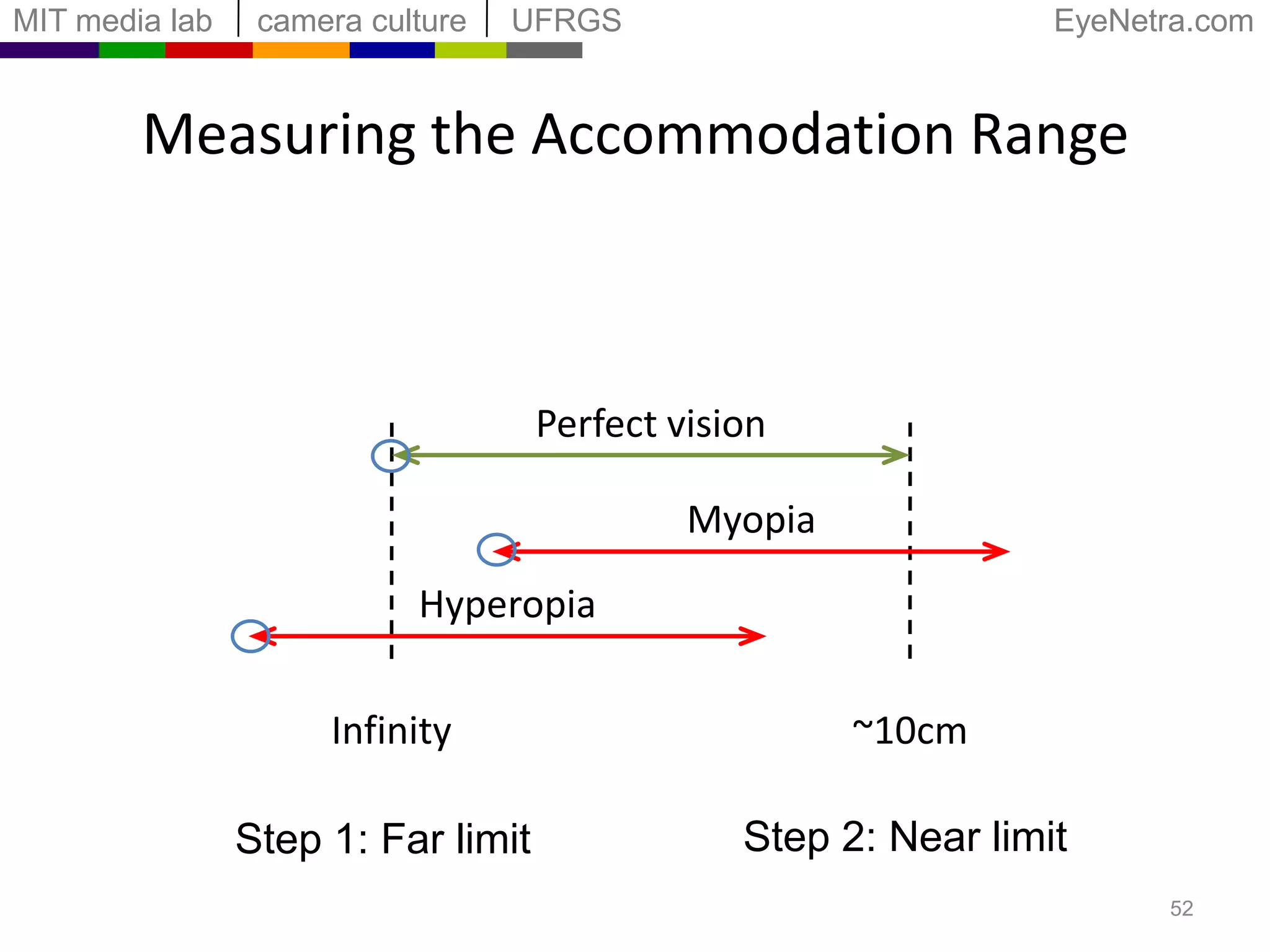
Measuring the Accommodation Range52MyopiaPerfect visionHyperopia~10cmInfinityStep 2: Near limitStep 1: Far limit
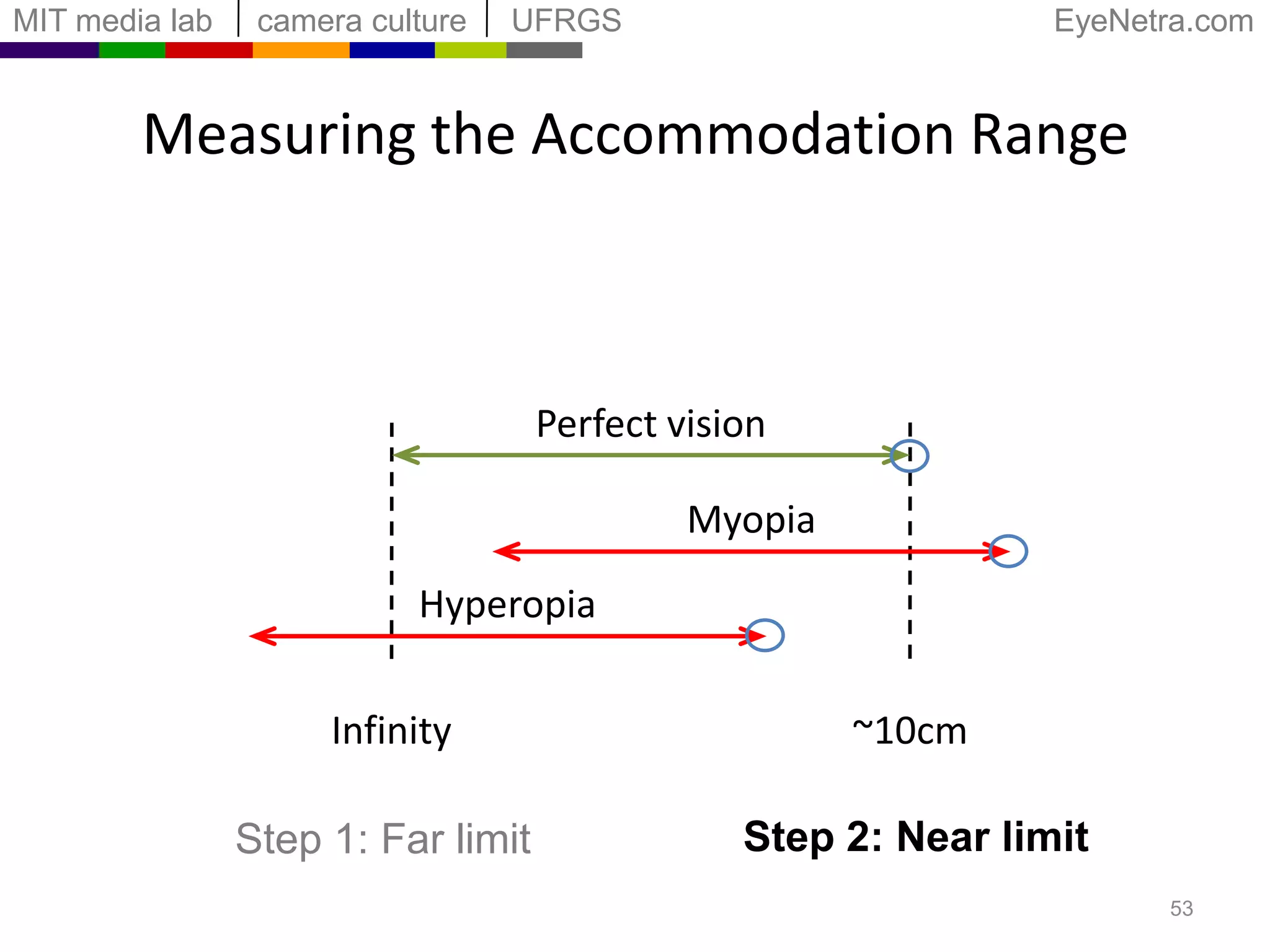
Measuring the Accommodation Range53MyopiaPerfect visionHyperopia~10cmInfinityStep 2: Near limitStep 1: Far limit
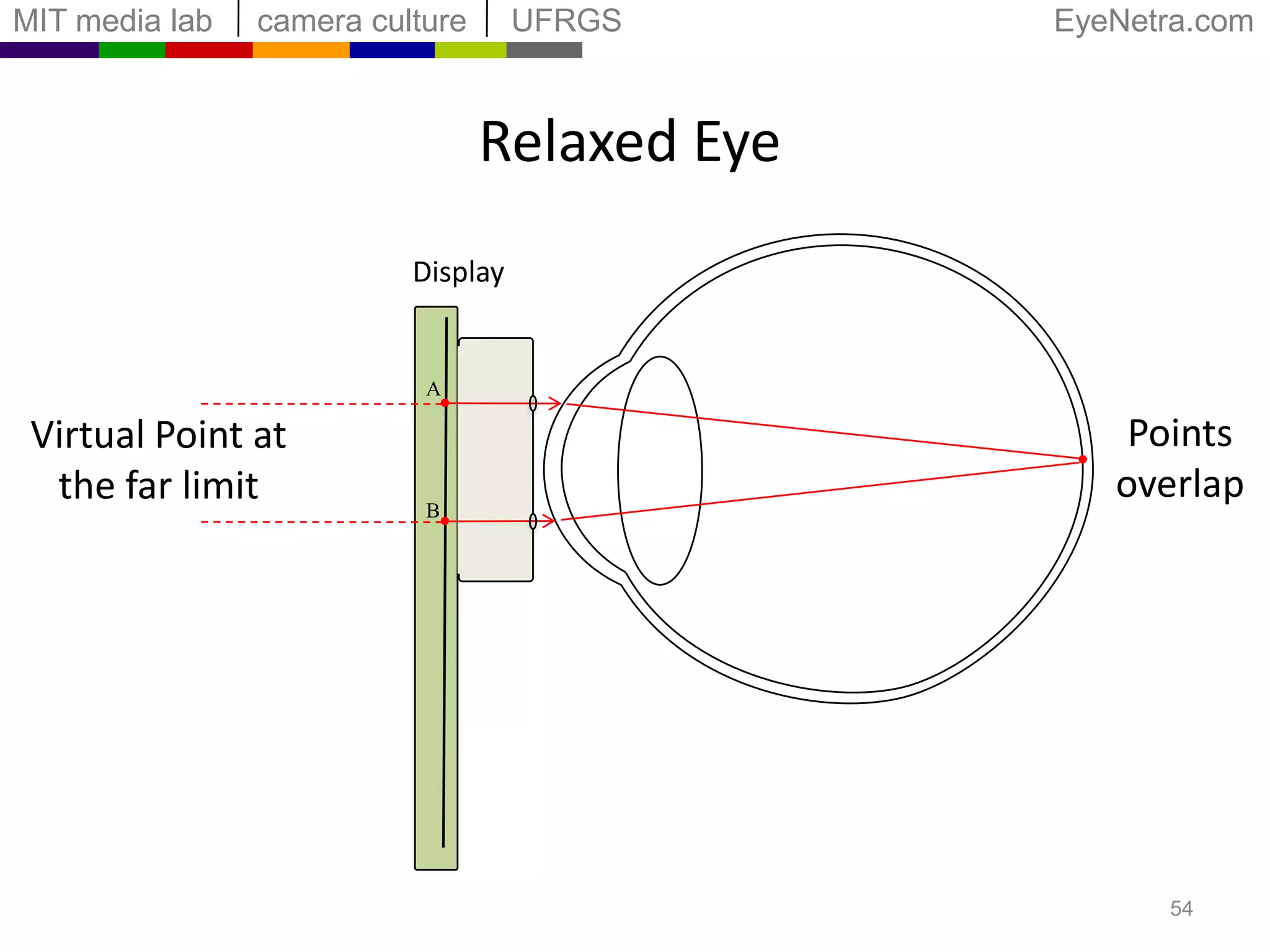
Relaxed Eye DisplayAPoints overlapVirtual Point at the far limitB54
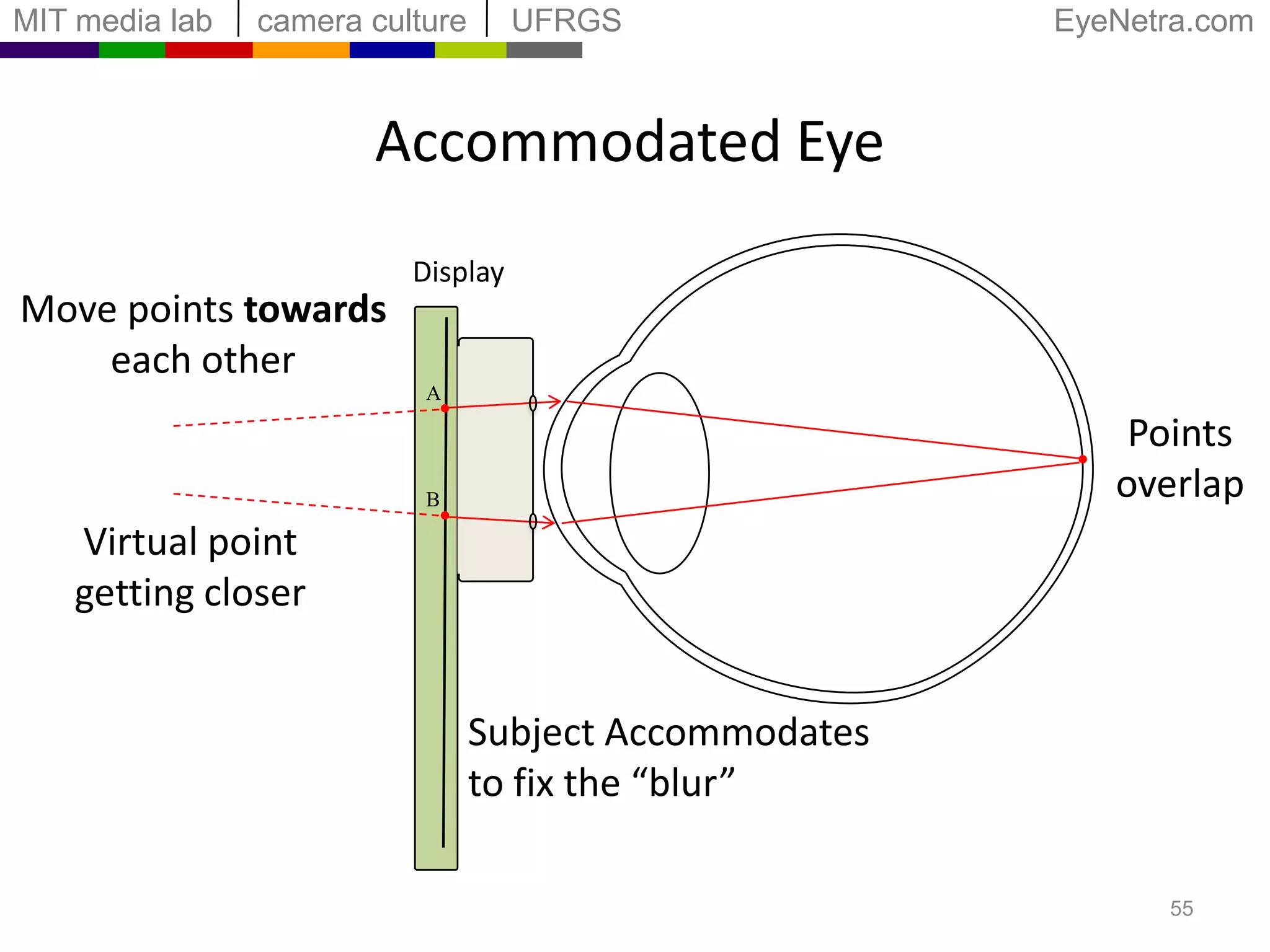
Accommodated Eye DisplayMove points towards each otherAPoints overlapB55Virtual pointgetting closerSubject Accommodates to fix the “blur”
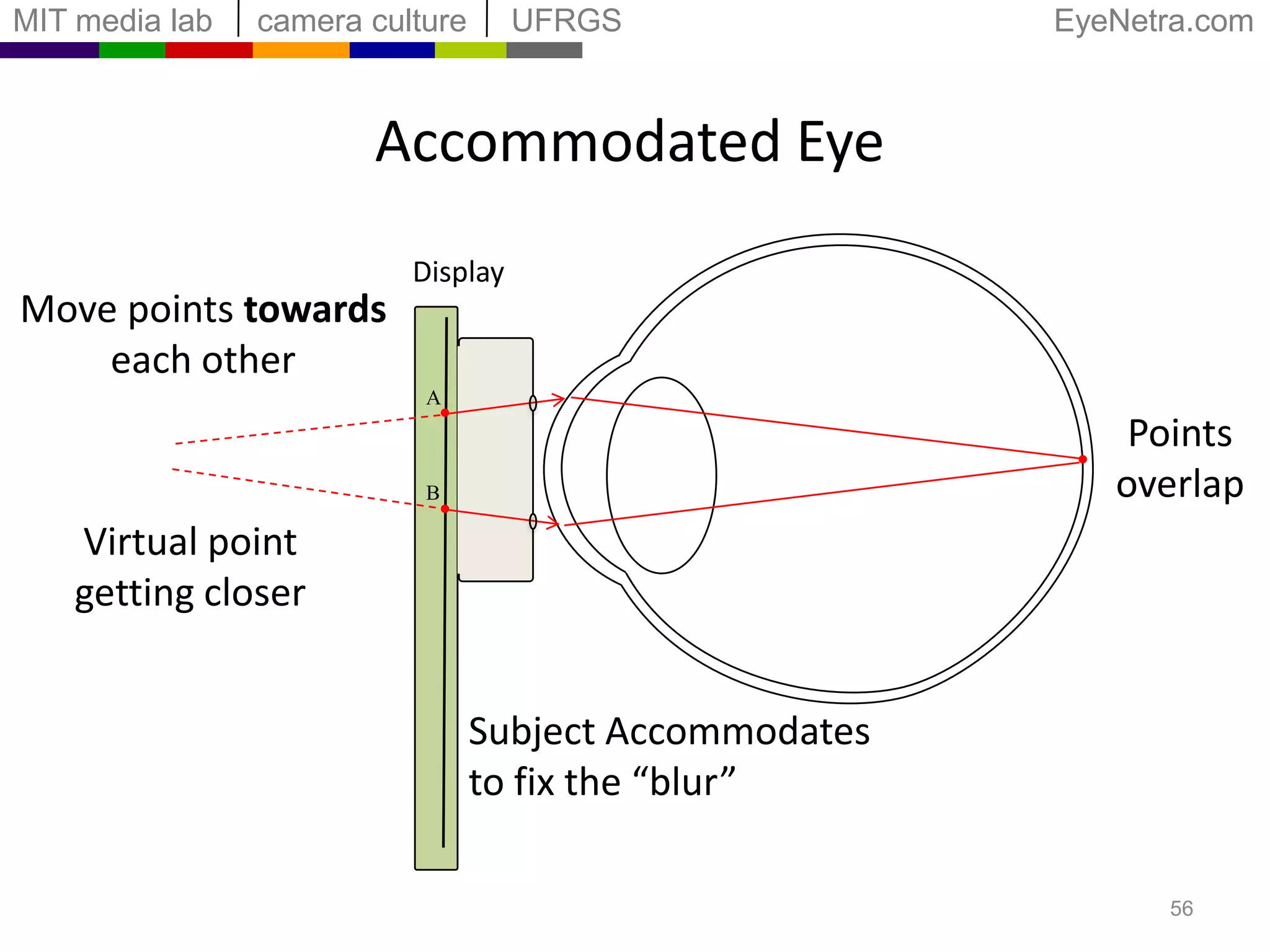
Accommodated Eye DisplayMove points towards each otherAPoints overlapB56Virtual pointgetting closerSubject Accommodates to fix the “blur”
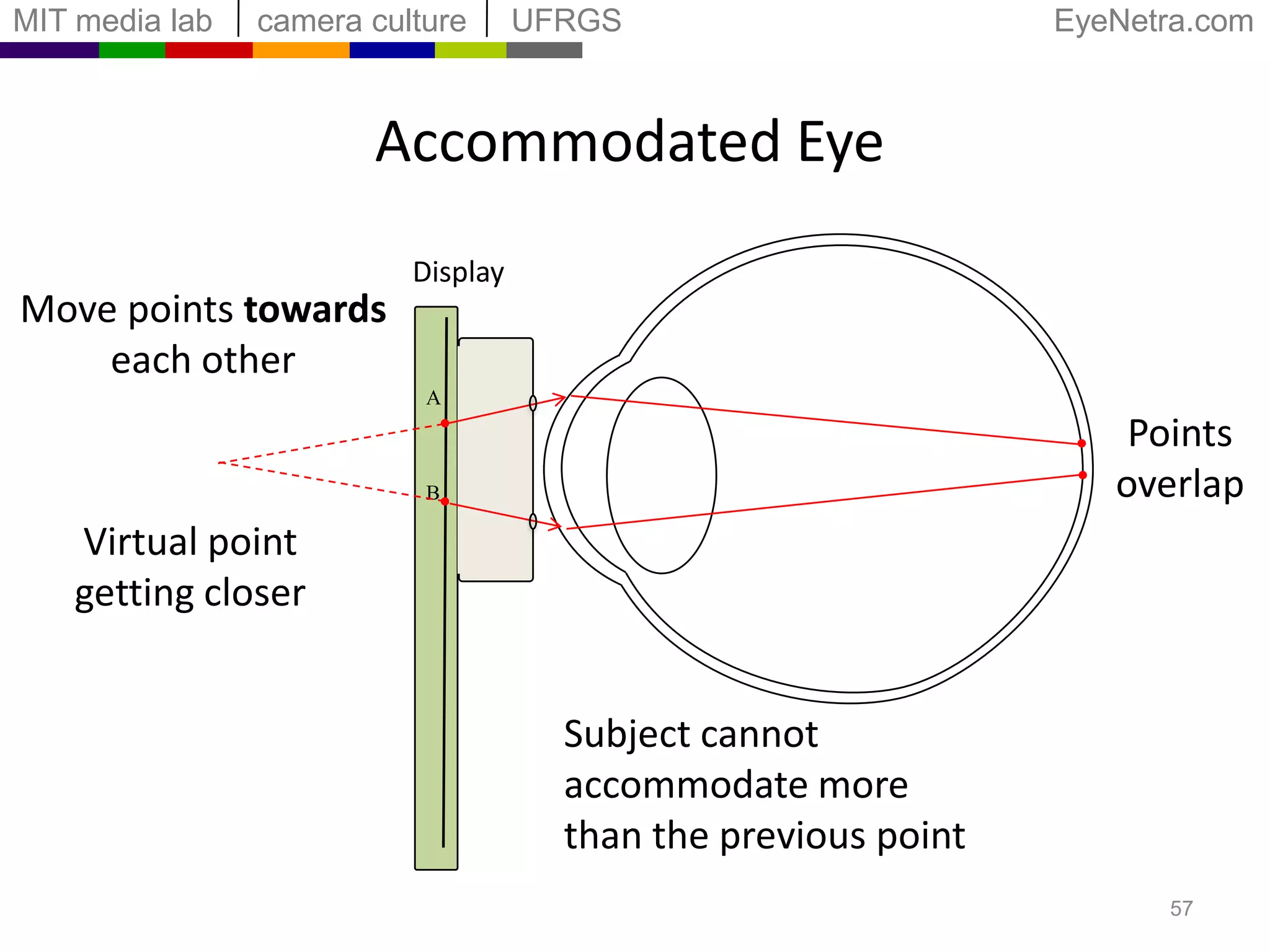
Accommodated Eye DisplayMove points towards each otherAPoints overlapB57Virtual pointgetting closerSubject cannot accommodate more than the previous point

NETRA on SIGGRAPH 2010

Editor's Notes

  • #2 In this paper, we show a self-optometry solution. You look at a cell phone display thru a clip-on eye piece, interactively align a few patterns, hit calculate and get data for your eye prescription.
  • #3 We call our tool NETRA: near eye tool for refractive assessmentsuch as nearsightedness/far/astigmatismBasic idea is to create a unique interactive lightfield display near the eye and is possible due to the highresolution of modern LCDs.
  • #4 2 billion people have refractive errorsAnd half a billion in developing countries worldwide have uncorrected vision that affects their daily livelyhood. They don’t have access to an optometrist or it simply too expensive. While making and distributing of lenses has become quite easy now, surprisingly there is still no easy solution for measuring eyesight.Can we use a fraction of the 4.5B cellphone displays to address this problem?
  • #5 In Computational photography, we try to understand howcameras work, overcome their limitations and extend the abilities of these cameras. But we all carry atleast 3 cameras with us. Yes, your cellphone camera and the two eyes. Can we transition ideas from computational photography that deal with focus blur, motion blur and so on into optometry and opthalmalogy?
  • #6 Reading charts appear to be an easy solution, this method has too many problems. Sharpness of legible text is very subjective. The brightness of the chart has to be very carefully chosen otherwise the pupil size will change, increasing depth of field, and allowing user to recognize even lower rows.The trial lenses + the lens frame the doctor will use also cost over $150% Reading chart tests involve using a frame or a phoropter. The doctor will swing a sequence of lenses in front of your eye and ask for which lens allows you to see the lower rows on the reading chart.
  • #7 For better precision, there are many kinds of solutions, some really clever. The beauty of netra is that it avoids moving parts or shining lasers, and all intelligence is in the software.
  • #8 The most accurate method is based on a so called SH WS. It involves shining a laser at the back of the retina and observing the wavefront using a sophisticated sensor.We ask user to generate a spot diagram. But navigating in a high dimensional space ischallenging so we come up with a strikingly simple approach to let the user interactively create the spotdiagram.We are first to make connection between Shack Hartmann and Lightfields (and it goes well with recentwork in computational photography about ALF and Zhang/Levoy). Connection to Adaptive optics/Astronomy. The way that this device works is that, it shines a lasers in the eye, the laser is reflected in the retina and comes out of the eye being distorted by the cornea. These light rays reaches an array of lenses that focus them to dots in a sensor. The device measures how much this dots deviate from the ideal case. Since it uses lasers, the device is expensive and requires trained professionals
  • #9 For a normal eye, the light coming out of the eye forms a parallel wavefront. The sensor has a lenslet array and we get a spot diagram of uniform dots.This lenslet should remind you of a lightfield camera, and in fact Levoy and others showed last year that there is a close relationship between the two.In addition, Zhang and Levoy, plus our grp has shown the relationship between wavefront sensing and lightfield sensing.
  • #10 When the eye has a distortion, the spot diagram is not uniform.And the displacement of the spots from the center indicates the local slope of the wavefront. From the slope one can integrate and recover the wave shape.
  • #11 NETRA uses an exact inverse of this sensor. We get rid of the laser and we instead show the same spot diagram in a cellphone display. For normal eye, it will appear as a dot to the user.And then we replace the sensor for a light field display. If the user sees a single red dot, he does not need glasses, but if he sees more than one, he interacts with this display.
  • #12 For eye with distortion, the user will interactively displace the 25 points so that he will see a single spot. Of course changing 25 spot locations is cumbersome, but we realize that there are only 3 parameters for eye-prescription and we help the user navigate thru this space efficiently.But if you think about these theory, you will realize that we have the dual of the shack-hartmann. First we though out the laser.
  • #13 Before we go on. Here is a 2 minute primer on optometry.So, in a perfect vision system, the light coming from a point at infinity will converge to a single point at the retina. A subject with perfect vision see clearly from infinity to up to 10cm.
  • #14 Myopes cannot see far. Therefore, all the rays coming from a point at infinity, converges before the retina. The Accommodation range for those people is shifted to close, so they can closer than regular individuals.
  • #16 The correction for myopia includes a divergent lens, which brings the focal point back to the retina by shifting the Accommodation range.
  • #17 Hyperopes cannot see close. All the rays coming from a point at infinity, converges behind the retina.
  • #18 The Accommodation range for those people is shifted to the far field, so they can actually see ‘infinity and beyond’, much like the buzz lightyear.
  • #19 The correction for myopia includes a convergent lens, which shifts the Accommodation range back to the regular indivudial.
  • #20 We need to measure the difference between the subject’s farthest focal point wrt infinity.
  • #21 And this is measured in diopters which is 1 divided by this distance.
  • #22 So, lets start with an eye with myopia. Remember, they cannot see far, so a red point at infinity for them will look like a red blur.
  • #23 Using Shceiner’s principle, if we put two pinholes in the field, this will instead create two distinct dots.
  • #24 Instead of a distant point source, we put an LCD display behind the pinholes. If we draw two spots exactly under these pin-holes, we create a virtual point at infinity.
  • #25 So, as we move the two red circles toward each other, the virtual point gets closer to the subject and he sees the two red dots getting closer.
  • #26 When this two red circles overlaps for the subject, we can compute d based on the spot displacements
  • #27 Which is the distance between the eye and this virtual point.
  • #28 Turns out that the inverse of D is the refractive power required for this person to see clearly objects at infinity. In other words, the lens that will shift the accommodation range of this subject back to the regular one.
  • #29 In case of a perfect eye using the system, since the subject can see far, he will see the two points overlapping in his retina, meaning that he does not need glasses.
  • #30 Hyperopes focal point is behind the retina.
  • #31 When they move these spots away from each other, we are moving the virtual point beyond infinityAnd buzz lightyear will entually see they overlap, and when this happens, we can compute the…
  • #32 convergent lens required to shift their accommodation range to the normal stage.
  • #33 The version that I showed to you uses pinholes to encode the apperture.
  • #34 However, if we change these pinholes for lenses, we can increase the light and also the number of testing points in the corneal surface, meaning that we can actually create a map of one’s refractive error. As you can see the pixel pitch directly affects the precision of creating virtual depth as well as refraction estimation.
  • #35 And number of clicks required for alignment indicates the refractive error
  • #37 In practice we display lines on the screen and the subject overlaps these lines by pressing the buttons of the cell phone or in the computer.
  • #38 Two main benefitsNo moving partsBlur into a more objective alignment problemUnfortunately, the lightfield and virtual point analogy does not extend to astigmatism and we can also compute ‘focal range’ rather than just relaxed state. Vitor will cover this.”ThanksRamesh, There is a third condition called astigmatism
  • #39 which is anangle-dependent refractive error. An astigmatic subject has two main focal lengths in perpendicular meridians. One …
  • #40 Stronger and one weaker
  • #41 Think of a cornea with the shape of an american football creating a cylindrical aberration with unknown focal length and axis.
  • #42 The required correction is now a function of measured angle. In order to measure the farthest point for these guys, we need to evaluate Cylindrical component, the Spherical component, and the angle theta on the equation. However, the interpolation of refractive powers between C and S leads to a situation where the pattern drawn on the screen matters.
  • #43 As you can see in this video, the astigmatic lenses create a deviation on the path of the pattern, and they may never overlap, turning the alignment task into a 2D search for some angles.
  • #44 However, if we drawn lines perpendicular to the measured angle, the alignment task is again an 1D search. The deviation still exists, but the pattern makes the task easier.
  • #45 So, we do the alignment task for a few meridians
  • #46 By showing oriented lines on the display.
  • #48 In the end, we best fit the sinusoidal curve over the four measured values to estimate the astigmatic parameters.
  • #49 In the end, we best fit the sinusoidal curve over the four measured values to estimate the astigmatic parameters.
  • #50 Using a minification system, we performed user study with a high resolution display. Using a a camera to simulate perfect eye and a trial set of lenses to simulate lens aberration, the average spherical error was under 0.09 diopter and astigmatism axis error of 8 degrees.
  • #51 In subjective human studies, the difference from known prescription was under 0.5 diopters. But note that the current prescription may not match the actual refractive error.
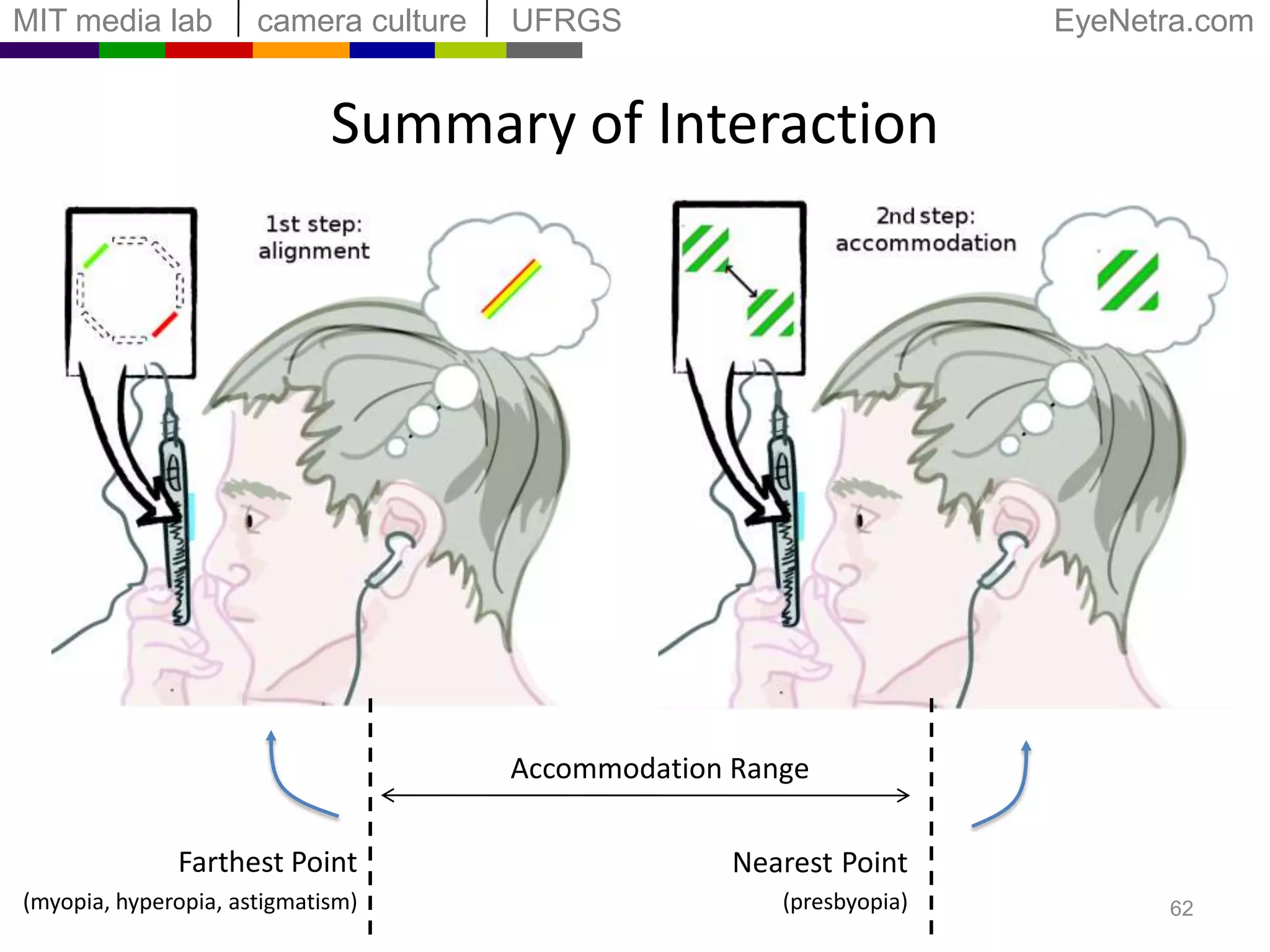
  • #52 Ours is the only system where one can estimate not only the farthest point
  • #53 one can focus but also
  • #54 the nearest point without any mechanically moving parts. So, in order to measure the closest reading point
  • #55 We draw a pattern on the screen that induces accommodation. In this way, when we move A and B closer on the screen,
  • #56 the user will try to focus on a closer object. We can move this virtual point all the way to the nearest discernable point.
  • #58 When the user is not able to focus anymore, the visual system give up and the user start seeing more than one pattern.
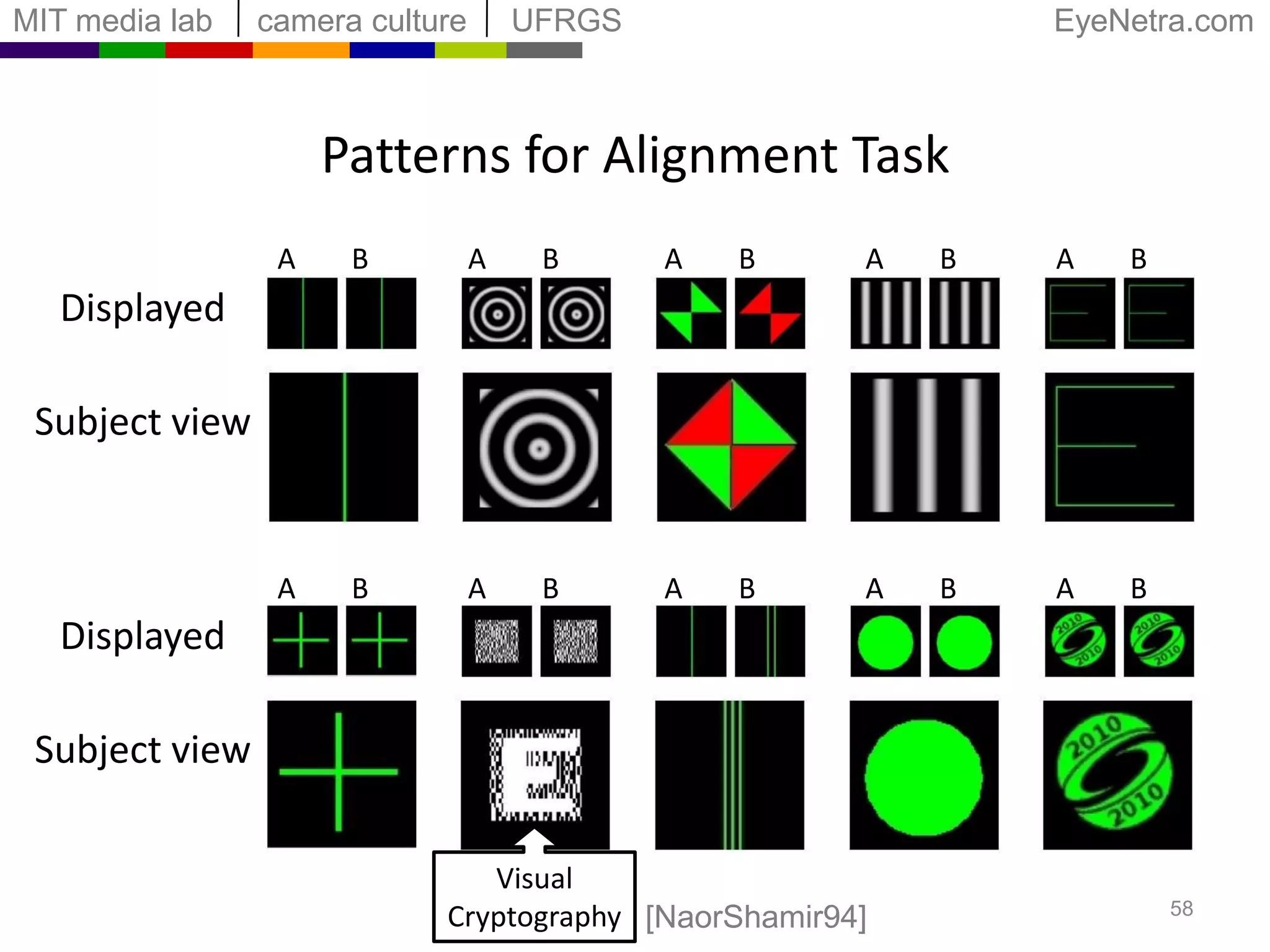
  • #59 As I sad before, this is possible because we can draw whatever we want in the display. We tested many patterns, static and dynamic, including visual cryptography.
  • #60 Turns out that the best pattern to induce accommodation is the sinosoidal curves aligned perpendicular to the measurement angle.
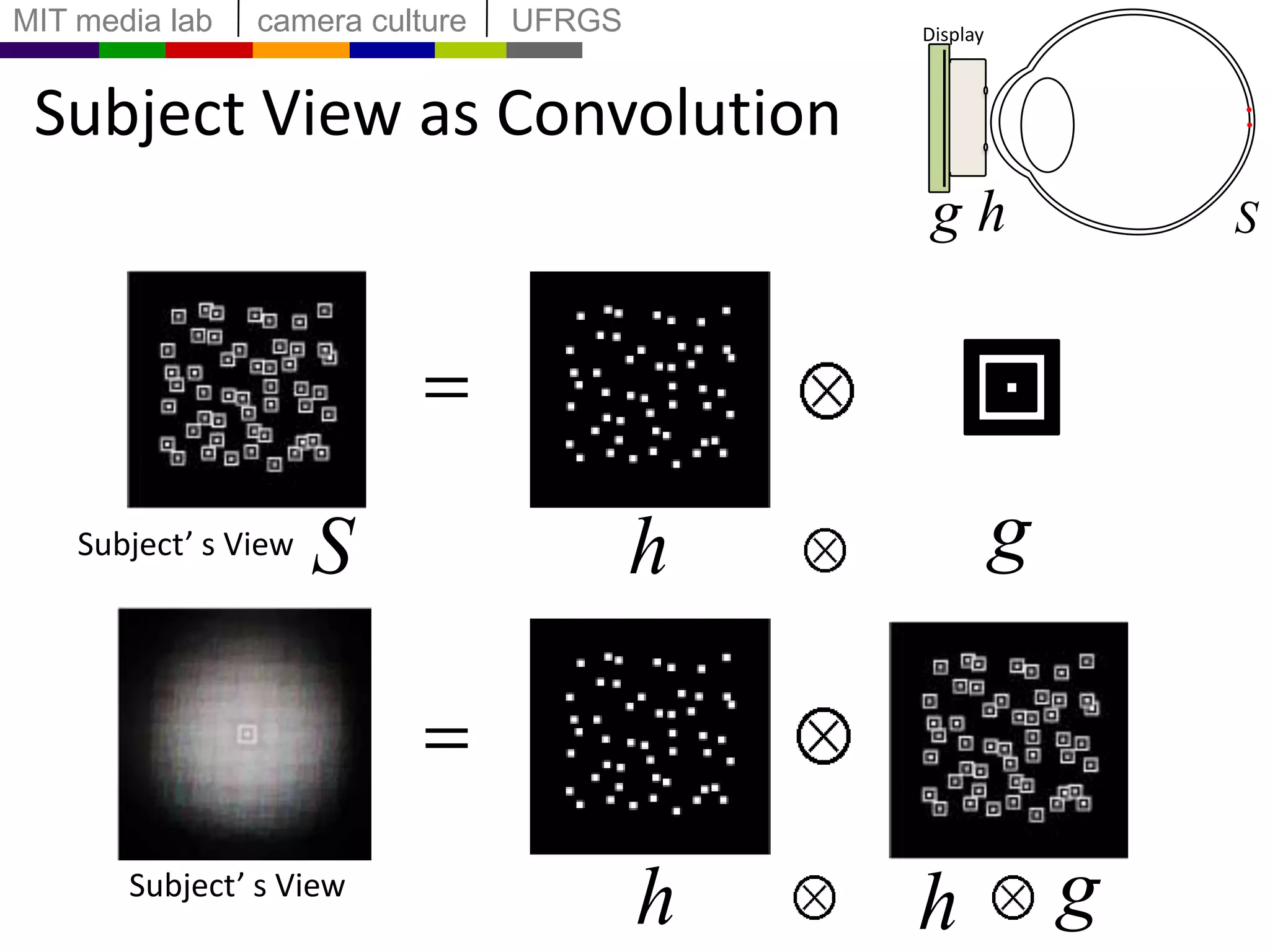
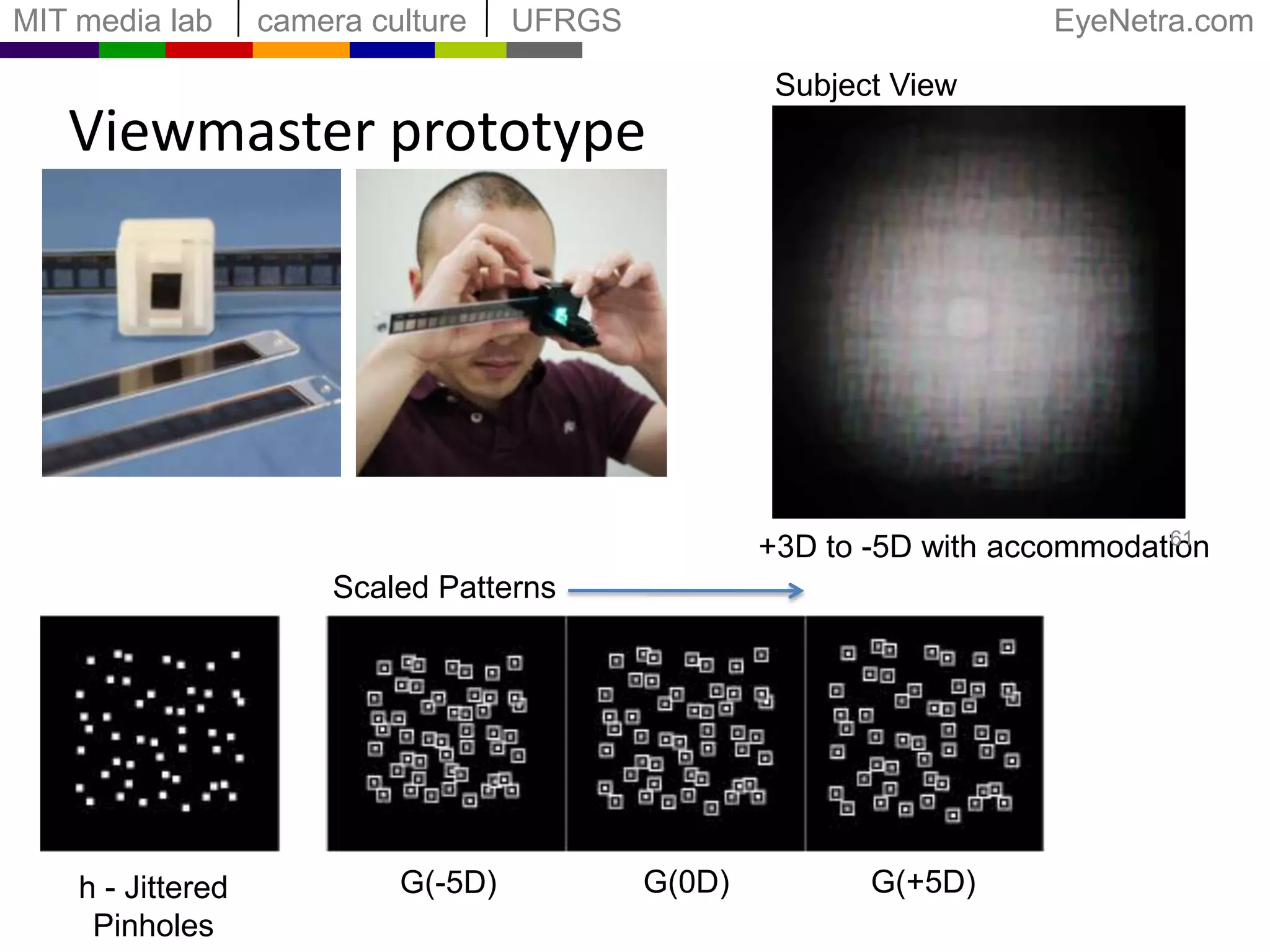
  • #61 We have complete freedom for pattern G on display and the filter pattern h, which has been pin hole grid so far. But observe that subjects view is just a convolution of the pattern g and the filter h. So here is a very interesting effect. If we show this convoluted pattern with same filter, we get double convolution. If h is a broadband random dot pattern, the double convolution is a delta function, which means user will again see the pattern g.
  • #62 We exploited this trick to build a viewmaster system. In this case, instead of moving lines closer we scale the pattern. The amount of scale give us the refractive power needed.
  • #63 As a summary, our method has two steps. First measures the farthest point in focus in many angles using lines and the second step measures the nearest point using sinusoidals oriented on the angle of astigmatism.
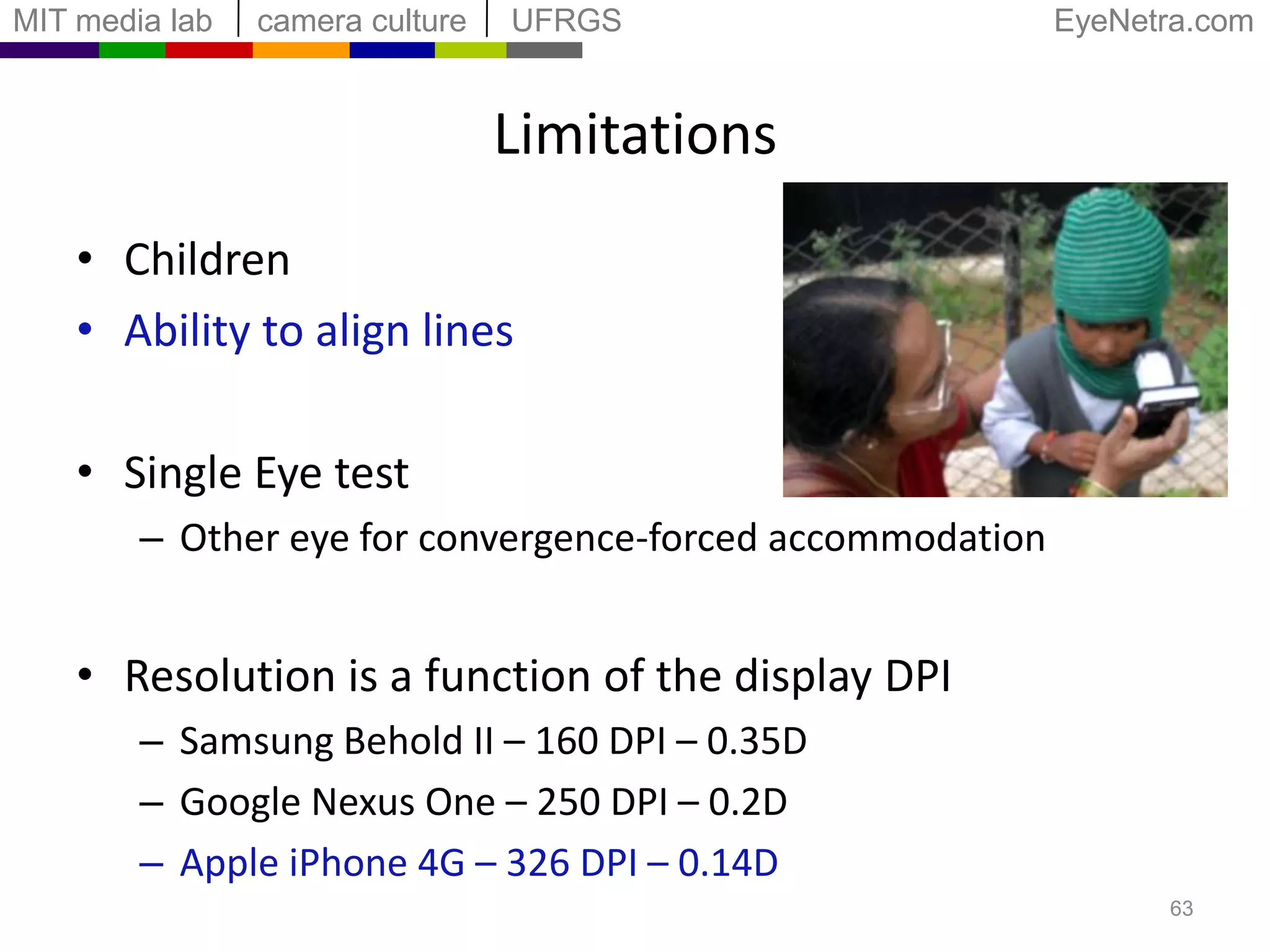
  • #64 Since we are relying on the user interaction, the subject has to be aware of the alignment tasks. So, very young Children may not be able to run the test. Instead of just one eye, one may use both eyes to exploit convergence. And of course, the resolution of NETRA itself is a function of the resolution of the display. With a 326 dpi display, resolution is 0.14 diopters and presciption glasses come in increments of 0.25 diopters. So our system is already sufficiently accurate.
  • #65 For future work, we are partnering with many institutions that would like to use our device as an optometry tool and as a new tool for doing research. For instance, we think we have a new opportunity to monitor people eyesight over time.Field trials in regions with cultural and language barriers
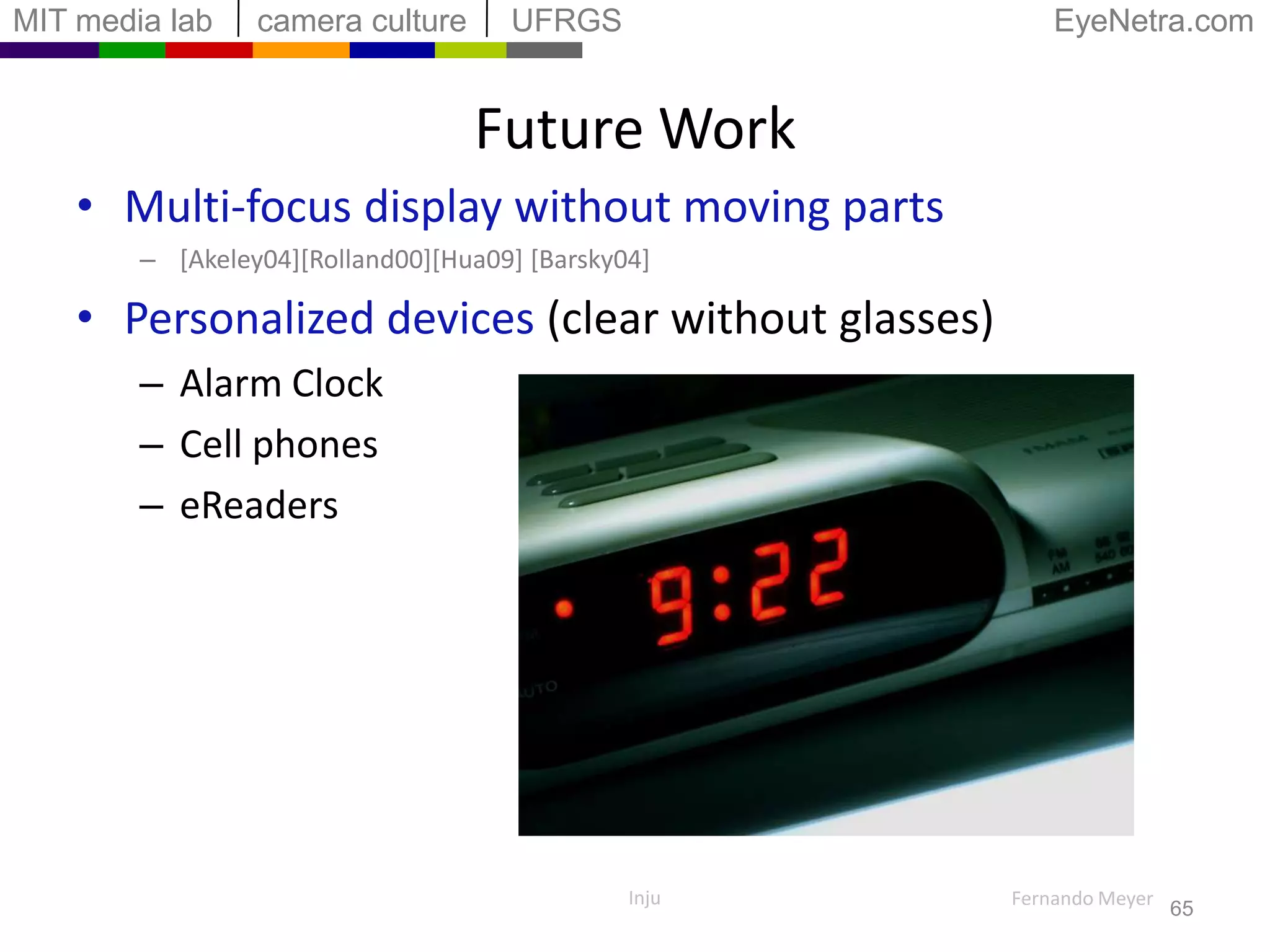
  • #66 Our work also create a new solution for a multi-focus displays without mechanically moving parts or large depths. Maybe we can even create alrm clock with optical correction built in. So you can read the clock without fiddling for eyeglasses.
  • #67 Before I conclude, We would like to thank our collaborators and sponsors.(count to 5)
  • #68 As a summary, we introduce the inverse of the Shack Hartmann system using a light field display and user interaction. We convert the blur problem into more objective alignment problem to estimate focal parameters. Our idea can be thought as thermometer for the eye. It is not a replacement for optometrist NETRA provides measurement, not prescriptions. At under $2, we have the cheapest accurateeye test ever. Given the 4.5 billion portable phones out there, we think it is an ideal solution in developing countries.
  • #69 So, thanks everyone.
  • #73 In this paper, we introduce the dual of the Shack Hartmann system using a light field display and user interaction. We also introduce an interactive technique to create objects at desired depths and an interface to measure refractive parameters of the eye. We validated this two main contributions by measuring lenses and comparing with lens prescriptions.
  • #75 Not just user interaction , but far greater impact on people’s lives!
  • #85 Image and Range
  • #86 Include Myopia Range
  • #87 Include Myopia Range
  • #88 Show without accommodation and accomodate
  • #89 Show without accommodation and accomodate
  • #90 Show without accommodation and accomodate
  • #97 ??
  • #98 ??
  • #100 Image and Range
  • #102 Include Myopia Range
  • #104 Include Myopia Range
  • #105 Show without accommodation and accomodate
  • #107 Show without accommodation and accomodate
  • #115 Show without accommodation and accomodate
  • #116 Show without accommodation and accomodate
  • #117 … Which is anangle-dependent refractive erros. An astigmatic subject has two focal lengths in perpendicular meridians. One …
  • #118 Stronger and one weaker
  • #119 In this case, the red meridian is called Spherical, the Blue one is called cylindrical and the axis of the Red meridian indicates the angle of astigmatism. In order to measure the farthest point for these guys, we
  • #120 In practice we display lines on the screen and the subject overlaps these lines by pressing the buttons of the cell phone or in the computer.
  • #122 When the lines were overlapped, we compute the correction for myopia or hyperopia. However, there is a third disease called astigmatism.
  • #123 The average error was under 0.5 diopters for both axis of astigmatism and the axis had an average error of 6 degrees.
  • #124 For this case, the average error was 0.09 diopters for myopia and hyperopia and 0.23 for astigmatism. The axis of astigmatism had an error of 8.43 degress
  • #125 We validate this extension by measuring the closest sharp point in cameras, and comparing with physical measurements.
  • #126 The second round of validation included 6 humans. Both cases we could get pretty close to the actual closest sharp point.
  • #127 In order to evaluate this technique, an LCD display was putted 2 meters away of a minification system, which created images in 3320 DPI. Inside the minification system we had a lens array. A camera was used to simulate the perfect eye.
  • #128 There is a third condition called astigmatism which means an additional cylindrical aberration with unknown focal length and axis. The required correction now is dependent on angle and this leads to a situation where the pattern drawn on the screen matters.
  • #129 There is a third condition called astigmatism which means an additional cylindrical aberration with unknown focal length and axis. The required correction now is dependent on angle and this leads to a situation where the pattern drawn on the screen matters.
  • #130 There is a third condition called astigmatism which means an additional cylindrical aberration with unknown focal length and axis. The required correction now is dependent on angle and this leads to a situation where the pattern drawn on the screen matters.