Visual acuity
 It is the degree to which details and
contours of the object are perceived,
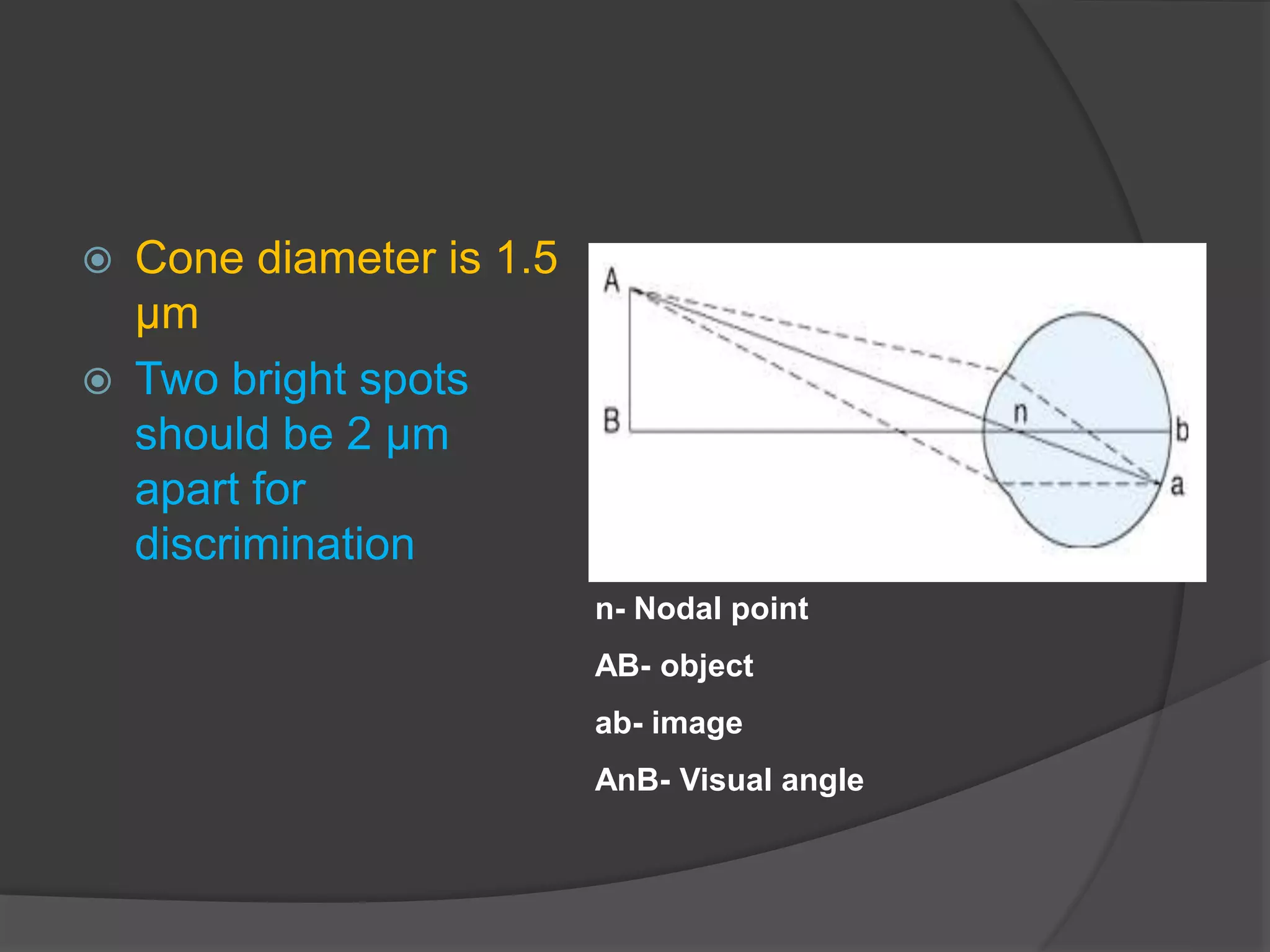
 it is expressed in term of visual angle
 Cone diameter is 1.5
Îźm
 Two bright spots
should be 2 Îźm
apart for
discrimination
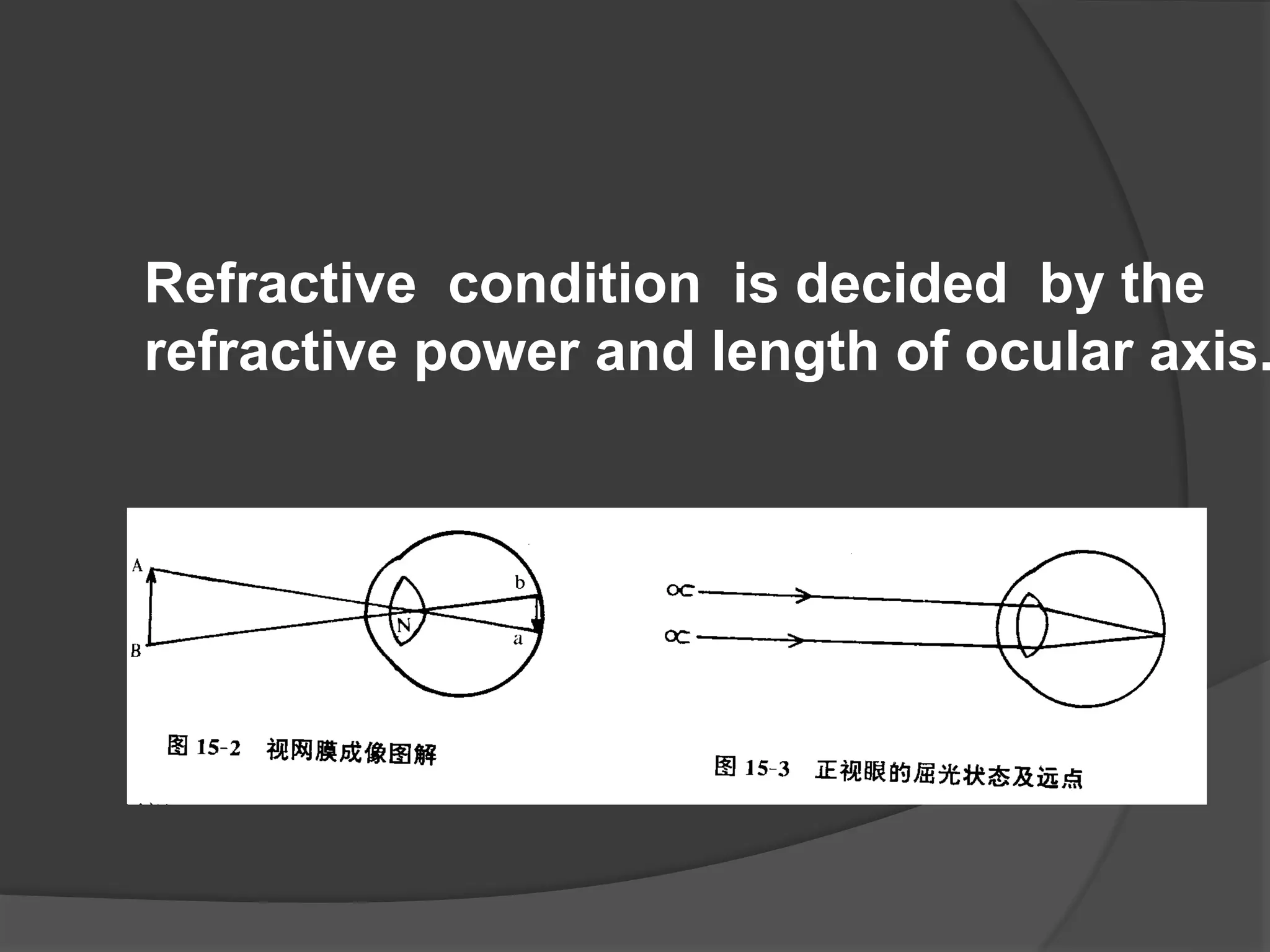
n- Nodal point
AB- object
ab- image
AnB- Visual angle
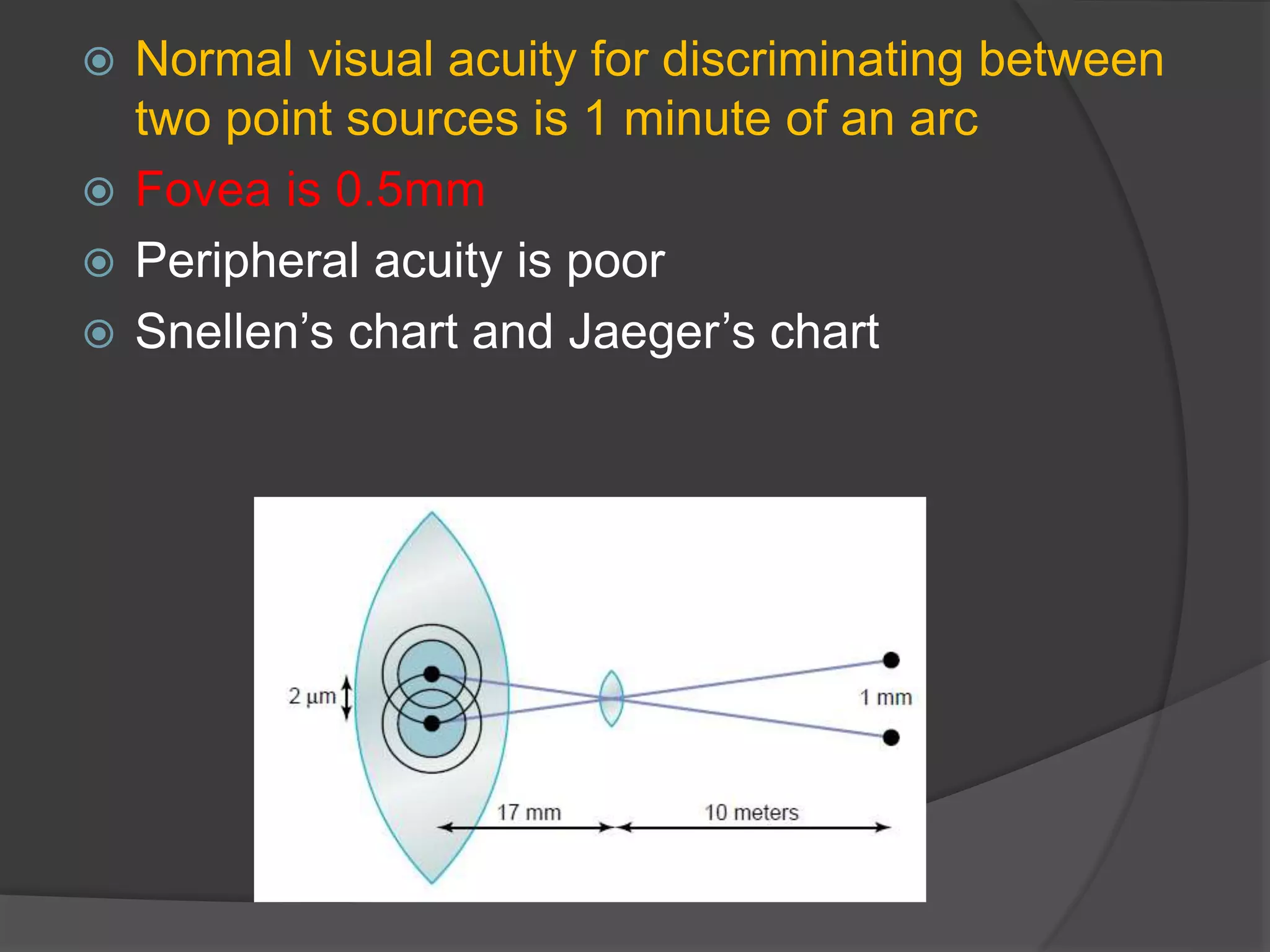
 Normal visual acuity for discriminating between
two point sources is 1 minute of an arc
 Fovea is 0.5mm
 Peripheral acuity is poor
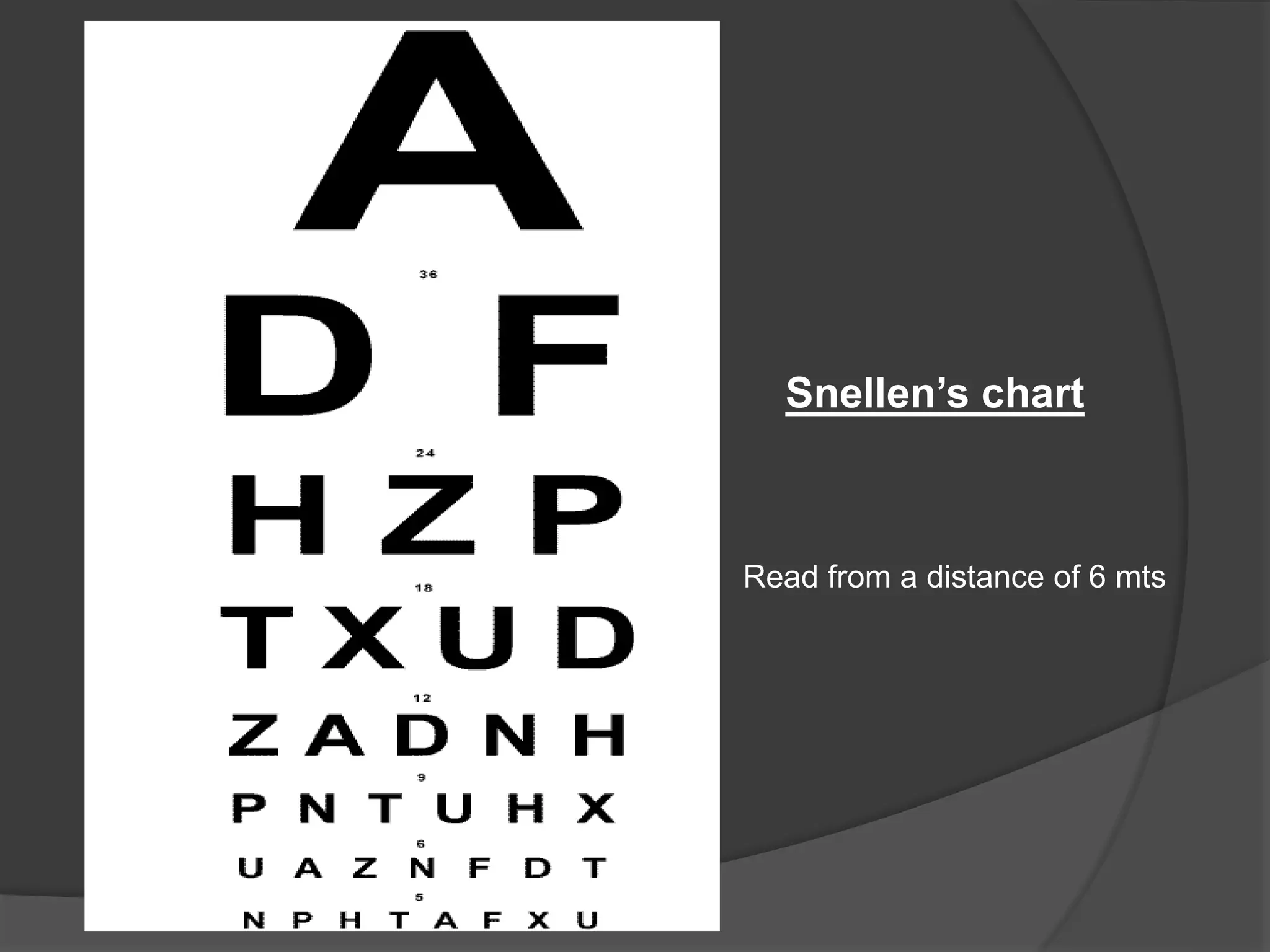
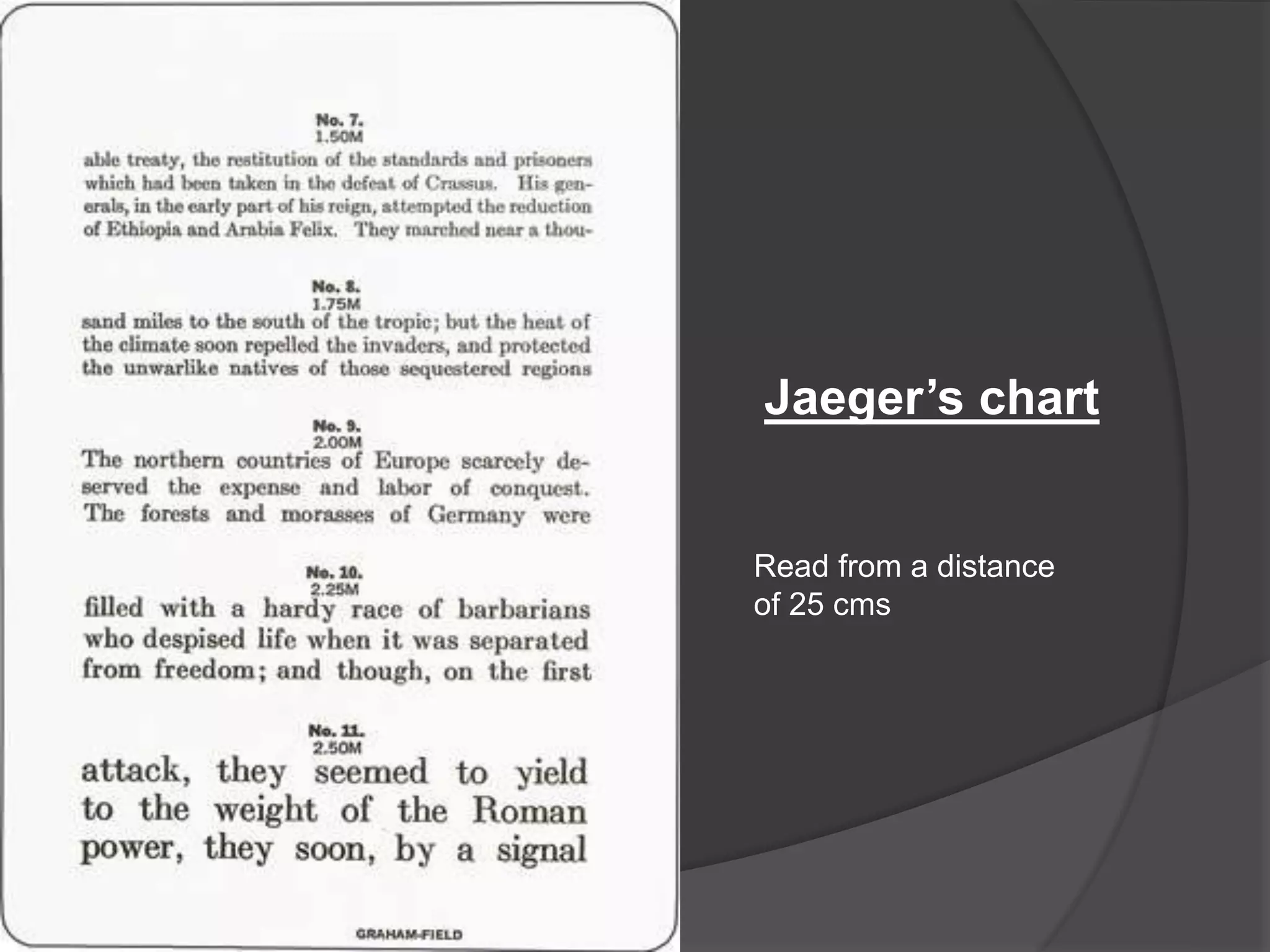
 Snellen’s chart and Jaeger’s chart
Snellen’s chart
Read from a distance of 6 mts
Jaeger’s chart
Read from a distance
of 25 cms
Factors affecting visual
acuity
1. Optical factors- state of image forming
mechanisms of eye
2. Retinal factors- fovea has better acuity
3. Stimulus factors-
(i) Size of the object
(ii) Color of the object
(iii) Illumination
(iv) Contrast
(v) Brightness
(vi) Duration of exposure
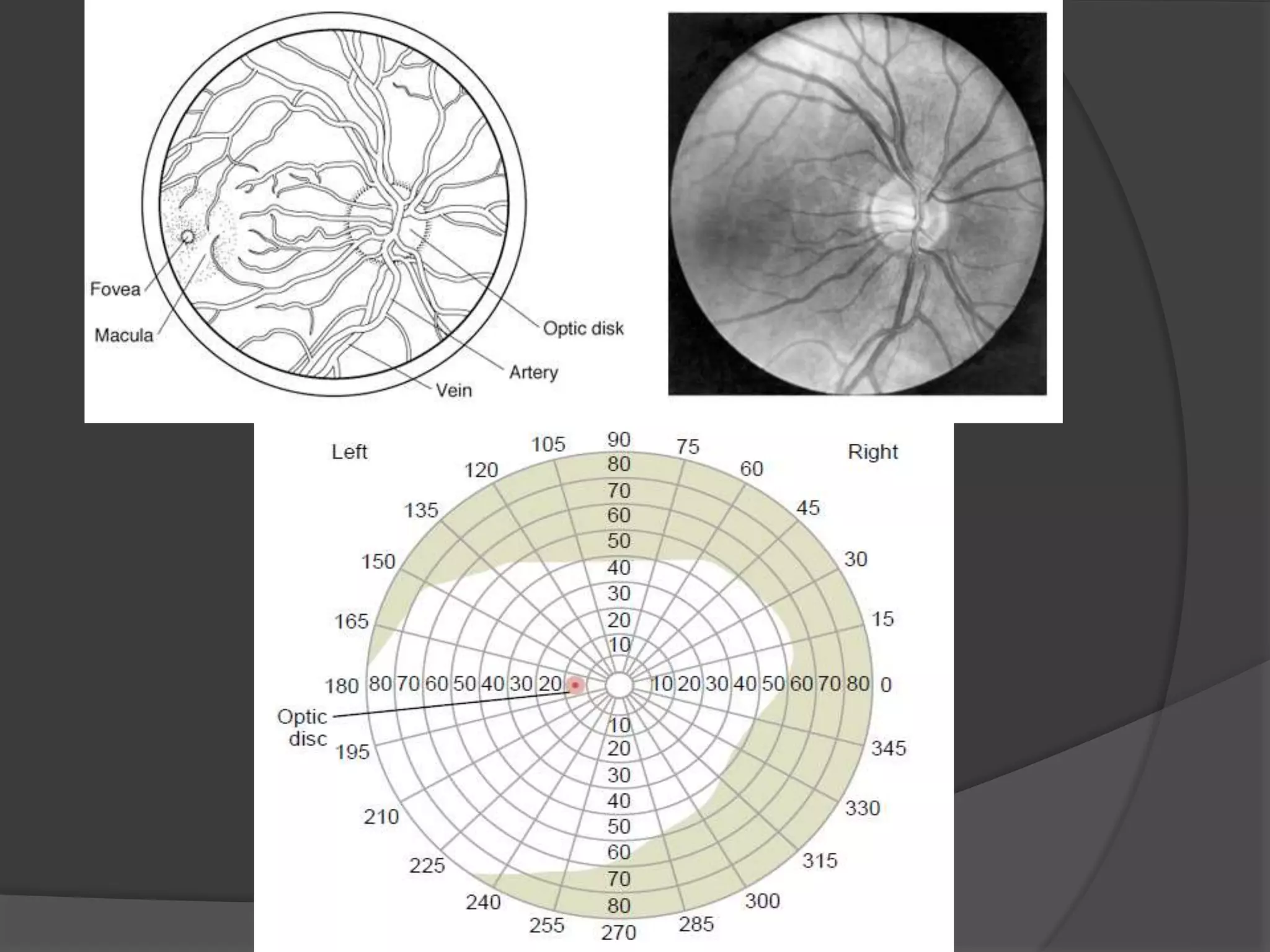
Field of vision
Def: All the surroundings visible when the
vision is fixed
Methods of assessment:
(i) Perimetry
(ii) Confrontation method
Blind spot- 3mm medial to & slightly above
posterior pole
Scotoma- Blind spots in regions other than
optic disc
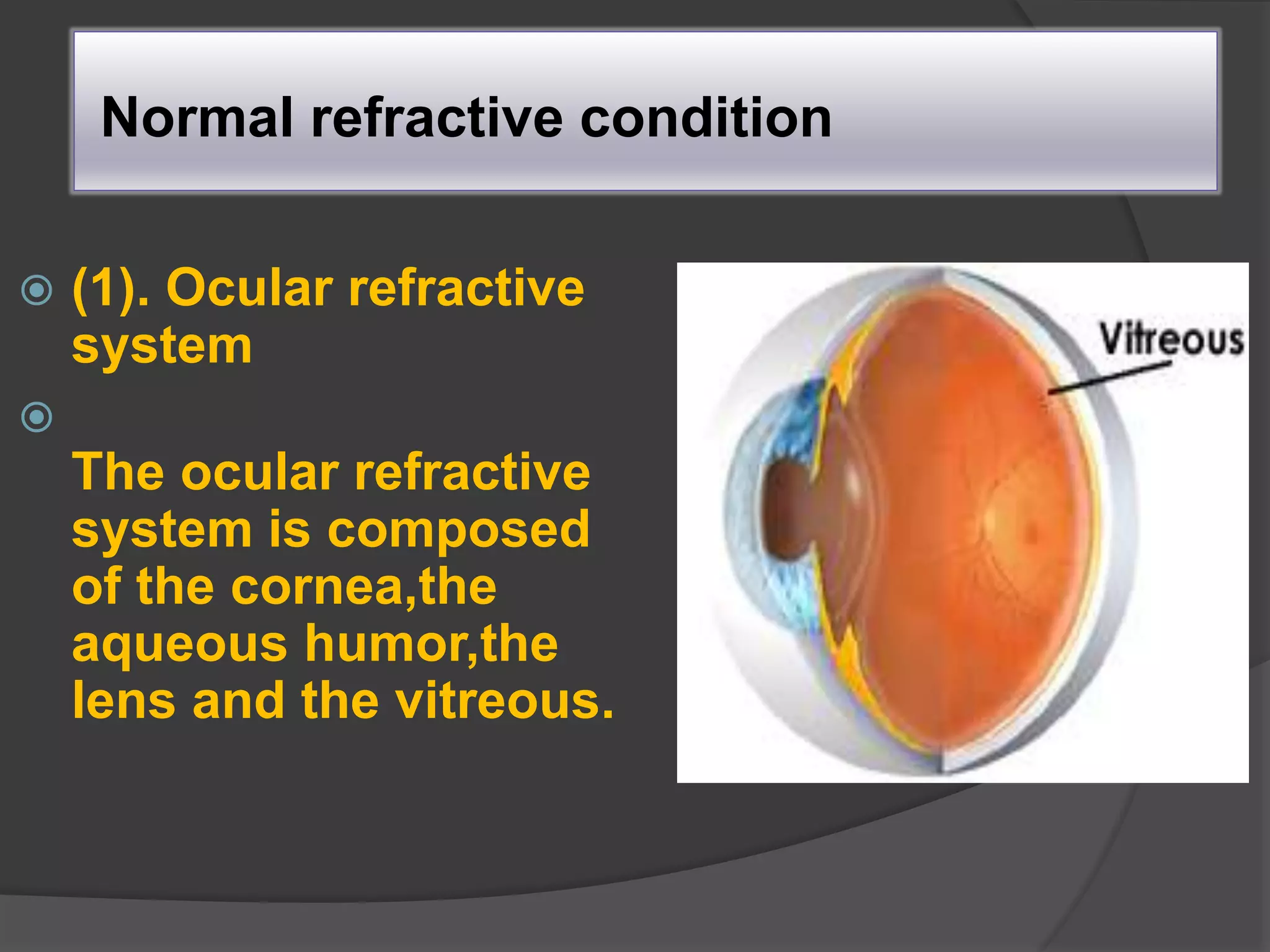
Normal refractive condition
 (1). Ocular refractive
system

The ocular refractive
system is composed
of the cornea,the
aqueous humor,the
lens and the vitreous.
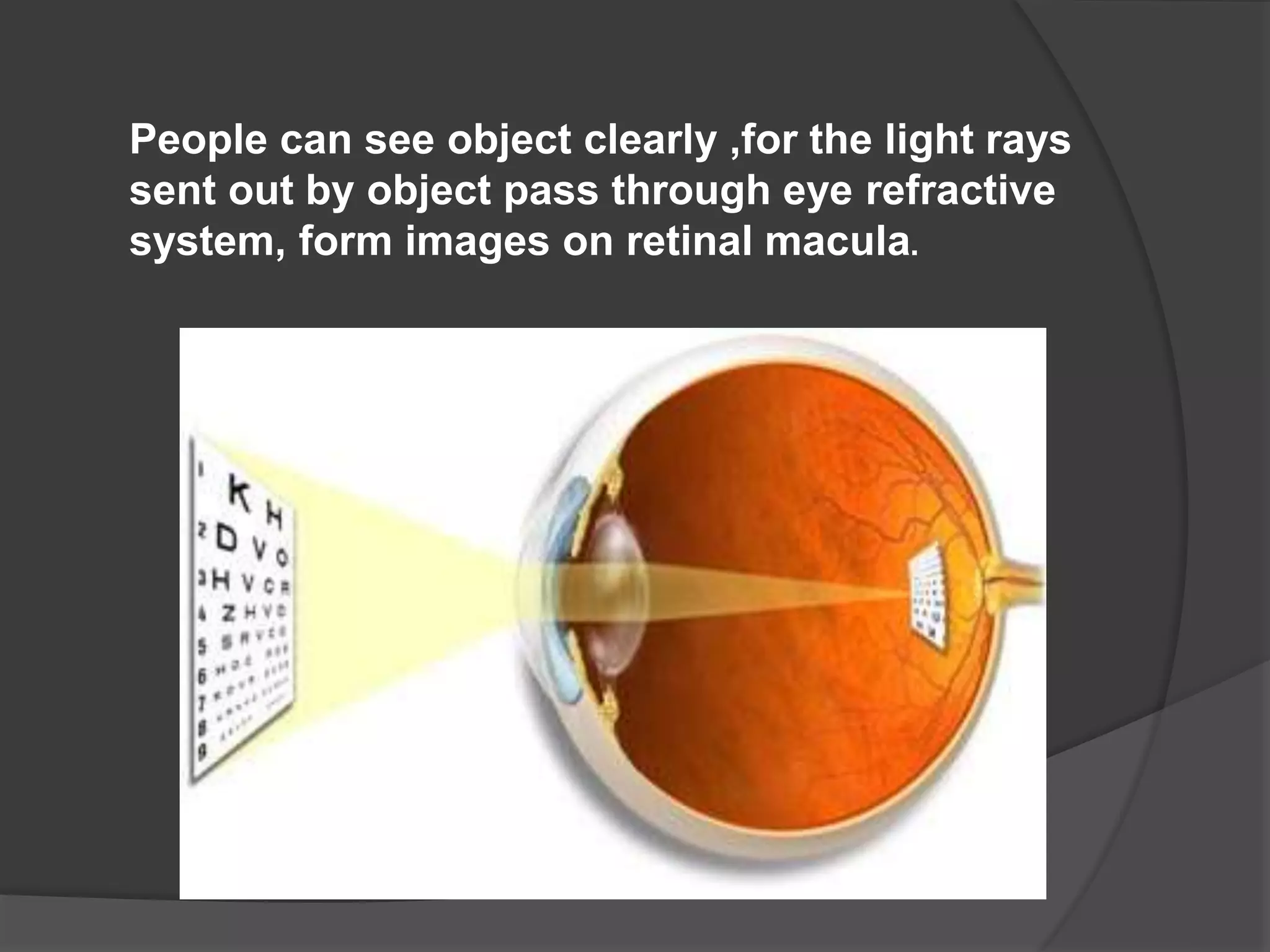
People can see object clearly ,for the light rays
sent out by object pass through eye refractive
system, form images on retinal macula.
Refractive condition is decided by the
refractive power and length of ocular axis.
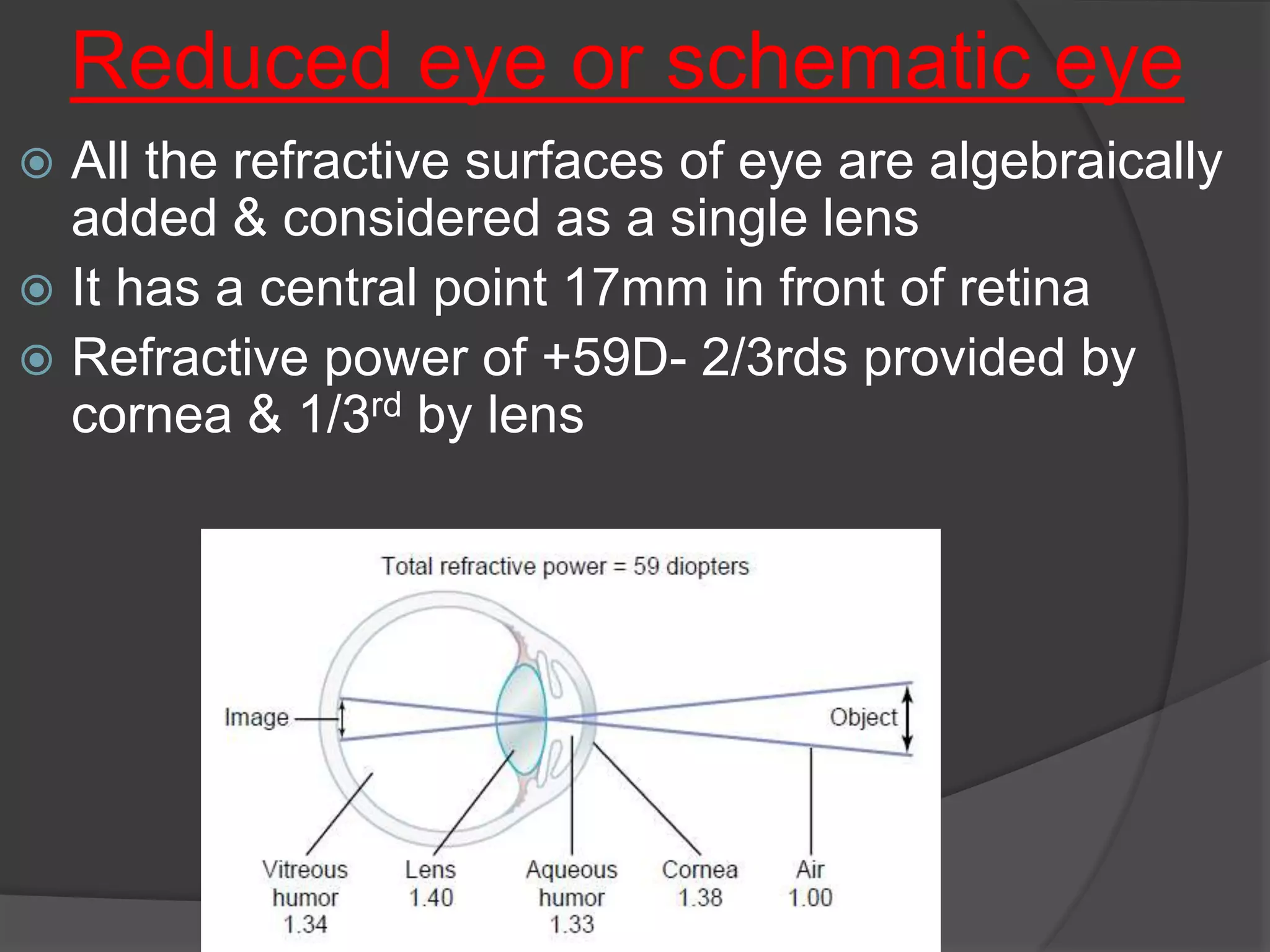
Reduced eye or schematic eye
 All the refractive surfaces of eye are algebraically
added & considered as a single lens
 It has a central point 17mm in front of retina
 Refractive power of +59D- 2/3rds provided by
cornea & 1/3rd by lens
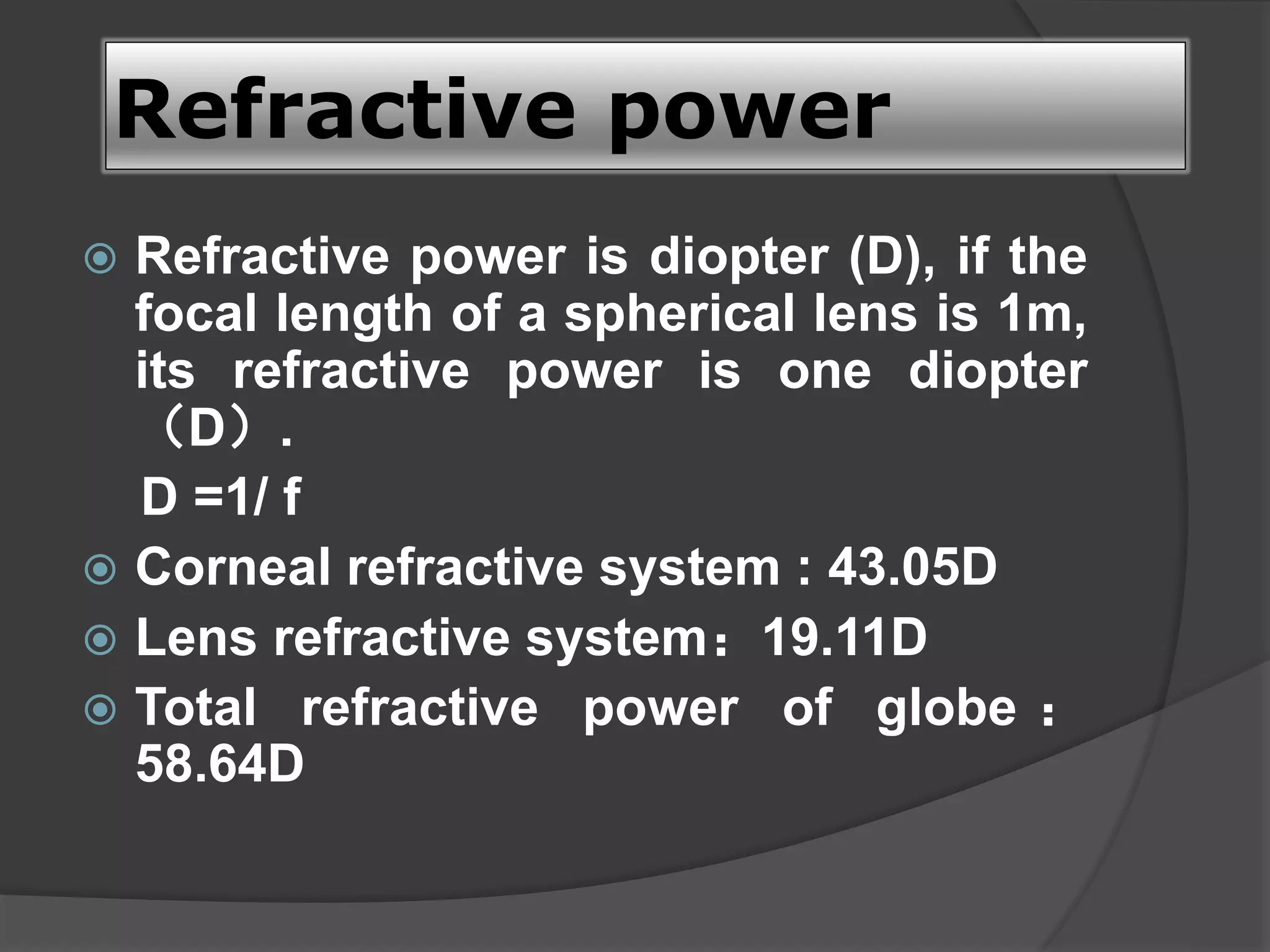
Refractive power
 Refractive power is diopter (D), if the
focal length of a spherical lens is 1m,
its refractive power is one diopter
(D).
D =1/ f
 Corneal refractive system : 43.05D
 Lens refractive system:19.11D
 Total refractive power of globe :
58.64D
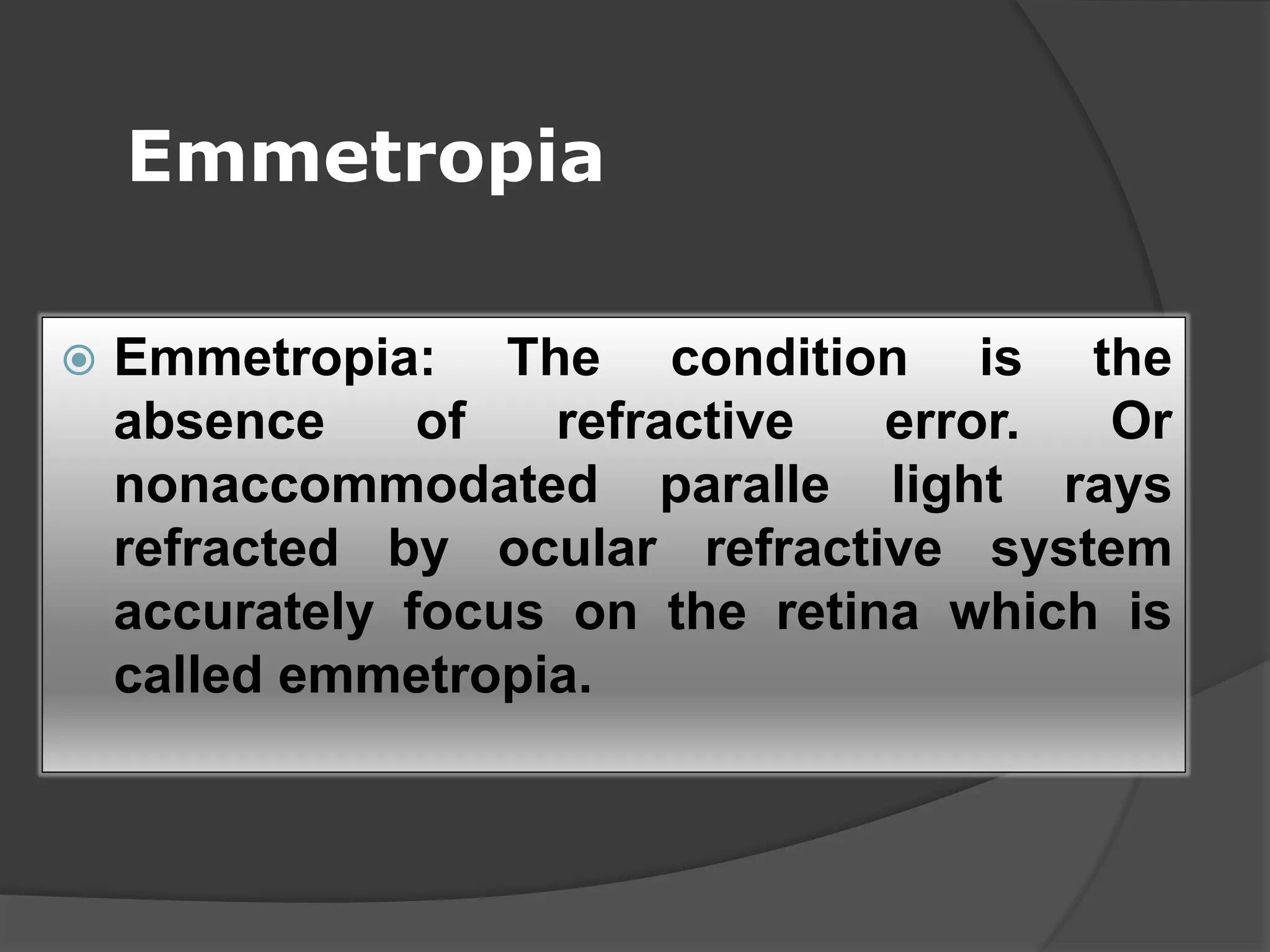
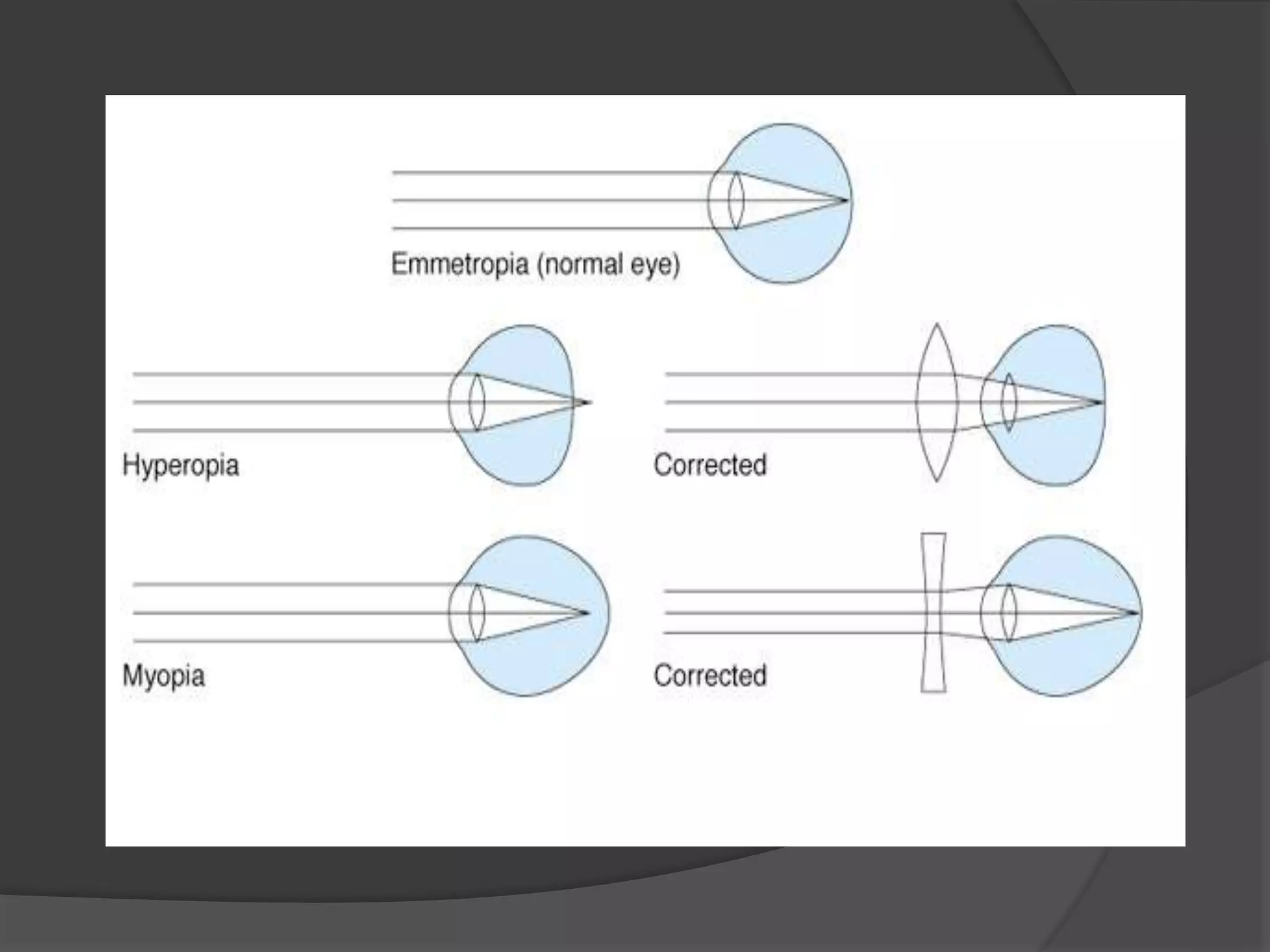
Emmetropia
 Emmetropia: The condition is the
absence of refractive error. Or
nonaccommodated paralle light rays
refracted by ocular refractive system
accurately focus on the retina which is
called emmetropia.
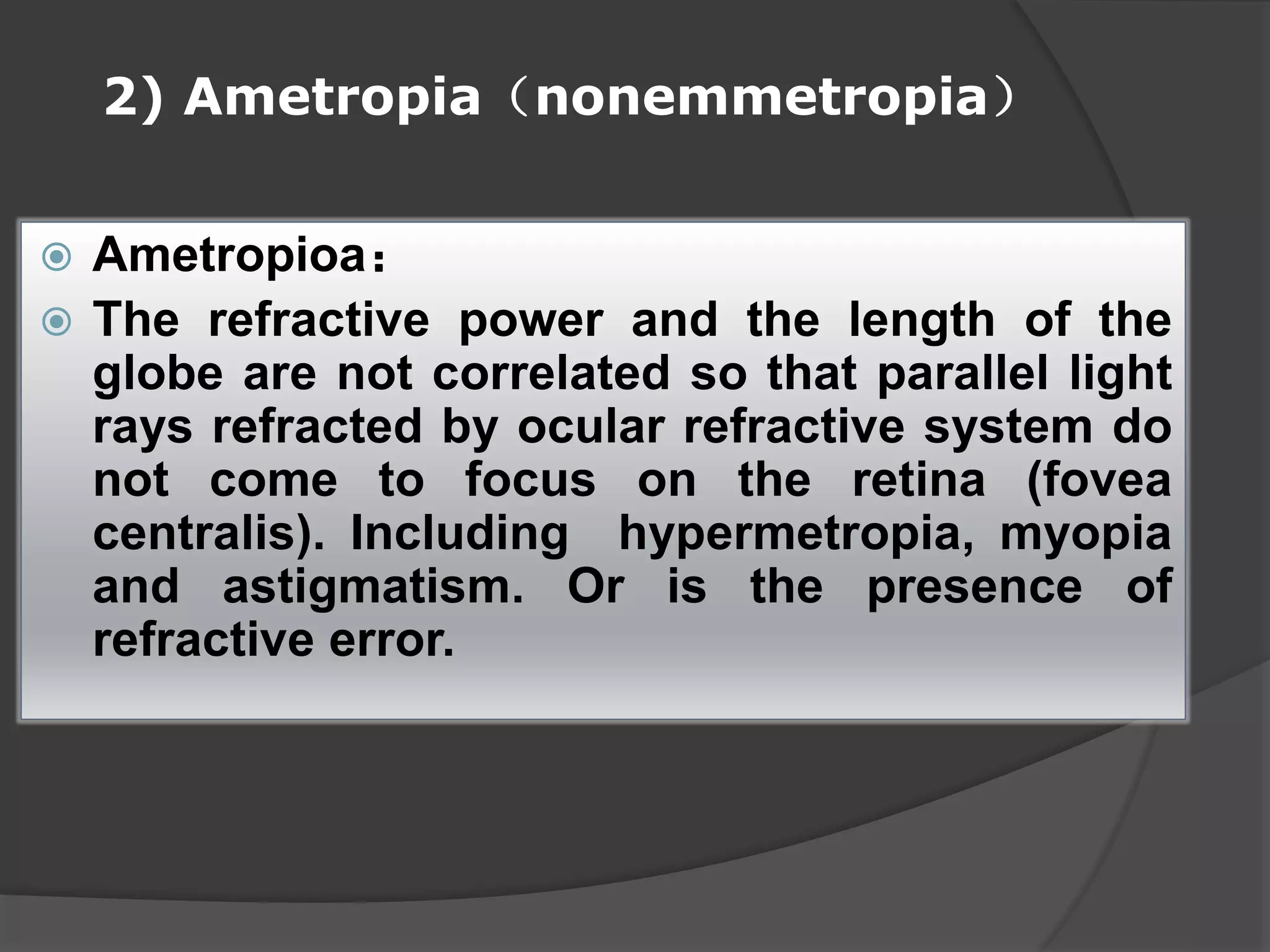
2) Ametropia(nonemmetropia)
 Ametropioa:
 The refractive power and the length of the
globe are not correlated so that parallel light
rays refracted by ocular refractive system do
not come to focus on the retina (fovea
centralis). Including hypermetropia, myopia
and astigmatism. Or is the presence of
refractive error.
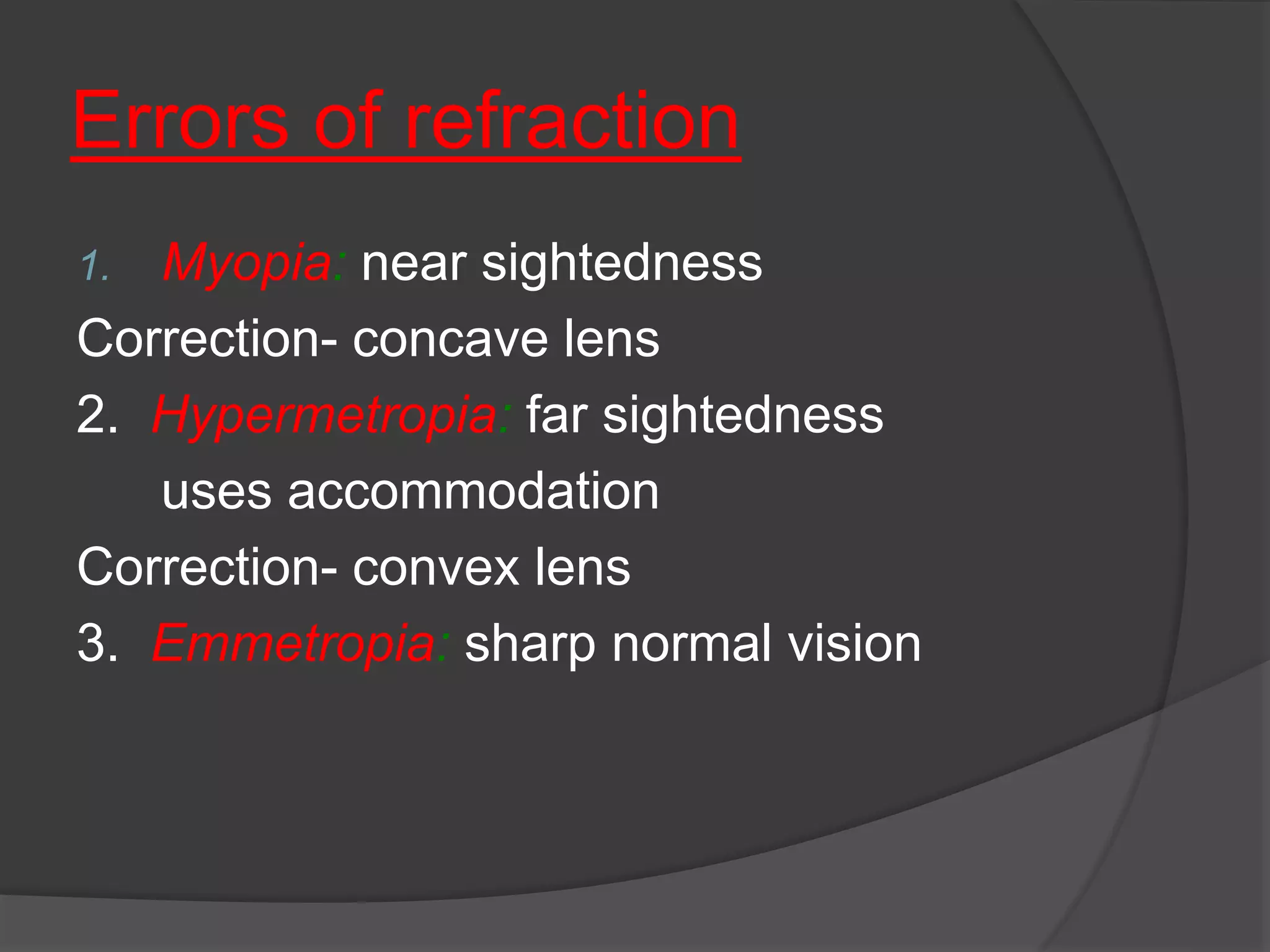
Errors of refraction
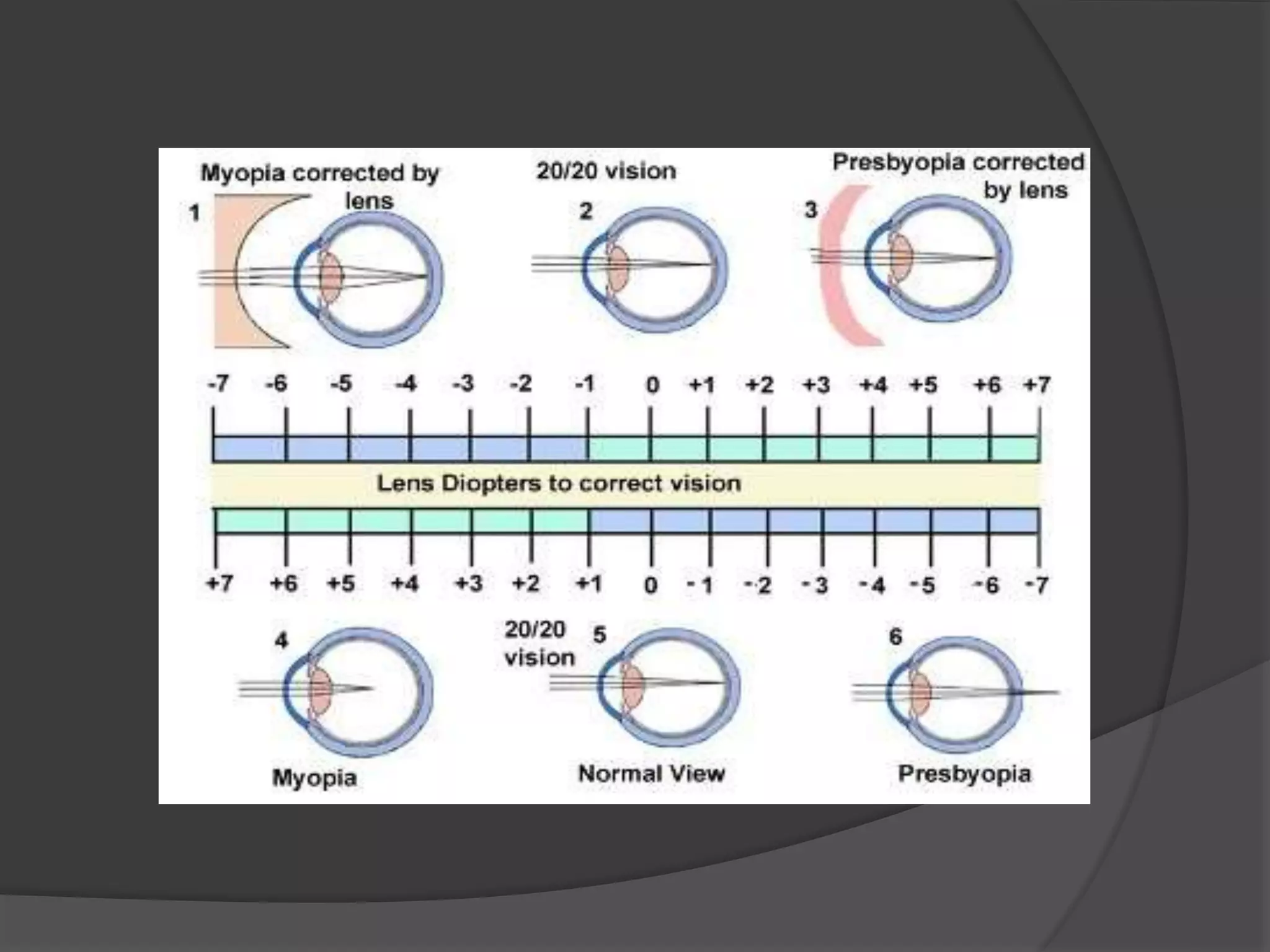
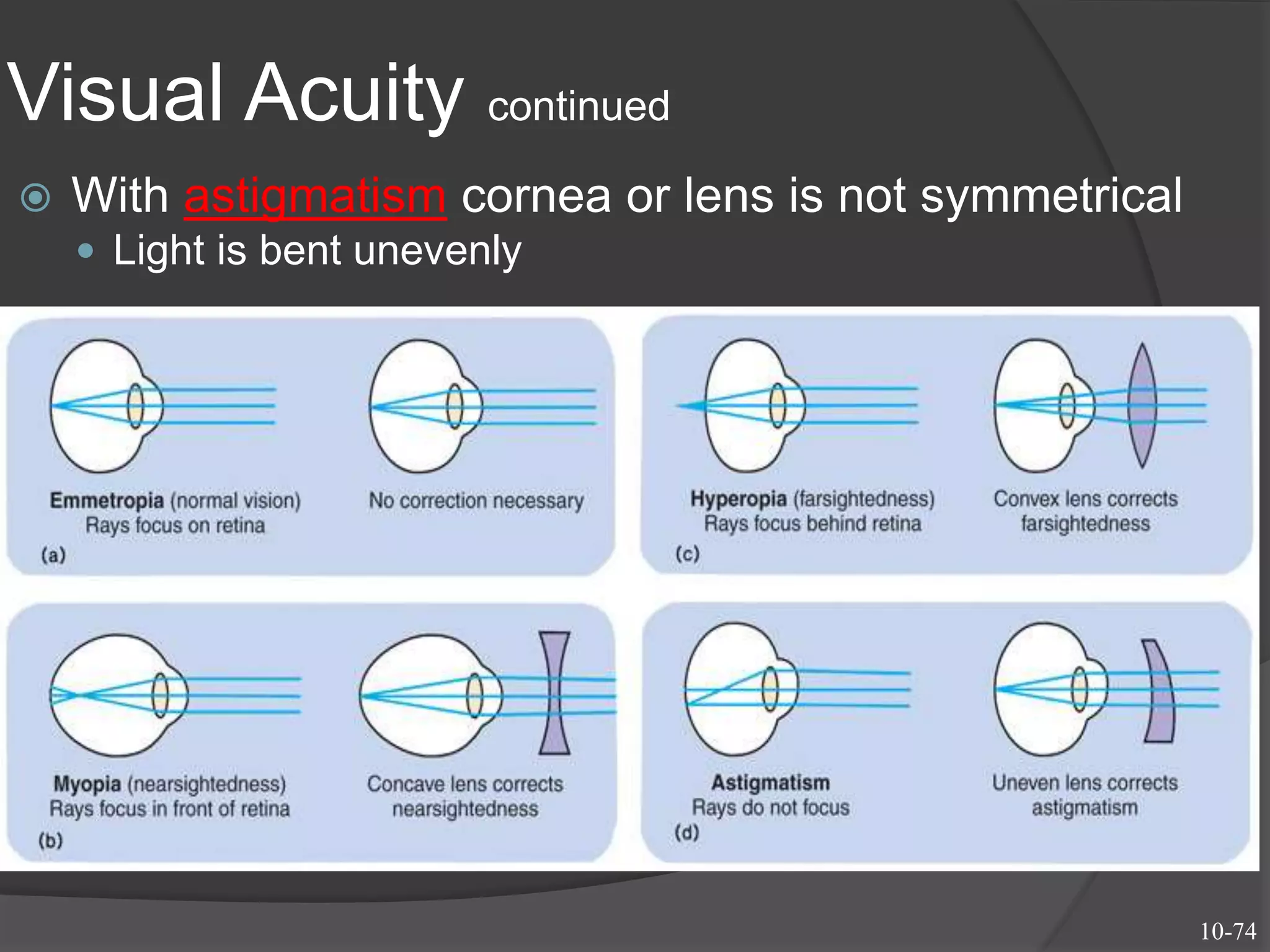
1. Myopia: near sightedness
Correction- concave lens
2. Hypermetropia: far sightedness
uses accommodation
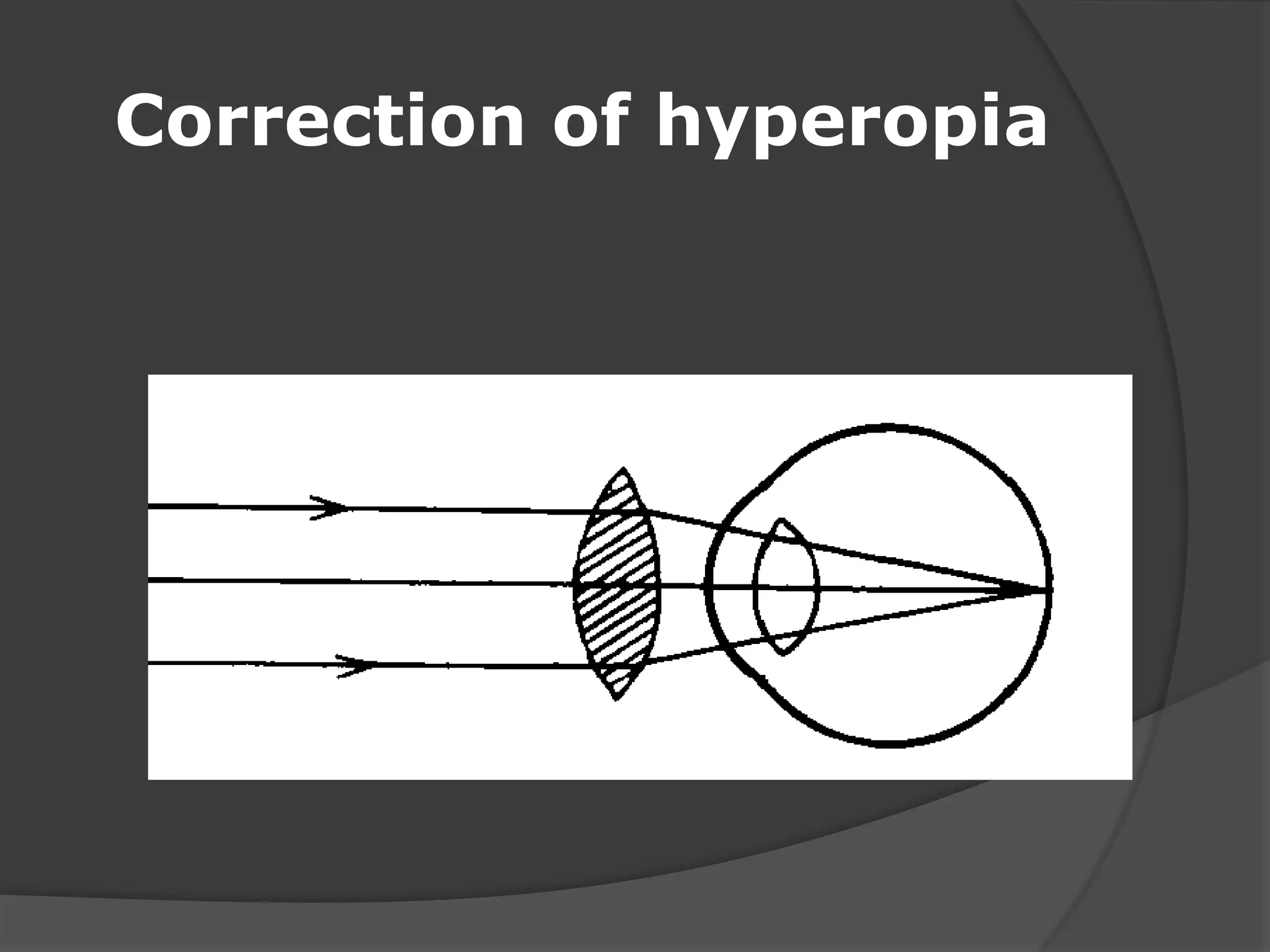
Correction- convex lens
3. Emmetropia: sharp normal vision
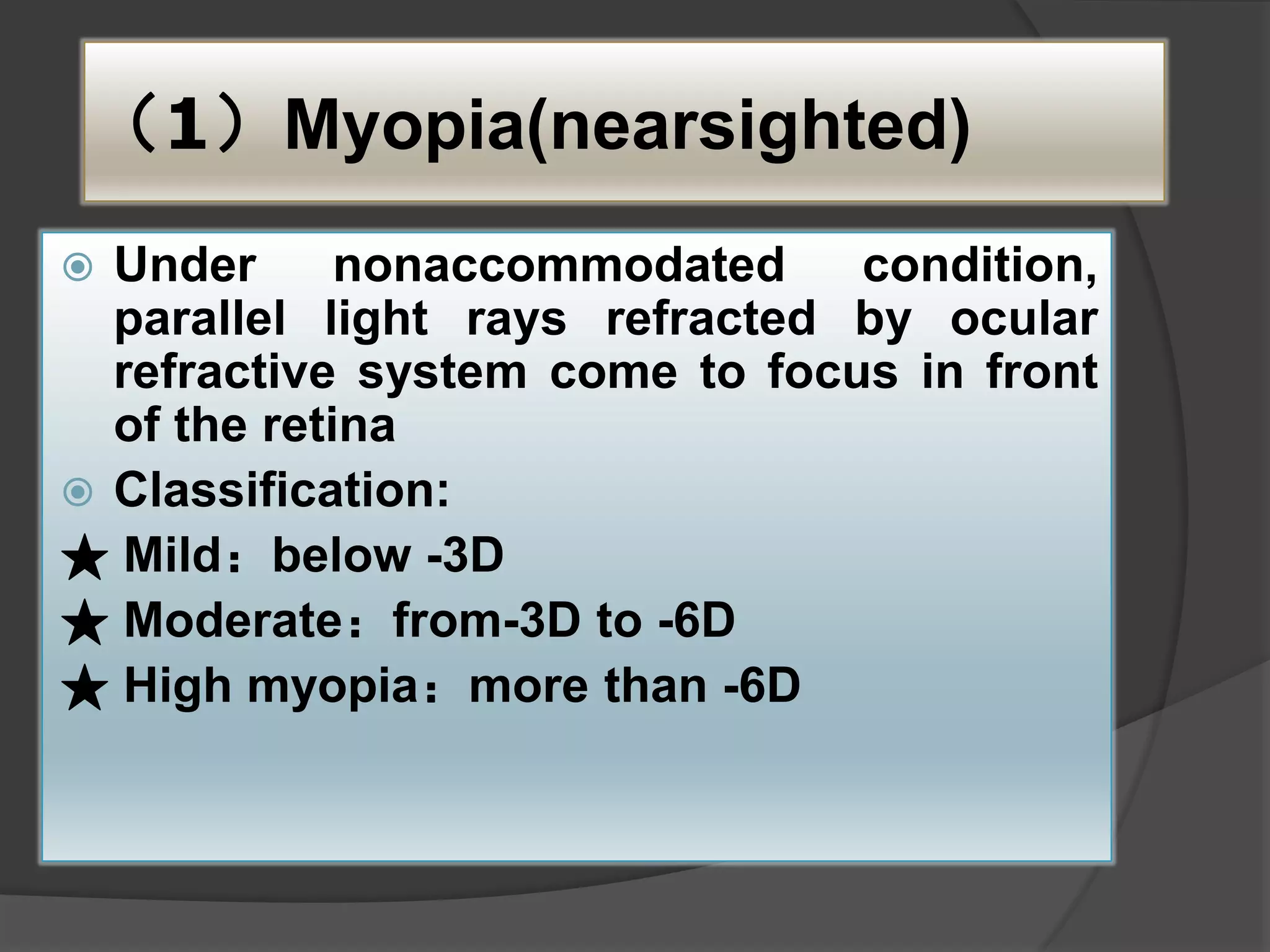
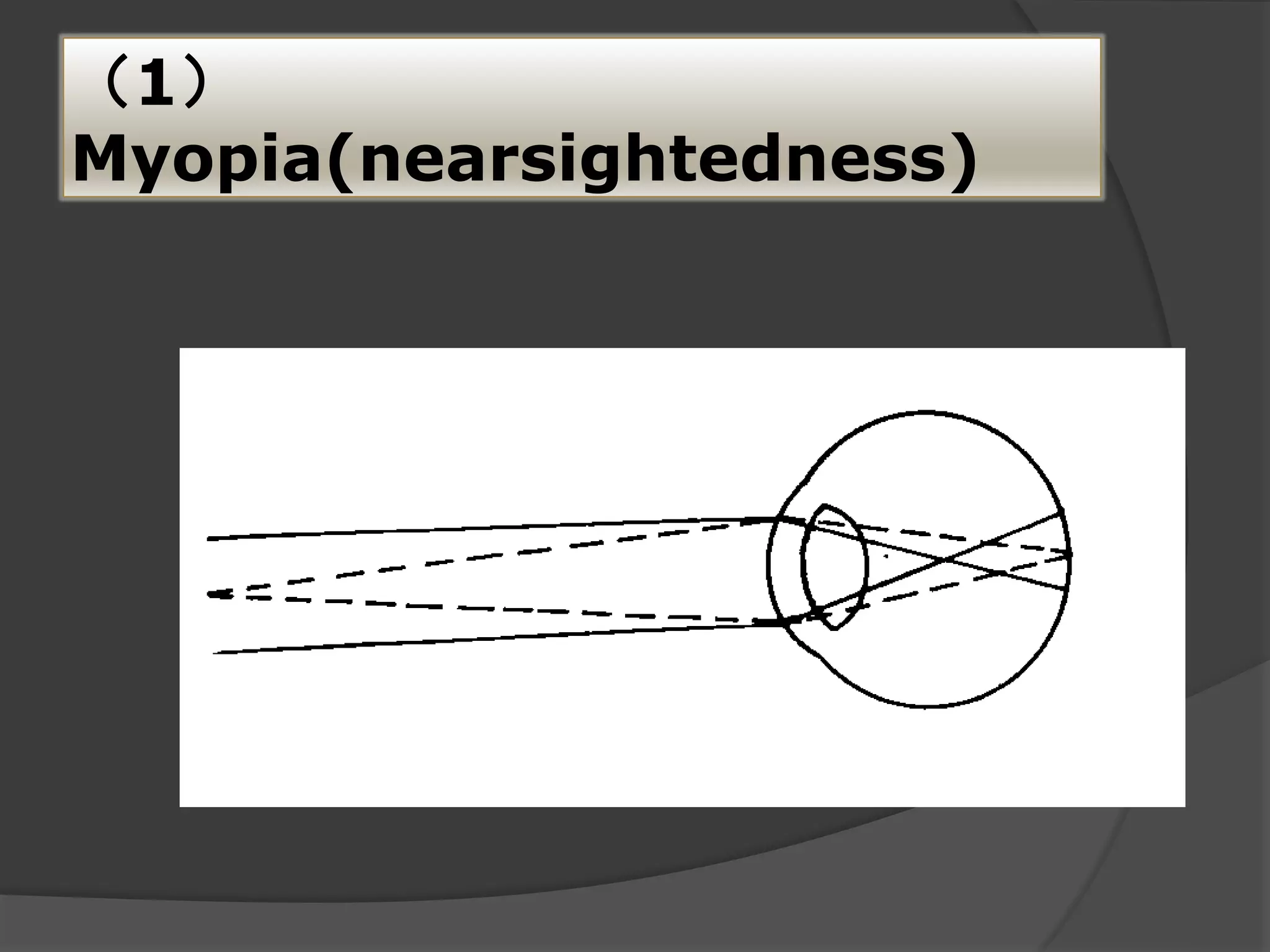
(1)Myopia(nearsighted)
 Under nonaccommodated condition,
parallel light rays refracted by ocular
refractive system come to focus in front
of the retina
 Classification:
★ Mild:below -3D
★ Moderate:from-3D to -6D
★ High myopia:more than -6D
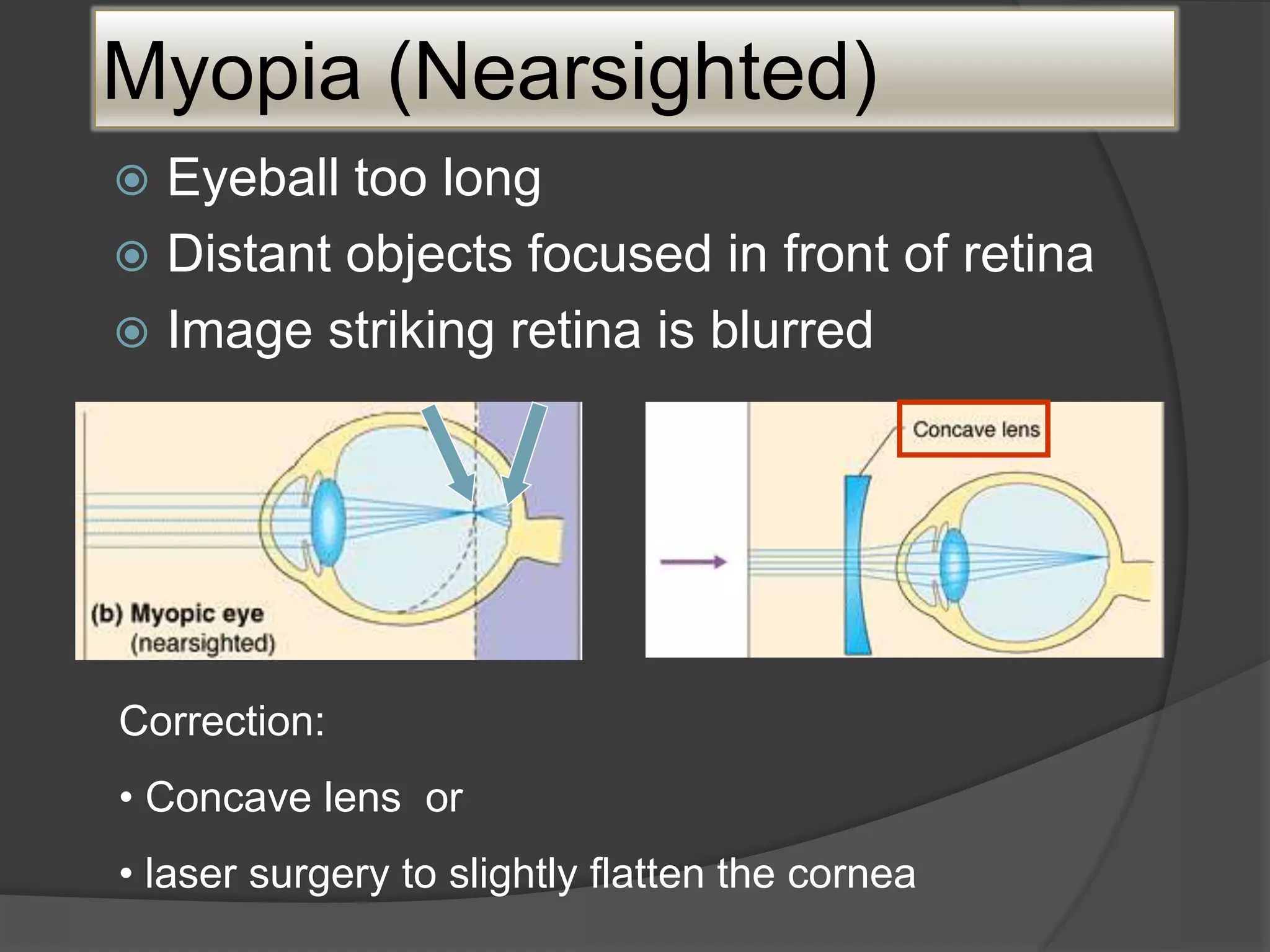
Myopia (Nearsighted)
 Eyeball too long
 Distant objects focused in front of retina
 Image striking retina is blurred
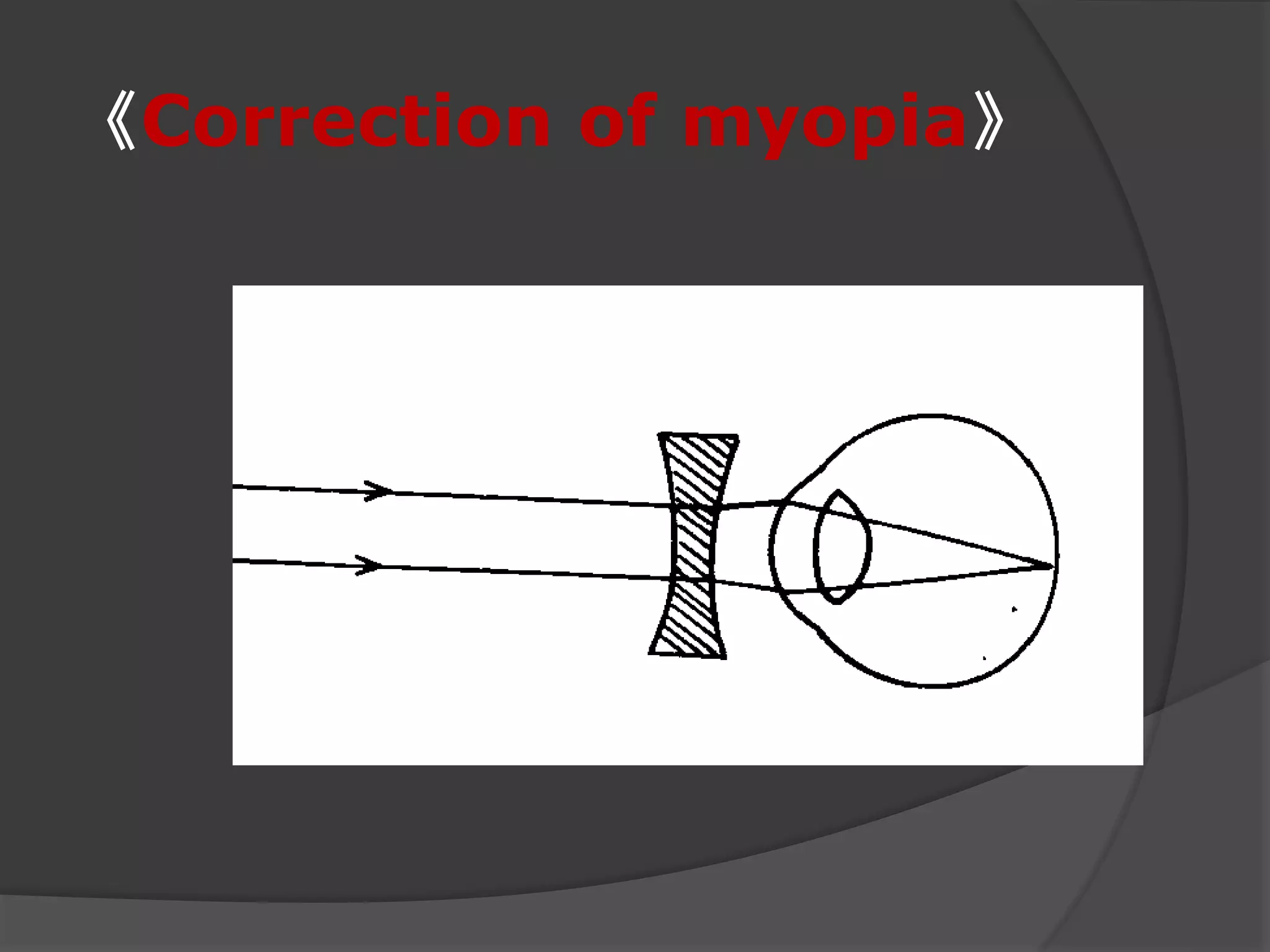
Correction:
• Concave lens or
• laser surgery to slightly flatten the cornea
(1)
Myopia(nearsightedness)
(1)Myopia(nearsighted)
 Nearsightedness or myopia, occurs when
light entering the eye focuses in front of
the retina instead of directly on it. This is
caused by a cornea that is steeper, or an
eye that is longer, than a normal eye.
Nearsighted people typically see well up
close, but have difficulty seeing far
away.
(1)Myopia (nearsightedness)
 This problem is often discovered in
school-age children who report having
trouble seeing the chalkboard.
(1)Myopia(nearsighted)
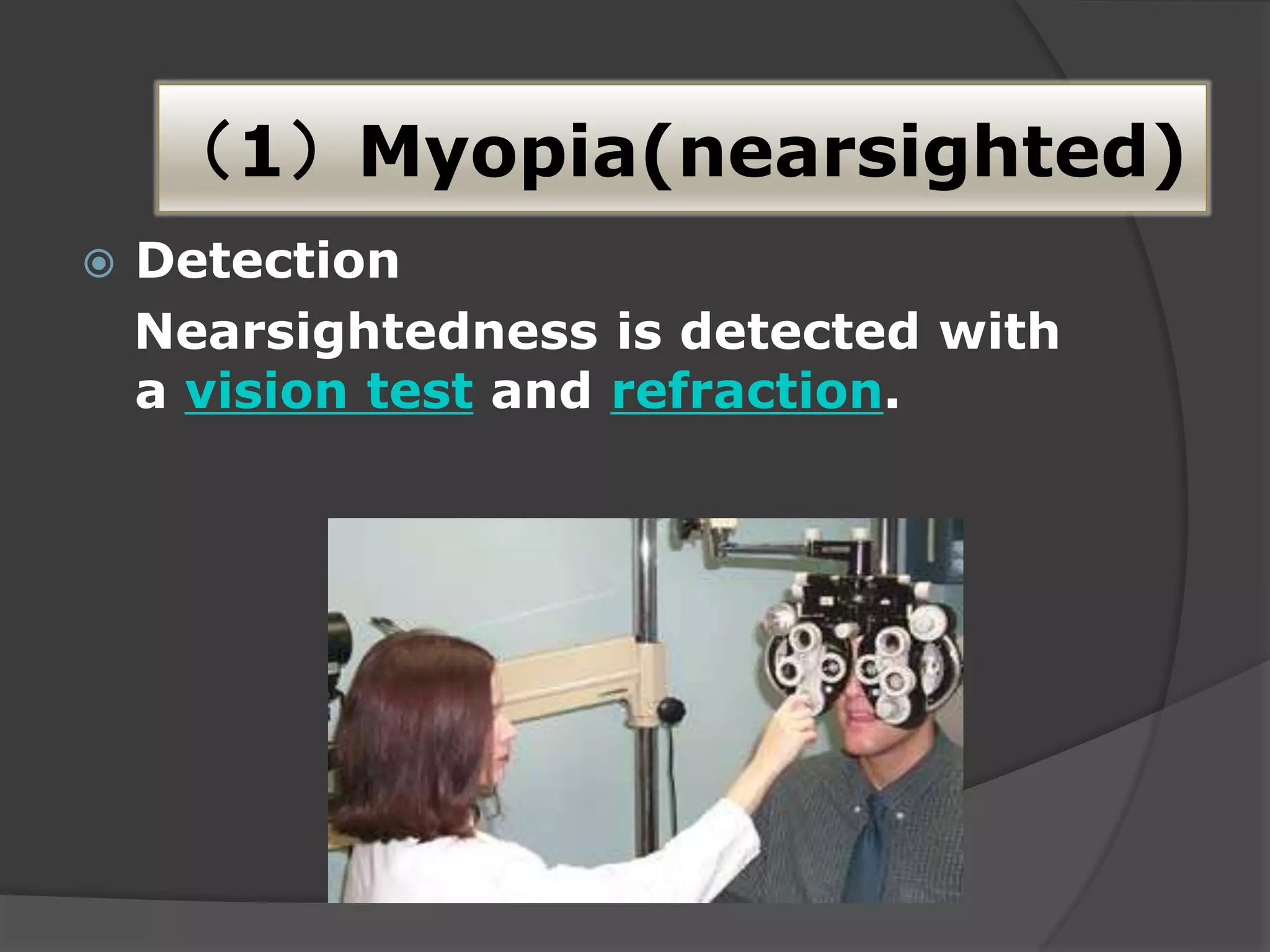
 Detection
Nearsightedness is detected with
a vision test and refraction.
《Etiology》
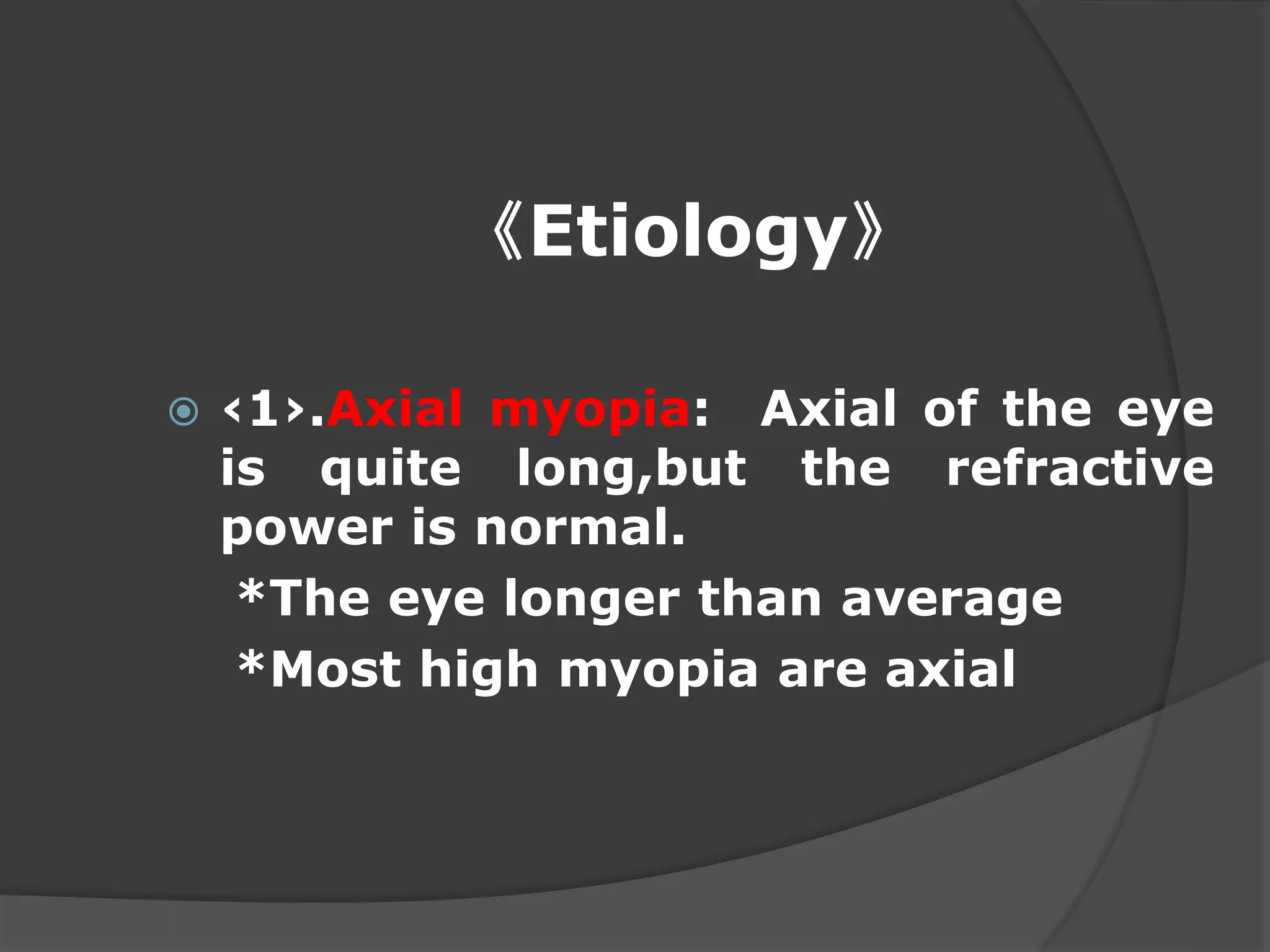
 ‹1›.Axial myopia: Axial of the eye
is quite long,but the refractive
power is normal.
*The eye longer than average
*Most high myopia are axial
《Etiology》
 ‹2›.Refractive myopia: The axis is
normal but the refractive power
increases.
《Correction of myopia》
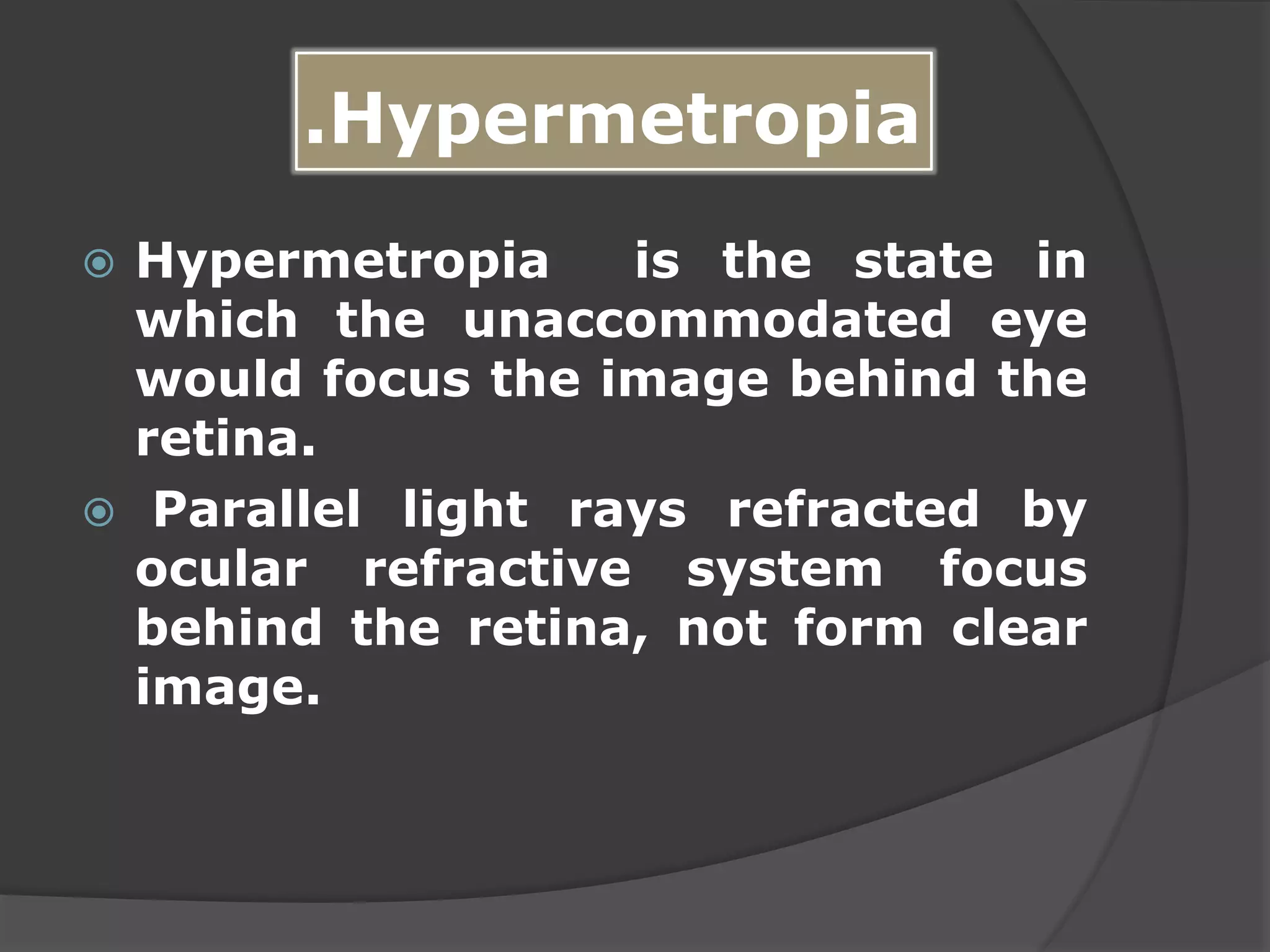
.Hypermetropia
 Hypermetropia is the state in
which the unaccommodated eye
would focus the image behind the
retina.
 Parallel light rays refracted by
ocular refractive system focus
behind the retina, not form clear
image.
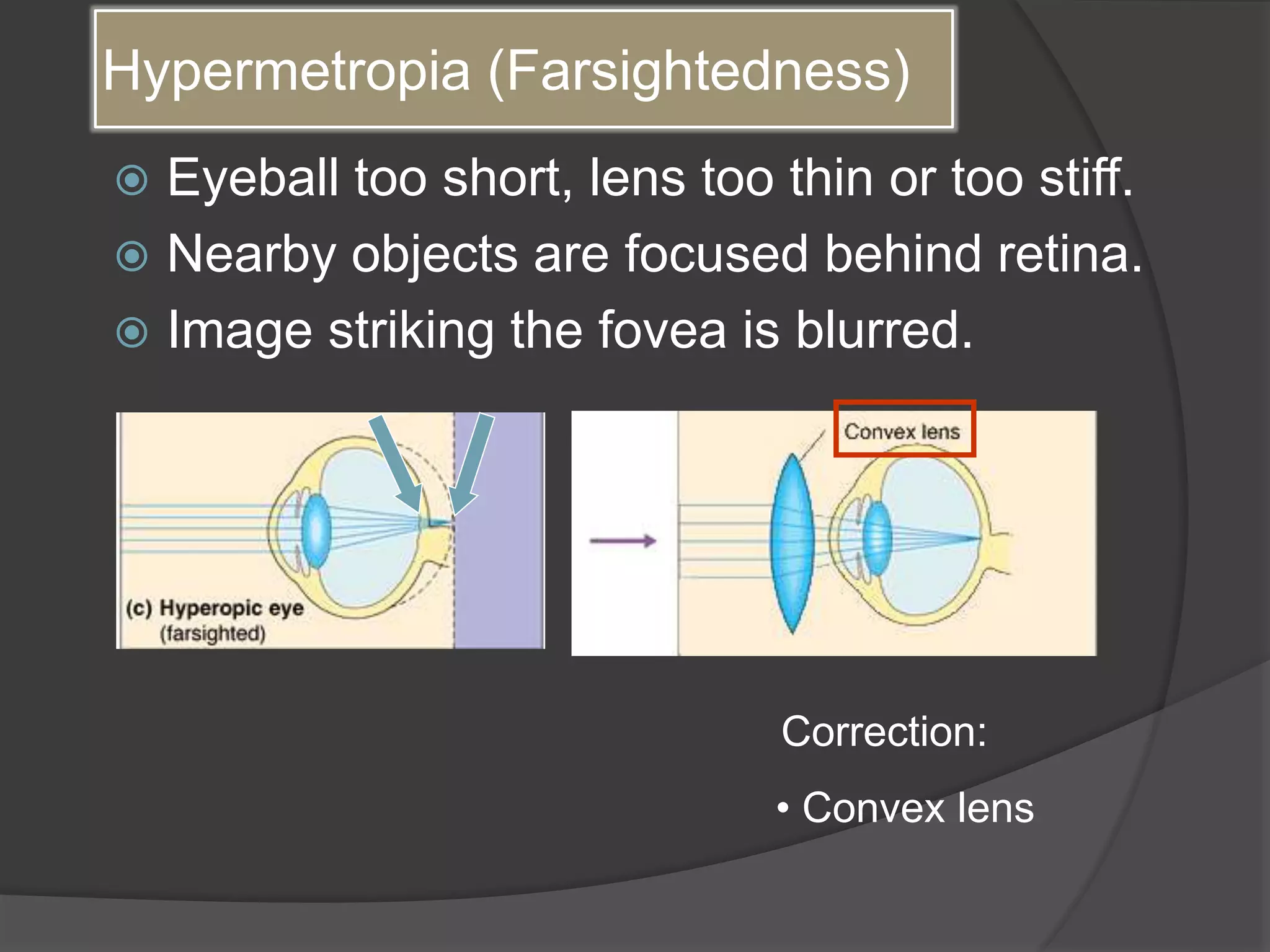
Hypermetropia (Farsightedness)
 Eyeball too short, lens too thin or too stiff.
 Nearby objects are focused behind retina.
 Image striking the fovea is blurred.
Correction:
• Convex lens
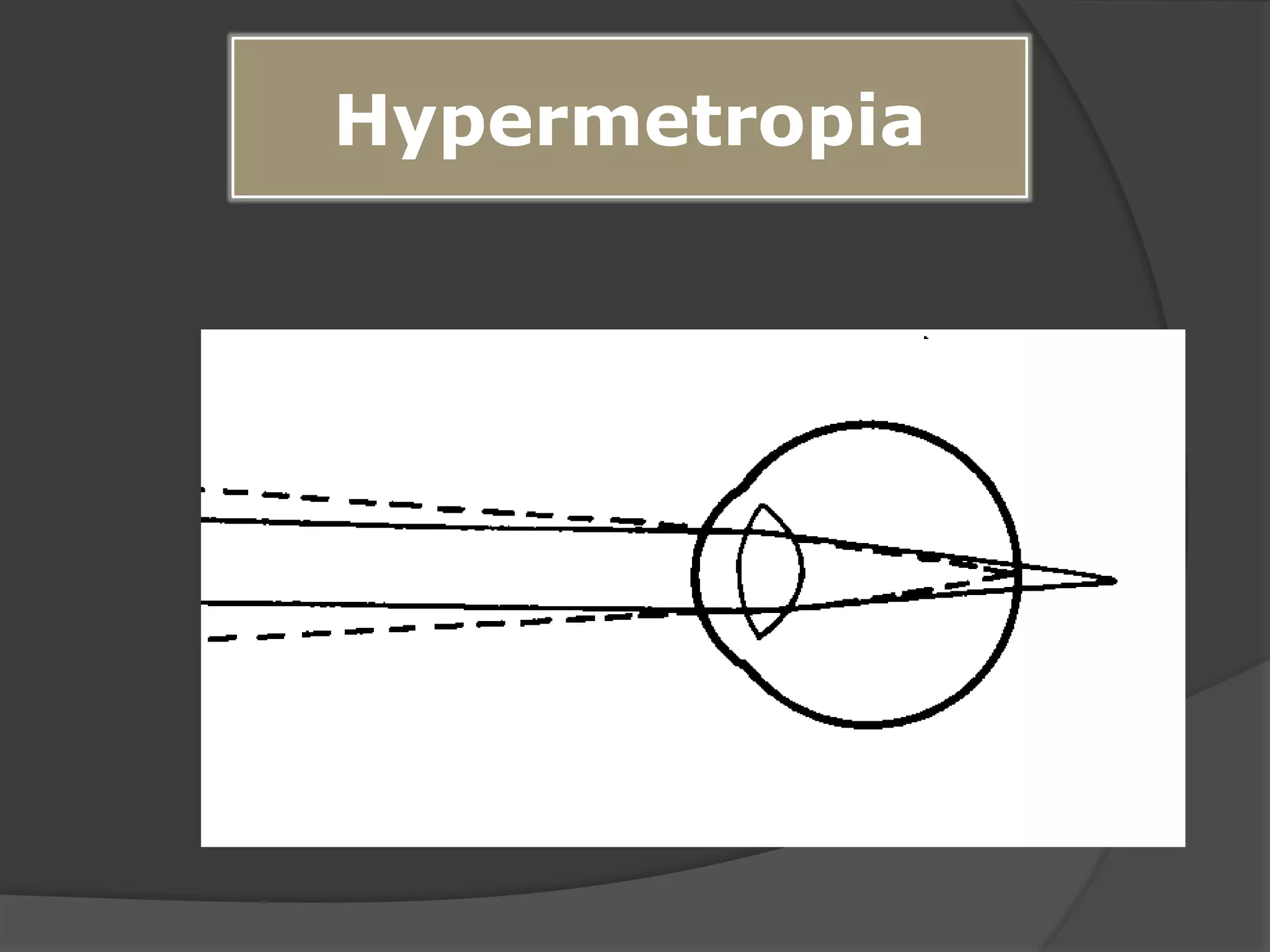
Hypermetropia
Hypermetropia
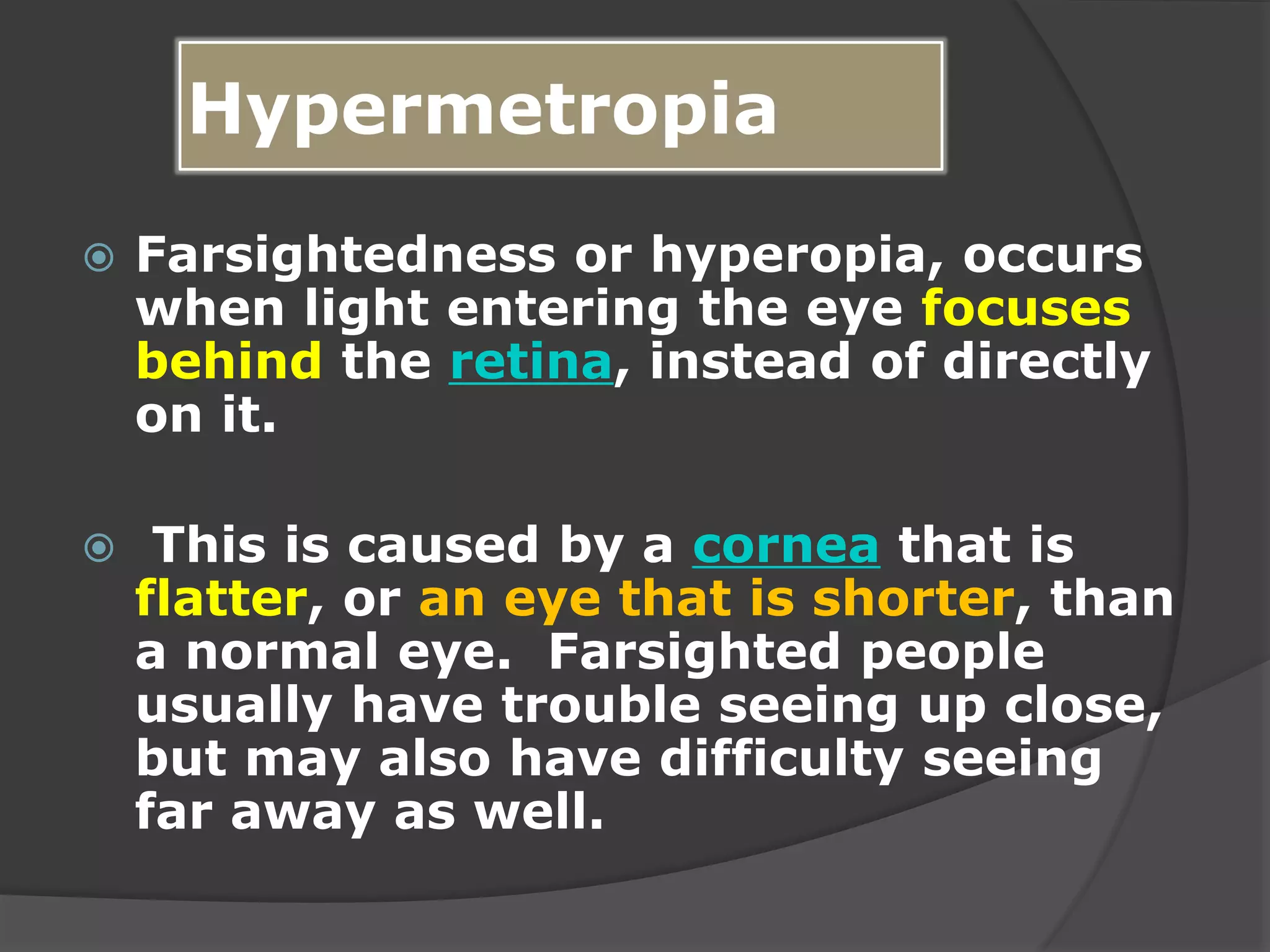
 Farsightedness or hyperopia, occurs
when light entering the eye focuses
behind the retina, instead of directly
on it.
 This is caused by a cornea that is
flatter, or an eye that is shorter, than
a normal eye. Farsighted people
usually have trouble seeing up close,
but may also have difficulty seeing
far away as well.
Hypermetropia
 Young people with mild to moderate hyperopia
are often able to see clearly because their natural
lens can adjust, or accommodate to increase the
eye’s focusing ability.
 However, as the eye gradually loses the ability to
accommodate (beginning at about 40 years of
age), blurred vision from hyperopia often
becomes more apparent.
Hypermetropia
 Signs and Symptoms
 Difficulty seeing up close
 Blurred distance vision (occurs with higher
amounts of hyperopia)
 Eye fatigue when reading

 Eye strain (headaches, pulling sensation, burning)
Hypermetropia
 Classification
Mild: less than+ 3D,
 moderate: +5D or less than +5D
 High: more than +5D
《Etiology》
 ‹1›.Axial hyperopia is indicated that ocular axis
is short but refractive power is normal.
 ‹2›.Refractive hyperopia is indicated that
ocular axis is normal, but refractive power is
weak.
《Clinical findings》
 ‹1›.Visual acuity Mild hyperopia may be
compensated by accommodation, so far or near
vision may be normal in mild hyperopia of
juvenile,
 if the degree of hyperopia is large or
accommodative power decreases with aging,
both far and near vision decrease in different
degrees, and near vision is much worse than far
one.
《Clinical findings 》
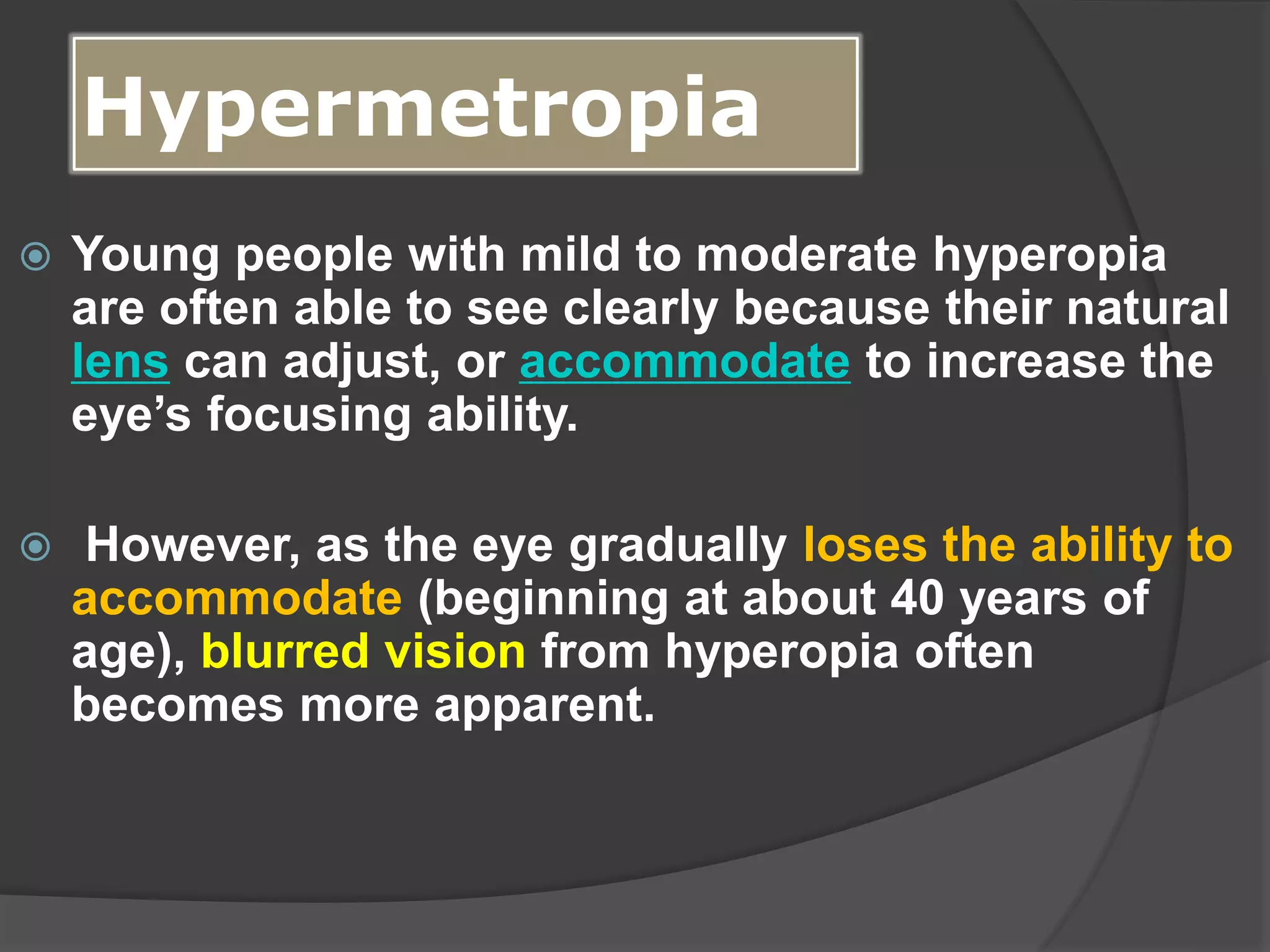
 ‹2›. Asthenopia Long-term near work,
excessive accommodation often may
induce asthenopia, its symptom is
blurred vision, distending pain in
superciliary arch.
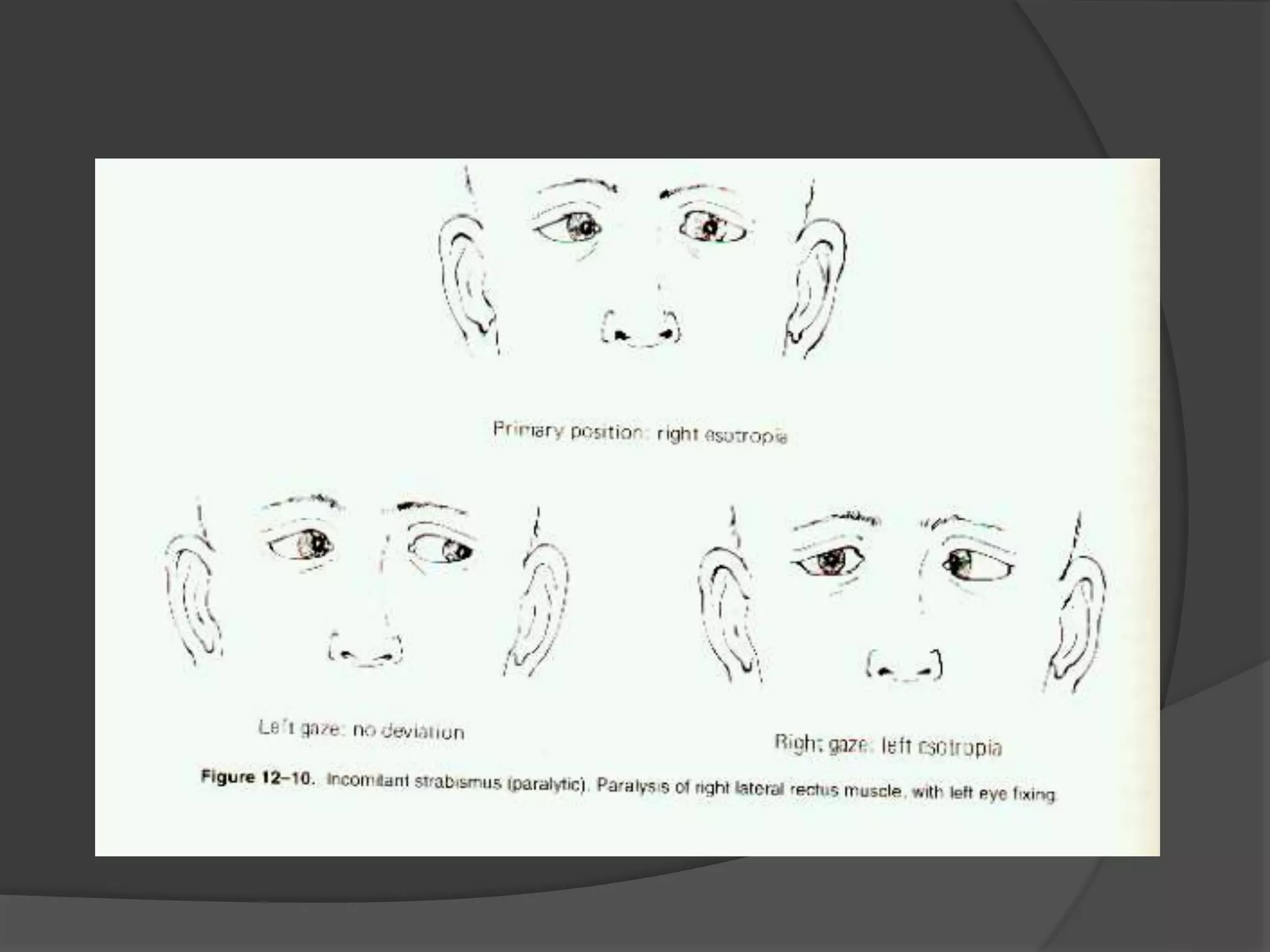
 ‹3›. Esotropia Due to excessive
accommodation leading to more
convergence which is easy to induce
esotropia .
Correction of hyperopia
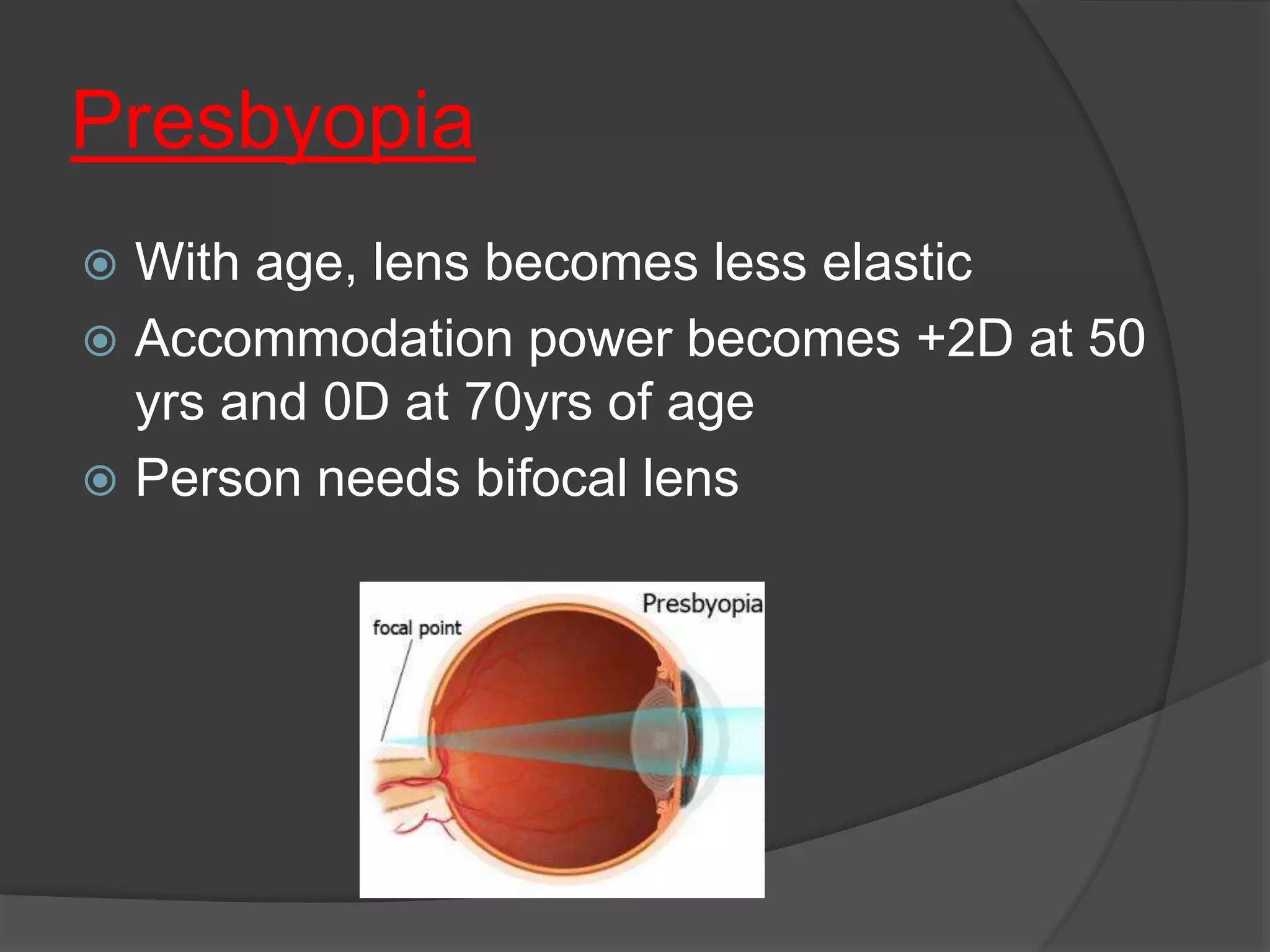
Presbyopia
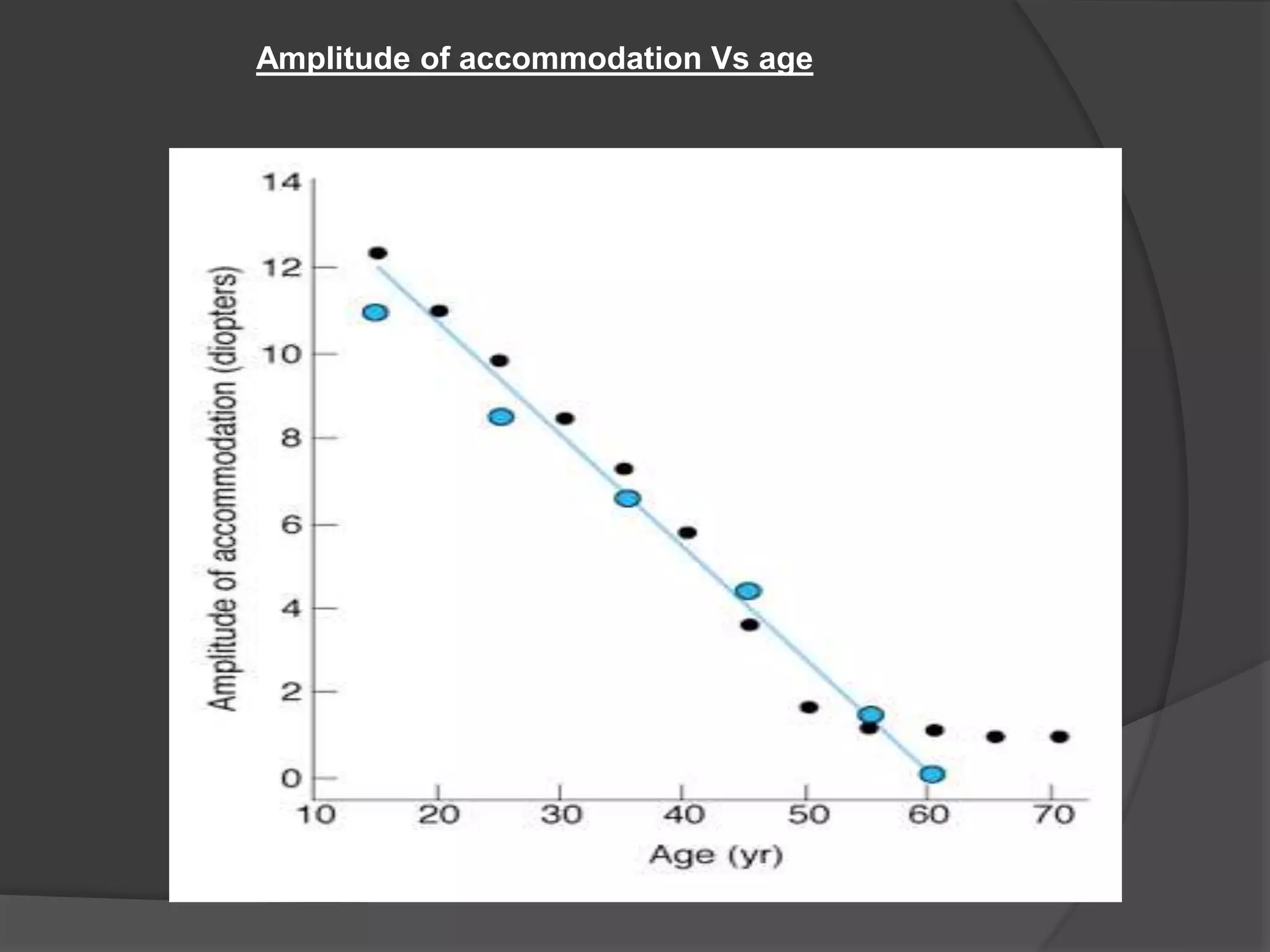
 With age, lens becomes less elastic
 Accommodation power becomes +2D at 50
yrs and 0D at 70yrs of age
 Person needs bifocal lens
. Presbyopia
 Presbyopia, also known as the “short arm syndrome,” is a
term used to describe an eye in which the natural lens can
no longer accommodate. With aging, accommodative
function decreases gradually, at about 40-45 years of age,
difficulty takes place in near work or reading, this
decrease of physiologic accommodation caused by aging
is known as presbyopia.
《Clinical finding》
 Most people first notice difficulty reading very fine print
such as the phone book, a medicine bottle, or the stock
market page. Print seems to have less contrast and the
eyes become easily fatigued when reading a book or
computer screen. The symptom of presbyopia is difficult
to see near thing.
Signs and Symptoms
 Difficulty seeing clearly for close work
 Print seems to have less contrast
 Brighter, more direct light required for
reading
 Reading material must be held further away
to see (for some)
 Fatigue and eyestrain when reading

Amplitude of accommodation Vs age
(3). Astigmatism
 Due to the difference of refractive
power in every meridian of eye, so
outside light rays can’t focus on the
retina to form clear image.
(3). Astigmatism
 Astigmatism means that the cornea is
oval instead of spherical like a
basketball. Most astigmatic corneas
have two curves – a steeper curve
and a flatter curve. This causes light
to focus on more than one point in
the eye, resulting in blurred vision at
distance or near. Astigmatism often
occurs along with nearsightedness or
farsightedness.
《Etiology》
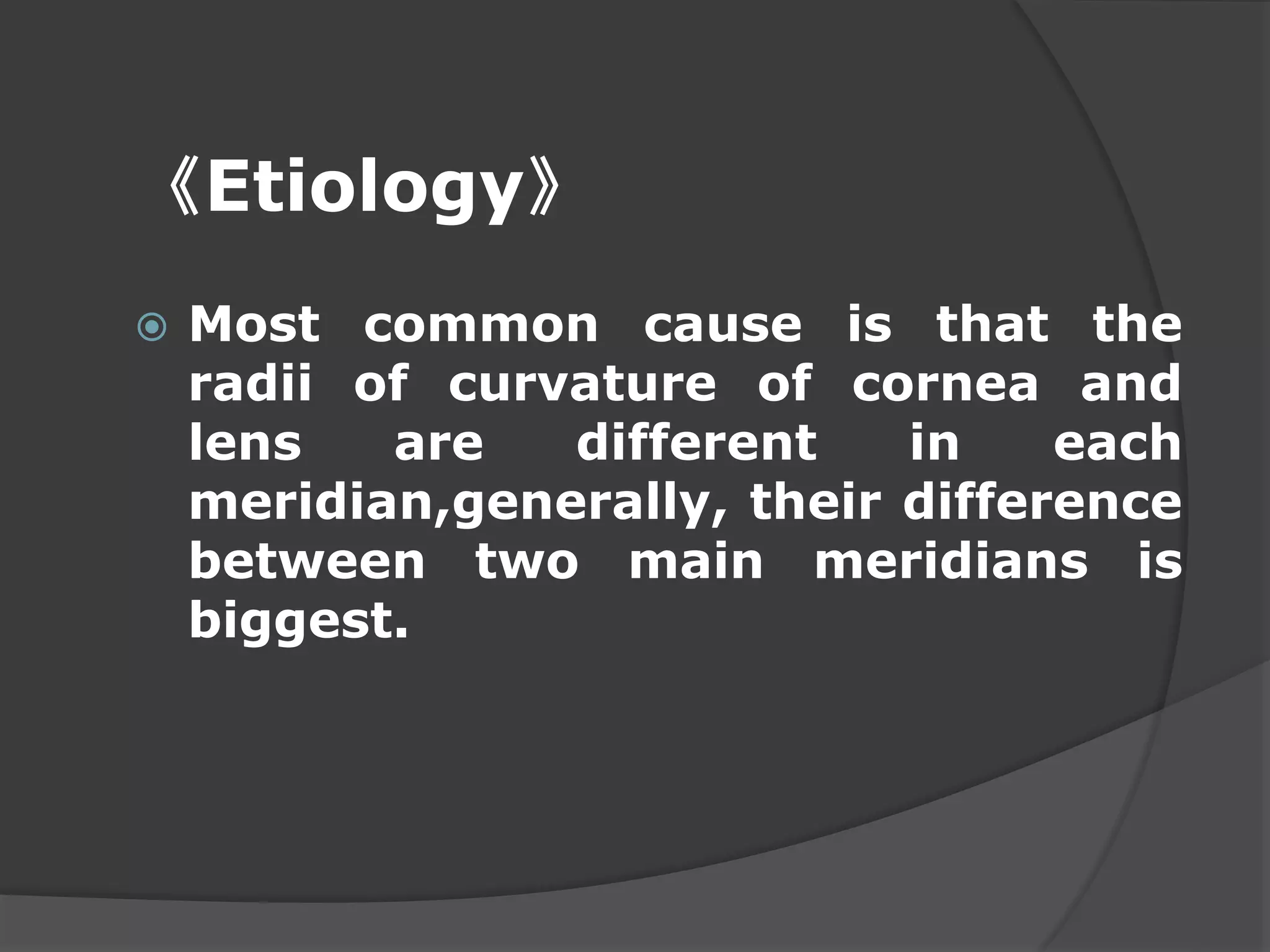
 Most common cause is that the
radii of curvature of cornea and
lens are different in each
meridian,generally, their difference
between two main meridians is
biggest.
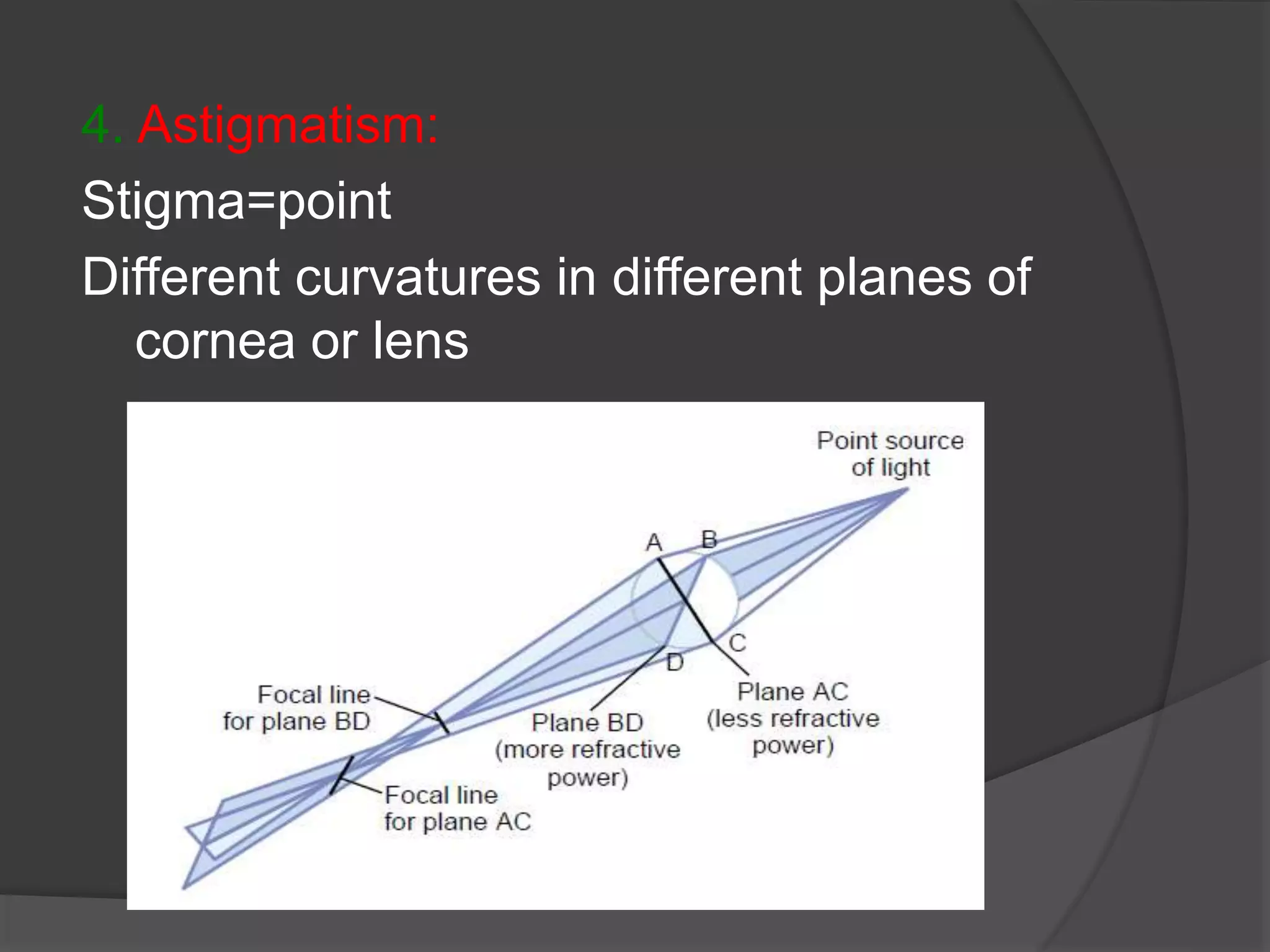
4. Astigmatism:
Stigma=point
Different curvatures in different planes of
cornea or lens
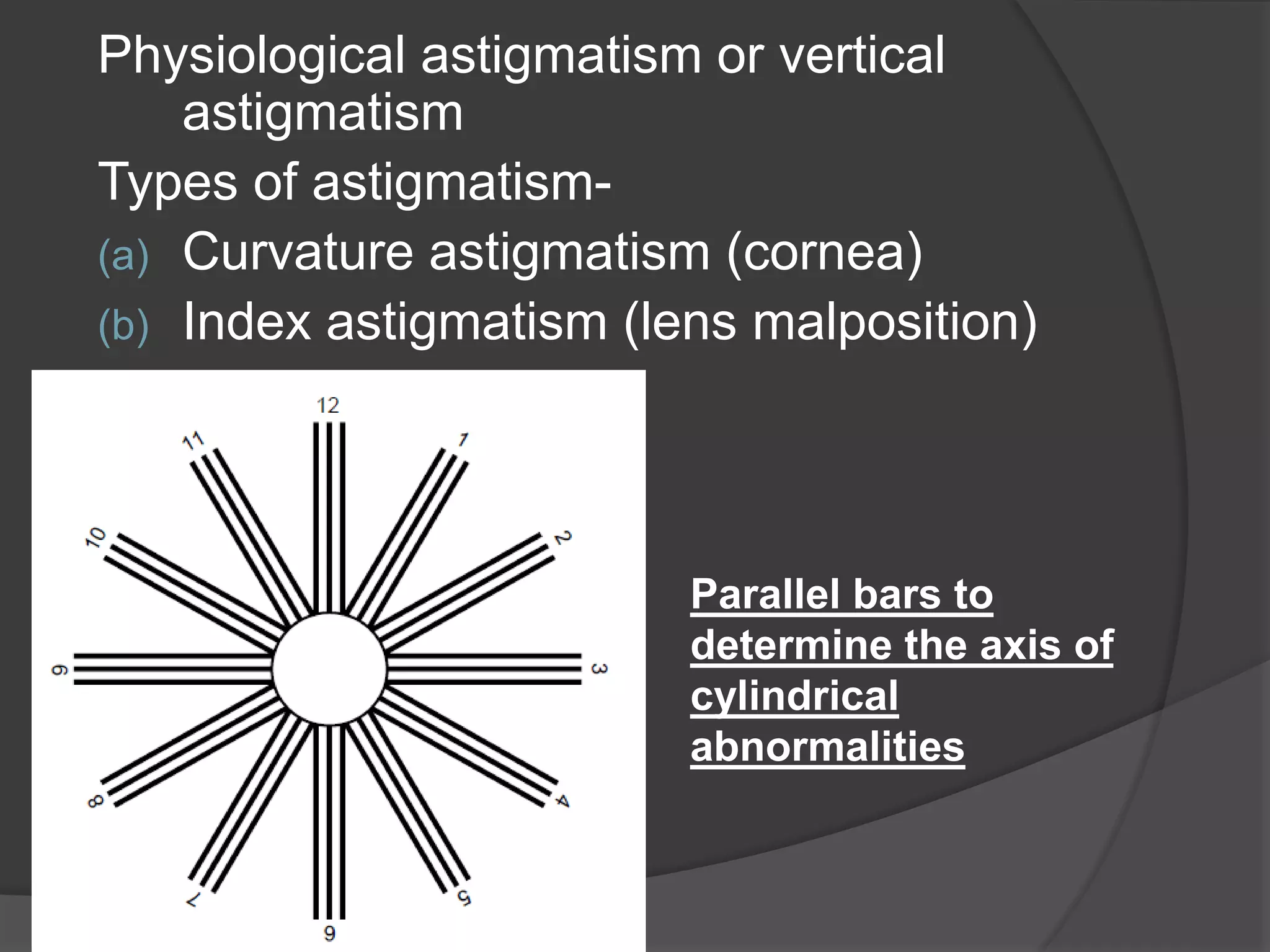
Physiological astigmatism or vertical
astigmatism
Types of astigmatism-
(a) Curvature astigmatism (cornea)
(b) Index astigmatism (lens malposition)
Parallel bars to
determine the axis of
cylindrical
abnormalities
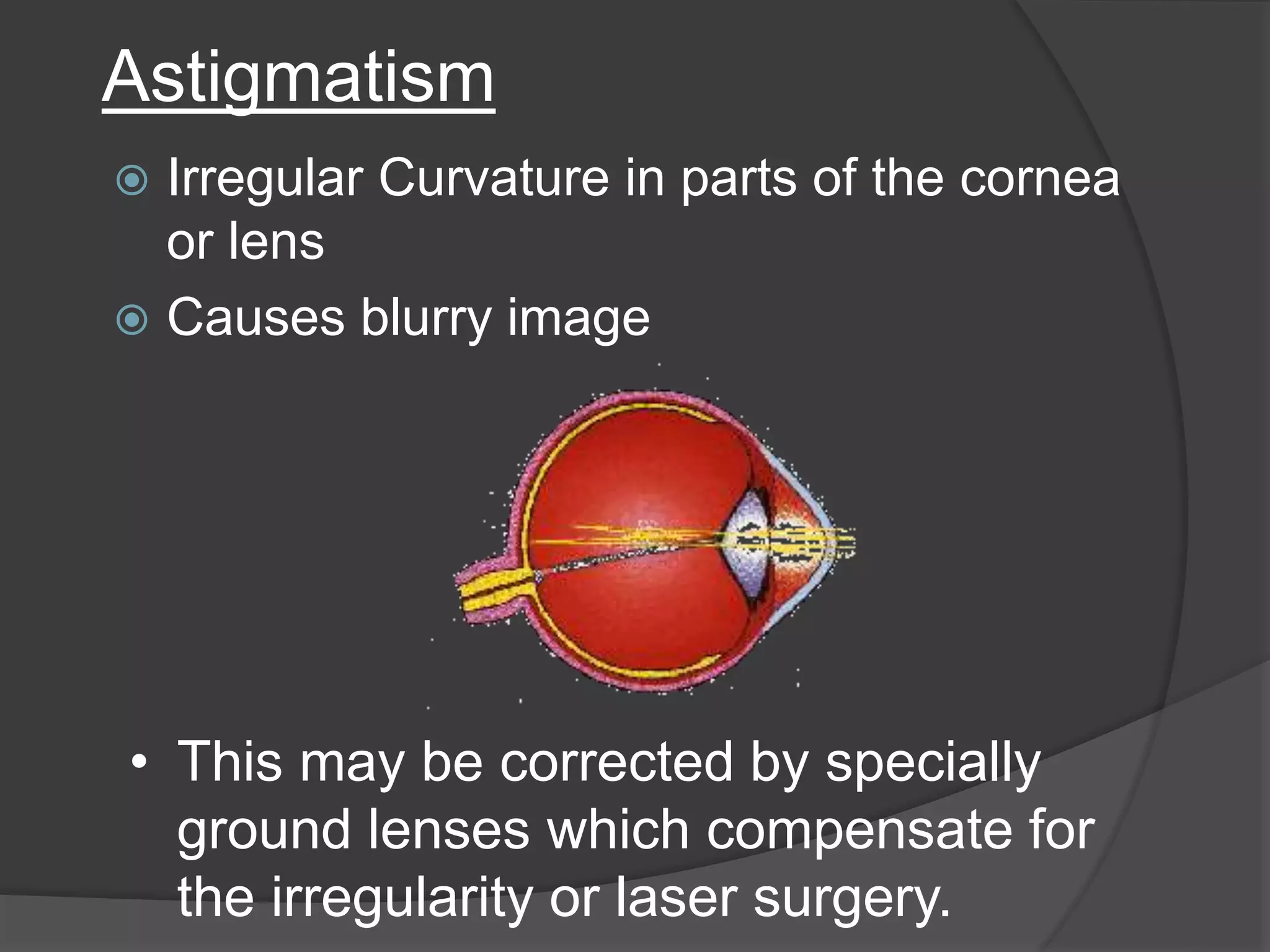
Astigmatism
 Irregular Curvature in parts of the cornea
or lens
 Causes blurry image
• This may be corrected by specially
ground lenses which compensate for
the irregularity or laser surgery.
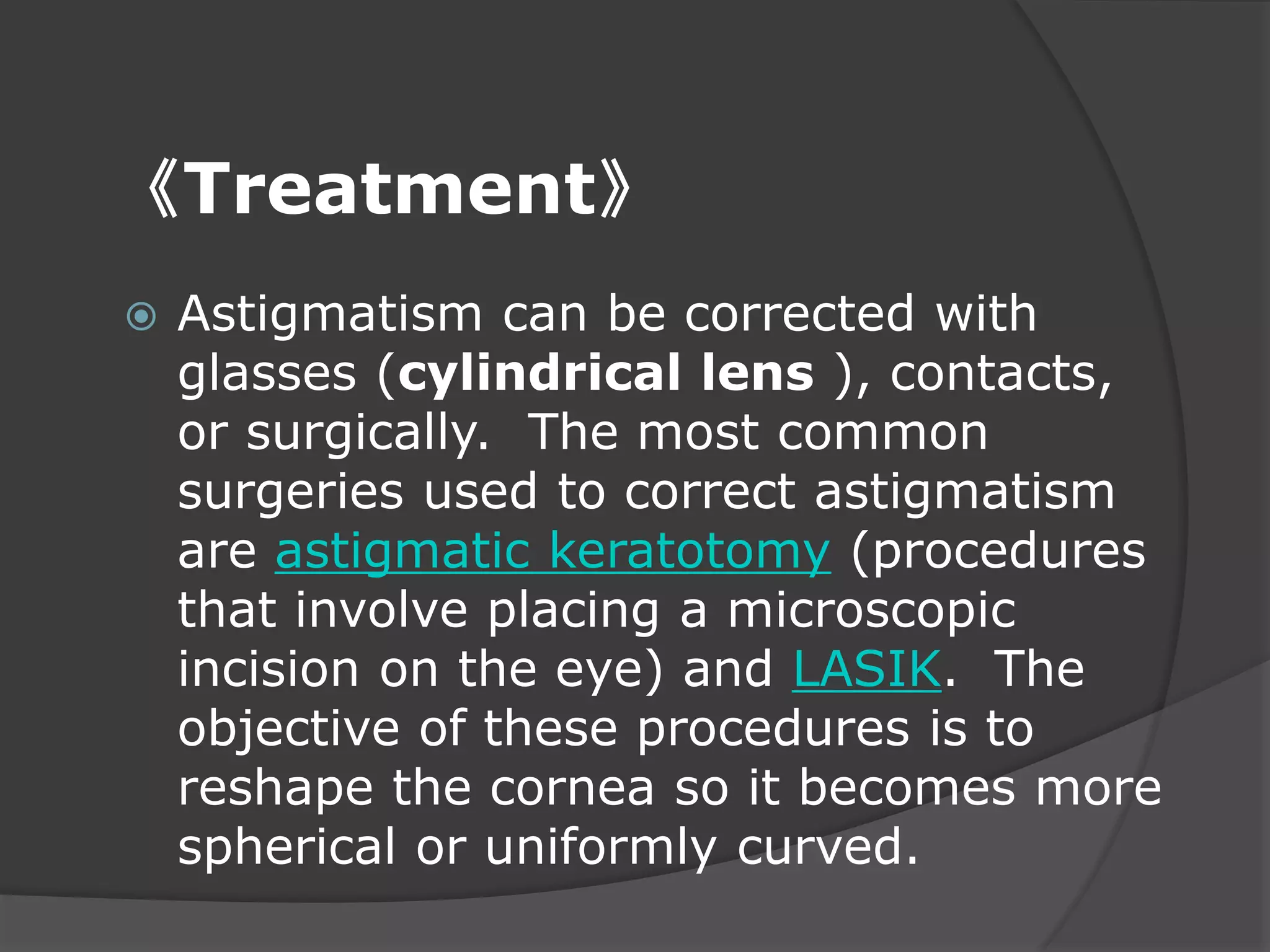
Treatment of astigmatism:
Spherical correction is done first for one of
the two planes of astigmatism 
Additional cylindrical correction is done in
the perpendicular plane
《Treatment》
 Astigmatism can be corrected with
glasses (cylindrical lens ), contacts,
or surgically. The most common
surgeries used to correct astigmatism
are astigmatic keratotomy (procedures
that involve placing a microscopic
incision on the eye) and LASIK. The
objective of these procedures is to
reshape the cornea so it becomes more
spherical or uniformly curved.
Optical aberration
 Spherical aberration:
Iris functions to reduce this by covering
periphery of the lens
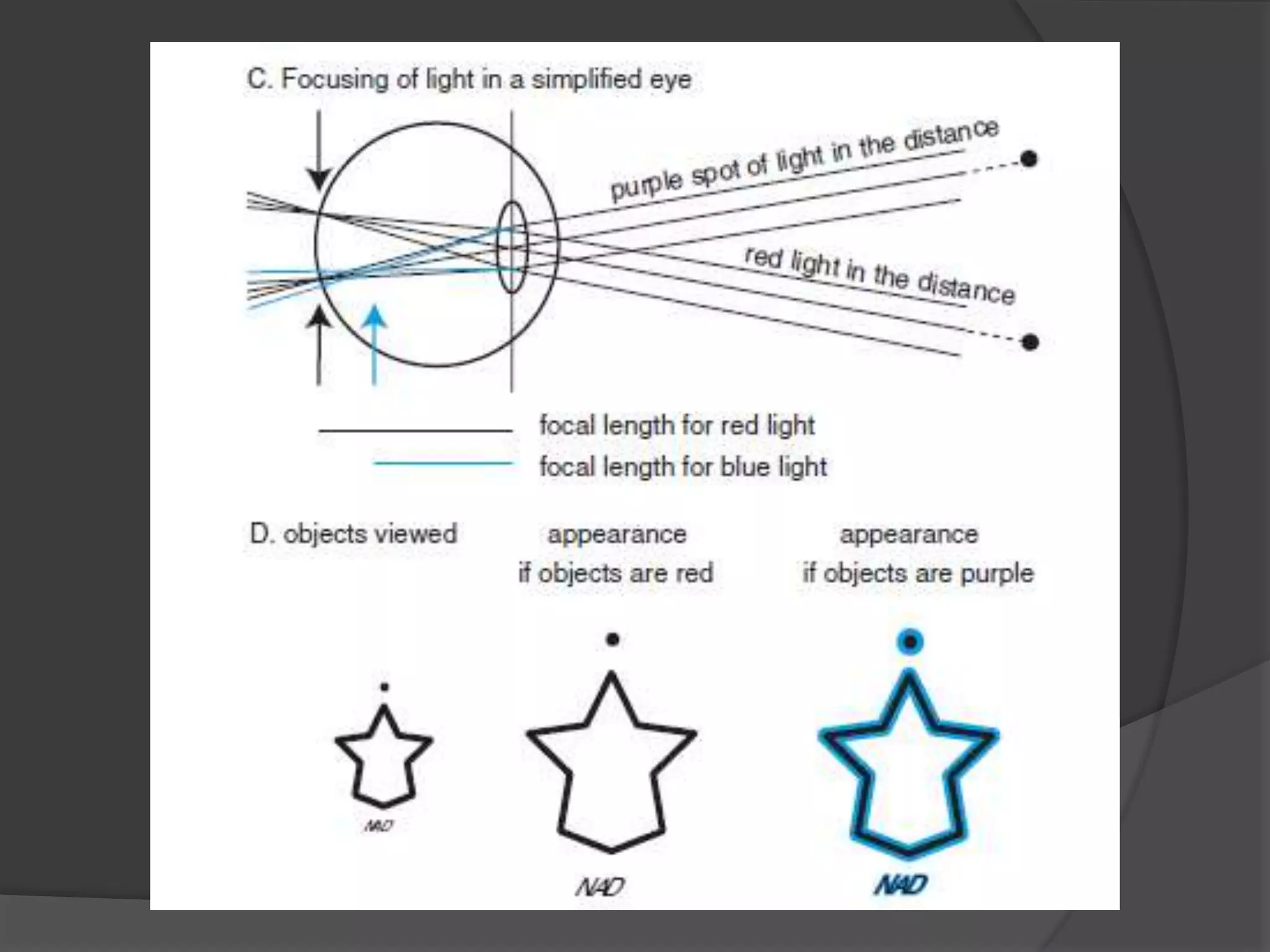
 Chromatic aberration:
Red color is refracted least & violet is refracted
most
Contact lens
 Broader field of clear vision
 No considerable reduction in object size
 No jack-in-box phenomenon
Cataract
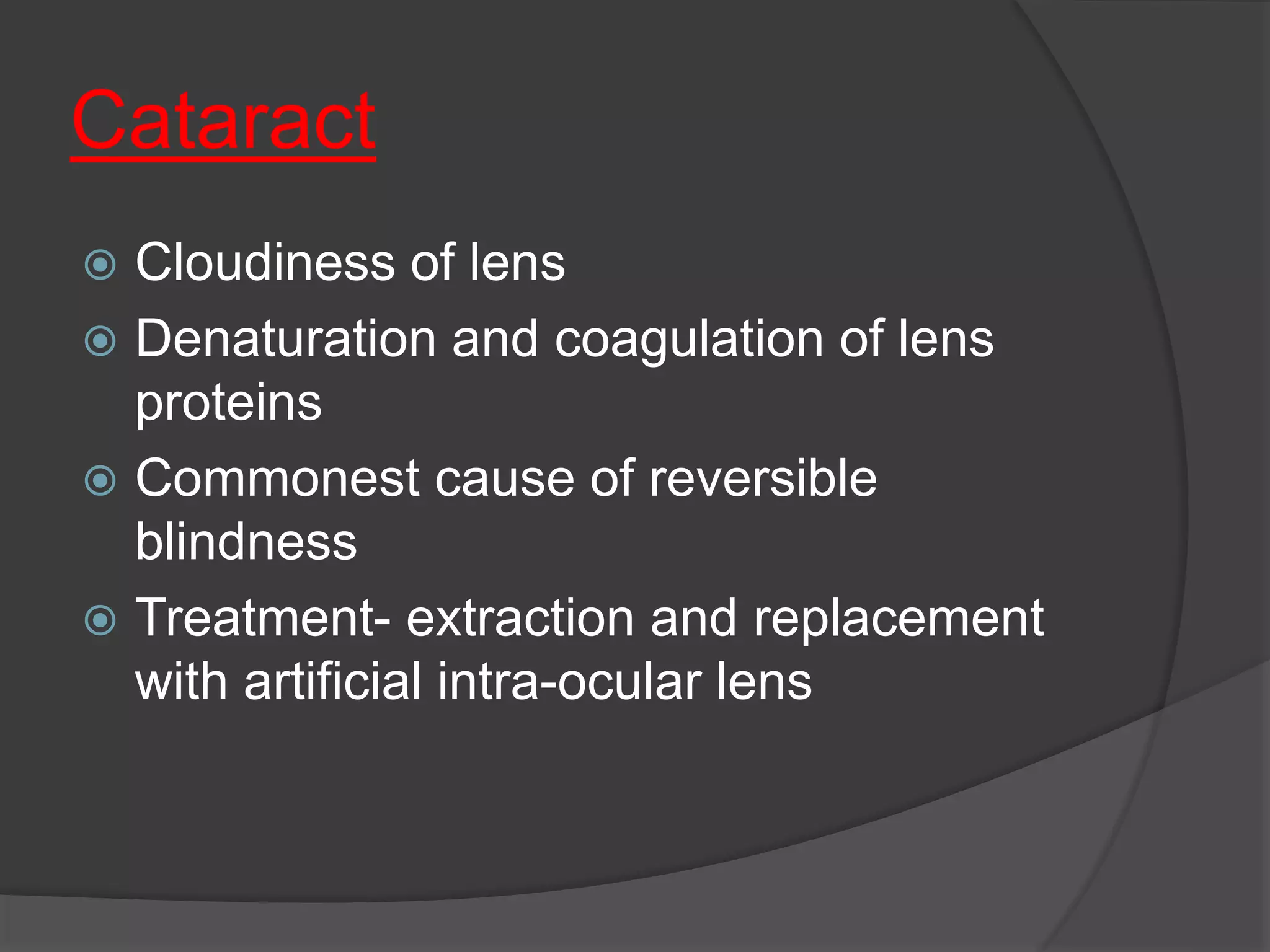
 Cloudiness of lens
 Denaturation and coagulation of lens
proteins
 Commonest cause of reversible
blindness
 Treatment- extraction and replacement
with artificial intra-ocular lens
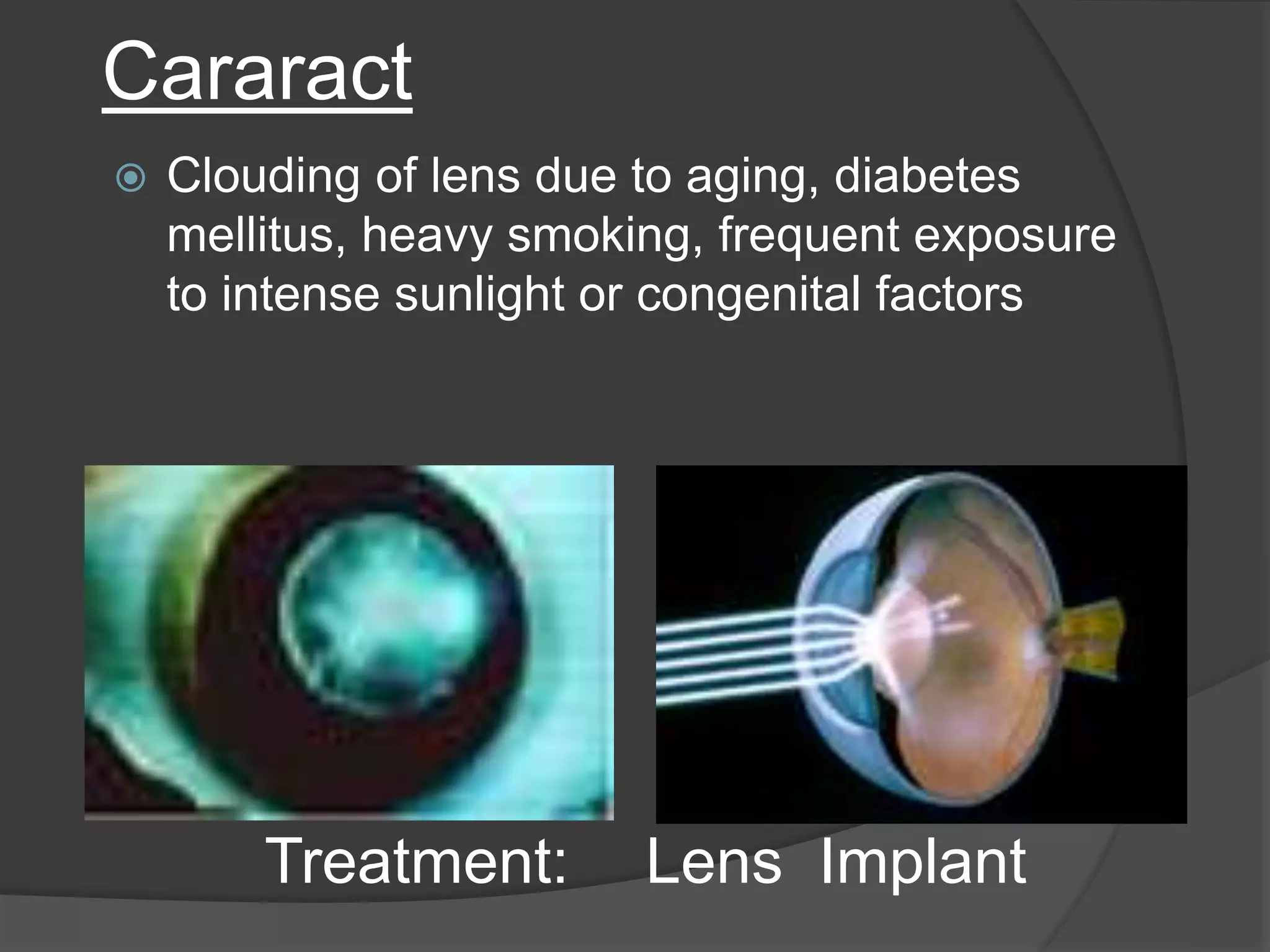
Cararact
 Clouding of lens due to aging, diabetes
mellitus, heavy smoking, frequent exposure
to intense sunlight or congenital factors
Treatment: Lens Implant
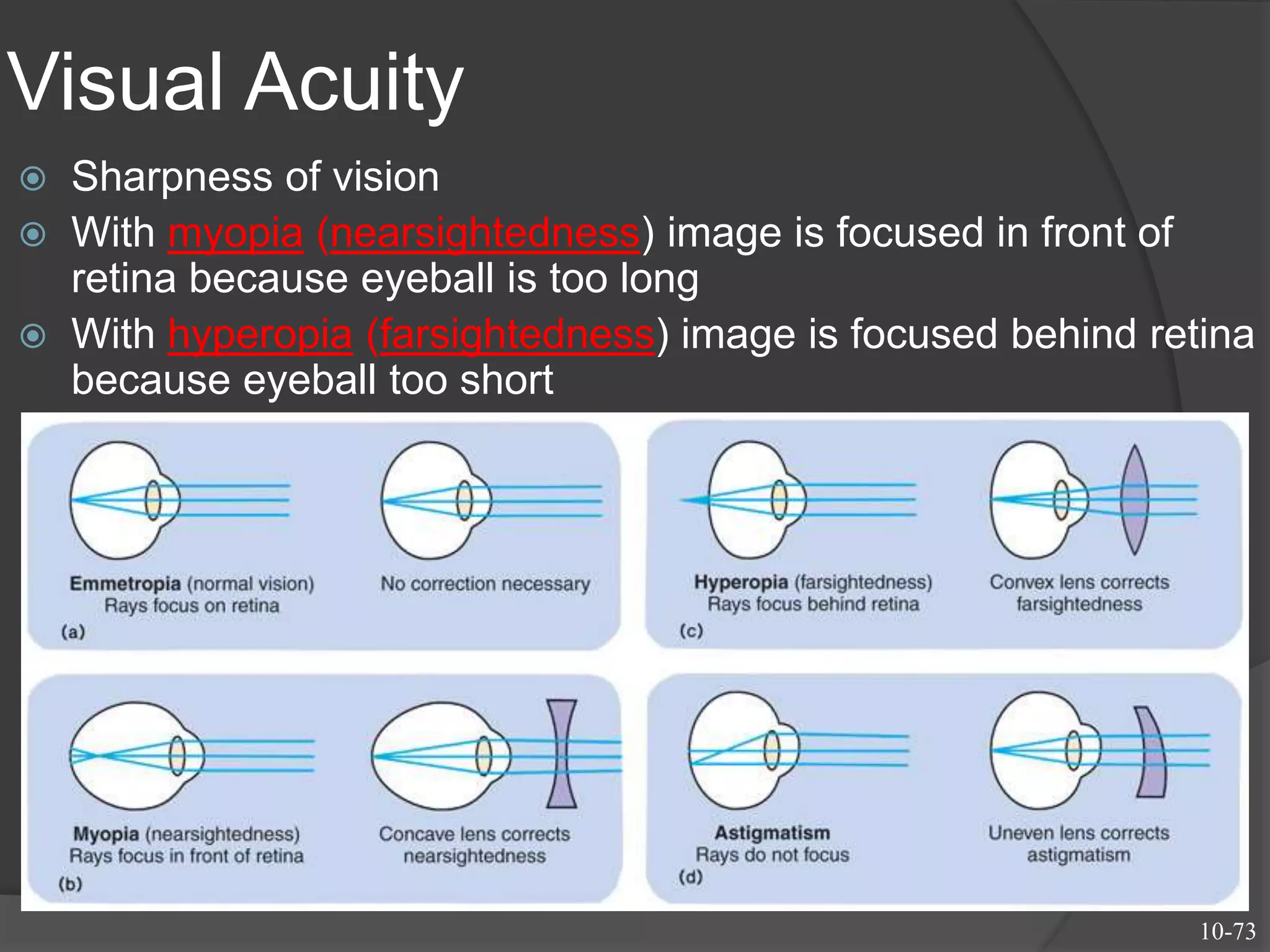
Visual Acuity
 Sharpness of vision
 With myopia (nearsightedness) image is focused in front of
retina because eyeball is too long
 With hyperopia (farsightedness) image is focused behind retina
because eyeball too short
10-73
Visual Acuity continued
 With astigmatism cornea or lens is not symmetrical
 Light is bent unevenly
10-74
Refrective errors of eyes

Refrective errors of eyes

  • 2.
    Visual acuity  Itis the degree to which details and contours of the object are perceived,  it is expressed in term of visual angle
  • 3.
     Cone diameteris 1.5 μm  Two bright spots should be 2 μm apart for discrimination n- Nodal point AB- object ab- image AnB- Visual angle
  • 4.
     Normal visualacuity for discriminating between two point sources is 1 minute of an arc  Fovea is 0.5mm  Peripheral acuity is poor  Snellen’s chart and Jaeger’s chart
  • 5.
    Snellen’s chart Read froma distance of 6 mts
  • 6.
    Jaeger’s chart Read froma distance of 25 cms
  • 7.
    Factors affecting visual acuity 1.Optical factors- state of image forming mechanisms of eye 2. Retinal factors- fovea has better acuity 3. Stimulus factors- (i) Size of the object (ii) Color of the object (iii) Illumination (iv) Contrast (v) Brightness (vi) Duration of exposure
  • 8.
    Field of vision Def:All the surroundings visible when the vision is fixed Methods of assessment: (i) Perimetry (ii) Confrontation method Blind spot- 3mm medial to & slightly above posterior pole Scotoma- Blind spots in regions other than optic disc
  • 11.
    Normal refractive condition (1). Ocular refractive system  The ocular refractive system is composed of the cornea,the aqueous humor,the lens and the vitreous.
  • 12.
    People can seeobject clearly ,for the light rays sent out by object pass through eye refractive system, form images on retinal macula.
  • 13.
    Refractive condition isdecided by the refractive power and length of ocular axis.
  • 14.
    Reduced eye orschematic eye  All the refractive surfaces of eye are algebraically added & considered as a single lens  It has a central point 17mm in front of retina  Refractive power of +59D- 2/3rds provided by cornea & 1/3rd by lens
  • 15.
    Refractive power  Refractivepower is diopter (D), if the focal length of a spherical lens is 1m, its refractive power is one diopter (D). D =1/ f  Corneal refractive system : 43.05D  Lens refractive system:19.11D  Total refractive power of globe : 58.64D
  • 16.
    Emmetropia  Emmetropia: Thecondition is the absence of refractive error. Or nonaccommodated paralle light rays refracted by ocular refractive system accurately focus on the retina which is called emmetropia.
  • 17.
    2) Ametropia(nonemmetropia)  Ametropioa: The refractive power and the length of the globe are not correlated so that parallel light rays refracted by ocular refractive system do not come to focus on the retina (fovea centralis). Including hypermetropia, myopia and astigmatism. Or is the presence of refractive error.
  • 18.
    Errors of refraction 1.Myopia: near sightedness Correction- concave lens 2. Hypermetropia: far sightedness uses accommodation Correction- convex lens 3. Emmetropia: sharp normal vision
  • 20.
    (1)Myopia(nearsighted)  Under nonaccommodatedcondition, parallel light rays refracted by ocular refractive system come to focus in front of the retina  Classification: ★ Mild:below -3D ★ Moderate:from-3D to -6D ★ High myopia:more than -6D
  • 21.
    Myopia (Nearsighted)  Eyeballtoo long  Distant objects focused in front of retina  Image striking retina is blurred Correction: • Concave lens or • laser surgery to slightly flatten the cornea
  • 22.
  • 23.
    (1)Myopia(nearsighted)  Nearsightedness ormyopia, occurs when light entering the eye focuses in front of the retina instead of directly on it. This is caused by a cornea that is steeper, or an eye that is longer, than a normal eye. Nearsighted people typically see well up close, but have difficulty seeing far away.
  • 24.
    (1)Myopia (nearsightedness)  Thisproblem is often discovered in school-age children who report having trouble seeing the chalkboard.
  • 25.
  • 26.
    《Etiology》  ‹1›.Axial myopia:Axial of the eye is quite long,but the refractive power is normal. *The eye longer than average *Most high myopia are axial
  • 27.
    《Etiology》  ‹2›.Refractive myopia:The axis is normal but the refractive power increases.
  • 28.
  • 31.
    .Hypermetropia  Hypermetropia isthe state in which the unaccommodated eye would focus the image behind the retina.  Parallel light rays refracted by ocular refractive system focus behind the retina, not form clear image.
  • 32.
    Hypermetropia (Farsightedness)  Eyeballtoo short, lens too thin or too stiff.  Nearby objects are focused behind retina.  Image striking the fovea is blurred. Correction: • Convex lens
  • 33.
  • 34.
    Hypermetropia  Farsightedness orhyperopia, occurs when light entering the eye focuses behind the retina, instead of directly on it.  This is caused by a cornea that is flatter, or an eye that is shorter, than a normal eye. Farsighted people usually have trouble seeing up close, but may also have difficulty seeing far away as well.
  • 35.
    Hypermetropia  Young peoplewith mild to moderate hyperopia are often able to see clearly because their natural lens can adjust, or accommodate to increase the eye’s focusing ability.  However, as the eye gradually loses the ability to accommodate (beginning at about 40 years of age), blurred vision from hyperopia often becomes more apparent.
  • 36.
    Hypermetropia  Signs andSymptoms  Difficulty seeing up close  Blurred distance vision (occurs with higher amounts of hyperopia)  Eye fatigue when reading   Eye strain (headaches, pulling sensation, burning)
  • 37.
    Hypermetropia  Classification Mild: lessthan+ 3D,  moderate: +5D or less than +5D  High: more than +5D
  • 38.
    《Etiology》  ‹1›.Axial hyperopiais indicated that ocular axis is short but refractive power is normal.  ‹2›.Refractive hyperopia is indicated that ocular axis is normal, but refractive power is weak.
  • 39.
    《Clinical findings》  ‹1›.Visualacuity Mild hyperopia may be compensated by accommodation, so far or near vision may be normal in mild hyperopia of juvenile,  if the degree of hyperopia is large or accommodative power decreases with aging, both far and near vision decrease in different degrees, and near vision is much worse than far one.
  • 40.
    《Clinical findings 》 ‹2›. Asthenopia Long-term near work, excessive accommodation often may induce asthenopia, its symptom is blurred vision, distending pain in superciliary arch.  ‹3›. Esotropia Due to excessive accommodation leading to more convergence which is easy to induce esotropia .
  • 47.
  • 48.
    Presbyopia  With age,lens becomes less elastic  Accommodation power becomes +2D at 50 yrs and 0D at 70yrs of age  Person needs bifocal lens
  • 49.
    . Presbyopia  Presbyopia,also known as the “short arm syndrome,” is a term used to describe an eye in which the natural lens can no longer accommodate. With aging, accommodative function decreases gradually, at about 40-45 years of age, difficulty takes place in near work or reading, this decrease of physiologic accommodation caused by aging is known as presbyopia.
  • 50.
    《Clinical finding》  Mostpeople first notice difficulty reading very fine print such as the phone book, a medicine bottle, or the stock market page. Print seems to have less contrast and the eyes become easily fatigued when reading a book or computer screen. The symptom of presbyopia is difficult to see near thing.
  • 51.
    Signs and Symptoms Difficulty seeing clearly for close work  Print seems to have less contrast  Brighter, more direct light required for reading  Reading material must be held further away to see (for some)  Fatigue and eyestrain when reading 
  • 52.
  • 55.
    (3). Astigmatism  Dueto the difference of refractive power in every meridian of eye, so outside light rays can’t focus on the retina to form clear image.
  • 56.
    (3). Astigmatism  Astigmatismmeans that the cornea is oval instead of spherical like a basketball. Most astigmatic corneas have two curves – a steeper curve and a flatter curve. This causes light to focus on more than one point in the eye, resulting in blurred vision at distance or near. Astigmatism often occurs along with nearsightedness or farsightedness.
  • 57.
    《Etiology》  Most commoncause is that the radii of curvature of cornea and lens are different in each meridian,generally, their difference between two main meridians is biggest.
  • 58.
    4. Astigmatism: Stigma=point Different curvaturesin different planes of cornea or lens
  • 59.
    Physiological astigmatism orvertical astigmatism Types of astigmatism- (a) Curvature astigmatism (cornea) (b) Index astigmatism (lens malposition) Parallel bars to determine the axis of cylindrical abnormalities
  • 60.
    Astigmatism  Irregular Curvaturein parts of the cornea or lens  Causes blurry image • This may be corrected by specially ground lenses which compensate for the irregularity or laser surgery.
  • 61.
    Treatment of astigmatism: Sphericalcorrection is done first for one of the two planes of astigmatism  Additional cylindrical correction is done in the perpendicular plane
  • 62.
    《Treatment》  Astigmatism canbe corrected with glasses (cylindrical lens ), contacts, or surgically. The most common surgeries used to correct astigmatism are astigmatic keratotomy (procedures that involve placing a microscopic incision on the eye) and LASIK. The objective of these procedures is to reshape the cornea so it becomes more spherical or uniformly curved.
  • 63.
    Optical aberration  Sphericalaberration: Iris functions to reduce this by covering periphery of the lens  Chromatic aberration: Red color is refracted least & violet is refracted most
  • 65.
    Contact lens  Broaderfield of clear vision  No considerable reduction in object size  No jack-in-box phenomenon
  • 66.
    Cataract  Cloudiness oflens  Denaturation and coagulation of lens proteins  Commonest cause of reversible blindness  Treatment- extraction and replacement with artificial intra-ocular lens
  • 67.
    Cararact  Clouding oflens due to aging, diabetes mellitus, heavy smoking, frequent exposure to intense sunlight or congenital factors Treatment: Lens Implant
  • 68.
    Visual Acuity  Sharpnessof vision  With myopia (nearsightedness) image is focused in front of retina because eyeball is too long  With hyperopia (farsightedness) image is focused behind retina because eyeball too short 10-73
  • 69.
    Visual Acuity continued With astigmatism cornea or lens is not symmetrical  Light is bent unevenly 10-74