Farhana Adnin
B.Optom,4th batch,
Institute of Community Ophthalmolog
University of Chittagong
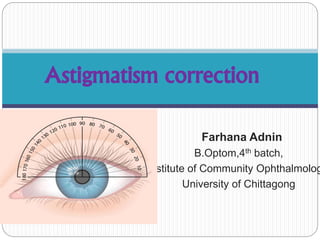
Astigmatism correction
Definition ???
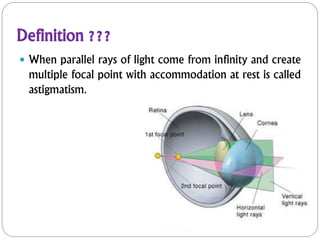
 When parallel rays of light come from infinity and create
multiple focal point with accommodation at rest is called
astigmatism.
For example
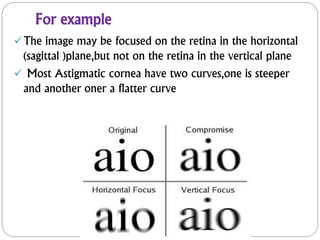
The image may be focused on the retina in the horizontal
(sagittal )plane,but not on the retina in the vertical plane
 Most Astigmatic cornea have two curves,one is steeper
and another oner a flatter curve
OPTICS…
A.Compound
Hyp.Astig
B.Simpl
e
Hyp.
C D E –Mixed Astig
F.Simple
Myop.A
G.Compound
Myop.A
Classification…
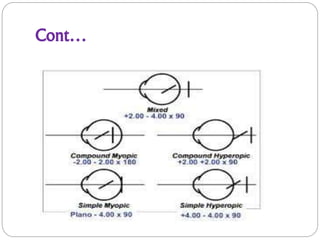
Based on focus of the principal meridian-
1. Simple astigmatism:
 Simple hyperopic astigmatism
 Simple myopic astigmatism
2.Compound astigmatism:
Compound hyperopic astigmatism
Compound myopic astigmatism
3.Mixed astigmatism
Cont…
Continue…
Based on axis of the principal meridians-
1.Regular astigmatism:
With the rule astigmatism
Against the rule astigmatism
Oblique astigmatism
2. Irregular astigmatism
Based on severity-
Mild astigmatism : <1 D
Moderate astigmatism : 1.00 to 2.00 D
 Severe astigmatism : 2.00 to 3.00 D
 Extreme astigmatism : > 3.00 D
Regular Astigmatism…
When horizontal and vertical meridians are at right angle
to each other.
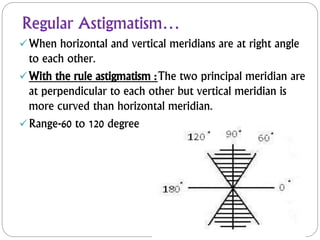
With the rule astigmatism :The two principal meridian are
at perpendicular to each other but vertical meridian is
more curved than horizontal meridian.
Range-60 to 120 degree
Cont…
Against the rule astigmatism : In which the horizontal
meridian is more curved than the vertical meridian.
Range : 0 to 30 degree,
150 to 180 degree.
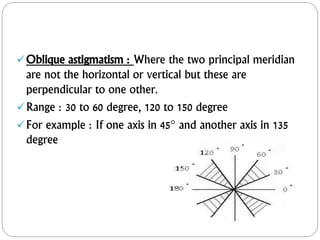
Oblique astigmatism : Where the two principal meridian
are not the horizontal or vertical but these are
perpendicular to one other.
Range : 30 to 60 degree, 120 to 150 degree
For example : If one axis in 45 and another axis in 135
degree
Regular astigmatism…
Etiology
1.Corneal - abnormalities of curvature [common]
2. Lenticular- rare. It may be:
i. Curvatural - abnormalities of curvature of lens as seen in
lenticonus.
ii. Positional - tilting or oblique placement of lens ,
subluxation.
iii. iii. Index astigmatism – variable refractive index in
different meridian.
3. Retinal - oblique placement of macula [rare]
Cont..
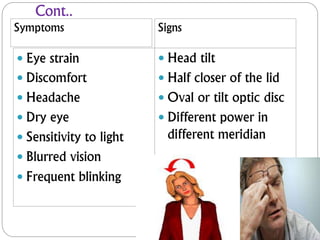
 Eye strain
 Discomfort
 Headache
 Dry eye
 Sensitivity to light
 Blurred vision
 Frequent blinking
 Head tilt
 Half closer of the lid
 Oval or tilt optic disc
 Different power in
different meridian
Symptoms Signs
Cont..
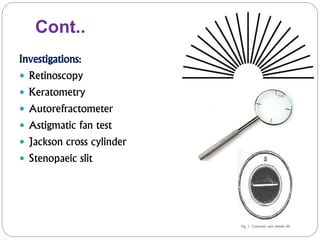
Investigations:
 Retinoscopy
 Keratometry
 Autorefractometer
 Astigmatic fan test
 Jackson cross cylinder
 Stenopaeic slit
cont…
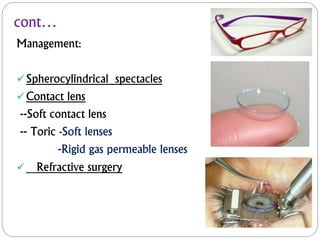
Management:
Spherocylindrical spectacles
Contact lens
--Soft contact lens
-- Toric -Soft lenses
-Rigid gas permeable lenses
 Refractive surgery
Refractive surgeries
 Astigmatic Keratotomy-upto 4-6D
 Photo Astigmatic refractive Keratectomy [PARK]- upto 3D
 LASIK surgery-upto 5-10D
Irregular Astigmatism
Defective vision
Distortion of objects
Polyopia
 Irregular pupillary reflex
 Corneal irregularity
 Irregular corneal curvature
Symptoms Signs
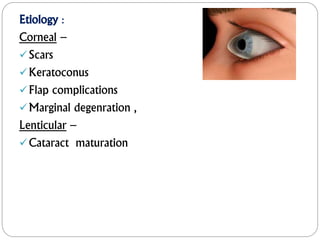
Etiology :
Corneal –
Scars
Keratoconus
Flap complications
Marginal degenration ,
Lenticular –
Cataract maturation
Investigations:
 Placido's disc test reveals distorted circles
 Corneal topography
 Penta cam
Treatment :
1.Optical treatment :
RGP contact lenses
Hybrid contact lenses
Scleral lenses
Piggyback lens
2.Corneal Cross-Linking With Riboflavin and Ultraviolet
Irradiation
3.Penetrating Keratoplasty [PKP]
4.Deep Anterior Lamellar Keratoplasty [DALK] etc.
Physiological astigmatism
 Diameter of cornea in vertical axis is 11.5mm and in horizontal
meridian is 12mm.
 This means horizontal meridian is flatter than vertical.
 Because diameter is inversely proportional to curvature.
 Occur as lid press on anterior corneal surface.
 Make vertical meridian steeper
 Only small astigmatic error
 Usually 0.12D
 No treatment required
Total astigmatism…
Corneal astigmatism: When the cornea has unequal
curvature or dioptric power on the anterior surface.
Internal astigmatism: It occurs due to posterior surface
of cornea & tilting of crystalline lens.
Total astigmatism: The sum of corneal & internal
astigmatism.
Residual astigmatism:
The amount of astigmatism that still remains after correction of
a refractive error.
In the case of correction of corneal astigmatism using rigid
contact lens ,lenticular residual astigmatism is exposed.
Surgical induced astigmatism…
 Usually following cataract surgery
 Induced by incission or suture
 If without suture ---
Against the rule astigmatism (superior limbal incission)
With the rule astigmatism (temporal limbal incission)
 If with suture ----(Opposite )
With the rule astigmatism (superior limbal incission)
Against the rule astigmatism (temporal limbal incission)
Cont…
 Management:
After 1 month of surgery spectacles prescribed.
Others-
Selective removal of sutures:
If more than 2-3 D WTR astigmatism present then after 2
month , suture with the steepest curve must be removed.
Relaxing incisions combined with compression (upto 10D
etc
Case study
 MR-910951
 Name: Abdul Barek
 Age- 20 y
 Gender- Male
 C/O- Dimness of vision B/E
 VAR-6/60 |PH 6/9
 VAL-3/60 |PH 6/9
Objective refraction-
OD)-2.50D/-8.50DC @40deg
OS)-9.00D/-12.00DC@170deg
Subjective refraction-
OD)-2.00D/-6.00DC@40....6/18
OS)-8.00D/-8.00DC@170...6/24
No glass prescribed
Patient was given RGP contact lens
OD)-5.00/6.00/9.00...6/9
OS)-5.oo/7.15/9.20....6/9
When to prescribe...?
1.Symptomatic patient:
~rarely <-0.75DC uncorrected astigmatism induce
symptom especially @180 degree.
~but induce symptom for <+0.75DC @90 degree or
oblique astigmatism since they tend to guide
accommodation all the time towards the circle of least
confusion.
cont....
2.Amblyopia risk:
~If <2DC, need not to be prescribed, as it may interfere
with emmetropization. (<6yrs)
~but in case of oblique <1.25DC after the age of 2 years
should be prescribed.
~Astigmatism that could reduce acuity , especially at near
or creates symptoms need to be prescribed directly.
When not to be prescribed...
 1.History of dizziness, disorientation and ear
infections etc.
 2.Small amounts , first time user,
recheck..especially if habitual Rx had always been
spherical.
 3.Highly cylindrical corrections .Check axis and
amount at near. consider under correcting
according to findings
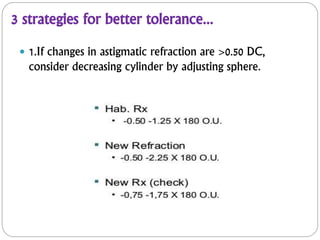
3 strategies for better tolerance...
 1.If changes in astigmatic refraction are >0.50 DC,
consider decreasing cylinder by adjusting sphere.
 2.Approach equality in cylindrical powers. Especially
when axis are oblique.
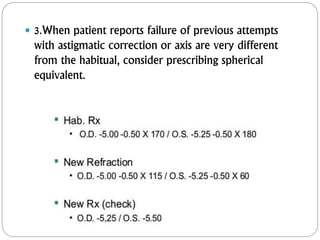
 3.When patient reports failure of previous attempts
with astigmatic correction or axis are very different
from the habitual, consider prescribing spherical
equivalent.
Key points before prescribing…
Keep axis as symmetrical as possible.
Keep axis as close to main meridians as possible.
Consult sensitive patients not to make significant changes
in frames shape.
Try to keep difference of correction between 2 eyes
within +/- 2.50DC.
More than 6DC should not be prescribed to make
grinding easier.
Reference...
 Primary care optometry
 Theory and practice of optics and refraction~
A.K.Khurana
 Essentials of Ophthalmology~ Samar K Basak
 Comprehensive Ophthalmplogy~ A.K.Khurana
 Internet
Astigmatism correction

Astigmatism correction

  • 1.
    Farhana Adnin B.Optom,4th batch, Instituteof Community Ophthalmolog University of Chittagong Astigmatism correction
  • 2.
    Definition ???  Whenparallel rays of light come from infinity and create multiple focal point with accommodation at rest is called astigmatism.
  • 3.
    For example The imagemay be focused on the retina in the horizontal (sagittal )plane,but not on the retina in the vertical plane  Most Astigmatic cornea have two curves,one is steeper and another oner a flatter curve
  • 4.
    OPTICS… A.Compound Hyp.Astig B.Simpl e Hyp. C D E–Mixed Astig F.Simple Myop.A G.Compound Myop.A
  • 5.
    Classification… Based on focusof the principal meridian- 1. Simple astigmatism:  Simple hyperopic astigmatism  Simple myopic astigmatism 2.Compound astigmatism: Compound hyperopic astigmatism Compound myopic astigmatism 3.Mixed astigmatism
  • 6.
  • 7.
    Continue… Based on axisof the principal meridians- 1.Regular astigmatism: With the rule astigmatism Against the rule astigmatism Oblique astigmatism 2. Irregular astigmatism Based on severity- Mild astigmatism : <1 D Moderate astigmatism : 1.00 to 2.00 D  Severe astigmatism : 2.00 to 3.00 D  Extreme astigmatism : > 3.00 D
  • 8.
    Regular Astigmatism… When horizontaland vertical meridians are at right angle to each other. With the rule astigmatism :The two principal meridian are at perpendicular to each other but vertical meridian is more curved than horizontal meridian. Range-60 to 120 degree
  • 9.
    Cont… Against the ruleastigmatism : In which the horizontal meridian is more curved than the vertical meridian. Range : 0 to 30 degree, 150 to 180 degree.
  • 10.
    Oblique astigmatism :Where the two principal meridian are not the horizontal or vertical but these are perpendicular to one other. Range : 30 to 60 degree, 120 to 150 degree For example : If one axis in 45 and another axis in 135 degree
  • 11.
    Regular astigmatism… Etiology 1.Corneal -abnormalities of curvature [common] 2. Lenticular- rare. It may be: i. Curvatural - abnormalities of curvature of lens as seen in lenticonus. ii. Positional - tilting or oblique placement of lens , subluxation. iii. iii. Index astigmatism – variable refractive index in different meridian. 3. Retinal - oblique placement of macula [rare]
  • 12.
    Cont..  Eye strain Discomfort  Headache  Dry eye  Sensitivity to light  Blurred vision  Frequent blinking  Head tilt  Half closer of the lid  Oval or tilt optic disc  Different power in different meridian Symptoms Signs
  • 13.
    Cont.. Investigations:  Retinoscopy  Keratometry Autorefractometer  Astigmatic fan test  Jackson cross cylinder  Stenopaeic slit
  • 14.
    cont… Management: Spherocylindrical spectacles Contact lens --Softcontact lens -- Toric -Soft lenses -Rigid gas permeable lenses  Refractive surgery
  • 15.
    Refractive surgeries  AstigmaticKeratotomy-upto 4-6D  Photo Astigmatic refractive Keratectomy [PARK]- upto 3D  LASIK surgery-upto 5-10D
  • 16.
    Irregular Astigmatism Defective vision Distortionof objects Polyopia  Irregular pupillary reflex  Corneal irregularity  Irregular corneal curvature Symptoms Signs
  • 17.
    Etiology : Corneal – Scars Keratoconus Flapcomplications Marginal degenration , Lenticular – Cataract maturation
  • 18.
    Investigations:  Placido's disctest reveals distorted circles  Corneal topography  Penta cam
  • 19.
    Treatment : 1.Optical treatment: RGP contact lenses Hybrid contact lenses Scleral lenses Piggyback lens 2.Corneal Cross-Linking With Riboflavin and Ultraviolet Irradiation 3.Penetrating Keratoplasty [PKP] 4.Deep Anterior Lamellar Keratoplasty [DALK] etc.
  • 20.
    Physiological astigmatism  Diameterof cornea in vertical axis is 11.5mm and in horizontal meridian is 12mm.  This means horizontal meridian is flatter than vertical.  Because diameter is inversely proportional to curvature.  Occur as lid press on anterior corneal surface.  Make vertical meridian steeper  Only small astigmatic error  Usually 0.12D  No treatment required
  • 21.
    Total astigmatism… Corneal astigmatism:When the cornea has unequal curvature or dioptric power on the anterior surface. Internal astigmatism: It occurs due to posterior surface of cornea & tilting of crystalline lens. Total astigmatism: The sum of corneal & internal astigmatism.
  • 22.
    Residual astigmatism: The amountof astigmatism that still remains after correction of a refractive error. In the case of correction of corneal astigmatism using rigid contact lens ,lenticular residual astigmatism is exposed.
  • 23.
    Surgical induced astigmatism… Usually following cataract surgery  Induced by incission or suture  If without suture --- Against the rule astigmatism (superior limbal incission) With the rule astigmatism (temporal limbal incission)  If with suture ----(Opposite ) With the rule astigmatism (superior limbal incission) Against the rule astigmatism (temporal limbal incission)
  • 24.
    Cont…  Management: After 1month of surgery spectacles prescribed. Others- Selective removal of sutures: If more than 2-3 D WTR astigmatism present then after 2 month , suture with the steepest curve must be removed. Relaxing incisions combined with compression (upto 10D etc
  • 25.
    Case study  MR-910951 Name: Abdul Barek  Age- 20 y  Gender- Male  C/O- Dimness of vision B/E  VAR-6/60 |PH 6/9  VAL-3/60 |PH 6/9 Objective refraction- OD)-2.50D/-8.50DC @40deg OS)-9.00D/-12.00DC@170deg Subjective refraction- OD)-2.00D/-6.00DC@40....6/18 OS)-8.00D/-8.00DC@170...6/24 No glass prescribed Patient was given RGP contact lens OD)-5.00/6.00/9.00...6/9 OS)-5.oo/7.15/9.20....6/9
  • 26.
    When to prescribe...? 1.Symptomaticpatient: ~rarely <-0.75DC uncorrected astigmatism induce symptom especially @180 degree. ~but induce symptom for <+0.75DC @90 degree or oblique astigmatism since they tend to guide accommodation all the time towards the circle of least confusion.
  • 27.
    cont.... 2.Amblyopia risk: ~If <2DC,need not to be prescribed, as it may interfere with emmetropization. (<6yrs) ~but in case of oblique <1.25DC after the age of 2 years should be prescribed. ~Astigmatism that could reduce acuity , especially at near or creates symptoms need to be prescribed directly.
  • 28.
    When not tobe prescribed...  1.History of dizziness, disorientation and ear infections etc.  2.Small amounts , first time user, recheck..especially if habitual Rx had always been spherical.  3.Highly cylindrical corrections .Check axis and amount at near. consider under correcting according to findings
  • 29.
    3 strategies forbetter tolerance...  1.If changes in astigmatic refraction are >0.50 DC, consider decreasing cylinder by adjusting sphere.
  • 30.
     2.Approach equalityin cylindrical powers. Especially when axis are oblique.
  • 31.
     3.When patientreports failure of previous attempts with astigmatic correction or axis are very different from the habitual, consider prescribing spherical equivalent.
  • 32.
    Key points beforeprescribing… Keep axis as symmetrical as possible. Keep axis as close to main meridians as possible. Consult sensitive patients not to make significant changes in frames shape. Try to keep difference of correction between 2 eyes within +/- 2.50DC. More than 6DC should not be prescribed to make grinding easier.
  • 33.
    Reference...  Primary careoptometry  Theory and practice of optics and refraction~ A.K.Khurana  Essentials of Ophthalmology~ Samar K Basak  Comprehensive Ophthalmplogy~ A.K.Khurana  Internet