The Light Field Stereoscope:
Immersive Computer Graphics via Factored
Near-Eye Light Field Displays with Focus Cues
Fu-Chung Huang1,2 Kevin Chen1 Gordon Wetzstein1
1Stanford University
2Now at NVIDIA Research
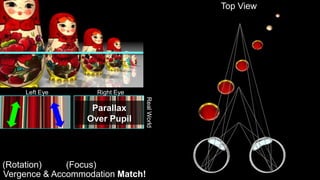
Top View
Vergence & Accommodation Match!
Left Eye Right Eye
(Rotation) (Focus)
RealWorld
Parallax
Over Pupil
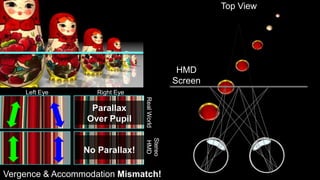
Top View
HMD
Screen
Stereo
HMD
Vergence & Accommodation Mismatch!
Left Eye Right Eye
RealWorld
No Parallax!
Parallax
Over Pupil
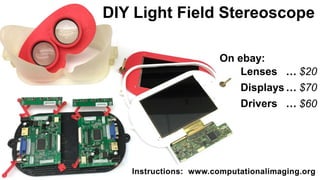
Lenses
Displays
Drivers
…
…
…
$20
$70
$60
On ebay:
DIY Light Field Stereoscope
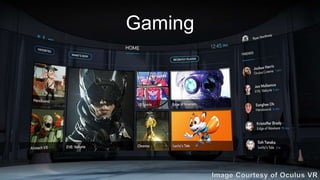
Gaming
Da vinci surgical system
HEALTH and SAFETY WARNING
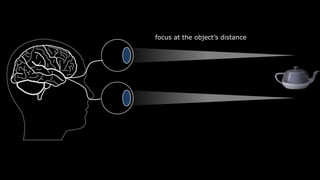
focus at the object’s distance
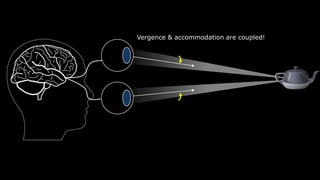
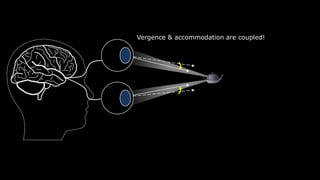
Vergence & accommodation are coupled!
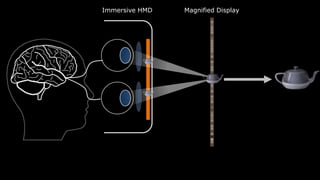
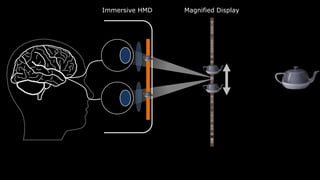
Immersive HMD Magnified Display
Decoupled!
Immersive HMD Magnified Display
!@#$$^R$%%&$
discomfort and fatigue, eyestrain, diplopic vision, headaches, nausea and …
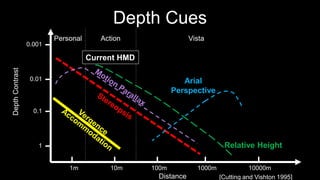
0.001
0.01
0.1
1
1m 10m 100m 1000m 10000m
Personal Action Vista
Relative Height
Arial
Perspective
DepthContrast
Distance [Cutting and Vishton 1995]
Current HMD
Depth Cues
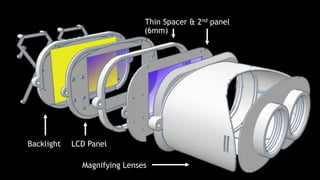
Backlight
Thin Spacer & 2nd panel
(6mm)
Magnifying Lenses
LCD Panel
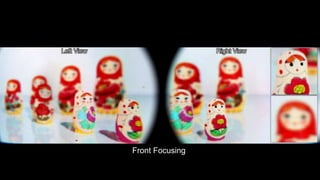
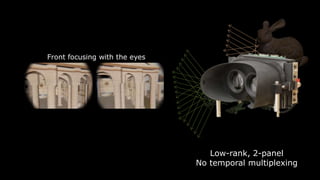
Front Focusing
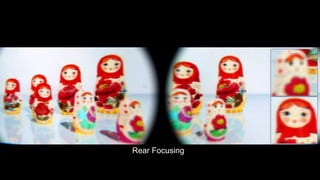
Rear Focusing
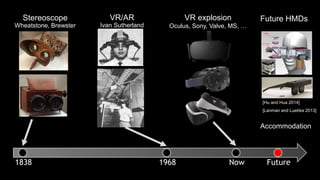
Stereoscope
Wheatstone, Brewster
1838
VR/AR
Ivan Sutherland
1968
VR explosion
Oculus, Sony, Valve, MS, …
Now Future
Future HMDs
Resolution
Latency
FOV
Form Factor
…
Accommodation
Stereoscope
Wheatstone, Brewster
1838
VR/AR
Ivan Sutherland
1968
VR explosion
Oculus, Sony, Valve, MS, …
Now Future
Future HMDs
[Lanman and Luebke 2013]
[Hu and Hua 2014]
Accommodation
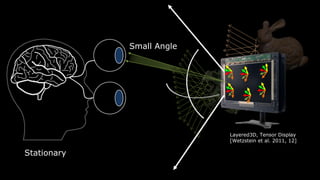
Object emits natural light rays
Light field enters eyes
Layered3D, Tensor Display
[Wetzstein et al. 2011, 12]
Small Angle
Stationary
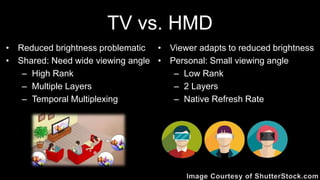
TV vs. HMD
• Reduced brightness problematic
• Shared: Need wide viewing angle
– High Rank
– Multiple Layers
– Temporal Multiplexing
• Viewer adapts to reduced brightness
• Personal: Small viewing angle
– Low Rank
– 2 Layers
– Native Refresh Rate
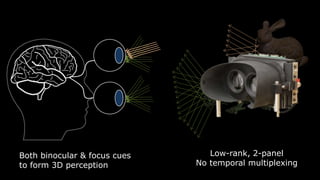
Low-rank, 2-panel
No temporal multiplexing
Both binocular & focus cues
to form 3D perception
Low-rank, 2-panel
No temporal multiplexing
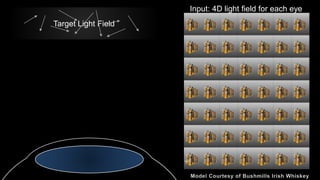
Target Light Field
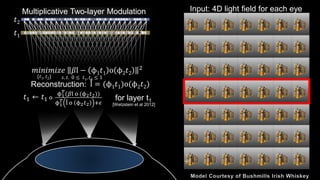
Input: 4D light field for each eye
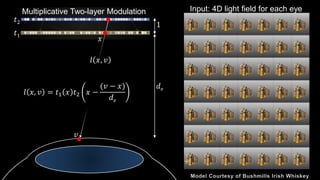
Multiplicative Two-layer Modulation
1
𝑙 𝑥, 𝑣
𝑥
𝑣
𝑡1
𝑡2
𝑙 𝑥, 𝑣 = 𝑡1 𝑥 𝑡2 𝑥 −
(𝑣 − 𝑥)
𝑑 𝑒
𝑑 𝑒
Input: 4D light field for each eye
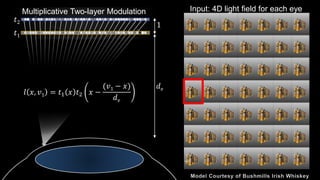
Multiplicative Two-layer Modulation
1
𝑡1
𝑡2
𝑙 𝑥, 𝑣1 = 𝑡1 𝑥 𝑡2 𝑥 −
(𝑣1 − 𝑥)
𝑑 𝑒
𝑑 𝑒
Input: 4D light field for each eye
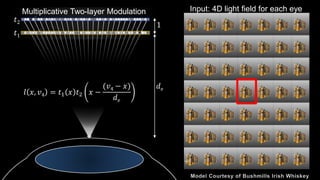
Multiplicative Two-layer Modulation
1
𝑡1
𝑡2
𝑙 𝑥, 𝑣4 = 𝑡1 𝑥 𝑡2 𝑥 −
(𝑣4 − 𝑥)
𝑑 𝑒
𝑑 𝑒
Input: 4D light field for each eye
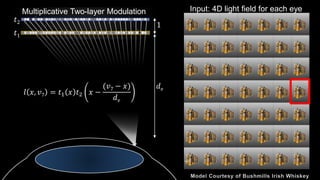
Multiplicative Two-layer Modulation
1
𝑡1
𝑡2
𝑙 𝑥, 𝑣7 = 𝑡1 𝑥 𝑡2 𝑥 −
(𝑣7 − 𝑥)
𝑑 𝑒
𝑑 𝑒
Input: 4D light field for each eye
Multiplicative Two-layer Modulation
𝑡1
𝑡2
Input: 4D light field for each eye
Parallax over the Pupil
Multiplicative Two-layer Modulation
𝑡1
𝑡2
l = (ϕ1 𝑡1)o(ϕ2 𝑡2)Reconstruction:
Input: 4D light field for each eye
𝑚𝑖𝑛𝑖𝑚𝑖𝑧𝑒 𝛽l − ϕ1 𝑡1 o ϕ2 𝑡2
2
{𝑡1, 𝑡2} 𝑠. 𝑡. 0 ≤ 𝑡1, 𝑡2 ≤ 1
𝑡1 ← 𝑡1 o
ϕ1
𝑇(𝛽l o (ϕ2 𝑡2))
ϕ1
𝑇 l o ϕ2 𝑡2 +𝜖
for layer t1
[Wetzstein et al 2012]
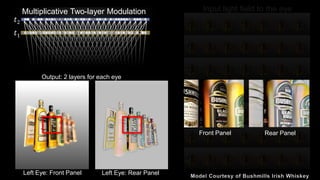
Input light field to the eyeMultiplicative Two-layer Modulation
𝑡1
𝑡2
Left Eye: Front Panel Left Eye: Rear Panel
Front Panel Rear Panel
Output: 2 layers for each eye
Front Focus Mid Focus Rear Focus
Front Object Mid Object Rear Object
Multiplicative Two-layer Modulation
𝑡1
𝑡2
Front Panel Rear Panel
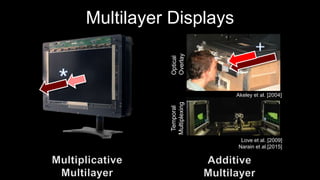
Multilayer Displays
Akeley et al. [2004]
Love et al. [2009]
Narain et al.[2015]
Optical
Overlay
Temporal
Multiplexing
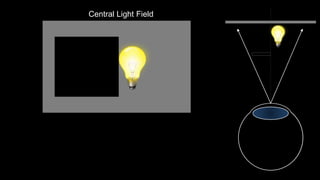
Central Light Field
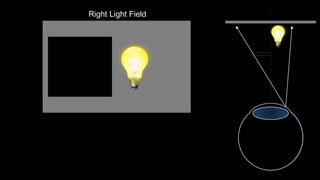
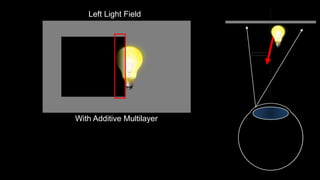
Right Light Field
Left Light Field
With Additive Multilayer
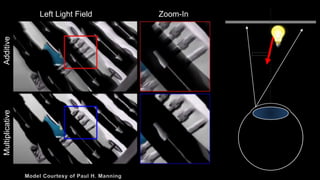
Left Light Field
Additive
Zoom-In
Multiplicative
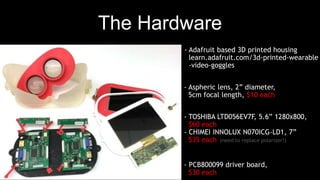
The Hardware
- Adafruit based 3D printed housing
learn.adafruit.com/3d-printed-wearable
-video-goggles
- Aspheric lens, 2” diameter,
5cm focal length, $10 each
- TOSHIBA LTD056EV7F, 5.6” 1280x800,
$60 each
- CHIMEI INNOLUX N070ICG-LD1, 7”
$35 each (need to replace polarizer!)
- PCB800099 driver board,
$30 each
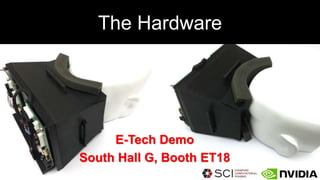
E-Tech Demo
South Hall G, Booth ET18
The Hardware
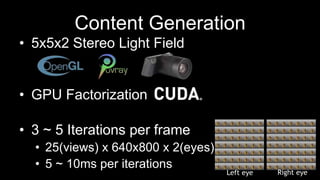
Content Generation
• 5x5x2 Stereo Light Field
• GPU Factorization
• 3 ~ 5 Iterations per frame
• 25(views) x 640x800 x 2(eyes)
• 5 ~ 10ms per iterations
Left eye Right eye
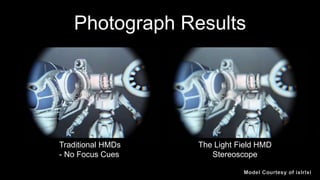
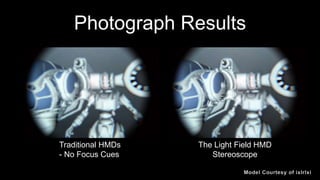
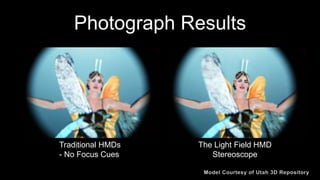
Photograph Results
Traditional HMDs
- No Focus Cues
The Light Field HMD
Stereoscope
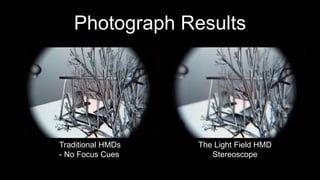
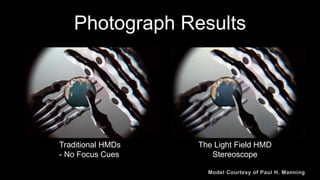
Photograph Results
Traditional HMDs
- No Focus Cues
The Light Field HMD
Stereoscope
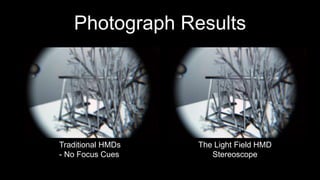
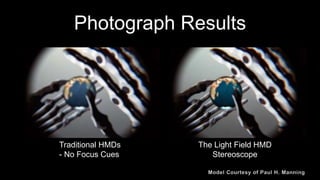
Photograph Results
Traditional HMDs
- No Focus Cues
The Light Field HMD
Stereoscope
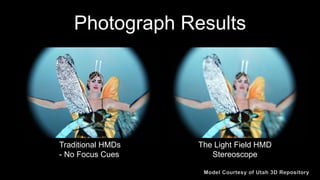
Photograph Results
Traditional HMDs
- No Focus Cues
The Light Field HMD
Stereoscope
Photograph Results
Traditional HMDs
- No Focus Cues
The Light Field HMD
Stereoscope
Photograph Results
Traditional HMDs
- No Focus Cues
The Light Field HMD
Stereoscope
Photograph Results
Traditional HMDs
- No Focus Cues
The Light Field HMD
Stereoscope
Photograph Results
Traditional HMDs
- No Focus Cues
The Light Field HMD
Stereoscope
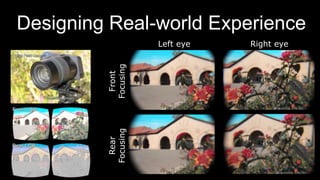
Designing Real-world Experience
Left eye Right eye
Front
Focusing
Rear
Focusing
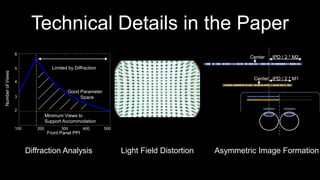
Technical Details in the Paper
Good Parameter
Space
Limited by Diffraction
100 200 300 400 500
2
3
5
6
4
Front Panel PPI
NumberofViews
Minimum Views to
Support Accommodation
IPD / 2 * M2
IPD / 2 * M1
Center
Center
Diffraction Analysis Light Field Distortion Asymmetric Image Formation
Discussion
• Reduction in brightness
• Latency: 5x5x2 views
• Diffraction
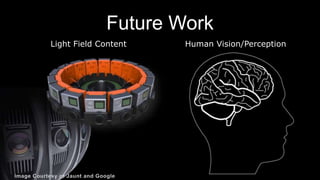
Future Work
Light Field Content Human Vision/Perception
IPD / 2 * M2
IPD / 2 * M1
Center
Center
Top View Light Field Side View Light Field

The Light Field Stereoscope | SIGGRAPH 2015

Editor's Notes

  • #3 Depth of field is a powerful tool to tell stories, But it also important for the eye to tell the difference in depth, even for a single eye. However, this focus cue is missing in the current generation Head mounted display In this talk, we will show you how to enable this for a comfortable visual experience.
  • #4 In real world, objects emits light field with parallax over the pupil that contains enough depth information, so our eye can not just verge to the target, which is a rotation, but also accommodate or focus to it. In this case, the two actions are always matched
  • #5 In the current VR head-mounted, There’s ony one display plane, and has no parallax, so the image always looks flat, that the eye cannot accommodate to the true depth. The mismatch between vergence and accommodation can sometimes cause discomfort, eye-strain, and even nausea
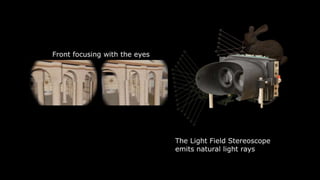
  • #6 In this work, we build a VR head-mount that is capable of emitting light field, allowing our eye to truly focus
  • #7 The prototype is also inexpensive and easy to build We all the resources and instruction online And we think this is gonna change the experience for future VR.
  • #8 So for the current generation VR headset, we all know that consumer VR is rising, and will be coming to us pretty soon.
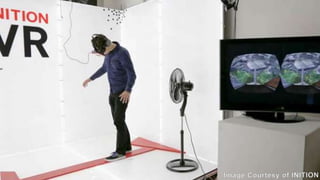
  • #9 While the majority of the advertisement is all about gaming
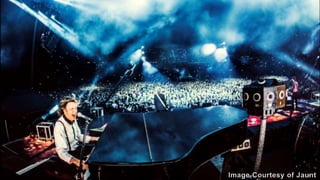
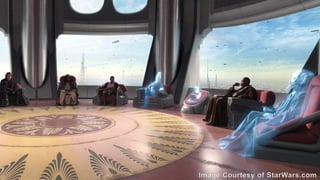
  • #10 you can also immerse yourself in real world event or places that you have never been
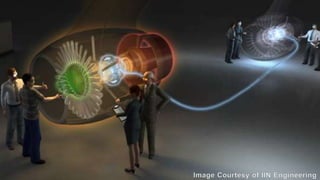
  • #11 It can also be used in collaborative work
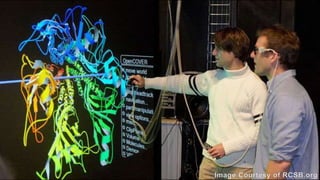
  • #12 In Educations
  • #13 help people treating Post Traumatic Stress Disorder
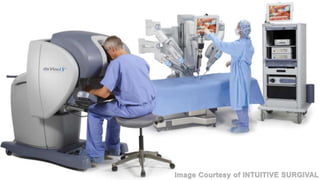
  • #14 On medical training or even remote surgery like the Da Vinci project Where doctors can spent hours in surgery and you really want them to be comfortable with that. All these applications sound exciting, but, there’s still a catch, it’s not perfect yet;
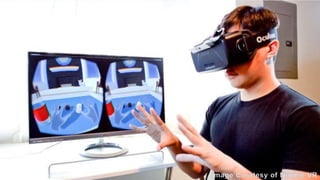
  • #15  Here is a safety warning from one of the recent VR device. It lists some symptoms that doesn’t sounds very pleasant, and there are many causes. But some of the symptoms like
  • #16 Eye-strain, blurred or double vision, Nausea, discomfort, or fatigue. are related to the Vergence-accommodation conflict, So why do we have these in HMD?
  • #17 In real-life, when looking at an object, the eyes focus at some distance
  • #18 And the eyes also verge or rotate so the two retinal images match. In this case, the vergence and the accommodation are coupled together
  • #19 When the object gets closer, The eyes accommodate more and also converge more, so that the two cues are still coupled.
  • #20 In an immersive Head-Mounted, we show two tiny objects on the panel near the eyes (click)After the magnification, the object appear to be on the right spot. (click)When the object moves further away
  • #21 We increases the separation or disparity
  • #22 And the eyes rotate away or diverge from each other. But since the eye is still focusing on the original depth, This separation decouples the vergence from the accomodation. (CLICK) And since our brain is so used to the coupling, the artificial separation leads to all kind of discomfort and problems
  • #23 Why do we even care about the problem? This diagram shows the importance of difference depth cue at different distance range (click)When objects are far away, we usually use the relative size and Arial perspective to determine the relative depth. (click)When things are close to us, we use motion parallax and stereopsis to discriminate the depth, and most HMDs support up to this. (click)However, Vergence and accommodation play the key role, when things get really close, like within our arm length
  • #24 And this is the range that we use our hands to manipulate with objects. If we can solve the problem, we can allow for more comfortable and useful interaction for future VR.
  • #25 This is our solution to support accommodation. In addition to the traditional head-mount components, (click) we only add a 2nd panel and a spacer that doesnt affect the design, And we leave the rest to computation
  • #26 Here is an example of what the eyes can see. You can focus on the foreground, leaving other places out-of-focused
  • #27 Or you can also focus on the background, and leave the foreground out-of-focus. Note that we can actually provide a continuous 3D space for the eye to focus, not just the 2 panels. All these new focusing capability are done with our naked eye So before we jump into how this work, let me briefly review the history
  • #28 The very first idea of making 3D is around 1838, and the stereoscope was a big hit in that time. Then it took more than a hundred years to have the first computer assisted head-mount. Fast-forward to now, consumer VR is exploding and is around us. However, looking forward, there still a lot of challenges, and in this work, we focus on improving the visual experience by providing accommodation cue
  • #29 There has been some work along this line using deformable mirrors, varifocal lens, additive multilayers, or integral imaging, but the form factor or resolution is not really satisfying. Learning from our prior Tensor display research, we try to address the vergence-accommodation problem using multiplicative multilayers.
  • #30 To enable an virtual experience similar to real world, we need to understand the visible light field to the eye. The important message here is that objects at different depth have different visible light field, that contains enough parallax even for just one eye to focus differently.
  • #31 To replicate this light field using a display, prior work needs many multiplicative layers running at hi-speed, to allow for a wide viewing angle. But the situation is different here! The head is relative stationary to the headmount, and the eye box only span a small angle to the display
  • #32 If we compare the two cases, Traditional TV cares a lot about brightness The display is shared, so in general the content is high rank, meaning you need multiple layers, and temporally multiplexing multiple frames. In VR headmount, the eye can adapt to the reduced brightness; And since the eye is relatively fixed to the display, the experience is kind of personal So the content is of low-rank, allowing us to implement with 2 panels without temporal multiplexing.
  • #33 This is one of our prototype with 2 LCD panels running at 60Hz that emits light field, so the eye can have the correct focus cue to form a comfortable 3D perception
  • #34 And here’s the focusing example that the eye can freely refocus. (say no eye tracking advantage, depth of field is completely done with the eye…) The next question is: how do we generate contents on the 2 display panels that gives us the visible light field
  • #35 To allow for such experience, we first generate all possible views visible to the eye. This is our input
  • #36 For the multiplicative 2 layers modulation, we know that each light ray is a multiplication of the pixels on the 2 panels
  • #37 And we can define each view being a set of rays entering the eye at different location
  • #38 So this is the central view
  • #39 And the right most view.
  • #40 I also want to mention that This is the parallax of the light field over the pupil that allows us to focus naturally
  • #41 A complete description of the light field can be expressed using a matrix from the 2 panels, (click) and this allows a inverse matrix factorization problem, that we know how to solve it efficiently from our prior work The details please refer to our paper.
  • #42 Here is the factorization found using our algorithm. Objects are mostly assigned to its nearest plane, (click) but objects in between planes are distributed with some strange patterns
  • #43 That you can not just focus on objects on the planes, where you can get a focus on them without a problem, (click) But also for objects in between planes, and you can still get a reasonable focus on them
  • #44 There are many different ways to approximate light field, with different degrees of freedom. You may wonder how that’s different from ours
  • #45 Here is an example of a dark object in the front and a a bright object in the back. Their edges are just touching each other to the eye
  • #46 When looking from the right side of the eye, there is some separation between the 2 due to parallax,
  • #47 But when you look from the left side of the eye, If you are using additive multilayer, the bright background shine through the front occluder. This is because you can only add light, leaving an incorrect light field
  • #48 here is a real-time rendering example showing the incorrect light field. (Click) Using a multiplicative method, we can actually have the front panel blocking the shine through light, Giving the correct light field.
  • #49 So let me some implementation details and show you some results
  • #50 We built our prototype from Adafruit’s design, you can find info on their website We bought 2 aspheric lens from eBay, they are about $10 each Our initial design use a 5 inch toshiba panel, but the diffraction behavior is not good enough So we switch to Chimei 7inch panel, and also cheaper, about $35 each The universal board is about $30 each You can find them all on ebay
  • #51 This is the latest prototype we built at NVIDIA, and we are also showing this at our ETECH booth. Please come try it out.
  • #52 We render 5x5x2 light field using OpenGL for real-time rendering, or PovRay for off-line renderer. We can also pull off light fields from the light field camera. (click) We factorize the content on GPU using CUDA. (click) We implemented 3 algorithms described in cascaded display, they all run the same, converge around 3 to 5 iterations. Each iteration we solves 25 views with each image 640x800 and 2 eye, And each iteration takes between 5 to 10ms, depending on the card.
  • #53 And here is the results. In a traditional headmount, everything looks sharp in focus, but it also looks kinda flat. In the light field headmount, we can focus on the foreground, leaving the background out-of-focused,
  • #54 Or look at the background, leaving the foreground defocused. When you look at the traditional headmount, when the eye diverge, and also decrease the accommodation, the image will also look blurred, you will experience this in our etech booth
  • #55 This is actually very disturbing when we have too much high frequency in the scene/foreground
  • #57 This is actually very disturbing when we have too much high frequency in the scene/foreground
  • #59 Finally like we mentioned earlier, enabling interaction with hand is important for future VR, and we can focus on foreground right hand
  • #60 Or background left hand
  • #61 And This is the place where we think people are going to find light field VR interesting by designing real world experience. we use a translational stage to shoot two image, but now this time using your own eye instead of using computer software
  • #62 Please also refer to the paper for the diffraction analysis, light field is distortion, and image formation, That we don’t have time to cover here
  • #63 There some limitations to our solution First is the reduction in brightness since we stack light-attenuation LCD panel. Fortunately human adaptation to brightness is extremely good for VR experience but not AR. Another issue is latency, currently we render a total of 50 views each frame, and it’s a big performance hit to the rendering pipeline We believe the next-gen engine incorporating shading reuse will solve the problem Finally, diffraction is the biggest challenging for future HMD, and we are here on the limit of geometric optics.
  • #64 2 pictures Including insight in human vision and human perception into the hardware and computation Can enable better visual experience Like Vision-correcting display last year
  • #65 Thank you for your attention, Questions?
  • #66 The final caveat is BACK UP SLIDE