
Psychopathology of mental
disorders Review of
structure & functions of
brain, limbic system &
abnormal
neurotransmission
By:
Tejal D. Virola
M.Sc. Nursing (MHN)
Learning Objectives
• Discuss structure & function of brain and
limbic system
• Explain abnormal neurotransmission
• Describe psychopathology of mental disorders
Psychopathology of mental
disorders
• Psychopathology: Brach of psychiatry
which deals with the study of
manifestations of behaviour and
experiences indicative of mental illness
• Four D’s defining abnormalities:
• Deviance
• Distress
• Dysfunction
• Danger
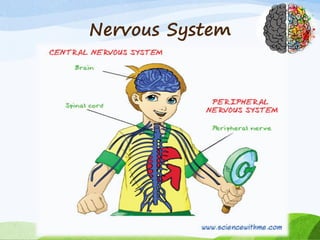
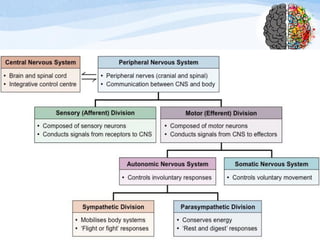
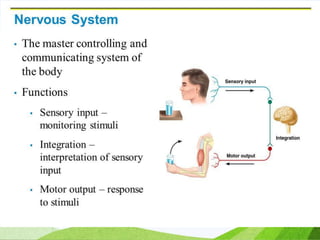
Nervous System
Central Nervous System
• Central nervous system (CNS) consists
of brain and the spinal cord, which
act as the integrating and command
centres of the nervous system.
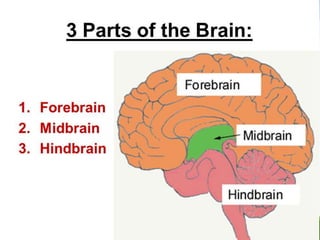
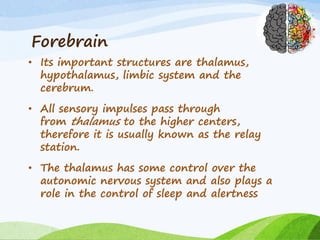
Forebrain
• Its important structures are thalamus,
hypothalamus, limbic system and the
cerebrum.
• All sensory impulses pass through
from thalamus to the higher centers,
therefore it is usually known as the relay
station.
• The thalamus has some control over the
autonomic nervous system and also plays a
role in the control of sleep and alertness
• Hypothalamus lies below the
thalamus.
• It exerts a key influence on all kind of
emotional as well as motivational
behavior.
• Centers in the hypothalamus have
control over the important body
processes like eating, drinking,
sleeping, temperature control and
sex.
• It also has control over the activities
of pituitary gland.
• Limbic system consists of structures in
the thalamus, hypothalamus and
cerebrum, which form a ring around the
lower part of the forebrain.
• Major structures within this system
include the olfactory bulb, septal nuclei,
hippocampus, amygdala and cingulate
gyrus of the cerebral cortex.
• The limbic system often called the
emotional brain, functions in emotional
aspects of behaviour related to survival,
memory, smell, pleasure and pain, rage
and aggression, affection, sexual desire
etc.
• Cerebrum is the most complex and
largest part of the brain.
• The cerebrum is covered by a thick
layer of tightly packed neurons called
the cerebral cortex.
• It is divided into two hemispheres; the
left and right hemispheres.
Right and Left
Hemispheres,
Association
Cortex
• Right and Left Hemispheres,
Association Cortex
• Cerebral cortex is responsible for many
higher order functions like language
and information processing.
• The cerebral cortex is divided into
sensory, motor and association areas
• Sensory area receives sensory input.
• Motor area controls movement of muscles.
• Association area is involved with more
complex functions such as writing.
• Each cerebral hemisphere is divided into four
lobes; frontal, parietal, occipital and
temporal lobes. The different parts of the
cerebrum are connected with different
mental functions. The visual area lying in the
occipital lobe is connected with the visual
organs or eye through the optic nerve. It is
the seat of visual sensations.
• The auditory area lies in the temporal lobe
and is connected with the auditory organs or
ears through the auditory nerves.
• It is the seat of auditory sensations and also
involved in memory.
• The parietal lobe lies in the upper rear
portion of the brain and is connected with
the information about special relationship
and structure.
• Frontal lobes contain several parts and are
concerned with organizing and planning our
actions, learning new tasks, generating
motivation and regulation of behaviour.
Right or Left
Brain
exercise
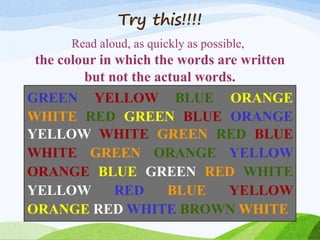
Try this!!!!
Read aloud, as quickly as possible,
the colour in which the words are written
but not the actual words.
GREEN YELLOW BLUE ORANGE
WHITE RED GREEN BLUE ORANGE
YELLOW WHITE GREEN RED BLUE
WHITE GREEN ORANGE YELLOW
ORANGE BLUE GREEN RED WHITE
YELLOW RED BLUE YELLOW
ORANGE RED WHITE BROWN WHITE
Midbrain
• Midbrain is concerned with the relaying of
messages particularly those related to
hearing and sight to higher brain centres.
One of its important structures is known as
reticular activating system (RAS).
• With the help of this structure an individual
is able to decide as to which impulses should
be registered consciously and, which should
be rejected.
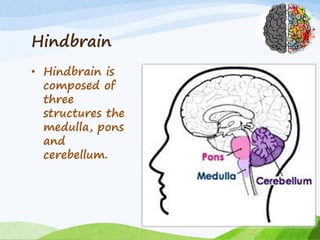
Hindbrain
• Hindbrain is
composed of
three
structures the
medulla, pons
and
cerebellum.
• ‘Medulla’ controls breathing and many
important reflexes, such as those that
help us to maintain our upright
postures.
• It also regulates the highly complex
processes like digestion, respiration
and circulation.
• The ‘pons’ assist in breathing,
transmitting impulses from the
cerebellum to the higher brain regions
and in coordinating the activities of
both sides of the brain.
• ‘Cerebellum’ is responsible for body
balance and the coordination of body
movements like dancing, typing,
playing, etc.
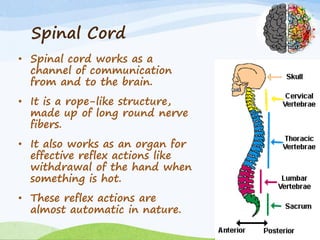
Spinal Cord
• Spinal cord works as a
channel of communication
from and to the brain.
• It is a rope-like structure,
made up of long round nerve
fibers.
• It also works as an organ for
effective reflex actions like
withdrawal of the hand when
something is hot.
• These reflex actions are
almost automatic in nature.
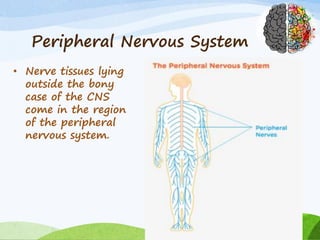
Peripheral Nervous System
• Nerve tissues lying
outside the bony
case of the CNS
come in the region
of the peripheral
nervous system.
• It consists of a network of nerves,
which helps in passing the sense
impressions to the CNS as well as in
conveying the orders of the CNS to
the muscles.
• This peripheral nervous system is
subdivided into two parts, the somatic
system and the autonomic system.
• The somatic system is both a sensory
and a motor system.
• The autonomic system is only a motor
system consisting of two divisions, the
sympathetic and parasympathetic
system.
• The sympathetic system is connected to
the spinal cord and carries messages to
the muscles and glands particularly in
stress situations to prepare for an
emergency.
• The parasympathetic system is connected to
the brain and to the lower portion of the
spinal cord. It tends to be active when we are
calm and relaxed.
• The messages conveyed by the nerve fibres of
this system direct the organs to do just the
opposite of what the sympathetic system had
done.
• It directs the body organs to return to the
normal state after the emergency has passed.
• The sympathetic and parasympathetic
divisions of the autonomic nervous system
work in close co-ordination for maintaining
the equilibrium of the body function.
Brain &
behaviour
• How we will behave in a particular
situation depends upon the judgment of
our brain.
• The sense impressions, which are
received through the sense organs, do
not bear any significance unless they are
given a meaning by the nervous system.
• Learning also to a great extent is
controlled by the nervous system.
• The proper growth and development of
nerve tissues and nervous system as a
whole helps in the task of proper
intellectual development.
• Any defect in the spinal cord or the brain
seriously affects the intellectual growth.
• The emotional behaviour is also influenced
by the nervous system, especially at the
time of anger, fear and other emotional
changes.
• The process of growth and development is
also directly and indirectly controlled by
the functioning of the nervous system.
• The personality of an individual is greatly
influenced through the mechanism of the
nervous system.
Nature of
Behaviour of an
Organism,
Integrated
Responses
• The cerebral cortex has primary
areas, which control the incoming
sensory stimuli and the outgoing
motor responses.
• An individual is able to adjust
himself effectively to the
environment, because the various
nerve impulses are systematically
integrated by the brain.
• There are millions of nerve fibers,
which connect the various neurons of
the brain. The connecting nerve fibers
are known as ‘associate fibers’.
• The associate fibers are the
foundations of memory, language,
reasoning and other higher mental
processes.
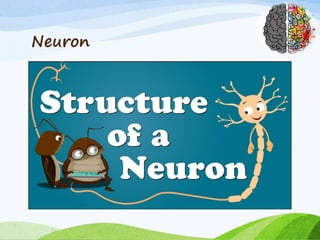
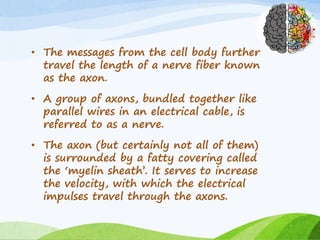
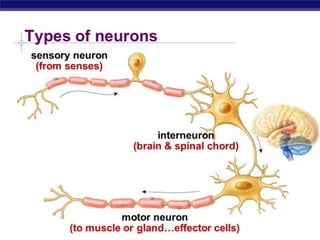
Neuron
• A nerve cell with all its branches is called a
neuron. These are the basic elements of the
nervous system.
• A neuron has a nucleus, a cell body and a
cell membrane to enclose the whole cell.
There are tiny fibers extending out from
the cell body called ‘dendrites’.
• Their role is to receive messages through
electrical impulses from the sense organs
or adjacent neurons and carry them to
the cell body.
• The messages from the cell body further
travel the length of a nerve fiber known
as the axon.
• A group of axons, bundled together like
parallel wires in an electrical cable, is
referred to as a nerve.
• The axon (but certainly not all of them)
is surrounded by a fatty covering called
the ‘myelin sheath’. It serves to increase
the velocity, with which the electrical
impulses travel through the axons.
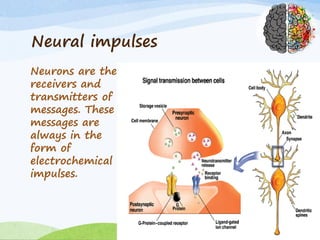
Neural impulses
Neurons are the
receivers and
transmitters of
messages. These
messages are
always in the
form of
electrochemical
impulses.
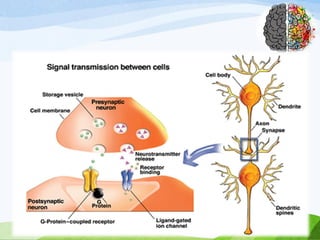
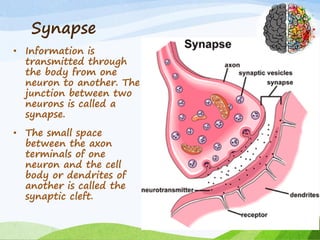
Synapse
• Information is
transmitted through
the body from one
neuron to another. The
junction between two
neurons is called a
synapse.
• The small space
between the axon
terminals of one
neuron and the cell
body or dendrites of
another is called the
synaptic cleft.
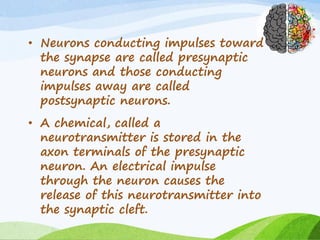
• Neurons conducting impulses toward
the synapse are called presynaptic
neurons and those conducting
impulses away are called
postsynaptic neurons.
• A chemical, called a
neurotransmitter is stored in the
axon terminals of the presynaptic
neuron. An electrical impulse
through the neuron causes the
release of this neurotransmitter into
the synaptic cleft.
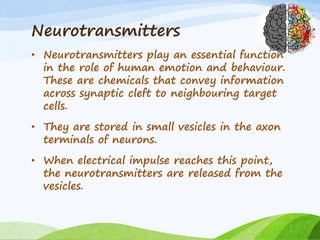
Neurotransmitters
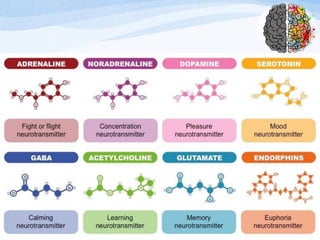
• Neurotransmitters play an essential function
in the role of human emotion and behaviour.
These are chemicals that convey information
across synaptic cleft to neighbouring target
cells.
• They are stored in small vesicles in the axon
terminals of neurons.
• When electrical impulse reaches this point,
the neurotransmitters are released from the
vesicles.
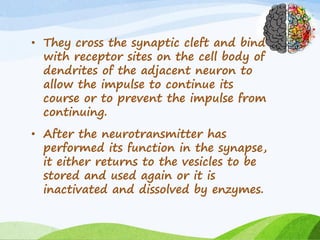
• They cross the synaptic cleft and bind
with receptor sites on the cell body of
dendrites of the adjacent neuron to
allow the impulse to continue its
course or to prevent the impulse from
continuing.
• After the neurotransmitter has
performed its function in the synapse,
it either returns to the vesicles to be
stored and used again or it is
inactivated and dissolved by enzymes.
• The process of being stored
for reuse is called reuptake.
• Deficiency or an excess of a
neurotransmitter can
produce severe behavioural
disorders.
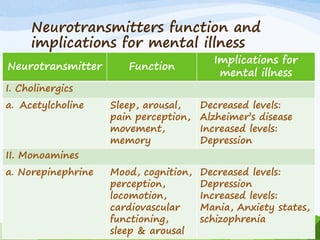
Neurotransmitters function and
implications for mental illness
Neurotransmitter Function
Implications for
mental illness
I. Cholinergics
a. Acetylcholine Sleep, arousal,
pain perception,
movement,
memory
Decreased levels:
Alzheimer’s disease
Increased levels:
Depression
II. Monoamines
a. Norepinephrine Mood, cognition,
perception,
locomotion,
cardiovascular
functioning,
sleep & arousal
Decreased levels:
Depression
Increased levels:
Mania, Anxiety states,
schizophrenia
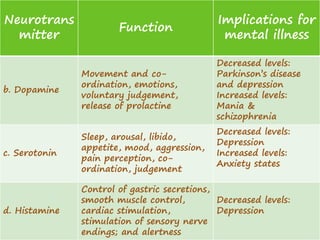
Neurotrans
mitter
Function
Implications for
mental illness
b. Dopamine
Movement and co-
ordination, emotions,
voluntary judgement,
release of prolactine
Decreased levels:
Parkinson’s disease
and depression
Increased levels:
Mania &
schizophrenia
c. Serotonin
Sleep, arousal, libido,
appetite, mood, aggression,
pain perception, co-
ordination, judgement
Decreased levels:
Depression
Increased levels:
Anxiety states
d. Histamine
Control of gastric secretions,
smooth muscle control,
cardiac stimulation,
stimulation of sensory nerve
endings; and alertness
Decreased levels:
Depression
Neurotrans
mitter
Function
Implications for
mental illness
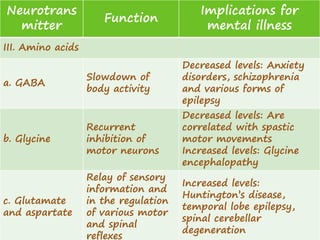
III. Amino acids
a. GABA
Slowdown of
body activity
Decreased levels: Anxiety
disorders, schizophrenia
and various forms of
epilepsy
b. Glycine
Recurrent
inhibition of
motor neurons
Decreased levels: Are
correlated with spastic
motor movements
Increased levels: Glycine
encephalopathy
c. Glutamate
and aspartate
Relay of sensory
information and
in the regulation
of various motor
and spinal
reflexes
Increased levels:
Huntington’s disease,
temporal lobe epilepsy,
spinal cerebellar
degeneration
Neurotrans
mitter
Function
Implications for
mental illness
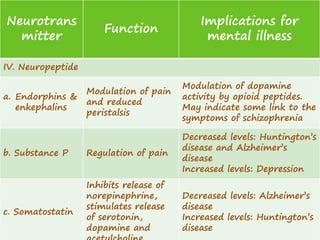
IV. Neuropeptide
a. Endorphins &
enkephalins
Modulation of pain
and reduced
peristalsis
Modulation of dopamine
activity by opioid peptides.
May indicate some link to the
symptoms of schizophrenia
b. Substance P Regulation of pain
Decreased levels: Huntington’s
disease and Alzheimer’s
disease
Increased levels: Depression
c. Somatostatin
Inhibits release of
norepinephrine,
stimulates release
of serotonin,
dopamine and
Decreased levels: Alzheimer’s
disease
Increased levels: Huntington’s
disease
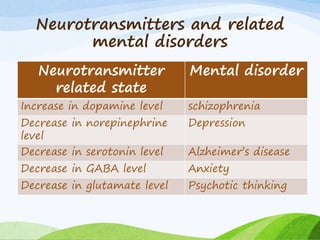
Neurotransmitters and related
mental disorders
Neurotransmitter
related state
Mental disorder
Increase in dopamine level schizophrenia
Decrease in norepinephrine
level
Depression
Decrease in serotonin level Alzheimer’s disease
Decrease in GABA level Anxiety
Decrease in glutamate level Psychotic thinking
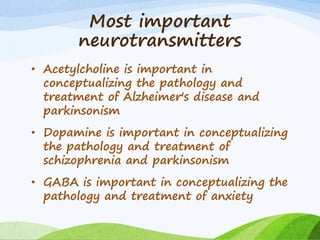
Most important
neurotransmitters
• Acetylcholine is important in
conceptualizing the pathology and
treatment of Alzheimer's disease and
parkinsonism
• Dopamine is important in conceptualizing
the pathology and treatment of
schizophrenia and parkinsonism
• GABA is important in conceptualizing the
pathology and treatment of anxiety
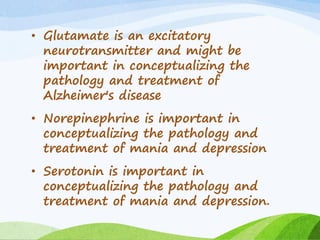
• Glutamate is an excitatory
neurotransmitter and might be
important in conceptualizing the
pathology and treatment of
Alzheimer's disease
• Norepinephrine is important in
conceptualizing the pathology and
treatment of mania and depression
• Serotonin is important in
conceptualizing the pathology and
treatment of mania and depression.
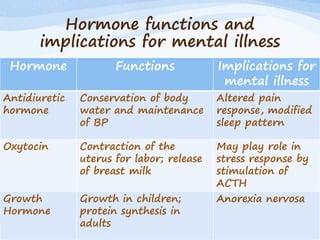
Hormone functions and
implications for mental illness
Hormone Functions Implications for
mental illness
Antidiuretic
hormone
Conservation of body
water and maintenance
of BP
Altered pain
response, modified
sleep pattern
Oxytocin Contraction of the
uterus for labor; release
of breast milk
May play role in
stress response by
stimulation of
ACTH
Growth
Hormone
Growth in children;
protein synthesis in
adults
Anorexia nervosa
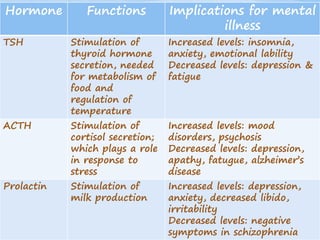
Hormone Functions Implications for mental
illness
TSH Stimulation of
thyroid hormone
secretion, needed
for metabolism of
food and
regulation of
temperature
Increased levels: insomnia,
anxiety, emotional lability
Decreased levels: depression &
fatigue
ACTH Stimulation of
cortisol secretion;
which plays a role
in response to
stress
Increased levels: mood
disorders, psychosis
Decreased levels: depression,
apathy, fatugue, alzheimer’s
disease
Prolactin Stimulation of
milk production
Increased levels: depression,
anxiety, decreased libido,
irritability
Decreased levels: negative
symptoms in schizophrenia
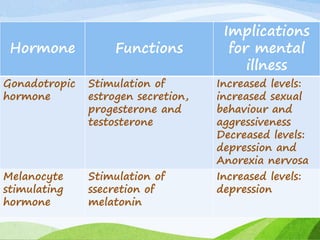
Hormone Functions
Implications
for mental
illness
Gonadotropic
hormone
Stimulation of
estrogen secretion,
progesterone and
testosterone
Increased levels:
increased sexual
behaviour and
aggressiveness
Decreased levels:
depression and
Anorexia nervosa
Melanocyte
stimulating
hormone
Stimulation of
ssecretion of
melatonin
Increased levels:
depression
Review of structure
Review of structure

Review of structure

  • 1.
    Psychopathology of mental disordersReview of structure & functions of brain, limbic system & abnormal neurotransmission By: Tejal D. Virola M.Sc. Nursing (MHN)
  • 2.
    Learning Objectives • Discussstructure & function of brain and limbic system • Explain abnormal neurotransmission • Describe psychopathology of mental disorders
  • 3.
    Psychopathology of mental disorders •Psychopathology: Brach of psychiatry which deals with the study of manifestations of behaviour and experiences indicative of mental illness • Four D’s defining abnormalities: • Deviance • Distress • Dysfunction • Danger
  • 4.
  • 6.
    Central Nervous System •Central nervous system (CNS) consists of brain and the spinal cord, which act as the integrating and command centres of the nervous system.
  • 8.
    Forebrain • Its importantstructures are thalamus, hypothalamus, limbic system and the cerebrum. • All sensory impulses pass through from thalamus to the higher centers, therefore it is usually known as the relay station. • The thalamus has some control over the autonomic nervous system and also plays a role in the control of sleep and alertness
  • 9.
    • Hypothalamus liesbelow the thalamus. • It exerts a key influence on all kind of emotional as well as motivational behavior. • Centers in the hypothalamus have control over the important body processes like eating, drinking, sleeping, temperature control and sex. • It also has control over the activities of pituitary gland.
  • 10.
    • Limbic systemconsists of structures in the thalamus, hypothalamus and cerebrum, which form a ring around the lower part of the forebrain. • Major structures within this system include the olfactory bulb, septal nuclei, hippocampus, amygdala and cingulate gyrus of the cerebral cortex. • The limbic system often called the emotional brain, functions in emotional aspects of behaviour related to survival, memory, smell, pleasure and pain, rage and aggression, affection, sexual desire etc.
  • 11.
    • Cerebrum isthe most complex and largest part of the brain. • The cerebrum is covered by a thick layer of tightly packed neurons called the cerebral cortex. • It is divided into two hemispheres; the left and right hemispheres.
  • 12.
  • 13.
    • Right andLeft Hemispheres, Association Cortex • Cerebral cortex is responsible for many higher order functions like language and information processing. • The cerebral cortex is divided into sensory, motor and association areas
  • 15.
    • Sensory areareceives sensory input. • Motor area controls movement of muscles. • Association area is involved with more complex functions such as writing. • Each cerebral hemisphere is divided into four lobes; frontal, parietal, occipital and temporal lobes. The different parts of the cerebrum are connected with different mental functions. The visual area lying in the occipital lobe is connected with the visual organs or eye through the optic nerve. It is the seat of visual sensations.
  • 16.
    • The auditoryarea lies in the temporal lobe and is connected with the auditory organs or ears through the auditory nerves. • It is the seat of auditory sensations and also involved in memory. • The parietal lobe lies in the upper rear portion of the brain and is connected with the information about special relationship and structure. • Frontal lobes contain several parts and are concerned with organizing and planning our actions, learning new tasks, generating motivation and regulation of behaviour.
  • 17.
  • 18.
    Try this!!!! Read aloud,as quickly as possible, the colour in which the words are written but not the actual words. GREEN YELLOW BLUE ORANGE WHITE RED GREEN BLUE ORANGE YELLOW WHITE GREEN RED BLUE WHITE GREEN ORANGE YELLOW ORANGE BLUE GREEN RED WHITE YELLOW RED BLUE YELLOW ORANGE RED WHITE BROWN WHITE
  • 19.
    Midbrain • Midbrain isconcerned with the relaying of messages particularly those related to hearing and sight to higher brain centres. One of its important structures is known as reticular activating system (RAS). • With the help of this structure an individual is able to decide as to which impulses should be registered consciously and, which should be rejected.
  • 20.
    Hindbrain • Hindbrain is composedof three structures the medulla, pons and cerebellum.
  • 21.
    • ‘Medulla’ controlsbreathing and many important reflexes, such as those that help us to maintain our upright postures. • It also regulates the highly complex processes like digestion, respiration and circulation.
  • 22.
    • The ‘pons’assist in breathing, transmitting impulses from the cerebellum to the higher brain regions and in coordinating the activities of both sides of the brain. • ‘Cerebellum’ is responsible for body balance and the coordination of body movements like dancing, typing, playing, etc.
  • 23.
    Spinal Cord • Spinalcord works as a channel of communication from and to the brain. • It is a rope-like structure, made up of long round nerve fibers. • It also works as an organ for effective reflex actions like withdrawal of the hand when something is hot. • These reflex actions are almost automatic in nature.
  • 24.
    Peripheral Nervous System •Nerve tissues lying outside the bony case of the CNS come in the region of the peripheral nervous system.
  • 25.
    • It consistsof a network of nerves, which helps in passing the sense impressions to the CNS as well as in conveying the orders of the CNS to the muscles. • This peripheral nervous system is subdivided into two parts, the somatic system and the autonomic system.
  • 26.
    • The somaticsystem is both a sensory and a motor system. • The autonomic system is only a motor system consisting of two divisions, the sympathetic and parasympathetic system. • The sympathetic system is connected to the spinal cord and carries messages to the muscles and glands particularly in stress situations to prepare for an emergency.
  • 27.
    • The parasympatheticsystem is connected to the brain and to the lower portion of the spinal cord. It tends to be active when we are calm and relaxed. • The messages conveyed by the nerve fibres of this system direct the organs to do just the opposite of what the sympathetic system had done. • It directs the body organs to return to the normal state after the emergency has passed. • The sympathetic and parasympathetic divisions of the autonomic nervous system work in close co-ordination for maintaining the equilibrium of the body function.
  • 28.
  • 29.
    • How wewill behave in a particular situation depends upon the judgment of our brain. • The sense impressions, which are received through the sense organs, do not bear any significance unless they are given a meaning by the nervous system. • Learning also to a great extent is controlled by the nervous system. • The proper growth and development of nerve tissues and nervous system as a whole helps in the task of proper intellectual development.
  • 30.
    • Any defectin the spinal cord or the brain seriously affects the intellectual growth. • The emotional behaviour is also influenced by the nervous system, especially at the time of anger, fear and other emotional changes. • The process of growth and development is also directly and indirectly controlled by the functioning of the nervous system. • The personality of an individual is greatly influenced through the mechanism of the nervous system.
  • 31.
    Nature of Behaviour ofan Organism, Integrated Responses
  • 33.
    • The cerebralcortex has primary areas, which control the incoming sensory stimuli and the outgoing motor responses. • An individual is able to adjust himself effectively to the environment, because the various nerve impulses are systematically integrated by the brain.
  • 34.
    • There aremillions of nerve fibers, which connect the various neurons of the brain. The connecting nerve fibers are known as ‘associate fibers’. • The associate fibers are the foundations of memory, language, reasoning and other higher mental processes.
  • 35.
  • 36.
    • A nervecell with all its branches is called a neuron. These are the basic elements of the nervous system. • A neuron has a nucleus, a cell body and a cell membrane to enclose the whole cell. There are tiny fibers extending out from the cell body called ‘dendrites’. • Their role is to receive messages through electrical impulses from the sense organs or adjacent neurons and carry them to the cell body.
  • 37.
    • The messagesfrom the cell body further travel the length of a nerve fiber known as the axon. • A group of axons, bundled together like parallel wires in an electrical cable, is referred to as a nerve. • The axon (but certainly not all of them) is surrounded by a fatty covering called the ‘myelin sheath’. It serves to increase the velocity, with which the electrical impulses travel through the axons.
  • 40.
    Neural impulses Neurons arethe receivers and transmitters of messages. These messages are always in the form of electrochemical impulses.
  • 41.
    Synapse • Information is transmittedthrough the body from one neuron to another. The junction between two neurons is called a synapse. • The small space between the axon terminals of one neuron and the cell body or dendrites of another is called the synaptic cleft.
  • 42.
    • Neurons conductingimpulses toward the synapse are called presynaptic neurons and those conducting impulses away are called postsynaptic neurons. • A chemical, called a neurotransmitter is stored in the axon terminals of the presynaptic neuron. An electrical impulse through the neuron causes the release of this neurotransmitter into the synaptic cleft.
  • 43.
    Neurotransmitters • Neurotransmitters playan essential function in the role of human emotion and behaviour. These are chemicals that convey information across synaptic cleft to neighbouring target cells. • They are stored in small vesicles in the axon terminals of neurons. • When electrical impulse reaches this point, the neurotransmitters are released from the vesicles.
  • 44.
    • They crossthe synaptic cleft and bind with receptor sites on the cell body of dendrites of the adjacent neuron to allow the impulse to continue its course or to prevent the impulse from continuing. • After the neurotransmitter has performed its function in the synapse, it either returns to the vesicles to be stored and used again or it is inactivated and dissolved by enzymes.
  • 45.
    • The processof being stored for reuse is called reuptake. • Deficiency or an excess of a neurotransmitter can produce severe behavioural disorders.
  • 47.
    Neurotransmitters function and implicationsfor mental illness Neurotransmitter Function Implications for mental illness I. Cholinergics a. Acetylcholine Sleep, arousal, pain perception, movement, memory Decreased levels: Alzheimer’s disease Increased levels: Depression II. Monoamines a. Norepinephrine Mood, cognition, perception, locomotion, cardiovascular functioning, sleep & arousal Decreased levels: Depression Increased levels: Mania, Anxiety states, schizophrenia
  • 48.
    Neurotrans mitter Function Implications for mental illness b.Dopamine Movement and co- ordination, emotions, voluntary judgement, release of prolactine Decreased levels: Parkinson’s disease and depression Increased levels: Mania & schizophrenia c. Serotonin Sleep, arousal, libido, appetite, mood, aggression, pain perception, co- ordination, judgement Decreased levels: Depression Increased levels: Anxiety states d. Histamine Control of gastric secretions, smooth muscle control, cardiac stimulation, stimulation of sensory nerve endings; and alertness Decreased levels: Depression
  • 49.
    Neurotrans mitter Function Implications for mental illness III.Amino acids a. GABA Slowdown of body activity Decreased levels: Anxiety disorders, schizophrenia and various forms of epilepsy b. Glycine Recurrent inhibition of motor neurons Decreased levels: Are correlated with spastic motor movements Increased levels: Glycine encephalopathy c. Glutamate and aspartate Relay of sensory information and in the regulation of various motor and spinal reflexes Increased levels: Huntington’s disease, temporal lobe epilepsy, spinal cerebellar degeneration
  • 50.
    Neurotrans mitter Function Implications for mental illness IV.Neuropeptide a. Endorphins & enkephalins Modulation of pain and reduced peristalsis Modulation of dopamine activity by opioid peptides. May indicate some link to the symptoms of schizophrenia b. Substance P Regulation of pain Decreased levels: Huntington’s disease and Alzheimer’s disease Increased levels: Depression c. Somatostatin Inhibits release of norepinephrine, stimulates release of serotonin, dopamine and Decreased levels: Alzheimer’s disease Increased levels: Huntington’s disease
  • 51.
    Neurotransmitters and related mentaldisorders Neurotransmitter related state Mental disorder Increase in dopamine level schizophrenia Decrease in norepinephrine level Depression Decrease in serotonin level Alzheimer’s disease Decrease in GABA level Anxiety Decrease in glutamate level Psychotic thinking
  • 52.
    Most important neurotransmitters • Acetylcholineis important in conceptualizing the pathology and treatment of Alzheimer's disease and parkinsonism • Dopamine is important in conceptualizing the pathology and treatment of schizophrenia and parkinsonism • GABA is important in conceptualizing the pathology and treatment of anxiety
  • 53.
    • Glutamate isan excitatory neurotransmitter and might be important in conceptualizing the pathology and treatment of Alzheimer's disease • Norepinephrine is important in conceptualizing the pathology and treatment of mania and depression • Serotonin is important in conceptualizing the pathology and treatment of mania and depression.
  • 54.
    Hormone functions and implicationsfor mental illness Hormone Functions Implications for mental illness Antidiuretic hormone Conservation of body water and maintenance of BP Altered pain response, modified sleep pattern Oxytocin Contraction of the uterus for labor; release of breast milk May play role in stress response by stimulation of ACTH Growth Hormone Growth in children; protein synthesis in adults Anorexia nervosa
  • 55.
    Hormone Functions Implicationsfor mental illness TSH Stimulation of thyroid hormone secretion, needed for metabolism of food and regulation of temperature Increased levels: insomnia, anxiety, emotional lability Decreased levels: depression & fatigue ACTH Stimulation of cortisol secretion; which plays a role in response to stress Increased levels: mood disorders, psychosis Decreased levels: depression, apathy, fatugue, alzheimer’s disease Prolactin Stimulation of milk production Increased levels: depression, anxiety, decreased libido, irritability Decreased levels: negative symptoms in schizophrenia
  • 56.
    Hormone Functions Implications for mental illness Gonadotropic hormone Stimulationof estrogen secretion, progesterone and testosterone Increased levels: increased sexual behaviour and aggressiveness Decreased levels: depression and Anorexia nervosa Melanocyte stimulating hormone Stimulation of ssecretion of melatonin Increased levels: depression