The nervous system Content by Megan McDonald
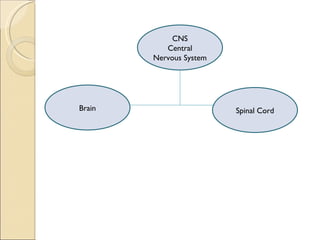
CNS Central Nervous System Brain Spinal Cord
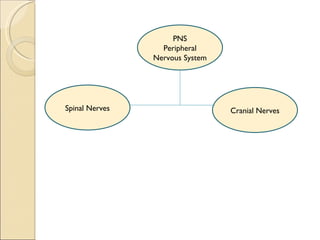
PNS Peripheral Nervous System Spinal Nerves Cranial Nerves
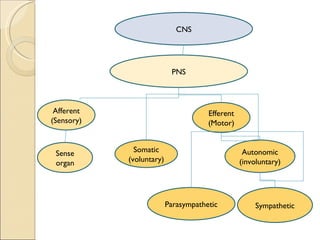
CNS PNS Afferent (Sensory) Efferent (Motor) Sense organ Somatic (voluntary) Autonomic (involuntary) Parasympathetic Sympathetic
Activity Marieb colouring book Chapter 7, Qu.2, Page 132
Nervous system function Sensory – afferent Integrative – information processed Motor - efferent
Nervous tissue Neurons – Afferent, interneurons, efferent Neuroglia – supporting cells
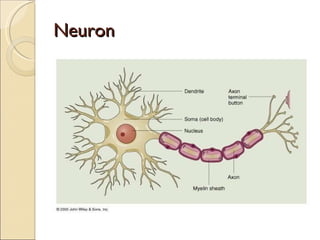
Neurons Nerve cell Initiates, propagates and transmits electrical signals.
Neuron
Neuroglia Supporting cell of nervous system Astrocytes – metabolic, physical support; brain Oligodendrocytes – myelin forming; CNS Ependymal cells – produces CSF Microglia – repair damaged neurons; CNS Schwann cells – myelin forming; PNS
Activity 14.3 Marieb colouring book Chapter 7, Qu.7, Page 135 Chapter 7, Qu.6, Page 131
Activity 14.4 Purple book
Neuron function Stimulus  Excitability Synapse Action potential
Action Potential Resting state – inside cell membrane is more –ve than outside Depolarisation – inside membrane becomes +ve Repolarisation – inside membrane returns to –ve.
Synapse Neurons not connected physically Gaps between neurons Impulses pass over synapses via neurotransmitters
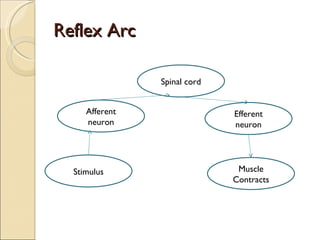
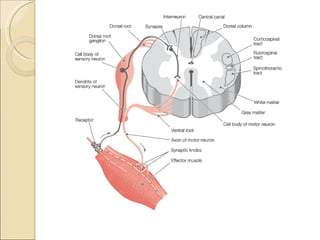
Reflex Arc Rapid action without conscious control Occurs at spinal cord level
Reflex Arc Stimulus Afferent neuron Spinal cord Efferent neuron Muscle Contracts
 
Activity 14.5 Marieb colouring book Chapter 7, Qu.11, Page 137
Central Nervous System Brain Spinal Cord
 
 
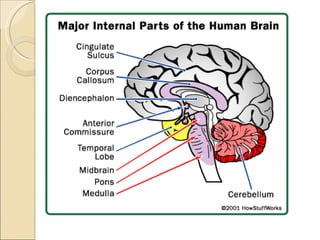
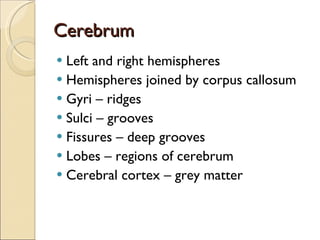
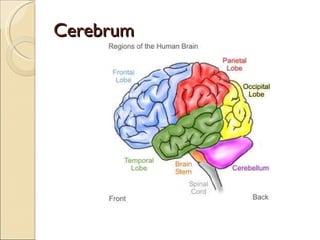
Cerebrum Left and right hemispheres Hemispheres joined by corpus callosum Gyri – ridges Sulci – grooves Fissures – deep grooves Lobes – regions of cerebrum Cerebral cortex – grey matter
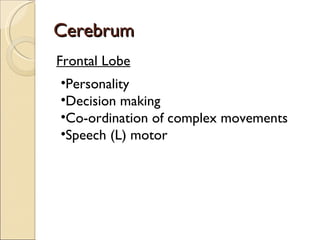
Cerebrum Frontal Lobe Personality Decision making Co-ordination of complex movements Speech (L) motor
Cerebrum Parietal Lobe Sensation Proprioception Understanding of sensation Speech comprehension
Cerebrum Occipital Lobe Vision Interpreting vision
Cerebrum Temporal Lobe Motivation Emotion Memory Hearing
Cerebrum
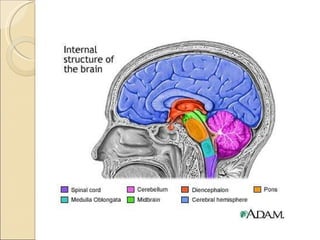
Diencephalon Enclosed by cerebral hemispheres Thalamus Hypothalamus Epithalamus Pineal body Choroid plexus
 
Brainstem Connects cerebrum and cerebellum to spinal cord Midbrain Pons Medulla oblongata
Cerebellum “ Little brain” Posterior and inferior to cerebrum Posture and balance
Basal Nuclei AKA Basal ganglia Masses of neuron cell bodies Lentiform nucleus Caudate nucleus Substantia nigra
Activity 14.6 Marieb colouring book Chapter 7, Qu.13, Page 138 Chapter 7, Qu.15, Page 138 Chapter 7, Qu.16, Page 139 Chapter 7, Qu.17, Page 140 Chapter 7, Qu.18, Page 141
CNS Protection Bony Membranous (meninges) Cerebral Spinal Fluid Blood brain barrier
Meninges Three layers of tissue form meninges Dura mater Arachnoid mater Pia mater
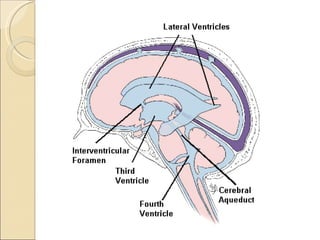
CSF Cerebrospinal Fluid Contained between Arachnoid and Pia maters In subarachnoid space Formed by choroid plexus Contained in ventricles Nourishment
 
Activity 14.7 Purple book
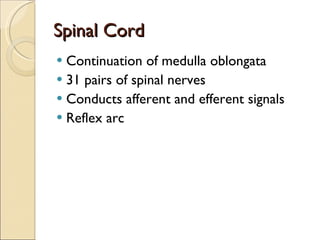
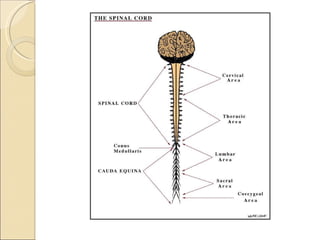
Spinal Cord Continuation of medulla oblongata 31 pairs of spinal nerves Conducts afferent and efferent signals Reflex arc
 
PNS Peripheral Nervous System Cranial Nerves Spinal Nerves
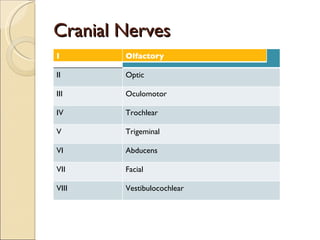
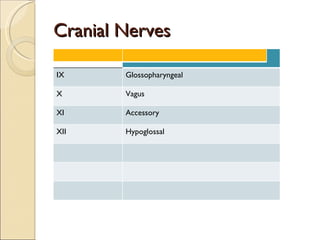
Cranial Nerves 12 Pairs Originate in brain Pge 149
Cranial Nerves I I Olfactory II Optic III Oculomotor IV Trochlear V Trigeminal VI Abducens VII Facial VIII Vestibulocochlear I Olfactory
Cranial Nerves I I Olfactory IX Glossopharyngeal X Vagus XI Accessory XII Hypoglossal
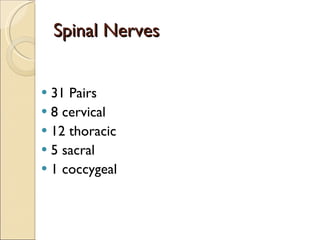
Spinal Nerves 31 Pairs 8 cervical 12 thoracic 5 sacral 1 coccygeal
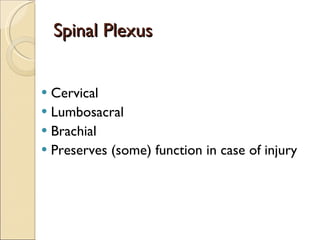
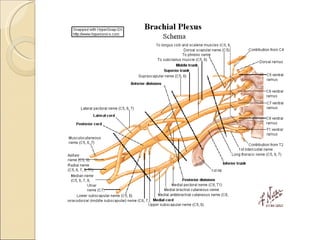
Spinal Plexus Cervical Lumbosacral Brachial Preserves (some) function in case of injury
 
Somatic Nervous System Conscious control Efferent impulses – to muscles Afferent impulses – from skin etc
Autonomic Nervous System Unconscious control Sympathetic Parasympathetic
Activity 14.11 Purple book
Homework! Muscle chart Anat family
Thank you

Nervous System