Mastoiditis
Mr. Binu Babu
M.Sc. Nursing
Mrs. Jincy Ealias
M.Sc. Nursing
Definition
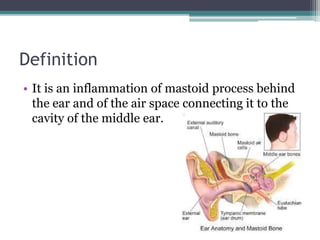
• It is an inflammation of mastoid process behind
the ear and of the air space connecting it to the
cavity of the middle ear.
Etiology
• Otitis media
• CSOM
• Inadequate drainage of exudate in otitis media
• Inadequate treatment of AOM
• Cholesteatoma : skin cyst in the middle ear may
block drainage of the ear.
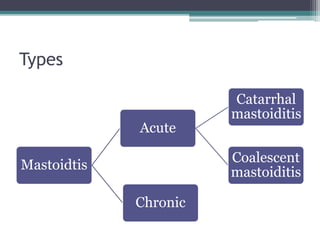
Types
Mastoidtis
Acute
Catarrhal
mastoiditis
Coalescent
mastoiditis
Chronic
Types
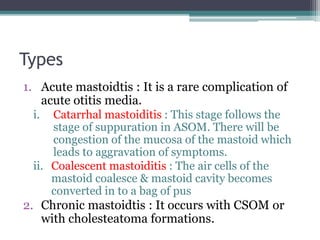
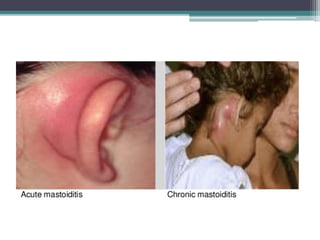
1. Acute mastoidtis : It is a rare complication of
acute otitis media.
i. Catarrhal mastoiditis : This stage follows the
stage of suppuration in ASOM. There will be
congestion of the mucosa of the mastoid which
leads to aggravation of symptoms.
ii. Coalescent mastoiditis : The air cells of the
mastoid coalesce & mastoid cavity becomes
converted in to a bag of pus
2. Chronic mastoidtis : It occurs with CSOM or
with cholesteatoma formations.
Pathophysiology
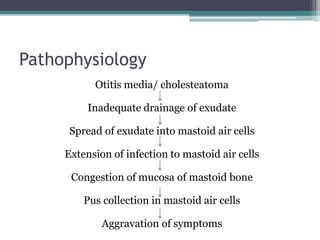
Otitis media/ cholesteatoma
Inadequate drainage of exudate
Spread of exudate into mastoid air cells
Extension of infection to mastoid air cells
Congestion of mucosa of mastoid bone
Pus collection in mastoid air cells
Aggravation of symptoms
Clinical manifestations
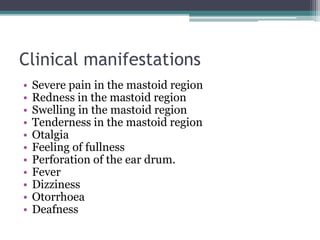
• Severe pain in the mastoid region
• Redness in the mastoid region
• Swelling in the mastoid region
• Tenderness in the mastoid region
• Otalgia
• Feeling of fullness
• Perforation of the ear drum.
• Fever
• Dizziness
• Otorrhoea
• Deafness
Diagnostic measures
• History collection
• Physical examination.
• Mastoid bone x ray.
• CT scan
• CBC, Blood culture
• Tympanocentesis : ear culture, fluid from middle
ear send for culture.
• Audiography: to assess hearing loss.
• Lumbar puncture: to identify the extension of
infection to CNS.
Complications
• Hearing loss
• Meningitis
• Brain abscess
Management
MEDICAL MANAGEMENT
• Antibiotic for infection and inflammation. Both
systemic and topical. e.g. Ciplox-D, tetracycline,
cephalosporin
• Analgesics
• Systemic decongestants: phenylephrine HCl
• Corticosteroids
• Antipyretics
• Ear-irrigation: For removing purulent discharge.
SURGICAL MANAGEMENT
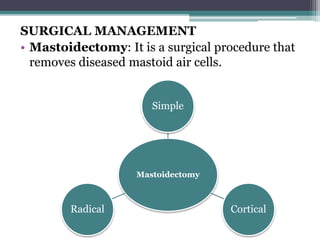
• Mastoidectomy: It is a surgical procedure that
removes diseased mastoid air cells.
Mastoidectomy
Simple
CorticalRadical
• Simple mastoidectomy - The incision is
made behind the ear to remove the infected air
cells by approaching through the ear.
• Radical mastoidectomy- A radical
mastoidectomy removes the tympanic
membrane and is indicated for extensive spread
of a cholesteatoma. The eardrum and middle ear
structures may be completely removed. Usually
the stapes is spared if possible to help preserve
some hearing.
• Cortical mastoidectomy - Removal of
mastoid air cells without disturbing the middle
ear.
• Myringotomy: It is a surgical procedure in
which a tiny incision is created in the eardrum
relieves pressure caused by excessive buildup of
fluid or pus.
Nursing management
• Assess pain for location, intensity etc.
• Administer analgesics as prescribed to relieve
pain.
• Administer medications as ordered.
• Provide plenty of fluids.
• Encourage patient and family to use signs of non
verbal communication such facial expression,
pointing, body movement in case of hearing
difficulties.
Nursing diagnosis
• Pain relate to inflammatory process.
• Impaired auditory sensory perception related to
perforation of tympanic membrane.
• Impaired verbal communication related to
hearing deficit.
POST-OPERATIVE CARE
• Place the patient on bed rest for 24 hours.
• Provide comfortable position i.e. the patient lies
with operated ear up.
• Elevate the head of bed to reduce swelling &
pressure on operated ear.
• Instruct the patient to keep the ear dry for 4 – 6
weeks after surgery.
• Avoid heavy lifting , straining , exertion , do not
blow nose for 2- 3 weeks after surgery to prevent
dislodging tympanic membrane graft.
• Administer antibiotics , analgesics & antihistamines.
• Assess hearing acuity by using whisper test , Rinne’s
test & Weber test postoperatively.

Mastoiditis

  • 1.
    Mastoiditis Mr. Binu Babu M.Sc.Nursing Mrs. Jincy Ealias M.Sc. Nursing
  • 2.
    Definition • It isan inflammation of mastoid process behind the ear and of the air space connecting it to the cavity of the middle ear.
  • 3.
    Etiology • Otitis media •CSOM • Inadequate drainage of exudate in otitis media • Inadequate treatment of AOM • Cholesteatoma : skin cyst in the middle ear may block drainage of the ear.
  • 4.
  • 5.
    Types 1. Acute mastoidtis: It is a rare complication of acute otitis media. i. Catarrhal mastoiditis : This stage follows the stage of suppuration in ASOM. There will be congestion of the mucosa of the mastoid which leads to aggravation of symptoms. ii. Coalescent mastoiditis : The air cells of the mastoid coalesce & mastoid cavity becomes converted in to a bag of pus 2. Chronic mastoidtis : It occurs with CSOM or with cholesteatoma formations.
  • 7.
    Pathophysiology Otitis media/ cholesteatoma Inadequatedrainage of exudate Spread of exudate into mastoid air cells Extension of infection to mastoid air cells Congestion of mucosa of mastoid bone Pus collection in mastoid air cells Aggravation of symptoms
  • 8.
    Clinical manifestations • Severepain in the mastoid region • Redness in the mastoid region • Swelling in the mastoid region • Tenderness in the mastoid region • Otalgia • Feeling of fullness • Perforation of the ear drum. • Fever • Dizziness • Otorrhoea • Deafness
  • 9.
    Diagnostic measures • Historycollection • Physical examination. • Mastoid bone x ray. • CT scan • CBC, Blood culture • Tympanocentesis : ear culture, fluid from middle ear send for culture. • Audiography: to assess hearing loss. • Lumbar puncture: to identify the extension of infection to CNS.
  • 10.
    Complications • Hearing loss •Meningitis • Brain abscess
  • 11.
    Management MEDICAL MANAGEMENT • Antibioticfor infection and inflammation. Both systemic and topical. e.g. Ciplox-D, tetracycline, cephalosporin • Analgesics • Systemic decongestants: phenylephrine HCl • Corticosteroids • Antipyretics • Ear-irrigation: For removing purulent discharge.
  • 12.
    SURGICAL MANAGEMENT • Mastoidectomy:It is a surgical procedure that removes diseased mastoid air cells. Mastoidectomy Simple CorticalRadical
  • 13.
    • Simple mastoidectomy- The incision is made behind the ear to remove the infected air cells by approaching through the ear. • Radical mastoidectomy- A radical mastoidectomy removes the tympanic membrane and is indicated for extensive spread of a cholesteatoma. The eardrum and middle ear structures may be completely removed. Usually the stapes is spared if possible to help preserve some hearing. • Cortical mastoidectomy - Removal of mastoid air cells without disturbing the middle ear.
  • 14.
    • Myringotomy: Itis a surgical procedure in which a tiny incision is created in the eardrum relieves pressure caused by excessive buildup of fluid or pus.
  • 15.
    Nursing management • Assesspain for location, intensity etc. • Administer analgesics as prescribed to relieve pain. • Administer medications as ordered. • Provide plenty of fluids. • Encourage patient and family to use signs of non verbal communication such facial expression, pointing, body movement in case of hearing difficulties.
  • 16.
    Nursing diagnosis • Painrelate to inflammatory process. • Impaired auditory sensory perception related to perforation of tympanic membrane. • Impaired verbal communication related to hearing deficit.
  • 17.
    POST-OPERATIVE CARE • Placethe patient on bed rest for 24 hours. • Provide comfortable position i.e. the patient lies with operated ear up. • Elevate the head of bed to reduce swelling & pressure on operated ear. • Instruct the patient to keep the ear dry for 4 – 6 weeks after surgery. • Avoid heavy lifting , straining , exertion , do not blow nose for 2- 3 weeks after surgery to prevent dislodging tympanic membrane graft. • Administer antibiotics , analgesics & antihistamines. • Assess hearing acuity by using whisper test , Rinne’s test & Weber test postoperatively.