Practice
teaching
on
Fracture
Presented by:
Mr. Hari singh nagar
M. Sc Nursing 1st year
Objectives
After completion of the class students will be able to
• Introduce the fracture.
• Define fracture
• Explain the Causes of fracture
• Enlist the types of fracture
• Enlist the pattern of fracture
• Explain the Pathophysiology of fracture
• Enumerate the Clinical manifestations
• Enlist the diagnostic evaluation of fracture
Objectives
• Explain the management of fracture.
• Enlist the complication of fracture.
• Explain the nursing management of the fracture
Introduction
It is the disruption in the continuity of
bone. It occurs when the bone is subjected
to stress greater then the bone can absorb.
It is caused by direct blows, crushing forces,
extreme muscle contraction and sudden
twisting motion, when it occurs, nearby
structure is also affected result in soft
tissue edema, hemorrhage into the muscle
and joints, joint dislocation, ruptured
tendons, severe nerve and damaged blood
vessels.
Incidence
• The International Osteoporosis Foundation
estimates that osteoporosis affects about 200
million women worldwide.
• 68 percent of the 44 million people at risk for
osteoporosis are women.
• One of every two women over age 50 will likely
have an osteoporosis-related fracture in their
lifetime. That’s twice the rate of fractures in men
— one in four.
• 75 percent of all cases of hip osteoporosis affect
women.
Definition
• A fracture is a break in the continuity of bone
and is defined according to its type and extent.
• Fracture is a break in any bone in the body.
Causes of fracture
direct
blows
crushing
forces
sudden
twisting
motions
extreme
muscle
contractions
Causes of fracture
Accident,
trauma
Bone tumor
Osteoporosis
Calcium and
vit. D deficiency
Types of fracture
1. Complete
2. Incomplete
3. Closed
4. Open
5. Pathologic
Types of fracture
Complete
fracture
A break across the
entire cross-section
of the bone.
Types of fracture
Incomplete
fracture
The break occurs
through only part of
the cross-section of
the bone.
Types of fracture
Closed
fracture
(simple fracture) is one
that does not cause
a break in the skin.
Types of fracture
Open
fracture
(compound, or complex,
fracture) is one in
which the skin or
mucous membrane
wound extends to the
fractured bone.
Types of fracture
Pathologic
fracture
It occurs through
the area of disease
bone.
Pattern of fracture
1. Greenstick
2. Transverse
3. Oblique
4. Spiral
5. Comminuted
6. Compression
7. Depression
8. Avulsion
9. Impacted
10.Fracture dislocation
Patterns of fracture
Greenstick
fracture
A fracture in which
one side of a bone is
broken while the
other is bent (like a
green stick).
Patterns of fracture
Transverse
fracture
A fracture, in which
the break is across
the bone, at a right
angle to the long
axis of the bone.
Patterns of fracture
Oblique
fracture
A fracture straight
across the bone
obliquely
Patterns of fracture
Spiral
fracture
also known as torsion
fracture, A fracture
that is shaft around
the bone
Patterns of fracture
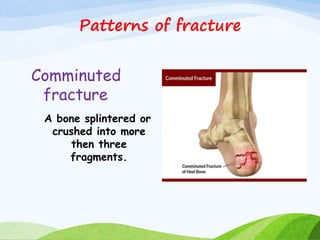
Comminuted
fracture
A bone splintered or
crushed into more
then three
fragments.
Patterns of fracture
Compression
fracture
A fracture caused by
compression, the act
of pressing together.
Compression
fractures of the
vertebrae are
especially common
with osteoporosis.
Patterns of fracture
Depressed
fracture
A fracture in which
fragments are driven
inward (seen
frequently in
fractures of skull
and facial bones)
Patterns of fracture
Avulsion
fracture
A fracture which
occurs when a
fragment of bone
tears away from the
main mass of bone.
Patterns of fracture
Impacted
fracture
A fracture which
occurs when a
fragment of bone
wedged into other
bone fragments
Patterns of fracture
Fracture
dislocation
A fracture
complicated by the
bone being out of
the joints.
Pathophysiology
Due to any etiology(crushing movement)
|
Fracture occurs, muscle that were attached to bone are
disrupted and cause spasm
|
Proximal portion of bone remains in place, the distal
portion can become displaced in response to both
causative force & spasm in the associated muscles
In addition, the periosteum and blood vessels in the
cortex and marrow are disrupted
|
Soft tissue damage occurs, leads to bleeding and
formation of hematoma between the fracture
fragment and beneath the periosteum
|
Bone tissue surroundings the fracture site dies,
creating an intense inflammatory response
release chemical mediators histamines,
prostaglandins
|
Resulting in vasodilatation, edema, pain, loss
of function, leukocytes and infiltration of
WBC
Clinical manifestations
1. Physical finding
• Pain
• Swelling
• False motion, loss of function
• Crepitus (cracked sound)
• Deformity
• Ecchymosis
• shortening
Clinical manifestations
2. Neurovascular status
• Paresthesia
• Ischemia
• Pallor
• Pain on movement
• Loss of active motion
• Injured blood vessels, muscle and
nerve
Clinical manifestations
3. Shock
• Bone is vascular
• Fetal
Diagnostic evaluation of
fracture
• X- ray
• Blood studies – decreased hemoglobin and
hematocrit
• Arthroscopy – joint involvement
• Angiography – blood vessels injury
• Electromyogram – nerve injury
Management
Bone healing
hematoma forms between the end of bone and in
surrounding soft tissue
inflammation and accumulation of inflammatory
exudates
macrophages that phagocytes the hematoma and
small fragment of bone
Fibroblast migrate to the site.
Granulation tissue and new capillaries develop
New bone forms as large number of osteoblast secrete
spongy bone
Bone healing
which unites the broken end and is protected by an
outer layer of bone and cartilage
These new deposit of bone and cartilage are called
callus
the callus mature and the cartilage is gradually
replaced with new bone
Medullary canal is reopened through the callus
bone heals completely with the callus and tissue
completely replaced with the mature compact bone
bone is thicker and stronger at the repair site than
originally and a Second fracture is more likely to
occur at the different site
emergency Management Of
Fractures:
• If fracture is suspected, immobilized the fracture
site by using the splint to prevent movement of
fracture fragments that causes pain, bleeding and
soft tissue damage.
• Splint may be used in the forms of leg by
bandaging the legs together with unaffected leg
serving as a splint for the injured one.
• If upper extremity is fracture, bandage to the
chest or may be placed in a slings.
emergency Management Of
Fractures:
• Before and after splinting neurovascular status
should be assessed to determine the adequacy of
peripheral tissue perfusion and nerve function.
• With a open fracture, cover with a sterile dressing
to prevent contamination.
• In emergency department, patient is evaluated
completely then remove the clothe from uninjured
site first then injured site. The patient clothing
may be cut away.
Medical /Surgical Management Of
Fractures:
1.Reduction
Reduction of a fracture (“setting” the bone) refers to
restoration of the fracture fragments to anatomic
alignment and rotation.
open reduction
It’s a surgical approach, the fracture fragments are
reduced.
External/Internal fixation devices (metallic pins,
wires, screws, plates, nails, or rods) may be used
to hold the bone fragments in position until solid
bone healing occurs.
Internal fixation
External
fixation
Closed reduction
• closed reduction is accomplished by bringing the
bone fragments into apposition (i.e. - placing the
ends in contact) through manipulation and manual
traction.
• Extremity is held in the desired position while the
physician applies a cast, splint, or other device.
• Traction (skin or skeletal) may be used in fracture
reduction and immobilization.
Type of cast
1. Short arm cast, Long arm cast and Arm
cylinder cast
2. Short leg cast, long leg cat and Leg cylinder
cast
3. Unilateral hip spica cast
4. Shoulder spica cast, One and one-half hip spica
cast, and Bilateral long leg hip spica cast.
5. Short leg hip spica cast
6. Abduction boot cast
Composition of plaster of paris
Plaster of Paris is also known as Gypsum Plaster
(CaSO4·1/2H2O) or (2CaSO4·H2O)
1. Chemically it is called as "Calcium sulfate
hemihydrates“
2. is a white powdery slightly hydrated calcium sulfate
3. It is produced by heating Gypsum (CaSO4·2H2O) to
about 300 °F (150 °C)
CaSO4·2H2O + heat → CaSO4·0.5H2O + 1.5H2O
(Heat released as steam)
4. It is also used in medicine to make plaster casts to
immobilize broken bones while they heal, though
some orthopaedic casts are made of fiberglass or
thermoplastics
Fiberglass plaster
• A fibreglass cast is the plaster cast made from
fibreglass material.
• Fiberglass cast is a lightweight, synthetic, more
durable and extremely strong material as
compared to traditional plaster of Paris cast. It is
three times stronger and but is only one third in
weight.
• Another aspect that needs to be looked into is the
expense. Typically a fibreglass plaster bandage costs
more than plaster of Paris bandage but number of
bandages required in a given setting are less.
Cont….
• Plaster of Paris casts are white in color. Fiberglass
casts come in many colors and some doctors even
let the patient choose the color.
• Fiberglass cast, like its plaster of Paris counterpart,
is applied in case of fracture treatment. The
fibreglass cast however is not applied in acute
settings because this cast is less accommodating to
swelling or where the reduction of the fragments
necessitates molding.
• Therefore fibreglass cast is used mostly in those
cases where the healing process has already begun,
acute period of injury has passed and fractures
which are not displaced.
2.Immobilization
• Immobilization may be accomplished by external or
internal fixation.
• Methods of external fixation include bandages,
casts, splints, continuous traction, and external
fixators.
• Metal implants used for internal fixation serve as
internal splints to immobilize the fracture.
Internal fixation
External
fixation
Difference between internal or
external fixation
3. Maintaining and restoring
function
• Restlessness, anxiety, and discomfort are controlled
with a variety of approaches, such as reassurance,
position changes, and pain relief strategies, including
use of analgesics.
• exercises are encouraged to promote circulation.
• Participation in activities of daily living (ADLs) is
encouraged to promote independent functioning
and self-esteem.
Complication of fracture
Early complications
• Shock
• fat embolism
• compartment syndrome
• deep vein thrombosis
• disseminated intravascular coagulation
• infection
Delayed complications
• delayed union and nonunion
• avascular necrosis of bone
• reaction to internal fixation devices
Nursing
Management
1. Acute pain related breakdown of continuity of the
bone as evidenced by facial expressions and
verbalization of patient.
• Goals: Patient will not feel pain
• Intervention:
• Assess the onset, duration, location, severity and
intensity of pain.
• Administer the analgesic according to physician
order.
• Provide comfort devices like sand bags for
immobilization of affected parts.
• Provide diversion therapy
2. Impaired physical mobility related to application
of traction or cast as evidenced by assessment
• Goal: Patient will able to move affected area.
• Intervention:
• Provide range of motion exercises to the
patient.
• Assist the patient in ambulation after recovery
of fracture.
• Provide assistance while using walker or
crutches if required.
• Prevent from complication which usually
occurs due to immobility.
3. Self care deficit related to fracture as evidenced
by poor personal hygiene.
• Goal: Patient will maintain the personal hygiene
• Intervention:
• Assess the need of self care
• Encourage the patient or relatives to do self
care activity
• Head to foot care to be provided to the patient.
• Educate about importance of maintaining
personal hygiene.
4. Imbalanced nutrition less than body requirement
relate to increase demand of nutrient for bone
healing as evidenced by observation.
• Goal: Maintain the nutritional status of the patient
• Intervention:
• Assess the nutritional status by intake/output
chart, biochemical measures, body mass.
• Encourages the patient to take protein rich diet.
• Plenty of fluids and frequent intake of meal is
necessary.
• Try to assess the daily weight of the client
Research
Incidence of hip fracture in Rohtak district, North
India
• A total number of 543 patients with hip fracture
were identified in year 2009 from Rohtak
district of North India
• Majority of these patients (n=435) were from
PGI, Rohtak and rest (n=108)from other four
hospitals.
• Among these 315 (58%) were women.
• Out of total 543 patients with hip fractures, 304
were from Rohtak district and rest from other
Research
• districts. The projected population in 2009 based
on 2001 census was about 1.15 million.
Summary
References
• “Joyce M. Black Jane Hokanson” medical surgical
nursing,7th edition, Elsevier publication, volume
1,page no. 619-651
• “Suddarth’s & burnner” text book of medical
surgical nursing, twelth edition,Wolters
publication, Page no. 2084 -2092
• “Saunders” comprehensive review for the NCLEX
RN examination, fifth edition, elsevier publication,
page no. 984-989
• www.authorstream.com
• www.slideshare.com
Thank you

Fracture and it's Nursing Management

  • 1.
    Practice teaching on Fracture Presented by: Mr. Harisingh nagar M. Sc Nursing 1st year
  • 2.
    Objectives After completion ofthe class students will be able to • Introduce the fracture. • Define fracture • Explain the Causes of fracture • Enlist the types of fracture • Enlist the pattern of fracture • Explain the Pathophysiology of fracture • Enumerate the Clinical manifestations • Enlist the diagnostic evaluation of fracture
  • 3.
    Objectives • Explain themanagement of fracture. • Enlist the complication of fracture. • Explain the nursing management of the fracture
  • 4.
    Introduction It is thedisruption in the continuity of bone. It occurs when the bone is subjected to stress greater then the bone can absorb. It is caused by direct blows, crushing forces, extreme muscle contraction and sudden twisting motion, when it occurs, nearby structure is also affected result in soft tissue edema, hemorrhage into the muscle and joints, joint dislocation, ruptured tendons, severe nerve and damaged blood vessels.
  • 6.
    Incidence • The InternationalOsteoporosis Foundation estimates that osteoporosis affects about 200 million women worldwide. • 68 percent of the 44 million people at risk for osteoporosis are women. • One of every two women over age 50 will likely have an osteoporosis-related fracture in their lifetime. That’s twice the rate of fractures in men — one in four. • 75 percent of all cases of hip osteoporosis affect women.
  • 7.
    Definition • A fractureis a break in the continuity of bone and is defined according to its type and extent. • Fracture is a break in any bone in the body.
  • 8.
  • 9.
    Causes of fracture Accident, trauma Bonetumor Osteoporosis Calcium and vit. D deficiency
  • 10.
    Types of fracture 1.Complete 2. Incomplete 3. Closed 4. Open 5. Pathologic
  • 11.
    Types of fracture Complete fracture Abreak across the entire cross-section of the bone.
  • 12.
    Types of fracture Incomplete fracture Thebreak occurs through only part of the cross-section of the bone.
  • 13.
    Types of fracture Closed fracture (simplefracture) is one that does not cause a break in the skin.
  • 14.
    Types of fracture Open fracture (compound,or complex, fracture) is one in which the skin or mucous membrane wound extends to the fractured bone.
  • 15.
    Types of fracture Pathologic fracture Itoccurs through the area of disease bone.
  • 16.
    Pattern of fracture 1.Greenstick 2. Transverse 3. Oblique 4. Spiral 5. Comminuted 6. Compression 7. Depression 8. Avulsion 9. Impacted 10.Fracture dislocation
  • 17.
    Patterns of fracture Greenstick fracture Afracture in which one side of a bone is broken while the other is bent (like a green stick).
  • 18.
    Patterns of fracture Transverse fracture Afracture, in which the break is across the bone, at a right angle to the long axis of the bone.
  • 19.
    Patterns of fracture Oblique fracture Afracture straight across the bone obliquely
  • 20.
    Patterns of fracture Spiral fracture alsoknown as torsion fracture, A fracture that is shaft around the bone
  • 21.
    Patterns of fracture Comminuted fracture Abone splintered or crushed into more then three fragments.
  • 22.
    Patterns of fracture Compression fracture Afracture caused by compression, the act of pressing together. Compression fractures of the vertebrae are especially common with osteoporosis.
  • 23.
    Patterns of fracture Depressed fracture Afracture in which fragments are driven inward (seen frequently in fractures of skull and facial bones)
  • 24.
    Patterns of fracture Avulsion fracture Afracture which occurs when a fragment of bone tears away from the main mass of bone.
  • 25.
    Patterns of fracture Impacted fracture Afracture which occurs when a fragment of bone wedged into other bone fragments
  • 26.
    Patterns of fracture Fracture dislocation Afracture complicated by the bone being out of the joints.
  • 27.
    Pathophysiology Due to anyetiology(crushing movement) | Fracture occurs, muscle that were attached to bone are disrupted and cause spasm | Proximal portion of bone remains in place, the distal portion can become displaced in response to both causative force & spasm in the associated muscles
  • 28.
    In addition, theperiosteum and blood vessels in the cortex and marrow are disrupted | Soft tissue damage occurs, leads to bleeding and formation of hematoma between the fracture fragment and beneath the periosteum | Bone tissue surroundings the fracture site dies, creating an intense inflammatory response
  • 29.
    release chemical mediatorshistamines, prostaglandins | Resulting in vasodilatation, edema, pain, loss of function, leukocytes and infiltration of WBC
  • 30.
    Clinical manifestations 1. Physicalfinding • Pain • Swelling • False motion, loss of function • Crepitus (cracked sound) • Deformity • Ecchymosis • shortening
  • 31.
    Clinical manifestations 2. Neurovascularstatus • Paresthesia • Ischemia • Pallor • Pain on movement • Loss of active motion • Injured blood vessels, muscle and nerve
  • 32.
    Clinical manifestations 3. Shock •Bone is vascular • Fetal
  • 33.
    Diagnostic evaluation of fracture •X- ray • Blood studies – decreased hemoglobin and hematocrit • Arthroscopy – joint involvement • Angiography – blood vessels injury • Electromyogram – nerve injury
  • 34.
  • 35.
    Bone healing hematoma formsbetween the end of bone and in surrounding soft tissue inflammation and accumulation of inflammatory exudates macrophages that phagocytes the hematoma and small fragment of bone Fibroblast migrate to the site. Granulation tissue and new capillaries develop New bone forms as large number of osteoblast secrete spongy bone
  • 36.
    Bone healing which unitesthe broken end and is protected by an outer layer of bone and cartilage These new deposit of bone and cartilage are called callus the callus mature and the cartilage is gradually replaced with new bone Medullary canal is reopened through the callus bone heals completely with the callus and tissue completely replaced with the mature compact bone bone is thicker and stronger at the repair site than originally and a Second fracture is more likely to occur at the different site
  • 38.
    emergency Management Of Fractures: •If fracture is suspected, immobilized the fracture site by using the splint to prevent movement of fracture fragments that causes pain, bleeding and soft tissue damage. • Splint may be used in the forms of leg by bandaging the legs together with unaffected leg serving as a splint for the injured one. • If upper extremity is fracture, bandage to the chest or may be placed in a slings.
  • 39.
    emergency Management Of Fractures: •Before and after splinting neurovascular status should be assessed to determine the adequacy of peripheral tissue perfusion and nerve function. • With a open fracture, cover with a sterile dressing to prevent contamination. • In emergency department, patient is evaluated completely then remove the clothe from uninjured site first then injured site. The patient clothing may be cut away.
  • 42.
    Medical /Surgical ManagementOf Fractures: 1.Reduction Reduction of a fracture (“setting” the bone) refers to restoration of the fracture fragments to anatomic alignment and rotation. open reduction It’s a surgical approach, the fracture fragments are reduced. External/Internal fixation devices (metallic pins, wires, screws, plates, nails, or rods) may be used to hold the bone fragments in position until solid bone healing occurs.
  • 43.
  • 44.
  • 45.
    Closed reduction • closedreduction is accomplished by bringing the bone fragments into apposition (i.e. - placing the ends in contact) through manipulation and manual traction. • Extremity is held in the desired position while the physician applies a cast, splint, or other device. • Traction (skin or skeletal) may be used in fracture reduction and immobilization.
  • 48.
    Type of cast 1.Short arm cast, Long arm cast and Arm cylinder cast 2. Short leg cast, long leg cat and Leg cylinder cast 3. Unilateral hip spica cast 4. Shoulder spica cast, One and one-half hip spica cast, and Bilateral long leg hip spica cast. 5. Short leg hip spica cast 6. Abduction boot cast
  • 54.
    Composition of plasterof paris Plaster of Paris is also known as Gypsum Plaster (CaSO4·1/2H2O) or (2CaSO4·H2O) 1. Chemically it is called as "Calcium sulfate hemihydrates“ 2. is a white powdery slightly hydrated calcium sulfate 3. It is produced by heating Gypsum (CaSO4·2H2O) to about 300 °F (150 °C) CaSO4·2H2O + heat → CaSO4·0.5H2O + 1.5H2O (Heat released as steam) 4. It is also used in medicine to make plaster casts to immobilize broken bones while they heal, though some orthopaedic casts are made of fiberglass or thermoplastics
  • 55.
    Fiberglass plaster • Afibreglass cast is the plaster cast made from fibreglass material. • Fiberglass cast is a lightweight, synthetic, more durable and extremely strong material as compared to traditional plaster of Paris cast. It is three times stronger and but is only one third in weight. • Another aspect that needs to be looked into is the expense. Typically a fibreglass plaster bandage costs more than plaster of Paris bandage but number of bandages required in a given setting are less.
  • 56.
    Cont…. • Plaster ofParis casts are white in color. Fiberglass casts come in many colors and some doctors even let the patient choose the color. • Fiberglass cast, like its plaster of Paris counterpart, is applied in case of fracture treatment. The fibreglass cast however is not applied in acute settings because this cast is less accommodating to swelling or where the reduction of the fragments necessitates molding. • Therefore fibreglass cast is used mostly in those cases where the healing process has already begun, acute period of injury has passed and fractures which are not displaced.
  • 58.
    2.Immobilization • Immobilization maybe accomplished by external or internal fixation. • Methods of external fixation include bandages, casts, splints, continuous traction, and external fixators. • Metal implants used for internal fixation serve as internal splints to immobilize the fracture.
  • 59.
  • 60.
  • 61.
    Difference between internalor external fixation
  • 62.
    3. Maintaining andrestoring function • Restlessness, anxiety, and discomfort are controlled with a variety of approaches, such as reassurance, position changes, and pain relief strategies, including use of analgesics. • exercises are encouraged to promote circulation. • Participation in activities of daily living (ADLs) is encouraged to promote independent functioning and self-esteem.
  • 63.
    Complication of fracture Earlycomplications • Shock • fat embolism • compartment syndrome • deep vein thrombosis • disseminated intravascular coagulation • infection
  • 64.
    Delayed complications • delayedunion and nonunion • avascular necrosis of bone • reaction to internal fixation devices
  • 65.
  • 66.
    1. Acute painrelated breakdown of continuity of the bone as evidenced by facial expressions and verbalization of patient. • Goals: Patient will not feel pain • Intervention: • Assess the onset, duration, location, severity and intensity of pain. • Administer the analgesic according to physician order. • Provide comfort devices like sand bags for immobilization of affected parts. • Provide diversion therapy
  • 67.
    2. Impaired physicalmobility related to application of traction or cast as evidenced by assessment • Goal: Patient will able to move affected area. • Intervention: • Provide range of motion exercises to the patient. • Assist the patient in ambulation after recovery of fracture. • Provide assistance while using walker or crutches if required. • Prevent from complication which usually occurs due to immobility.
  • 68.
    3. Self caredeficit related to fracture as evidenced by poor personal hygiene. • Goal: Patient will maintain the personal hygiene • Intervention: • Assess the need of self care • Encourage the patient or relatives to do self care activity • Head to foot care to be provided to the patient. • Educate about importance of maintaining personal hygiene.
  • 69.
    4. Imbalanced nutritionless than body requirement relate to increase demand of nutrient for bone healing as evidenced by observation. • Goal: Maintain the nutritional status of the patient • Intervention: • Assess the nutritional status by intake/output chart, biochemical measures, body mass. • Encourages the patient to take protein rich diet. • Plenty of fluids and frequent intake of meal is necessary. • Try to assess the daily weight of the client
  • 70.
    Research Incidence of hipfracture in Rohtak district, North India • A total number of 543 patients with hip fracture were identified in year 2009 from Rohtak district of North India • Majority of these patients (n=435) were from PGI, Rohtak and rest (n=108)from other four hospitals. • Among these 315 (58%) were women. • Out of total 543 patients with hip fractures, 304 were from Rohtak district and rest from other
  • 71.
    Research • districts. Theprojected population in 2009 based on 2001 census was about 1.15 million.
  • 72.
  • 73.
    References • “Joyce M.Black Jane Hokanson” medical surgical nursing,7th edition, Elsevier publication, volume 1,page no. 619-651 • “Suddarth’s & burnner” text book of medical surgical nursing, twelth edition,Wolters publication, Page no. 2084 -2092 • “Saunders” comprehensive review for the NCLEX RN examination, fifth edition, elsevier publication, page no. 984-989 • www.authorstream.com • www.slideshare.com
  • 74.