V.Lokeesan
BSc.Nursing
FHCS,EUSL
 Nephrotic syndrome is one of the
common cause of hospitalization
among children.
 Incidence of the condition is 2 to7
per1000.
 It is more common in male child.
 Mean age of occurrence is 2 to 5
years.
It is a symptom complex manifested
by massive oedema,
hypoalbuminemia, marked
Classification
 Congenital nephrotic syndrome
 Idiopathic or primary nephrotic
syndrome
 Secondary nephrotic syndrome
Congenital nephrotic
syndrome
 It is rare but serious and fatal problem
usually associated with other congenital
abnormalities of kidney.
 It is inherited as autosomal recessive
disease.
 Severe renal insufficiency and urinary
infections along with this condition result is
poor prognosis.
Idiopathic or primary nephrotic
syndrome
 It is the most common type(about 90%)
and regarded as autoimmune
phenomenon as it responds to
immunosuppressive therapy.
 Subgroup of this type
◦ Minimal change nephrotic syndrome(85%)
◦ Proliferative nephrotic syndrome(5%)
◦ Focal sclerosis nephrotic syndrome(10%)
Secondary nephrotic syndrome
 It occur in children about 10% of all cases.
This condition may occur due to some
form of chronic glomerularnephritis or due
to diabetes mellites,systimic lupus
erythematosis(SLE), malaria,malignant
hypertension, hepatitis ‘B’, infective
endocarditis, drug toxicity, lymphomas and
syphilis
pathophysiology
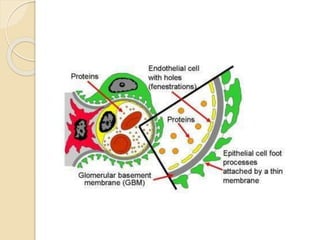
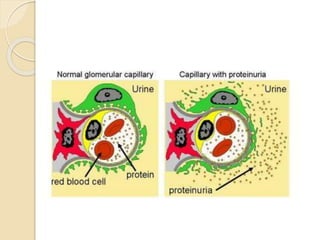
 The pathological changes of nephrotic
syndrome may be due to loss of
charge selectivity and thickening of
the foot plate of the glomerular
basement membrane.
 These result in increased glomerular
permiability which permits the
negatively charged protein, mainly
albumin to pass through the capillary
walls into the urine.
 Excess loss of albumin result in decrease
in serum albumin
 As a result of hypoalbuminemia,there is
reduction in plasma oncotic pressure.
Thus fluid flows from the capillaries into
the interstitial space and produce oedma.
 The sift fo fluid from the plasma to the
interstitial spaces the intravascular fluid
volume resulting hypovolemia,which
stimulate ranin angiotension axis and
volume receptor to secret aldosterone and
antidiuretic hormone these lead to
reabsorption of Na & H2O in distal tubules
resulting oedema.
 Loss of protein & immunoglobulin
predisposes to infection in the child.
Diminished oncotic pressure leades to
hepatic lipoprotein synthesis which result
in hyperlipidemia.
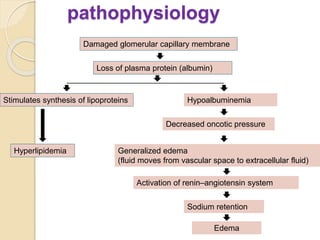
pathophysiology
Damaged glomerular capillary membrane
Loss of plasma protein (albumin)
Stimulates synthesis of lipoproteins Hypoalbuminemia
Hyperlipidemia
Decreased oncotic pressure
Generalized edema
(fluid moves from vascular space to extracellular fluid)
Activation of renin–angiotensin system
Sodium retention
Edema
Clinical features
 Child may present with periorbital
puffiness.
 Oedema may be minimal or massive.
 Profound weight gain with in a short
period.
 Dependent oedema develops in the ankle,
feet, genitalia(scrotum) & hand.
 Oedmatus part soft & pits easily on
pressure.
 Striae may be appear on the skin due to
 Fluid accumulate in the body space
resulting ascites,pleural effusion with
respiratory distress and generalized
oedema
 Urine out put is reduce
 GI disturbances usually found as vomiting,
loss of appetite & diarrhoea
 Other features include fatigue, lethergy,
pallor & irritability, hypertension, hematuria,
hepatomegaly & wasting of muscle may
found in some cases.
Clinical feactures Cont..
Complications
 Ascitis
 Pleural effusion
 Generalized oedema(anasarca)
 Coagulation disorder
 Thrombosis
 Recurrent infection
 Growth retardation
 Calcium & Vitamin D deficiency
 Protein energy malnutrition
Nursing management
 Assessment and document the
location and character of the patient's
oedema.
 Measure blood pressure with the
patient lying down and standing.
Immediately report a decrease in
systolic or diastolic pressure
exceeding 20 mm Hg.
 Monitor intake and output and weigh
the patient each morning after he
voids and before he eats. Make sure
he's wearing the same amount of
clothing each time you weigh him.
 Ask the dietitian to plan a low-sodium
diet with moderate amounts of protein.
 Frequently check urine for protein.
 Monitor plasma albumin and
transferrin concentrations to evaluate
overall nutritional status
 Provide meticulous skin care to
combat the edema that usually occurs
with nephrotic syndrome.
 To prevent the occurrence of
thrombophlebitis, encourage activity
and exercise, and provide
antiembolism stockings as ordered.
 Give the patient and family
reassurance and support, especially
during the acute phase, when edema
is severe and the patient's body image
changes
 Assessment
• Oedma around eyes,feet and genitalia
• Urine out put in 24 hrs – 200ml
• Body weight 18kg
• Fluid intake 250ml in 24 hrs
 Nursing diagnosis
• Fluid volume excess related to accumulation in tissue
 Planning
• To reduce excess amount of fluid accumulated in tissue
 Implementation
• Providing rest, comfortable position and frequent change of
position
• Allowing diet with law salt and high protein(egg,fish,pulse)
• Administering prescribed medications.
• Offering potassium containing food(orange juice,banana)
• Restricting fluid intake
• Maintaining intake-output and body weight chart
• Urine testing for albumin
 Assessment
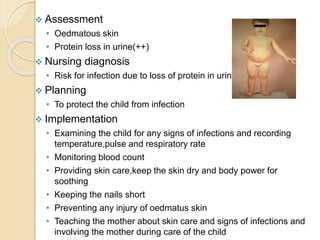
• Oedmatous skin
• Protein loss in urine(++)
 Nursing diagnosis
• Risk for infection due to loss of protein in urine
 Planning
• To protect the child from infection
 Implementation
• Examining the child for any signs of infections and recording
temperature,pulse and respiratory rate
• Monitoring blood count
• Providing skin care,keep the skin dry and body power for
soothing
• Keeping the nails short
• Preventing any injury of oedmatus skin
• Teaching the mother about skin care and signs of infections and
involving the mother during care of the child
 Assessment
• Loss of appetite
• Proteinuria
• Lethargy
 Nursing diagnosis
• Altered nutrition less than body requirement related to disease
condition
 Planning
• To improve nutritional status
 Implementation
• Providing small frequent feeding with protein and carbohydrate,
considering dietary restriction and child’s like and dislikes
• Providing nutritional supplementation as needed
• Encourage child to take food
 Assessment
• Anxiety of the parents
• Fear of the child
 Nursing diagnosis
• Altered family process support due to hospitalization
 Planning
• To provide emotional child care
 Implementation
• Allowing parental involvement in
• Allowing play and self care as tolerated by the child
• Encouraging interaction with other child having chronic illness
• Answering the questions asked by the parents and allowing to
express frustration
 Assessment
• Inability to take care of the child by the parents
 Nursing diagnosis
• Knowledge deficit about caring the child and medical
management
 Planning
• To improve knowledge about child care by health
teaching
 Implementation
• Discussing about the care after discharge from
hospital, regarding rest, diet, hygiene, continuation of
medications, need for medical help an follow up
• Teaching about features of infections, signs of relapse
and precautions to prevent complications
Patient teaching and home
health care guide for nephrotic
Syndrome
 If the patients receive
immunosuppressants, teach him and
family members to report even mild
signs of infection.
 If the patients receive long-term
corticosteroid therapy, teach him and
family members to report muscle
weakness and mental changes.
 To prevent gastrointestinal
complications, suggest to the patient
that he take steroids with an antacid or
with cimetidine or ranitidine. Explain
that the adverse effects of steroids
subside when therapy stops, but warn
the patient not to discontinue the drug
without a physician's consent.
 Stress the importance of adhering to
the special diet.
 If the physician prescribes
antiembolism stockings for home use,
show the patient how to safely apply
and remove them.
Nephrotic syndrome

Nephrotic syndrome

  • 1.
  • 2.
     Nephrotic syndromeis one of the common cause of hospitalization among children.  Incidence of the condition is 2 to7 per1000.  It is more common in male child.  Mean age of occurrence is 2 to 5 years. It is a symptom complex manifested by massive oedema, hypoalbuminemia, marked
  • 3.
    Classification  Congenital nephroticsyndrome  Idiopathic or primary nephrotic syndrome  Secondary nephrotic syndrome
  • 4.
    Congenital nephrotic syndrome  Itis rare but serious and fatal problem usually associated with other congenital abnormalities of kidney.  It is inherited as autosomal recessive disease.  Severe renal insufficiency and urinary infections along with this condition result is poor prognosis.
  • 5.
    Idiopathic or primarynephrotic syndrome  It is the most common type(about 90%) and regarded as autoimmune phenomenon as it responds to immunosuppressive therapy.  Subgroup of this type ◦ Minimal change nephrotic syndrome(85%) ◦ Proliferative nephrotic syndrome(5%) ◦ Focal sclerosis nephrotic syndrome(10%)
  • 6.
    Secondary nephrotic syndrome It occur in children about 10% of all cases. This condition may occur due to some form of chronic glomerularnephritis or due to diabetes mellites,systimic lupus erythematosis(SLE), malaria,malignant hypertension, hepatitis ‘B’, infective endocarditis, drug toxicity, lymphomas and syphilis
  • 7.
    pathophysiology  The pathologicalchanges of nephrotic syndrome may be due to loss of charge selectivity and thickening of the foot plate of the glomerular basement membrane.  These result in increased glomerular permiability which permits the negatively charged protein, mainly albumin to pass through the capillary walls into the urine.
  • 10.
     Excess lossof albumin result in decrease in serum albumin  As a result of hypoalbuminemia,there is reduction in plasma oncotic pressure. Thus fluid flows from the capillaries into the interstitial space and produce oedma.
  • 11.
     The siftfo fluid from the plasma to the interstitial spaces the intravascular fluid volume resulting hypovolemia,which stimulate ranin angiotension axis and volume receptor to secret aldosterone and antidiuretic hormone these lead to reabsorption of Na & H2O in distal tubules resulting oedema.  Loss of protein & immunoglobulin predisposes to infection in the child. Diminished oncotic pressure leades to hepatic lipoprotein synthesis which result in hyperlipidemia.
  • 12.
    pathophysiology Damaged glomerular capillarymembrane Loss of plasma protein (albumin) Stimulates synthesis of lipoproteins Hypoalbuminemia Hyperlipidemia Decreased oncotic pressure Generalized edema (fluid moves from vascular space to extracellular fluid) Activation of renin–angiotensin system Sodium retention Edema
  • 13.
    Clinical features  Childmay present with periorbital puffiness.  Oedema may be minimal or massive.  Profound weight gain with in a short period.  Dependent oedema develops in the ankle, feet, genitalia(scrotum) & hand.  Oedmatus part soft & pits easily on pressure.  Striae may be appear on the skin due to
  • 14.
     Fluid accumulatein the body space resulting ascites,pleural effusion with respiratory distress and generalized oedema  Urine out put is reduce  GI disturbances usually found as vomiting, loss of appetite & diarrhoea  Other features include fatigue, lethergy, pallor & irritability, hypertension, hematuria, hepatomegaly & wasting of muscle may found in some cases. Clinical feactures Cont..
  • 15.
    Complications  Ascitis  Pleuraleffusion  Generalized oedema(anasarca)  Coagulation disorder  Thrombosis  Recurrent infection  Growth retardation  Calcium & Vitamin D deficiency  Protein energy malnutrition
  • 16.
    Nursing management  Assessmentand document the location and character of the patient's oedema.  Measure blood pressure with the patient lying down and standing. Immediately report a decrease in systolic or diastolic pressure exceeding 20 mm Hg.
  • 17.
     Monitor intakeand output and weigh the patient each morning after he voids and before he eats. Make sure he's wearing the same amount of clothing each time you weigh him.  Ask the dietitian to plan a low-sodium diet with moderate amounts of protein.  Frequently check urine for protein.  Monitor plasma albumin and transferrin concentrations to evaluate overall nutritional status
  • 18.
     Provide meticulousskin care to combat the edema that usually occurs with nephrotic syndrome.  To prevent the occurrence of thrombophlebitis, encourage activity and exercise, and provide antiembolism stockings as ordered.  Give the patient and family reassurance and support, especially during the acute phase, when edema is severe and the patient's body image changes
  • 20.
     Assessment • Oedmaaround eyes,feet and genitalia • Urine out put in 24 hrs – 200ml • Body weight 18kg • Fluid intake 250ml in 24 hrs  Nursing diagnosis • Fluid volume excess related to accumulation in tissue  Planning • To reduce excess amount of fluid accumulated in tissue  Implementation • Providing rest, comfortable position and frequent change of position • Allowing diet with law salt and high protein(egg,fish,pulse) • Administering prescribed medications. • Offering potassium containing food(orange juice,banana) • Restricting fluid intake • Maintaining intake-output and body weight chart • Urine testing for albumin
  • 21.
     Assessment • Oedmatousskin • Protein loss in urine(++)  Nursing diagnosis • Risk for infection due to loss of protein in urine  Planning • To protect the child from infection  Implementation • Examining the child for any signs of infections and recording temperature,pulse and respiratory rate • Monitoring blood count • Providing skin care,keep the skin dry and body power for soothing • Keeping the nails short • Preventing any injury of oedmatus skin • Teaching the mother about skin care and signs of infections and involving the mother during care of the child
  • 22.
     Assessment • Lossof appetite • Proteinuria • Lethargy  Nursing diagnosis • Altered nutrition less than body requirement related to disease condition  Planning • To improve nutritional status  Implementation • Providing small frequent feeding with protein and carbohydrate, considering dietary restriction and child’s like and dislikes • Providing nutritional supplementation as needed • Encourage child to take food
  • 23.
     Assessment • Anxietyof the parents • Fear of the child  Nursing diagnosis • Altered family process support due to hospitalization  Planning • To provide emotional child care  Implementation • Allowing parental involvement in • Allowing play and self care as tolerated by the child • Encouraging interaction with other child having chronic illness • Answering the questions asked by the parents and allowing to express frustration
  • 24.
     Assessment • Inabilityto take care of the child by the parents  Nursing diagnosis • Knowledge deficit about caring the child and medical management  Planning • To improve knowledge about child care by health teaching  Implementation • Discussing about the care after discharge from hospital, regarding rest, diet, hygiene, continuation of medications, need for medical help an follow up • Teaching about features of infections, signs of relapse and precautions to prevent complications
  • 25.
    Patient teaching andhome health care guide for nephrotic Syndrome  If the patients receive immunosuppressants, teach him and family members to report even mild signs of infection.  If the patients receive long-term corticosteroid therapy, teach him and family members to report muscle weakness and mental changes.
  • 26.
     To preventgastrointestinal complications, suggest to the patient that he take steroids with an antacid or with cimetidine or ranitidine. Explain that the adverse effects of steroids subside when therapy stops, but warn the patient not to discontinue the drug without a physician's consent.
  • 27.
     Stress theimportance of adhering to the special diet.  If the physician prescribes antiembolism stockings for home use, show the patient how to safely apply and remove them.