Dr.Muhammad Saleem Laghari
Associate Professor
Department of pediatrics
SZMC,RYK
 Globally, about one quarter of all neonatal
deaths are caused by birth asphyxia.
Effective resuscitation at birth can prevent a
large proportion of these deaths.
 About 10% of all new born require some
assistance to begin breathing just after
delivery.
 <1% of them require extensive resuscitation
Ref: BMC Public Health 2011 11(Suppl 3):S12
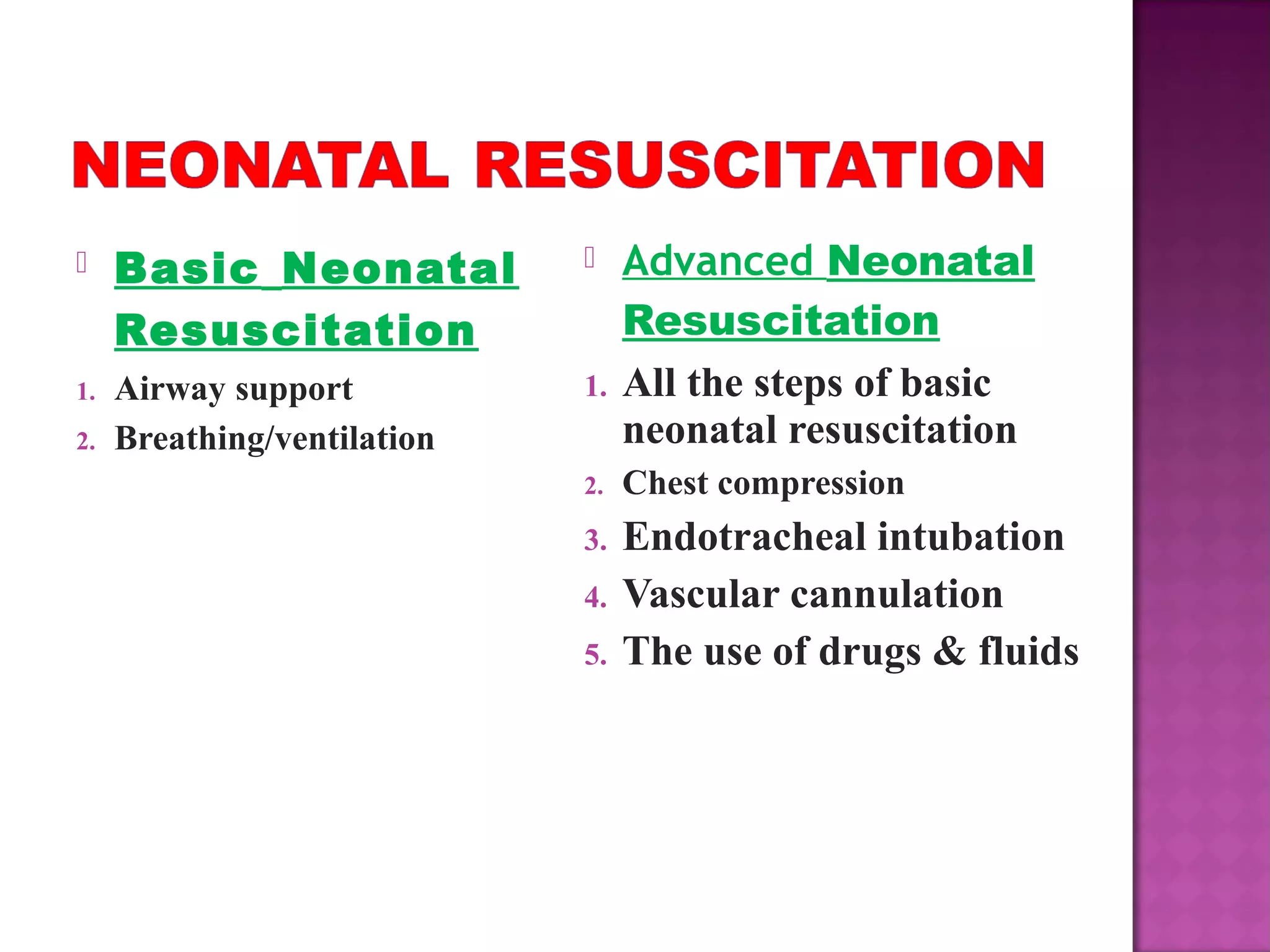
 Basic Neonatal
Resuscitation
1. Airway support
2. Breathing/ventilation
 Advanced Neonatal
Resuscitation
1. All the steps of basic
neonatal resuscitation
2. Chest compression
3. Endotracheal intubation
4. Vascular cannulation
5. The use of drugs & fluids
Following scheme is recommended
1. Preparation
2. Safety
3. Shout for help
4. Stimulate
1. Dry & rub the back with towel and cover the newborn
2. Gentle verbal / tactile stimuli in a neonate
5. Assess for breathing (crying/movement of chest)
6. Airway
1. Open
2. Clear
7. Reassess for breathing
8. Breathing
Inflation / ventilation / rescue breaths
7. Reassess for breathing and heart rate
8. Chest compressions
Thumb/two finger technique
7. Reassess for breathing and heart rate
8. Drugs
Adrenaline
Sodium bicarbonate
Dextrose
Volume expenders
7. Reassess for breathing and heart rate
8. post-resuscitation care
 Is the key to a successful outcome.
 Cooperation between obstetric and pediatric staff
is important.
 Review notes
 Communicate with the parents
 Wash hands & Use sterile gloves
 Thermoneutral environment
 Check for equipment
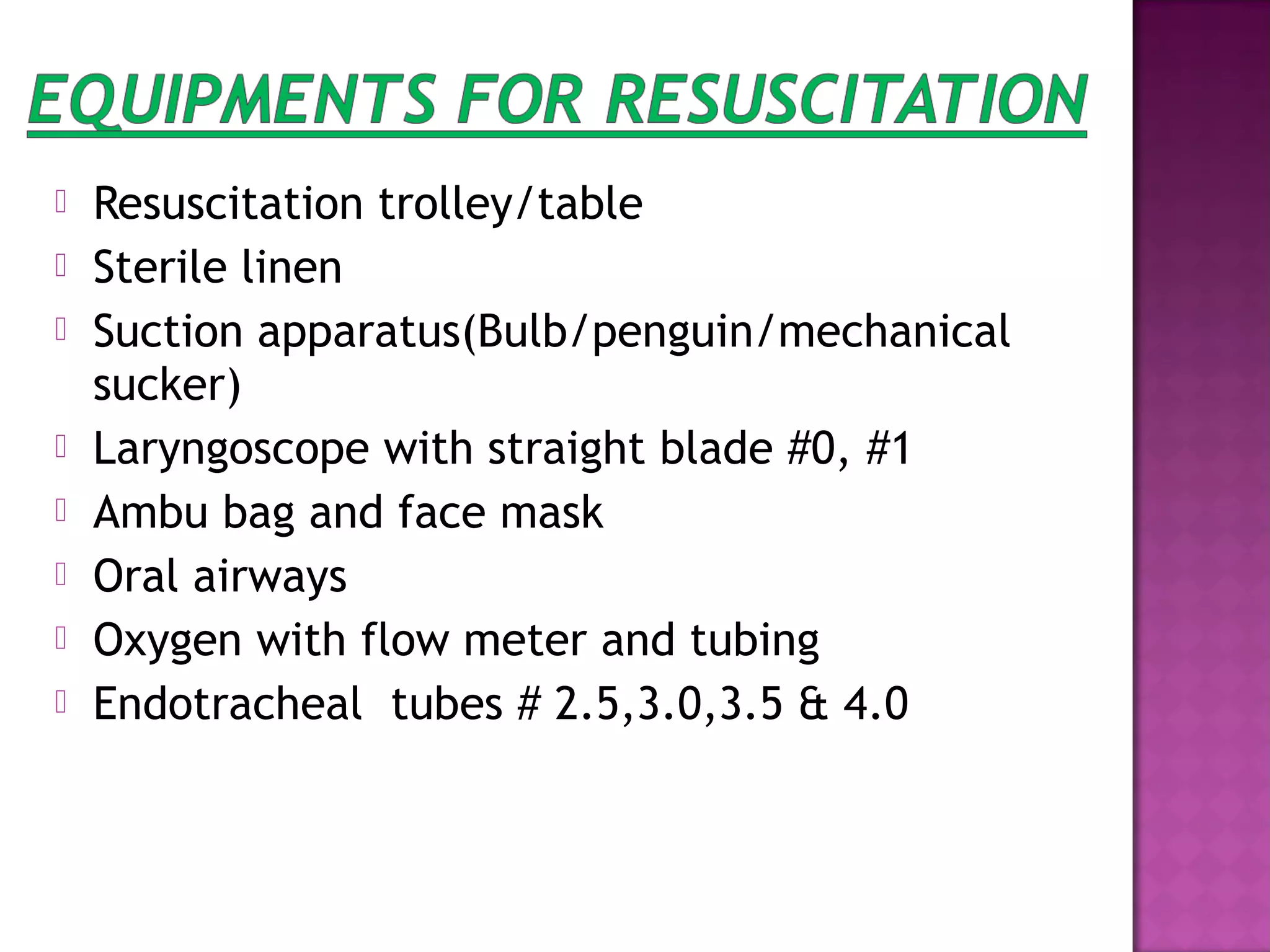
 Resuscitation trolley/table
 Sterile linen
 Suction apparatus(Bulb/penguin/mechanical
sucker)
 Laryngoscope with straight blade #0, #1
 Ambu bag and face mask
 Oral airways
 Oxygen with flow meter and tubing
 Endotracheal tubes # 2.5,3.0,3.5 & 4.0
 Radiant warmer
 Stethoscope
 Adhesive tapes
 Syringes
 Butterfly needles
 Umbilical venous catheterization tray
 Umbilical catheter 3 and 5 fr
 Feeding tubes 5 fr.
 Disposable syringes
 Epinephrine 1:10,000
 Volume expanders i.e. N/saline,Albumin5%,
Ringer lactate, O-ve blood
 Sodium bicarbonate
 Dextrose water 10%
 Sterile water
1. Ensure your own as well as patient’s safety
2. Look for the clues as to what may have
caused this emergency.
3. Wear gloves & do not perform direct mouth
to mouth breathing.
Do not hesitate to call for help especially in
high risk situations.
IN CASE OF NEWBORN:
1- Start the clock
Timing to cut the cord
Ascertain the duration of CPR
2- Dry the baby
3- Assess for breathing
4- Stimulate if not breathing
5- If baby starts breathing/ crying, no further help
6- if no response, then proceed further
IN CASE OF NEONATE:
Stimulate the baby by gentle shaking of arms or
rubbing of skin or by verbal stimuli
Assessment & reassessment is done after every
30 seconds, and take no longer than 10
seconds.
 Look: Chest movements
 Listen: Breath sounds & heart sounds (auscultation)
 Feel: Breaths and pulse
Open airway by
 Neutral position
 Chin lift
 Jaw thrust
Clear airway
secretions, foreign body, vomits by gentle
suctioning of mouth first and then nose.
 In newborns after the airway is opened and cleared
and the newborn is still not breathing, then it is
necessary to aerate the lungs first with “inflation
breaths” and then to continue with ‘ventilation
breaths’
 In case of a neonate inflation breaths are not
required. Only ventilation breaths, called ‘rescue
breaths’, are given.
 Ventilation / rescue breaths are given at the rate
30/min.
 Effective ventilation:
 Good chest movement
 Improvement of heart rate within 20-30 seconds
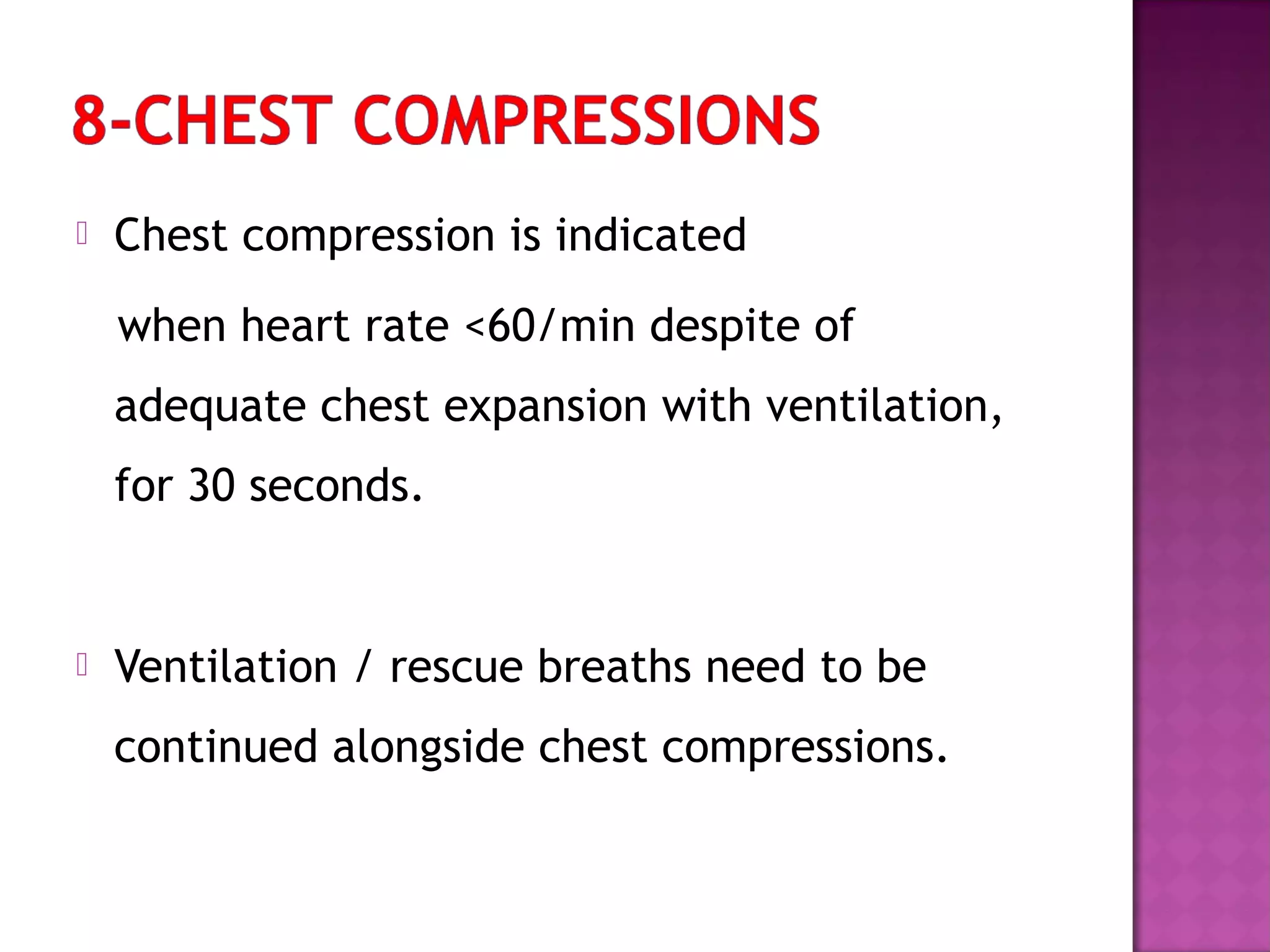
 Chest compression is indicated
when heart rate <60/min despite of
adequate chest expansion with ventilation,
for 30 seconds.
 Ventilation / rescue breaths need to be
continued alongside chest compressions.
Technique
 Two thumbs technique
 Two fingers technique
 At lower third sternum (between the xiphoid and a
line draw between nipples)
 Compression depth; approximately one third of the
anterio-posterior diameter of chest
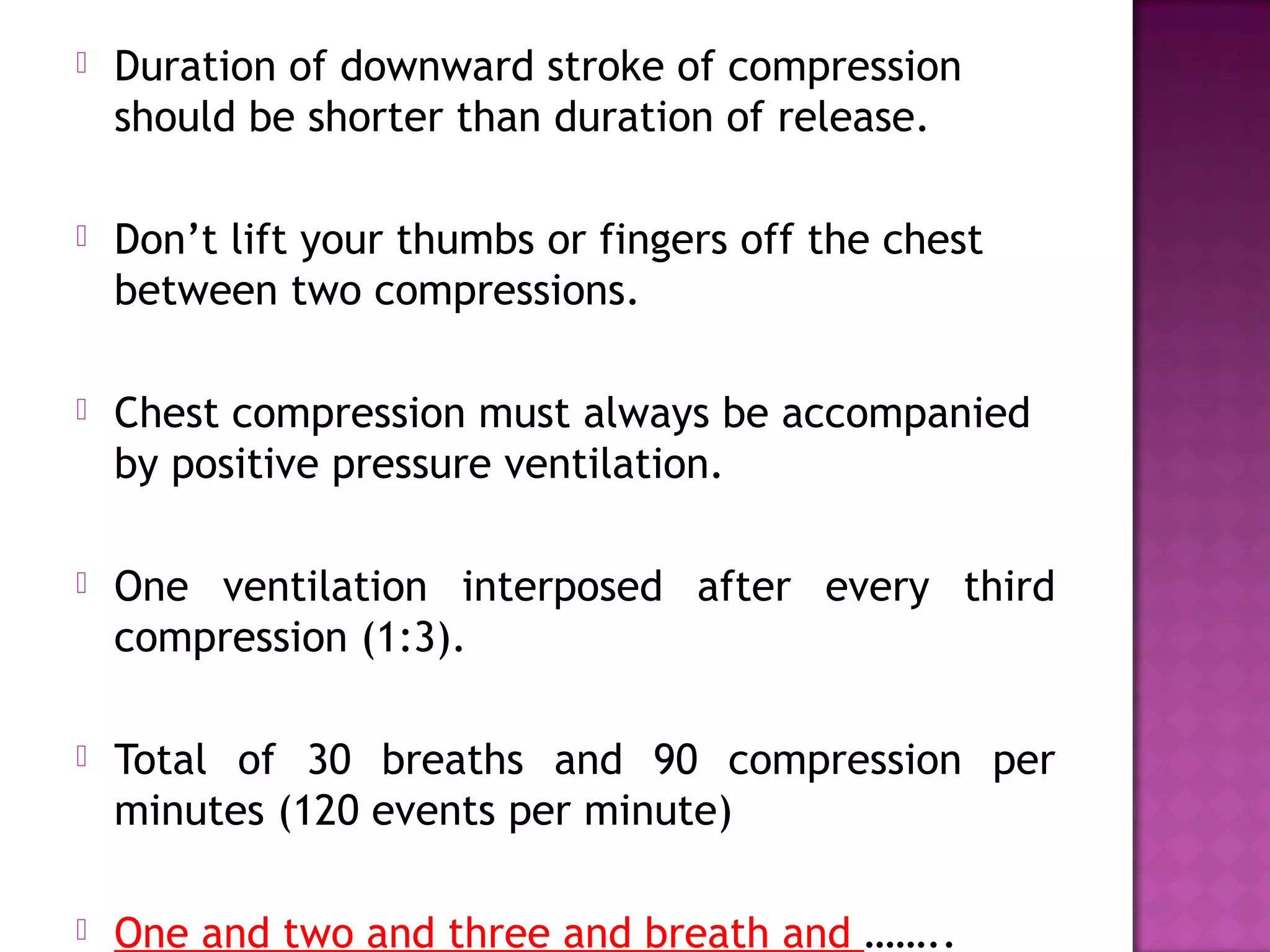
 Duration of downward stroke of compression
should be shorter than duration of release.
 Don’t lift your thumbs or fingers off the chest
between two compressions.
 Chest compression must always be accompanied
by positive pressure ventilation.
 One ventilation interposed after every third
compression (1:3).
 Total of 30 breaths and 90 compression per
minutes (120 events per minute)
 One and two and three and breath and ……..
 If heart rate not improving(below 60/min)
despite adequate ventilation and chest
compressions for 30 seconds then drugs
should be considered.
 Drug must be followed by 0.5-1.0 ml normal
saline to clear the drug from catheter.
ADRENALINE:
 Preparation: 1:10,000 (1g/10,000ml, 100mg/l or
100µg/ml)
 Dose: 10µg/kg, 0.1ml-0.3 ml/kg (0.5-1.0 ml/kg
via endotracheal tube)
 Route: Umbilical venous catheter or
endotracheal tube
 Rate: Rapidly
SODIUM BICARBONATE:
 Preparation: 4.2% (or 8.4% diluted 1:1)
 Dose: 1-2 mmol/kg (2-4ml/kg)
 Route: umbilical venous catheter
 Rate: 1mmol/kg/min
VOLUME EXPANDERS:
 Preparation:
 Normal saline
 Ringer lactate
 O negative blood, cross matched with mother’s blood if time
permits (if prenatal diagnosis has suggested low fetal blood
volume)
 Dose: 10 ml/kg
 Route: Umbilical vein
 Rate: over 5-10 min
DEXTROSE
 Preparation: 10%
 Dose: 250 mg/kg or 2.5 ml/kg
 Route: umbilical vein
 Reassess after every 30 seconds, and take no
longer than 10 seconds.
1. Ambu bagging not effective
2. Prolonged ventilation is expected
3. Suspected diaphragmatic hernia
4. Severe anatomical or functional upper
airway obstruction
5. Need for high pressure to maintain
adequate oxygenation
6. Need for bronchial or tracheal suctioning in
meconium stained un-responsive baby
7. Instability or high probability of any of the
above occurring before or during transport.
Different methods are used for its calculation
 Formula 1:gestational age (weeks)/ 10
 Formula 2:
Tube size Weight (g) Gestational age
(wk)
2.5 < 1,000 < 28
3.0 1,000-2,000 28-34
3.5 2,000-3,000 34-38
3.5-4.0 >3,000 >38
Different methods are used for its calculation
 Formula 1: baby’s weight (in kilograms) + 6
 Formula 2: Length of tube according to
weight
Weight Depth of insertion
(in cm from upper lip)
1 7
2 8
3 9
4 10
1. The conditions suitable for a neonate
should be maintained during the transfer.
2. Transferring team must be able to deal with
any problems arising during transportation.
3. The receiving hospital should be informed
before departure.
1. Monitor vital signs, glucose
2. Monitor events & complications
3. Care of endotracheal tube & vascular lines
4. Skin to skin contact with mother where
possible
5. Reassess the baby as required
6. Keep record
7. Communicate with parents
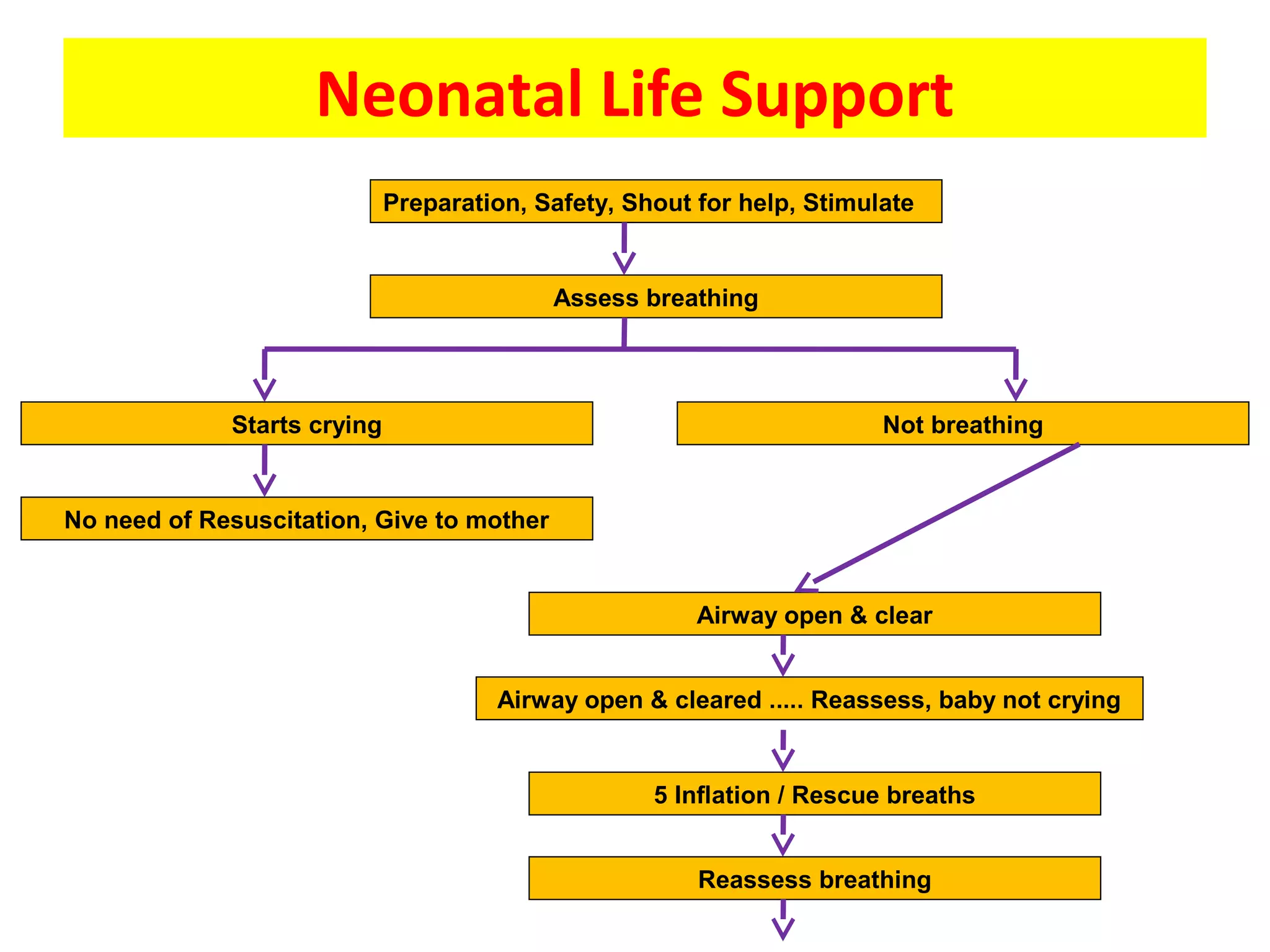
Neonatal Life Support
Preparation, Safety, Shout for help, Stimulate
Assess breathing
Not breathingStarts crying
No need of Resuscitation, Give to mother
Airway open & clear
Airway open & cleared ..... Reassess, baby not crying
5 Inflation / Rescue breaths
Reassess breathing
Reassess breathing
No chest movementGood chest movement
Ventilation/Rescue breaths
Repeat 5 inflation/rescue breath
Check chest movement
Good chest movement
Reassess HR
Reassess (every 30 sec)
Regular breathing, good HR
Stop ventilation/Rescue breaths
Reassess, check airway
No chest movement
Consider ETT, Guedel airway
Good HR Slow HR
Chest compression
Reassess breathing
No good chest
movement
Consider other
possibilities
Chest compressions
Ventilation / Rescue breaths
Stop ventilation/rescue
breaths
Reassess (after 30sec)
Reassess (every 30 sec)
Regular breathing, good HR
Continue CC, ventilation / rescue
breaths
Consider drugs
Reassess (every 30 sec)
Good HR Slow HR
Slow heart rate
Abandon resuscitation
after 10 minutes of
undetectable HR
 Effective spontaneous breathing has been
established as evidenced by:
 Increasing heart rate
 Spontaneous breathing
 Senior staff and parents must be consulted
before stopping positive pressure ventilation in
cases of:
 Signs of established biological death
 The existence of DNR is established
 If there is no detectable heart rate for >10 min despite
adequate measures
 Standard algorithm of ‘ABCD’ is used but
with minimal variation.
 Attempts to aspirate meconium from nose & mouth
of the unborn baby , while the head is still on the
perineum is not recommended.
 If at birth, a meconium stained baby has:
Normal respiratory effort
normal muscle tone
heart rate grater than 100beats/min
Intervention:
1. Use a bulb/penguin sucker or large bore suction
catheter to clear secretions from oropharynx and
nose.
2. Do not intubate or do blind oropharyngeal suction.
 If at birth, a meconium stained baby has:
depressed respiration
depressed muscle tone
heart rate <100 beats/min
Intervention:
1. immediate endotracheal intubation and
direct suctioning of trachea is done without
stimulation.
2.
Results from:
Positive pressure ventilation
Lung malformation
 If the chest is not expanding adequately despite
proper positioning of airways , ambu-bagging, giving
adequate pressure, placing Guedel airways and there
is no improvement in heart rate, then this condition
must be considered.
 Removing obstruction of lung airways by external
chest drainage of air through placement of needle or
chest drain in pleural space.
 In neonate it may results from:
Hydrops fetalis
Chylothorax
 Manage by chest drain insertion.
 If Chest is not expanding adequately despite
proper positioning of airways, ambu-baging,
giving adequate pressure, placing Guedel airways
and there is no improvement in heart rate.
 Think CDH and confirm on examination.
 Resuscitation with a bag and mask
contraindicated.
 Should have immediate endotracheal intubation
and place a large orogastric catheter.
 Babies are nasal breathers.
 Should be considered where after proper
airway opening and clearing maneuvers, good
expansion of the chest cannot be obtained by
ambu-baging.
Intervention:
 Inserting a plastic oral airway will allow air
to pass through mouth.
 Developmental malformation of palate and
oropharynx.
 Small mandible results in critical narrowing
of pharyngeal airway.
 Tongue, posteriorly placed, falls back into
pharynx and obstructs it just above larynx.
 Maintain airway by positioning or use of
plastic oral airway.
 Get hypothermic earlier than term babies.
 Fragile lungs and thus inability to breath
effectively.
 Maintain body temperature during
resuscitation and use lower pressures for
chest expansion.
 Naloxone is no longer recommended as part of
initial resuscitation in a delivery room.
 Giving a narcotic antagonist is not the correct
first therapy for a baby who is not breathing.
 The first corrective action is positive pressure
ventilation.
Indications:
1. Continued respiratory depression after PPV has
restored a normal HR.
2. A history of maternal narcotic administration during
labour within 4 hours.
 Naloxone : DOSE : 0.1 mg/kg I/V bolus.
 Caution: Do Not give Naloxone to the
newborn whose mother is suspected of being
addicted to narcotics.
Neonatal resuscitation part 2 by dr.saleem

Neonatal resuscitation part 2 by dr.saleem

  • 1.
    Dr.Muhammad Saleem Laghari AssociateProfessor Department of pediatrics SZMC,RYK
  • 2.
     Globally, aboutone quarter of all neonatal deaths are caused by birth asphyxia. Effective resuscitation at birth can prevent a large proportion of these deaths.  About 10% of all new born require some assistance to begin breathing just after delivery.  <1% of them require extensive resuscitation
  • 3.
    Ref: BMC PublicHealth 2011 11(Suppl 3):S12
  • 4.
     Basic Neonatal Resuscitation 1.Airway support 2. Breathing/ventilation  Advanced Neonatal Resuscitation 1. All the steps of basic neonatal resuscitation 2. Chest compression 3. Endotracheal intubation 4. Vascular cannulation 5. The use of drugs & fluids
  • 5.
    Following scheme isrecommended 1. Preparation 2. Safety 3. Shout for help 4. Stimulate 1. Dry & rub the back with towel and cover the newborn 2. Gentle verbal / tactile stimuli in a neonate 5. Assess for breathing (crying/movement of chest) 6. Airway 1. Open 2. Clear
  • 6.
    7. Reassess forbreathing 8. Breathing Inflation / ventilation / rescue breaths 7. Reassess for breathing and heart rate 8. Chest compressions Thumb/two finger technique 7. Reassess for breathing and heart rate 8. Drugs Adrenaline Sodium bicarbonate Dextrose Volume expenders 7. Reassess for breathing and heart rate 8. post-resuscitation care
  • 7.
     Is thekey to a successful outcome.  Cooperation between obstetric and pediatric staff is important.  Review notes  Communicate with the parents  Wash hands & Use sterile gloves  Thermoneutral environment  Check for equipment
  • 8.
     Resuscitation trolley/table Sterile linen  Suction apparatus(Bulb/penguin/mechanical sucker)  Laryngoscope with straight blade #0, #1  Ambu bag and face mask  Oral airways  Oxygen with flow meter and tubing  Endotracheal tubes # 2.5,3.0,3.5 & 4.0
  • 9.
     Radiant warmer Stethoscope  Adhesive tapes  Syringes  Butterfly needles  Umbilical venous catheterization tray  Umbilical catheter 3 and 5 fr  Feeding tubes 5 fr.  Disposable syringes
  • 10.
     Epinephrine 1:10,000 Volume expanders i.e. N/saline,Albumin5%, Ringer lactate, O-ve blood  Sodium bicarbonate  Dextrose water 10%  Sterile water
  • 11.
    1. Ensure yourown as well as patient’s safety 2. Look for the clues as to what may have caused this emergency. 3. Wear gloves & do not perform direct mouth to mouth breathing.
  • 12.
    Do not hesitateto call for help especially in high risk situations.
  • 13.
    IN CASE OFNEWBORN: 1- Start the clock Timing to cut the cord Ascertain the duration of CPR 2- Dry the baby 3- Assess for breathing 4- Stimulate if not breathing 5- If baby starts breathing/ crying, no further help 6- if no response, then proceed further IN CASE OF NEONATE: Stimulate the baby by gentle shaking of arms or rubbing of skin or by verbal stimuli
  • 14.
    Assessment & reassessmentis done after every 30 seconds, and take no longer than 10 seconds.  Look: Chest movements  Listen: Breath sounds & heart sounds (auscultation)  Feel: Breaths and pulse
  • 15.
    Open airway by Neutral position  Chin lift  Jaw thrust Clear airway secretions, foreign body, vomits by gentle suctioning of mouth first and then nose.
  • 18.
     In newbornsafter the airway is opened and cleared and the newborn is still not breathing, then it is necessary to aerate the lungs first with “inflation breaths” and then to continue with ‘ventilation breaths’  In case of a neonate inflation breaths are not required. Only ventilation breaths, called ‘rescue breaths’, are given.
  • 19.
     Ventilation /rescue breaths are given at the rate 30/min.  Effective ventilation:  Good chest movement  Improvement of heart rate within 20-30 seconds
  • 21.
     Chest compressionis indicated when heart rate <60/min despite of adequate chest expansion with ventilation, for 30 seconds.  Ventilation / rescue breaths need to be continued alongside chest compressions.
  • 22.
    Technique  Two thumbstechnique  Two fingers technique  At lower third sternum (between the xiphoid and a line draw between nipples)  Compression depth; approximately one third of the anterio-posterior diameter of chest
  • 23.
     Duration ofdownward stroke of compression should be shorter than duration of release.  Don’t lift your thumbs or fingers off the chest between two compressions.  Chest compression must always be accompanied by positive pressure ventilation.  One ventilation interposed after every third compression (1:3).  Total of 30 breaths and 90 compression per minutes (120 events per minute)  One and two and three and breath and ……..
  • 25.
     If heartrate not improving(below 60/min) despite adequate ventilation and chest compressions for 30 seconds then drugs should be considered.
  • 26.
     Drug mustbe followed by 0.5-1.0 ml normal saline to clear the drug from catheter. ADRENALINE:  Preparation: 1:10,000 (1g/10,000ml, 100mg/l or 100µg/ml)  Dose: 10µg/kg, 0.1ml-0.3 ml/kg (0.5-1.0 ml/kg via endotracheal tube)  Route: Umbilical venous catheter or endotracheal tube  Rate: Rapidly
  • 27.
    SODIUM BICARBONATE:  Preparation:4.2% (or 8.4% diluted 1:1)  Dose: 1-2 mmol/kg (2-4ml/kg)  Route: umbilical venous catheter  Rate: 1mmol/kg/min VOLUME EXPANDERS:  Preparation:  Normal saline  Ringer lactate  O negative blood, cross matched with mother’s blood if time permits (if prenatal diagnosis has suggested low fetal blood volume)  Dose: 10 ml/kg  Route: Umbilical vein  Rate: over 5-10 min
  • 28.
    DEXTROSE  Preparation: 10% Dose: 250 mg/kg or 2.5 ml/kg  Route: umbilical vein
  • 29.
     Reassess afterevery 30 seconds, and take no longer than 10 seconds.
  • 30.
    1. Ambu baggingnot effective 2. Prolonged ventilation is expected 3. Suspected diaphragmatic hernia 4. Severe anatomical or functional upper airway obstruction 5. Need for high pressure to maintain adequate oxygenation 6. Need for bronchial or tracheal suctioning in meconium stained un-responsive baby 7. Instability or high probability of any of the above occurring before or during transport.
  • 31.
    Different methods areused for its calculation  Formula 1:gestational age (weeks)/ 10  Formula 2: Tube size Weight (g) Gestational age (wk) 2.5 < 1,000 < 28 3.0 1,000-2,000 28-34 3.5 2,000-3,000 34-38 3.5-4.0 >3,000 >38
  • 32.
    Different methods areused for its calculation  Formula 1: baby’s weight (in kilograms) + 6  Formula 2: Length of tube according to weight Weight Depth of insertion (in cm from upper lip) 1 7 2 8 3 9 4 10
  • 33.
    1. The conditionssuitable for a neonate should be maintained during the transfer. 2. Transferring team must be able to deal with any problems arising during transportation. 3. The receiving hospital should be informed before departure.
  • 34.
    1. Monitor vitalsigns, glucose 2. Monitor events & complications 3. Care of endotracheal tube & vascular lines 4. Skin to skin contact with mother where possible 5. Reassess the baby as required 6. Keep record 7. Communicate with parents
  • 35.
    Neonatal Life Support Preparation,Safety, Shout for help, Stimulate Assess breathing Not breathingStarts crying No need of Resuscitation, Give to mother Airway open & clear Airway open & cleared ..... Reassess, baby not crying 5 Inflation / Rescue breaths Reassess breathing
  • 36.
    Reassess breathing No chestmovementGood chest movement Ventilation/Rescue breaths Repeat 5 inflation/rescue breath Check chest movement Good chest movement Reassess HR Reassess (every 30 sec) Regular breathing, good HR Stop ventilation/Rescue breaths Reassess, check airway No chest movement Consider ETT, Guedel airway Good HR Slow HR Chest compression Reassess breathing No good chest movement Consider other possibilities
  • 37.
    Chest compressions Ventilation /Rescue breaths Stop ventilation/rescue breaths Reassess (after 30sec) Reassess (every 30 sec) Regular breathing, good HR Continue CC, ventilation / rescue breaths Consider drugs Reassess (every 30 sec) Good HR Slow HR Slow heart rate Abandon resuscitation after 10 minutes of undetectable HR
  • 39.
     Effective spontaneousbreathing has been established as evidenced by:  Increasing heart rate  Spontaneous breathing  Senior staff and parents must be consulted before stopping positive pressure ventilation in cases of:  Signs of established biological death  The existence of DNR is established  If there is no detectable heart rate for >10 min despite adequate measures
  • 40.
     Standard algorithmof ‘ABCD’ is used but with minimal variation.
  • 41.
     Attempts toaspirate meconium from nose & mouth of the unborn baby , while the head is still on the perineum is not recommended.  If at birth, a meconium stained baby has: Normal respiratory effort normal muscle tone heart rate grater than 100beats/min Intervention: 1. Use a bulb/penguin sucker or large bore suction catheter to clear secretions from oropharynx and nose. 2. Do not intubate or do blind oropharyngeal suction.
  • 42.
     If atbirth, a meconium stained baby has: depressed respiration depressed muscle tone heart rate <100 beats/min Intervention: 1. immediate endotracheal intubation and direct suctioning of trachea is done without stimulation. 2.
  • 43.
    Results from: Positive pressureventilation Lung malformation  If the chest is not expanding adequately despite proper positioning of airways , ambu-bagging, giving adequate pressure, placing Guedel airways and there is no improvement in heart rate, then this condition must be considered.  Removing obstruction of lung airways by external chest drainage of air through placement of needle or chest drain in pleural space.
  • 44.
     In neonateit may results from: Hydrops fetalis Chylothorax  Manage by chest drain insertion.
  • 45.
     If Chestis not expanding adequately despite proper positioning of airways, ambu-baging, giving adequate pressure, placing Guedel airways and there is no improvement in heart rate.  Think CDH and confirm on examination.  Resuscitation with a bag and mask contraindicated.  Should have immediate endotracheal intubation and place a large orogastric catheter.
  • 46.
     Babies arenasal breathers.  Should be considered where after proper airway opening and clearing maneuvers, good expansion of the chest cannot be obtained by ambu-baging. Intervention:  Inserting a plastic oral airway will allow air to pass through mouth.
  • 47.
     Developmental malformationof palate and oropharynx.  Small mandible results in critical narrowing of pharyngeal airway.  Tongue, posteriorly placed, falls back into pharynx and obstructs it just above larynx.  Maintain airway by positioning or use of plastic oral airway.
  • 48.
     Get hypothermicearlier than term babies.  Fragile lungs and thus inability to breath effectively.  Maintain body temperature during resuscitation and use lower pressures for chest expansion.
  • 49.
     Naloxone isno longer recommended as part of initial resuscitation in a delivery room.  Giving a narcotic antagonist is not the correct first therapy for a baby who is not breathing.  The first corrective action is positive pressure ventilation. Indications: 1. Continued respiratory depression after PPV has restored a normal HR. 2. A history of maternal narcotic administration during labour within 4 hours.
  • 50.
     Naloxone :DOSE : 0.1 mg/kg I/V bolus.  Caution: Do Not give Naloxone to the newborn whose mother is suspected of being addicted to narcotics.