


GrowthGrowth
&&
DevelopmentDevelopment
ByBy
Dr Muhammad Saleem LaghariDr Muhammad Saleem Laghari
MBBS(KEMU), MCPS,FCPS (paeds)MBBS(KEMU), MCPS,FCPS (paeds)
Gold Medalist FCPS-IGold Medalist FCPS-I
Assistant ProfessorAssistant Professor
SZMC,RYKSZMC,RYK
22
GROWTHGROWTH
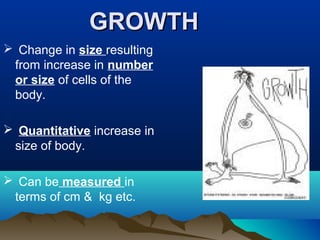
 Change in size resulting
from increase in number
or size of cells of the
body.
 Quantitative increase in
size of body.
 Can be measured in
terms of cm & kg etc.
DEVELOPMENTDEVELOPMENT
 Qualitative and
functional maturation
of organ system.
 Assessed in terms of
acquisition of skills and
ability to adopt to new
situation.
GROWTH & DEVELOPMENTGROWTH & DEVELOPMENT
Growth and development are assessedGrowth and development are assessed
simultaneously as they are verysimultaneously as they are very closelyclosely
relatedrelated to each otherto each other..
They provide the best and most practicalThey provide the best and most practical
means ofmeans of evaluation of healthevaluation of health of anof an
individual.individual.
Diseases tend to haveDiseases tend to have more impairmentmore impairment
when they occur during period ofwhen they occur during period of rapid
growth & development.growth & development.
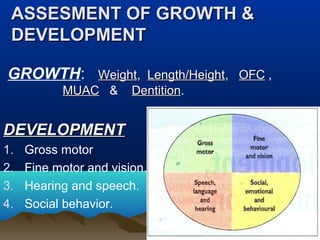
GROWTH: WeightWeight, Length/HeightLength/Height, OFCOFC ,
MUACMUAC & DentitionDentition.
DEVELOPMENTDEVELOPMENT
1. Gross motor
2. Fine motor and vision.
3. Hearing and speech.
4. Social behavior.
ASSESMENT OF GROWTH &ASSESMENT OF GROWTH &
DEVELOPMENTDEVELOPMENT
GROWTHGROWTH
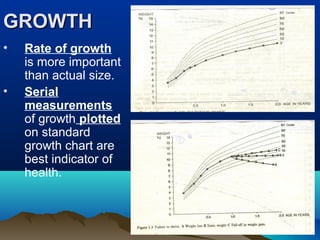
• Rate of growth
is more important
than actual size.
• Serial
measurements
of growth plotted
on standard
growth chart are
best indicator of
health.
WEIGHTWEIGHT
• The best index of nutrition & growth.
• Changes in weight occur before changes in
other aspects of growth.
• Average weight at birth is 3.2 kg. (7lb)
• The increase in weight is 30 gm/ day or 200
gm/week during first three months.
• Birth weight is doubled at 6-months, tripled
at 1-year and four times at 2-years age.
• Then annual increase of 5-lb/year.
• At 7-years it becomes 7-time of birth weight.
• During puberty, there is growth spurt.
HEIGHT (LENGTH)HEIGHT (LENGTH)
• Average length at birth is 50 cm.
• It increases by 25 cm in first year.
• It is 85 cm at 2-years, 95 cm at 3 years, 100 cm
at 4 years.
• Then it increases by 5-cm/year until puberty.
• The pubertal growth spurt leads to increase 10-
cm/year for 2 -- 3 years.
• Adult height is twice the height at 2 years age.
• Only Chronic illness affects length.
HEAD CIRCUMFERENCEHEAD CIRCUMFERENCE
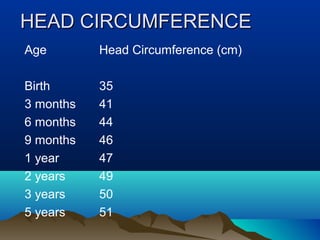
Age
Birth
3 months
6 months
9 months
1 year
2 years
3 years
5 years
Head Circumference (cm)
35
41
44
46
47
49
50
51
DENTITIONDENTITION
• First MILK tooth erupts at 6-months
age
• Eruption of milk teeth completes by 2.5
years (20-teeth)
• Shedding of milk teeth at 6-years and
is complete by 12-years of age.
• PERMANENT Teething is complete by
12-years of age except wisdom teeth
which appear at 22-years (32 - teeth).
DEVELOPMENTDEVELOPMENT
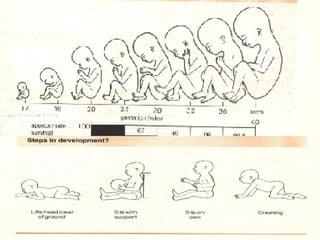
• It takes place in cephalocaudal
direction.
• It is influenced by,
 child’s maturity,
 illness,
 hunger or thirst and
 alertness or drowsiness.
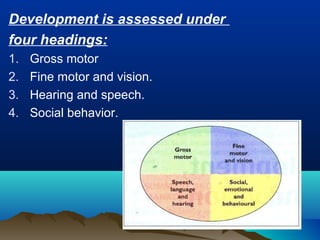
Development is assessed under
four headings:
1. Gross motor
2. Fine motor and vision.
3. Hearing and speech.
4. Social behavior.
NEONATENEONATE
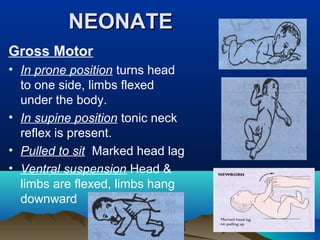
Gross Motor
• In prone position turns head
to one side, limbs flexed
under the body.
• In supine position tonic neck
reflex is present.
• Pulled to sit Marked head lag
• Ventral suspension Head &
limbs are flexed, limbs hang
downward
NEONATENEONATE
• Fine motor and vision
• Pupils react to light.
• Optical closure from sudden bright light.
• Doll’s eye reflex present.
Hearing & Speech
• Startle response to sudden loud noise.
• Cries vigorously.
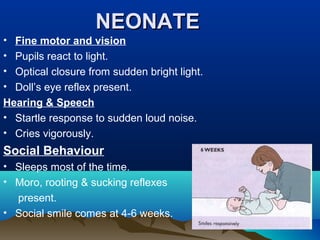
Social Behaviour
• Sleeps most of the time.
• Moro, rooting & sucking reflexes
present.
• Social smile comes at 4-6 weeks.
3 MONTHS AGE3 MONTHS AGE
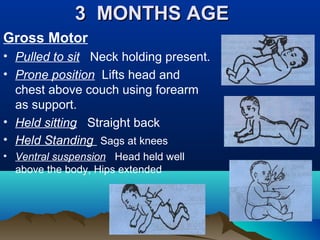
Gross Motor
• Pulled to sit Neck holding present.
• Prone position Lifts head and
chest above couch using forearm
as support.
• Held sitting Straight back
• Held Standing Sags at knees
• Ventral suspension Head held well
above the body, Hips extended
3 MONTHS AGE3 MONTHS AGE
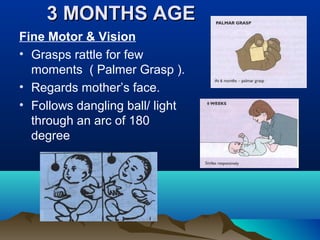
Fine Motor & Vision
• Grasps rattle for few
moments ( Palmer Grasp ).
• Regards mother’s face.
• Follows dangling ball/ light
through an arc of 180
degree
3 MONTHS AGE3 MONTHS AGE
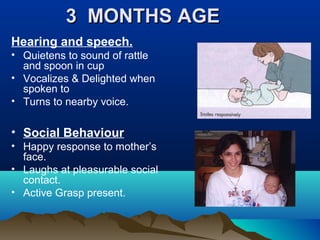
Hearing and speech.
• Quietens to sound of rattle
and spoon in cup
• Vocalizes & Delighted when
spoken to
• Turns to nearby voice.
• Social Behaviour
• Happy response to mother’s
face.
• Laughs at pleasurable social
contact.
• Active Grasp present.
6 MONTHS AGE6 MONTHS AGE
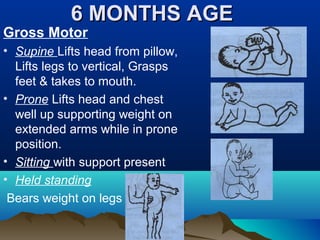
Gross Motor
• Supine Lifts head from pillow,
Lifts legs to vertical, Grasps
feet & takes to mouth.
• Prone Lifts head and chest
well up supporting weight on
extended arms while in prone
position.
• Sitting with support present
• Held standing
Bears weight on legs
6 MONTHS AGE6 MONTHS AGE
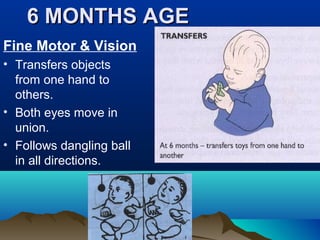
Fine Motor & Vision
• Transfers objects
from one hand to
others.
• Both eyes move in
union.
• Follows dangling ball
in all directions.
6 MONTHS AGE6 MONTHS AGE
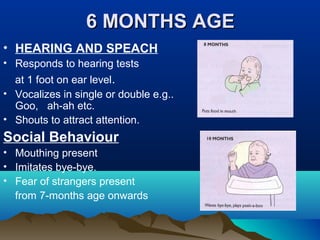
• HEARING AND SPEACH
• Responds to hearing tests
at 1 foot on ear level.
• Vocalizes in single or double e.g..
Goo, ah-ah etc.
• Shouts to attract attention.
Social Behaviour
• Mouthing present
• Imitates bye-bye.
• Fear of strangers present
from 7-months age onwards
12 MONTH AGE12 MONTH AGE
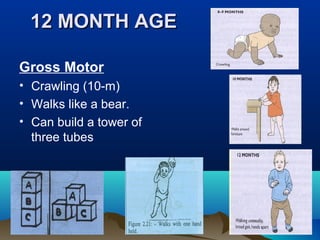
Gross Motor
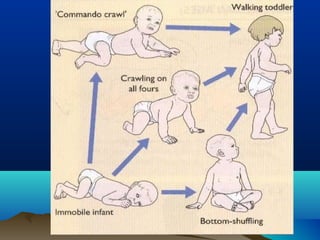
• Crawling (10-m)
• Walks like a bear.
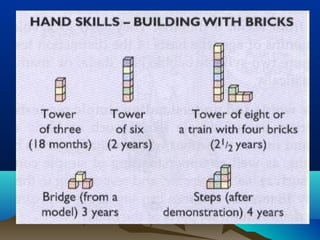
• Can build a tower of
three tubes
12 MONTH AGE12 MONTH AGE
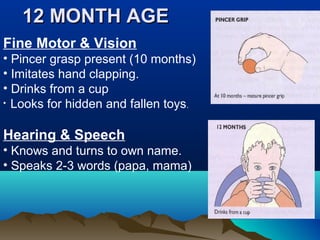
Fine Motor & Vision
• Pincer grasp present (10 months)
• Imitates hand clapping.
• Drinks from a cup
• Looks for hidden and fallen toys.
Hearing & Speech
• Knows and turns to own name.
• Speaks 2-3 words (papa, mama)
12 MONTHS AGE12 MONTHS AGE
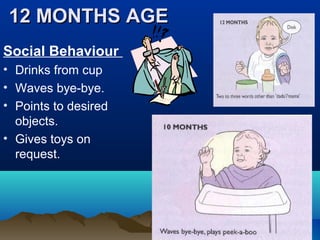
Social Behaviour
• Drinks from cup
• Waves bye-bye.
• Points to desired
objects.
• Gives toys on
request.
2 YEARS AGE2 YEARS AGE
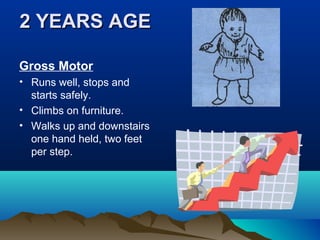
Gross Motor
• Runs well, stops and
starts safely.
• Climbs on furniture.
• Walks up and downstairs
one hand held, two feet
per step.
2 YEARS AGE2 YEARS AGE
Fine Motor & Vision
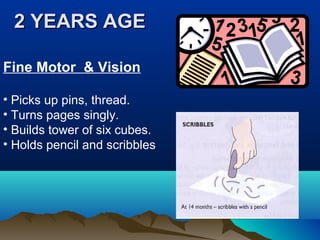
• Picks up pins, thread.
• Turns pages singly.
• Builds tower of six cubes.
• Holds pencil and scribbles
2 YEARS AGE2 YEARS AGE
HEARING & SPEACH
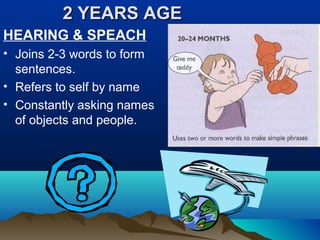
• Joins 2-3 words to form
sentences.
• Refers to self by name
• Constantly asking names
of objects and people.
2 YEARS AGE2 YEARS AGE
Social Behavior
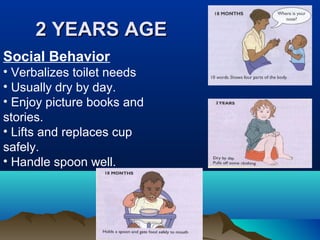
• Verbalizes toilet needs
• Usually dry by day.
• Enjoy picture books and
stories.
• Lifts and replaces cup
safely.
• Handle spoon well.
3 YEARS AGE3 YEARS AGE
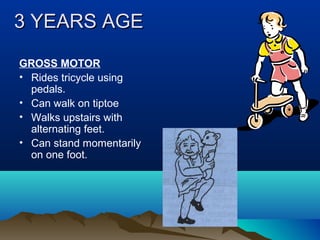
GROSS MOTOR
• Rides tricycle using
pedals.
• Can walk on tiptoe
• Walks upstairs with
alternating feet.
• Can stand momentarily
on one foot.
3 YEARS AGE3 YEARS AGE
FINE MOTOR AND
VISION
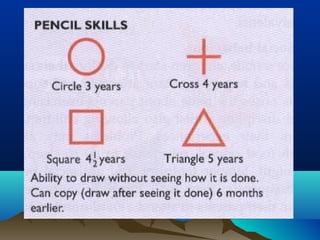
• Copies a circle
• Builds tower of 9-10
cubes.
3 YEARS AGE3 YEARS AGE
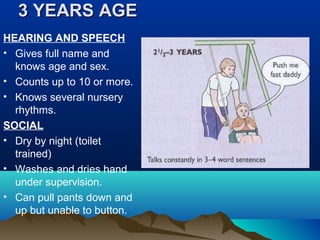
HEARING AND SPEECH
• Gives full name and
knows age and sex.
• Counts up to 10 or more.
• Knows several nursery
rhythms.
SOCIAL
• Dry by night (toilet
trained)
• Washes and dries hand
under supervision.
• Can pull pants down and
up but unable to button.
4 YEARS AGE4 YEARS AGE
GROSS MOTOR
• Stands on one foot 3-5 seconds.
• Runs on tiptoe.
• Climbs well.
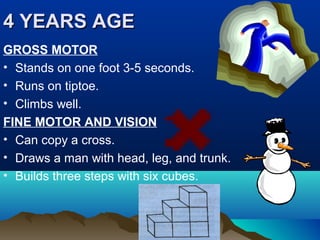
FINE MOTOR AND VISION
• Can copy a cross.
• Draws a man with head, leg, and trunk.
• Builds three steps with six cubes.
4 YEARS AGE4 YEARS AGE
HEARING AND SPEECH
• Gives full name and address
• Speaks grammatically correct and
intelligible
SOCIAL
• Washes and dries hand
• Brushes the teeth.
• Can dress and undress except shoe
laces.
• Tells a story.
• Understands taking turns as well as
sharing.
5 YEARS AGE5 YEARS AGE
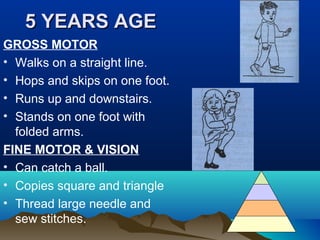
GROSS MOTOR
• Walks on a straight line.
• Hops and skips on one foot.
• Runs up and downstairs.
• Stands on one foot with
folded arms.
FINE MOTOR & VISION
• Can catch a ball.
• Copies square and triangle
• Thread large needle and
sew stitches.
5 YEARS AGE5 YEARS AGE
HEARING & SPEECH
• Gives full name, age
and birthday.
• Name four colors.
SOCIAL
• Washes and dries hands
and face.
• Dress and undress alone.
• Affectionate and helpful to
younger sibs.
• Knows right and left.
• Goes to school unattended.
THANKS

Growth and development

  • 2.
    GrowthGrowth && DevelopmentDevelopment ByBy Dr Muhammad SaleemLaghariDr Muhammad Saleem Laghari MBBS(KEMU), MCPS,FCPS (paeds)MBBS(KEMU), MCPS,FCPS (paeds) Gold Medalist FCPS-IGold Medalist FCPS-I Assistant ProfessorAssistant Professor SZMC,RYKSZMC,RYK 22
  • 4.
    GROWTHGROWTH  Change insize resulting from increase in number or size of cells of the body.  Quantitative increase in size of body.  Can be measured in terms of cm & kg etc.
  • 5.
    DEVELOPMENTDEVELOPMENT  Qualitative and functionalmaturation of organ system.  Assessed in terms of acquisition of skills and ability to adopt to new situation.
  • 6.
    GROWTH & DEVELOPMENTGROWTH& DEVELOPMENT Growth and development are assessedGrowth and development are assessed simultaneously as they are verysimultaneously as they are very closelyclosely relatedrelated to each otherto each other.. They provide the best and most practicalThey provide the best and most practical means ofmeans of evaluation of healthevaluation of health of anof an individual.individual. Diseases tend to haveDiseases tend to have more impairmentmore impairment when they occur during period ofwhen they occur during period of rapid growth & development.growth & development.
  • 8.
    GROWTH: WeightWeight, Length/HeightLength/Height,OFCOFC , MUACMUAC & DentitionDentition. DEVELOPMENTDEVELOPMENT 1. Gross motor 2. Fine motor and vision. 3. Hearing and speech. 4. Social behavior. ASSESMENT OF GROWTH &ASSESMENT OF GROWTH & DEVELOPMENTDEVELOPMENT
  • 10.
    GROWTHGROWTH • Rate ofgrowth is more important than actual size. • Serial measurements of growth plotted on standard growth chart are best indicator of health.
  • 11.
    WEIGHTWEIGHT • The bestindex of nutrition & growth. • Changes in weight occur before changes in other aspects of growth. • Average weight at birth is 3.2 kg. (7lb)
  • 12.
    • The increasein weight is 30 gm/ day or 200 gm/week during first three months. • Birth weight is doubled at 6-months, tripled at 1-year and four times at 2-years age. • Then annual increase of 5-lb/year. • At 7-years it becomes 7-time of birth weight. • During puberty, there is growth spurt.
  • 13.
    HEIGHT (LENGTH)HEIGHT (LENGTH) •Average length at birth is 50 cm. • It increases by 25 cm in first year. • It is 85 cm at 2-years, 95 cm at 3 years, 100 cm at 4 years. • Then it increases by 5-cm/year until puberty. • The pubertal growth spurt leads to increase 10- cm/year for 2 -- 3 years. • Adult height is twice the height at 2 years age. • Only Chronic illness affects length.
  • 14.
    HEAD CIRCUMFERENCEHEAD CIRCUMFERENCE Age Birth 3months 6 months 9 months 1 year 2 years 3 years 5 years Head Circumference (cm) 35 41 44 46 47 49 50 51
  • 15.
    DENTITIONDENTITION • First MILKtooth erupts at 6-months age • Eruption of milk teeth completes by 2.5 years (20-teeth) • Shedding of milk teeth at 6-years and is complete by 12-years of age. • PERMANENT Teething is complete by 12-years of age except wisdom teeth which appear at 22-years (32 - teeth).
  • 16.
    DEVELOPMENTDEVELOPMENT • It takesplace in cephalocaudal direction. • It is influenced by,  child’s maturity,  illness,  hunger or thirst and  alertness or drowsiness.
  • 18.
    Development is assessedunder four headings: 1. Gross motor 2. Fine motor and vision. 3. Hearing and speech. 4. Social behavior.
  • 19.
    NEONATENEONATE Gross Motor • Inprone position turns head to one side, limbs flexed under the body. • In supine position tonic neck reflex is present. • Pulled to sit Marked head lag • Ventral suspension Head & limbs are flexed, limbs hang downward
  • 20.
    NEONATENEONATE • Fine motorand vision • Pupils react to light. • Optical closure from sudden bright light. • Doll’s eye reflex present. Hearing & Speech • Startle response to sudden loud noise. • Cries vigorously. Social Behaviour • Sleeps most of the time. • Moro, rooting & sucking reflexes present. • Social smile comes at 4-6 weeks.
  • 21.
    3 MONTHS AGE3MONTHS AGE Gross Motor • Pulled to sit Neck holding present. • Prone position Lifts head and chest above couch using forearm as support. • Held sitting Straight back • Held Standing Sags at knees • Ventral suspension Head held well above the body, Hips extended
  • 22.
    3 MONTHS AGE3MONTHS AGE Fine Motor & Vision • Grasps rattle for few moments ( Palmer Grasp ). • Regards mother’s face. • Follows dangling ball/ light through an arc of 180 degree
  • 23.
    3 MONTHS AGE3MONTHS AGE Hearing and speech. • Quietens to sound of rattle and spoon in cup • Vocalizes & Delighted when spoken to • Turns to nearby voice. • Social Behaviour • Happy response to mother’s face. • Laughs at pleasurable social contact. • Active Grasp present.
  • 24.
    6 MONTHS AGE6MONTHS AGE Gross Motor • Supine Lifts head from pillow, Lifts legs to vertical, Grasps feet & takes to mouth. • Prone Lifts head and chest well up supporting weight on extended arms while in prone position. • Sitting with support present • Held standing Bears weight on legs
  • 25.
    6 MONTHS AGE6MONTHS AGE Fine Motor & Vision • Transfers objects from one hand to others. • Both eyes move in union. • Follows dangling ball in all directions.
  • 26.
    6 MONTHS AGE6MONTHS AGE • HEARING AND SPEACH • Responds to hearing tests at 1 foot on ear level. • Vocalizes in single or double e.g.. Goo, ah-ah etc. • Shouts to attract attention. Social Behaviour • Mouthing present • Imitates bye-bye. • Fear of strangers present from 7-months age onwards
  • 27.
    12 MONTH AGE12MONTH AGE Gross Motor • Crawling (10-m) • Walks like a bear. • Can build a tower of three tubes
  • 28.
    12 MONTH AGE12MONTH AGE Fine Motor & Vision • Pincer grasp present (10 months) • Imitates hand clapping. • Drinks from a cup • Looks for hidden and fallen toys. Hearing & Speech • Knows and turns to own name. • Speaks 2-3 words (papa, mama)
  • 29.
    12 MONTHS AGE12MONTHS AGE Social Behaviour • Drinks from cup • Waves bye-bye. • Points to desired objects. • Gives toys on request.
  • 30.
    2 YEARS AGE2YEARS AGE Gross Motor • Runs well, stops and starts safely. • Climbs on furniture. • Walks up and downstairs one hand held, two feet per step.
  • 31.
    2 YEARS AGE2YEARS AGE Fine Motor & Vision • Picks up pins, thread. • Turns pages singly. • Builds tower of six cubes. • Holds pencil and scribbles
  • 32.
    2 YEARS AGE2YEARS AGE HEARING & SPEACH • Joins 2-3 words to form sentences. • Refers to self by name • Constantly asking names of objects and people.
  • 33.
    2 YEARS AGE2YEARS AGE Social Behavior • Verbalizes toilet needs • Usually dry by day. • Enjoy picture books and stories. • Lifts and replaces cup safely. • Handle spoon well.
  • 35.
    3 YEARS AGE3YEARS AGE GROSS MOTOR • Rides tricycle using pedals. • Can walk on tiptoe • Walks upstairs with alternating feet. • Can stand momentarily on one foot.
  • 36.
    3 YEARS AGE3YEARS AGE FINE MOTOR AND VISION • Copies a circle • Builds tower of 9-10 cubes.
  • 37.
    3 YEARS AGE3YEARS AGE HEARING AND SPEECH • Gives full name and knows age and sex. • Counts up to 10 or more. • Knows several nursery rhythms. SOCIAL • Dry by night (toilet trained) • Washes and dries hand under supervision. • Can pull pants down and up but unable to button.
  • 38.
    4 YEARS AGE4YEARS AGE GROSS MOTOR • Stands on one foot 3-5 seconds. • Runs on tiptoe. • Climbs well. FINE MOTOR AND VISION • Can copy a cross. • Draws a man with head, leg, and trunk. • Builds three steps with six cubes.
  • 39.
    4 YEARS AGE4YEARS AGE HEARING AND SPEECH • Gives full name and address • Speaks grammatically correct and intelligible SOCIAL • Washes and dries hand • Brushes the teeth. • Can dress and undress except shoe laces. • Tells a story. • Understands taking turns as well as sharing.
  • 41.
    5 YEARS AGE5YEARS AGE GROSS MOTOR • Walks on a straight line. • Hops and skips on one foot. • Runs up and downstairs. • Stands on one foot with folded arms. FINE MOTOR & VISION • Can catch a ball. • Copies square and triangle • Thread large needle and sew stitches.
  • 42.
    5 YEARS AGE5YEARS AGE HEARING & SPEECH • Gives full name, age and birthday. • Name four colors. SOCIAL • Washes and dries hands and face. • Dress and undress alone. • Affectionate and helpful to younger sibs. • Knows right and left. • Goes to school unattended.
  • 44.