NEONATAL
RESUSCITAION
PROGRAM
Presented by:
Manisha Thakur
Nursing Tutor
NEONATAL RESUSCITATION
PROGRAM
 When the baby is inside uterine the fetus get all
nutrition from the mother through the umbilical
cord attached to placenta
 When the baby is born, the baby is transiting from
intra-uterine environment to extra-uterine
environment. We need to make sure that the
baby is well adjusting to its outer environment i.e.
the baby is crying, taking normal breaths and
have normal range of heart rate.
 but if the baby is not able to breath properly in its
extra-uterine environment, this might lead to brain
death as the oxygen is not reaching to its vital
organ.
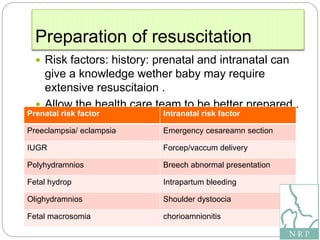
Preparation of resuscitation
 Risk factors: history: prenatal and intranatal can
give a knowledge wether baby may require
extensive resuscitaion .
 Allow the health care team to be better prepared .
Prenatal risk factor Intranatal risk factor
Preeclampsia/ eclampsia Emergency cesareamn section
IUGR Forcep/vaccum delivery
Polyhydramnios Breech abnormal presentation
Fetal hydrop Intrapartum bleeding
Olighydramnios Shoulder dystoocia
Fetal macrosomia chorioamnionitis
GOLDEN ONE
MINUTE
If the child is not able to breath properly in this first
minute of his/her life
Then the health care professional should help him/her to
initate the breath or facilitate in taking breath so , that
there is not limitation of oxygen in the baby body
NEONATAL RESUSCITATION PROGRAM
ARTICLES REQUIRED FOR
NRP
Articles Quatity
Radiant warmer
cap, plastic wrap
Neopuff 1
Oxygen blender
2 Bed sheet/ towels 2
Shoulder roll 1
Bulb syringe
Term/preterm mask
Pulse oxymeter
Stethoscope
Quantity
Ambu bag 1 To provide PPV
Laryngoscope 1 To visulalize larynx for intubation
Endotracheal tube 2.5,
3.0, 3.5
Syringes 1 To provide medication
Cutting blade 1 To cut cord
Sticking tape 1 To fix ET
Feeding tube 1 To suction the nose and mouth
Suction catheter 1 To suction the nose and mouth
Central line tray 1 For central line catherization
Umblical line 1 For umblical catherization
Cord clamp 1 To clamp cut cord
Vitamin K injection 1 To prevent bleeding in new born
Inj adrenaline 1 To increase HR
Normal saline 1 For suctioning and dilution with medication
BEFORE DELIVERY
1. Anticipate
2. Counseling of parents
3. ROLE ASSIGNMENT IN PARENTS
(airway, chest compressions, IV and
time keeping)
4. Keep instrument ready (radiant
warmer: instruments)
 The radiant warmer and keep it on manual mode
and bed sheet which is there should be warm too
(as cold bed sheet can cause the hypothermia).
 Receive the baby with gloved hand in the radiant
warmer and receive the baby in the warm bed-
sheet.
 As soon as we receive baby we need to see baby
for three things:
1. Gestation al age ( full/ preterm)
2. Crying or not
3. Tone is good or not.
 If answer is yes, the routine care should be given
Routine
care
Dry the baby
Maintain
temperature.
Airway
maintain
Cord
clamping
delayed for
30 secs.
Breastfeed
as soon as
possible
 If answer is NO, the routine care should be given
 Cord should be clamped.
 The baby is moved under radiant warmer.
 The baby is managed according to resuscitation
algorithim.
Clean the baby under radiant warmer
& clean
Sniffing position: shoulder roll
Tickle feet and rub back
Suctioning: oral followed by
nasal. Oral 5cm and nasal
2cm . Pressure: 100 cm of
water
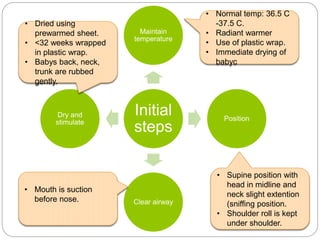
Initial
steps
Maintain
temperature
Position
Clear airway
Dry and
stimulate
• Normal temp: 36.5 C
-37.5 C.
• Radiant warmer
• Use of plastic wrap.
• Immediate drying of
babyc
• Supine position with
head in midline and
neck slight extention
(sniffing position.
• Shoulder roll is kept
under shoulder.
• Mouth is suction
before nose.
• Dried using
prewarmed sheet.
• <32 weeks wrapped
in plastic wrap.
• Babys back, neck,
trunk are rubbed
gently.
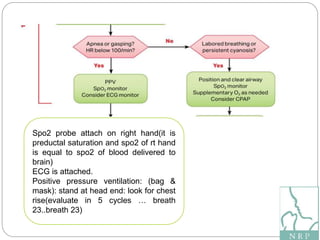
Spo2 probe attach on right hand(it is
preductal saturation and spo2 of rt hand
is equal to spo2 of blood delivered to
brain)
ECG is attached.
Positive pressure ventilation: (bag &
mask): stand at head end: look for chest
rise(evaluate in 5 cycles … breath
23..breath 23)
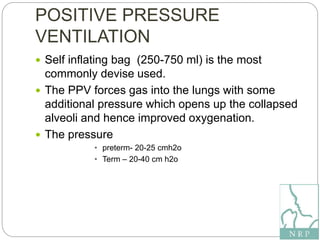
POSITIVE PRESSURE
VENTILATION
 Self inflating bag (250-750 ml) is the most
commonly devise used.
 The PPV forces gas into the lungs with some
additional pressure which opens up the collapsed
alveoli and hence improved oxygenation.
 The pressure
• preterm- 20-25 cmh2o
• Term – 20-40 cm h2o
 If the chest is ot movig with each reath and there are
poor breath sounds, ventilation corrective steps are
taken.
 Causes for ineffective ventilation:
1. Inadequate mask seal
2. Blocked airway
3. Inadequate pressure
MR SOPA
Ventilation corrective steps
M Mask adjustment Reapply the mask. Consider
using two hand technique
R Reposition airway Place head in sniffing position.
S Suction Use bulb syringe or suction catheter
O Open airway Open the mouth and lift the jaw
forward
P Pressure increase Increase pressure in 5-10cm H2O,
max. 40 cm H2o
A Alternate airway Place endotracheal tube or
laryngeal mask airway
Correct position of head ad neck to keep the
airway open.
Appropriate sized mask. The mask should cover the
nose ad the mouth but not the eyes
Evaluate for 30 secs.
HR more than 100 – stop bag and
mask
HR less than 100 but more than 60-
continue bag & mask
HR less than 60- start chest
compression
Chest compression: 3:1 i.e. 3
compression and 1 breath ( chest
compression should be 1&2&3&
breath, & helps for chest recoil)
Method : two finger compression
Arms around method( done at below
nipple line, at xiphi sternum)
Compress 1/3rd of anterio posterior
diameter
Chest
compress
ion for 1
min
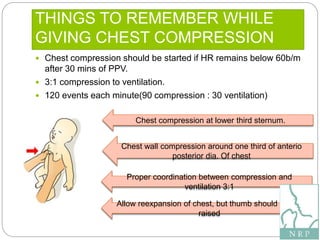
THINGS TO REMEMBER WHILE
GIVING CHEST COMPRESSION
 Chest compression should be started if HR remains below 60b/m
after 30 mins of PPV.
 3:1 compression to ventilation.
 120 events each minute(90 compression : 30 ventilation)
Chest compression at lower third sternum.
Chest wall compression around one third of anterio
posterior dia. Of chest
Proper coordination between compression and
ventilation 3:1
Allow reexpansion of chest, but thumb should not be
raised
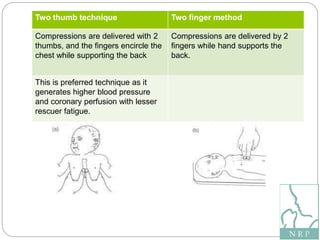
Techniques of chest compression
Nipple line
Compression
area
xiphoid
Two thumb technique Two finger technique
Two thumb technique Two finger method
Compressions are delivered with 2
thumbs, and the fingers encircle the
chest while supporting the back
Compressions are delivered by 2
fingers while hand supports the
back.
This is preferred technique as it
generates higher blood pressure
and coronary perfusion with lesser
rescuer fatigue.
 Continue chest compression while giving
adrenaline and always flush after giving
adrenaline.
 Evaluate after one min whether HR is above 60
or not
 If HR remains below 60: repeat dose of
adrenaline. Continue intubation if not already
done and rule out pneumothorax or
hypervolemia.
 Adrenaline : increases muscles strenght and
cardiac contractility, increases peripheral
vasoconstriction.
Drug Route Dose (ml/kg) Administration
Epinephrine
(1:10000)
Intravenous 0.1-0.3 Flush with 0.5-1
ml of N/S
Intraosseous 0.1-0.3 Flush with 0.5-1
ml of N/S
Endotracheal o.5-1 PPV breaths to
distribute into
lungs
Post resuscitative care
 Once the ventilation and circulation are
established, the infant should be transferred to
intensive care unit and kept under close
observation.
 Monitoring and maintaining normal glucose level
 Temperature maintanenace.
 Shift to mother site.
NEONATAL RESUSCITATION PROGRAM.pptx

NEONATAL RESUSCITATION PROGRAM.pptx

  • 1.
  • 2.
    NEONATAL RESUSCITATION PROGRAM  Whenthe baby is inside uterine the fetus get all nutrition from the mother through the umbilical cord attached to placenta  When the baby is born, the baby is transiting from intra-uterine environment to extra-uterine environment. We need to make sure that the baby is well adjusting to its outer environment i.e. the baby is crying, taking normal breaths and have normal range of heart rate.  but if the baby is not able to breath properly in its extra-uterine environment, this might lead to brain death as the oxygen is not reaching to its vital organ.
  • 3.
    Preparation of resuscitation Risk factors: history: prenatal and intranatal can give a knowledge wether baby may require extensive resuscitaion .  Allow the health care team to be better prepared . Prenatal risk factor Intranatal risk factor Preeclampsia/ eclampsia Emergency cesareamn section IUGR Forcep/vaccum delivery Polyhydramnios Breech abnormal presentation Fetal hydrop Intrapartum bleeding Olighydramnios Shoulder dystoocia Fetal macrosomia chorioamnionitis
  • 4.
    GOLDEN ONE MINUTE If thechild is not able to breath properly in this first minute of his/her life Then the health care professional should help him/her to initate the breath or facilitate in taking breath so , that there is not limitation of oxygen in the baby body NEONATAL RESUSCITATION PROGRAM
  • 5.
    ARTICLES REQUIRED FOR NRP ArticlesQuatity Radiant warmer cap, plastic wrap Neopuff 1 Oxygen blender 2 Bed sheet/ towels 2 Shoulder roll 1 Bulb syringe Term/preterm mask Pulse oxymeter Stethoscope
  • 6.
    Quantity Ambu bag 1To provide PPV Laryngoscope 1 To visulalize larynx for intubation Endotracheal tube 2.5, 3.0, 3.5 Syringes 1 To provide medication Cutting blade 1 To cut cord Sticking tape 1 To fix ET Feeding tube 1 To suction the nose and mouth Suction catheter 1 To suction the nose and mouth Central line tray 1 For central line catherization Umblical line 1 For umblical catherization Cord clamp 1 To clamp cut cord Vitamin K injection 1 To prevent bleeding in new born Inj adrenaline 1 To increase HR Normal saline 1 For suctioning and dilution with medication
  • 7.
    BEFORE DELIVERY 1. Anticipate 2.Counseling of parents 3. ROLE ASSIGNMENT IN PARENTS (airway, chest compressions, IV and time keeping) 4. Keep instrument ready (radiant warmer: instruments)
  • 8.
     The radiantwarmer and keep it on manual mode and bed sheet which is there should be warm too (as cold bed sheet can cause the hypothermia).  Receive the baby with gloved hand in the radiant warmer and receive the baby in the warm bed- sheet.  As soon as we receive baby we need to see baby for three things: 1. Gestation al age ( full/ preterm) 2. Crying or not 3. Tone is good or not.
  • 9.
     If answeris yes, the routine care should be given Routine care Dry the baby Maintain temperature. Airway maintain Cord clamping delayed for 30 secs. Breastfeed as soon as possible
  • 10.
     If answeris NO, the routine care should be given  Cord should be clamped.  The baby is moved under radiant warmer.  The baby is managed according to resuscitation algorithim.
  • 11.
    Clean the babyunder radiant warmer & clean Sniffing position: shoulder roll Tickle feet and rub back Suctioning: oral followed by nasal. Oral 5cm and nasal 2cm . Pressure: 100 cm of water
  • 12.
    Initial steps Maintain temperature Position Clear airway Dry and stimulate •Normal temp: 36.5 C -37.5 C. • Radiant warmer • Use of plastic wrap. • Immediate drying of babyc • Supine position with head in midline and neck slight extention (sniffing position. • Shoulder roll is kept under shoulder. • Mouth is suction before nose. • Dried using prewarmed sheet. • <32 weeks wrapped in plastic wrap. • Babys back, neck, trunk are rubbed gently.
  • 13.
    Spo2 probe attachon right hand(it is preductal saturation and spo2 of rt hand is equal to spo2 of blood delivered to brain) ECG is attached. Positive pressure ventilation: (bag & mask): stand at head end: look for chest rise(evaluate in 5 cycles … breath 23..breath 23)
  • 14.
    POSITIVE PRESSURE VENTILATION  Selfinflating bag (250-750 ml) is the most commonly devise used.  The PPV forces gas into the lungs with some additional pressure which opens up the collapsed alveoli and hence improved oxygenation.  The pressure • preterm- 20-25 cmh2o • Term – 20-40 cm h2o
  • 15.
     If thechest is ot movig with each reath and there are poor breath sounds, ventilation corrective steps are taken.  Causes for ineffective ventilation: 1. Inadequate mask seal 2. Blocked airway 3. Inadequate pressure MR SOPA
  • 16.
    Ventilation corrective steps MMask adjustment Reapply the mask. Consider using two hand technique R Reposition airway Place head in sniffing position. S Suction Use bulb syringe or suction catheter O Open airway Open the mouth and lift the jaw forward P Pressure increase Increase pressure in 5-10cm H2O, max. 40 cm H2o A Alternate airway Place endotracheal tube or laryngeal mask airway
  • 17.
    Correct position ofhead ad neck to keep the airway open.
  • 18.
    Appropriate sized mask.The mask should cover the nose ad the mouth but not the eyes
  • 19.
    Evaluate for 30secs. HR more than 100 – stop bag and mask HR less than 100 but more than 60- continue bag & mask HR less than 60- start chest compression Chest compression: 3:1 i.e. 3 compression and 1 breath ( chest compression should be 1&2&3& breath, & helps for chest recoil) Method : two finger compression Arms around method( done at below nipple line, at xiphi sternum) Compress 1/3rd of anterio posterior diameter Chest compress ion for 1 min
  • 20.
    THINGS TO REMEMBERWHILE GIVING CHEST COMPRESSION  Chest compression should be started if HR remains below 60b/m after 30 mins of PPV.  3:1 compression to ventilation.  120 events each minute(90 compression : 30 ventilation) Chest compression at lower third sternum. Chest wall compression around one third of anterio posterior dia. Of chest Proper coordination between compression and ventilation 3:1 Allow reexpansion of chest, but thumb should not be raised
  • 21.
    Techniques of chestcompression Nipple line Compression area xiphoid Two thumb technique Two finger technique
  • 22.
    Two thumb techniqueTwo finger method Compressions are delivered with 2 thumbs, and the fingers encircle the chest while supporting the back Compressions are delivered by 2 fingers while hand supports the back. This is preferred technique as it generates higher blood pressure and coronary perfusion with lesser rescuer fatigue.
  • 23.
     Continue chestcompression while giving adrenaline and always flush after giving adrenaline.  Evaluate after one min whether HR is above 60 or not  If HR remains below 60: repeat dose of adrenaline. Continue intubation if not already done and rule out pneumothorax or hypervolemia.
  • 24.
     Adrenaline :increases muscles strenght and cardiac contractility, increases peripheral vasoconstriction. Drug Route Dose (ml/kg) Administration Epinephrine (1:10000) Intravenous 0.1-0.3 Flush with 0.5-1 ml of N/S Intraosseous 0.1-0.3 Flush with 0.5-1 ml of N/S Endotracheal o.5-1 PPV breaths to distribute into lungs
  • 25.
    Post resuscitative care Once the ventilation and circulation are established, the infant should be transferred to intensive care unit and kept under close observation.  Monitoring and maintaining normal glucose level  Temperature maintanenace.  Shift to mother site.