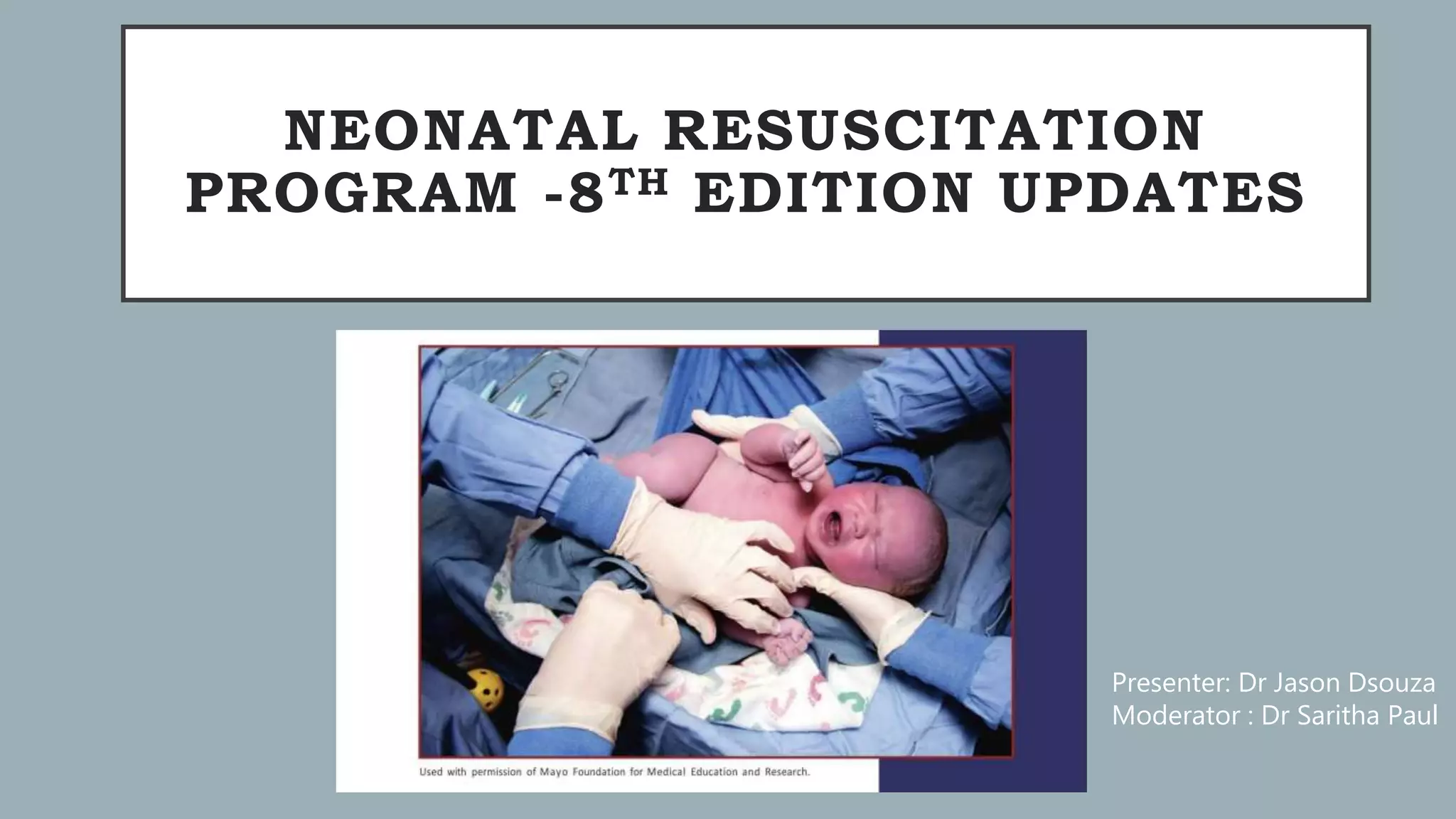
NEONATAL RESUSCITATION
PROGRAM -8TH EDITION UPDATES
Presenter: Dr Jason Dsouza
Moderator : Dr Saritha Paul
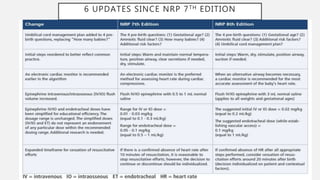
6 UPDATES SINCE NRP 7TH EDITION
INTRODUCTION
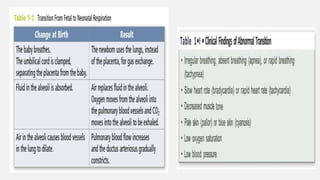
• Successful transition from intrauterine to extrauterine life is dependent upon
significant physiologic changes that occur at birth
• Within 30sec after birth , 85% Term newborns will begin breathing while an
additional 10% begin breathing in response to drying and stimulation
• One to 3 babies per 1000 live births will receive chest compressions or emergency
medications
NEONATAL RESUSCITATION
• 1. Foundations of Neonatal Resuscitation
• 2. Preparing for resuscitation
• 3. Initial steps of newborn care
• 4. Positive pressure ventilation
• 5. Alternative airways :endotracheal tubes and laryngeal masks
• 6. Chest compressions
• 7. Medications
• 8. Summary
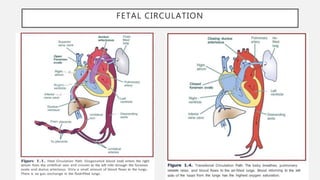
FETAL CIRCULATION
NEONATAL
RESUSCITATION
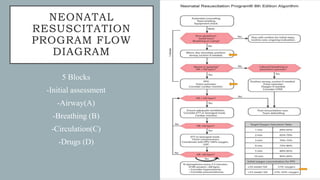
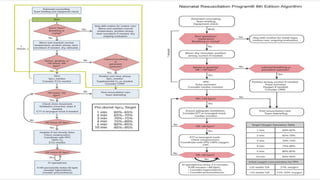
PROGRAM FLOW
DIAGRAM
5 Blocks
-Initial assessment
-Airway(A)
-Breathing (B)
-Circulation(C)
-Drugs (D)
PREPARING FOR RESUSCITATION
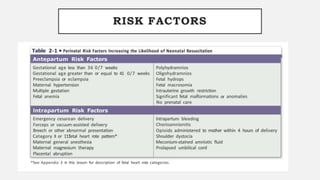
• Know the risk factors
• Assemble Resuscitation team
• Ask Obstetric provider 4 key questions before birth
• Pre resuscitation team briefing
• Assemble and check Resuscitation supplies and equipments
RISK FACTORS
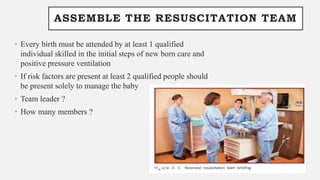
ASSEMBLE THE RESUSCITATION TEAM
• Every birth must be attended by at least 1 qualified
individual skilled in the initial steps of new born care and
positive pressure ventilation
• If risk factors are present at least 2 qualified people should
be present solely to manage the baby
• Team leader ?
• How many members ?
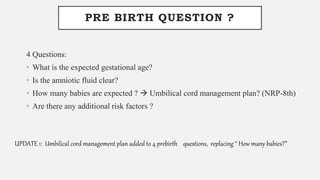
PRE BIRTH QUESTION ?
4 Questions:
• What is the expected gestational age?
• Is the amniotic fluid clear?
• How many babies are expected ?  Umbilical cord management plan? (NRP-8th)
• Are there any additional risk factors ?
UPDATE 1: Umbilical cord management plan added to 4 prebirth questions, replacing “ How many babies?”
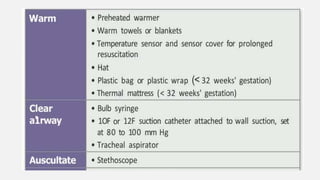
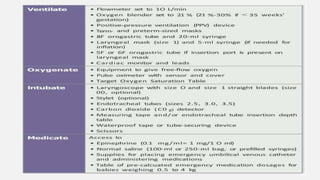
ASSEMBLE AND CHECK SUPPLIES
• Warm
• Clear airway
• Auscultate
• Ventilate
• Oxygenate
• Intubate
• Medicate
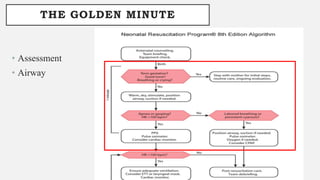
THE GOLDEN MINUTE
• Assessment
• Airway
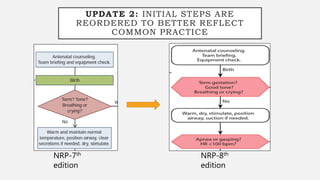
UPDATE 2: INITIAL STEPS ARE
REORDERED TO BETTER REFLECT
COMMON PRACTICE
NRP-7th
edition
NRP-8th
edition
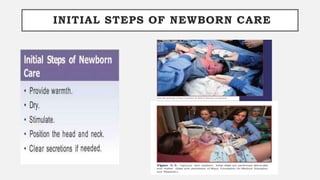
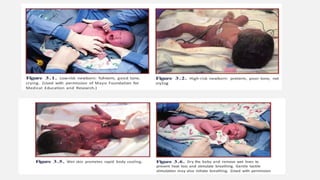
INITIAL STEPS OF NEWBORN CARE
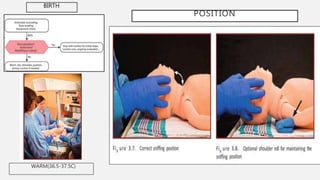
POSITION
WARM(36.5-37.5C)
BIRTH
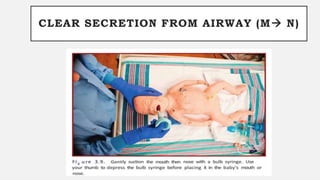
CLEAR SECRETION FROM AIRWAY (M N)
STIMULATE
• Gently rub the newborns back, trunk or extremities
• Over vigorous stimulation is not helpful and can cause Injury
• NEVER SHAKE A BABY
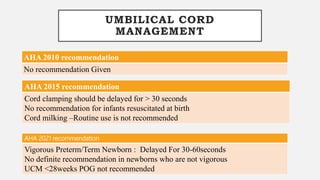
UMBILICAL CORD
MANAGEMENT
AHA 2010 recommendation
No recommendation Given
AHA 2015 recommendation
Cord clamping should be delayed for > 30 seconds
No recommendation for infants resuscitated at birth
Cord milking –Routine use is not recommended
AHA 2021 recommendation
Vigorous Preterm/Term Newborn : Delayed For 30-60seconds
No definite recommendation in newborns who are not vigorous
UCM <28weeks POG not recommended
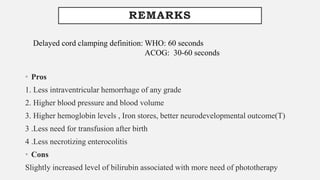
REMARKS
• Pros
1. Less intraventricular hemorrhage of any grade
2. Higher blood pressure and blood volume
3. Higher hemoglobin levels , Iron stores, better neurodevelopmental outcome(T)
3 .Less need for transfusion after birth
4 .Less necrotizing enterocolitis
• Cons
Slightly increased level of bilirubin associated with more need of phototherapy
Delayed cord clamping definition: WHO: 60 seconds
ACOG: 30-60 seconds
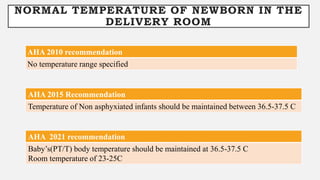
NORMAL TEMPERATURE OF NEWBORN IN THE
DELIVERY ROOM
AHA 2010 recommendation
No temperature range specified
AHA 2015 Recommendation
Temperature of Non asphyxiated infants should be maintained between 36.5-37.5 C
AHA 2021 recommendation
Baby’s(PT/T) body temperature should be maintained at 36.5-37.5 C
Room temperature of 23-25C
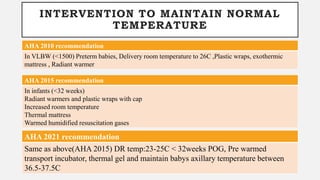
INTERVENTION TO MAINTAIN NORMAL
TEMPERATURE
AHA 2010 recommendation
In VLBW (<1500) Preterm babies, Delivery room temperature to 26C ,Plastic wraps, exothermic
mattress , Radiant warmer
AHA 2015 recommendation
In infants (<32 weeks)
Radiant warmers and plastic wraps with cap
Increased room temperature
Thermal mattress
Warmed humidified resuscitation gases
AHA 2021 recommendation
Same as above(AHA 2015) DR temp:23-25C < 32weeks POG, Pre warmed
transport incubator, thermal gel and maintain babys axillary temperature between
36.5-37.5C
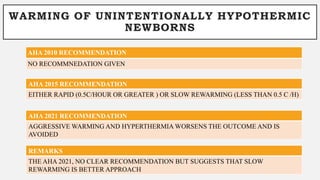
WARMING OF UNINTENTIONALLY HYPOTHERMIC
NEWBORNS
AHA 2010 RECOMMENDATION
NO RECOMMNEDATION GIVEN
AHA 2015 RECOMMENDATION
EITHER RAPID (0.5C/HOUR OR GREATER ) OR SLOW REWARMING (LESS THAN 0.5 C /H)
REMARKS
THE AHA 2021, NO CLEAR RECOMMENDATION BUT SUGGESTS THAT SLOW
REWARMING IS BETTER APPROACH
AHA 2021 RECOMMENDATION
AGGRESSIVE WARMING AND HYPERTHERMIA WORSENS THE OUTCOME AND IS
AVOIDED
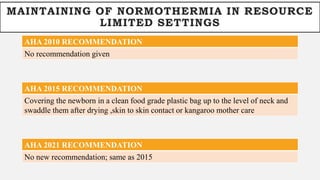
MAINTAINING OF NORMOTHERMIA IN RESOURCE
LIMITED SETTINGS
AHA 2010 RECOMMENDATION
No recommendation given
AHA 2015 RECOMMENDATION
Covering the newborn in a clean food grade plastic bag up to the level of neck and
swaddle them after drying ,skin to skin contact or kangaroo mother care
AHA 2021 RECOMMENDATION
No new recommendation; same as 2015
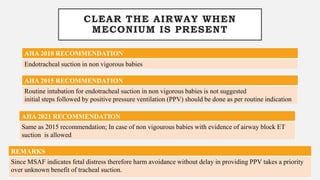
CLEAR THE AIRWAY WHEN
MECONIUM IS PRESENT
AHA 2010 RECOMMENDATION
Endotracheal suction in non vigorous babies
AHA 2015 RECOMMENDATION
Routine intubation for endotracheal suction in non vigorous babies is not suggested
initial steps followed by positive pressure ventilation (PPV) should be done as per routine indication
REMARKS
Since MSAF indicates fetal distress therefore harm avoidance without delay in providing PPV takes a priority
over unknown benefit of tracheal suction.
AHA 2021 RECOMMENDATION
Same as 2015 recommendation; In case of non vigourous babies with evidence of airway block ET
suction is allowed
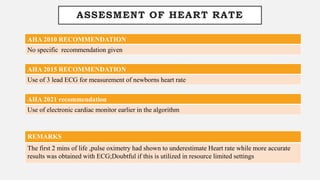
ASSESMENT OF HEART RATE
AHA 2010 RECOMMENDATION
No specific recommendation given
AHA 2015 RECOMMENDATION
Use of 3 lead ECG for measurement of newborns heart rate
REMARKS
The first 2 mins of life ,pulse oximetry had shown to underestimate Heart rate while more accurate
results was obtained with ECG;Doubtful if this is utilized in resource limited settings
AHA 2021 recommendation
Use of electronic cardiac monitor earlier in the algorithm
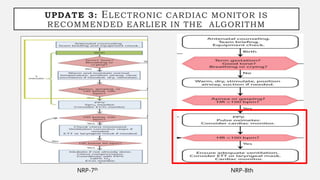
UPDATE 3: ELECTRONIC CARDIAC MONITOR IS
RECOMMENDED EARLIER IN THE ALGORITHM
NRP-7th NRP-8th
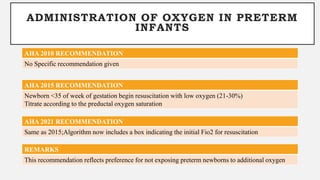
ADMINISTRATION OF OXYGEN IN PRETERM
INFANTS
AHA 2010 RECOMMENDATION
No Specific recommendation given
AHA 2015 RECOMMENDATION
Newborn <35 of week of gestation begin resuscitation with low oxygen (21-30%)
Titrate according to the preductal oxygen saturation
REMARKS
This recommendation reflects preference for not exposing preterm newborns to additional oxygen
AHA 2021 RECOMMENDATION
Same as 2015;Algorithm now includes a box indicating the initial Fio2 for resuscitation
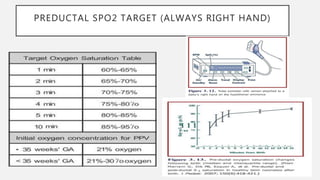
PREDUCTAL SPO2 TARGET (ALWAYS RIGHT HAND)
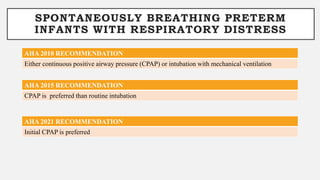
SPONTANEOUSLY BREATHING PRETERM
INFANTS WITH RESPIRATORY DISTRESS
AHA 2010 RECOMMENDATION
Either continuous positive airway pressure (CPAP) or intubation with mechanical ventilation
AHA 2015 RECOMMENDATION
CPAP is preferred than routine intubation
AHA 2021 RECOMMENDATION
Initial CPAP is preferred
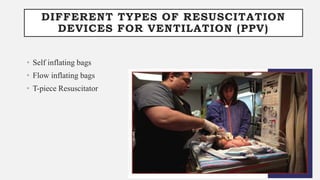
DIFFERENT TYPES OF RESUSCITATION
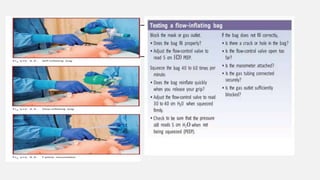
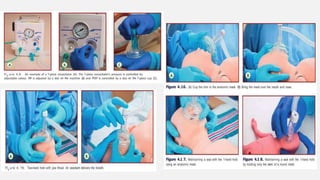
DEVICES FOR VENTILATION (PPV)
• Self inflating bags
• Flow inflating bags
• T-piece Resuscitator
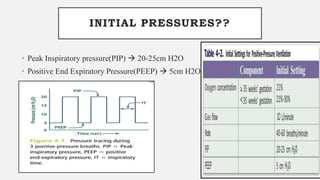
INITIAL PRESSURES??
• Peak Inspiratory pressure(PIP)  20-25cm H2O
• Positive End Expiratory Pressure(PEEP)  5cm H2O
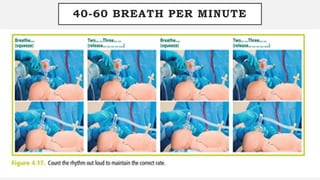
40-60 BREATH PER MINUTE
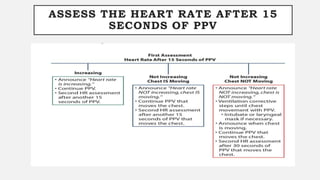
ASSESS THE HEART RATE AFTER 15
SECONDS OF PPV
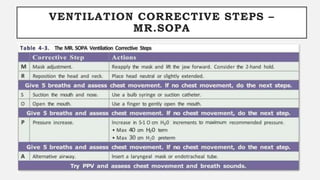
VENTILATION CORRECTIVE STEPS –
MR.SOPA
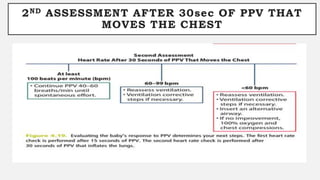
2ND ASSESSMENT AFTER 30sec OF PPV THAT
MOVES THE CHEST
WHEN SHOULD ALTERNATIVE AIRWAY BE
CONSIDERED ?
Endotracheal tube or LMA, Should be considered:
• If PPV with a face mask does not result in clinical improvement  to improve ventilation
efficacy
• If PPV last for more than a few minutes  improve the efficacy of ventilation and ease of
assisted ventilation
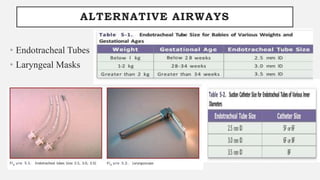
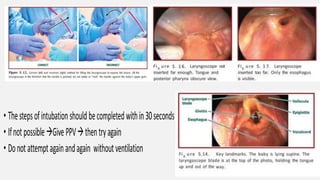
ALTERNATIVE AIRWAYS
• Endotracheal Tubes
• Laryngeal Masks
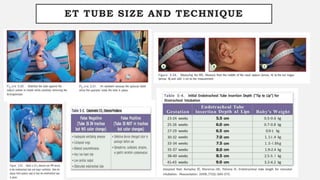
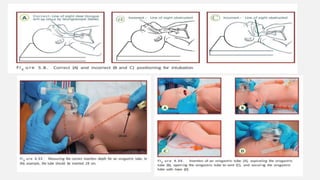
ET TUBE SIZE AND TECHNIQUE
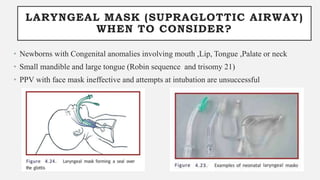
LARYNGEAL MASK (SUPRAGLOTTIC AIRWAY)
WHEN TO CONSIDER?
• Newborns with Congenital anomalies involving mouth ,Lip, Tongue ,Palate or neck
• Small mandible and large tongue (Robin sequence and trisomy 21)
• PPV with face mask ineffective and attempts at intubation are unsuccessful
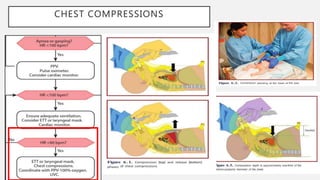
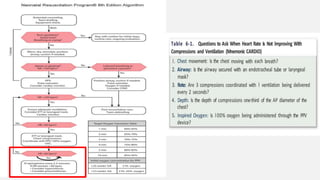
CHEST COMPRESSIONS
WHEN TO BEGIN CHEST COMPRESSION
• Indicated when HR remains less than 60 bpm after at least 30 seconds of effective
PPV
• Do not begin chest compressions unless you have achieved chest movement with
your ventilation attempts
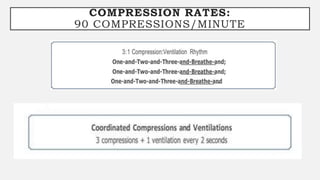
COMPRESSION RATES:
90 COMPRESSIONS/MINUTE
CHEST COMPRESSION
• AHA 2010 RECOMMENDATION
• No specific recommendations were provided for oxygen use during chest
compressions
• However ,it mentioned providing 100% oxygen ,in newborns with bradycardia even
after 90 seconds of resuscitation with lower concentration of oxygen
• AHA 2015 RECOMMENDATION : Give 100% oxygen with chest compression
• AHA 2021 RECOMMENDATION : Use 100% oxygen during chest compression
WHEN TO CHECK HEART RATE AFTER
STARTING COMPRESSIONS
• 60 seconds
• Take one minute or more for for the heart rate to increase after chest compression
• When compressions are stopped ,coronary perfusion is decreased and requires time for
recovery
• Avoid unnecessary interruptions
• When to stop chest compressions : Heart rate is >60bpm
SODIUM BICARBONATE INFUSION
AHA 2010 RECOMMENDATION
No recommendation
AHA 2015 RECOMMENDATION
No recommendation
REMARKS
Uasage of sodium bicarbonate in prolonged arrests doesn’t find any mention in AHA guidelines
AHA 2021 recommendation
No recommendation
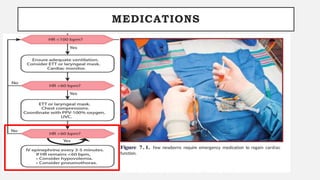
MEDICATIONS
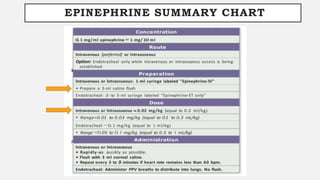
WHEN IS EPINEPHRINE INDICATED?
Heart rate below 60bpm after,
• Atleast 30 seconds of PPV that inflates the lungs
&
• Another 60 seconds of chest compression coordinated with PPV using
100% oxygen
EPINEPHRINE SUMMARY CHART
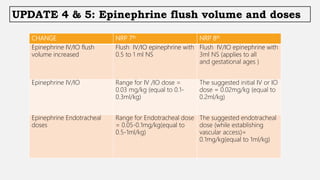
CHANGE NRP 7th NRP 8th
Epinephrine IV/IO flush
volume increased
Flush IV/IO epinephrine with
0.5 to 1 ml NS
Flush IV/IO epinephrine with
3ml NS (applies to all
and gestational ages )
Epinephrine IV/IO Range for IV /IO dose =
0.03 mg/kg (equal to 0.1-
0.3ml/kg)
The suggested initial IV or IO
dose = 0.02mg/kg (equal to
0.2ml/kg)
Epinephrine Endotracheal
doses
Range for Endotracheal dose
= 0.05-0.1mg/kg(equal to
0.5-1ml/kg)
The suggested endotracheal
dose (while establishing
vascular access)=
0.1mg/kg(equal to 1ml/kg)
UPDATE 4 & 5: Epinephrine flush volume and doses
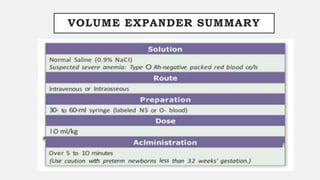
VOLUME EXPANDER SUMMARY
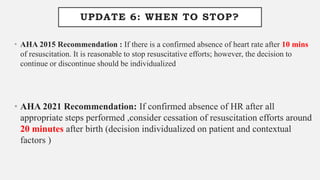
UPDATE 6: WHEN TO STOP?
• AHA 2015 Recommendation : If there is a confirmed absence of heart rate after 10 mins
of resuscitation. It is reasonable to stop resuscitative efforts; however, the decision to
continue or discontinue should be individualized
• AHA 2021 Recommendation: If confirmed absence of HR after all
appropriate steps performed ,consider cessation of resuscitation efforts around
20 minutes after birth (decision individualized on patient and contextual
factors )
TOP 10 TAKE-HOME MESSAGES FOR NEONATAL LIFE SUPPORT
1. Newborn resuscitation requires anticipation and preparation by providers who train individually and as teams.
2. Most newly born infants do not require immediate cord clamping or resuscitation and can be evaluated and
monitored during skin-to-skin contact with their mothers after birth.
3. Inflation and ventilation of the lungs are the priority in newly born infants who need support after birth.
4. A rise in heart rate is the most important indicator of effective ventilation and response to resuscitative
interventions.
5. Pulse oximetry is used to guide oxygen therapy and meet oxygen saturation goals.
6. Chest compressions are provided if there is a poor heart rate response to ventilation after appropriate
ventilation corrective steps, .
7. The heart rate response to chest compressions and medications should be monitored
electrocardiographically.
8. If the response to chest compressions is poor, it may be reasonable to provide
epinephrine, preferably via the intravenous route.
9. Failure to respond to epinephrine in a newborn with history or examination
consistent with blood loss may require volume expansion.
10. If all these steps of resuscitation are effectively completed and there is no heart rate response by 20
minutes, redirection of care should be discussed with the team and family.
THANK YOU
Neonatal resuscitation program  8 th edition updates

Neonatal resuscitation program 8 th edition updates

  • 1.
    NEONATAL RESUSCITATION PROGRAM -8THEDITION UPDATES Presenter: Dr Jason Dsouza Moderator : Dr Saritha Paul
  • 2.
    6 UPDATES SINCENRP 7TH EDITION
  • 3.
    INTRODUCTION • Successful transitionfrom intrauterine to extrauterine life is dependent upon significant physiologic changes that occur at birth • Within 30sec after birth , 85% Term newborns will begin breathing while an additional 10% begin breathing in response to drying and stimulation • One to 3 babies per 1000 live births will receive chest compressions or emergency medications
  • 4.
    NEONATAL RESUSCITATION • 1.Foundations of Neonatal Resuscitation • 2. Preparing for resuscitation • 3. Initial steps of newborn care • 4. Positive pressure ventilation • 5. Alternative airways :endotracheal tubes and laryngeal masks • 6. Chest compressions • 7. Medications • 8. Summary
  • 5.
  • 7.
    NEONATAL RESUSCITATION PROGRAM FLOW DIAGRAM 5 Blocks -Initialassessment -Airway(A) -Breathing (B) -Circulation(C) -Drugs (D)
  • 8.
    PREPARING FOR RESUSCITATION •Know the risk factors • Assemble Resuscitation team • Ask Obstetric provider 4 key questions before birth • Pre resuscitation team briefing • Assemble and check Resuscitation supplies and equipments
  • 9.
  • 10.
    ASSEMBLE THE RESUSCITATIONTEAM • Every birth must be attended by at least 1 qualified individual skilled in the initial steps of new born care and positive pressure ventilation • If risk factors are present at least 2 qualified people should be present solely to manage the baby • Team leader ? • How many members ?
  • 11.
    PRE BIRTH QUESTION? 4 Questions: • What is the expected gestational age? • Is the amniotic fluid clear? • How many babies are expected ?  Umbilical cord management plan? (NRP-8th) • Are there any additional risk factors ? UPDATE 1: Umbilical cord management plan added to 4 prebirth questions, replacing “ How many babies?”
  • 12.
    ASSEMBLE AND CHECKSUPPLIES • Warm • Clear airway • Auscultate • Ventilate • Oxygenate • Intubate • Medicate
  • 15.
    THE GOLDEN MINUTE •Assessment • Airway
  • 16.
    UPDATE 2: INITIALSTEPS ARE REORDERED TO BETTER REFLECT COMMON PRACTICE NRP-7th edition NRP-8th edition
  • 17.
    INITIAL STEPS OFNEWBORN CARE
  • 19.
  • 20.
    CLEAR SECRETION FROMAIRWAY (M N)
  • 21.
    STIMULATE • Gently rubthe newborns back, trunk or extremities • Over vigorous stimulation is not helpful and can cause Injury • NEVER SHAKE A BABY
  • 22.
    UMBILICAL CORD MANAGEMENT AHA 2010recommendation No recommendation Given AHA 2015 recommendation Cord clamping should be delayed for > 30 seconds No recommendation for infants resuscitated at birth Cord milking –Routine use is not recommended AHA 2021 recommendation Vigorous Preterm/Term Newborn : Delayed For 30-60seconds No definite recommendation in newborns who are not vigorous UCM <28weeks POG not recommended
  • 23.
    REMARKS • Pros 1. Lessintraventricular hemorrhage of any grade 2. Higher blood pressure and blood volume 3. Higher hemoglobin levels , Iron stores, better neurodevelopmental outcome(T) 3 .Less need for transfusion after birth 4 .Less necrotizing enterocolitis • Cons Slightly increased level of bilirubin associated with more need of phototherapy Delayed cord clamping definition: WHO: 60 seconds ACOG: 30-60 seconds
  • 24.
    NORMAL TEMPERATURE OFNEWBORN IN THE DELIVERY ROOM AHA 2010 recommendation No temperature range specified AHA 2015 Recommendation Temperature of Non asphyxiated infants should be maintained between 36.5-37.5 C AHA 2021 recommendation Baby’s(PT/T) body temperature should be maintained at 36.5-37.5 C Room temperature of 23-25C
  • 25.
    INTERVENTION TO MAINTAINNORMAL TEMPERATURE AHA 2010 recommendation In VLBW (<1500) Preterm babies, Delivery room temperature to 26C ,Plastic wraps, exothermic mattress , Radiant warmer AHA 2015 recommendation In infants (<32 weeks) Radiant warmers and plastic wraps with cap Increased room temperature Thermal mattress Warmed humidified resuscitation gases AHA 2021 recommendation Same as above(AHA 2015) DR temp:23-25C < 32weeks POG, Pre warmed transport incubator, thermal gel and maintain babys axillary temperature between 36.5-37.5C
  • 26.
    WARMING OF UNINTENTIONALLYHYPOTHERMIC NEWBORNS AHA 2010 RECOMMENDATION NO RECOMMNEDATION GIVEN AHA 2015 RECOMMENDATION EITHER RAPID (0.5C/HOUR OR GREATER ) OR SLOW REWARMING (LESS THAN 0.5 C /H) REMARKS THE AHA 2021, NO CLEAR RECOMMENDATION BUT SUGGESTS THAT SLOW REWARMING IS BETTER APPROACH AHA 2021 RECOMMENDATION AGGRESSIVE WARMING AND HYPERTHERMIA WORSENS THE OUTCOME AND IS AVOIDED
  • 27.
    MAINTAINING OF NORMOTHERMIAIN RESOURCE LIMITED SETTINGS AHA 2010 RECOMMENDATION No recommendation given AHA 2015 RECOMMENDATION Covering the newborn in a clean food grade plastic bag up to the level of neck and swaddle them after drying ,skin to skin contact or kangaroo mother care AHA 2021 RECOMMENDATION No new recommendation; same as 2015
  • 28.
    CLEAR THE AIRWAYWHEN MECONIUM IS PRESENT AHA 2010 RECOMMENDATION Endotracheal suction in non vigorous babies AHA 2015 RECOMMENDATION Routine intubation for endotracheal suction in non vigorous babies is not suggested initial steps followed by positive pressure ventilation (PPV) should be done as per routine indication REMARKS Since MSAF indicates fetal distress therefore harm avoidance without delay in providing PPV takes a priority over unknown benefit of tracheal suction. AHA 2021 RECOMMENDATION Same as 2015 recommendation; In case of non vigourous babies with evidence of airway block ET suction is allowed
  • 29.
    ASSESMENT OF HEARTRATE AHA 2010 RECOMMENDATION No specific recommendation given AHA 2015 RECOMMENDATION Use of 3 lead ECG for measurement of newborns heart rate REMARKS The first 2 mins of life ,pulse oximetry had shown to underestimate Heart rate while more accurate results was obtained with ECG;Doubtful if this is utilized in resource limited settings AHA 2021 recommendation Use of electronic cardiac monitor earlier in the algorithm
  • 30.
    UPDATE 3: ELECTRONICCARDIAC MONITOR IS RECOMMENDED EARLIER IN THE ALGORITHM NRP-7th NRP-8th
  • 31.
    ADMINISTRATION OF OXYGENIN PRETERM INFANTS AHA 2010 RECOMMENDATION No Specific recommendation given AHA 2015 RECOMMENDATION Newborn <35 of week of gestation begin resuscitation with low oxygen (21-30%) Titrate according to the preductal oxygen saturation REMARKS This recommendation reflects preference for not exposing preterm newborns to additional oxygen AHA 2021 RECOMMENDATION Same as 2015;Algorithm now includes a box indicating the initial Fio2 for resuscitation
  • 32.
    PREDUCTAL SPO2 TARGET(ALWAYS RIGHT HAND)
  • 33.
    SPONTANEOUSLY BREATHING PRETERM INFANTSWITH RESPIRATORY DISTRESS AHA 2010 RECOMMENDATION Either continuous positive airway pressure (CPAP) or intubation with mechanical ventilation AHA 2015 RECOMMENDATION CPAP is preferred than routine intubation AHA 2021 RECOMMENDATION Initial CPAP is preferred
  • 36.
    DIFFERENT TYPES OFRESUSCITATION DEVICES FOR VENTILATION (PPV) • Self inflating bags • Flow inflating bags • T-piece Resuscitator
  • 39.
    INITIAL PRESSURES?? • PeakInspiratory pressure(PIP)  20-25cm H2O • Positive End Expiratory Pressure(PEEP)  5cm H2O
  • 40.
  • 41.
    ASSESS THE HEARTRATE AFTER 15 SECONDS OF PPV
  • 42.
  • 43.
    2ND ASSESSMENT AFTER30sec OF PPV THAT MOVES THE CHEST
  • 44.
    WHEN SHOULD ALTERNATIVEAIRWAY BE CONSIDERED ? Endotracheal tube or LMA, Should be considered: • If PPV with a face mask does not result in clinical improvement  to improve ventilation efficacy • If PPV last for more than a few minutes  improve the efficacy of ventilation and ease of assisted ventilation
  • 45.
    ALTERNATIVE AIRWAYS • EndotrachealTubes • Laryngeal Masks
  • 46.
    ET TUBE SIZEAND TECHNIQUE
  • 49.
    LARYNGEAL MASK (SUPRAGLOTTICAIRWAY) WHEN TO CONSIDER? • Newborns with Congenital anomalies involving mouth ,Lip, Tongue ,Palate or neck • Small mandible and large tongue (Robin sequence and trisomy 21) • PPV with face mask ineffective and attempts at intubation are unsuccessful
  • 51.
  • 52.
    WHEN TO BEGINCHEST COMPRESSION • Indicated when HR remains less than 60 bpm after at least 30 seconds of effective PPV • Do not begin chest compressions unless you have achieved chest movement with your ventilation attempts
  • 53.
  • 54.
    CHEST COMPRESSION • AHA2010 RECOMMENDATION • No specific recommendations were provided for oxygen use during chest compressions • However ,it mentioned providing 100% oxygen ,in newborns with bradycardia even after 90 seconds of resuscitation with lower concentration of oxygen • AHA 2015 RECOMMENDATION : Give 100% oxygen with chest compression • AHA 2021 RECOMMENDATION : Use 100% oxygen during chest compression
  • 55.
    WHEN TO CHECKHEART RATE AFTER STARTING COMPRESSIONS • 60 seconds • Take one minute or more for for the heart rate to increase after chest compression • When compressions are stopped ,coronary perfusion is decreased and requires time for recovery • Avoid unnecessary interruptions • When to stop chest compressions : Heart rate is >60bpm
  • 56.
    SODIUM BICARBONATE INFUSION AHA2010 RECOMMENDATION No recommendation AHA 2015 RECOMMENDATION No recommendation REMARKS Uasage of sodium bicarbonate in prolonged arrests doesn’t find any mention in AHA guidelines AHA 2021 recommendation No recommendation
  • 58.
  • 59.
    WHEN IS EPINEPHRINEINDICATED? Heart rate below 60bpm after, • Atleast 30 seconds of PPV that inflates the lungs & • Another 60 seconds of chest compression coordinated with PPV using 100% oxygen
  • 60.
  • 61.
    CHANGE NRP 7thNRP 8th Epinephrine IV/IO flush volume increased Flush IV/IO epinephrine with 0.5 to 1 ml NS Flush IV/IO epinephrine with 3ml NS (applies to all and gestational ages ) Epinephrine IV/IO Range for IV /IO dose = 0.03 mg/kg (equal to 0.1- 0.3ml/kg) The suggested initial IV or IO dose = 0.02mg/kg (equal to 0.2ml/kg) Epinephrine Endotracheal doses Range for Endotracheal dose = 0.05-0.1mg/kg(equal to 0.5-1ml/kg) The suggested endotracheal dose (while establishing vascular access)= 0.1mg/kg(equal to 1ml/kg) UPDATE 4 & 5: Epinephrine flush volume and doses
  • 62.
  • 63.
    UPDATE 6: WHENTO STOP? • AHA 2015 Recommendation : If there is a confirmed absence of heart rate after 10 mins of resuscitation. It is reasonable to stop resuscitative efforts; however, the decision to continue or discontinue should be individualized • AHA 2021 Recommendation: If confirmed absence of HR after all appropriate steps performed ,consider cessation of resuscitation efforts around 20 minutes after birth (decision individualized on patient and contextual factors )
  • 64.
    TOP 10 TAKE-HOMEMESSAGES FOR NEONATAL LIFE SUPPORT 1. Newborn resuscitation requires anticipation and preparation by providers who train individually and as teams. 2. Most newly born infants do not require immediate cord clamping or resuscitation and can be evaluated and monitored during skin-to-skin contact with their mothers after birth. 3. Inflation and ventilation of the lungs are the priority in newly born infants who need support after birth. 4. A rise in heart rate is the most important indicator of effective ventilation and response to resuscitative interventions. 5. Pulse oximetry is used to guide oxygen therapy and meet oxygen saturation goals.
  • 65.
    6. Chest compressionsare provided if there is a poor heart rate response to ventilation after appropriate ventilation corrective steps, . 7. The heart rate response to chest compressions and medications should be monitored electrocardiographically. 8. If the response to chest compressions is poor, it may be reasonable to provide epinephrine, preferably via the intravenous route. 9. Failure to respond to epinephrine in a newborn with history or examination consistent with blood loss may require volume expansion. 10. If all these steps of resuscitation are effectively completed and there is no heart rate response by 20 minutes, redirection of care should be discussed with the team and family.
  • 66.

Editor's Notes

  • #4 Most newborns make transition to extrauterine life without any intervention In almost all infants these changes are successfully completed at delivery without any special assistance
  • #14 Ensure equipment check before every birth
  • #17 Not much change ; just reordered what is being followed as common practice
  • #23 ERC 2015 recommendation : Delayed cord clamping for ≥ 1 min is recommended No recommendation for infants resuscitated at birth but generally Cord milking is done ;But neonates <28weeks cord milking isn’t recommended
  • #25 Admission temperature should be routinely recorded Prevent hypothermia(<36C) as well as hyperthermia(>38c) as both are found to have increased risk of adverse outcomes
  • #26 So basically a bundle of care management,
  • #27 THERE HAS ALWAYS BEEN A DEBATE ON HOW TO REWARM NEWBORNS .
  • #28 AHA in 2015 SEPARATELY INTRODUCED RECOMMENDATION FOR MAINTAING NORMAL NEWBORN IN RESOURCE LIMITED SETTINGS
  • #29 Routine intubation for tracheal suction in this setting is not suggested because the insufficient evidence (Class 2b,LOE C-LD) to continue this practice.
  • #30 Lot of decision is based on HR, eg ppv < 100, chest compression < 60) therefore accurate measurement of HR is most important During resuscitation an increase in newborn heart rate is considered the most sensitive indicator of a successful response to each intervention Estimate HR for 6 seconds and multiply by 10 (Ausculatation)
  • #31 NRP-7: an electronic cardiac monitor is preffered method for assessing heart rate during cardiac compressions NRP-8: when an alternative airway becomes necessary ,a cardiac monitor is recommended for the most accurate assessment of babys heart rate
  • #33 Always apply saturation probe on the right hand of the newborn baby Indications: when resuscitation is anticipated,confirming perception of cyanosis,administration of supplemenatal oxygen, when ppv is required
  • #34 Most resuscitation teams are comfortable with CPAP Trial was done in infants born at <30 weeks gestation
  • #36 Compltete initial steps of new born care if not done already , Suction mouth and nose to be certain that secretions will not obstruct PPV Indication of PPV
  • #39 Testing a T-piece: Occlude gas outlet; does peep read 5 cm H20 Occlude opening of t-piece cap; does pip read 20-25cm H20 If pressure not correct ? Is T-piece outlet sealed? Gas tubing connected? Flow kept at 10L/min?
  • #41 Theres a concept of sustained inflation which was mentioned ,i.e to provide pEEP for a longer duration just to attain FRC soon , but it has been shown to be more harmful in the RCT hence not recommneded
  • #57 ERC 2015 recommendation: during prolonged arrests unresponsive to other therapies ,dosage of 1-2mmol/kg ,Slow iV infusion
  • #60 Epinephrine IV/IO flush volume increased NRP 7th: Flush IV/IO epinephrine with 0.5 to 1 ml NS NRP 8th: Flush IV/IO epinephrine with 3ml NS(applies to all weights and gestational ages )
  • #61 Epinephrine IV/IO flush volume increased NRP 7th: Flush IV/IO epinephrine with 0.5 to 1 ml NS NRP 8th: Flush IV/IO epinephrine with 3ml NS(applies to all weights and gestational ages )
  • #62 Epinephrine IV/IO and Endotracheal doses have been simplified for educational efficiency. The dosage range is unchanged .The simplified doses(iv/io and ET) do not represent an endorsement of any particular dose within the recommended dosing range .Additional research is needed