DR CHINEDU IBEH
MBBS, MPH, FWACP
11/05/2021
HSD, IAUE
OUTLINE
 INTRODUCTION
 NEONATAL RESUSCITATION
 FACTORS FOR NEONATAL RESUSCITATION
 APGAR SCORE
 STEPS IN NEONATAL RESUSCITATION
Neonatal Resuscitation
 Globally, about 1/4 of all newborn deaths are caused by
asphyxia at birth, which can be prevented by effective and
rapid resuscitation.
 Series of actions, used to assist newborns with difficulty
making the physiological ‘transition’ to extra-uterine life
 They are emergency procedures to support newborns that
 are not breathing, are gasping or have a weak heartbeat at
birth.
 About 10% will require some assistance at birth to begin
breathing
Factors for neonatal resuscitation
Maternal Fetal
 PROM (> 18 hours)
 Bleeding in 2nd or 3rd
trimester
 PIH
 Diabetes mellitus
 Maternal pyrexia
 Chorioamnionitis
 Heavy sedation
 Previous fetal or neonatal
death
 Multiple gestation
 gestation (< 35 wks; >41 wks)
 Large for dates
 IUGR
 Polyhydramnios and
oligohydramnios
 Reduced fetal movement before
onset of labour
 Congenital abnormalities which
may effect breathing,
cardiovascular function or oth
Facilities/Equipments for Neonatal
Resuscitation
 The first 60 seconds after delivery is critical
 The need for resuscitation is often unexpected, therefore,
one need to have:
 A warm labor room with good light sources to assess the
baby
 Equipment
 Resuscitation bed, over head warmer (infrared heater), towel,
stethoscope, pulse oximeter
 An Ambu bag with a baby-sized mask
 Clock, Clean ties, Scissors, Clean towels
 Suction device with Suction catheter, Bulb syringe
Equipment
 Resuscitation bed, over head warmer (infrared heater),
towel, stethoscope, pulse oximeter
 An Ambu bag with a baby-sized mask
 Clock , Clean ties, Scissors, Clean towels
 Suction device with Suction catheter, Bulb syringe
 Breathing support: Facemask; PPV device, O2 gas
 Circulation support: UVC kit, iv kit, io needle,
 Drug and fluids: Adrenaline(1;10000/0.1mg/ml), NS,
Blood
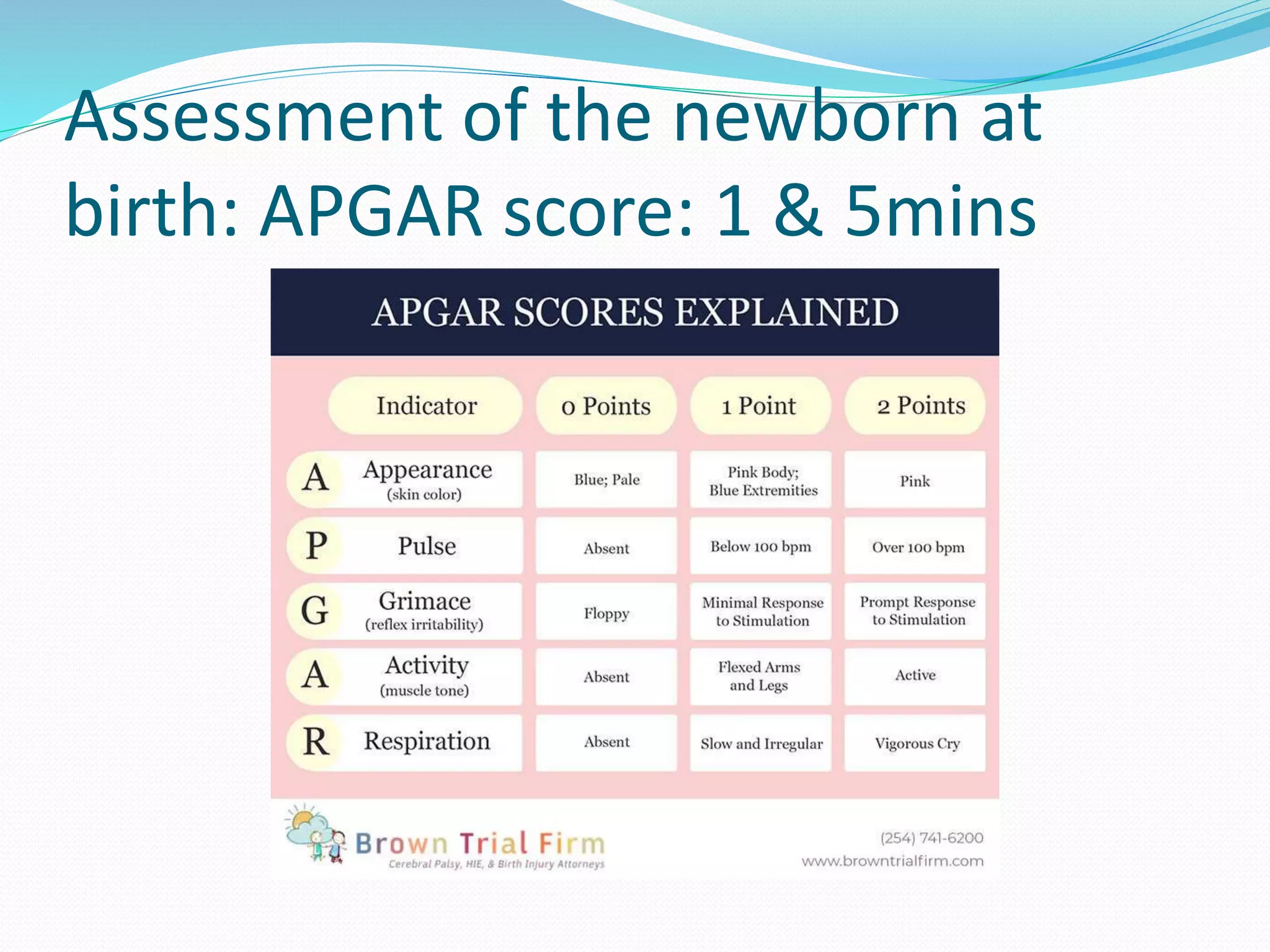
Assessment of the newborn at
birth: APGAR score: 1 & 5mins
APGAR SCORE
 This is a quick test performed on a baby at 1 and 5 minutes
after birth.
 The 1-minute score determines how well the baby tolerated
the birthing process.
 The 5-minute score tells the health care provider how well
the baby is doing outside the mother's womb.
 In rare cases, the test will be done 10 minutes after birth.
 A score of
 7 to 10 after five minutes is “reassuring.”
 4 to 6 is “moderately abnormal.”
 0 to 3 is concerning.
APGAR Score
 APGAR Score 7-10
 Achieved by 90% of neonates
 Nothing is required, except
 nasal and oral suctioning
 drying of the skin
 maintenance of normal body temperature.
 APGAR Score 4-6
 Suffered mild asphyxia just before birth.
 -Respond to vigorous stimulation
 -Oxygen blown over the face.
APGAR Score contd
 APGAR Score 3
 These Neonates are moderately depressed at birth.
 They are usually cyanotic and have poor respiratory efforts.
 But they usually respond to BMV, breath, and become pink.
 APGAR Score 0-2
 These neonates severely asphyxiated and require
immediate resuscitation
Anticipation of Resuscitation Need
 Anticipation, adequate preparation, accurate
evaluation, and prompt initiation of support are
critical for successful neonatal resuscitation.
 At every delivery at least 1 person required
whose primary responsibility is the newly born.
 This person must be capable of initiating
resuscitation, including administration of PPV and
chest compressions.
“the Golden Minute”
 ≈60 sec for initial steps, reevaluating, and beginning
ventilation if required.
 The decision to progress beyond initial steps is
determined by simultaneous assessment of: ▫
 Respirations (apnea, gasping, or labored or unlabored
breathing)
 HR (whether < 100/min or > 100/min)
Steps in Resuscitation
 Infant should receive one or more of the following
action in sequence:
 Initial steps in stabilization
 Ventilation
 Chest compressions
 Administration of epinephrine and/or volume
expansion
Initial Steps
 To provide warmth by placing the baby under a radiant
heat source,
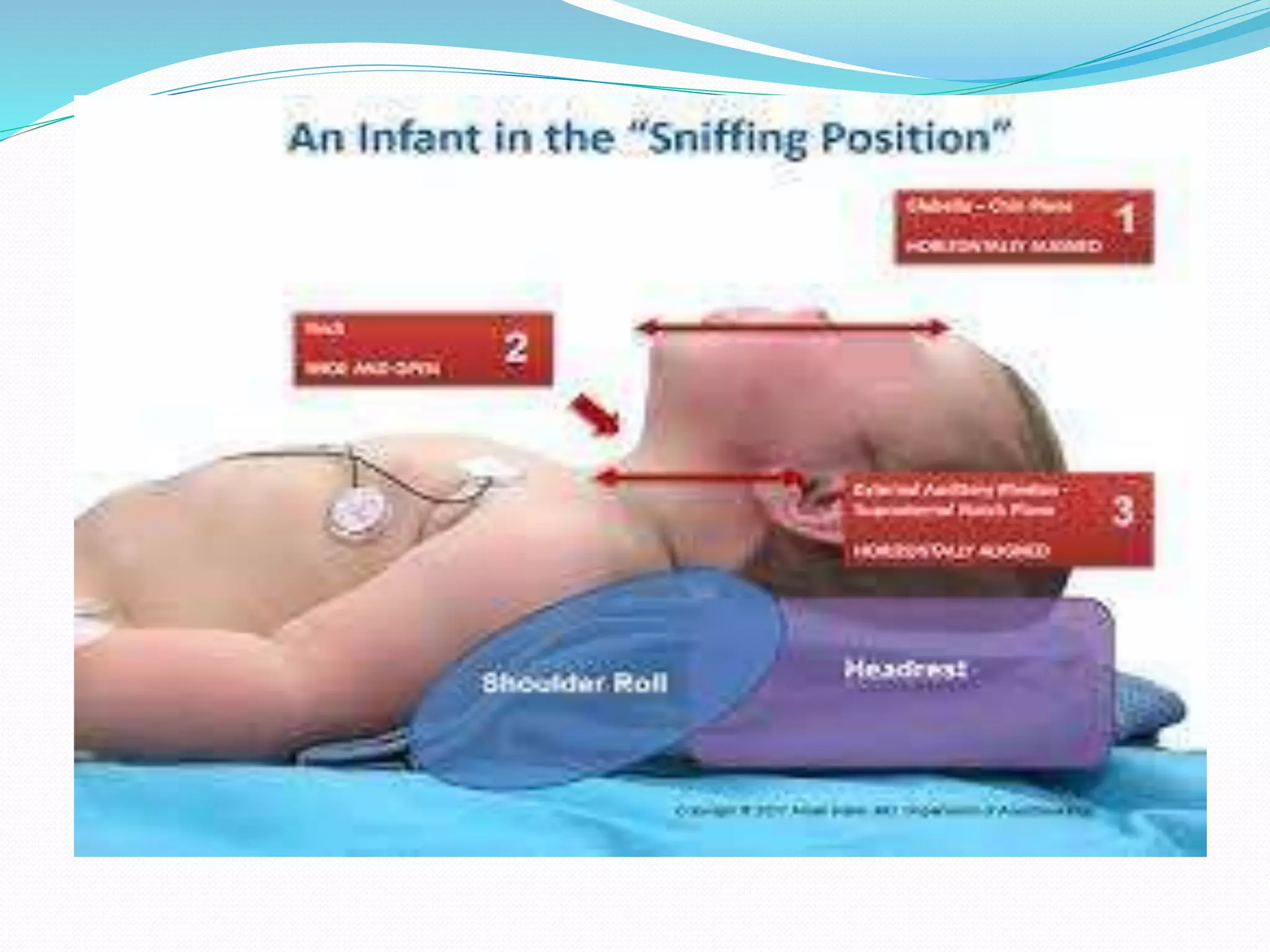
 Positioning the head in a “sniffing” position to open
the airway,
 Clearing the airway if necessary with a bulb syringe or
suction catheter,
 Drying the baby, and
 Stimulating respiration.
Keeping the baby warm
 Immediately after birth, the baby is wrapped in a dry,
warm towel and rubbed gently, to stimulate breathing.
 The baby’s back and soles of feet is rubbed gently also
for five seconds to stimulate breathing.
 The baby is dried with warmed towels or blankets to
avoid lowering of body heat.
Additional warming techniques :
 Pre-warming the delivery room to 26°C,
 Covering the baby in plastic wrapping (food or
medical grade, heat-resistant plastic)
 Placing the baby on an exothermic mattress ,
 Placing the baby under radiant heat .
Clearing the airway
-Suctioning
 Clear the airway by sucking mouth secretions with a
bulb syringe quickly within five seconds.
 Suctioning immediately after birth should be reserved
for babies who have obvious obstruction to
spontaneous breathing.
 When Amniotic Fluid Is Clear,
 Deep Suctioning is avoided
 nasopharynx → bradycardia during resuscitation.
 Remove thick meconium (if present) using a wide port
tube.
Clearing the airway
-Suctioning contd
 When Meconium is Present,
 Suctioning, Chest physical therapy, and postural
drainage done every 30 min for 2 hrs and hourly
thereafter for the next 6 hrs help remove residual
meconium from the lung.
 All neonates born after meconium aspiration should
be observed for 24 hrs
 because they can develop Persistent Fetal Circulation
syndrome.
Clamping and cutting the cord
 If the baby is breathing adequately, then the doctor
will
 Keep the baby at the same height as the placenta or
below the placenta until the cord is clamped to
enhance blood transfusion.
 Clamp the cord approximately one to three minutes after
birth to minimize anemia (low red blood cells in the
blood).
 Return the baby to the mother for skin-to-skin contact
to keep the baby warm.
Opening the airway for breathing
 If the baby is still not breathing, to open the airways
 They will be kept on a flat surface on their back.
 Their head will be kept in a neutral position (parallel to
the surface).
 A two to three centimeter thick folded towel will be
placed beneath their shoulders.
Keeping the baby breathing
 If the baby still does not breathe with a low heart rate (less
than 100 beats/minute), then
 Place a mask over the baby’s mouth and nose, connecting it
with an Ambu bag.
 Provide five inflation breaths by slowly squeezing the bag.
 Inspect the baby’s chest movement.
 Reassess the inflation and listen to the heart and check
whether the baby is breathing.
 Repeat the maneuver if the baby is still not responding
 Return the baby to the mother for breastfeeding if the baby
starts breathing.
 Monitor the baby further for six hours.
Chest compression
 Some babies may need chest compressions if the heart
rate is absent or low (less than 60 beats/minute) and
not responding to being resuscitated with an Ambu
bag.
 Then the doctor will
 Hold the baby’s chest with two hands while placing the
thumbs below the nipples.
 Press the baby’s chest with their thumbs quickly.
 Another method in smaller babies is using the index
and middle fingers to gentle press over the breastbone.
 Make sure there is time for the chest to recoil.
Chest compression contd
 Provide three chest compressions to one breath with
the help of an attendant.
 A 3:1 compression to ventilation ratio is used where
ventilation compromise is the primary cause, but
rescuers should consider using higher ratios (eg, 15:2)
if the arrest is believed to be of cardiac origin.
 Continue chest compression until the baby’s heart rate
gets to normal.
 Check for responses by listening to the baby's heart
rate every 30 seconds to one minute and see chest
movements with each breath, after each intervention.
Chest compression contd
 Compressions should be delivered on the lower third
of the sternum to a depth of ≈1/3rd of the AP diameter
of the chest.
 indicated when HR < 60/min despite adequate PPV
with O2 for 30 seconds.
 Rescuers should ensure that assisted ventilation is
being delivered optimally before starting chest
compressions because ▫
 ventilation is the most effective action and
 chest compressions are likely to compete with effective
ventilation,
RESUSCITATION DRUGS
 If the HR remains < 60/min despite adequate
ventilation and chest compressions with100% O2,
 adrenaline or volume expansion or both are indicated
 IV is the preferred route: UVC is preferable to
intraosseous
 Recommended IV dose is 0.01-0.03 mg/kg/dose; rapid
bolus followed by 1ml of 0.9% NS flush
 Intratracheal dose is higher(0.05 to 0.1 mg/kg);
1:10,000 (0.1 mg/mL);
 Can be repeated every 5 minutes, if HR remains <
60/min.
Treatment of Hypovolemia
 Best be done with blood and crystalloids
 If hypovolemia is suspected at birth, Rhnegative type
O PRBCs should be available in delivery room before
neonate is born.
 Crystalloid and blood should be titrated in 10 mL/kg
and given slowly over 10 minutes.
 In most cases, <10-20 mL/kg of volume restores mean
arterial pressure to normal.
Role of Glucose
 Newborns with lower blood glucose levels are at ↑ risk
for brain injury so maintain BGL >2.5 mmol/L.
 If the blood glucose concentration is low,
 bolus of glucose (0.5 to 1.0 mL/kg of 10% dextrose) and
 constant infusion of 5-7 mg/kg/min intravenously is
given .
Post-resuscitation Care
 Babies who require resuscitation are at risk for
deterioration after their vital signs have returned to
normal.
 Once adequate ventilation and circulation have been
established,
 the infant should be maintained,
 or transferred to an environment where close
monitoring and anticipatory care can be provided.
Monitoring required may include:
 Oxygen saturation(SpO2)
 Heart rate and ECG
 Respiratory rate and pattern
 Blood glucose measurement
 Blood gas analysis
 Fluid balance and nutrition
 Blood pressure
 Temperature
 Neurological
Discontinuing Resuscitative Efforts
 In a newly born baby with no detectable HR,
resuscitation are discontinued if the HR remains
undetectable for 10 min.
 Resuscitation efforts beyond 10 min with no HR
should be considered if presumed etiology of the
arrest, gestation of the baby, and the parental desire.
When should a doctor stop
resuscitation?
 In the majority of cases, the above steps are enough to save
a baby.
 Even after this if there is no improvement, infants may
require tracheal intubation
 if endotracheal (ET) administration of medications is desired,
 congenital diaphragmatic hernia is suspected or
 there is a prolonged need for assisted ventilation.
 Such measures are only done in a neonatal intensive care
unit (NICU) supervised by an experienced doctor.
 Each country's guidelines vary as to when a doctor should
stop resuscitation attempts (from 10 to 20 minutes after
birth).
Thank you for your time
 Questions
 Comments

Neonatal resuscitation 1

  • 1.
    DR CHINEDU IBEH MBBS,MPH, FWACP 11/05/2021 HSD, IAUE
  • 2.
    OUTLINE  INTRODUCTION  NEONATALRESUSCITATION  FACTORS FOR NEONATAL RESUSCITATION  APGAR SCORE  STEPS IN NEONATAL RESUSCITATION
  • 3.
    Neonatal Resuscitation  Globally,about 1/4 of all newborn deaths are caused by asphyxia at birth, which can be prevented by effective and rapid resuscitation.  Series of actions, used to assist newborns with difficulty making the physiological ‘transition’ to extra-uterine life  They are emergency procedures to support newborns that  are not breathing, are gasping or have a weak heartbeat at birth.  About 10% will require some assistance at birth to begin breathing
  • 4.
    Factors for neonatalresuscitation Maternal Fetal  PROM (> 18 hours)  Bleeding in 2nd or 3rd trimester  PIH  Diabetes mellitus  Maternal pyrexia  Chorioamnionitis  Heavy sedation  Previous fetal or neonatal death  Multiple gestation  gestation (< 35 wks; >41 wks)  Large for dates  IUGR  Polyhydramnios and oligohydramnios  Reduced fetal movement before onset of labour  Congenital abnormalities which may effect breathing, cardiovascular function or oth
  • 5.
    Facilities/Equipments for Neonatal Resuscitation The first 60 seconds after delivery is critical  The need for resuscitation is often unexpected, therefore, one need to have:  A warm labor room with good light sources to assess the baby  Equipment  Resuscitation bed, over head warmer (infrared heater), towel, stethoscope, pulse oximeter  An Ambu bag with a baby-sized mask  Clock, Clean ties, Scissors, Clean towels  Suction device with Suction catheter, Bulb syringe
  • 6.
    Equipment  Resuscitation bed,over head warmer (infrared heater), towel, stethoscope, pulse oximeter  An Ambu bag with a baby-sized mask  Clock , Clean ties, Scissors, Clean towels  Suction device with Suction catheter, Bulb syringe  Breathing support: Facemask; PPV device, O2 gas  Circulation support: UVC kit, iv kit, io needle,  Drug and fluids: Adrenaline(1;10000/0.1mg/ml), NS, Blood
  • 7.
    Assessment of thenewborn at birth: APGAR score: 1 & 5mins
  • 8.
    APGAR SCORE  Thisis a quick test performed on a baby at 1 and 5 minutes after birth.  The 1-minute score determines how well the baby tolerated the birthing process.  The 5-minute score tells the health care provider how well the baby is doing outside the mother's womb.  In rare cases, the test will be done 10 minutes after birth.  A score of  7 to 10 after five minutes is “reassuring.”  4 to 6 is “moderately abnormal.”  0 to 3 is concerning.
  • 9.
    APGAR Score  APGARScore 7-10  Achieved by 90% of neonates  Nothing is required, except  nasal and oral suctioning  drying of the skin  maintenance of normal body temperature.  APGAR Score 4-6  Suffered mild asphyxia just before birth.  -Respond to vigorous stimulation  -Oxygen blown over the face.
  • 10.
    APGAR Score contd APGAR Score 3  These Neonates are moderately depressed at birth.  They are usually cyanotic and have poor respiratory efforts.  But they usually respond to BMV, breath, and become pink.  APGAR Score 0-2  These neonates severely asphyxiated and require immediate resuscitation
  • 11.
    Anticipation of ResuscitationNeed  Anticipation, adequate preparation, accurate evaluation, and prompt initiation of support are critical for successful neonatal resuscitation.  At every delivery at least 1 person required whose primary responsibility is the newly born.  This person must be capable of initiating resuscitation, including administration of PPV and chest compressions.
  • 12.
    “the Golden Minute” ≈60 sec for initial steps, reevaluating, and beginning ventilation if required.  The decision to progress beyond initial steps is determined by simultaneous assessment of: ▫  Respirations (apnea, gasping, or labored or unlabored breathing)  HR (whether < 100/min or > 100/min)
  • 13.
    Steps in Resuscitation Infant should receive one or more of the following action in sequence:  Initial steps in stabilization  Ventilation  Chest compressions  Administration of epinephrine and/or volume expansion
  • 14.
    Initial Steps  Toprovide warmth by placing the baby under a radiant heat source,  Positioning the head in a “sniffing” position to open the airway,  Clearing the airway if necessary with a bulb syringe or suction catheter,  Drying the baby, and  Stimulating respiration.
  • 16.
    Keeping the babywarm  Immediately after birth, the baby is wrapped in a dry, warm towel and rubbed gently, to stimulate breathing.  The baby’s back and soles of feet is rubbed gently also for five seconds to stimulate breathing.  The baby is dried with warmed towels or blankets to avoid lowering of body heat.
  • 17.
    Additional warming techniques:  Pre-warming the delivery room to 26°C,  Covering the baby in plastic wrapping (food or medical grade, heat-resistant plastic)  Placing the baby on an exothermic mattress ,  Placing the baby under radiant heat .
  • 18.
    Clearing the airway -Suctioning Clear the airway by sucking mouth secretions with a bulb syringe quickly within five seconds.  Suctioning immediately after birth should be reserved for babies who have obvious obstruction to spontaneous breathing.  When Amniotic Fluid Is Clear,  Deep Suctioning is avoided  nasopharynx → bradycardia during resuscitation.  Remove thick meconium (if present) using a wide port tube.
  • 19.
    Clearing the airway -Suctioningcontd  When Meconium is Present,  Suctioning, Chest physical therapy, and postural drainage done every 30 min for 2 hrs and hourly thereafter for the next 6 hrs help remove residual meconium from the lung.  All neonates born after meconium aspiration should be observed for 24 hrs  because they can develop Persistent Fetal Circulation syndrome.
  • 20.
    Clamping and cuttingthe cord  If the baby is breathing adequately, then the doctor will  Keep the baby at the same height as the placenta or below the placenta until the cord is clamped to enhance blood transfusion.  Clamp the cord approximately one to three minutes after birth to minimize anemia (low red blood cells in the blood).  Return the baby to the mother for skin-to-skin contact to keep the baby warm.
  • 21.
    Opening the airwayfor breathing  If the baby is still not breathing, to open the airways  They will be kept on a flat surface on their back.  Their head will be kept in a neutral position (parallel to the surface).  A two to three centimeter thick folded towel will be placed beneath their shoulders.
  • 22.
    Keeping the babybreathing  If the baby still does not breathe with a low heart rate (less than 100 beats/minute), then  Place a mask over the baby’s mouth and nose, connecting it with an Ambu bag.  Provide five inflation breaths by slowly squeezing the bag.  Inspect the baby’s chest movement.  Reassess the inflation and listen to the heart and check whether the baby is breathing.  Repeat the maneuver if the baby is still not responding  Return the baby to the mother for breastfeeding if the baby starts breathing.  Monitor the baby further for six hours.
  • 23.
    Chest compression  Somebabies may need chest compressions if the heart rate is absent or low (less than 60 beats/minute) and not responding to being resuscitated with an Ambu bag.  Then the doctor will  Hold the baby’s chest with two hands while placing the thumbs below the nipples.  Press the baby’s chest with their thumbs quickly.  Another method in smaller babies is using the index and middle fingers to gentle press over the breastbone.  Make sure there is time for the chest to recoil.
  • 24.
    Chest compression contd Provide three chest compressions to one breath with the help of an attendant.  A 3:1 compression to ventilation ratio is used where ventilation compromise is the primary cause, but rescuers should consider using higher ratios (eg, 15:2) if the arrest is believed to be of cardiac origin.  Continue chest compression until the baby’s heart rate gets to normal.  Check for responses by listening to the baby's heart rate every 30 seconds to one minute and see chest movements with each breath, after each intervention.
  • 25.
    Chest compression contd Compressions should be delivered on the lower third of the sternum to a depth of ≈1/3rd of the AP diameter of the chest.  indicated when HR < 60/min despite adequate PPV with O2 for 30 seconds.  Rescuers should ensure that assisted ventilation is being delivered optimally before starting chest compressions because ▫  ventilation is the most effective action and  chest compressions are likely to compete with effective ventilation,
  • 26.
    RESUSCITATION DRUGS  Ifthe HR remains < 60/min despite adequate ventilation and chest compressions with100% O2,  adrenaline or volume expansion or both are indicated  IV is the preferred route: UVC is preferable to intraosseous  Recommended IV dose is 0.01-0.03 mg/kg/dose; rapid bolus followed by 1ml of 0.9% NS flush  Intratracheal dose is higher(0.05 to 0.1 mg/kg); 1:10,000 (0.1 mg/mL);  Can be repeated every 5 minutes, if HR remains < 60/min.
  • 27.
    Treatment of Hypovolemia Best be done with blood and crystalloids  If hypovolemia is suspected at birth, Rhnegative type O PRBCs should be available in delivery room before neonate is born.  Crystalloid and blood should be titrated in 10 mL/kg and given slowly over 10 minutes.  In most cases, <10-20 mL/kg of volume restores mean arterial pressure to normal.
  • 28.
    Role of Glucose Newborns with lower blood glucose levels are at ↑ risk for brain injury so maintain BGL >2.5 mmol/L.  If the blood glucose concentration is low,  bolus of glucose (0.5 to 1.0 mL/kg of 10% dextrose) and  constant infusion of 5-7 mg/kg/min intravenously is given .
  • 29.
    Post-resuscitation Care  Babieswho require resuscitation are at risk for deterioration after their vital signs have returned to normal.  Once adequate ventilation and circulation have been established,  the infant should be maintained,  or transferred to an environment where close monitoring and anticipatory care can be provided.
  • 30.
    Monitoring required mayinclude:  Oxygen saturation(SpO2)  Heart rate and ECG  Respiratory rate and pattern  Blood glucose measurement  Blood gas analysis  Fluid balance and nutrition  Blood pressure  Temperature  Neurological
  • 31.
    Discontinuing Resuscitative Efforts In a newly born baby with no detectable HR, resuscitation are discontinued if the HR remains undetectable for 10 min.  Resuscitation efforts beyond 10 min with no HR should be considered if presumed etiology of the arrest, gestation of the baby, and the parental desire.
  • 32.
    When should adoctor stop resuscitation?  In the majority of cases, the above steps are enough to save a baby.  Even after this if there is no improvement, infants may require tracheal intubation  if endotracheal (ET) administration of medications is desired,  congenital diaphragmatic hernia is suspected or  there is a prolonged need for assisted ventilation.  Such measures are only done in a neonatal intensive care unit (NICU) supervised by an experienced doctor.  Each country's guidelines vary as to when a doctor should stop resuscitation attempts (from 10 to 20 minutes after birth).
  • 33.
    Thank you foryour time  Questions  Comments

Editor's Notes

  • #12 1. Immature lungs- difficult to ventilate and also more vulnerable to injury by PPV; 2. Immature blood vessels in the brain that are prone to hemorrhage; 3. Thin skin & large BSA→ Rapid heat loss; 4. Increased susceptibility to infection; 5. ↑ risk of hypovolemic shock related to small blood volume
  • #20 Persistent fetal circulation (PFC), also known as persistent pulmonary hypertension of the newborn, is defined as postnatal persistence of right-to-left ductal or atrial shunting, or both in the presence of elevated right ventricular pressure.