Neoclassicism
Prepared and presented by
Dr. Shubham Shiva
Associate Professor & Head
Department of Painting
DG PG College, Kanpur
9839512609
Shubhams.shiva@gmail.com
This presentation is prepared for online teaching and learning purpose. This is not intended to be published or printed.
Neoclassicism
Started: 1750 ; Ended: 1850
The rallying cry of populations immersed in the 18th century Age of Enlightenment was
The new classics of the highest rank!
They wanted their artwork and architecture to mirror, and carry the same set of standards, as the
idealized works of the Greeks and Romans.
In conjunction with the exciting archaeological rediscoveries of Pompeii and Herculaneum in Rome,
Neoclassicism arose as artists and architects infused their work with past Greco-Roman ideals. A
return to the study of science, history, mathematics, and anatomical correctness abounded, replacing
the Rococo vanity culture and court-painting climate that preceded.
This presentation is prepared for online teaching and learning purpose. This is not intended to be published or printed
.
Ideas & Accomplishments of Neoclassicism
This presentation is prepared for online teaching and learning purpose. This is not intended to be published or printed
.
• Neoclassical art arose in opposition to the overly decorative and gaudy styles of Rococo and Baroque
that were infusing society with a vanity art culture based on personal conceits and whimsy. It
brought about a general revival in classical thought that mirrored what was going on in political
and social arenas of the time, leading to the French Revolution.
• The primary Neoclassicist belief was that art should express the ideal virtues in life and could
improve the viewer by imparting a moralizing message. It had the power to civilize, reform, and
transform society, as society itself was being transformed by new approaches to government and the
rising forces of the Industrial Revolution, driven by scientific discovery and invention.
• Neoclassical architecture was based on the principles of simplicity, symmetry, and mathematics,
which were seen as virtues of the arts in Ancient Greece and Rome. It also evolved the more recent
influences of the equally antiquity-informed 16th century Renaissance Classicism.
• Neoclassicism's rise was in large part due to the popularity of the Grand Tour, in which art students
and the general aristocracy were given access to recently unearthed ruins in Italy, and as a result
became enamored with the aesthetics and philosophies of ancient art.
Neoclassicism adopted the hierarchy of
painting that was established by the
French Royal Academy of the Arts in
1669. History painting, which included
subjects from the Bible, classical
mythology, and history, was ranked as
the top category, followed by portraiture,
genre painting, landscapes, and still
lifes. This hierarchy, was used to
evaluate works submitted for the Salon
or for prizes like the illustrious Prix de
Rome, and influenced the financial
value of works for patrons and
collectors. The works of Nicolas Poussin
and Claude Lorrain were revered as the
ideal exemplars of history painting, and
both artists were primary influences
upon Neoclassicism.
Beginnings of Neoclassicism
Nicolas Poussin and Claude Lorrain
Neoclassicism adopted the hierarchy of painting that was
established by the French Royal Academy of the Arts in
1669. History painting, which included subjects from the
Bible, classical mythology, and history, was ranked as the
top category, followed by portraiture, genre painting,
landscapes, and still lifes. This hierarchy, was used to
evaluate works submitted for the Salon or for prizes like the
illustrious Prix de Rome, and influenced the financial value
of works for patrons and collectors. The works of Nicolas
Poussin and Claude Lorrain were revered as the ideal
exemplars of history painting, and both artists were
primary influences upon Neoclassicism.
Claude Lorrain's A landscape with Apollo guarding the herds of
Admetus and Mercury stealing them (1645), depicts a scene from
Greek mythology with contemporary details, as Apollo is playing a
violin and Mercury resembles an ordinary villager, thus bringing the
classical past and present reality into one serene vision.
While Nicolas Poussin and Claude Lorrain were both
French Baroque artists who spent most of their working
lives in Rome, it was their distinctive emphasis on a
more classical approach that appealed to Neoclassical
artists. Claude, as he is commonly called, painted
landscapes, using naturalistic detail and the observation
of light and its effects, with figures from mythological or
Biblical scenes, as seen in his A landscape with Apollo
guarding the herds of Admetus and Mercury stealing
them (1645) An effect of orderly harmony was conveyed
in many of his works, which appealed to Neoclassicism's
belief that art should express the ideal virtues.
Nicolas Poussin's The Death of Germanicus (1627)
depicted the death and suspected assassination of the
popular Roman general as recorded by the Roman historian Tacitus.
While he was also a noted painter of religious subjects, Nicholas Poussin's mythological and historical scenes
were his primary influence on Neoclassicism. His The Death of Germanicus (1627) made him famous in his own
time, and influenced Jacques-Louis David as well as Benjamin West whose The Death of General Wolfe (1770)
draws upon the work. Though the works of Venetian Renaissance artist Titian influenced his color palette,
Poussin's compositions emphasized clarity and logic, and his figurative treatments favored strong lines.
Pompeo Batoni's Francis Basset (1778) depicted his subject, a
future British Baron, as the quintessential aristocratic tourist
on the Grand Tour in Rome leaning against a fictional Roman
altar with St. Peter's Basilica and the Castel Sant-Angelo in
the background.
Neoclassicism was inspired by the discovery of ancient Greek
and Roman archeological sites and artifacts that became known
throughout Europe in popular illustrated reports of various
travel expeditions. Scholars such as James Stuart and Nicholas
Revett made a systematic effort to catalog and record the past in
works like their Antiquities of Athens (1762). Wanting to see
these works first hand, young European aristocrats on the
Grand Tour, a traditional and educational rite of passage,
traveled to Italy "in search of art, culture, and the roots of
Western civilization," as cultural critic Matt Gross wrote. Rome
with its Roman ruins, Renaissance works, and recently
discovered antiquities became a major stop. Famous artists,
such as Pompeo Batoni and Antonio Canova, held open studios
as many of these aristocratic tourists were both avid collectors
and commissioned various works.
Johann Joachim Winckelmann
Anton von Maron's Portrait of Johann Joachim Winckelmann (1767) depicts the historian
contemplating a reproduction of Greek art, while writing, and with a Greek bust
behind him.
Neoclassicism began in Rome, as Johann Joachim Winckelmann's Thoughts on the
Imitation of Greek Works in Painting and Sculpture (1750) played a leading role in
establishing the aesthetic and theory of Neoclassicism. Though German, he lived
most of his life in Rome where several notable Catholic officials became his patrons.
Arguing that art should strive toward "noble simplicity and calm grandeur," he advocated,
"the one way for us to become great, perhaps inimitable, is by imitating the ancients.
" The work, which made him famous, was widely translated, first into French, then into
English by the artist Henry Fuseli in 1765.
Small Herculaneum Woman (30-1 B.C. E.) is a noted sculpture found
during the excavation of Herculaneum.
In 1738, the ruined city of Herculaneum was discovered and excavated, followed by the excavation of
Pompeii and Paestum in 1748. In the sudden eruption of Mount Vesuvius in 79 CE the cities had
been covered in volcanic ash, so that elements of ancient everyday life, noted sculptures, and
many frescoes were preserved. In 1758 Winckelmann visited the excavations, and published the first
accounts of the archeological finds in his Letter about the Discoveries at Herculaneum (1762).
Winckelmann's masterwork History of Ancient Art (1764)
became an instant classic, as art historians Francis
Haskell and Nicholas Penny wrote, his "most significant
and lasting achievement was to produce a thorough,
comprehensive and lucid chronological account of all
antique art - including that of the Egyptians and
Etruscans." He was the first to create an orderly vision of
art, from beginning to maturity to decline, looking at a
civilization's art as integrally connected to the culture
itself. The book influenced noted intellectuals both of his
time and in the following centuries, including Lessing,
Herder, Goethe, Nietzsche, and Spengler.
The title page of Johann Joachim Winckelmann's Geschichte der Kunst des Alterhums Vol. 1 (1776)
shows Winckelmann in the center, with a bust of Homer and the Sphinx on the right, and the she-wolf
with Romulus and Remus, legendary founders of Rome on the left with an Etruscan vase behind them.
Early Neoclassicism: Anton Raphael Mengs
Anton Raphael Mengs' Parnassus (c.1750-1760s),
an oil sketch for his 1761 fresco in the Villa
Albani in Rome, has been described by art historian
Thomas Pelzel as, ‘among the earliest
examples in Neoclassical painting in which we find
such extended evidence of the use of figures
derived from the ancient paintings of Herculaneum.’
Influenced by his close friend Winckelmann,
Anton Raphael Mengs was an early pioneer of
Neoclassical painting. The circle of artists that
gathered around Mengs and Winckelmann
positioned Rome as the center of the new
movement. Mengs noted frescoes, depicting mythological subjects led to his being dubbed "the greatest painter
of the day." He influenced a number of noted artists, who were to lead the subsequent development of
Neoclassicism in Britain, including Benjamin West, Angelica Kauffman, John Flaxman, and Gavin Hamilton.
He also influenced Jacques-Louis David, who led the later period of Neoclassicism centered in France, as the
two artists met during David's Prix de Rome stay from 1775-1780.
The Enlightenment
This image shows the title page of the first volume of the twenty-eight volume
Encyclopédie, ou dictionnaire raisonné des sciences, des arts et des métiers
Encyclopaedia or a Systematic Dictionary of the Sciences, Arts and Crafts (1751-1772),
edited by Denis Diderot and Jean le Rond D'Alembert.
Neoclassicism developed with the Enlightenment, a political and philosophical
movement that primarily valued science, reason, and exploration. Also called "The
Age of Reason," the Enlightenment was informed by the skepticism of the noted
philosopher René Descartes and the political philosophy of John Locke as the
absolutes of the monarchy and religious dogma were fundamentally questioned,
and the ideals of individual liberty, religious tolerance, and constitutional governments
were advanced. The French Encyclopédie (Encyclopedia) (1751-1772), representing a
compendium of Enlightenment thought and the most significant publication of the
century, had an international influence. Denis Diderot, also known as a founder of the
discipline of art history, who edited the work, said its purpose was " to change the way
people think." As historian Clorinda Donato wrote, it "successfully argued...[for]...the
potential of reason and unified knowledge to empower human will and ...to shape the
social issues." Adopting this view, Neoclassical artists felt art could civilize, reform, and
transform society, as society itself was being transformed by the rising forces of the
Industrial Revolution, driven by scientific discovery and invention.
The Apex of Neoclassicism: Jacques-Louis David
The later period of Neoclassicism, centered in France,
emphasized strong line, austere classical settings lit
with an artificial light, and simplified elements to convey
moral vigor. Shown at the 1785 Paris Salon, Jacque-Louis
David's Oath of the Horatii (1784) exemplified the new
direction in Neoclassical painting and made him the
leader of the movement. The artist completed the
painting while he was in Rome, where he associated with
Mengs, and, subsequently, visited the ruins at Herculaneum,
an experience that he compared to having cataracts
surgically removed. Although Oath of the Horatii (1784),
appealed to King Louis XVI, whose government had
commissioned it, with its emphasis on loyalty, the painting became subsequently identified with the
revolutionary movement in France. The French Revolution was a period of far-reaching political and social
upheaval that overthrew the monarchy, established a republic and culminated as a dictatorship under
Napoleon inspired by radical new liberalist ideas. The Jacobins, a highly influential political club of the
time, adopted the salute of the Horatii brothers as seen in David's The Tennis Court Oath (1791). David's
influence was so great that the later period of Neoclassicism was dubbed "the Age of David," as he
personally trained artists including Anne Louis Girodet-Trioson, François Gérard, Antoine Jean Gros, and
Jean Auguste Dominique Ingres.
Neoclassicism: Concepts, Styles, and Trends
Influenced by Venetian Renaissance architect Andrea Palladio's designs and informed by the archeological discoveries
at Herculaneum and Winckelmann's theories, Neoclassical architecture began in the mid-1700s and spread throughout
Europe. The ensuing style, found in the designs of public buildings, notable residences, and urban planning, employed a
grid design taken from classical Roman examples. Ancient Romans, and before them even older civilizations, had used a
consolidated scheme for city planning for defense and civil convenience purposes. At its most basic design, the plan
emphasized a squared system of streets with a central forum for city services. However, regional variations developed in
the early 1800s, as the British turned to the Greek Revival style, and the French to the Empire style developed during
the reign of Napoleon Bonaparte. Both styles were connected to a sense of national identity, encouraged by the political
environment of the time.
The British Greek Revival style was influenced by the archeological findings of James Stuart and Nicholas Revett who
published The Antiquities of Athens (1762), and the discovery of several Greek temples in Italy that could be easily
visited. British Greek Revival architecture, led by the architects Williams Wilkins and Robert Smirke, noted for its
emphasis on simplicity and its use of Doric columns, influenced architecture in Germany, the United States, and
Northern Europe. Carl Gotthard Langhans's Brandenburg Gate (1788-1791) in Berlin was a noted example.
As Hugh Honour wrote, the French Empire style "turned to the florid opulence of Imperial Rome. The abstemious
severity of Doric was replaced by Corinthian richness and splendor." Charles Percier and Pierre Fontaine, both of
whom trained in Rome, were the leading architects of the style, as seen in their Arc de Triomphe du Carousel (1801-
1806). The triumphal arch became a noted feature of the style, both in France as seen in the Arc de Triomphe de
l'Étoile (1806-1836) and, internationally, as seen in the Navra Triumphal Arch (1827-1834) in Saint Petersburg to
commemorate the Russian defeat of Napoleon.
Interior Design
Interior design and furnishings in the Empire style were partially influenced by the
discoveries at Herculaneum and Pompeii. Empire interiors, meant to impress, employed
gilded ornament often with a militaristic motif or motifs evoking ancient Egypt and other
civilizations conquered by the Romans, and in the early 1800s conquered by Napoleon.
Both in architecture and design, the Empire style became international, as it
corresponded to the Regency style in England, the Federal style in the United States,
and the Biedermeier style in Germany.
Sculpture
The French Jean-Baptiste Pigalle was an early leader of Neoclassical sculpture. His
Mercury (1744) was acclaimed by Voltaire as comparable to the best Greek sculpture and
widely reproduced. Pigalle was also a noted teacher, as his student Jean-Antoine Houdon,
renowned for his portrait busts, subsequently led the movement in France. As the
movement was truly international, the Italian sculptor Antonio Canova was considered to
be the leading exponent of Neoclassicism as his works were compared in their beauty and
grace to those of the ancient Greek sculptor Praxiteles. In England, John Flaxman was the
most influential sculptor, known not only for his figures such as his Pastoral Apollo (1824)
but his reliefs and his Neoclassical designs for Josiah Wedgwood's Jasperware, an
internationally popular stoneware.
Later Developments -
Neoclassicism in painting and sculpture began declining with the rise of Romanticism, though in the early
1800s the two styles existed in rivalry, as Ingres held to Neoclassicism, by then considered "traditional,"
and Delacroix emphasized individual sensibility and feeling. By the 1850s Neoclassicism as a movement
had come to an end, though academic artists continued to employ classical styles and subjects throughout
most of the 19th century, while opposed and challenged by modern art movements, such as Realism,
Naturalism, and Impressionism.
Nonetheless Ingres' work continued to influence later artists as he evolved away from Neoclassicism and
into Romanticism with his female odalisques and their elongated backs. He impacted Edgar Degas,
Auguste Renoir, Henri Matisse, and Pablo Picasso, who were informed by his figurative treatments with
their stylistic distortions. David's work, particularly his The Death of Marat (1793), was rediscovered in the
mid-19th century, and, subsequently, influenced Picasso and Edvard Munch, as well as contemporary
artists such as Vik Muniz. Contemporary artist Cindy Sherman's History Portraits (1988-1990) repurposes
a number of famous Neoclassical works through self-portrait film stills.
While Neoclassical architecture declined by the mid 1800s, its influence continued to be felt in new
movements, such as the American Renaissance movement and Beaux-Arts architecture. Additionally,
architects commissioned to create noted public projects continued to turn to the style in the 20th century as
seen in the Lincoln Memorial (1922) and the American Museum of Natural History's Theodore Roosevelt
Memorial (1936). The Soviet Union also frequently employed the style in state architecture, both at home
and by exporting it to other communist countries.
Jacques-Louis David
Born: August 30, 1748 –
Paris, France
Died: December 29, 1825 –
Brussels, Belgium
The quintessential Neoclassical painter, David's monumental canvases were perhaps the final triumph of
traditional history painting. Adopting the fashionable Greco-Roman style, David blended these antique
subjects with Enlightenment philosophy to create moral exemplars. His linear forms dramatically
illustrated narratives that often mirrored contemporary politics. As the premier painter of his day, David
served the monarchy of Louis XVI, the post-revolutionary government, and the Emperor Napoleon
Bonaparte, despite the radical differences in these ruling regimes. He also ran an important studio
where his students would later rebel against his example, sowing the seeds of modernism.
This presentation is prepared for online teaching and learning purpose. This is not intended to be published or printed
.
Accomplishments
• David was the first French artist to unite classical subjects with a linear precision and minimalist
composition. Completely rejecting the decorative and painterly effects of the Rococo, his canvases created
powerful, didactic works of moral clarity with few distractions or pictorial flourishes. David's paintings
answered the demand for art that directly conveyed civic virtues to a wide audience.
• Although paintings such as The Oath of the Horatii and Death of Socrates would come to be associated with
the Revolution of 1789, David's earliest successes were iconic images of valor and noble deeds, commissioned
by royal and aristocratic patrons, who adopted the classical style as the latest trend. A political chameleon,
David adapted this Neoclassical style to remain successful throughout the tumultuous climate of the late-
18th and early-19th centuries. He secured important commissions from the monarchy, the Revolutionary
government, and Napoleon Bonaparte, all of whom used David's classicism to legitimize their claim to
authority.
• Although he is most often identified with his activities during the French Revolution, during which he served
on the National Council and organized propaganda, David was adept politically and adjusted his art to fit
the needs of each of his patron. This ability provided an example for working with contemporary subjects
and of modifying to fit different political engagements.
• The Academy taught drawing; to learn to paint, students would apprentice in the studio of a master. David's
studio became the most important training ground for artists of the late-18th and early-19th centuries.
Although many of his students would eventually rebel against this model and turn towards the burgeoning
Romantic movement and its spiritual questioning, his legacy was established through generations of artists
who could trace their instruction back to David's studio - his most famous student was Jean-Auguste-
Dominique Ingres.
This presentation is prepared for online teaching and learning purpose. This is not intended to be published or printed
.
1784
The Oath of the Horatii
The Oath of the Horatii depicts
narrative from early Roman history.
On the left, three young soldiers
reach toward their father, pledging
to fight for their homeland. They
appear resolute and unified, every
muscle in their bodies is actively
engaged and forcefully described, as
if to confirm their selflessness and
bravery. These Roman Horatii
brothers were to battle against
three Curatii brothers from Alba to
settle a territorial dispute between
their city-states. They are willing to
fight to the death, sacrificing
themselves for home and family.
This presentation is prepared for online teaching and learning purpose. This is not intended to be published or printed
Underscoring their moral integrity, David compares their positive example with weakness. On the right,
women and children collapse on each other, overwhelmed by their emotions and fear. Indeed, the women are
more conflicted; one, a Curatii, was married to one of the Horatii while a Horatii sister was engaged to another
of the Curatii. As they watch this dramatic pledge, they understand that either their husbands or their
brothers were going to die and their loyalties are divided. David juxtaposes these two family groups, dividing
the canvas not only into male and female roles, but contrasting the heroic and selfless with the fearful and
uncertain.
This clarity is also reflected in the severity of the composition and style; while earlier artists had begun to
mine Greco-Roman narratives as a fashionable trend in art, no other artist united these stories with David's
stylistic minimalism and simplicity. The bare stage-like setting, organized by the sparse arches in the
background, provides no distraction from the lesson being taught. Every figure and object in the painting
contributes to this central moral.
Indeed, David even invented this scene to most concisely convey the essence of the narrative and its moral
implications. In neither the written history, nor the 18th-century stage production of this story, do the sons
pledge an oath to their father. David added this element because it allowed him to condense the larger epic into
a singular moment, and to create the strongest possible emotional charge.
The enthusiastic reception of this painting at the Salon cemented David's reputation as the leading artist in
the new Neoclassical style. Although the work was his first royal commission, and its emphasis on selflessness
and patriotism was conceived with the monarchy in mind, its depiction of fraternity and heroic sacrifice would
soon resonate with the French Revolution of 1789.
1787
The Death of Socrates
Another narrative of stoic self-sacrifice and dignity, David presented the suicide of Socrates as an
admirable and noble act. Set in the bare scene of his prison cell, the muscular body of the aged
philosopher is meant to convey his moral and intellectual fitness. He sits upright, preparing to swallow
the bowl of poisonous hemlock without any hesitation or uncertainty; he would rather die than
renounce his teachings. His arm is raised in an oratory gesture, lecturing until his last moment, while
his students demonstrate a range of emotional responses to his execution.
David's painting draws from Plato's account of the event, linking this painting with a classical source;
yet, as in The Oath of the Horatii, David takes artistic license to manipulate the scene for greater
dramatic effect. He eliminates some of the figures mentioned in Plato's account and idealizes the aged
figure of Socrates, making his message of heroic logic and intellectualism clear to the viewer.
As tensions rose in pre-revolutionary France, David's depiction of resistance against an unjust
authority quickly became popular. In a letter to the famous British portraitist Sir Joshua Reynolds, the
artist John Boydell claimed it to be "the greatest effort of art since the Sistine Chapel and the stanza of
Raphael."
This presentation is prepared for online teaching and learning purpose. This is not intended to be published or printed
.
1789 The Lictors Returning to Brutus the
Bodies of his Sons
In the dark shadows that fall across the
lower left corner, sits a man on a bench;
looking out at the viewer, his facial
expression is difficult to decipher. Separated
from the rest of the composition by this
darkness, as well as a Doric column and
silhouetted statue, the viewer's eye moves
from him to the brightly lit, dramatically
posed woman to the right. Her two children
cling to her, as she reaches out an arm, a
movement that is balanced by a figure in
blue who has collapsed. Following this
outstretched arm, the viewer finally arrives
at the titular subject - the light falls upon a
corpse being borne on a stretcher. The circuit
connecting these three main actors: Brutus,
his wife, and his dead son, is a tight circle,
creating through light and gesture.
This presentation is prepared for online teaching and learning purpose. This is not intended to be published or printed
David uses these two fundamental components to succinctly retell a story from Roman history; here,
Brutus, a father, has sentenced to death his two sons because of their treasonous actions. His
patriotism was greater than even his love for his family, although his stoic grief reveals the dear cost of
this conviction.
This painting, with its messaging about patriotism, loyalty, and sacrifice, was due to be exhibited at the
Salon in the earliest days of the Revolution. The royal authorities, still in control of the exhibition,
examined each work to ensure that it would not contribute to the political instability and further
jeopardize the stability of the monarchy. One of David's paintings, a portrait of a known Jacobist, was
refused, as was this charged depiction of Brutus. When this was announced, there was a public outcry;
the painting was ultimately displayed under the protection of David's students. The painting inspired a
passionate following and permeated popular culture; this work was even re-enacted with live actors
from National Theatre following a November 1790 performance of Voltaire's Brutus.
This presentation is prepared for online teaching and learning purpose. This is not intended to be published or printed
1793 The Death of Marat
Once more turning to contemporary politics, David was
commissioned to create a memorial to Jean-Paul Marat
following his 1793 assassination by Charlotte Corday. A
French politician, physician, journalist, and a leader of the
radical Montagnard faction, Marat had been murdered while
sitting in a medicinal bath that alleviated the symptoms of a
painful skin condition. David's painting combines such factual
information (including a legible version of Corday's deceptive
plea, calculated to gain an audience with Marat) along with
highly symbolic elements of propaganda to create an image
that elevates Marat to martyrdom. Sometimes referred to as
Marat Breathing his Last, we see the humble workspace of a
tireless public servant: only his bath and a simple box that
serves as his writing desk.
This presentation is prepared for online teaching and learning purpose. This is not intended to be published or printed
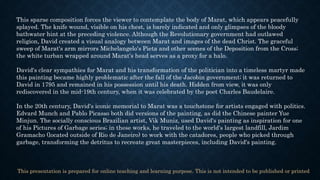
This sparse composition forces the viewer to contemplate the body of Marat, which appears peacefully
splayed. The knife wound, visible on his chest, is barely indicated and only glimpses of the bloody
bathwater hint at the preceding violence. Although the Revolutionary government had outlawed
religion, David created a visual analogy between Marat and images of the dead Christ. The graceful
sweep of Marat's arm mirrors Michelangelo's Pieta and other scenes of the Deposition from the Cross;
the white turban wrapped around Marat's head serves as a proxy for a halo.
David's clear sympathies for Marat and his transformation of the politician into a timeless martyr made
this painting became highly problematic after the fall of the Jacobin government; it was returned to
David in 1795 and remained in his possession until his death. Hidden from view, it was only
rediscovered in the mid-19th century, when it was celebrated by the poet Charles Baudelaire.
In the 20th century, David's iconic memorial to Marat was a touchstone for artists engaged with politics.
Edvard Munch and Pablo Picasso both did versions of the painting, as did the Chinese painter Yue
Minjun. The socially conscious Brazilian artist, Vik Muniz, used David's painting as inspiration for one
of his Pictures of Garbage series; in these works, he traveled to the world's largest landfill, Jardim
Gramacho (located outside of Rio de Janeiro) to work with the catadores, people who picked through
garbage, transforming the detritus to recreate great masterpieces, including David's painting.
This presentation is prepared for online teaching and learning purpose. This is not intended to be published or printed
1800
Bonaparte Crossing the Grand Saint-Bernard Pass, 20
May 1800
An image of absolute control, confidence, and optimism,
Bonaparte Crossing the St Bernard Pass is a large-
scale equestrian portrait of the ruler. Shown heroically
conquering this inhospitable terrain, Napoleon secures
his place in history alongside two other generals who
found victory in this same difficult military approach;
their names are inscribed on the rocks in the lower left
corner: Hannibal, and Charlemagne.
This presentation is prepared for online teaching and learning purpose. This is not intended to be published or printed
Napoleon had come to power through a military coup in 1799, declaring himself First Consul
and seizing command. This painting represents this bold general and his ability to maintain
control in the face of chaos and danger. Although the horse rears up on the edge of a rocky
precipice, Napoleon calmly holds the reins in one hand while gesturing forward with his other
arm. The movement of the horse is echoed in the flowing golden yellow cape of Bonaparte.
Everything about the leader suggests a forward trajectory, highlighting his ability to lead
France above the turmoil of the Revolutionary period. While David had supported the
Revolution, he committed himself to the new French leader Bonaparte (who had restored
David's reputation and financial success) and painted many portraits of the general that helped
to legitimize his claim to authority.
This work was commissioned by King Charles IV of Spain, who admired the leader and was
relieved at the restoration of order to neighboring France. The actual moment depicted was
entirely fictitious: although Napoleon led his troops over the Alps, he rode a mule through a
narrow mountain trail (as the soldiers in the distance are shown). Indeed, Napoleon even
refused David's request to sit for the portrait, stating, "No one knows if portraits of great men
are likenesses: it suffices that genius lives." Instead, David used models wearing Napoleon's
clothes to pose for the hero. The painting originally was displayed in the Spanish royal palace,
but Napoleon quickly ordered three copies for himself. David was subsequently named First
Painter to Napoleon in 1801 and he, and his students, would provide official portraits and
propaganda throughout the emperor's reign.
This presentation is prepared for online teaching and learning purpose. This is not intended to be published or printed
Jean-Auguste-Dominique Ingres
Born: August 29, 1780 - Montauban, France
Died: January 14, 1867 - Paris, France
With a daring blend of traditional technique and experimental
sensuality, Jean-Auguste-Dominique Ingres reimagined Classical
and Renaissance sources for 19th century tastes. A talented
draftsman known for his serpentine line and impeccably rendered,
illusionistic textures, he was at the center of a revived version of
the ancient debate: is line or color the most important element of
painting? Yet Ingres was not always successful; his experiments
with abstracting the body and introducing more exotic and
emotionally complex subjects earned harsh criticism in his early
career. In truth, his work is best understood as a hybrid between
Neoclassicism and Romanticism. It was only as the foil to the more
dramatic Romanticism of Eugène Delacroix that Ingres came to be
widely accepted as the defender of traditional painting and
classicism.
This presentation is prepared for online teaching and learning purpose. This is not intended to be published or printed
Accomplishments
 One of the most talented students in the studio of Jacques Louis David, Ingres found early success,
winning the coveted Prix de Rome on only his second attempt. Yet while Ingres would always
reflect the classical style associated with David, he complicated his master's legacy by distorting
his figures and in choosing narratives that broke with the moral exemplars of his teacher.
 In pursuit of more beautiful forms and harmonious line, Ingres pushed the abstraction of the body
beyond the idealism of the Neoclassical. He abstracted his figures, even departing from the
plausible construction of the body, to emphasize graceful contours and a pleasant visual effect. This
new level of freedom would encourage other artists to take liberties with the human form, from
Renoir (who was reportedly infatuated with Ingres) to the 20th century Surrealists.
 Despite his transgressions, when compared to the painterly brushwork and brilliant palettes of the
Romantics, such as Eugène Delacroix, Ingres was undoubtedly connected to the classical tradition
and academic style. In the mid-19th century, he came to represent the Poussinistes, who believed
that the cerebral quality of the drawn line was more critical to a painting, opposed to the
Rubenistes, who favored the emotional impact of color. As the defender of tradition, Ingres updated
Renaissance ideals for the modern era, in particular working after the model of Raphael.
This presentation is prepared for online teaching and learning purpose. This is not intended to be published or printed
1806 Napoléon on his Imperial Throne
Perhaps now the most iconic portrait of Emperor Napoléon I, Ingres's painting
was originally dismissed as overly gothic, archaic, and even "barbaric." Opulently
adorned, the newly crowned emperor is represented among a hodgepodge of
Roman, Byzantine, and Carolingian symbols. The intention, to legitimize his
claim to authority, is overshadowed by the strangeness of this imposing
frontality; his pallid face emerges from layers of ostentatiously regal garb to look
past the viewer with a stony gaze.
Ingres's painting was inspired by art historical depictions of power; it was a
strategy similarly employed by Napoleon himself, who often used symbolism
associated with the Roman and Holy Roman empires to reinforce his rule.
Pictorially, Ingres looks directly to the God the Father panel from Jan van Eyck's
Ghent Altarpiece (looted during the Napoleonic Wars, this altarpiece was part of
the new Musée Napoléon); replacing God with Napoleon, encircled by the golden
laurel wreath and throne, Ingres suggests his sitter's power, even divinity. This
pose also recalled the legendary statue of Zeus at Olympia by the ancient Greek
sculptor Phidias. Although that statue had been lost in antiquity, the
Neoclassical interest in such relics made it a newly relevant and recognizable
reference for the 19th-century viewer.
This presentation is prepared for online teaching and learning purpose. This is not intended to be published or printed
Coupled with these art historical references, the presentation of Napoleon's body and accessories
underscores his power. Indeed, Ingres uses every inch of the considerable, nearly 9' tall, canvas to project
Napoléon's political and martial prowess, assembling an eclectic yet legible iconography: Napoléon's robes
are of rich purple, a color long associated with royalty and the Roman empire; a heraldic shield bearing
the crest of the Papal states can be seen above his left shoulder, a reference to his position as King of
Italy; his Legion of Honor medal rests on a lavish ermine collar; and the hand of justice sits atop a rod
that crosses subtly with a bejeweled sword (modeled after the sword of Charlemagne, a ruler that the
emperor sought to emulate), representing a balance of fairness and might. Most pointedly, Napoléon
grasps a scepter in his right hand topped with a statuette of Charlemagne who holds the fleur-de-lis
(associated with the royal Bourbon family) and the Imperial orb. This scepter, believed to have belonged
to Charles IV, positions Napoleon as the successor to the French royal family as well as the historical line
of Emperors.
Despite these art historical precedents, Ingres's portrait was soundly criticized at the Salon of 1806; it
was even dismissed as "unintelligible" by his own teacher, Jacques-Louis David. As the Neoclassical style
began to ebb, with tastes preferring a more natural and contemporary representation of power, Ingres's
complex compendium of historical motifs seemed retrograde and outdated. Even though it was the target
of scorn, with this complicated web of iconography and symbolism, Ingres ushered in a new twist on the
Neoclassical and demonstrated his interests in art historical references and stylistic experiments.
This presentation is prepared for online teaching and learning purpose. This is not intended to be published or printed
1824
The Vow of Louis XIII
When Ingres left Paris for Italy in 1806, he swore that he would not come
back until he was acknowledged as a serious and important history
painter. This 1824 altarpiece allowed his triumphant return, as this
hometown commission for the Montauban Cathedral was highly
celebrated. The monumental painting, which measures nearly 14 feet
high, was a challenging subject that brought together historical and
religious iconographies and spaces. The scene commemorates an iconic
moment from the reign of King Louis XIII from 1638, when he pledged
the dedication of France to the Virgin Mary. This act, which had been
celebrated as an annual holiday prior to the Revolution of 1789, had
recently been reinstated under the Restoration period, which returned
the Bourbon kings to the French throne. It was, therefore, a historical
episode with very specific contemporary meaning, promising a divine
benevolence and reinforcing the absolutist claim to rule. The Vow of
Louis XIII demonstrates Ingres's ability to meld the historical and the
contemporary, translating the classical scene into the simplified visual
vocabulary of the 19th century.
This presentation is prepared for online teaching and learning purpose. This is not intended to be published or printed
The narrative required Ingres to carefully balance the composition between the earthly realm of Louis
XIII and the heavenly sphere above. Ingres created two different atmospheres to distinguish between
the spaces, bathing the Virgin Mary in a warm, idealized glow and emphasizing the materiality and
textures of Louis XIII in a more concrete fashion. Again, Ingres drew heavily from art historical
precedents, closely modeling his Virgin on Raphael's Sistine Madonna. The comparison was successful
and positioned Ingres as the modern-day descendant of the Renaissance tradition, an important
distinction as 1824 also marked the rise of Romanticism.
Before the painting's installation in Montauban Cathedral, it was exhibited at the Salon of 1824, an
early battleground between the traditions of Neoclassicism and the emerging challenges of
Romanticism. Compared to the expressive colors and contemporary subject of Eugène Delacroix's
Scenes from the Massacres at Scio (1824), which were perceived as troublingly revolutionary (even
incendiary), Ingres's Vow was seen as a bastion of tradition. Thus, despite the mixed reception of
Ingres's earlier works and his departures from the Neoclassical, Ingres became the great defender of
the classical tradition, a reputation that would follow him throughout his career. The year after this
success, Ingres was awarded the Legion of Honor and elected to membership in the Academy, securing
his reputation.
This presentation is prepared for online teaching and learning purpose. This is not intended to be published or printed
1832
Portrait of Monsieur Bertin
There is a devil-may-care realism to this portrait,
suggested by the informal grooming and slightly
aggressive stance of the sitter. A somewhat gruff-
looking older man, Monsieur Bertin sits hunched in a
mahogany chair, legs splayed a bit indecorously;
defying the protocols of formal portraiture, his jacket is
crumpled and his waistcoat strains to contain his
voluminous torso. There is little idealization, but rather
a strong sense of character; Ingres seems to draw once
again from the example of Raphael, recalling the
Renaissance portrait of Baldessare Castiglione. Indeed,
despite its informalities, Ingres's Portrait of Monsieur
Bertin is anything but careless; meticulously drawn -
one can practically count the strands of gray hair
falling in tousled locks - and highly composed, the artist
famously struggled to perfect the pose and demeanor of
his sitter, producing many preparatory sketches in
various configurations.
This presentation is prepared for online teaching and learning purpose. This is not intended to be published or printed
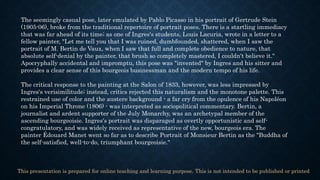
The seemingly casual pose, later emulated by Pablo Picasso in his portrait of Gertrude Stein
(1905-06), broke from the traditional repertoire of portrait poses. There is a startling immediacy
that was far ahead of its time; as one of Ingres's students, Louis Lacuria, wrote in a letter to a
fellow painter, "Let me tell you that I was ruined, dumbfounded, shattered, when I saw the
portrait of M. Bertin de Vaux, when I saw that full and complete obedience to nature, that
absolute self-denial by the painter, that brush so completely mastered, I couldn't believe it."
Apocryphally accidental and impromptu, this pose was "invented" by Ingres and his sitter and
provides a clear sense of this bourgeois businessman and the modern tempo of his life.
The critical response to the painting at the Salon of 1833, however, was less impressed by
Ingres's verisimilitude; instead, critics rejected this naturalism and the monotone palette. This
restrained use of color and the austere background - a far cry from the opulence of his Napoléon
on his Imperial Throne (1806) - was interpreted as sociopolitical commentary. Bertin, a
journalist and ardent supporter of the July Monarchy, was an archetypal member of the
ascending bourgeoisie. Ingres's portrait was disparaged as overtly opportunistic and self-
congratulatory, and was widely received as representative of the new, bourgeois era. The
painter Édouard Manet went so far as to describe Portrait of Monsieur Bertin as the "Buddha of
the self-satisfied, well-to-do, triumphant bourgeoisie."
This presentation is prepared for online teaching and learning purpose. This is not intended to be published or printed
1852-63
The Turkish Bath
The Turkish Bath both summarizes Ingres's treatment of the female
nude and extends his legacy into the modern era. One of his most
complex compositions, bodies seem to spill past the limits of the round
canvas, the cramped spatial depth seems to multiply the plentiful
flesh. Situating the viewer within an Orientalist interior, Ingres
demonstrates his continued interest in colonialist themes. The open
sensuality of the figures is striking, as their limbs intertwine to
display an available, exotic eroticism.
Once more, Ingres brings together elements of the Neoclassical and the Romantic. His signature
sinuous line verges on the fluidity of an arabesque, although he maintains the sculptural surface
and precise rendering of his training. As with his earlier female nudes, Ingres takes artistic
liberties when representing human anatomy - the limbs and torsos of the figures are distorted in
order to achieve a more harmonious aesthetic - and yet they are painted with the undetectable
brushwork of an academician.
This presentation is prepared for online teaching and learning purpose. This is not intended to be published or printed
Never having traveled to the Near East or Africa, Ingres was inspired by the letters of the 18th-
century aristocrat Lady Mary Montague, copying her writings on the Ottoman Empire into his own
notes. In one letter, Montague described the crowded bath at Adrianople: "naked women in various
poses... some conversing, others at their work, others drinking coffee or tasting a sorbet, and many
stretched out nonchalantly." Ingres translated the sense of languid relaxation in the supine bodies
of his figures, adorned in turbans and the richly embroidered fabrics associated with the imagined
Orient.
The sensuous nature of this expansive array of female flesh was too much for Ingres's patron.
Commissioned by Prince Napoléon in 1852, it was initially displayed in the Palais Royal until the
Princess Clotilde objected. The painting was returned to Ingres, who continued to modify it
extensively until 1863. He finally decided to radically alter the traditional, rectangular format of
the painting into a tondo, augmenting the sense of compression among the figures. Only in 1905
was the painting displayed publicly; even then, its debut at the Salon d'Automne was deemed
revolutionary. Ingres was enthusiastically received by the emerging avant-garde as titillating and
audacious in his treatment of flesh, abstraction of the body, and celebration of female sexuality. In
particular, the young Pablo Picasso found it compelling, creating a series of works that recall the
subject, including his Les Demoiselles d'Avignon (1907). Ingres's painting also inspired the many
odalisques and female nudes of the Fauve artist Henri Matisse.
This presentation is prepared for online teaching and learning purpose. This is not intended to be published or printed
.
Prepared and presented by
Dr. Shubham Shiva
Associate Professor & Head
Department of Painting
DG PG College, Kanpur
9839512609
shubhams.shiva@gmail.com
THANK YOU

neoclassicism.pptx

  • 1.
    Neoclassicism Prepared and presentedby Dr. Shubham Shiva Associate Professor & Head Department of Painting DG PG College, Kanpur 9839512609 Shubhams.shiva@gmail.com This presentation is prepared for online teaching and learning purpose. This is not intended to be published or printed.
  • 2.
    Neoclassicism Started: 1750 ;Ended: 1850 The rallying cry of populations immersed in the 18th century Age of Enlightenment was The new classics of the highest rank! They wanted their artwork and architecture to mirror, and carry the same set of standards, as the idealized works of the Greeks and Romans. In conjunction with the exciting archaeological rediscoveries of Pompeii and Herculaneum in Rome, Neoclassicism arose as artists and architects infused their work with past Greco-Roman ideals. A return to the study of science, history, mathematics, and anatomical correctness abounded, replacing the Rococo vanity culture and court-painting climate that preceded. This presentation is prepared for online teaching and learning purpose. This is not intended to be published or printed .
  • 3.
    Ideas & Accomplishmentsof Neoclassicism This presentation is prepared for online teaching and learning purpose. This is not intended to be published or printed . • Neoclassical art arose in opposition to the overly decorative and gaudy styles of Rococo and Baroque that were infusing society with a vanity art culture based on personal conceits and whimsy. It brought about a general revival in classical thought that mirrored what was going on in political and social arenas of the time, leading to the French Revolution. • The primary Neoclassicist belief was that art should express the ideal virtues in life and could improve the viewer by imparting a moralizing message. It had the power to civilize, reform, and transform society, as society itself was being transformed by new approaches to government and the rising forces of the Industrial Revolution, driven by scientific discovery and invention. • Neoclassical architecture was based on the principles of simplicity, symmetry, and mathematics, which were seen as virtues of the arts in Ancient Greece and Rome. It also evolved the more recent influences of the equally antiquity-informed 16th century Renaissance Classicism. • Neoclassicism's rise was in large part due to the popularity of the Grand Tour, in which art students and the general aristocracy were given access to recently unearthed ruins in Italy, and as a result became enamored with the aesthetics and philosophies of ancient art.
  • 4.
    Neoclassicism adopted thehierarchy of painting that was established by the French Royal Academy of the Arts in 1669. History painting, which included subjects from the Bible, classical mythology, and history, was ranked as the top category, followed by portraiture, genre painting, landscapes, and still lifes. This hierarchy, was used to evaluate works submitted for the Salon or for prizes like the illustrious Prix de Rome, and influenced the financial value of works for patrons and collectors. The works of Nicolas Poussin and Claude Lorrain were revered as the ideal exemplars of history painting, and both artists were primary influences upon Neoclassicism.
  • 5.
    Beginnings of Neoclassicism NicolasPoussin and Claude Lorrain Neoclassicism adopted the hierarchy of painting that was established by the French Royal Academy of the Arts in 1669. History painting, which included subjects from the Bible, classical mythology, and history, was ranked as the top category, followed by portraiture, genre painting, landscapes, and still lifes. This hierarchy, was used to evaluate works submitted for the Salon or for prizes like the illustrious Prix de Rome, and influenced the financial value of works for patrons and collectors. The works of Nicolas Poussin and Claude Lorrain were revered as the ideal exemplars of history painting, and both artists were primary influences upon Neoclassicism. Claude Lorrain's A landscape with Apollo guarding the herds of Admetus and Mercury stealing them (1645), depicts a scene from Greek mythology with contemporary details, as Apollo is playing a violin and Mercury resembles an ordinary villager, thus bringing the classical past and present reality into one serene vision.
  • 6.
    While Nicolas Poussinand Claude Lorrain were both French Baroque artists who spent most of their working lives in Rome, it was their distinctive emphasis on a more classical approach that appealed to Neoclassical artists. Claude, as he is commonly called, painted landscapes, using naturalistic detail and the observation of light and its effects, with figures from mythological or Biblical scenes, as seen in his A landscape with Apollo guarding the herds of Admetus and Mercury stealing them (1645) An effect of orderly harmony was conveyed in many of his works, which appealed to Neoclassicism's belief that art should express the ideal virtues. Nicolas Poussin's The Death of Germanicus (1627) depicted the death and suspected assassination of the popular Roman general as recorded by the Roman historian Tacitus. While he was also a noted painter of religious subjects, Nicholas Poussin's mythological and historical scenes were his primary influence on Neoclassicism. His The Death of Germanicus (1627) made him famous in his own time, and influenced Jacques-Louis David as well as Benjamin West whose The Death of General Wolfe (1770) draws upon the work. Though the works of Venetian Renaissance artist Titian influenced his color palette, Poussin's compositions emphasized clarity and logic, and his figurative treatments favored strong lines.
  • 7.
    Pompeo Batoni's FrancisBasset (1778) depicted his subject, a future British Baron, as the quintessential aristocratic tourist on the Grand Tour in Rome leaning against a fictional Roman altar with St. Peter's Basilica and the Castel Sant-Angelo in the background. Neoclassicism was inspired by the discovery of ancient Greek and Roman archeological sites and artifacts that became known throughout Europe in popular illustrated reports of various travel expeditions. Scholars such as James Stuart and Nicholas Revett made a systematic effort to catalog and record the past in works like their Antiquities of Athens (1762). Wanting to see these works first hand, young European aristocrats on the Grand Tour, a traditional and educational rite of passage, traveled to Italy "in search of art, culture, and the roots of Western civilization," as cultural critic Matt Gross wrote. Rome with its Roman ruins, Renaissance works, and recently discovered antiquities became a major stop. Famous artists, such as Pompeo Batoni and Antonio Canova, held open studios as many of these aristocratic tourists were both avid collectors and commissioned various works.
  • 8.
    Johann Joachim Winckelmann Antonvon Maron's Portrait of Johann Joachim Winckelmann (1767) depicts the historian contemplating a reproduction of Greek art, while writing, and with a Greek bust behind him. Neoclassicism began in Rome, as Johann Joachim Winckelmann's Thoughts on the Imitation of Greek Works in Painting and Sculpture (1750) played a leading role in establishing the aesthetic and theory of Neoclassicism. Though German, he lived most of his life in Rome where several notable Catholic officials became his patrons. Arguing that art should strive toward "noble simplicity and calm grandeur," he advocated, "the one way for us to become great, perhaps inimitable, is by imitating the ancients. " The work, which made him famous, was widely translated, first into French, then into English by the artist Henry Fuseli in 1765. Small Herculaneum Woman (30-1 B.C. E.) is a noted sculpture found during the excavation of Herculaneum. In 1738, the ruined city of Herculaneum was discovered and excavated, followed by the excavation of Pompeii and Paestum in 1748. In the sudden eruption of Mount Vesuvius in 79 CE the cities had been covered in volcanic ash, so that elements of ancient everyday life, noted sculptures, and many frescoes were preserved. In 1758 Winckelmann visited the excavations, and published the first accounts of the archeological finds in his Letter about the Discoveries at Herculaneum (1762).
  • 9.
    Winckelmann's masterwork Historyof Ancient Art (1764) became an instant classic, as art historians Francis Haskell and Nicholas Penny wrote, his "most significant and lasting achievement was to produce a thorough, comprehensive and lucid chronological account of all antique art - including that of the Egyptians and Etruscans." He was the first to create an orderly vision of art, from beginning to maturity to decline, looking at a civilization's art as integrally connected to the culture itself. The book influenced noted intellectuals both of his time and in the following centuries, including Lessing, Herder, Goethe, Nietzsche, and Spengler. The title page of Johann Joachim Winckelmann's Geschichte der Kunst des Alterhums Vol. 1 (1776) shows Winckelmann in the center, with a bust of Homer and the Sphinx on the right, and the she-wolf with Romulus and Remus, legendary founders of Rome on the left with an Etruscan vase behind them.
  • 10.
    Early Neoclassicism: AntonRaphael Mengs Anton Raphael Mengs' Parnassus (c.1750-1760s), an oil sketch for his 1761 fresco in the Villa Albani in Rome, has been described by art historian Thomas Pelzel as, ‘among the earliest examples in Neoclassical painting in which we find such extended evidence of the use of figures derived from the ancient paintings of Herculaneum.’ Influenced by his close friend Winckelmann, Anton Raphael Mengs was an early pioneer of Neoclassical painting. The circle of artists that gathered around Mengs and Winckelmann positioned Rome as the center of the new movement. Mengs noted frescoes, depicting mythological subjects led to his being dubbed "the greatest painter of the day." He influenced a number of noted artists, who were to lead the subsequent development of Neoclassicism in Britain, including Benjamin West, Angelica Kauffman, John Flaxman, and Gavin Hamilton. He also influenced Jacques-Louis David, who led the later period of Neoclassicism centered in France, as the two artists met during David's Prix de Rome stay from 1775-1780.
  • 11.
    The Enlightenment This imageshows the title page of the first volume of the twenty-eight volume Encyclopédie, ou dictionnaire raisonné des sciences, des arts et des métiers Encyclopaedia or a Systematic Dictionary of the Sciences, Arts and Crafts (1751-1772), edited by Denis Diderot and Jean le Rond D'Alembert. Neoclassicism developed with the Enlightenment, a political and philosophical movement that primarily valued science, reason, and exploration. Also called "The Age of Reason," the Enlightenment was informed by the skepticism of the noted philosopher René Descartes and the political philosophy of John Locke as the absolutes of the monarchy and religious dogma were fundamentally questioned, and the ideals of individual liberty, religious tolerance, and constitutional governments were advanced. The French Encyclopédie (Encyclopedia) (1751-1772), representing a compendium of Enlightenment thought and the most significant publication of the century, had an international influence. Denis Diderot, also known as a founder of the discipline of art history, who edited the work, said its purpose was " to change the way people think." As historian Clorinda Donato wrote, it "successfully argued...[for]...the potential of reason and unified knowledge to empower human will and ...to shape the social issues." Adopting this view, Neoclassical artists felt art could civilize, reform, and transform society, as society itself was being transformed by the rising forces of the Industrial Revolution, driven by scientific discovery and invention.
  • 12.
    The Apex ofNeoclassicism: Jacques-Louis David The later period of Neoclassicism, centered in France, emphasized strong line, austere classical settings lit with an artificial light, and simplified elements to convey moral vigor. Shown at the 1785 Paris Salon, Jacque-Louis David's Oath of the Horatii (1784) exemplified the new direction in Neoclassical painting and made him the leader of the movement. The artist completed the painting while he was in Rome, where he associated with Mengs, and, subsequently, visited the ruins at Herculaneum, an experience that he compared to having cataracts surgically removed. Although Oath of the Horatii (1784), appealed to King Louis XVI, whose government had commissioned it, with its emphasis on loyalty, the painting became subsequently identified with the revolutionary movement in France. The French Revolution was a period of far-reaching political and social upheaval that overthrew the monarchy, established a republic and culminated as a dictatorship under Napoleon inspired by radical new liberalist ideas. The Jacobins, a highly influential political club of the time, adopted the salute of the Horatii brothers as seen in David's The Tennis Court Oath (1791). David's influence was so great that the later period of Neoclassicism was dubbed "the Age of David," as he personally trained artists including Anne Louis Girodet-Trioson, François Gérard, Antoine Jean Gros, and Jean Auguste Dominique Ingres.
  • 13.
    Neoclassicism: Concepts, Styles,and Trends Influenced by Venetian Renaissance architect Andrea Palladio's designs and informed by the archeological discoveries at Herculaneum and Winckelmann's theories, Neoclassical architecture began in the mid-1700s and spread throughout Europe. The ensuing style, found in the designs of public buildings, notable residences, and urban planning, employed a grid design taken from classical Roman examples. Ancient Romans, and before them even older civilizations, had used a consolidated scheme for city planning for defense and civil convenience purposes. At its most basic design, the plan emphasized a squared system of streets with a central forum for city services. However, regional variations developed in the early 1800s, as the British turned to the Greek Revival style, and the French to the Empire style developed during the reign of Napoleon Bonaparte. Both styles were connected to a sense of national identity, encouraged by the political environment of the time. The British Greek Revival style was influenced by the archeological findings of James Stuart and Nicholas Revett who published The Antiquities of Athens (1762), and the discovery of several Greek temples in Italy that could be easily visited. British Greek Revival architecture, led by the architects Williams Wilkins and Robert Smirke, noted for its emphasis on simplicity and its use of Doric columns, influenced architecture in Germany, the United States, and Northern Europe. Carl Gotthard Langhans's Brandenburg Gate (1788-1791) in Berlin was a noted example. As Hugh Honour wrote, the French Empire style "turned to the florid opulence of Imperial Rome. The abstemious severity of Doric was replaced by Corinthian richness and splendor." Charles Percier and Pierre Fontaine, both of whom trained in Rome, were the leading architects of the style, as seen in their Arc de Triomphe du Carousel (1801- 1806). The triumphal arch became a noted feature of the style, both in France as seen in the Arc de Triomphe de l'Étoile (1806-1836) and, internationally, as seen in the Navra Triumphal Arch (1827-1834) in Saint Petersburg to commemorate the Russian defeat of Napoleon.
  • 14.
    Interior Design Interior designand furnishings in the Empire style were partially influenced by the discoveries at Herculaneum and Pompeii. Empire interiors, meant to impress, employed gilded ornament often with a militaristic motif or motifs evoking ancient Egypt and other civilizations conquered by the Romans, and in the early 1800s conquered by Napoleon. Both in architecture and design, the Empire style became international, as it corresponded to the Regency style in England, the Federal style in the United States, and the Biedermeier style in Germany. Sculpture The French Jean-Baptiste Pigalle was an early leader of Neoclassical sculpture. His Mercury (1744) was acclaimed by Voltaire as comparable to the best Greek sculpture and widely reproduced. Pigalle was also a noted teacher, as his student Jean-Antoine Houdon, renowned for his portrait busts, subsequently led the movement in France. As the movement was truly international, the Italian sculptor Antonio Canova was considered to be the leading exponent of Neoclassicism as his works were compared in their beauty and grace to those of the ancient Greek sculptor Praxiteles. In England, John Flaxman was the most influential sculptor, known not only for his figures such as his Pastoral Apollo (1824) but his reliefs and his Neoclassical designs for Josiah Wedgwood's Jasperware, an internationally popular stoneware.
  • 15.
    Later Developments - Neoclassicismin painting and sculpture began declining with the rise of Romanticism, though in the early 1800s the two styles existed in rivalry, as Ingres held to Neoclassicism, by then considered "traditional," and Delacroix emphasized individual sensibility and feeling. By the 1850s Neoclassicism as a movement had come to an end, though academic artists continued to employ classical styles and subjects throughout most of the 19th century, while opposed and challenged by modern art movements, such as Realism, Naturalism, and Impressionism. Nonetheless Ingres' work continued to influence later artists as he evolved away from Neoclassicism and into Romanticism with his female odalisques and their elongated backs. He impacted Edgar Degas, Auguste Renoir, Henri Matisse, and Pablo Picasso, who were informed by his figurative treatments with their stylistic distortions. David's work, particularly his The Death of Marat (1793), was rediscovered in the mid-19th century, and, subsequently, influenced Picasso and Edvard Munch, as well as contemporary artists such as Vik Muniz. Contemporary artist Cindy Sherman's History Portraits (1988-1990) repurposes a number of famous Neoclassical works through self-portrait film stills. While Neoclassical architecture declined by the mid 1800s, its influence continued to be felt in new movements, such as the American Renaissance movement and Beaux-Arts architecture. Additionally, architects commissioned to create noted public projects continued to turn to the style in the 20th century as seen in the Lincoln Memorial (1922) and the American Museum of Natural History's Theodore Roosevelt Memorial (1936). The Soviet Union also frequently employed the style in state architecture, both at home and by exporting it to other communist countries.
  • 16.
    Jacques-Louis David Born: August30, 1748 – Paris, France Died: December 29, 1825 – Brussels, Belgium The quintessential Neoclassical painter, David's monumental canvases were perhaps the final triumph of traditional history painting. Adopting the fashionable Greco-Roman style, David blended these antique subjects with Enlightenment philosophy to create moral exemplars. His linear forms dramatically illustrated narratives that often mirrored contemporary politics. As the premier painter of his day, David served the monarchy of Louis XVI, the post-revolutionary government, and the Emperor Napoleon Bonaparte, despite the radical differences in these ruling regimes. He also ran an important studio where his students would later rebel against his example, sowing the seeds of modernism.
  • 17.
    This presentation isprepared for online teaching and learning purpose. This is not intended to be published or printed . Accomplishments • David was the first French artist to unite classical subjects with a linear precision and minimalist composition. Completely rejecting the decorative and painterly effects of the Rococo, his canvases created powerful, didactic works of moral clarity with few distractions or pictorial flourishes. David's paintings answered the demand for art that directly conveyed civic virtues to a wide audience. • Although paintings such as The Oath of the Horatii and Death of Socrates would come to be associated with the Revolution of 1789, David's earliest successes were iconic images of valor and noble deeds, commissioned by royal and aristocratic patrons, who adopted the classical style as the latest trend. A political chameleon, David adapted this Neoclassical style to remain successful throughout the tumultuous climate of the late- 18th and early-19th centuries. He secured important commissions from the monarchy, the Revolutionary government, and Napoleon Bonaparte, all of whom used David's classicism to legitimize their claim to authority. • Although he is most often identified with his activities during the French Revolution, during which he served on the National Council and organized propaganda, David was adept politically and adjusted his art to fit the needs of each of his patron. This ability provided an example for working with contemporary subjects and of modifying to fit different political engagements. • The Academy taught drawing; to learn to paint, students would apprentice in the studio of a master. David's studio became the most important training ground for artists of the late-18th and early-19th centuries. Although many of his students would eventually rebel against this model and turn towards the burgeoning Romantic movement and its spiritual questioning, his legacy was established through generations of artists who could trace their instruction back to David's studio - his most famous student was Jean-Auguste- Dominique Ingres.
  • 18.
    This presentation isprepared for online teaching and learning purpose. This is not intended to be published or printed . 1784 The Oath of the Horatii The Oath of the Horatii depicts narrative from early Roman history. On the left, three young soldiers reach toward their father, pledging to fight for their homeland. They appear resolute and unified, every muscle in their bodies is actively engaged and forcefully described, as if to confirm their selflessness and bravery. These Roman Horatii brothers were to battle against three Curatii brothers from Alba to settle a territorial dispute between their city-states. They are willing to fight to the death, sacrificing themselves for home and family.
  • 19.
    This presentation isprepared for online teaching and learning purpose. This is not intended to be published or printed Underscoring their moral integrity, David compares their positive example with weakness. On the right, women and children collapse on each other, overwhelmed by their emotions and fear. Indeed, the women are more conflicted; one, a Curatii, was married to one of the Horatii while a Horatii sister was engaged to another of the Curatii. As they watch this dramatic pledge, they understand that either their husbands or their brothers were going to die and their loyalties are divided. David juxtaposes these two family groups, dividing the canvas not only into male and female roles, but contrasting the heroic and selfless with the fearful and uncertain. This clarity is also reflected in the severity of the composition and style; while earlier artists had begun to mine Greco-Roman narratives as a fashionable trend in art, no other artist united these stories with David's stylistic minimalism and simplicity. The bare stage-like setting, organized by the sparse arches in the background, provides no distraction from the lesson being taught. Every figure and object in the painting contributes to this central moral. Indeed, David even invented this scene to most concisely convey the essence of the narrative and its moral implications. In neither the written history, nor the 18th-century stage production of this story, do the sons pledge an oath to their father. David added this element because it allowed him to condense the larger epic into a singular moment, and to create the strongest possible emotional charge. The enthusiastic reception of this painting at the Salon cemented David's reputation as the leading artist in the new Neoclassical style. Although the work was his first royal commission, and its emphasis on selflessness and patriotism was conceived with the monarchy in mind, its depiction of fraternity and heroic sacrifice would soon resonate with the French Revolution of 1789.
  • 20.
  • 21.
    Another narrative ofstoic self-sacrifice and dignity, David presented the suicide of Socrates as an admirable and noble act. Set in the bare scene of his prison cell, the muscular body of the aged philosopher is meant to convey his moral and intellectual fitness. He sits upright, preparing to swallow the bowl of poisonous hemlock without any hesitation or uncertainty; he would rather die than renounce his teachings. His arm is raised in an oratory gesture, lecturing until his last moment, while his students demonstrate a range of emotional responses to his execution. David's painting draws from Plato's account of the event, linking this painting with a classical source; yet, as in The Oath of the Horatii, David takes artistic license to manipulate the scene for greater dramatic effect. He eliminates some of the figures mentioned in Plato's account and idealizes the aged figure of Socrates, making his message of heroic logic and intellectualism clear to the viewer. As tensions rose in pre-revolutionary France, David's depiction of resistance against an unjust authority quickly became popular. In a letter to the famous British portraitist Sir Joshua Reynolds, the artist John Boydell claimed it to be "the greatest effort of art since the Sistine Chapel and the stanza of Raphael."
  • 22.
    This presentation isprepared for online teaching and learning purpose. This is not intended to be published or printed . 1789 The Lictors Returning to Brutus the Bodies of his Sons In the dark shadows that fall across the lower left corner, sits a man on a bench; looking out at the viewer, his facial expression is difficult to decipher. Separated from the rest of the composition by this darkness, as well as a Doric column and silhouetted statue, the viewer's eye moves from him to the brightly lit, dramatically posed woman to the right. Her two children cling to her, as she reaches out an arm, a movement that is balanced by a figure in blue who has collapsed. Following this outstretched arm, the viewer finally arrives at the titular subject - the light falls upon a corpse being borne on a stretcher. The circuit connecting these three main actors: Brutus, his wife, and his dead son, is a tight circle, creating through light and gesture.
  • 23.
    This presentation isprepared for online teaching and learning purpose. This is not intended to be published or printed David uses these two fundamental components to succinctly retell a story from Roman history; here, Brutus, a father, has sentenced to death his two sons because of their treasonous actions. His patriotism was greater than even his love for his family, although his stoic grief reveals the dear cost of this conviction. This painting, with its messaging about patriotism, loyalty, and sacrifice, was due to be exhibited at the Salon in the earliest days of the Revolution. The royal authorities, still in control of the exhibition, examined each work to ensure that it would not contribute to the political instability and further jeopardize the stability of the monarchy. One of David's paintings, a portrait of a known Jacobist, was refused, as was this charged depiction of Brutus. When this was announced, there was a public outcry; the painting was ultimately displayed under the protection of David's students. The painting inspired a passionate following and permeated popular culture; this work was even re-enacted with live actors from National Theatre following a November 1790 performance of Voltaire's Brutus.
  • 24.
    This presentation isprepared for online teaching and learning purpose. This is not intended to be published or printed 1793 The Death of Marat Once more turning to contemporary politics, David was commissioned to create a memorial to Jean-Paul Marat following his 1793 assassination by Charlotte Corday. A French politician, physician, journalist, and a leader of the radical Montagnard faction, Marat had been murdered while sitting in a medicinal bath that alleviated the symptoms of a painful skin condition. David's painting combines such factual information (including a legible version of Corday's deceptive plea, calculated to gain an audience with Marat) along with highly symbolic elements of propaganda to create an image that elevates Marat to martyrdom. Sometimes referred to as Marat Breathing his Last, we see the humble workspace of a tireless public servant: only his bath and a simple box that serves as his writing desk.
  • 25.
    This presentation isprepared for online teaching and learning purpose. This is not intended to be published or printed This sparse composition forces the viewer to contemplate the body of Marat, which appears peacefully splayed. The knife wound, visible on his chest, is barely indicated and only glimpses of the bloody bathwater hint at the preceding violence. Although the Revolutionary government had outlawed religion, David created a visual analogy between Marat and images of the dead Christ. The graceful sweep of Marat's arm mirrors Michelangelo's Pieta and other scenes of the Deposition from the Cross; the white turban wrapped around Marat's head serves as a proxy for a halo. David's clear sympathies for Marat and his transformation of the politician into a timeless martyr made this painting became highly problematic after the fall of the Jacobin government; it was returned to David in 1795 and remained in his possession until his death. Hidden from view, it was only rediscovered in the mid-19th century, when it was celebrated by the poet Charles Baudelaire. In the 20th century, David's iconic memorial to Marat was a touchstone for artists engaged with politics. Edvard Munch and Pablo Picasso both did versions of the painting, as did the Chinese painter Yue Minjun. The socially conscious Brazilian artist, Vik Muniz, used David's painting as inspiration for one of his Pictures of Garbage series; in these works, he traveled to the world's largest landfill, Jardim Gramacho (located outside of Rio de Janeiro) to work with the catadores, people who picked through garbage, transforming the detritus to recreate great masterpieces, including David's painting.
  • 26.
    This presentation isprepared for online teaching and learning purpose. This is not intended to be published or printed 1800 Bonaparte Crossing the Grand Saint-Bernard Pass, 20 May 1800 An image of absolute control, confidence, and optimism, Bonaparte Crossing the St Bernard Pass is a large- scale equestrian portrait of the ruler. Shown heroically conquering this inhospitable terrain, Napoleon secures his place in history alongside two other generals who found victory in this same difficult military approach; their names are inscribed on the rocks in the lower left corner: Hannibal, and Charlemagne.
  • 27.
    This presentation isprepared for online teaching and learning purpose. This is not intended to be published or printed Napoleon had come to power through a military coup in 1799, declaring himself First Consul and seizing command. This painting represents this bold general and his ability to maintain control in the face of chaos and danger. Although the horse rears up on the edge of a rocky precipice, Napoleon calmly holds the reins in one hand while gesturing forward with his other arm. The movement of the horse is echoed in the flowing golden yellow cape of Bonaparte. Everything about the leader suggests a forward trajectory, highlighting his ability to lead France above the turmoil of the Revolutionary period. While David had supported the Revolution, he committed himself to the new French leader Bonaparte (who had restored David's reputation and financial success) and painted many portraits of the general that helped to legitimize his claim to authority. This work was commissioned by King Charles IV of Spain, who admired the leader and was relieved at the restoration of order to neighboring France. The actual moment depicted was entirely fictitious: although Napoleon led his troops over the Alps, he rode a mule through a narrow mountain trail (as the soldiers in the distance are shown). Indeed, Napoleon even refused David's request to sit for the portrait, stating, "No one knows if portraits of great men are likenesses: it suffices that genius lives." Instead, David used models wearing Napoleon's clothes to pose for the hero. The painting originally was displayed in the Spanish royal palace, but Napoleon quickly ordered three copies for himself. David was subsequently named First Painter to Napoleon in 1801 and he, and his students, would provide official portraits and propaganda throughout the emperor's reign.
  • 28.
    This presentation isprepared for online teaching and learning purpose. This is not intended to be published or printed Jean-Auguste-Dominique Ingres Born: August 29, 1780 - Montauban, France Died: January 14, 1867 - Paris, France With a daring blend of traditional technique and experimental sensuality, Jean-Auguste-Dominique Ingres reimagined Classical and Renaissance sources for 19th century tastes. A talented draftsman known for his serpentine line and impeccably rendered, illusionistic textures, he was at the center of a revived version of the ancient debate: is line or color the most important element of painting? Yet Ingres was not always successful; his experiments with abstracting the body and introducing more exotic and emotionally complex subjects earned harsh criticism in his early career. In truth, his work is best understood as a hybrid between Neoclassicism and Romanticism. It was only as the foil to the more dramatic Romanticism of Eugène Delacroix that Ingres came to be widely accepted as the defender of traditional painting and classicism.
  • 29.
    This presentation isprepared for online teaching and learning purpose. This is not intended to be published or printed Accomplishments  One of the most talented students in the studio of Jacques Louis David, Ingres found early success, winning the coveted Prix de Rome on only his second attempt. Yet while Ingres would always reflect the classical style associated with David, he complicated his master's legacy by distorting his figures and in choosing narratives that broke with the moral exemplars of his teacher.  In pursuit of more beautiful forms and harmonious line, Ingres pushed the abstraction of the body beyond the idealism of the Neoclassical. He abstracted his figures, even departing from the plausible construction of the body, to emphasize graceful contours and a pleasant visual effect. This new level of freedom would encourage other artists to take liberties with the human form, from Renoir (who was reportedly infatuated with Ingres) to the 20th century Surrealists.  Despite his transgressions, when compared to the painterly brushwork and brilliant palettes of the Romantics, such as Eugène Delacroix, Ingres was undoubtedly connected to the classical tradition and academic style. In the mid-19th century, he came to represent the Poussinistes, who believed that the cerebral quality of the drawn line was more critical to a painting, opposed to the Rubenistes, who favored the emotional impact of color. As the defender of tradition, Ingres updated Renaissance ideals for the modern era, in particular working after the model of Raphael.
  • 30.
    This presentation isprepared for online teaching and learning purpose. This is not intended to be published or printed 1806 Napoléon on his Imperial Throne Perhaps now the most iconic portrait of Emperor Napoléon I, Ingres's painting was originally dismissed as overly gothic, archaic, and even "barbaric." Opulently adorned, the newly crowned emperor is represented among a hodgepodge of Roman, Byzantine, and Carolingian symbols. The intention, to legitimize his claim to authority, is overshadowed by the strangeness of this imposing frontality; his pallid face emerges from layers of ostentatiously regal garb to look past the viewer with a stony gaze. Ingres's painting was inspired by art historical depictions of power; it was a strategy similarly employed by Napoleon himself, who often used symbolism associated with the Roman and Holy Roman empires to reinforce his rule. Pictorially, Ingres looks directly to the God the Father panel from Jan van Eyck's Ghent Altarpiece (looted during the Napoleonic Wars, this altarpiece was part of the new Musée Napoléon); replacing God with Napoleon, encircled by the golden laurel wreath and throne, Ingres suggests his sitter's power, even divinity. This pose also recalled the legendary statue of Zeus at Olympia by the ancient Greek sculptor Phidias. Although that statue had been lost in antiquity, the Neoclassical interest in such relics made it a newly relevant and recognizable reference for the 19th-century viewer.
  • 31.
    This presentation isprepared for online teaching and learning purpose. This is not intended to be published or printed Coupled with these art historical references, the presentation of Napoleon's body and accessories underscores his power. Indeed, Ingres uses every inch of the considerable, nearly 9' tall, canvas to project Napoléon's political and martial prowess, assembling an eclectic yet legible iconography: Napoléon's robes are of rich purple, a color long associated with royalty and the Roman empire; a heraldic shield bearing the crest of the Papal states can be seen above his left shoulder, a reference to his position as King of Italy; his Legion of Honor medal rests on a lavish ermine collar; and the hand of justice sits atop a rod that crosses subtly with a bejeweled sword (modeled after the sword of Charlemagne, a ruler that the emperor sought to emulate), representing a balance of fairness and might. Most pointedly, Napoléon grasps a scepter in his right hand topped with a statuette of Charlemagne who holds the fleur-de-lis (associated with the royal Bourbon family) and the Imperial orb. This scepter, believed to have belonged to Charles IV, positions Napoleon as the successor to the French royal family as well as the historical line of Emperors. Despite these art historical precedents, Ingres's portrait was soundly criticized at the Salon of 1806; it was even dismissed as "unintelligible" by his own teacher, Jacques-Louis David. As the Neoclassical style began to ebb, with tastes preferring a more natural and contemporary representation of power, Ingres's complex compendium of historical motifs seemed retrograde and outdated. Even though it was the target of scorn, with this complicated web of iconography and symbolism, Ingres ushered in a new twist on the Neoclassical and demonstrated his interests in art historical references and stylistic experiments.
  • 32.
    This presentation isprepared for online teaching and learning purpose. This is not intended to be published or printed 1824 The Vow of Louis XIII When Ingres left Paris for Italy in 1806, he swore that he would not come back until he was acknowledged as a serious and important history painter. This 1824 altarpiece allowed his triumphant return, as this hometown commission for the Montauban Cathedral was highly celebrated. The monumental painting, which measures nearly 14 feet high, was a challenging subject that brought together historical and religious iconographies and spaces. The scene commemorates an iconic moment from the reign of King Louis XIII from 1638, when he pledged the dedication of France to the Virgin Mary. This act, which had been celebrated as an annual holiday prior to the Revolution of 1789, had recently been reinstated under the Restoration period, which returned the Bourbon kings to the French throne. It was, therefore, a historical episode with very specific contemporary meaning, promising a divine benevolence and reinforcing the absolutist claim to rule. The Vow of Louis XIII demonstrates Ingres's ability to meld the historical and the contemporary, translating the classical scene into the simplified visual vocabulary of the 19th century.
  • 33.
    This presentation isprepared for online teaching and learning purpose. This is not intended to be published or printed The narrative required Ingres to carefully balance the composition between the earthly realm of Louis XIII and the heavenly sphere above. Ingres created two different atmospheres to distinguish between the spaces, bathing the Virgin Mary in a warm, idealized glow and emphasizing the materiality and textures of Louis XIII in a more concrete fashion. Again, Ingres drew heavily from art historical precedents, closely modeling his Virgin on Raphael's Sistine Madonna. The comparison was successful and positioned Ingres as the modern-day descendant of the Renaissance tradition, an important distinction as 1824 also marked the rise of Romanticism. Before the painting's installation in Montauban Cathedral, it was exhibited at the Salon of 1824, an early battleground between the traditions of Neoclassicism and the emerging challenges of Romanticism. Compared to the expressive colors and contemporary subject of Eugène Delacroix's Scenes from the Massacres at Scio (1824), which were perceived as troublingly revolutionary (even incendiary), Ingres's Vow was seen as a bastion of tradition. Thus, despite the mixed reception of Ingres's earlier works and his departures from the Neoclassical, Ingres became the great defender of the classical tradition, a reputation that would follow him throughout his career. The year after this success, Ingres was awarded the Legion of Honor and elected to membership in the Academy, securing his reputation.
  • 34.
    This presentation isprepared for online teaching and learning purpose. This is not intended to be published or printed 1832 Portrait of Monsieur Bertin There is a devil-may-care realism to this portrait, suggested by the informal grooming and slightly aggressive stance of the sitter. A somewhat gruff- looking older man, Monsieur Bertin sits hunched in a mahogany chair, legs splayed a bit indecorously; defying the protocols of formal portraiture, his jacket is crumpled and his waistcoat strains to contain his voluminous torso. There is little idealization, but rather a strong sense of character; Ingres seems to draw once again from the example of Raphael, recalling the Renaissance portrait of Baldessare Castiglione. Indeed, despite its informalities, Ingres's Portrait of Monsieur Bertin is anything but careless; meticulously drawn - one can practically count the strands of gray hair falling in tousled locks - and highly composed, the artist famously struggled to perfect the pose and demeanor of his sitter, producing many preparatory sketches in various configurations.
  • 35.
    This presentation isprepared for online teaching and learning purpose. This is not intended to be published or printed The seemingly casual pose, later emulated by Pablo Picasso in his portrait of Gertrude Stein (1905-06), broke from the traditional repertoire of portrait poses. There is a startling immediacy that was far ahead of its time; as one of Ingres's students, Louis Lacuria, wrote in a letter to a fellow painter, "Let me tell you that I was ruined, dumbfounded, shattered, when I saw the portrait of M. Bertin de Vaux, when I saw that full and complete obedience to nature, that absolute self-denial by the painter, that brush so completely mastered, I couldn't believe it." Apocryphally accidental and impromptu, this pose was "invented" by Ingres and his sitter and provides a clear sense of this bourgeois businessman and the modern tempo of his life. The critical response to the painting at the Salon of 1833, however, was less impressed by Ingres's verisimilitude; instead, critics rejected this naturalism and the monotone palette. This restrained use of color and the austere background - a far cry from the opulence of his Napoléon on his Imperial Throne (1806) - was interpreted as sociopolitical commentary. Bertin, a journalist and ardent supporter of the July Monarchy, was an archetypal member of the ascending bourgeoisie. Ingres's portrait was disparaged as overtly opportunistic and self- congratulatory, and was widely received as representative of the new, bourgeois era. The painter Édouard Manet went so far as to describe Portrait of Monsieur Bertin as the "Buddha of the self-satisfied, well-to-do, triumphant bourgeoisie."
  • 36.
    This presentation isprepared for online teaching and learning purpose. This is not intended to be published or printed 1852-63 The Turkish Bath The Turkish Bath both summarizes Ingres's treatment of the female nude and extends his legacy into the modern era. One of his most complex compositions, bodies seem to spill past the limits of the round canvas, the cramped spatial depth seems to multiply the plentiful flesh. Situating the viewer within an Orientalist interior, Ingres demonstrates his continued interest in colonialist themes. The open sensuality of the figures is striking, as their limbs intertwine to display an available, exotic eroticism. Once more, Ingres brings together elements of the Neoclassical and the Romantic. His signature sinuous line verges on the fluidity of an arabesque, although he maintains the sculptural surface and precise rendering of his training. As with his earlier female nudes, Ingres takes artistic liberties when representing human anatomy - the limbs and torsos of the figures are distorted in order to achieve a more harmonious aesthetic - and yet they are painted with the undetectable brushwork of an academician.
  • 37.
    This presentation isprepared for online teaching and learning purpose. This is not intended to be published or printed Never having traveled to the Near East or Africa, Ingres was inspired by the letters of the 18th- century aristocrat Lady Mary Montague, copying her writings on the Ottoman Empire into his own notes. In one letter, Montague described the crowded bath at Adrianople: "naked women in various poses... some conversing, others at their work, others drinking coffee or tasting a sorbet, and many stretched out nonchalantly." Ingres translated the sense of languid relaxation in the supine bodies of his figures, adorned in turbans and the richly embroidered fabrics associated with the imagined Orient. The sensuous nature of this expansive array of female flesh was too much for Ingres's patron. Commissioned by Prince Napoléon in 1852, it was initially displayed in the Palais Royal until the Princess Clotilde objected. The painting was returned to Ingres, who continued to modify it extensively until 1863. He finally decided to radically alter the traditional, rectangular format of the painting into a tondo, augmenting the sense of compression among the figures. Only in 1905 was the painting displayed publicly; even then, its debut at the Salon d'Automne was deemed revolutionary. Ingres was enthusiastically received by the emerging avant-garde as titillating and audacious in his treatment of flesh, abstraction of the body, and celebration of female sexuality. In particular, the young Pablo Picasso found it compelling, creating a series of works that recall the subject, including his Les Demoiselles d'Avignon (1907). Ingres's painting also inspired the many odalisques and female nudes of the Fauve artist Henri Matisse.
  • 38.
    This presentation isprepared for online teaching and learning purpose. This is not intended to be published or printed . Prepared and presented by Dr. Shubham Shiva Associate Professor & Head Department of Painting DG PG College, Kanpur 9839512609 shubhams.shiva@gmail.com THANK YOU