Neck examination
By FAIZA LIAQAT
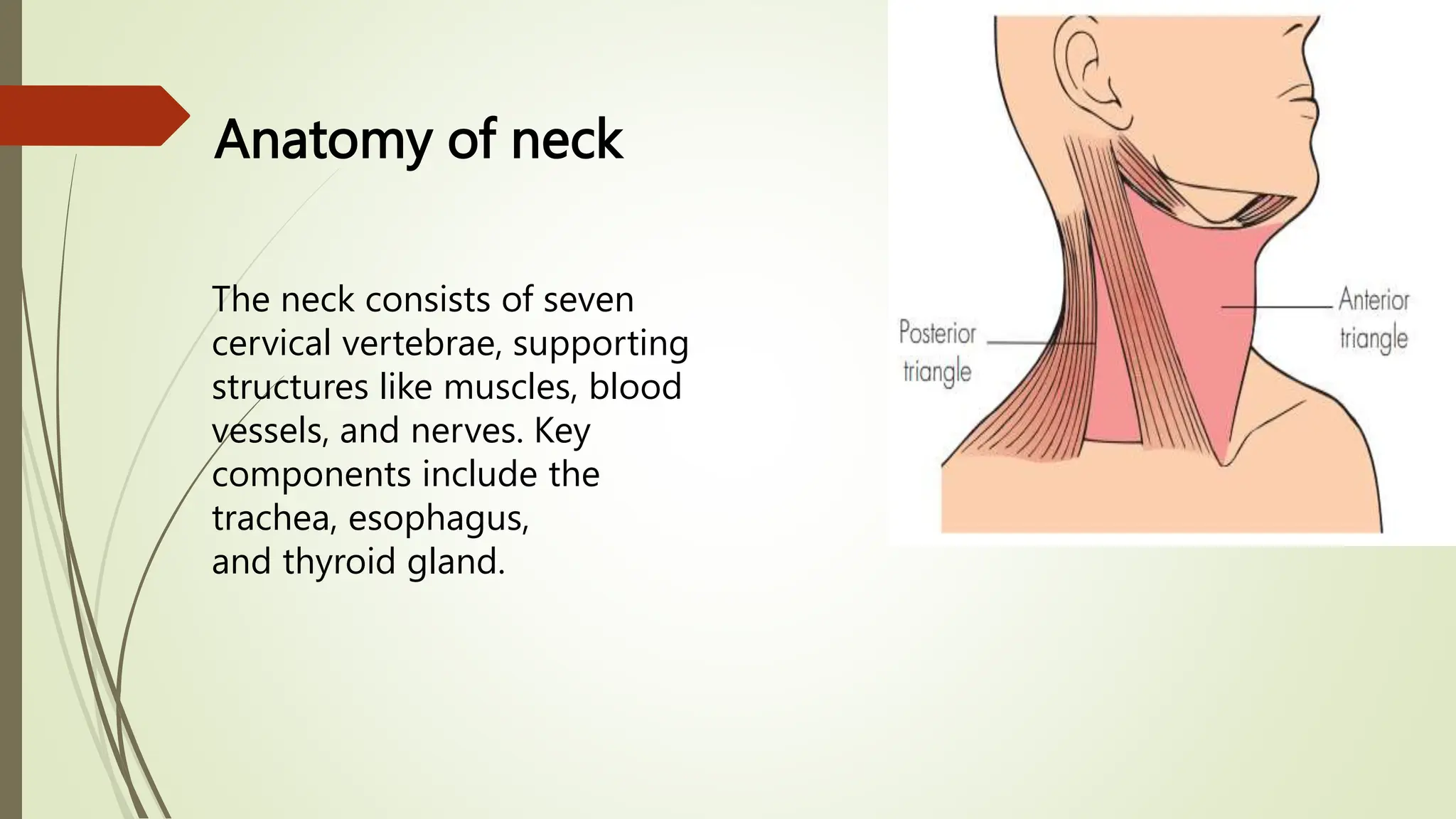
Anatomy of neck
The neck consists of seven
cervical vertebrae, supporting
structures like muscles, blood
vessels, and nerves. Key
components include the
trachea, esophagus,
and thyroid gland.
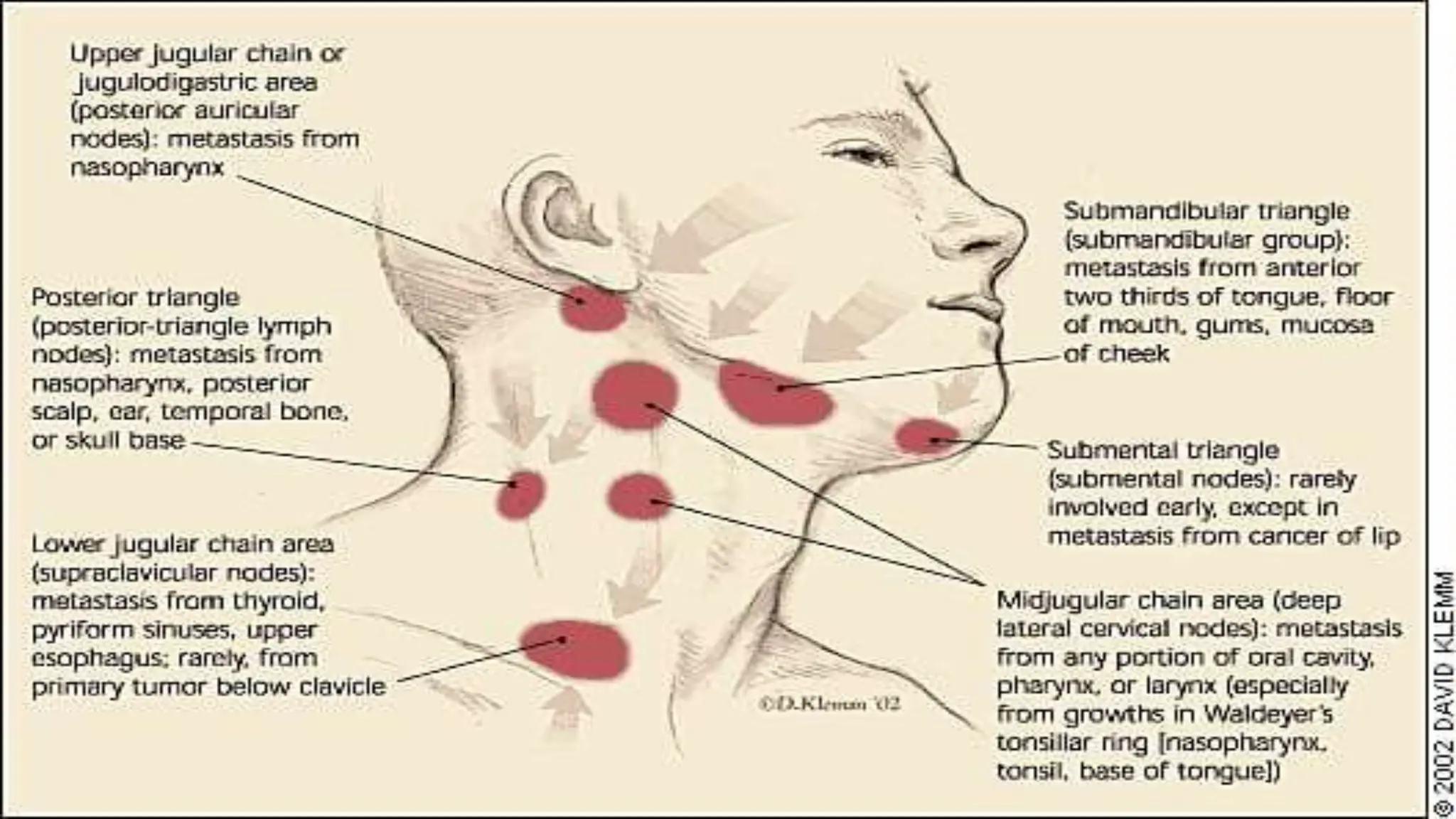
I. Submental and submandibular
nodes.
II. Upper third sternocleidomastoid
(SCM) muscle.
III. Middle third SCM (between hyoid
and cricoid.
IV. Lower third SCM (between cricoid
and clavicle).
V. Posterior to SCM (posterior
triangle).
VI. Midline from hyoid to
manubrium.
Cervical lymph node levels
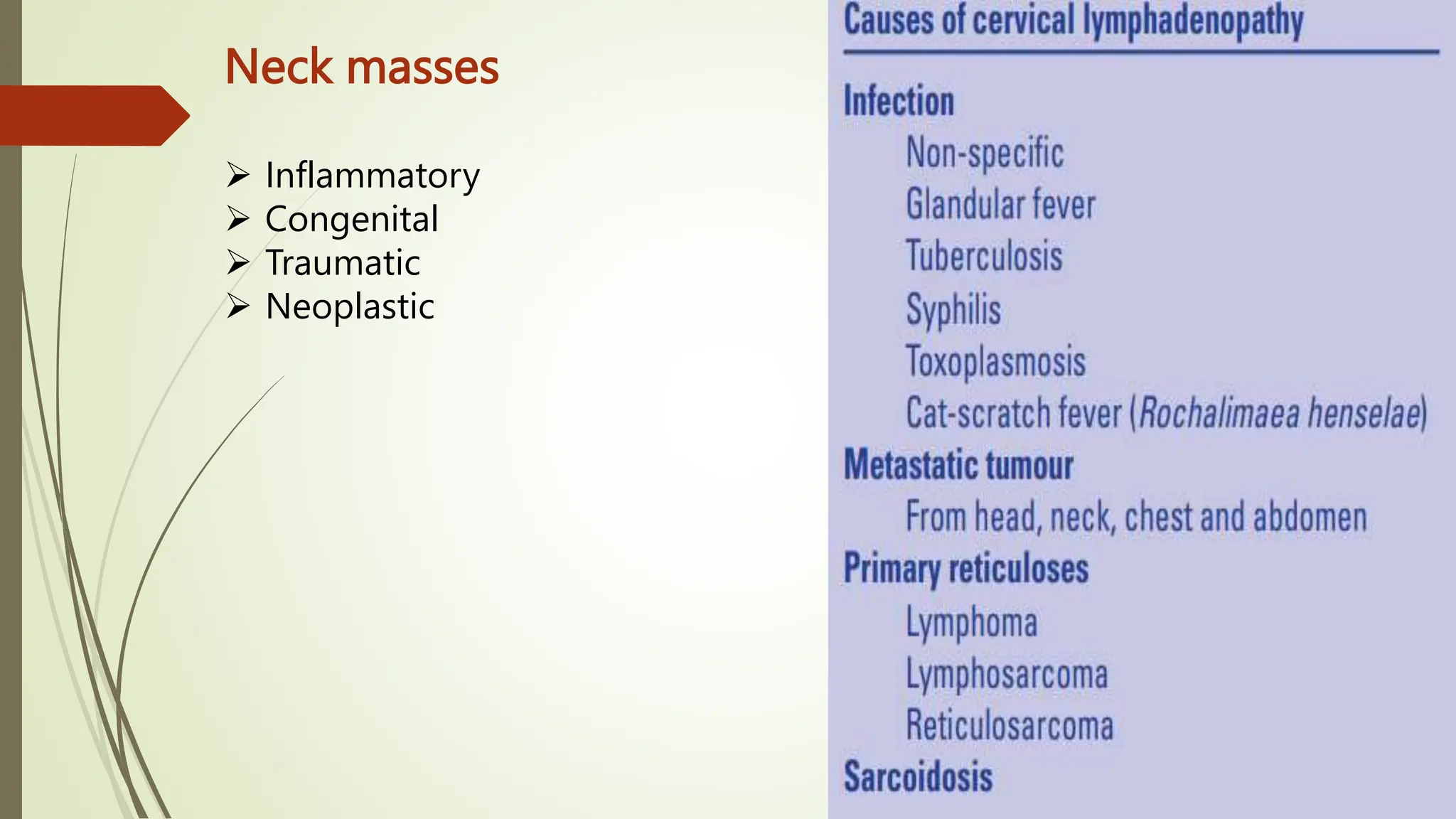
Neck masses
 Inflammatory
 Congenital
 Traumatic
 Neoplastic
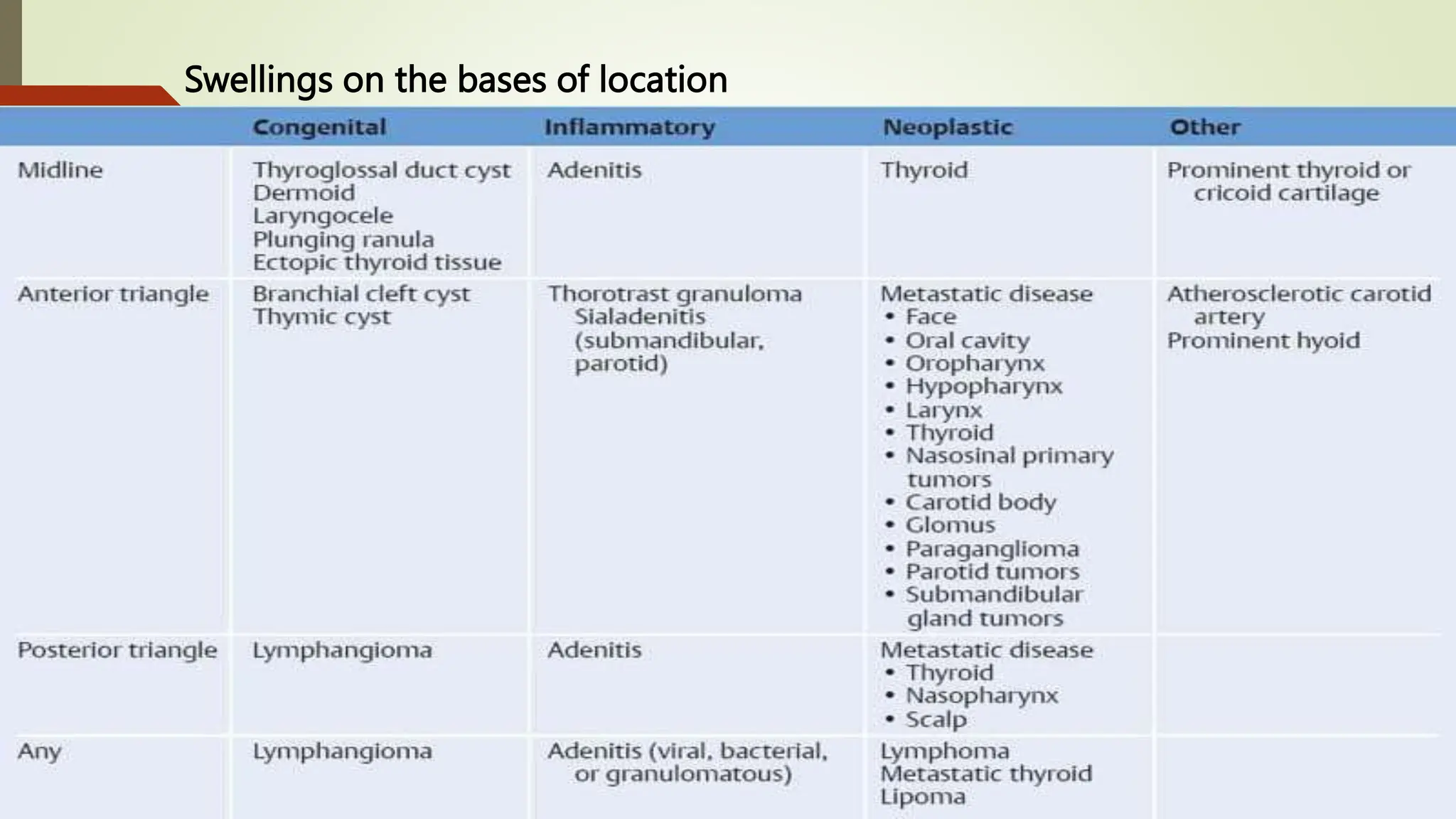
Swellings on the bases of location
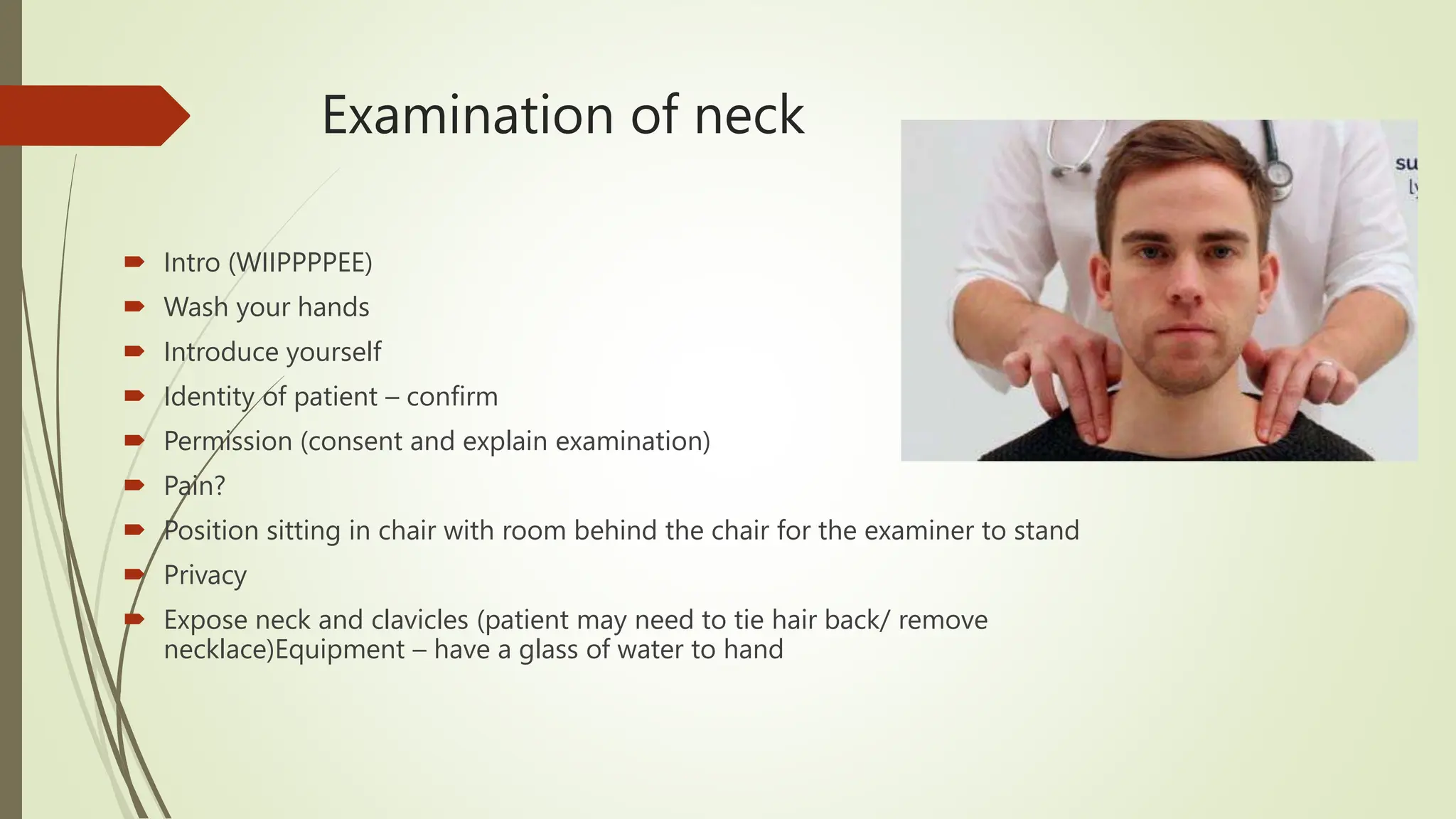
Examination of neck
 Intro (WIIPPPPEE)
 Wash your hands
 Introduce yourself
 Identity of patient – confirm
 Permission (consent and explain examination)
 Pain?
 Position sitting in chair with room behind the chair for the examiner to stand
 Privacy
 Expose neck and clavicles (patient may need to tie hair back/ remove
necklace)Equipment – have a glass of water to hand
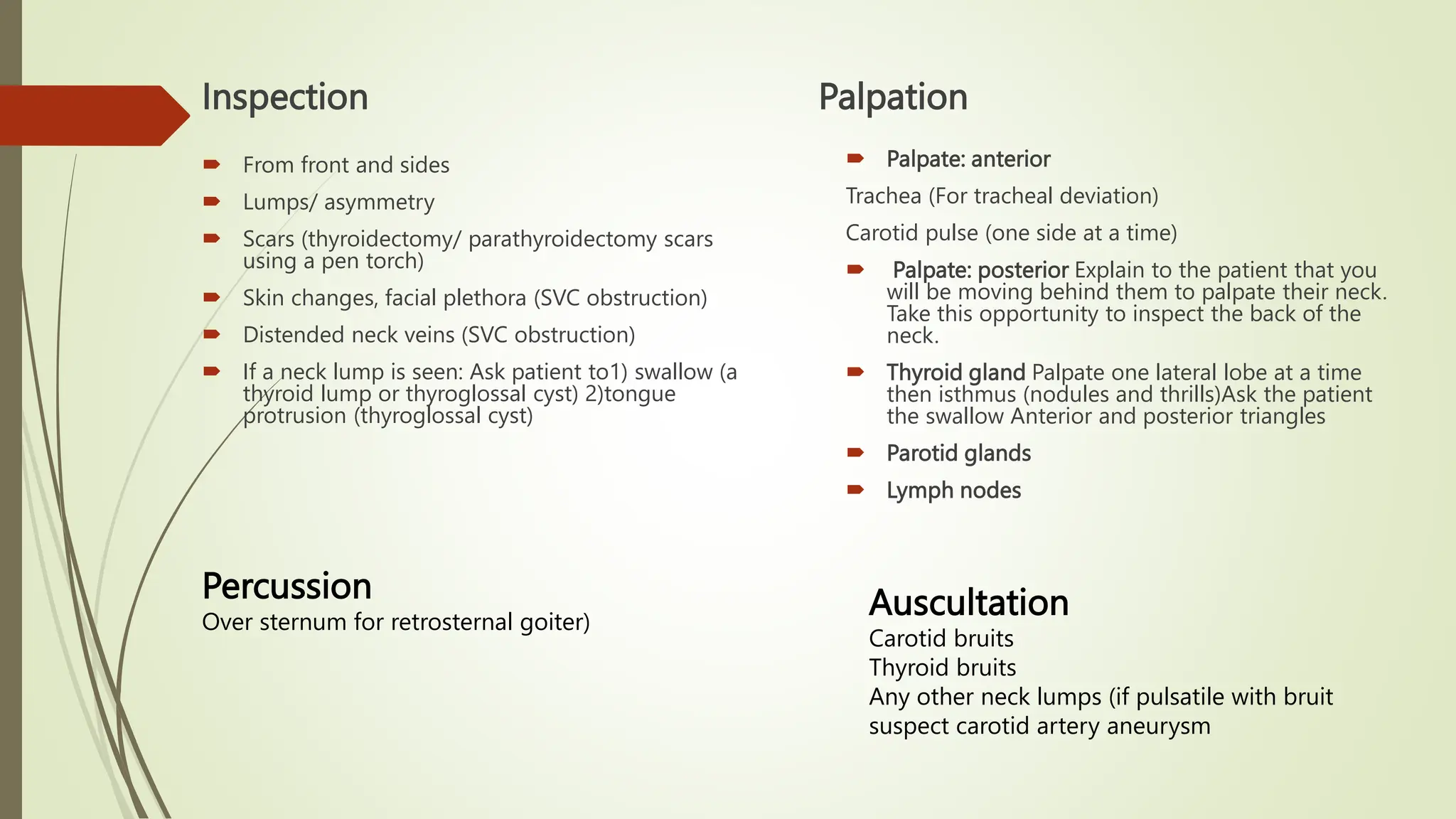
Inspection
 From front and sides
 Lumps/ asymmetry
 Scars (thyroidectomy/ parathyroidectomy scars
using a pen torch)
 Skin changes, facial plethora (SVC obstruction)
 Distended neck veins (SVC obstruction)
 If a neck lump is seen: Ask patient to1) swallow (a
thyroid lump or thyroglossal cyst) 2)tongue
protrusion (thyroglossal cyst)
Palpation
 Palpate: anterior
Trachea (For tracheal deviation)
Carotid pulse (one side at a time)
 Palpate: posterior Explain to the patient that you
will be moving behind them to palpate their neck.
Take this opportunity to inspect the back of the
neck.
 Thyroid gland Palpate one lateral lobe at a time
then isthmus (nodules and thrills)Ask the patient
the swallow Anterior and posterior triangles
 Parotid glands
 Lymph nodes
Percussion
Over sternum for retrosternal goiter)
Auscultation
Carotid bruits
Thyroid bruits
Any other neck lumps (if pulsatile with bruit
suspect carotid artery aneurysm
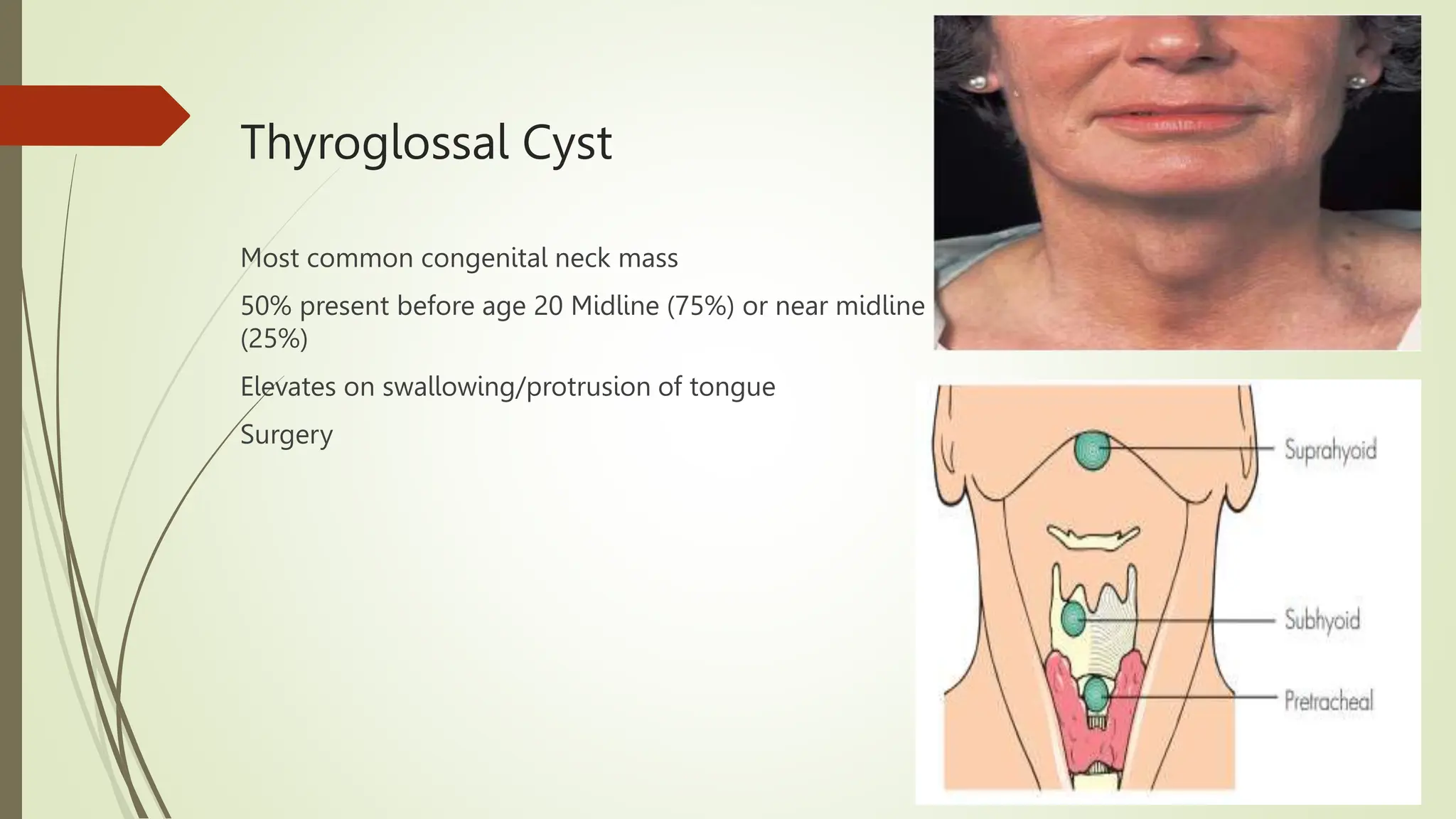
Thyroglossal Cyst
Most common congenital neck mass
50% present before age 20 Midline (75%) or near midline
(25%)
Elevates on swallowing/protrusion of tongue
Surgery
Branchial cyst
 Cystic mass
 Behind the anterior margin of the SCM muscle, below mandible
 Remnant of 2nd Branchial clefts
 Appear at any age (mostly 15-25)
 Painless swelling
 Hard, smooth, not very mobile
 Full of yellowish golden material, cholesterol crystals Can not be reduced or
compressed May have small sinus tract into tonsillar fossae No associated LAP
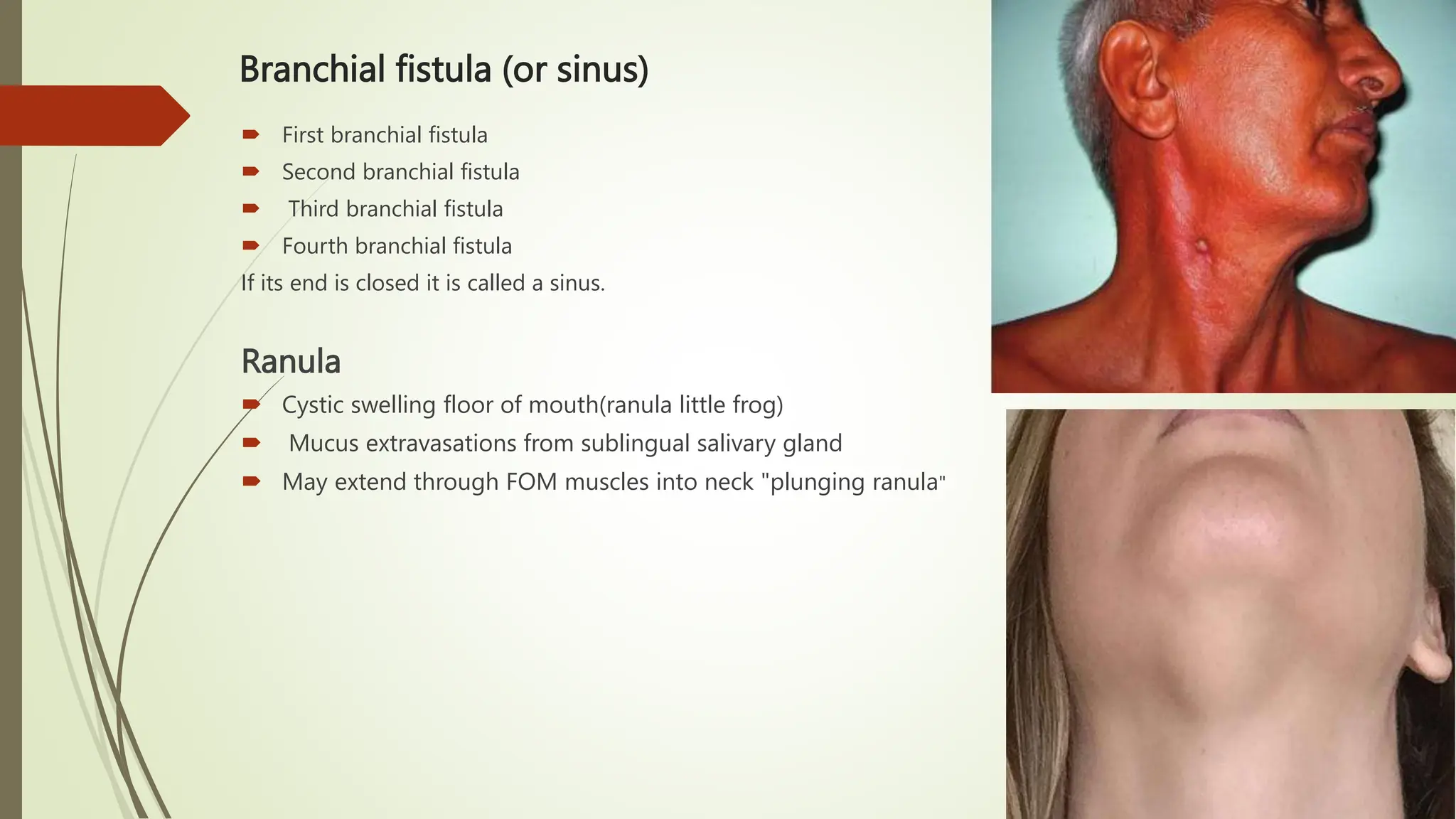
Branchial fistula (or sinus)
 First branchial fistula
 Second branchial fistula
 Third branchial fistula
 Fourth branchial fistula
If its end is closed it is called a sinus.
Ranula
 Cystic swelling floor of mouth(ranula little frog)
 Mucus extravasations from sublingual salivary gland
 May extend through FOM muscles into neck "plunging ranula"
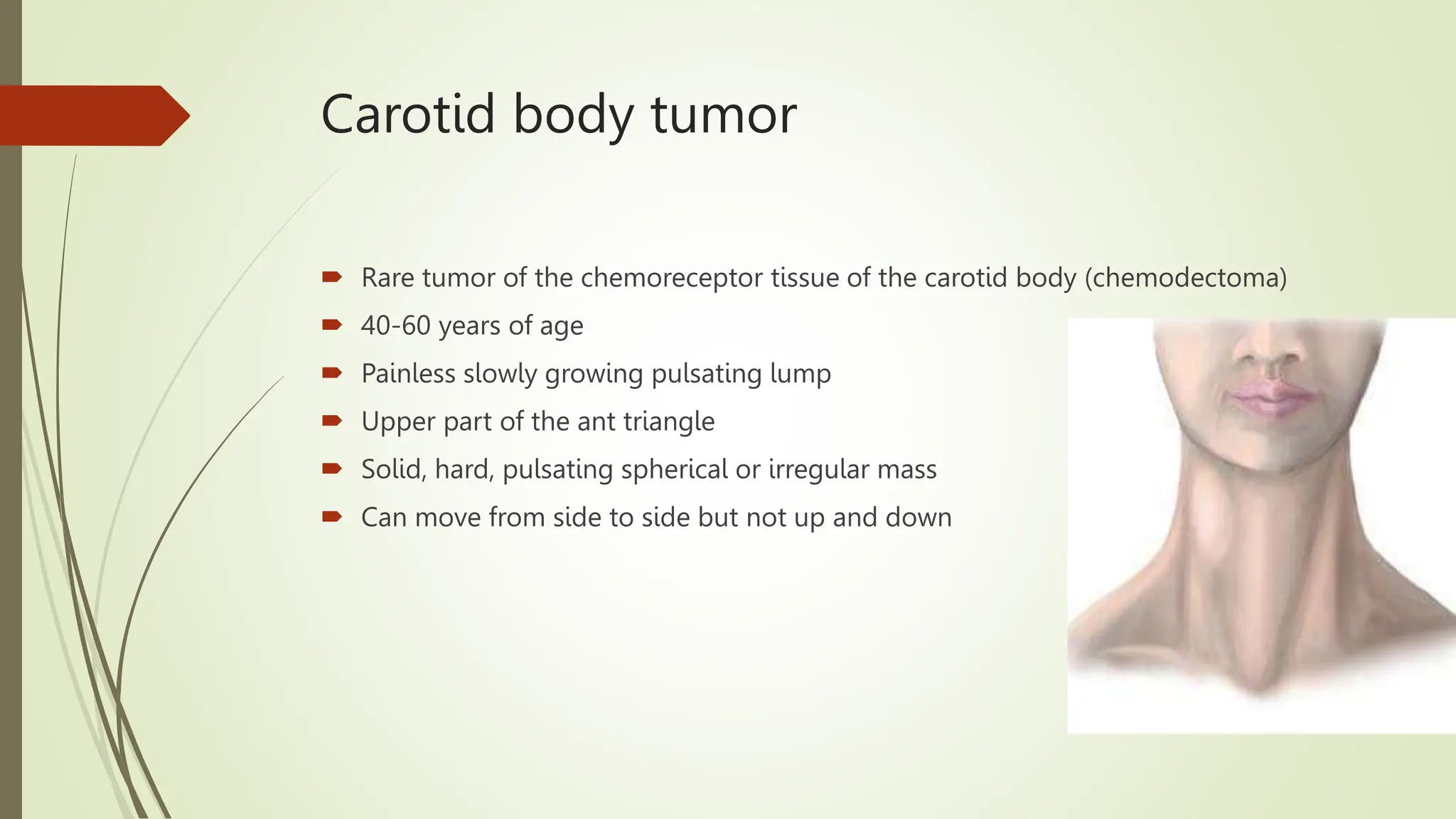
 Rare tumor of the chemoreceptor tissue of the carotid body (chemodectoma)
 40-60 years of age
 Painless slowly growing pulsating lump
 Upper part of the ant triangle
 Solid, hard, pulsating spherical or irregular mass
 Can move from side to side but not up and down
Carotid body tumor
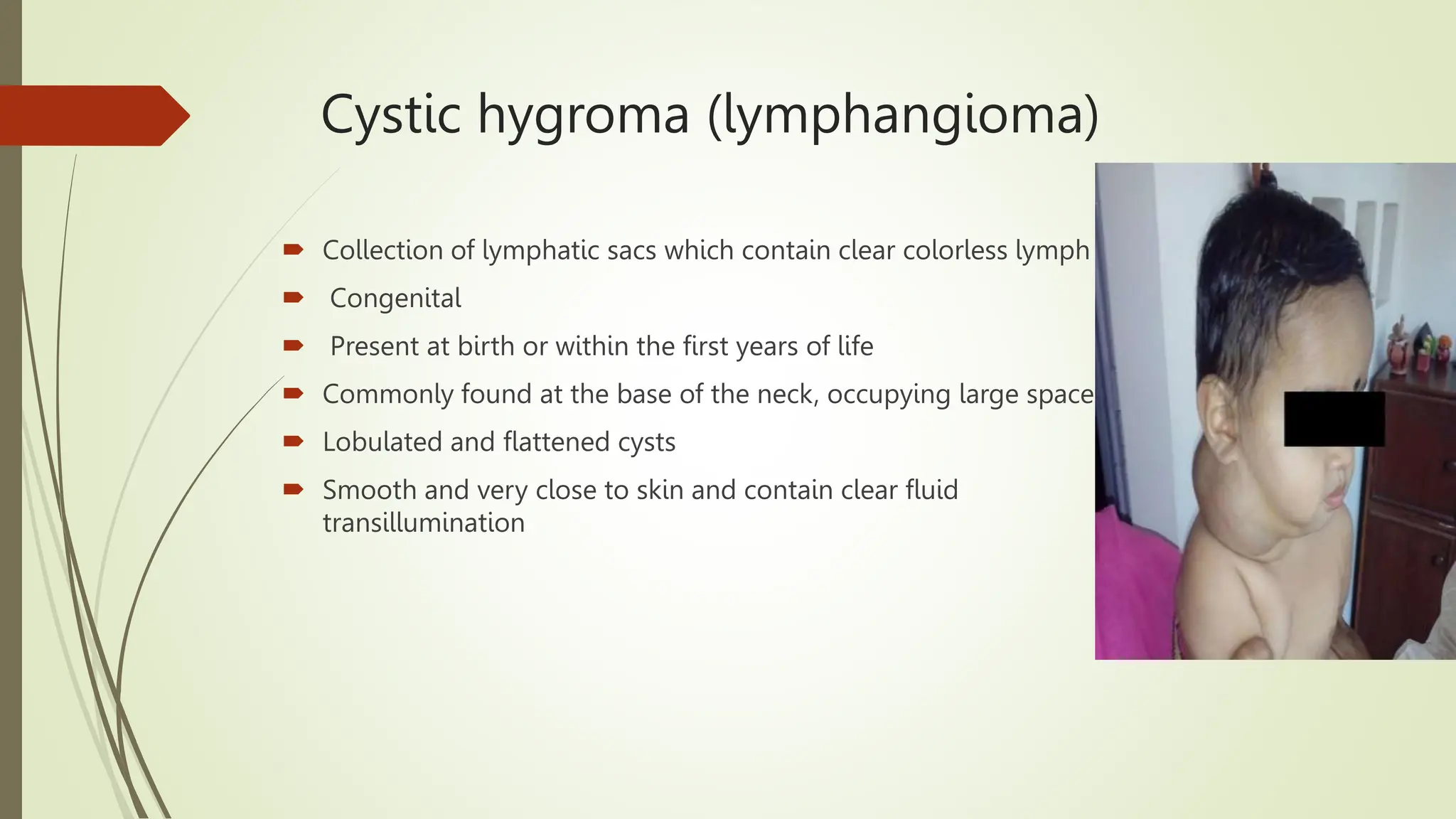
Cystic hygroma (lymphangioma)
 Collection of lymphatic sacs which contain clear colorless lymph
 Congenital
 Present at birth or within the first years of life
 Commonly found at the base of the neck, occupying large space
 Lobulated and flattened cysts
 Smooth and very close to skin and contain clear fluid
transillumination
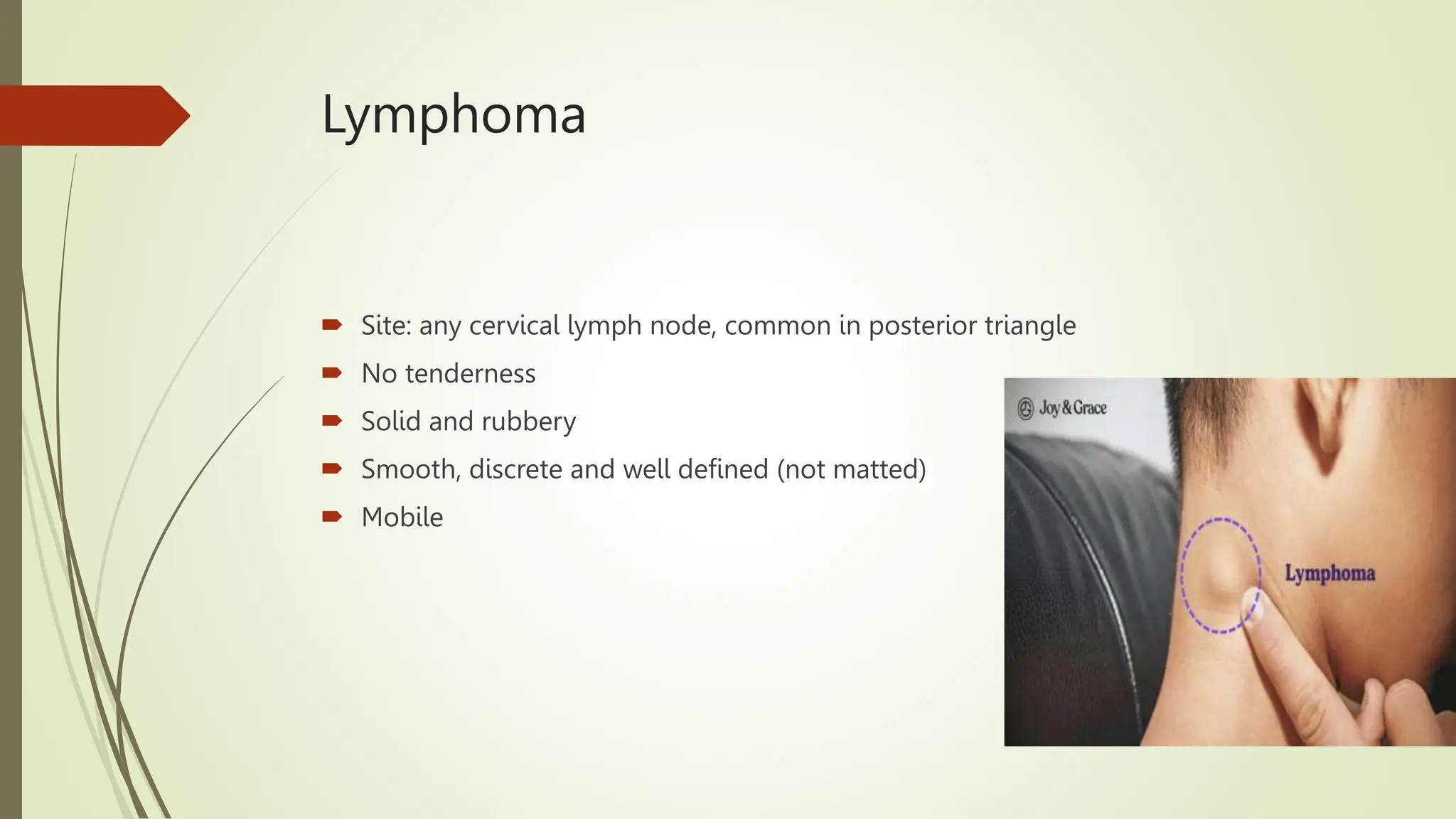
Lymphoma
 Site: any cervical lymph node, common in posterior triangle
 No tenderness
 Solid and rubbery
 Smooth, discrete and well defined (not matted)
 Mobile
Investigations
 Blood test
 Ultrasound
 Xray
 CT scan
 FNAC
 Thyroid function test
neck exam.pptx cervical lymph node examination

neck exam.pptx cervical lymph node examination

  • 1.
  • 2.
    Anatomy of neck Theneck consists of seven cervical vertebrae, supporting structures like muscles, blood vessels, and nerves. Key components include the trachea, esophagus, and thyroid gland.
  • 3.
    I. Submental andsubmandibular nodes. II. Upper third sternocleidomastoid (SCM) muscle. III. Middle third SCM (between hyoid and cricoid. IV. Lower third SCM (between cricoid and clavicle). V. Posterior to SCM (posterior triangle). VI. Midline from hyoid to manubrium. Cervical lymph node levels
  • 5.
    Neck masses  Inflammatory Congenital  Traumatic  Neoplastic
  • 6.
    Swellings on thebases of location
  • 8.
    Examination of neck Intro (WIIPPPPEE)  Wash your hands  Introduce yourself  Identity of patient – confirm  Permission (consent and explain examination)  Pain?  Position sitting in chair with room behind the chair for the examiner to stand  Privacy  Expose neck and clavicles (patient may need to tie hair back/ remove necklace)Equipment – have a glass of water to hand
  • 9.
    Inspection  From frontand sides  Lumps/ asymmetry  Scars (thyroidectomy/ parathyroidectomy scars using a pen torch)  Skin changes, facial plethora (SVC obstruction)  Distended neck veins (SVC obstruction)  If a neck lump is seen: Ask patient to1) swallow (a thyroid lump or thyroglossal cyst) 2)tongue protrusion (thyroglossal cyst) Palpation  Palpate: anterior Trachea (For tracheal deviation) Carotid pulse (one side at a time)  Palpate: posterior Explain to the patient that you will be moving behind them to palpate their neck. Take this opportunity to inspect the back of the neck.  Thyroid gland Palpate one lateral lobe at a time then isthmus (nodules and thrills)Ask the patient the swallow Anterior and posterior triangles  Parotid glands  Lymph nodes Percussion Over sternum for retrosternal goiter) Auscultation Carotid bruits Thyroid bruits Any other neck lumps (if pulsatile with bruit suspect carotid artery aneurysm
  • 10.
    Thyroglossal Cyst Most commoncongenital neck mass 50% present before age 20 Midline (75%) or near midline (25%) Elevates on swallowing/protrusion of tongue Surgery
  • 11.
    Branchial cyst  Cysticmass  Behind the anterior margin of the SCM muscle, below mandible  Remnant of 2nd Branchial clefts  Appear at any age (mostly 15-25)  Painless swelling  Hard, smooth, not very mobile  Full of yellowish golden material, cholesterol crystals Can not be reduced or compressed May have small sinus tract into tonsillar fossae No associated LAP
  • 12.
    Branchial fistula (orsinus)  First branchial fistula  Second branchial fistula  Third branchial fistula  Fourth branchial fistula If its end is closed it is called a sinus. Ranula  Cystic swelling floor of mouth(ranula little frog)  Mucus extravasations from sublingual salivary gland  May extend through FOM muscles into neck "plunging ranula"
  • 13.
     Rare tumorof the chemoreceptor tissue of the carotid body (chemodectoma)  40-60 years of age  Painless slowly growing pulsating lump  Upper part of the ant triangle  Solid, hard, pulsating spherical or irregular mass  Can move from side to side but not up and down Carotid body tumor
  • 14.
    Cystic hygroma (lymphangioma) Collection of lymphatic sacs which contain clear colorless lymph  Congenital  Present at birth or within the first years of life  Commonly found at the base of the neck, occupying large space  Lobulated and flattened cysts  Smooth and very close to skin and contain clear fluid transillumination
  • 15.
    Lymphoma  Site: anycervical lymph node, common in posterior triangle  No tenderness  Solid and rubbery  Smooth, discrete and well defined (not matted)  Mobile
  • 16.
    Investigations  Blood test Ultrasound  Xray  CT scan  FNAC  Thyroid function test