Surgical Aspect
Of Neck Lump
• Compartments
1. Visceral Compartment
• Endocrine Gland (Thyroid & Parathyroid)
• GIT (Pharynx & Esophagus)
• Respiratory System
2. Two Vascular Compartment
• Major Blood Vessels (Common Carotid Artery & Jugular Vein + Vagus Nerve)
3. Vertebral Compartment
• Cervical Vertebrae
• Spinal Cord
• Cervical Nerves
• Muscle Associated With Vertebral Column
• Fascia Of The Neck
1. Superficial Fascia (Platysma)
2. Deep Cervical Fascia
• Investing Layer
• Pre-Vertebral Layer
• Pre-Tracheal Layer
• Carotid Sheaths
• Triangles
1. Anterior (SCM, Mandible Bone & Midline Of The Neck)
• Sub-Muntal (Hyoid Bone, Anterior Belly Of Digastric Muscle & Midline Of The Neck)
# Sub-Mental Lymph Nodes
# Anterior Jugular Veins
• Sub-Mandible (Mandible, Anterior & Posterior Bellies Of Digastric Muscle)
# Sub-Mandibular Salivary Gland
# Facial Blood Vessels
# Sub-Mandibular Lymph Nodes
• Carotid (Antero-Inferiorly Superior Belly Of Omo-Hyoid Muscle, Superiorly Stylo-Hyoid
Muscle & Posterior Belly Of Digastric Muscle & Posteriorly SCM)
# Carotid Artery & Internal Jugular Vein
# Vagus Nerve (X), Glossopharyngeal Nerve (IX) & Hypoglossal Nerve (XII)
# Deep Cervical Lymph Nodes
• Muscular (Hyoid Bone, Superior Belly Of Omo-Hyoid Muscle, SCM & Midline)
# Infra-Hyoid Muscles
# Pharynx
# Thyroid & Parathyroid Glands
2. Posterior (SCM, Trapezius Muscle & Middle 3rd Of Clavicle)
# Splenius Capitis
# Levator Scapulae
# Scalenus Posterior
# Scalenus Medius
# Scalenus Anterior
Anatomy Of The Neck
-
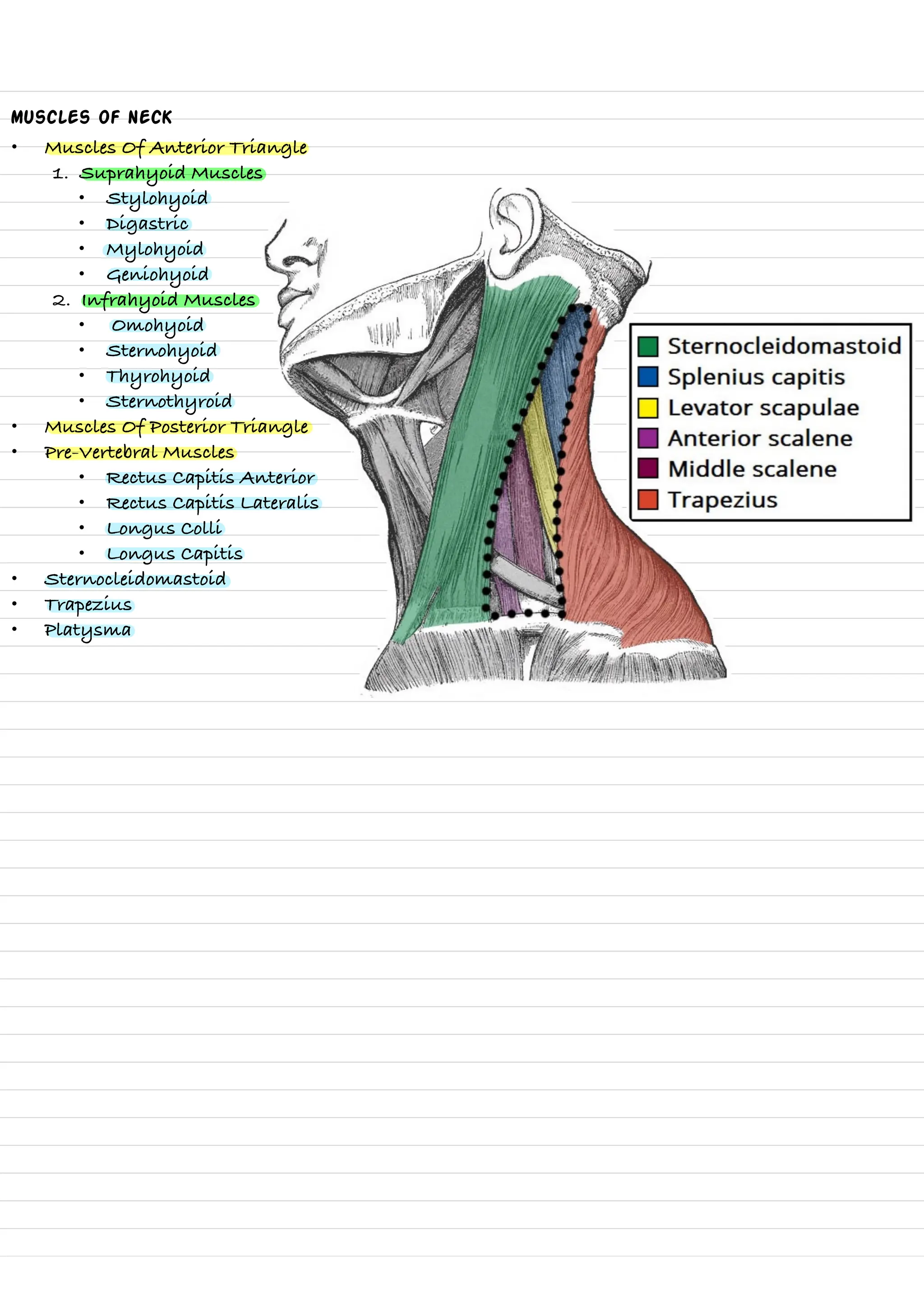
• Muscles Of Anterior Triangle
1. Suprahyoid Muscles
• Stylohyoid
• Digastric
• Mylohyoid
• Geniohyoid
2. Infrahyoid Muscles
• Omohyoid
• Sternohyoid
• Thyrohyoid
• Sternothyroid
• Muscles Of Posterior Triangle
• Pre-Vertebral Muscles
• Rectus Capitis Anterior
• Rectus Capitis Lateralis
• Longus Colli
• Longus Capitis
• Sternocleidomastoid
• Trapezius
• Platysma
muscles of neck
-
-
-
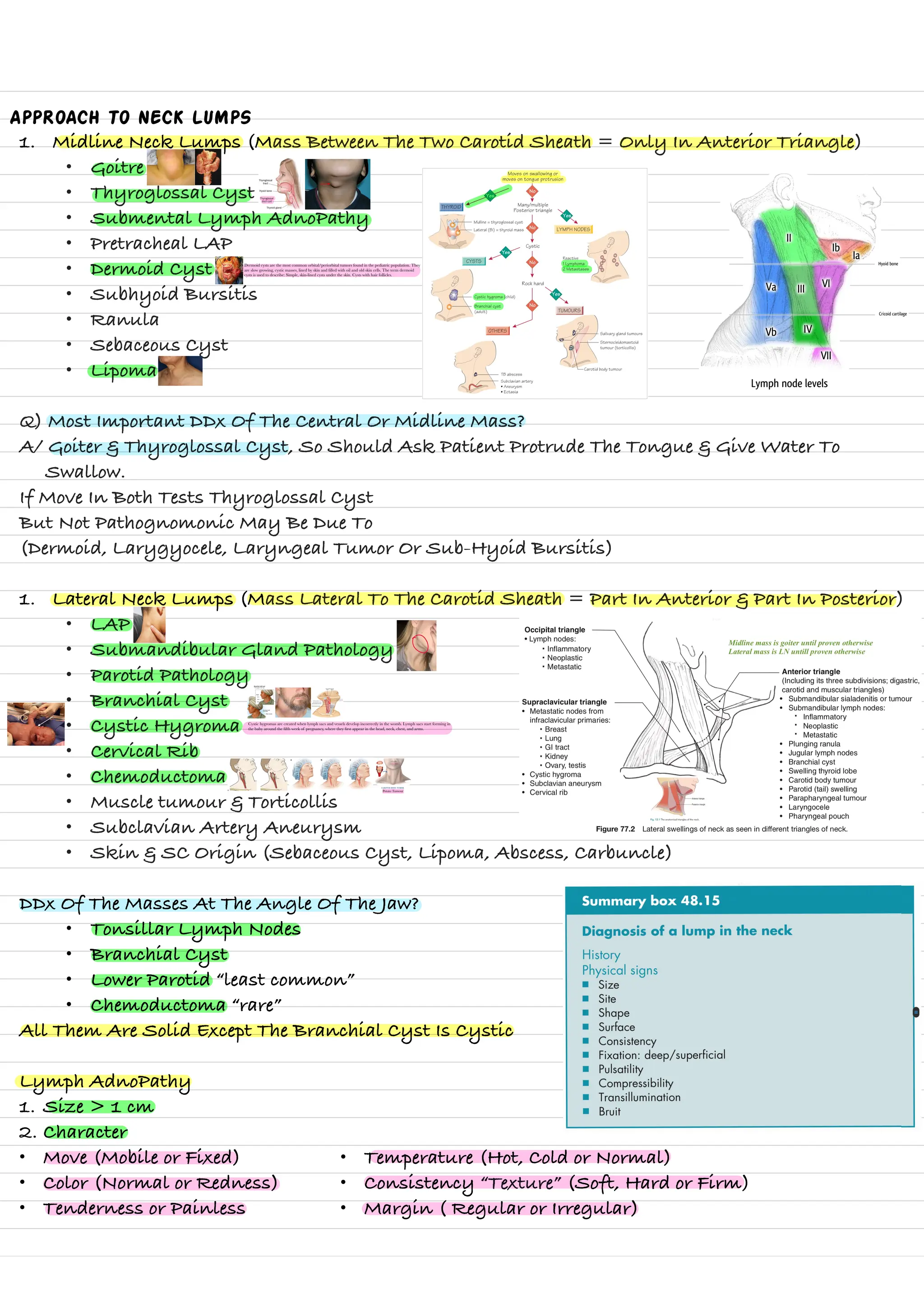
APPROACH TO NECK LUMPS
1. Midline Neck Lumps (Mass Between The Two Carotid Sheath = Only In Anterior Triangle)
• Goitre
• Thyroglossal Cyst
• Submental Lymph AdnoPathy
• Pretracheal LAP
• Dermoid Cyst
• Subhyoid Bursitis
• Ranula
• Sebaceous Cyst
• Lipoma
Q) Most Important DDx Of The Central Or Midline Mass?
A/ Goiter & Thyroglossal Cyst, So Should Ask Patient Protrude The Tongue & Give Water To
Swallow.
If Move In Both Tests Thyroglossal Cyst
But Not Pathognomonic May Be Due To
(Dermoid, Larygyocele, Laryngeal Tumor Or Sub-Hyoid Bursitis)
1. Lateral Neck Lumps (Mass Lateral To The Carotid Sheath = Part In Anterior & Part In Posterior)
• LAP
• Submandibular Gland Pathology
• Parotid Pathology
• Branchial Cyst
• Cystic Hygroma
• Cervical Rib
• Chemoductoma
• Muscle tumour & Torticollis
• Subclavian Artery Aneurysm
• Skin & SC Origin (Sebaceous Cyst, Lipoma, Abscess, Carbuncle)
DDx Of The Masses At The Angle Of The Jaw?
• Tonsillar Lymph Nodes
• Branchial Cyst
• Lower Parotid “least common”
• Chemoductoma “rare”
All Them Are Solid Except The Branchial Cyst Is Cystic
Lymph AdnoPathy
1. Size > 1 cm
2. Character
• Move (Mobile or Fixed)
• Color (Normal or Redness)
• Tenderness or Painless
• Temperature (Hot, Cold or Normal)
• Consistency “Texture” (Soft, Hard or Firm)
• Margin ( Regular or Irregular)
Dermoid cysts are the most common orbital/periorbital tumors found in the pediatric population. They
are slow growing, cystic masses, lined by skin and filled with oil and old skin cells. The term dermoid
cysts is used to describe: Simple, skin-lined cysts under the skin. Cysts with hair follicles.
Cystic hygromas are created when lymph sacs and vessels develop incorrectly in the womb. Lymph sacs start forming in
the baby around the fifth week of pregnancy, where they first appear in the head, neck, chest, and arms.
Potato Tumour
CERVICAL LAP
1. AETIOLOGY
• Acute Infections (Viral-Bacterial)
• Chronic Infections
# TB
# Toxoplasmosis
# Cat Scratch Disease
# Leshmaniasis
• Primary Tumours (NHL “Non-Hodgkin Lymphoma” & HL “Hodgkin Lymphoma”)
• Secondaries (LN Metastasis)
• Others (Necrotizing Lymphadenitis)
2. Examination Including Oral Cavity, Lips, Tongue, Salivary Glands, Scalp & Thyroid Gland
Chest, Breast & Abdomen For Lumps & Organomegaly
3. A Trial Of 2 wk Of Antibiotics Is Worthy
—> No Response Within One Week But The Condition Aggravate
4. So Here Do Investigation
• Lab
# CBC
— Lymphocytosis & Neutrophilia —> Simple Infection (Viral Or Bacteria)
— Low Platelet & Hb —> Leukaemia
# ESR Very High —> Malignancy
# Blood Film Search For Blast Cells —> Malignancy
• So Next Step Is Bone Marrow Aspiration& Biopsy To Confirm The Diagnosis
• Imaging
# US (Destructed Hilum, Stiffness On Elastogram, Calcification, Size & Heterogeneous)
— Features Of Malignancy (If Present Send For FNAC)
• Heterogeneity
• Necrosis Inside
• Cystic Degeneration (Hypoechoic Hilum)
• Irregular Margin
• Calcification
• Invasion To Surrounding Structures
• Hard On Elastogram
# CXR To Exclude Lung & Mediastinal Tumours
• Biopsy (IF There Features Of Malignancy) “Fine Needle Aspiration Cytology (FNAC)”
# Primary Tumours
— Lymphocytes —> Excisional Biopsy
(NHL Or HL “Chemotherapy Or Radiotherapy” Or Caseating Granuloma “Anti-TB”)
# Secondary Tumours
— Squamous Cell —> Panendoscopy With Multiple Biopsies From Upper Airodigestive
Tract, Bronchoscopy, Mammography & CXR (For Lung CA)
— Papillary Cell —> Total Thyroidectomy With MRND
— Glandular (Adenoid) Cell —> Upper/Lower Endoscopy & CT Scan Of Chest/Abdomen
suspected
FNAC Cannot Differentiate Malignant From Benign Lymphocytes (Called Negative FNAC )
Modified Radical Neck Dissection (Removal Of All Neck Lymph Nodes)
Indicates Metastasis Commonly From The Glandular GIT (Stomach, Colon, Pancreas & Biliary System) Or Less Common from Lung Adenocarcinoma Or Breast (Ductal Carcinoma)
- Infection [Acute
Chronic
2 - Tumour Prim - CHL , NHL
[ second (Metast-
size
Type Of Biopsy In General:-
1. FNAC (Collect Spare Cells)
• Less Sensitivity
• Lesser Trauma If Area Rich In Vital Structures
2. True Cut Biopsy (Piece Of Tissue Picked Out)
• More Sensitive & Specific
• Can Not Be Done In The Neck There Are Vital Structures
3. Incisional Biopsy
• Part From Tumour & Part From Normal Tissue
4. Excisional Biopsy (Gold Standard)
• Excise The Whole Node With Its Capsule
• Fistula > Sinus > Cyst
• Types
1. Congenital “Lower 3rd Of SCM” (Commonly Anomaly 2nd Branchial Cleft
Less Commonly 1st Cleft Anomaly
Least Is 3rd Cleft Anomaly
4th Cleft Anomaly Is Quite Rare)
2. Acquired “Upper 3rd Of SCM” (Induce By Surgery Or Drainage)
• Fixed To Upper 3rd Of SCM
• usually Unilateral 90% & In Middle Age Group
• Dx.
# Trans-illumination Test —> -ve
# Imaging
1. If Fistula (Fistulogram “X-Ray + Contrast” Or CT + Contrast)
2. If Sinus (Sinogram “X-Ray + Contrast” Or CT + Contrast)
3. If Cyst (US “Cystic Lesion & Size > 4 cm”, CT Scan & MRI)
# Biopsy (FNAC) — Dirty Fluid With Cholesterol Crystals
• Treatment (Complete Excision To Avoid Recurrence)
• Complications
# Injury To Carotid Vessels
# Internal Jugular Vein
# Hypoglossal Nerve (Tongue Deviation To The Same Side, If Baby Dropping Of Milk)
# Marginal Mandibular Nerve (Incision Should Be 2-3 cm Below The Angle Of The Jaw)
• Congenital Anomaly Of Lymphatic System
• Occur In All Sites Of LN Special In Posterior Triangle Of Neck, Oral Cavity, Face, Groins &
Axillae
• Commonly Before 2 yrs Age (90%), It May Obstruct Labour Or Appears Later In Life
• Single Or Multi-Cystic Mass Containing Usually Clear Fluid (Lymph)
BRANCHIAL CLEFT ANOMALIES
DDx Of The Masses At The Angle Of The Jaw?
1. If Cyst (Soft To Firm)
• Branchial Cyst
2. If Sold
• Tonsillar Lymph Nodes
• Lower Parotid “least common”
• Chemoductoma “rare”
Age At Birth But Cause Symptoms In Adult Life (Between 15-25 yrs) But Can Present In Childhood Or In 40 Or 50
CYSTIC HYGROMA
• Dx (Clinical Dx.)
# Soft Fluctuating Compressible & +ve Transillumination Test
# To See The Extension & To Know The Anatomy
1. US
2. CT Scan + Oral Contrast
3. MRI
• Rx.
# If Not Sit On Vital Organ (Carotid Artery, Facial & Accessory Nerve) —> Surgical Resection
# If Sit On Vital Organ —> Partial Excision With Ablation Remaining Part By
(Electrocuttery, Pure Alcohol Or OK-432)
What Is The Cases That +ve Transilluminated Test?!
1. Cystic Hygroma
2. Epidydimal Cyst
3. Vaginal Hydrocele
• Rare Benign Tumour Of Carotid Body Cells
• Sometimes Called Potato Tumour, Glomus Tumour or Paraganglioma
• Affects Elderly People
• Firm Or Hard Mobile From Side To Side But Not Vertically
• Dx.
# US (Hyperechoiec “Hypervascular”)
# CT Angio (CT Scan + Contrast)
• Rx.
# Surgical Excision +/- Arterial Shunt
• Complications
# Carotid Injury Lead To CVA
# Hypoglossal, Marginal Mandibular & Vagus Nerves Injuries
• Most Patients Are Asymptomatic 90%
• Usually Felt As Hard Mass In The Posterior Triangle Of The Neck
• It May Presents As Thoracic Outlet Syndrome
• Dx.
# CXR
# CT-Scan
• Rx
# Conservative
# Excision Only In Symptomatic Patients
Carotid Body Contains Chemoreceptors That Sense The Changes In (PH, O2 & CO2)
Carotid Sinus Contains Stretch Receptors That Sense The Changes In (Blood Volume)
Hoarseness Of Voice (Recurrent Laryngeal Nerve Is A Branch Of Vagus)
CHEMODUCTOMA
CERVICAL RIB
Thoracic outlet syndrome (TOS) is a term that refers to three
related syndromes involving compression of the nerves,
arteries, and veins in the lower neck and upper chest area.
This compression causes pain in the arm, shoulder, and neck.
from 16 or 7
• Congenital Anomaly Of The Thyroglossal Duct That Starts From Foramen Caecum To Thyroid
Gland Passing Behind Hyoid Bone, Rarely In Front Or Even Through It
• Never Ever Become Fistula As Tongue Develop After Thyroid Descent Is Complete
• Children < 10 Years Are Affected In 90% Of Cases (Commonest Age Is 5 Years)
• Cyst Is Usually Juxta-Hyoid Commonly Infra-Hyoid (60-70 %)
• Diagnosis
# Clinic Dx.
1. Patient Should Be Sit On Armless Chair & Neck Slightly Extension
2. Ask Patient To Protrude The Tongue
3. Give Glass Of Water To Swallow
If Mass Move Upward In Both Test This Mean Thyroglossal Cyst
Mostly Clinical Dx. Is Enough But Can Do:
# Lab (Thyroid Function Test)
# Imaging
1. If Cyst U/S
2. If Sinus (Acquired) CT Scan, MRI & Sinogram
• Rx.
# Sistrunk Procedure (Surgical Excision Of The TG Cyst With Middle Part Of Hyoid Bone)
• Diseases Of Function (Hyper TSH < 0.25 uU/L vs Hypo TSH > 4.5 uU/L) TSH(0.25-4.5)
• Diseases Of Size Or Both (Function & Size)
• Others As Thyroiditis & Tumours
• Case Senior 2 Pt. Asymptomatic, Normal U/S & TSH of 1st Pt. > 4.5 & TSH Of 2nd Pt. < 2.5
Q) What Is Your Next Step?
• Give Thyroxine For 1st Pt. (1.4-2 Ug/kg) & Assess TSH After 35-40 Days
• Give Anti-Thyroid For 2nd Pt. (12-18M + CBC & LFT Every Month ) & Assess TSH After
35-40D After 12-18M Give Thyroxine To Prevent Goitre (Block & Replace)
• Hyperthyroidism Means Elevated TFT (+/- Clinical Features)
• Thyrotoxicosis Means Clinical Manifestation Of Elevated TFT
• Dx.
# Lab. (TFT “TSH & Free T4)
# Imaging (U/S)
THYROGLOSSAL CYST/SINUS
THYROID DISEASE
Clinical Features Of:
• Hyperthyroidism
1. Weight Loss With Increased Appetite
2. Heat Intolerance
3. Tremors
4. Palpitations
• Hypothyroidism
1. Weight Gain
2. Cold Intolerance
3. Skin (Dry, Thick & Cold)
4. Supra-Clavicular Fullness
5. Generalised Weakness & Fatigue
5. Tachycardia
6. Nervousness
7. Menstrual Irregularities (Hypomenorrhia Or Amenorrhoea)
8. Eye Signs (Lid Lag, Lid Retraction, Exophthalmos)
6. Change In Mood (Depression, Coma)
7. Bradycardia & Low Stroke Volume Pulse
8. Hypotonia & Hyporeflexia
9. Loss of Outer 3rd Of Eyebrows
8
• Diseases Of Size +/- Function Diseases (Toxic Or Not Toxic)
# Diffuse + Toxic = Grave’s Disease
# Solitary Nodule + Toxic = Toxic Adenoma
# Multi-Nodular + Toxic = Toxic MNG “Multi-Nodular Goiter” (Plummer’s Syndrome)
— Toxic Mean Hyper Function
— Not Toxic Mean Hypo Or Euo
• Dx.
# Lab.
• TFT (TSH & Free T4)
• Thyroid AB (Anti-ThyroGlobulin & Anti. TPO)
# Imaging
• U/S
1. Diffuse —> Graves Disease
2. Single —> Toxic Adenoma
3. Multinodular —> Toxic MNG
• Isotope Scan (Technetium-99 Dx., Iodine 123 Dx. & Iodine 131 Rx. & Dx.)
• CT Scan / MRI For Substernal Extension
# Biopsy (FNAC)
• Rx.
# Medical To Correct TSH
1. BB (Propranolol “Inderal” or Metaprolol) In Pt. With (Palpitation, Tremor, Sweating)
2. Antithyroid Drugs (Carbimazole or Methimazole)
SE (Liver Derangement & Aggranulocytosis)
3. PTU (Anti-Thyroid) Used In Pregnant & Lactating Women
# Surgical
1. STN —> Hemi-Thyroid-ectomy (Remove The Affected Lobe & Isthmus)
2. MNG —> Total or Near Thyroid-ectomy (Because Of High Recurrence Rate)
3. Graves —> Subtotal Or Total Or Near Total Thyroid-ectomy
# Radioactive Iodine
• Thyroid Tumor Markers
1. TG (Thyroid-Globulin)
2. Anti-Thyroid Antibodies
• Thyroid Antibodies
1. Anti-Thyroid Antibodies
2. Anti-TPO
• Indications Of Isotopes Scan:
1. Toxicity & Nodularity
2. Risk Of Malignancy
3. Post Operative To Look For Metastasis
4. Factitious Thyrotoxicosis
5. Ectopic Thyroid Hormone Secretion As In Struma Ovary
Solitary Toxic Nodule
Lab Test
• +ve TPO & TR Auto-Antibodies = Hashimoto’s Dis.
• +ve Anti-TG = Grave’s Dis.
Toxic MNG
Hot Nodular = Toxic Nodular (1% Malignant)
Cold Nodular = Mostly Malignant
• So Cold Nodular More Dangerous From Hot
VIS NTSH Normal ↓ TSH
To XiC
Adenoma
+ clothes
Q) When Does The Goiter Lose The Up & Down With Deglutition?
• Huge Goiter
• Malignant Goiter (Infiltration To Trachea, Esophagus Or Other)
• Retrosternal Goiter
Q) How Can Differentiate Between Tachycardia Of Hyper-Thyroidism & Anxiety?
• Tachycardia Due To Hyperthyroidism Persist During Sleep & with Other Symptoms
(Wight Loss With Good Appetite & Sweating, Hot Intolerance, Eye Signs & Other)
Q) What Are The Causes Of Dysphagia With Thyroid Disease?
A/ Because Of
• Retrosternal Goitre Compression On Esophagus
• Malignancy Infiltration To Esophagus
Q/ What Is The Deference Of AF Due To Hyperthyroidism From Other Causes?
• Persistent Atrial Fibrillation Or Not Responsive To Digoxin Mostly Hyperthyroidism
• Usually Occurs In Adolescents, Pregnant Ladies, Acromegaly, Gigantism & Patients In Areas
With Iodide-Poor Diet (Goitre Due To Elevated TSH “Trophic Hormone”)
• Dx.
# Lab
1. TFT (Slightly Elevated TSH)
2. Thyroid AB -ve (Anti-ThyroGlobulin & Anti. TPO)
# Imaging
1. U/S (Diffuse Goiter)
• Rx. (Gall Of Rx. Minimize TSH)
# Suppressive Dose Of Thyroxine 50-100 Ug/D (Stop When Disappear Goiter)
(This Not Replacement Dose This Is Supplement)
# Iodide-Rich Diet Is Advised
• Dx.
# Lab
1. TFT (Slightly Elevated TSH)
2. Thyroid AB -ve (Anti-ThyroGlobulin & Anti. TPO)
# Imaging
1. U/S ( Multi-Nodular Goiter)
2. Isotope Scan (If There Malignant Features In U/S)
3. CT-Scan Or MRI If The Symptoms Of Extension
# Biopsy
1. FNAC (If There Malignant Features In U/S)
• Rx.
# Medical (Size <1 cm & No Feature Of Malignant In U/S & FNAC) —> Rx. As Simple Goitre
# Surgical (Near-Total Or Total Thyroidectomy) In Cases:-
1. Suspicion Of Malignancy
2. Substernal Extension
3. Compressive Symptoms On Trachea Or Oesophagus
SIMPLE GOITRE
nMNG (Non Toxic Multi-Nodular Goitre)
4. Toxicity
5. Patient Wishes
Dyspnoea
Cough
Stridor
Dysphagia
+ve Pemberton’s Sign
HugeSee
Q) How Can You Dx The Retrosternal Goiter?
A/
1. Clinically:
• If Compression On Trachea (Dyspnoea, Cough & Stridor)
• If Compression On Oesophagus (Dysphagia)
• Pemberton’s Sign
2. Radiologically:
• Show A Soft Tissue Shadow In The Superior Mediastinum
DDx Of Weight Loss Despite Good Appetite?
1. Thyrotoxicosis
2. Diabetes Mellitus
3. Parasitic Infestation
4. Mal-Absorption Syndrome
5. Pheochromocytoma
6. Cancer
• Dx. As nMNG
• Rx
# Medical As nMNG
# Surgical
1. No Features Of Malignant Or -ve FNAC
— Hemi-Thyroid-Ectomy
2. Features Of Malignant Or +ve FNAC
— Total thyroidectomy Or Radical Thyroidectomy
• Thyroiditis In General Pass Through 4 Phases:
# 1st (Inflammation)
# 2nd (Return To Euthyroid)
• Acute (Bacterial & Very Rare)”Pass 4 Phases”
• Subacute “Either Pass 4 Phase Or Stop In Phase 3”
# Viral Or DeQuervain Thyroiditis
# Peripartum Thyroiditis
• Chronic “Stop In Phase 3”
# Hashimoto’s Thyroiditis
# Riedel’s Thyroiditis (Fibrosing Thyroiditis) Difficult To Differentiate From Malignancy
• Dx.
# Lab (TFT & Thyroid Antibodies “+ve TRAB & TPO)
# Imaging(U/S)
• RX.
# Steroids In Early Stages
# Antibiotics Antipyretic & Painkillers If Bacterial Infection
# Thyroxine If Chronic Or Hashimoto’s Thyroiditis
Features Of Malignant:
• Large Size
• Solid
• Hard In Consistency
• Fixity
• Associated LAP
• Associated Hoarseness Of Voice Or Dysphagia
• US Findings (Calcification, High Vascularity, Necrosis & Stiffness On Elastogram)
• FNAC (Suspicious Or Malignant)
nSTN (Non toxic solitary nodule)
THYROIDITIS
Rx.
1.Tamoxifen
2.Steroids & NSAIDs
3.Surgery (Isthmus-cetomy)
# 3rd (Hypothyroid)
# 4th (Resolution Of Inflammation & Return Euthyroid)
• Benign (Follicular & Hurthle’s Adenoma)
• Malignant
# Primary:
1. Differentiated (Papillary, Follicular & Medullary)
2. Anaplastic
3. Lymphoma
# Secondaries
• Papillary & Follicular Haven’t Stage 3 & 4 Only Stage
1 &2 If Age Of Pt. < 45 yrs
Ex. Female 35 yrs With Papillary
CA & Liver Metastasis = Stage 2
# Stage 1 Without Metastasis
# Stage 2 With Metastasis
• Rx Of Malignant Tumours (Radical Thyroidectomy)
• TNM Classification Of Tumour
# T1–4 Based On The Size (T4 Refers To The Infiltration Of Neighboring Organs)
# N stage
— N0 (No Lymph Node Involvement)
— N1–3 (Lymph Node Involvement)
# M stage
— M0 (No Distant Metastasis)
— M1 (Present Distant Metastasis)
— Mx (Unknown If Distant Metastasis Present Or Not)
• Complications Of Thyroid Surgery
1. Recurrent Laryngeal Nerve
# If Complete Unilateral Hoarseness & Bilateral Aphonia
# If Partial Unilateral Dyspnoia On Exertion & Bilateral Stridor
2. Parathyroids Gland (Hypocalcaemia Rx. “Vit D + Ca”)
3. Supraclavicular Nerve Injury
4. Sympathetic Trunk (Horner’s Syndrome)
5. Anesthesia Copm.
6. Hematoma
7. Wound Infection
8. Hypothyroidism (Rx, Life-Long Thyroxine)
THYROID TUMOURS
Good
Prognosis
Bad
Prognosis
• Action Of PTH ( Increase Serum Ca+2 & Decrease PO4)
# Bone
1. Increase Release Of Ca+2—> Increase Serum Ca+2
# GIT
1. Indirectly Increases Calcium Absorption
# Renal
1. Reabsorption Of Ca+2 & Excretion Of PO4 —> Serum Ca+2 & PO4
2. Stimulate The Formation Of Vitamin D
• Causes Of HPT
# Primary HPT
1. Adenoma (Single Benign Focus In The Gland)
2. Hyperplasia (All The Gland Is Enlarged)
3. Carcinoma
# Secondary HPT (Response To High Phosphate Or Low Ca)
1. CKD
2. Vitamin D Deficiency
3. Malabsorption
4. Drugs (Thiazides, Frusemide, Denosumab, Bisphonates, Anticonvulsants)
# Tertiary HPT
1. Hypocalcaemia
• Main Presentations Of HPT
• Dx.
# Lab
1. PTH (15-80)
2. Serum Ca, PO4 & ALP (Alkaline Phosphatase)
3. Urinary Ca & PO4
4. RFT
# Imaging
1. U/S
2. Isotope Scan (Sestemibi Scan)
3. CT Scan, MRI & PET Scan
• Rx.
# If Primary
1. Adenoma —> Excision Of Affected Gland(s)
2. Hyperplasia —> Subtotal or Total Parathyroidectomy + Autotransplantation
3. Carcinoma —> Radical Surgery (Total Parathyroidectomy, Autotransplantation,
Ipsilateral Hemithyroidectomy, Group 6 LN Dissection & Upper Thymus Gland)
# If Secondary
1. Treatment The Underline Cause
HYPERPARATHYROIDISM (HPT)
There Are 4 PTG
• 2 Superior Varies Position
• 2 Inferior Fixed Position
• Indicated in symptomatic patients with:
# High calcium level & high PTH
# Calcium phosphate product> 70
# Soft tissue calcification
# Renal osteodystrophy
#Calciphylaxis
Thyroxine
Q1) Theme: NECK LUMPS
A. Banchial cyst
B. Carotid body tumour
C. Cystic hygroma
D. Demoid cyst
E. Ludwig's angina
F. Lymphoma
Scenarios:
1- A 2 year old girl develops a slow growing swelling in the neck that involves whole anterior & posterior
triangles. On exam, it is compressible, somewhat reducible, fluctuant & not tender.
2- A 67 years old male with a left supralavicular mass that is slowly growing over the past two years. On exam,
it is firm, nontender, moving with skin with a central pit over it.
3- An eight years old boy presents with chewing difficulty & a painful preauricular lump that appeared after a
short flu-like illness 2 days earlier. On exam, the lump is tender. His younger brother has similar illness the
week before.
4- A 28 year old woman notices that there is a lump in front of her neck. She is easily irritable and has warm,
sweaty palms and a resting tachycardia.
5- A 6 year old boy presents with a painful diffuse swelling of the neck which started below the mandible and
extends down to the level of the clavicle. The swelling is tender and indurated and causes him difficulty with
his breathing.
6- A 16 year old boy presents with a painless, midline swelling of the neck the swelling moves up with
swallowing. It is firm and nontender. He reported it is increasing in size with upper respiratory tract infections.
7- A 6 months old baby is brought by his parents with a left neck mass that was there since birth and doesn't
change in size. On exam. It is firm and not tender. The baby's neck is tilted to the left.
8- A 21 years old slim medical student presents with a left supraclavicular lump that she discovered accidently
while palpating her neck. It is hard, immobile with smooth surface. The skin moves freely over it. US of the
neck is otherwise normal.
9- A 27 years old male presents with pulsatile left supraclavicular neck lump that appeared few weeks after
sustaining left neck small shell injury in a bombing in Baghdad last month which was treated conservatively.
10- A 67 years old male is found to have several hard lumps in the right side of the neck on regular exam by
otolayngologist for investigating a recent onset hoarseness of voice. Apart from these lumps, US shows normal
thyroid gland.
G. Infective LAP
H. Sternomastoid tumour
I. Sialolithiasis
J. Salivary tumours
K. Sialdiitis
L. Thyroglossal cyst
M. Toxic thyroid swelling
N. Sebaceous cyst
O. Lipoma
P. Torticollis
Q. Cervical rib
R. Subclavian aneurysm
S. TB T. LN metastastasis
A
S or f
Surgical Aspect Of Neck Lump (general surgery).pdf

Surgical Aspect Of Neck Lump (general surgery).pdf

  • 1.
  • 2.
    • Compartments 1. VisceralCompartment • Endocrine Gland (Thyroid & Parathyroid) • GIT (Pharynx & Esophagus) • Respiratory System 2. Two Vascular Compartment • Major Blood Vessels (Common Carotid Artery & Jugular Vein + Vagus Nerve) 3. Vertebral Compartment • Cervical Vertebrae • Spinal Cord • Cervical Nerves • Muscle Associated With Vertebral Column • Fascia Of The Neck 1. Superficial Fascia (Platysma) 2. Deep Cervical Fascia • Investing Layer • Pre-Vertebral Layer • Pre-Tracheal Layer • Carotid Sheaths • Triangles 1. Anterior (SCM, Mandible Bone & Midline Of The Neck) • Sub-Muntal (Hyoid Bone, Anterior Belly Of Digastric Muscle & Midline Of The Neck) # Sub-Mental Lymph Nodes # Anterior Jugular Veins • Sub-Mandible (Mandible, Anterior & Posterior Bellies Of Digastric Muscle) # Sub-Mandibular Salivary Gland # Facial Blood Vessels # Sub-Mandibular Lymph Nodes • Carotid (Antero-Inferiorly Superior Belly Of Omo-Hyoid Muscle, Superiorly Stylo-Hyoid Muscle & Posterior Belly Of Digastric Muscle & Posteriorly SCM) # Carotid Artery & Internal Jugular Vein # Vagus Nerve (X), Glossopharyngeal Nerve (IX) & Hypoglossal Nerve (XII) # Deep Cervical Lymph Nodes • Muscular (Hyoid Bone, Superior Belly Of Omo-Hyoid Muscle, SCM & Midline) # Infra-Hyoid Muscles # Pharynx # Thyroid & Parathyroid Glands 2. Posterior (SCM, Trapezius Muscle & Middle 3rd Of Clavicle) # Splenius Capitis # Levator Scapulae # Scalenus Posterior # Scalenus Medius # Scalenus Anterior Anatomy Of The Neck -
  • 3.
    • Muscles OfAnterior Triangle 1. Suprahyoid Muscles • Stylohyoid • Digastric • Mylohyoid • Geniohyoid 2. Infrahyoid Muscles • Omohyoid • Sternohyoid • Thyrohyoid • Sternothyroid • Muscles Of Posterior Triangle • Pre-Vertebral Muscles • Rectus Capitis Anterior • Rectus Capitis Lateralis • Longus Colli • Longus Capitis • Sternocleidomastoid • Trapezius • Platysma muscles of neck - - -
  • 4.
    APPROACH TO NECKLUMPS 1. Midline Neck Lumps (Mass Between The Two Carotid Sheath = Only In Anterior Triangle) • Goitre • Thyroglossal Cyst • Submental Lymph AdnoPathy • Pretracheal LAP • Dermoid Cyst • Subhyoid Bursitis • Ranula • Sebaceous Cyst • Lipoma Q) Most Important DDx Of The Central Or Midline Mass? A/ Goiter & Thyroglossal Cyst, So Should Ask Patient Protrude The Tongue & Give Water To Swallow. If Move In Both Tests Thyroglossal Cyst But Not Pathognomonic May Be Due To (Dermoid, Larygyocele, Laryngeal Tumor Or Sub-Hyoid Bursitis) 1. Lateral Neck Lumps (Mass Lateral To The Carotid Sheath = Part In Anterior & Part In Posterior) • LAP • Submandibular Gland Pathology • Parotid Pathology • Branchial Cyst • Cystic Hygroma • Cervical Rib • Chemoductoma • Muscle tumour & Torticollis • Subclavian Artery Aneurysm • Skin & SC Origin (Sebaceous Cyst, Lipoma, Abscess, Carbuncle) DDx Of The Masses At The Angle Of The Jaw? • Tonsillar Lymph Nodes • Branchial Cyst • Lower Parotid “least common” • Chemoductoma “rare” All Them Are Solid Except The Branchial Cyst Is Cystic Lymph AdnoPathy 1. Size > 1 cm 2. Character • Move (Mobile or Fixed) • Color (Normal or Redness) • Tenderness or Painless • Temperature (Hot, Cold or Normal) • Consistency “Texture” (Soft, Hard or Firm) • Margin ( Regular or Irregular) Dermoid cysts are the most common orbital/periorbital tumors found in the pediatric population. They are slow growing, cystic masses, lined by skin and filled with oil and old skin cells. The term dermoid cysts is used to describe: Simple, skin-lined cysts under the skin. Cysts with hair follicles. Cystic hygromas are created when lymph sacs and vessels develop incorrectly in the womb. Lymph sacs start forming in the baby around the fifth week of pregnancy, where they first appear in the head, neck, chest, and arms. Potato Tumour
  • 5.
    CERVICAL LAP 1. AETIOLOGY •Acute Infections (Viral-Bacterial) • Chronic Infections # TB # Toxoplasmosis # Cat Scratch Disease # Leshmaniasis • Primary Tumours (NHL “Non-Hodgkin Lymphoma” & HL “Hodgkin Lymphoma”) • Secondaries (LN Metastasis) • Others (Necrotizing Lymphadenitis) 2. Examination Including Oral Cavity, Lips, Tongue, Salivary Glands, Scalp & Thyroid Gland Chest, Breast & Abdomen For Lumps & Organomegaly 3. A Trial Of 2 wk Of Antibiotics Is Worthy —> No Response Within One Week But The Condition Aggravate 4. So Here Do Investigation • Lab # CBC — Lymphocytosis & Neutrophilia —> Simple Infection (Viral Or Bacteria) — Low Platelet & Hb —> Leukaemia # ESR Very High —> Malignancy # Blood Film Search For Blast Cells —> Malignancy • So Next Step Is Bone Marrow Aspiration& Biopsy To Confirm The Diagnosis • Imaging # US (Destructed Hilum, Stiffness On Elastogram, Calcification, Size & Heterogeneous) — Features Of Malignancy (If Present Send For FNAC) • Heterogeneity • Necrosis Inside • Cystic Degeneration (Hypoechoic Hilum) • Irregular Margin • Calcification • Invasion To Surrounding Structures • Hard On Elastogram # CXR To Exclude Lung & Mediastinal Tumours • Biopsy (IF There Features Of Malignancy) “Fine Needle Aspiration Cytology (FNAC)” # Primary Tumours — Lymphocytes —> Excisional Biopsy (NHL Or HL “Chemotherapy Or Radiotherapy” Or Caseating Granuloma “Anti-TB”) # Secondary Tumours — Squamous Cell —> Panendoscopy With Multiple Biopsies From Upper Airodigestive Tract, Bronchoscopy, Mammography & CXR (For Lung CA) — Papillary Cell —> Total Thyroidectomy With MRND — Glandular (Adenoid) Cell —> Upper/Lower Endoscopy & CT Scan Of Chest/Abdomen suspected FNAC Cannot Differentiate Malignant From Benign Lymphocytes (Called Negative FNAC ) Modified Radical Neck Dissection (Removal Of All Neck Lymph Nodes) Indicates Metastasis Commonly From The Glandular GIT (Stomach, Colon, Pancreas & Biliary System) Or Less Common from Lung Adenocarcinoma Or Breast (Ductal Carcinoma) - Infection [Acute Chronic 2 - Tumour Prim - CHL , NHL [ second (Metast- size
  • 6.
    Type Of BiopsyIn General:- 1. FNAC (Collect Spare Cells) • Less Sensitivity • Lesser Trauma If Area Rich In Vital Structures 2. True Cut Biopsy (Piece Of Tissue Picked Out) • More Sensitive & Specific • Can Not Be Done In The Neck There Are Vital Structures 3. Incisional Biopsy • Part From Tumour & Part From Normal Tissue 4. Excisional Biopsy (Gold Standard) • Excise The Whole Node With Its Capsule • Fistula > Sinus > Cyst • Types 1. Congenital “Lower 3rd Of SCM” (Commonly Anomaly 2nd Branchial Cleft Less Commonly 1st Cleft Anomaly Least Is 3rd Cleft Anomaly 4th Cleft Anomaly Is Quite Rare) 2. Acquired “Upper 3rd Of SCM” (Induce By Surgery Or Drainage) • Fixed To Upper 3rd Of SCM • usually Unilateral 90% & In Middle Age Group • Dx. # Trans-illumination Test —> -ve # Imaging 1. If Fistula (Fistulogram “X-Ray + Contrast” Or CT + Contrast) 2. If Sinus (Sinogram “X-Ray + Contrast” Or CT + Contrast) 3. If Cyst (US “Cystic Lesion & Size > 4 cm”, CT Scan & MRI) # Biopsy (FNAC) — Dirty Fluid With Cholesterol Crystals • Treatment (Complete Excision To Avoid Recurrence) • Complications # Injury To Carotid Vessels # Internal Jugular Vein # Hypoglossal Nerve (Tongue Deviation To The Same Side, If Baby Dropping Of Milk) # Marginal Mandibular Nerve (Incision Should Be 2-3 cm Below The Angle Of The Jaw) • Congenital Anomaly Of Lymphatic System • Occur In All Sites Of LN Special In Posterior Triangle Of Neck, Oral Cavity, Face, Groins & Axillae • Commonly Before 2 yrs Age (90%), It May Obstruct Labour Or Appears Later In Life • Single Or Multi-Cystic Mass Containing Usually Clear Fluid (Lymph) BRANCHIAL CLEFT ANOMALIES DDx Of The Masses At The Angle Of The Jaw? 1. If Cyst (Soft To Firm) • Branchial Cyst 2. If Sold • Tonsillar Lymph Nodes • Lower Parotid “least common” • Chemoductoma “rare” Age At Birth But Cause Symptoms In Adult Life (Between 15-25 yrs) But Can Present In Childhood Or In 40 Or 50 CYSTIC HYGROMA
  • 7.
    • Dx (ClinicalDx.) # Soft Fluctuating Compressible & +ve Transillumination Test # To See The Extension & To Know The Anatomy 1. US 2. CT Scan + Oral Contrast 3. MRI • Rx. # If Not Sit On Vital Organ (Carotid Artery, Facial & Accessory Nerve) —> Surgical Resection # If Sit On Vital Organ —> Partial Excision With Ablation Remaining Part By (Electrocuttery, Pure Alcohol Or OK-432) What Is The Cases That +ve Transilluminated Test?! 1. Cystic Hygroma 2. Epidydimal Cyst 3. Vaginal Hydrocele • Rare Benign Tumour Of Carotid Body Cells • Sometimes Called Potato Tumour, Glomus Tumour or Paraganglioma • Affects Elderly People • Firm Or Hard Mobile From Side To Side But Not Vertically • Dx. # US (Hyperechoiec “Hypervascular”) # CT Angio (CT Scan + Contrast) • Rx. # Surgical Excision +/- Arterial Shunt • Complications # Carotid Injury Lead To CVA # Hypoglossal, Marginal Mandibular & Vagus Nerves Injuries • Most Patients Are Asymptomatic 90% • Usually Felt As Hard Mass In The Posterior Triangle Of The Neck • It May Presents As Thoracic Outlet Syndrome • Dx. # CXR # CT-Scan • Rx # Conservative # Excision Only In Symptomatic Patients Carotid Body Contains Chemoreceptors That Sense The Changes In (PH, O2 & CO2) Carotid Sinus Contains Stretch Receptors That Sense The Changes In (Blood Volume) Hoarseness Of Voice (Recurrent Laryngeal Nerve Is A Branch Of Vagus) CHEMODUCTOMA CERVICAL RIB Thoracic outlet syndrome (TOS) is a term that refers to three related syndromes involving compression of the nerves, arteries, and veins in the lower neck and upper chest area. This compression causes pain in the arm, shoulder, and neck. from 16 or 7
  • 8.
    • Congenital AnomalyOf The Thyroglossal Duct That Starts From Foramen Caecum To Thyroid Gland Passing Behind Hyoid Bone, Rarely In Front Or Even Through It • Never Ever Become Fistula As Tongue Develop After Thyroid Descent Is Complete • Children < 10 Years Are Affected In 90% Of Cases (Commonest Age Is 5 Years) • Cyst Is Usually Juxta-Hyoid Commonly Infra-Hyoid (60-70 %) • Diagnosis # Clinic Dx. 1. Patient Should Be Sit On Armless Chair & Neck Slightly Extension 2. Ask Patient To Protrude The Tongue 3. Give Glass Of Water To Swallow If Mass Move Upward In Both Test This Mean Thyroglossal Cyst Mostly Clinical Dx. Is Enough But Can Do: # Lab (Thyroid Function Test) # Imaging 1. If Cyst U/S 2. If Sinus (Acquired) CT Scan, MRI & Sinogram • Rx. # Sistrunk Procedure (Surgical Excision Of The TG Cyst With Middle Part Of Hyoid Bone) • Diseases Of Function (Hyper TSH < 0.25 uU/L vs Hypo TSH > 4.5 uU/L) TSH(0.25-4.5) • Diseases Of Size Or Both (Function & Size) • Others As Thyroiditis & Tumours • Case Senior 2 Pt. Asymptomatic, Normal U/S & TSH of 1st Pt. > 4.5 & TSH Of 2nd Pt. < 2.5 Q) What Is Your Next Step? • Give Thyroxine For 1st Pt. (1.4-2 Ug/kg) & Assess TSH After 35-40 Days • Give Anti-Thyroid For 2nd Pt. (12-18M + CBC & LFT Every Month ) & Assess TSH After 35-40D After 12-18M Give Thyroxine To Prevent Goitre (Block & Replace) • Hyperthyroidism Means Elevated TFT (+/- Clinical Features) • Thyrotoxicosis Means Clinical Manifestation Of Elevated TFT • Dx. # Lab. (TFT “TSH & Free T4) # Imaging (U/S) THYROGLOSSAL CYST/SINUS THYROID DISEASE Clinical Features Of: • Hyperthyroidism 1. Weight Loss With Increased Appetite 2. Heat Intolerance 3. Tremors 4. Palpitations • Hypothyroidism 1. Weight Gain 2. Cold Intolerance 3. Skin (Dry, Thick & Cold) 4. Supra-Clavicular Fullness 5. Generalised Weakness & Fatigue 5. Tachycardia 6. Nervousness 7. Menstrual Irregularities (Hypomenorrhia Or Amenorrhoea) 8. Eye Signs (Lid Lag, Lid Retraction, Exophthalmos) 6. Change In Mood (Depression, Coma) 7. Bradycardia & Low Stroke Volume Pulse 8. Hypotonia & Hyporeflexia 9. Loss of Outer 3rd Of Eyebrows 8
  • 9.
    • Diseases OfSize +/- Function Diseases (Toxic Or Not Toxic) # Diffuse + Toxic = Grave’s Disease # Solitary Nodule + Toxic = Toxic Adenoma # Multi-Nodular + Toxic = Toxic MNG “Multi-Nodular Goiter” (Plummer’s Syndrome) — Toxic Mean Hyper Function — Not Toxic Mean Hypo Or Euo • Dx. # Lab. • TFT (TSH & Free T4) • Thyroid AB (Anti-ThyroGlobulin & Anti. TPO) # Imaging • U/S 1. Diffuse —> Graves Disease 2. Single —> Toxic Adenoma 3. Multinodular —> Toxic MNG • Isotope Scan (Technetium-99 Dx., Iodine 123 Dx. & Iodine 131 Rx. & Dx.) • CT Scan / MRI For Substernal Extension # Biopsy (FNAC) • Rx. # Medical To Correct TSH 1. BB (Propranolol “Inderal” or Metaprolol) In Pt. With (Palpitation, Tremor, Sweating) 2. Antithyroid Drugs (Carbimazole or Methimazole) SE (Liver Derangement & Aggranulocytosis) 3. PTU (Anti-Thyroid) Used In Pregnant & Lactating Women # Surgical 1. STN —> Hemi-Thyroid-ectomy (Remove The Affected Lobe & Isthmus) 2. MNG —> Total or Near Thyroid-ectomy (Because Of High Recurrence Rate) 3. Graves —> Subtotal Or Total Or Near Total Thyroid-ectomy # Radioactive Iodine • Thyroid Tumor Markers 1. TG (Thyroid-Globulin) 2. Anti-Thyroid Antibodies • Thyroid Antibodies 1. Anti-Thyroid Antibodies 2. Anti-TPO • Indications Of Isotopes Scan: 1. Toxicity & Nodularity 2. Risk Of Malignancy 3. Post Operative To Look For Metastasis 4. Factitious Thyrotoxicosis 5. Ectopic Thyroid Hormone Secretion As In Struma Ovary Solitary Toxic Nodule Lab Test • +ve TPO & TR Auto-Antibodies = Hashimoto’s Dis. • +ve Anti-TG = Grave’s Dis. Toxic MNG Hot Nodular = Toxic Nodular (1% Malignant) Cold Nodular = Mostly Malignant • So Cold Nodular More Dangerous From Hot VIS NTSH Normal ↓ TSH To XiC Adenoma + clothes
  • 10.
    Q) When DoesThe Goiter Lose The Up & Down With Deglutition? • Huge Goiter • Malignant Goiter (Infiltration To Trachea, Esophagus Or Other) • Retrosternal Goiter Q) How Can Differentiate Between Tachycardia Of Hyper-Thyroidism & Anxiety? • Tachycardia Due To Hyperthyroidism Persist During Sleep & with Other Symptoms (Wight Loss With Good Appetite & Sweating, Hot Intolerance, Eye Signs & Other) Q) What Are The Causes Of Dysphagia With Thyroid Disease? A/ Because Of • Retrosternal Goitre Compression On Esophagus • Malignancy Infiltration To Esophagus Q/ What Is The Deference Of AF Due To Hyperthyroidism From Other Causes? • Persistent Atrial Fibrillation Or Not Responsive To Digoxin Mostly Hyperthyroidism • Usually Occurs In Adolescents, Pregnant Ladies, Acromegaly, Gigantism & Patients In Areas With Iodide-Poor Diet (Goitre Due To Elevated TSH “Trophic Hormone”) • Dx. # Lab 1. TFT (Slightly Elevated TSH) 2. Thyroid AB -ve (Anti-ThyroGlobulin & Anti. TPO) # Imaging 1. U/S (Diffuse Goiter) • Rx. (Gall Of Rx. Minimize TSH) # Suppressive Dose Of Thyroxine 50-100 Ug/D (Stop When Disappear Goiter) (This Not Replacement Dose This Is Supplement) # Iodide-Rich Diet Is Advised • Dx. # Lab 1. TFT (Slightly Elevated TSH) 2. Thyroid AB -ve (Anti-ThyroGlobulin & Anti. TPO) # Imaging 1. U/S ( Multi-Nodular Goiter) 2. Isotope Scan (If There Malignant Features In U/S) 3. CT-Scan Or MRI If The Symptoms Of Extension # Biopsy 1. FNAC (If There Malignant Features In U/S) • Rx. # Medical (Size <1 cm & No Feature Of Malignant In U/S & FNAC) —> Rx. As Simple Goitre # Surgical (Near-Total Or Total Thyroidectomy) In Cases:- 1. Suspicion Of Malignancy 2. Substernal Extension 3. Compressive Symptoms On Trachea Or Oesophagus SIMPLE GOITRE nMNG (Non Toxic Multi-Nodular Goitre) 4. Toxicity 5. Patient Wishes Dyspnoea Cough Stridor Dysphagia +ve Pemberton’s Sign HugeSee
  • 11.
    Q) How CanYou Dx The Retrosternal Goiter? A/ 1. Clinically: • If Compression On Trachea (Dyspnoea, Cough & Stridor) • If Compression On Oesophagus (Dysphagia) • Pemberton’s Sign 2. Radiologically: • Show A Soft Tissue Shadow In The Superior Mediastinum DDx Of Weight Loss Despite Good Appetite? 1. Thyrotoxicosis 2. Diabetes Mellitus 3. Parasitic Infestation 4. Mal-Absorption Syndrome 5. Pheochromocytoma 6. Cancer • Dx. As nMNG • Rx # Medical As nMNG # Surgical 1. No Features Of Malignant Or -ve FNAC — Hemi-Thyroid-Ectomy 2. Features Of Malignant Or +ve FNAC — Total thyroidectomy Or Radical Thyroidectomy • Thyroiditis In General Pass Through 4 Phases: # 1st (Inflammation) # 2nd (Return To Euthyroid) • Acute (Bacterial & Very Rare)”Pass 4 Phases” • Subacute “Either Pass 4 Phase Or Stop In Phase 3” # Viral Or DeQuervain Thyroiditis # Peripartum Thyroiditis • Chronic “Stop In Phase 3” # Hashimoto’s Thyroiditis # Riedel’s Thyroiditis (Fibrosing Thyroiditis) Difficult To Differentiate From Malignancy • Dx. # Lab (TFT & Thyroid Antibodies “+ve TRAB & TPO) # Imaging(U/S) • RX. # Steroids In Early Stages # Antibiotics Antipyretic & Painkillers If Bacterial Infection # Thyroxine If Chronic Or Hashimoto’s Thyroiditis Features Of Malignant: • Large Size • Solid • Hard In Consistency • Fixity • Associated LAP • Associated Hoarseness Of Voice Or Dysphagia • US Findings (Calcification, High Vascularity, Necrosis & Stiffness On Elastogram) • FNAC (Suspicious Or Malignant) nSTN (Non toxic solitary nodule) THYROIDITIS Rx. 1.Tamoxifen 2.Steroids & NSAIDs 3.Surgery (Isthmus-cetomy) # 3rd (Hypothyroid) # 4th (Resolution Of Inflammation & Return Euthyroid)
  • 12.
    • Benign (Follicular& Hurthle’s Adenoma) • Malignant # Primary: 1. Differentiated (Papillary, Follicular & Medullary) 2. Anaplastic 3. Lymphoma # Secondaries • Papillary & Follicular Haven’t Stage 3 & 4 Only Stage 1 &2 If Age Of Pt. < 45 yrs Ex. Female 35 yrs With Papillary CA & Liver Metastasis = Stage 2 # Stage 1 Without Metastasis # Stage 2 With Metastasis • Rx Of Malignant Tumours (Radical Thyroidectomy) • TNM Classification Of Tumour # T1–4 Based On The Size (T4 Refers To The Infiltration Of Neighboring Organs) # N stage — N0 (No Lymph Node Involvement) — N1–3 (Lymph Node Involvement) # M stage — M0 (No Distant Metastasis) — M1 (Present Distant Metastasis) — Mx (Unknown If Distant Metastasis Present Or Not) • Complications Of Thyroid Surgery 1. Recurrent Laryngeal Nerve # If Complete Unilateral Hoarseness & Bilateral Aphonia # If Partial Unilateral Dyspnoia On Exertion & Bilateral Stridor 2. Parathyroids Gland (Hypocalcaemia Rx. “Vit D + Ca”) 3. Supraclavicular Nerve Injury 4. Sympathetic Trunk (Horner’s Syndrome) 5. Anesthesia Copm. 6. Hematoma 7. Wound Infection 8. Hypothyroidism (Rx, Life-Long Thyroxine) THYROID TUMOURS Good Prognosis Bad Prognosis
  • 13.
    • Action OfPTH ( Increase Serum Ca+2 & Decrease PO4) # Bone 1. Increase Release Of Ca+2—> Increase Serum Ca+2 # GIT 1. Indirectly Increases Calcium Absorption # Renal 1. Reabsorption Of Ca+2 & Excretion Of PO4 —> Serum Ca+2 & PO4 2. Stimulate The Formation Of Vitamin D • Causes Of HPT # Primary HPT 1. Adenoma (Single Benign Focus In The Gland) 2. Hyperplasia (All The Gland Is Enlarged) 3. Carcinoma # Secondary HPT (Response To High Phosphate Or Low Ca) 1. CKD 2. Vitamin D Deficiency 3. Malabsorption 4. Drugs (Thiazides, Frusemide, Denosumab, Bisphonates, Anticonvulsants) # Tertiary HPT 1. Hypocalcaemia • Main Presentations Of HPT • Dx. # Lab 1. PTH (15-80) 2. Serum Ca, PO4 & ALP (Alkaline Phosphatase) 3. Urinary Ca & PO4 4. RFT # Imaging 1. U/S 2. Isotope Scan (Sestemibi Scan) 3. CT Scan, MRI & PET Scan • Rx. # If Primary 1. Adenoma —> Excision Of Affected Gland(s) 2. Hyperplasia —> Subtotal or Total Parathyroidectomy + Autotransplantation 3. Carcinoma —> Radical Surgery (Total Parathyroidectomy, Autotransplantation, Ipsilateral Hemithyroidectomy, Group 6 LN Dissection & Upper Thymus Gland) # If Secondary 1. Treatment The Underline Cause HYPERPARATHYROIDISM (HPT) There Are 4 PTG • 2 Superior Varies Position • 2 Inferior Fixed Position • Indicated in symptomatic patients with: # High calcium level & high PTH # Calcium phosphate product> 70 # Soft tissue calcification # Renal osteodystrophy #Calciphylaxis Thyroxine
  • 14.
    Q1) Theme: NECKLUMPS A. Banchial cyst B. Carotid body tumour C. Cystic hygroma D. Demoid cyst E. Ludwig's angina F. Lymphoma Scenarios: 1- A 2 year old girl develops a slow growing swelling in the neck that involves whole anterior & posterior triangles. On exam, it is compressible, somewhat reducible, fluctuant & not tender. 2- A 67 years old male with a left supralavicular mass that is slowly growing over the past two years. On exam, it is firm, nontender, moving with skin with a central pit over it. 3- An eight years old boy presents with chewing difficulty & a painful preauricular lump that appeared after a short flu-like illness 2 days earlier. On exam, the lump is tender. His younger brother has similar illness the week before. 4- A 28 year old woman notices that there is a lump in front of her neck. She is easily irritable and has warm, sweaty palms and a resting tachycardia. 5- A 6 year old boy presents with a painful diffuse swelling of the neck which started below the mandible and extends down to the level of the clavicle. The swelling is tender and indurated and causes him difficulty with his breathing. 6- A 16 year old boy presents with a painless, midline swelling of the neck the swelling moves up with swallowing. It is firm and nontender. He reported it is increasing in size with upper respiratory tract infections. 7- A 6 months old baby is brought by his parents with a left neck mass that was there since birth and doesn't change in size. On exam. It is firm and not tender. The baby's neck is tilted to the left. 8- A 21 years old slim medical student presents with a left supraclavicular lump that she discovered accidently while palpating her neck. It is hard, immobile with smooth surface. The skin moves freely over it. US of the neck is otherwise normal. 9- A 27 years old male presents with pulsatile left supraclavicular neck lump that appeared few weeks after sustaining left neck small shell injury in a bombing in Baghdad last month which was treated conservatively. 10- A 67 years old male is found to have several hard lumps in the right side of the neck on regular exam by otolayngologist for investigating a recent onset hoarseness of voice. Apart from these lumps, US shows normal thyroid gland. G. Infective LAP H. Sternomastoid tumour I. Sialolithiasis J. Salivary tumours K. Sialdiitis L. Thyroglossal cyst M. Toxic thyroid swelling N. Sebaceous cyst O. Lipoma P. Torticollis Q. Cervical rib R. Subclavian aneurysm S. TB T. LN metastastasis A S or f