
Higher Education in Perpetual Beta:  eLearning Open Educational Resources  CTC Technology Plan Cable Green, PhD eLearning Director
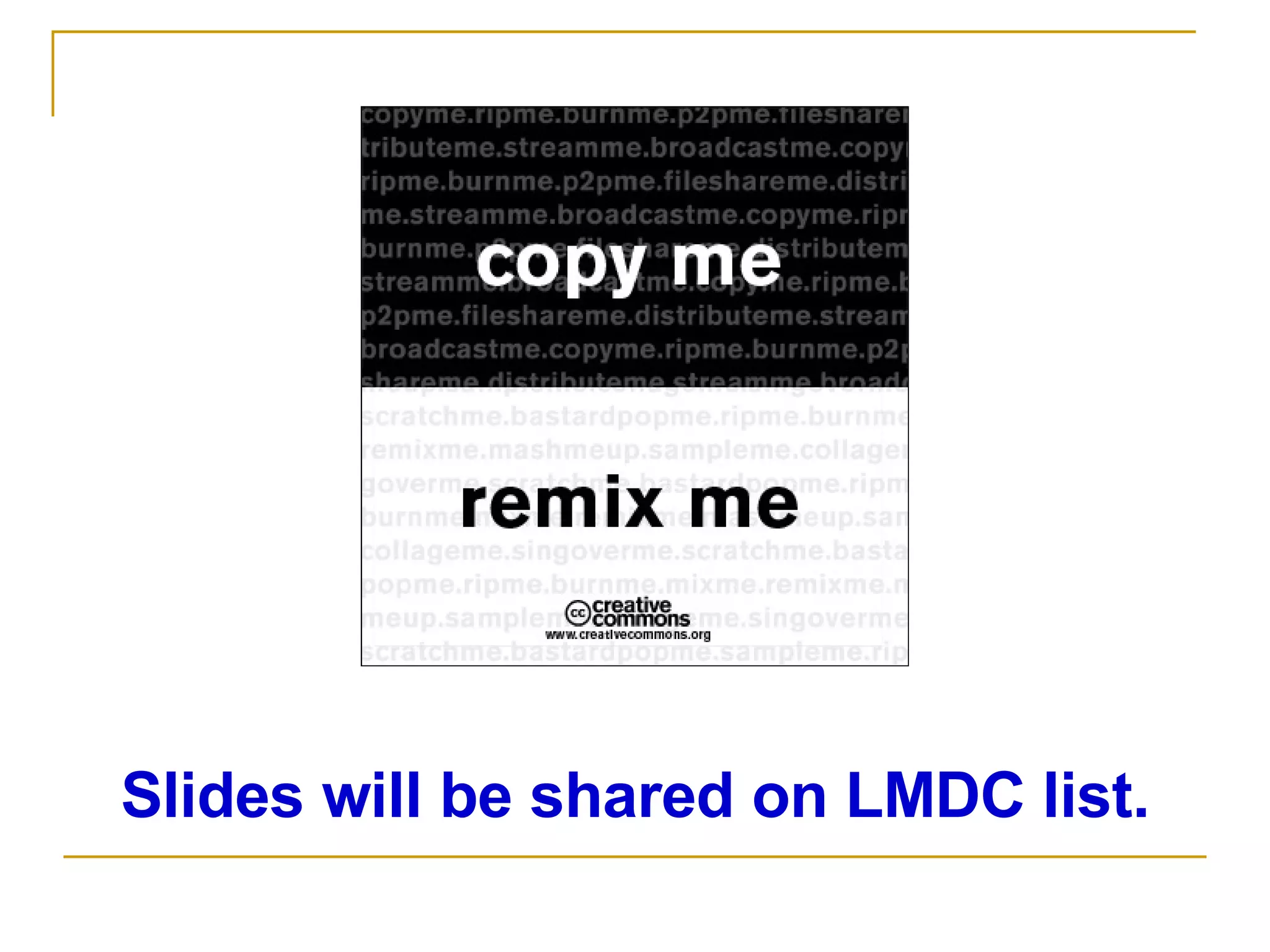
Slides will be shared on LMDC list.
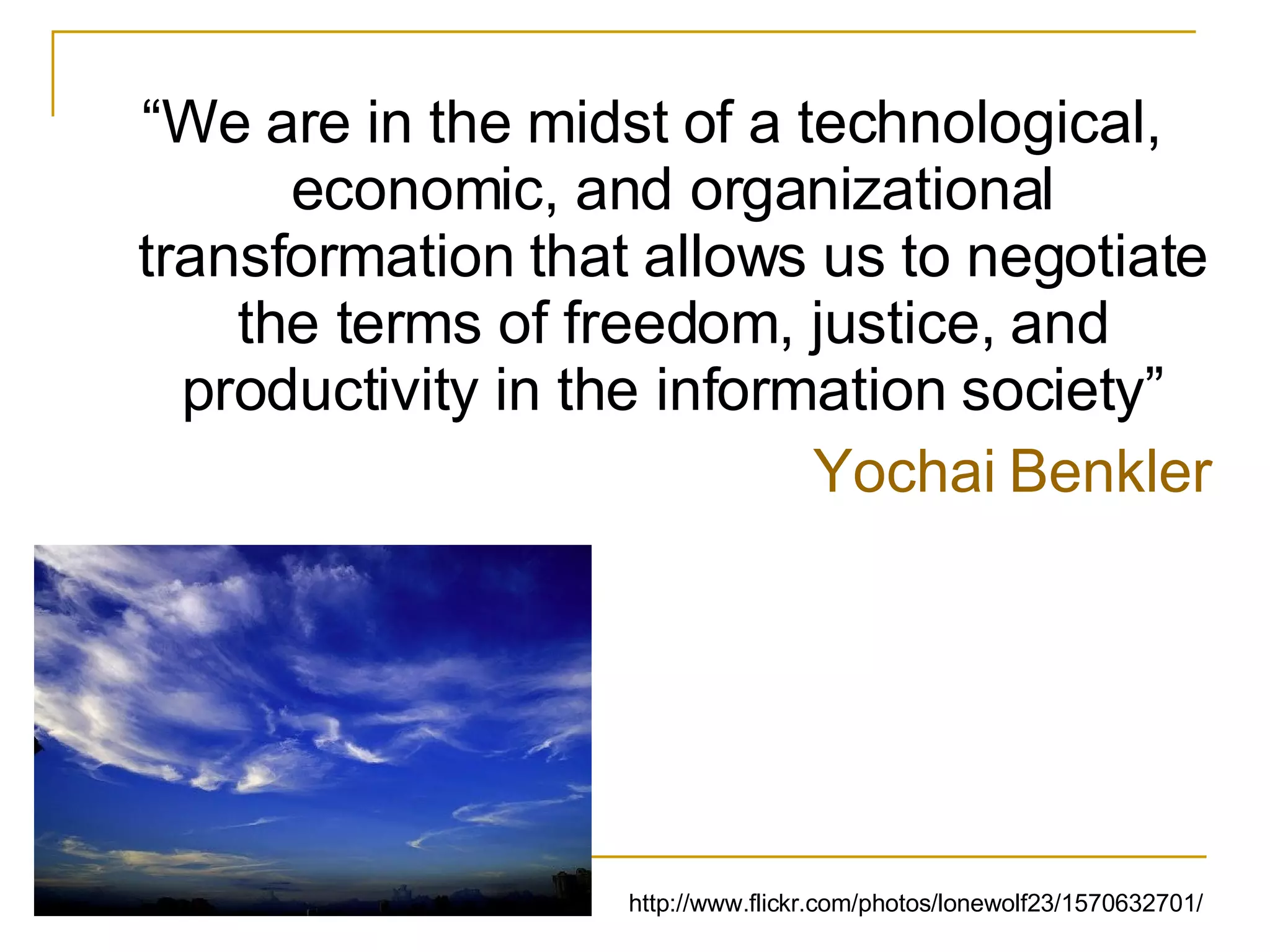
“ We are in the midst of a technological, economic, and organizational transformation that allows us to negotiate the terms of freedom, justice, and productivity in the information society” Yochai Benkler http://www.flickr.com/photos/lonewolf23/1570632701/
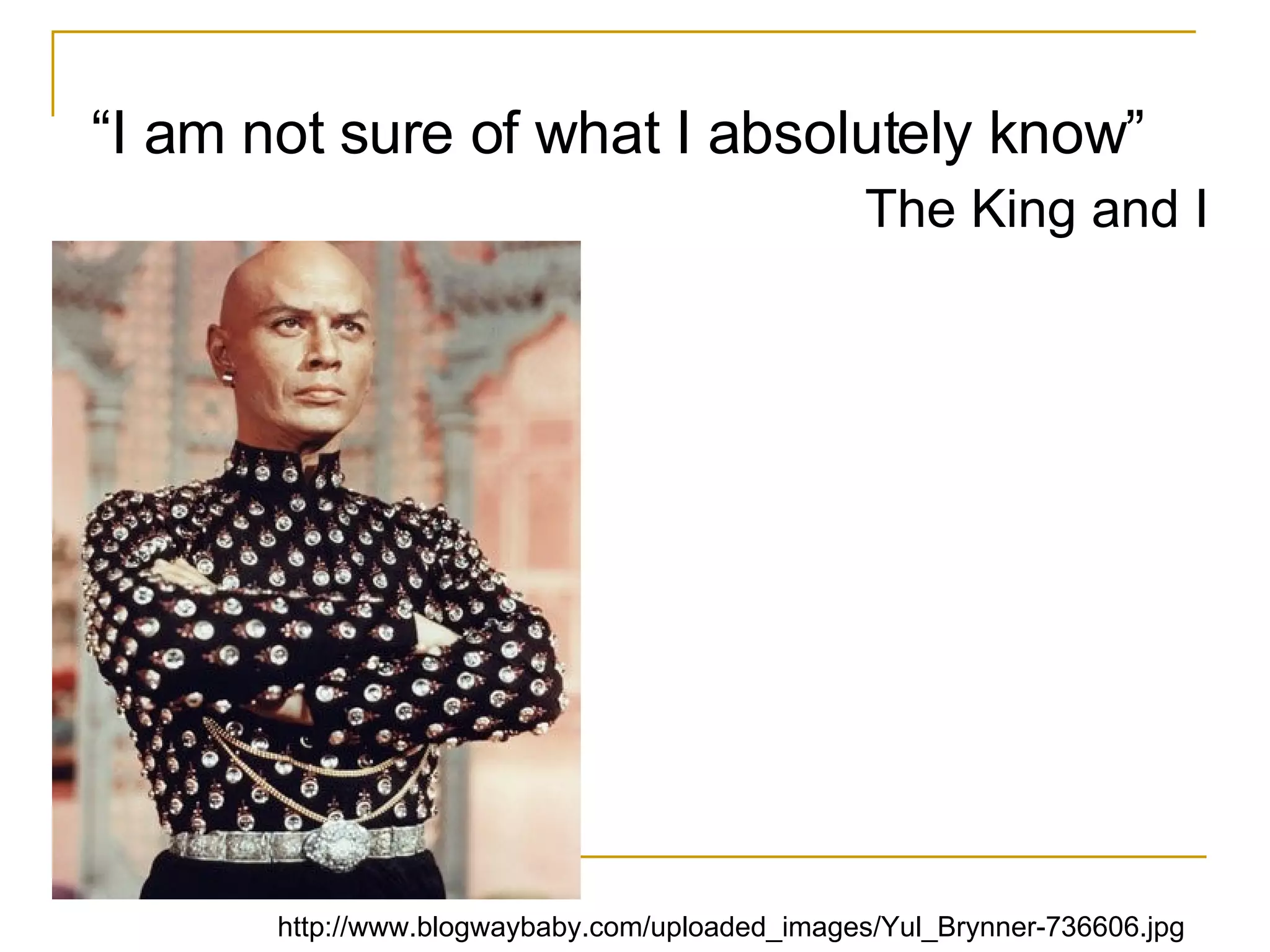
“ I am not sure of what I absolutely know”  The King and I http://www.blogwaybaby.com/uploaded_images/Yul_Brynner-736606.jpg
How do we Deal with This? We are preparing students for jobs that don’t yet exist, using technologies that haven’t been invented, to solve problems we don’t even know are problems yet.   http://www.youtube.com/watch?v=xHWTLA8WecI
1.  eLearning
“ Distance” is about being geographically separated. “ eLearning”  is about leveraging the unique affordances of digital technologies to support new ways of learning in new spaces. The  "e" in "eLearning" stands variously for enhanced, electronic, or extended.  “ eLearning”
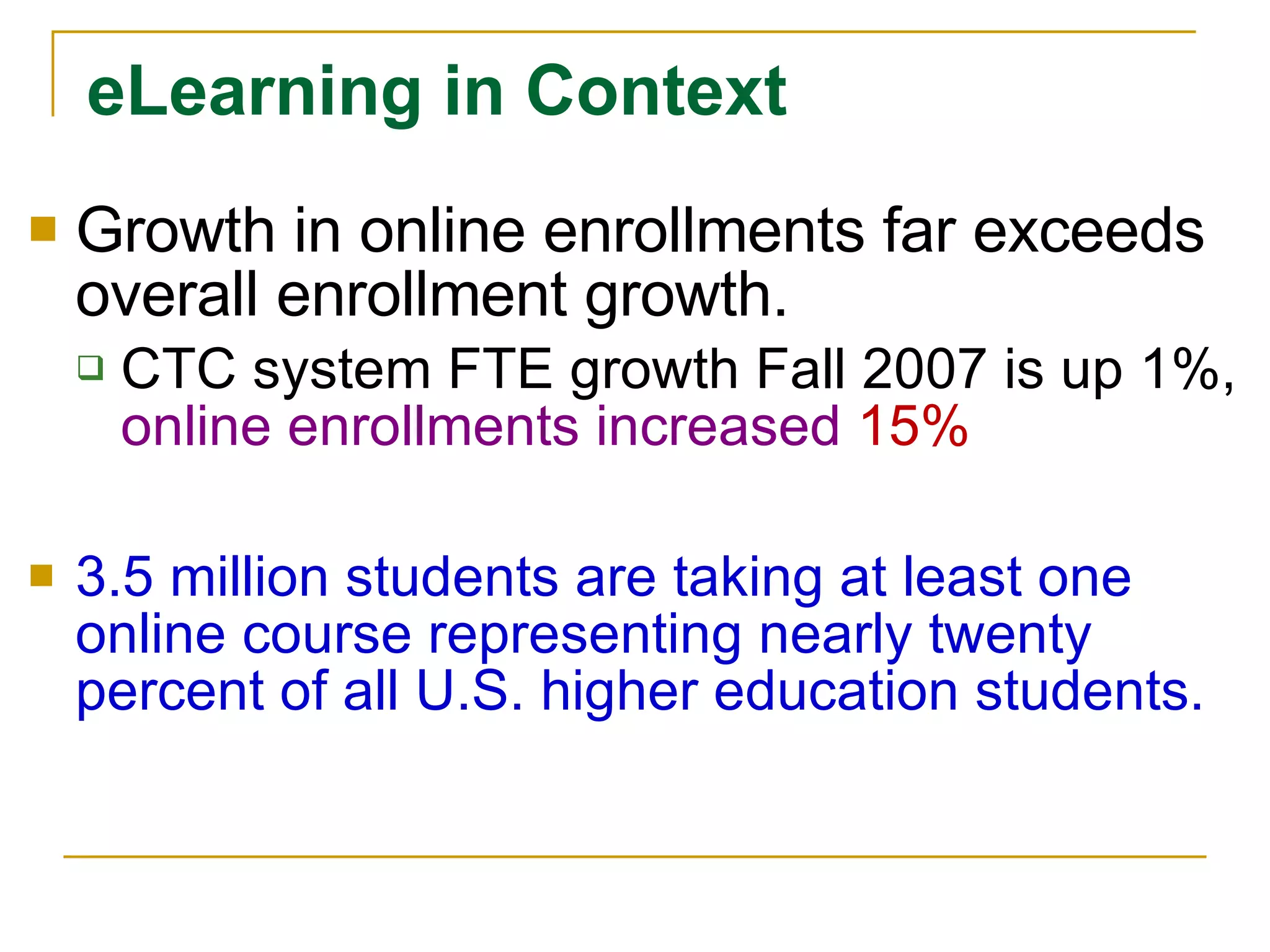
eLearning in Context  Growth in online enrollments far exceeds overall enrollment growth. CTC system FTE growth Fall 2007 is up 1%,  online enrollments increased  15% 3.5 million students are taking at least one online course representing nearly twenty percent of all U.S. higher education students.
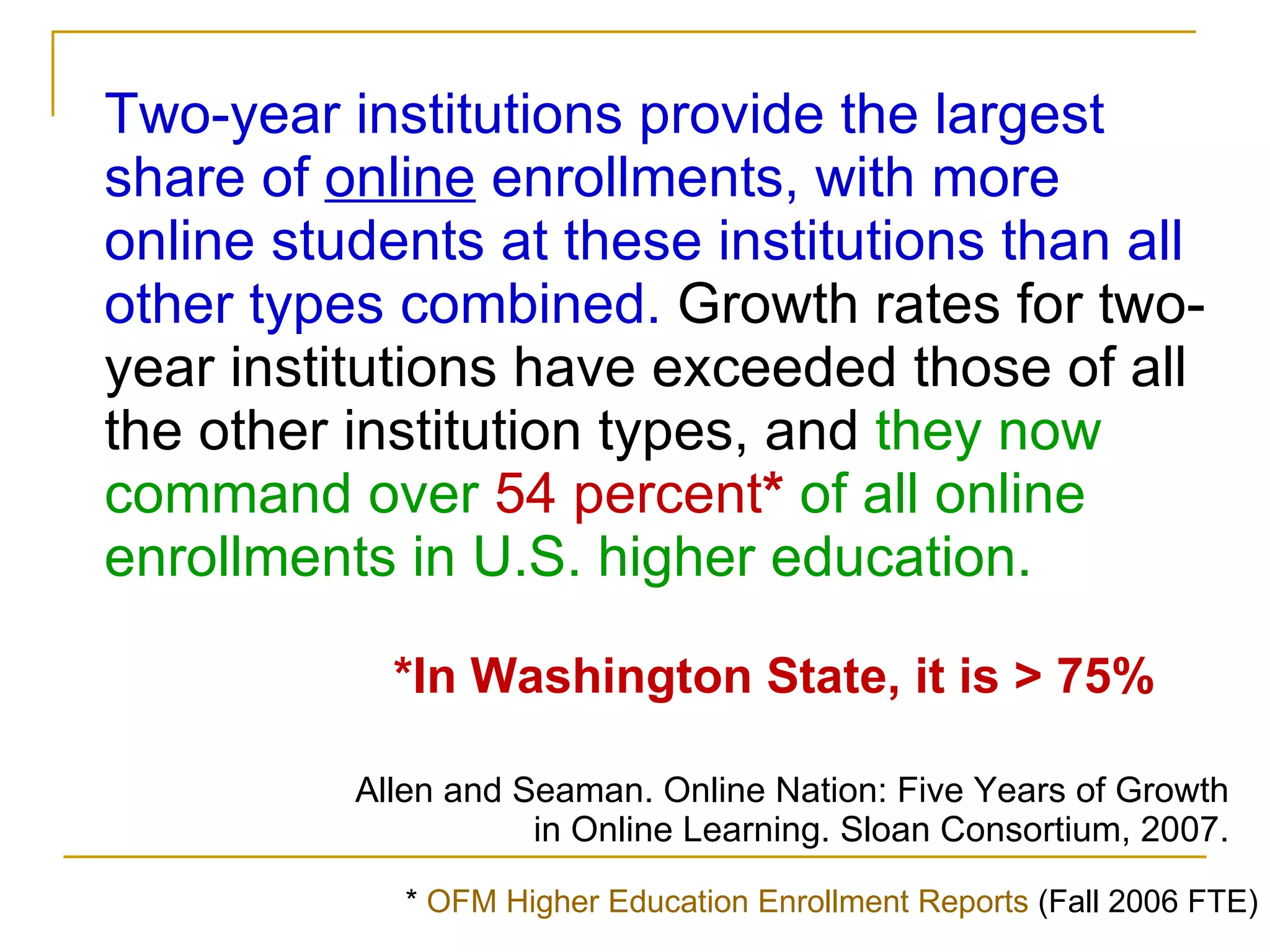
Two-year   institutions provide the largest share of  online  enrollments, with more online students at these institutions than all other types combined.  Growth rates for two-year institutions have exceeded those of all the other institution types, and  they now command over  54 percent *   of all online enrollments in U.S. higher education. Allen and Seaman. Online Nation: Five Years of Growth in Online Learning. Sloan Consortium, 2007. *In Washington State, it is > 75% *  OFM Higher Education Enrollment Reports  (Fall 2006 FTE)
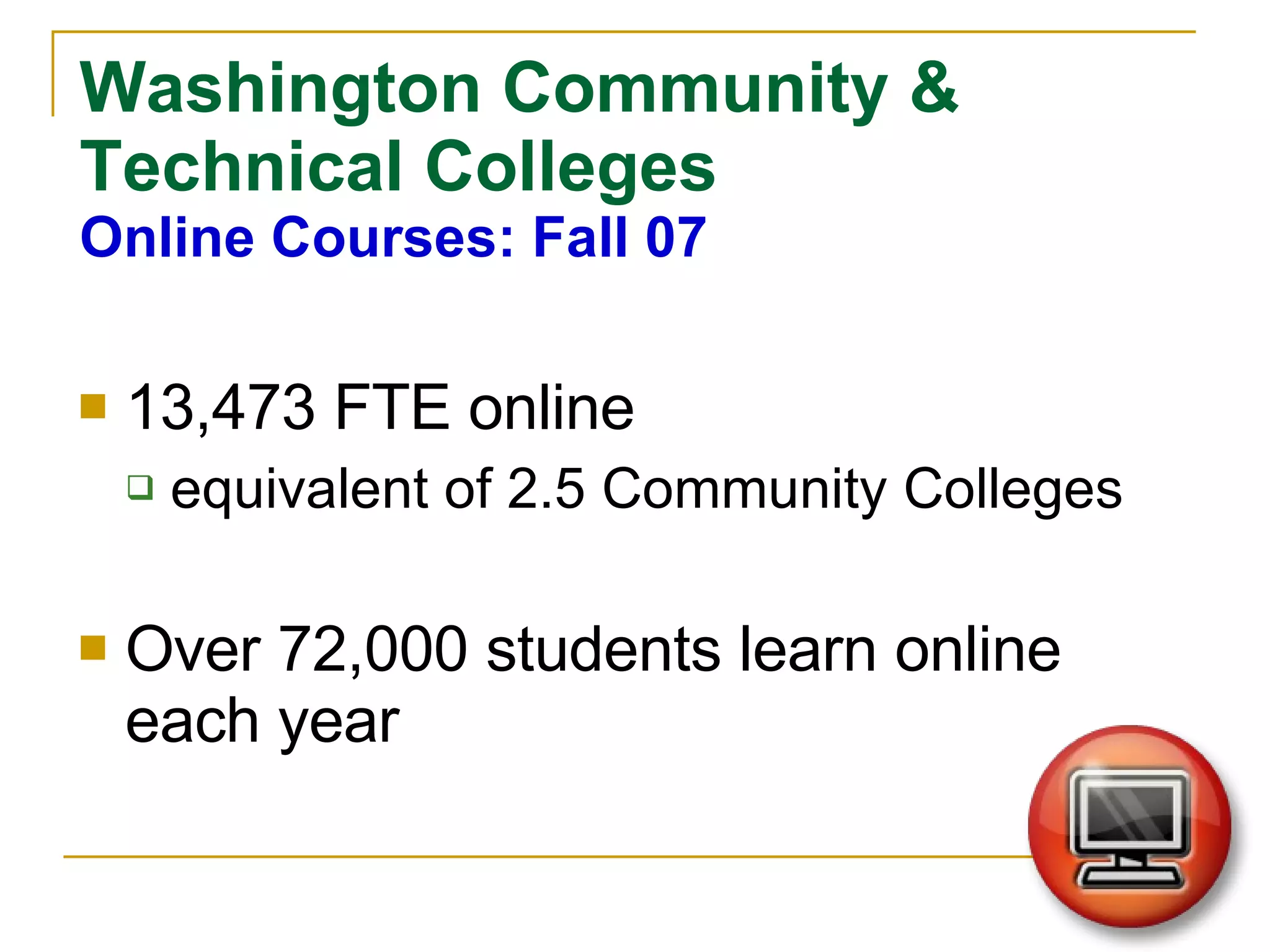
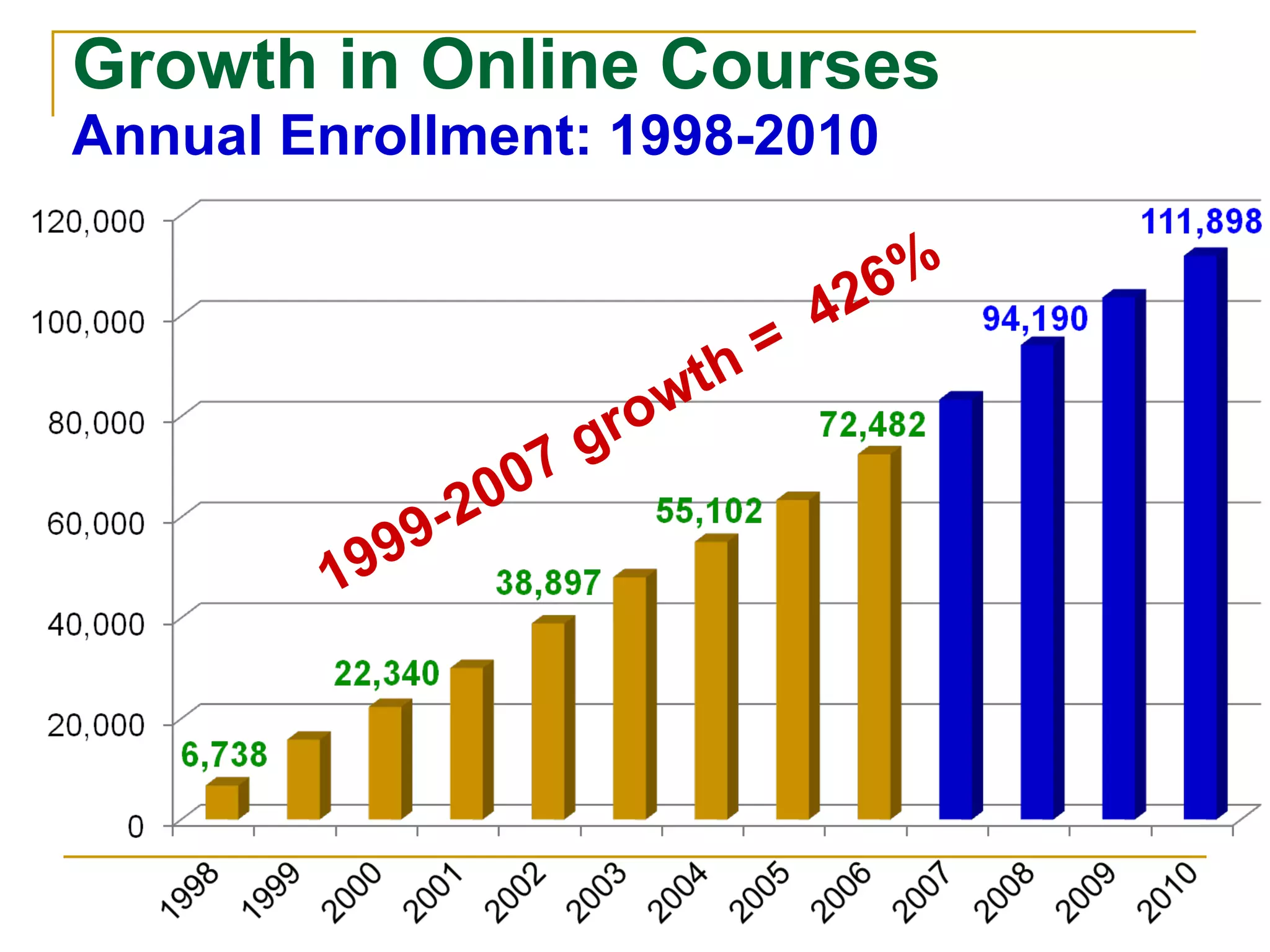
Washington Community & Technical Colleges Online Courses: Fall 07 13,473 FTE online equivalent of 2.5 Community Colleges Over 72,000 students learn online each year
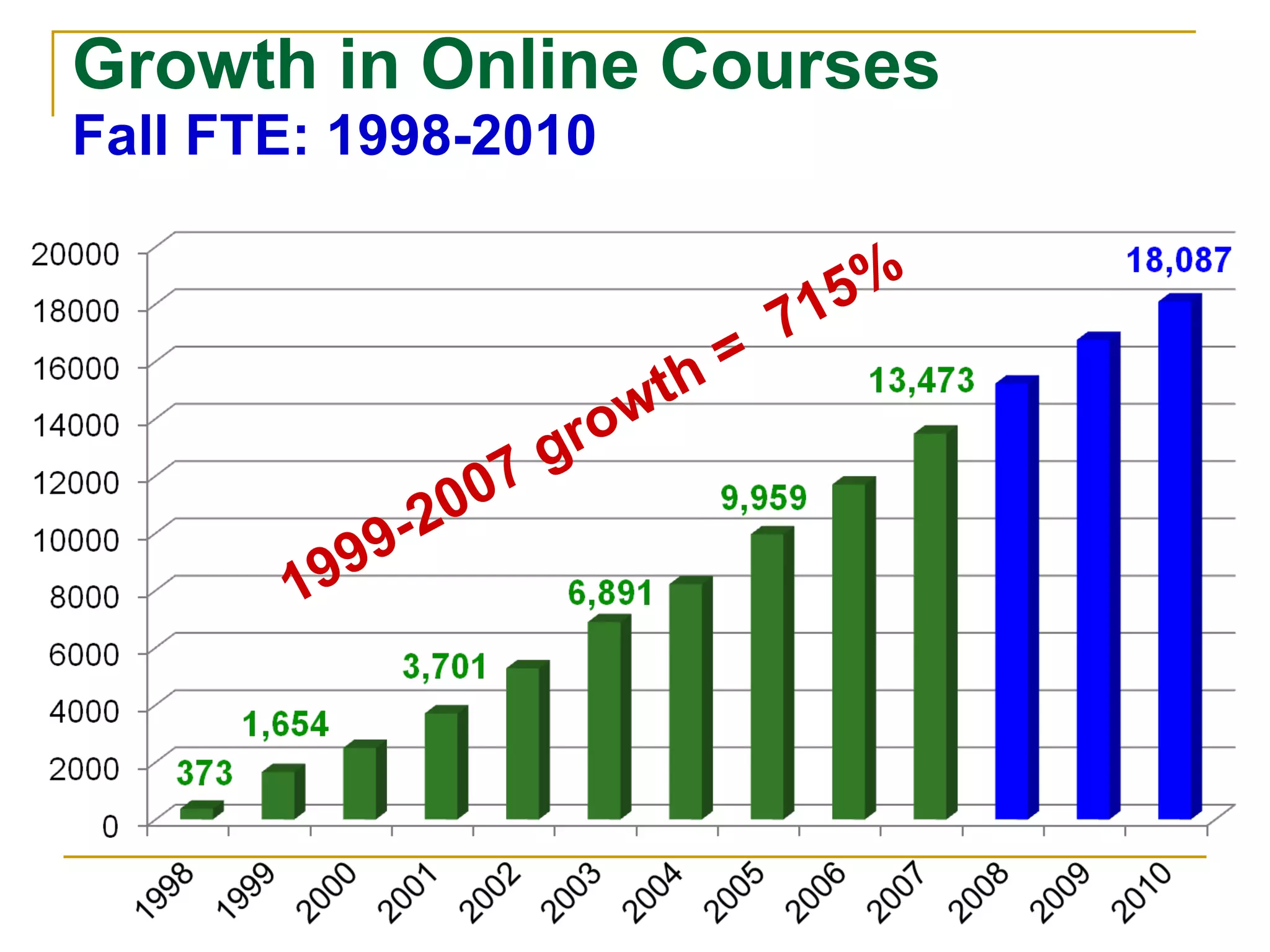
Growth in Online Courses Fall FTE: 1998-2010 1999-2007 growth =  715%
Growth in Online Courses Annual Enrollment: 1998-2010 1999-2007 growth =  426%
Why does this growth curve matter?
Educate More Citizens HECB Master Plan I. Raise educational attainment to create prosperity, opportunity  Policy Goal:  Increase the total number of degrees and certificates  produced annually to achieve Global Challenge State benchmarks.  By 2018, raise mid-level degrees and certificates to 36,200 annually, an increase of 9,400 degrees annually.
2.  Open Educational Resources
Because when we cooperate and share, we all win –  exponentially . Reedʼs Law:  Networks grow [in value] exponentially by the number of nodes. It’s a social justice issue:  everyone  has the right to access global knowledge. Why is “Open” Important? Institute for the Future whitepaper: Technologies of Cooperation
(one) Definition of OER Digitized materials, offered freely and openly for educators, students and self-learners, to use and re-use for teaching, learning and research. OER includes open access to both the content and the technology such as: Open Software, Open Standards and Open Licenses to distribute the Open Content. http://topics.developmentgateway.org/openeducation
We are on the cusp of a global revolution in teaching and learning. Educators worldwide are developing a vast pool of educational resources on the Internet, open and free for all to use. These educators are creating a world where each and every person on earth can access and contribute to the sum of all human knowledge… http://www.capetowndeclaration.org/read-the-declaration
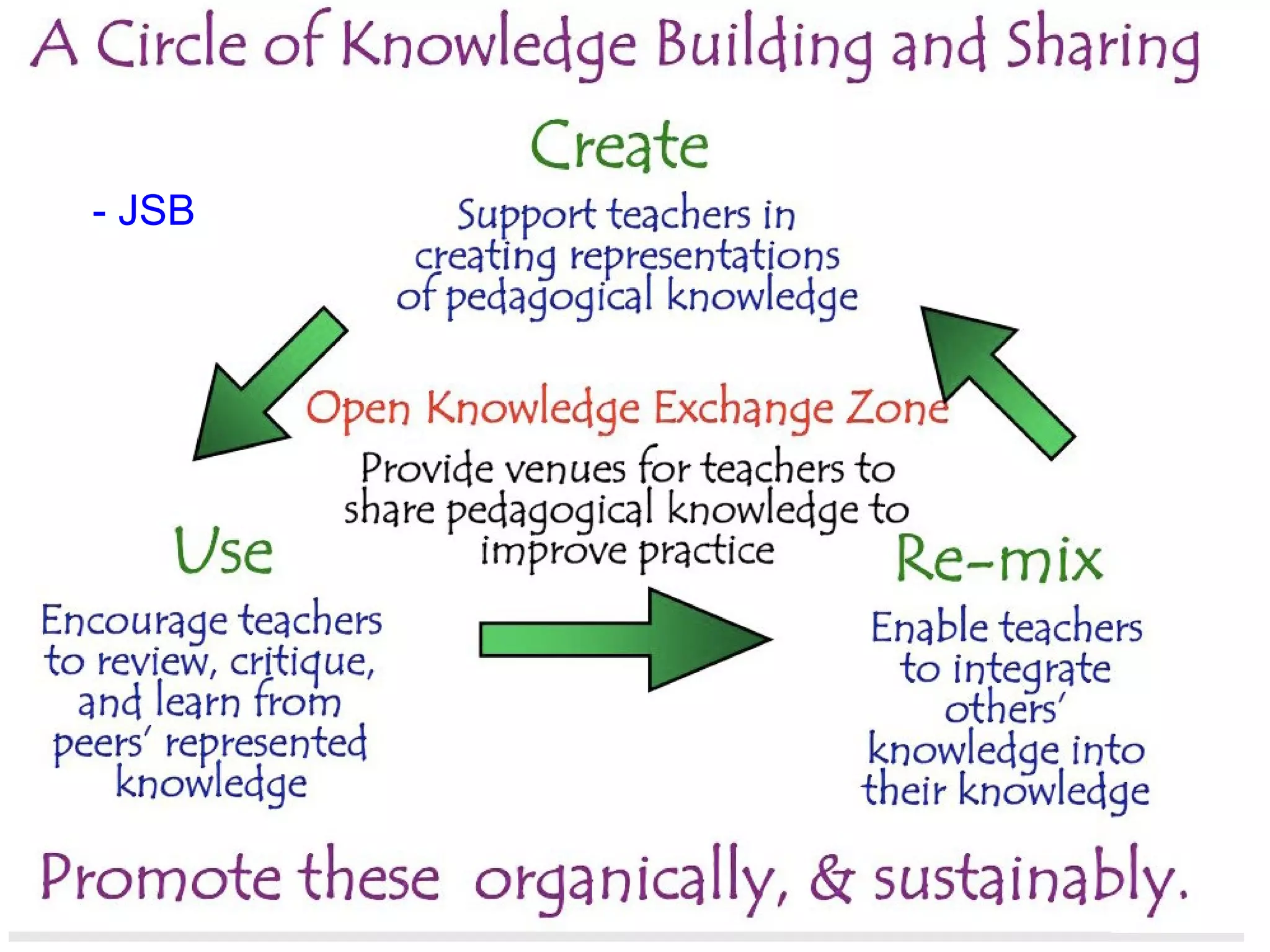
- JSB
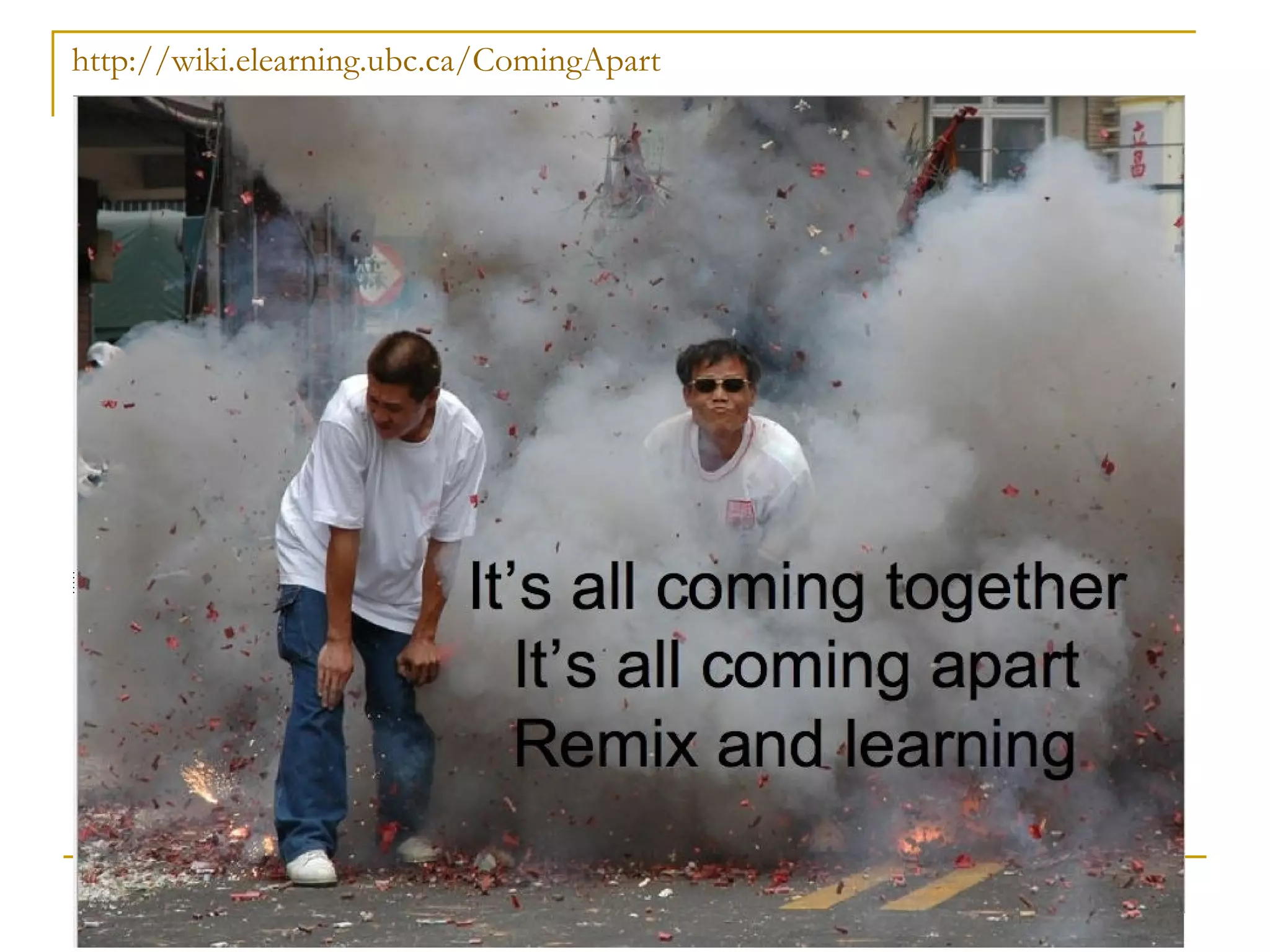
http://wiki.elearning.ubc.ca/ComingApart
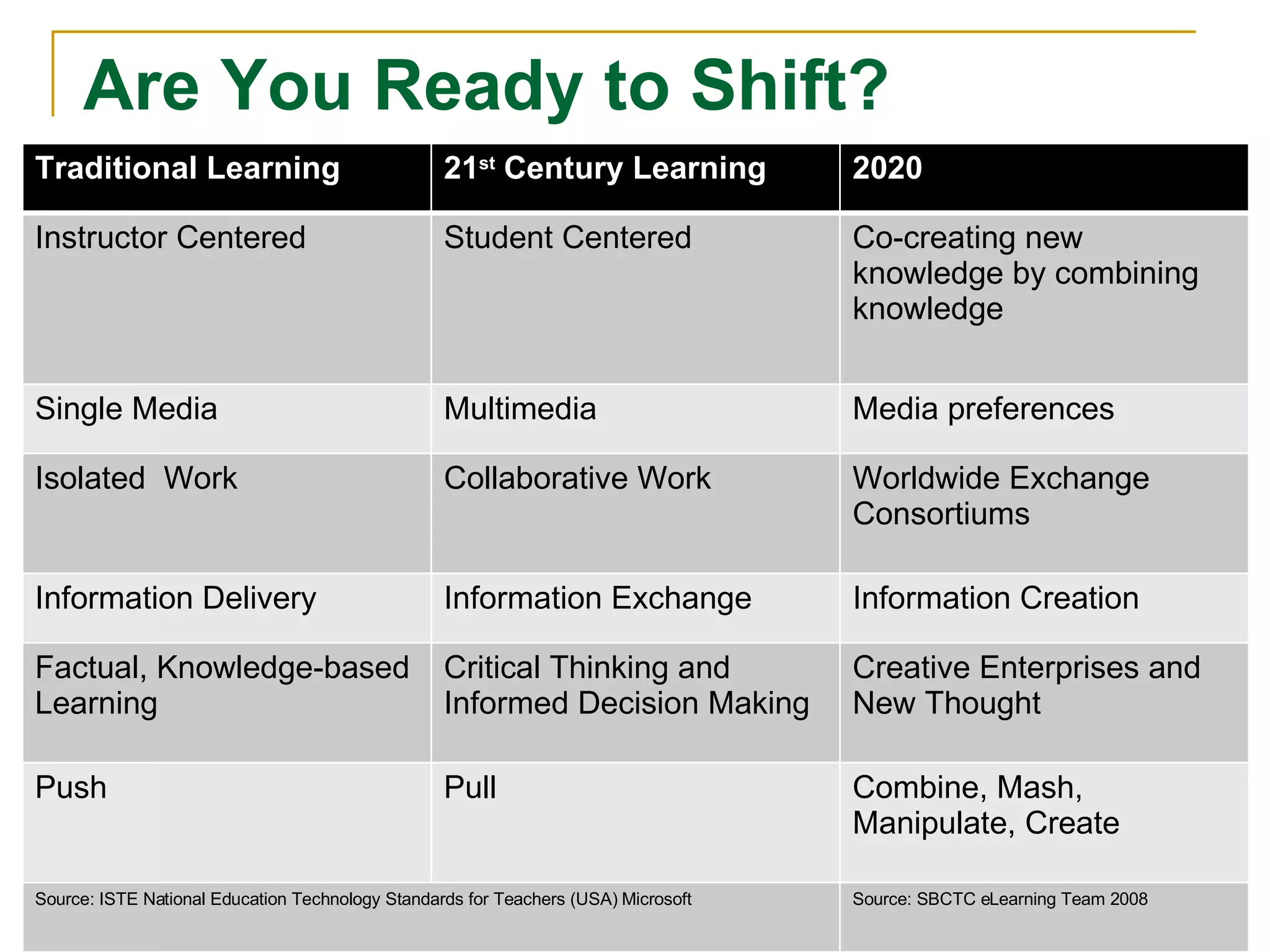
Are You Ready to Shift?  Traditional Learning  21 st  Century Learning 2020 Instructor Centered Student Centered Co-creating new knowledge by combining knowledge Single Media  Multimedia Media preferences  Isolated  Work Collaborative Work  Worldwide Exchange Consortiums Information Delivery Information Exchange Information Creation Factual, Knowledge-based Learning Critical Thinking and Informed Decision Making  Creative Enterprises and New Thought Push  Pull  Combine, Mash, Manipulate, Create Source: ISTE National Education Technology Standards for Teachers (USA) Microsoft Source: SBCTC eLearning Team 2008
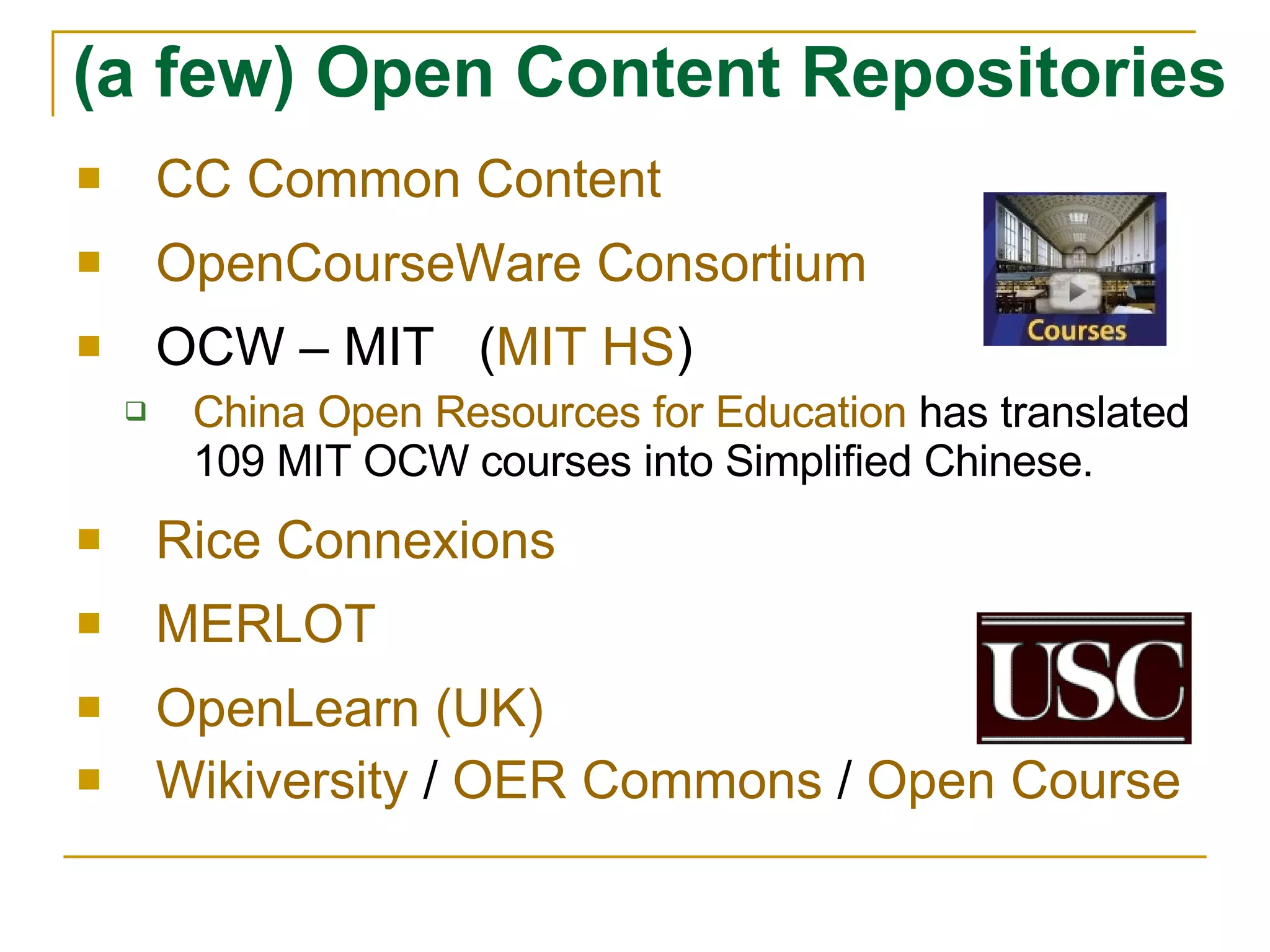
CC Common Content OpenCourseWare Consortium OCW – MIT  ( MIT HS ) China Open Resources for Education  has translated 109 MIT OCW courses into Simplified Chinese. Rice Connexions MERLOT OpenLearn (UK) Wikiversity  /  OER Commons  /  Open Course (a few) Open Content Repositories
All research funded by the  US National Institutes of Health , an agency with a $29 billion research budget, will now be required to be published online, free to the public, within 12 months after publication in any scientific journal.
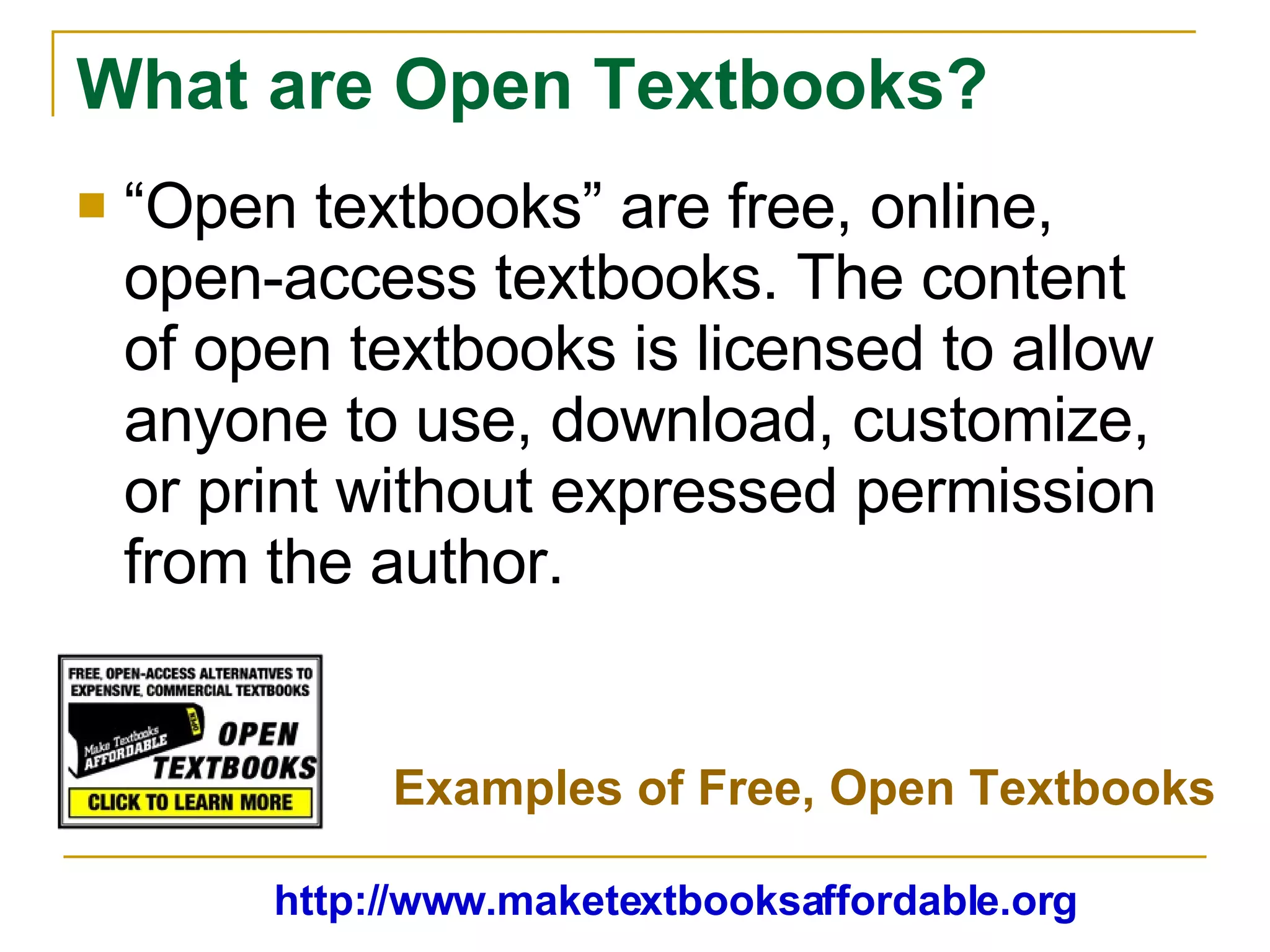
What are Open Textbooks? “ Open textbooks” are free, online, open-access textbooks. The content of open textbooks is licensed to allow anyone to use, download, customize, or print without expressed permission from the author. http://www.maketextbooksaffordable.org Examples of Free, Open Textbooks
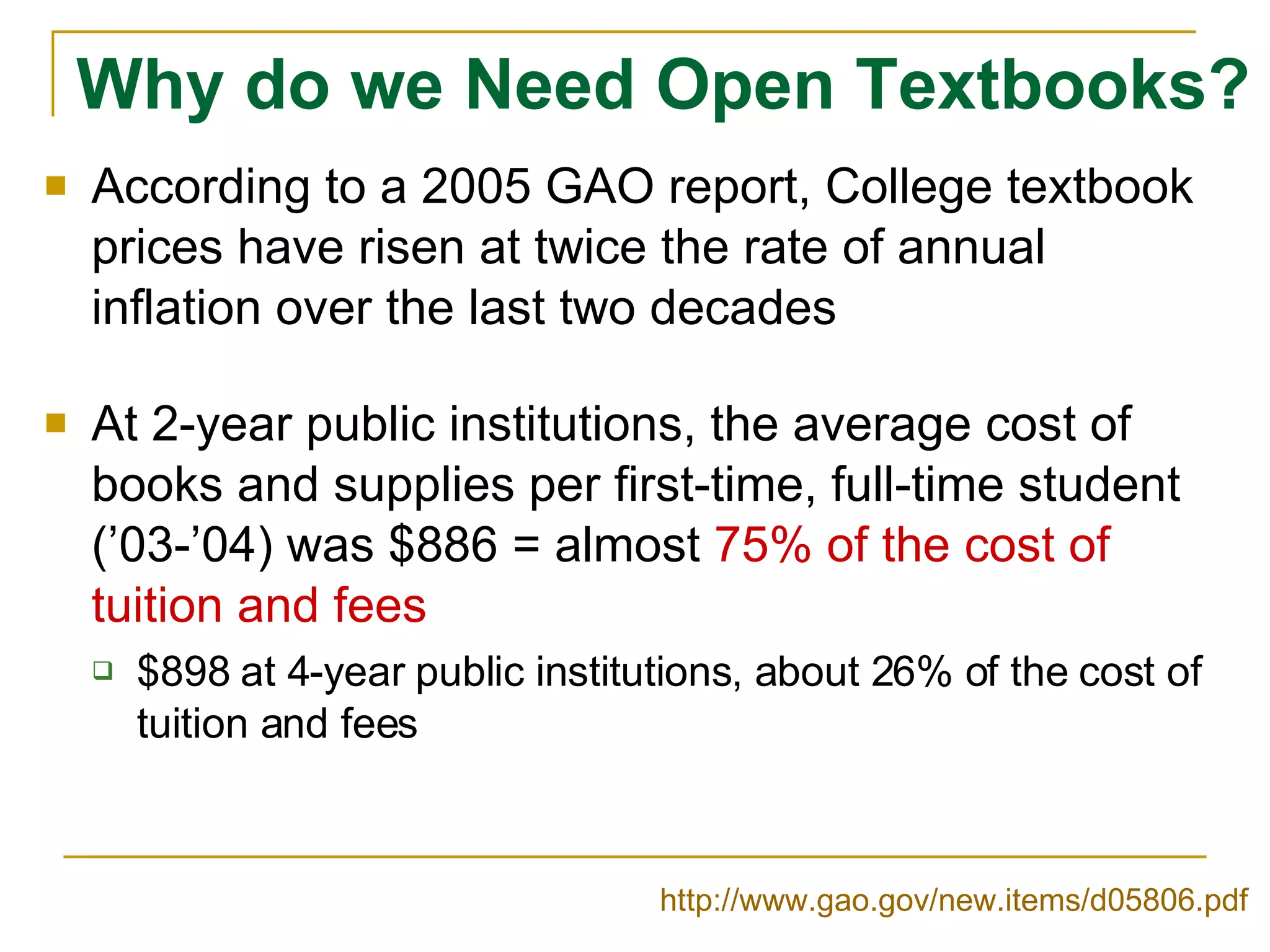
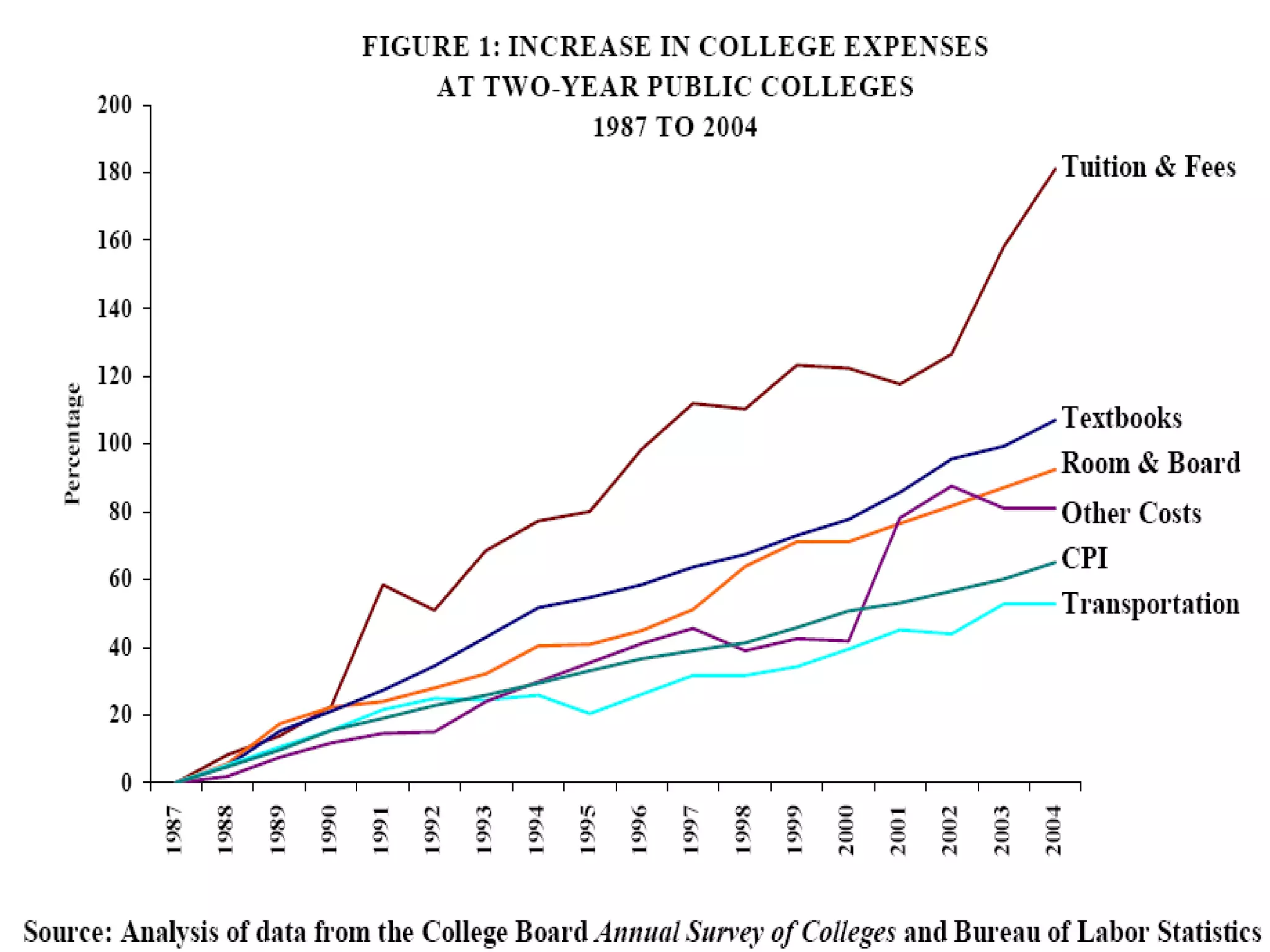
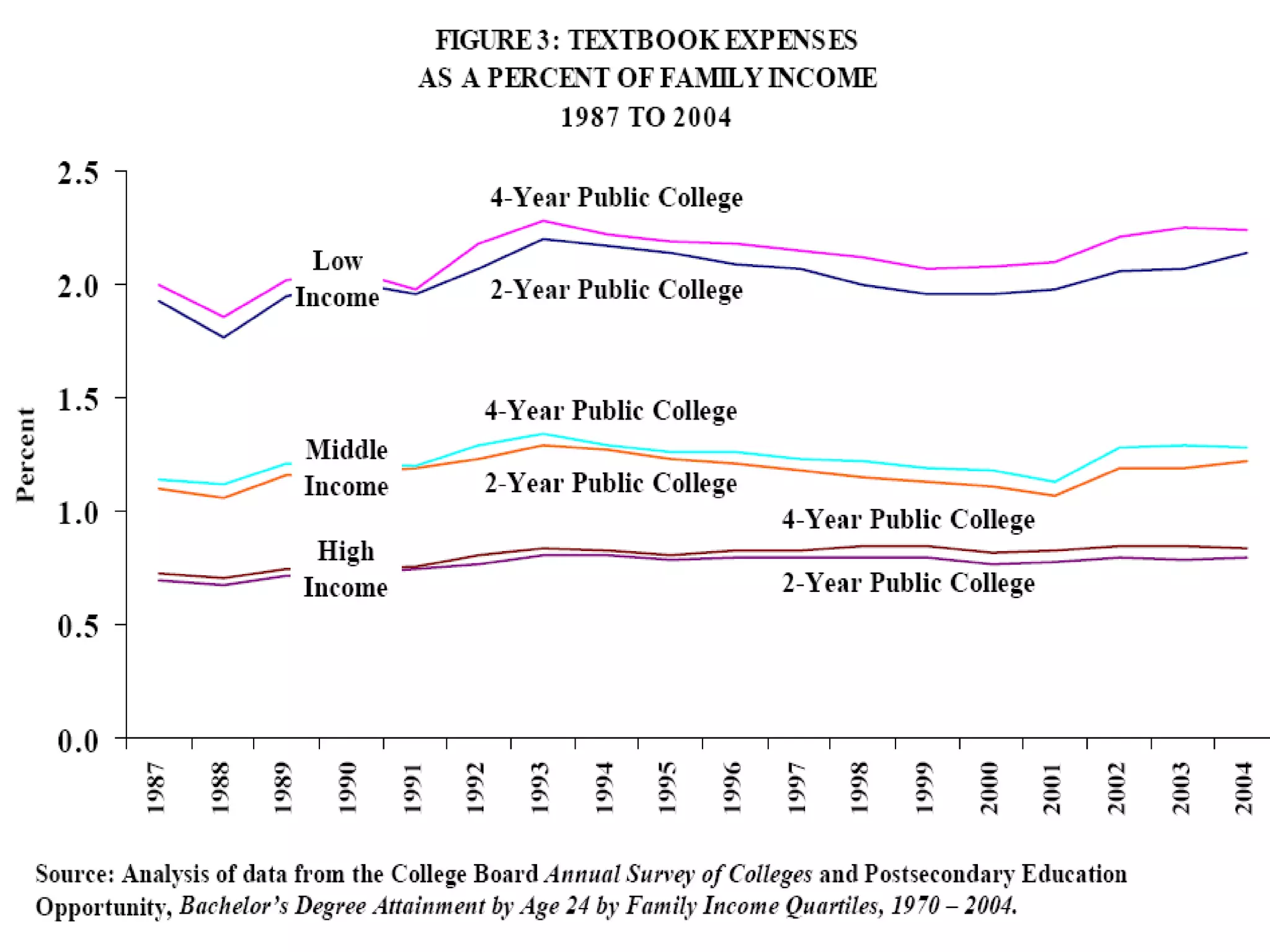
Why do we Need Open Textbooks? According to a 2005 GAO report, College textbook prices have risen at twice the rate of annual inflation over the last two decades At 2-year public institutions, the average cost of books and supplies per first-time, full-time student (’03-’04) was $886 = almost  75% of the cost of tuition and fees $898 at 4-year public institutions, about 26% of the cost of tuition and fees http://www.gao.gov/new.items/d05806.pdf
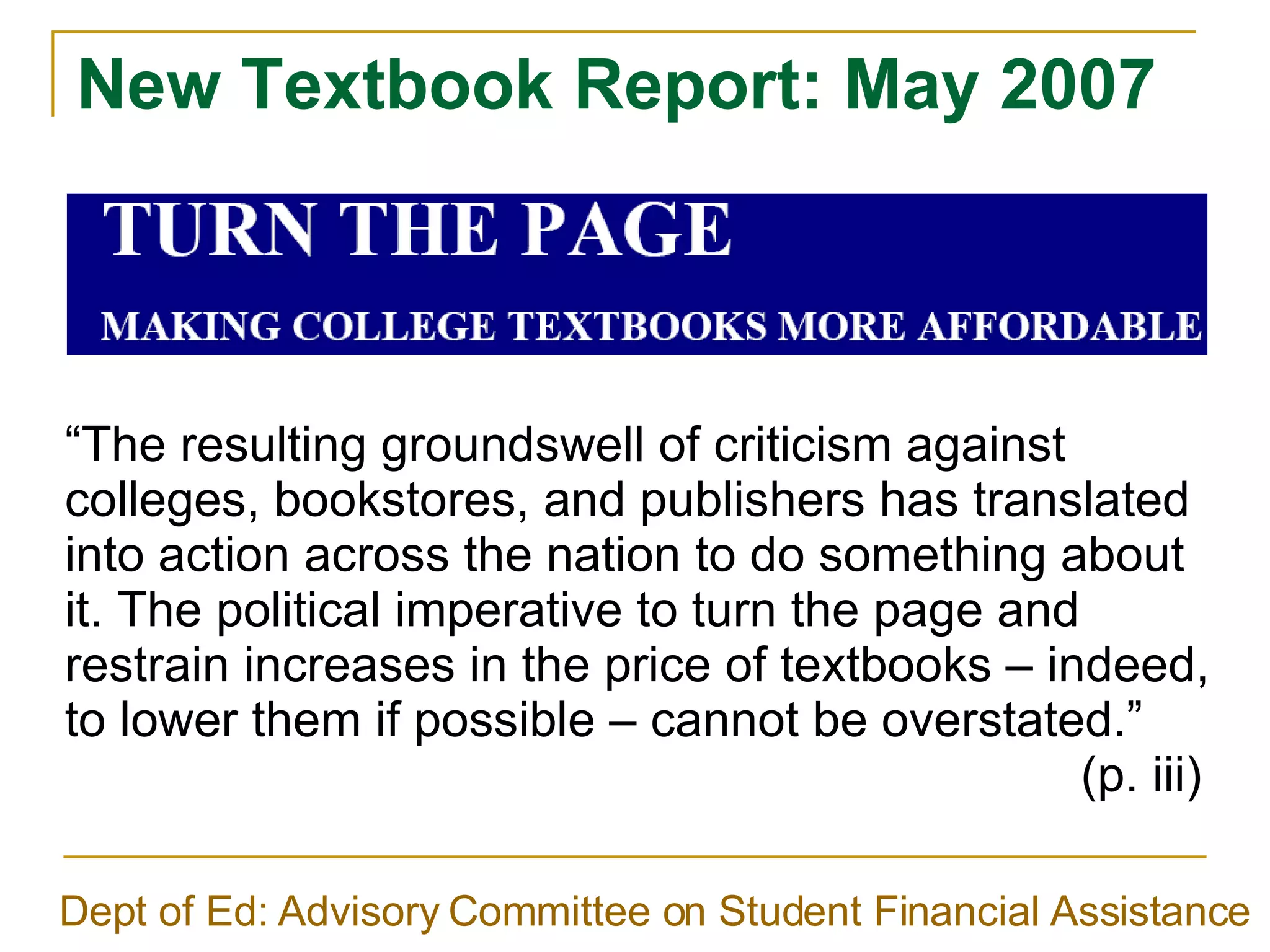
New Textbook Report: May 2007 Dept of Ed: Advisory Committee on Student Financial Assistance “ The resulting groundswell of criticism against colleges, bookstores, and publishers has translated into action across the nation to do something about it. The political imperative to turn the page and restrain increases in the price of textbooks – indeed, to lower them if possible – cannot be overstated.”  (p. iii)
 
 
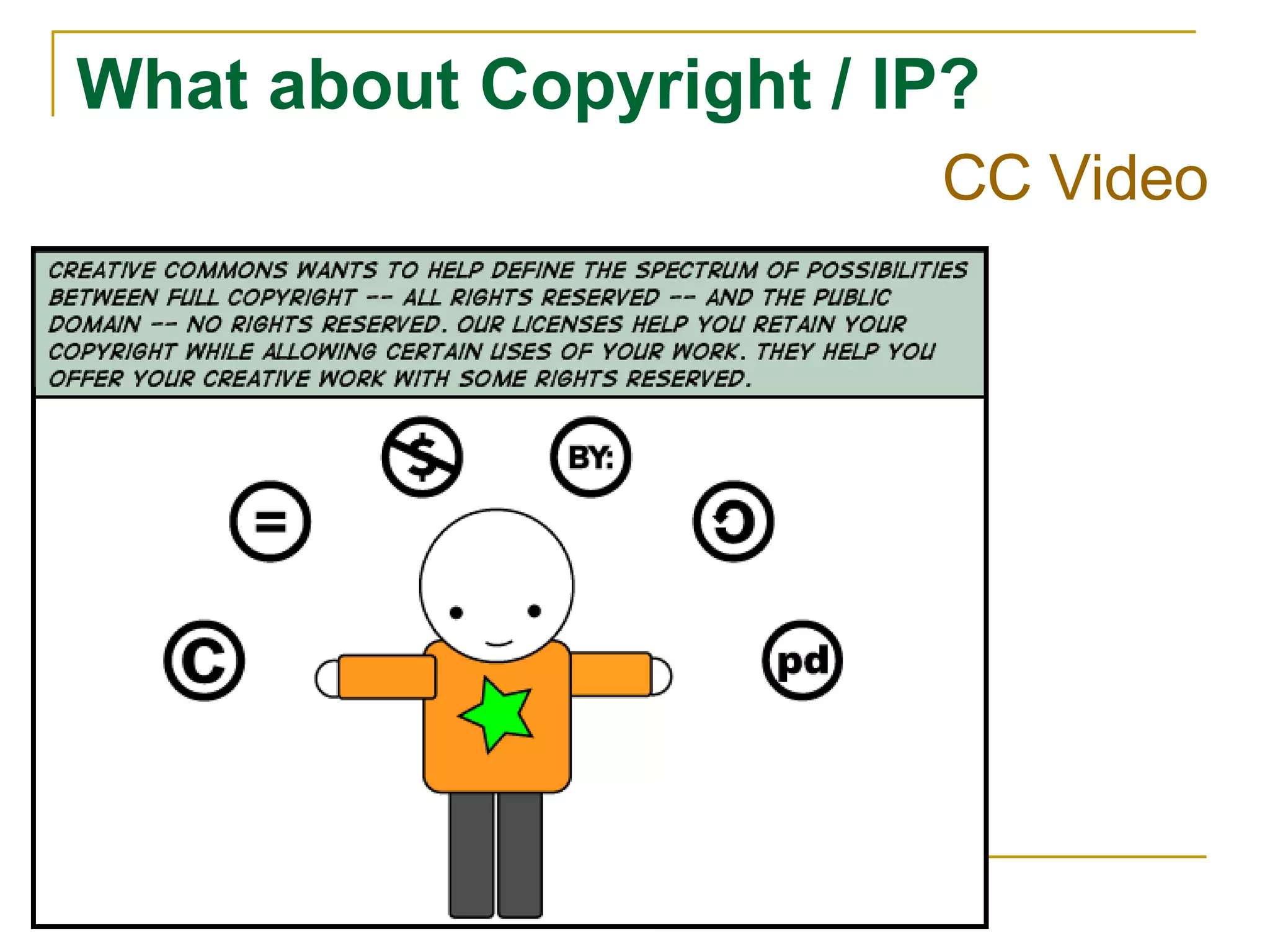
What about Copyright / IP? CC Video
We must get rid of our  “not invented here”  attitude regarding others’ content move to:  "proudly borrowed from there" Content is  not  a strategic advantage Nor can we (or our students) afford it: Students want open, free textbooks Students want access to the global courses Hey Higher Ed!
“ As uncomfortable a proposition as this new openness may be for some, I believe it is the future of higher education.” In web 2.0,  everything  is public & higher education needs to get used to it. Future  of Openness in Education David Wiley 2006. Open source, openness, and higher education.
3.  CTC Technology Plan
Technology Transformation Task Force Long-term planning to infuse innovative, student-centered technologies and transform learning throughout the CTC system. Structural shift to student-centric applications, services and development processes. Leverage technology, services and content across the 34 Colleges. Final report in Spring ’08.
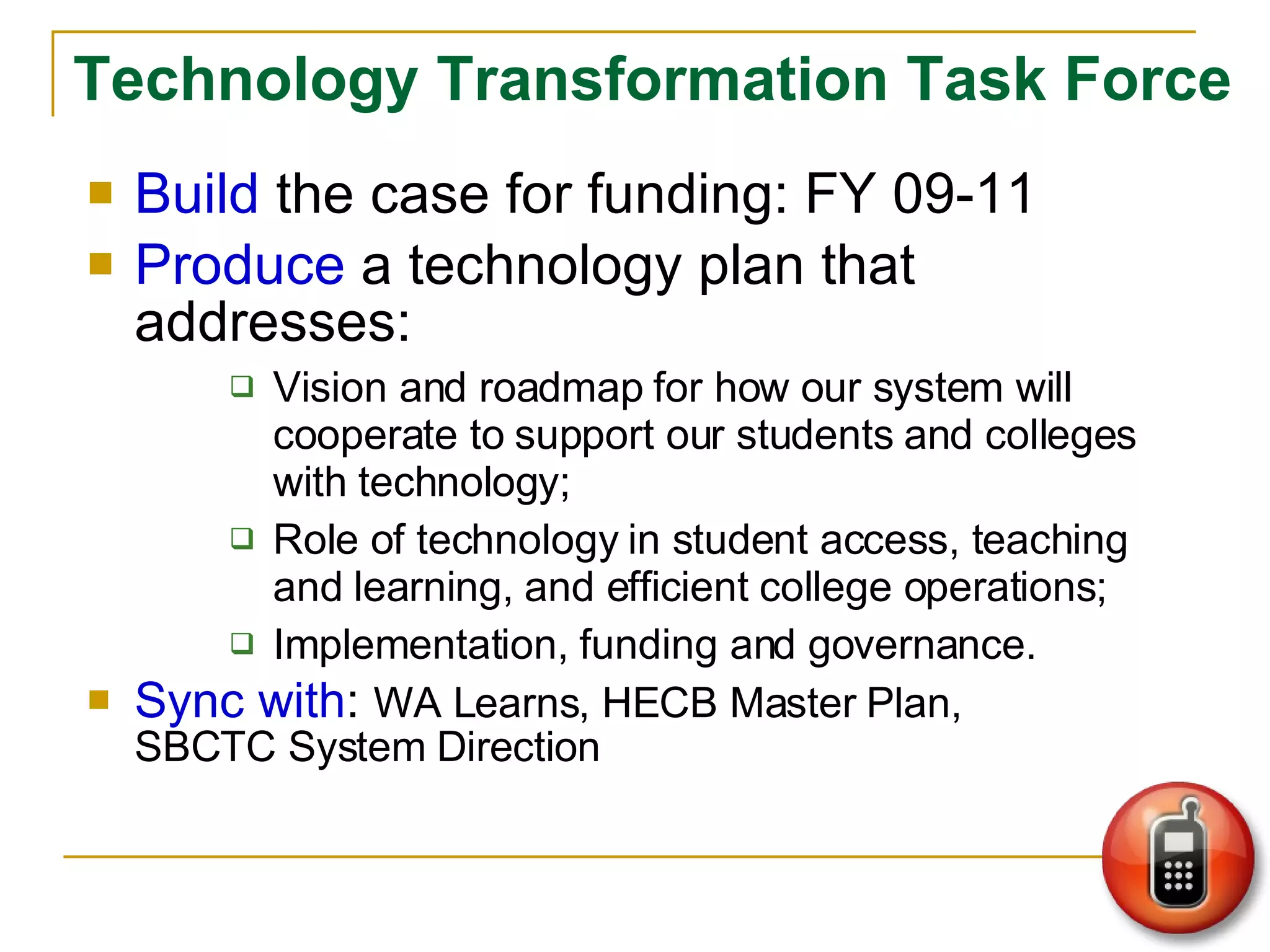
Technology Transformation Task Force Build  the case for funding: FY 09-11 Produce  a technology plan that addresses:  Vision and roadmap for how our system will cooperate to support our students and colleges with technology; Role of technology in student access, teaching and learning, and efficient college operations; Implementation, funding and governance. Sync with :  WA Learns, HECB Master Plan,  SBCTC System Direction
 
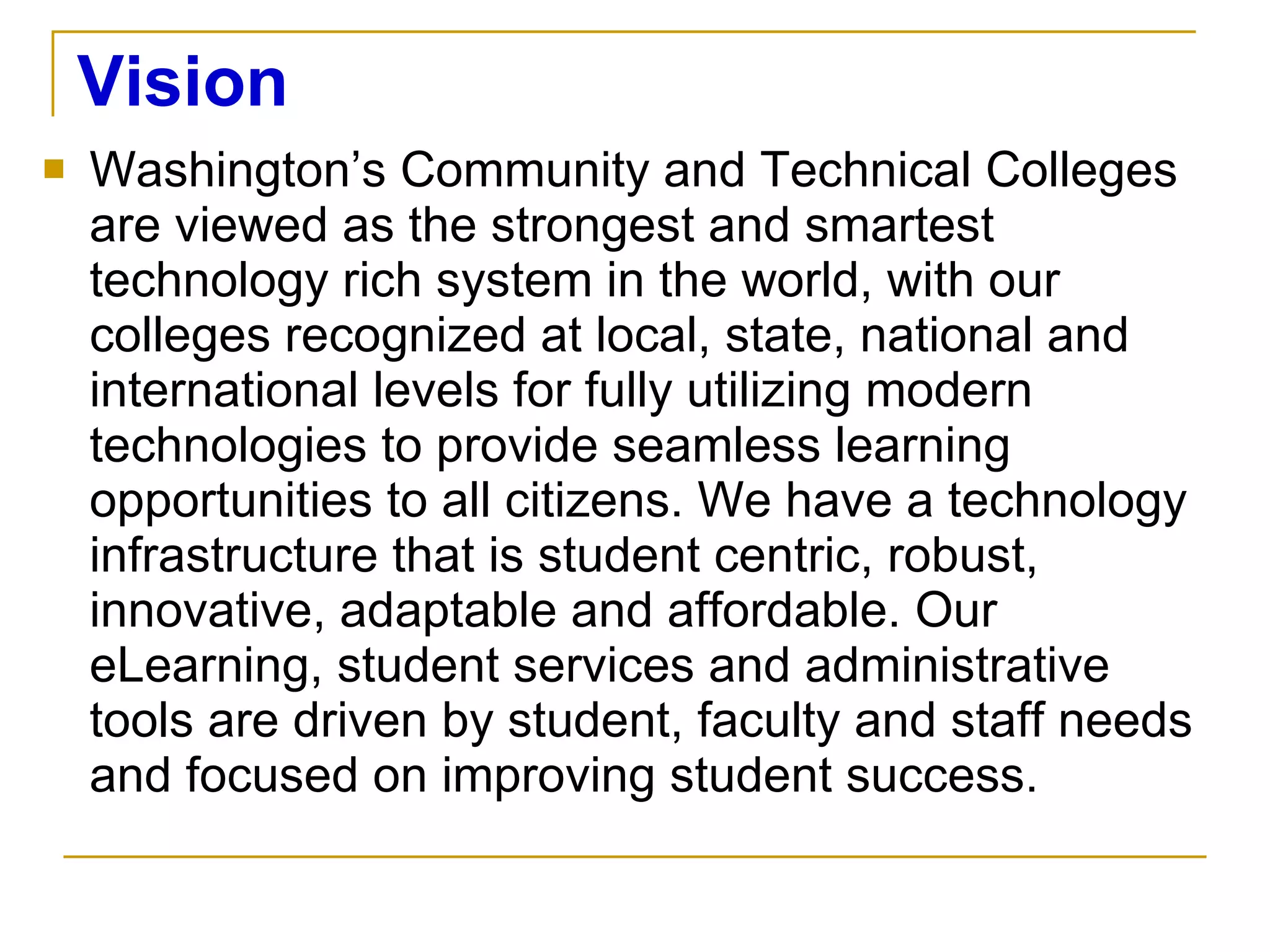
Vision Washington’s Community and Technical Colleges are viewed as the strongest and smartest technology rich system in the world, with our colleges recognized at local, state, national and international levels for fully utilizing modern technologies to provide seamless learning opportunities to all citizens. We have a technology infrastructure that is student centric, robust, innovative, adaptable and affordable. Our eLearning, student services and administrative tools are driven by student, faculty and staff needs and focused on improving student success.
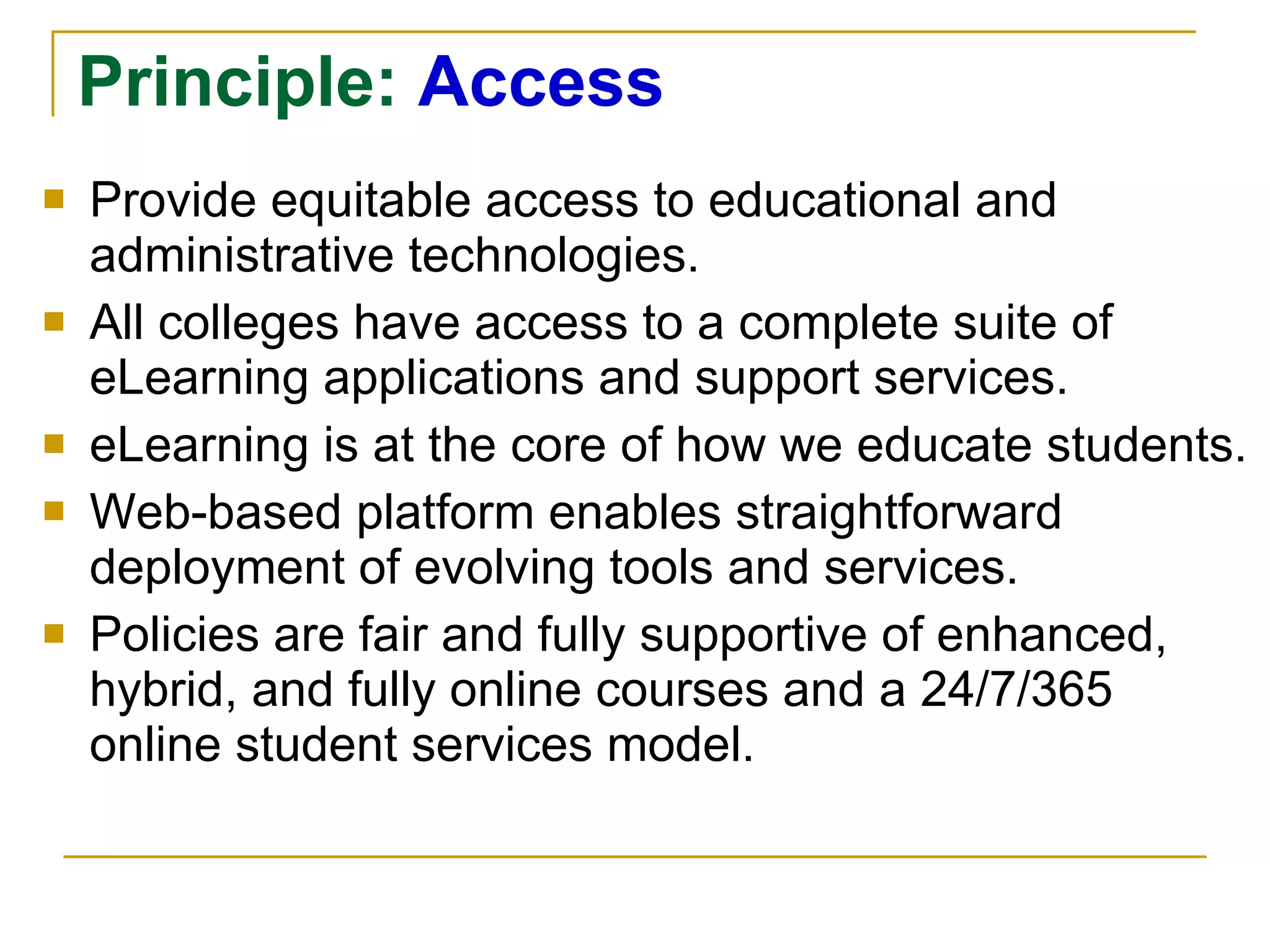
Principle:  Access Provide equitable access to educational and administrative technologies. All colleges have access to a complete suite of eLearning applications and support services. eLearning is at the core of how we educate students. Web-based platform enables straightforward deployment of evolving tools and services. Policies are fair and fully supportive of enhanced, hybrid, and fully online courses and a 24/7/365 online student services model.
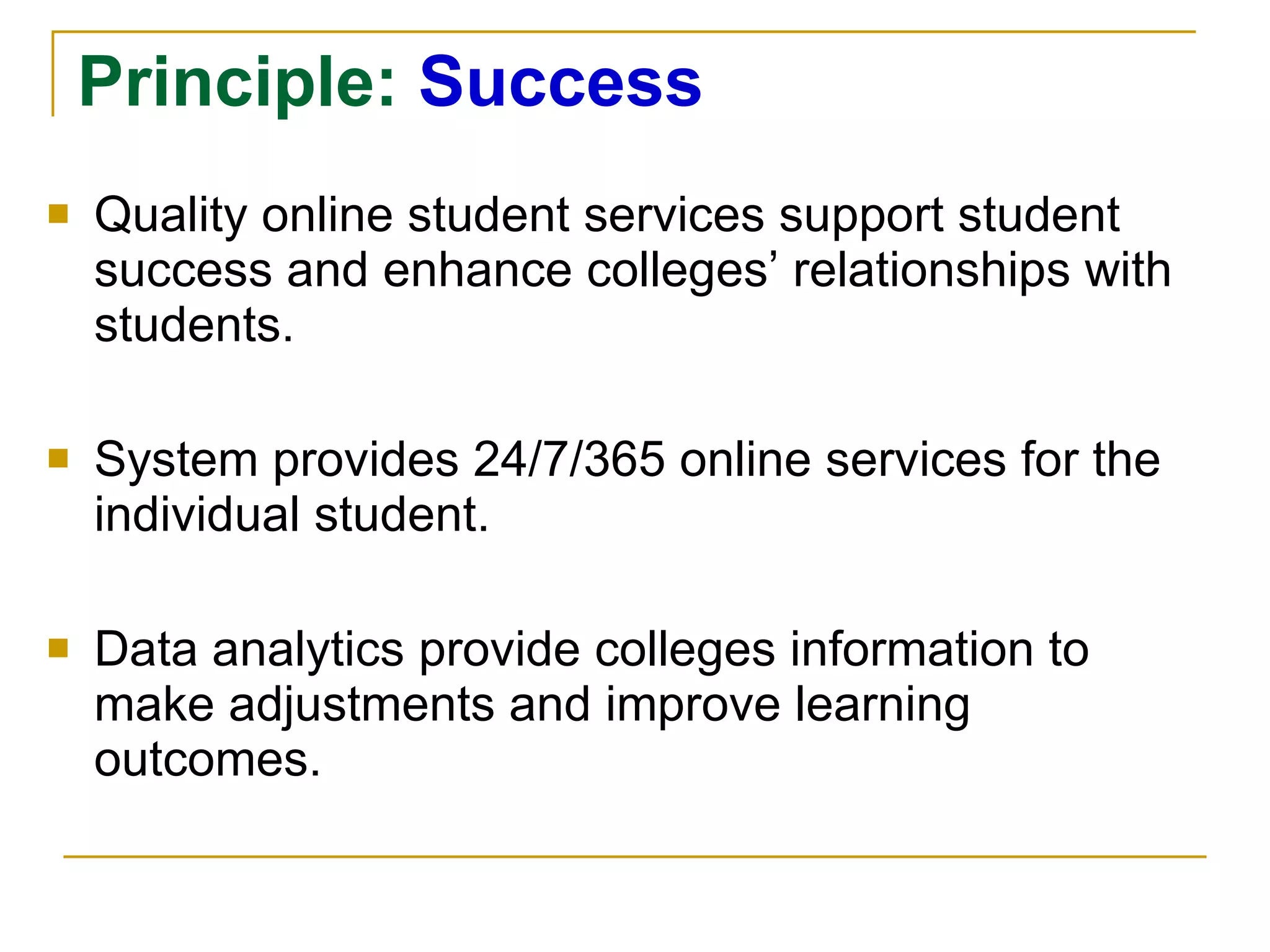
Principle:  Success Quality online student services support student success and enhance colleges’ relationships with students. System provides 24/7/365 online services for the individual student. Data analytics provide colleges information to make adjustments and improve learning outcomes.
Principle:  Transformation Our system embraces a culture of rapid, constant change and continuous improvement. We make frequent false starts in deploying and supporting applications. Expected and valued as part of our ongoing iterative design process to improve student, faculty and staff services.
Principle:  Innovation We support innovation wherever it occurs.  Students, faculty, staff, colleges and global partners are all sources of creative ideas for meeting local community needs and creating pioneering technology solutions.  The infrastructure   supports this through a flexible, responsive and open core of applications, an open system-wide testing environment and support for local experimentation.
Principle:  Informed Knowing how to infuse educational technologies unique capabilities throughout teaching and learning requires new thinking.  Our system provides comprehensive professional development around all tools and 21 st  century pedagogies to empower faculty and staff to become proficient with and excited about wielding new technologies to revolutionize learning.
Principle:  Accountable There is clear system level governance, vision, authority, accountability and funding to encourage efficiencies in technology. System rejects arguments for special customization or developing mature off-the-shelf and/or open source software that already exists. A governance team of technology leaders embraces a customer relationship with students and colleges by focusing on results for users and continually adding and enhancing tools and services.
Principle:  Funding Essential technologies and support services are funded like a utility and operated for and by our system.  Our system allocates a balanced mix of sustainable resources to support teaching and learning, student services and administrative infrastructure.  Our system takes full advantage of cost effective partnerships and leveraging outsourced resources.
Bottom Line Accountability Shared technology, support services and content is a responsible use of public funds. Accessibility All students, faculty and staff need access to enterprise eLearning & administrative systems and support services to compete in the global market. Affordability No College can afford  all  necessary eLearning & administrative systems & support services individually.
Contact Dr. Cable Green cgreen@sbctc.edu  (360) 704-4334
Play:  experiment with one’s surroundings as a form of problem-solving Performance:  adopt alternative identities for the purpose of improvisation and discovery Simulation:  interpret and construct dynamic models of real-world processes http://www.youtube.com/watch?v=B-e2n0F1L8s&feature=related   2020 Literacies McArthur Foundation: Confronting the Challenges of Participatory Culture: Media Education for the 21st Century
Appropriation:   meaningfully sample and remix media content Multitasking:   scan one’s environment and shift focus as needed to salient details. Distributed Cognition:   interact meaningfully with tools that expand mental capacities Collective Intelligence:   pool knowledge and compare notes with others toward a common goal 2020 Literacies
Judgment:   evaluate the reliability and credibility of different information sources Transmedia Navigation:   follow the flow of stories and information across multiple modalities Networking:   search for, synthesize, and disseminate information Negotiation:   travel across diverse communities, discerning and respecting multiple perspectives, and grasping and following alternative norms. 2020 Literacies

NE Teaching & Learning Conference (& LMDC)

  • 1.
    Higher Education inPerpetual Beta: eLearning Open Educational Resources CTC Technology Plan Cable Green, PhD eLearning Director
  • 2.
    Slides will beshared on LMDC list.
  • 3.
    “ We arein the midst of a technological, economic, and organizational transformation that allows us to negotiate the terms of freedom, justice, and productivity in the information society” Yochai Benkler http://www.flickr.com/photos/lonewolf23/1570632701/
  • 4.
    “ I amnot sure of what I absolutely know” The King and I http://www.blogwaybaby.com/uploaded_images/Yul_Brynner-736606.jpg
  • 5.
    How do weDeal with This? We are preparing students for jobs that don’t yet exist, using technologies that haven’t been invented, to solve problems we don’t even know are problems yet. http://www.youtube.com/watch?v=xHWTLA8WecI
  • 6.
  • 7.
    “ Distance” isabout being geographically separated. “ eLearning” is about leveraging the unique affordances of digital technologies to support new ways of learning in new spaces. The "e" in "eLearning" stands variously for enhanced, electronic, or extended. “ eLearning”
  • 8.
    eLearning in Context Growth in online enrollments far exceeds overall enrollment growth. CTC system FTE growth Fall 2007 is up 1%, online enrollments increased 15% 3.5 million students are taking at least one online course representing nearly twenty percent of all U.S. higher education students.
  • 9.
    Two-year institutions provide the largest share of online enrollments, with more online students at these institutions than all other types combined. Growth rates for two-year institutions have exceeded those of all the other institution types, and they now command over 54 percent * of all online enrollments in U.S. higher education. Allen and Seaman. Online Nation: Five Years of Growth in Online Learning. Sloan Consortium, 2007. *In Washington State, it is > 75% * OFM Higher Education Enrollment Reports (Fall 2006 FTE)
  • 10.
    Washington Community &Technical Colleges Online Courses: Fall 07 13,473 FTE online equivalent of 2.5 Community Colleges Over 72,000 students learn online each year
  • 11.
    Growth in OnlineCourses Fall FTE: 1998-2010 1999-2007 growth = 715%
  • 12.
    Growth in OnlineCourses Annual Enrollment: 1998-2010 1999-2007 growth = 426%
  • 13.
    Why does thisgrowth curve matter?
  • 14.
    Educate More CitizensHECB Master Plan I. Raise educational attainment to create prosperity, opportunity Policy Goal: Increase the total number of degrees and certificates produced annually to achieve Global Challenge State benchmarks. By 2018, raise mid-level degrees and certificates to 36,200 annually, an increase of 9,400 degrees annually.
  • 15.
    2. OpenEducational Resources
  • 16.
    Because when wecooperate and share, we all win – exponentially . Reedʼs Law: Networks grow [in value] exponentially by the number of nodes. It’s a social justice issue: everyone has the right to access global knowledge. Why is “Open” Important? Institute for the Future whitepaper: Technologies of Cooperation
  • 17.
    (one) Definition ofOER Digitized materials, offered freely and openly for educators, students and self-learners, to use and re-use for teaching, learning and research. OER includes open access to both the content and the technology such as: Open Software, Open Standards and Open Licenses to distribute the Open Content. http://topics.developmentgateway.org/openeducation
  • 18.
    We are onthe cusp of a global revolution in teaching and learning. Educators worldwide are developing a vast pool of educational resources on the Internet, open and free for all to use. These educators are creating a world where each and every person on earth can access and contribute to the sum of all human knowledge… http://www.capetowndeclaration.org/read-the-declaration
  • 19.
  • 20.
  • 21.
    Are You Readyto Shift? Traditional Learning 21 st Century Learning 2020 Instructor Centered Student Centered Co-creating new knowledge by combining knowledge Single Media Multimedia Media preferences Isolated Work Collaborative Work Worldwide Exchange Consortiums Information Delivery Information Exchange Information Creation Factual, Knowledge-based Learning Critical Thinking and Informed Decision Making Creative Enterprises and New Thought Push Pull Combine, Mash, Manipulate, Create Source: ISTE National Education Technology Standards for Teachers (USA) Microsoft Source: SBCTC eLearning Team 2008
  • 22.
    CC Common ContentOpenCourseWare Consortium OCW – MIT ( MIT HS ) China Open Resources for Education has translated 109 MIT OCW courses into Simplified Chinese. Rice Connexions MERLOT OpenLearn (UK) Wikiversity / OER Commons / Open Course (a few) Open Content Repositories
  • 23.
    All research fundedby the US National Institutes of Health , an agency with a $29 billion research budget, will now be required to be published online, free to the public, within 12 months after publication in any scientific journal.
  • 24.
    What are OpenTextbooks? “ Open textbooks” are free, online, open-access textbooks. The content of open textbooks is licensed to allow anyone to use, download, customize, or print without expressed permission from the author. http://www.maketextbooksaffordable.org Examples of Free, Open Textbooks
  • 25.
    Why do weNeed Open Textbooks? According to a 2005 GAO report, College textbook prices have risen at twice the rate of annual inflation over the last two decades At 2-year public institutions, the average cost of books and supplies per first-time, full-time student (’03-’04) was $886 = almost 75% of the cost of tuition and fees $898 at 4-year public institutions, about 26% of the cost of tuition and fees http://www.gao.gov/new.items/d05806.pdf
  • 26.
    New Textbook Report:May 2007 Dept of Ed: Advisory Committee on Student Financial Assistance “ The resulting groundswell of criticism against colleges, bookstores, and publishers has translated into action across the nation to do something about it. The political imperative to turn the page and restrain increases in the price of textbooks – indeed, to lower them if possible – cannot be overstated.” (p. iii)
  • 27.
  • 28.
  • 29.
    What about Copyright/ IP? CC Video
  • 30.
    We must getrid of our “not invented here” attitude regarding others’ content move to: "proudly borrowed from there" Content is not a strategic advantage Nor can we (or our students) afford it: Students want open, free textbooks Students want access to the global courses Hey Higher Ed!
  • 31.
    “ As uncomfortablea proposition as this new openness may be for some, I believe it is the future of higher education.” In web 2.0, everything is public & higher education needs to get used to it. Future of Openness in Education David Wiley 2006. Open source, openness, and higher education.
  • 32.
    3. CTCTechnology Plan
  • 33.
    Technology Transformation TaskForce Long-term planning to infuse innovative, student-centered technologies and transform learning throughout the CTC system. Structural shift to student-centric applications, services and development processes. Leverage technology, services and content across the 34 Colleges. Final report in Spring ’08.
  • 34.
    Technology Transformation TaskForce Build the case for funding: FY 09-11 Produce a technology plan that addresses: Vision and roadmap for how our system will cooperate to support our students and colleges with technology; Role of technology in student access, teaching and learning, and efficient college operations; Implementation, funding and governance. Sync with : WA Learns, HECB Master Plan, SBCTC System Direction
  • 35.
  • 36.
    Vision Washington’s Communityand Technical Colleges are viewed as the strongest and smartest technology rich system in the world, with our colleges recognized at local, state, national and international levels for fully utilizing modern technologies to provide seamless learning opportunities to all citizens. We have a technology infrastructure that is student centric, robust, innovative, adaptable and affordable. Our eLearning, student services and administrative tools are driven by student, faculty and staff needs and focused on improving student success.
  • 37.
    Principle: AccessProvide equitable access to educational and administrative technologies. All colleges have access to a complete suite of eLearning applications and support services. eLearning is at the core of how we educate students. Web-based platform enables straightforward deployment of evolving tools and services. Policies are fair and fully supportive of enhanced, hybrid, and fully online courses and a 24/7/365 online student services model.
  • 38.
    Principle: SuccessQuality online student services support student success and enhance colleges’ relationships with students. System provides 24/7/365 online services for the individual student. Data analytics provide colleges information to make adjustments and improve learning outcomes.
  • 39.
    Principle: TransformationOur system embraces a culture of rapid, constant change and continuous improvement. We make frequent false starts in deploying and supporting applications. Expected and valued as part of our ongoing iterative design process to improve student, faculty and staff services.
  • 40.
    Principle: InnovationWe support innovation wherever it occurs. Students, faculty, staff, colleges and global partners are all sources of creative ideas for meeting local community needs and creating pioneering technology solutions. The infrastructure supports this through a flexible, responsive and open core of applications, an open system-wide testing environment and support for local experimentation.
  • 41.
    Principle: InformedKnowing how to infuse educational technologies unique capabilities throughout teaching and learning requires new thinking. Our system provides comprehensive professional development around all tools and 21 st century pedagogies to empower faculty and staff to become proficient with and excited about wielding new technologies to revolutionize learning.
  • 42.
    Principle: AccountableThere is clear system level governance, vision, authority, accountability and funding to encourage efficiencies in technology. System rejects arguments for special customization or developing mature off-the-shelf and/or open source software that already exists. A governance team of technology leaders embraces a customer relationship with students and colleges by focusing on results for users and continually adding and enhancing tools and services.
  • 43.
    Principle: FundingEssential technologies and support services are funded like a utility and operated for and by our system. Our system allocates a balanced mix of sustainable resources to support teaching and learning, student services and administrative infrastructure. Our system takes full advantage of cost effective partnerships and leveraging outsourced resources.
  • 44.
    Bottom Line AccountabilityShared technology, support services and content is a responsible use of public funds. Accessibility All students, faculty and staff need access to enterprise eLearning & administrative systems and support services to compete in the global market. Affordability No College can afford all necessary eLearning & administrative systems & support services individually.
  • 45.
    Contact Dr. CableGreen cgreen@sbctc.edu (360) 704-4334
  • 46.
    Play: experimentwith one’s surroundings as a form of problem-solving Performance: adopt alternative identities for the purpose of improvisation and discovery Simulation: interpret and construct dynamic models of real-world processes http://www.youtube.com/watch?v=B-e2n0F1L8s&feature=related 2020 Literacies McArthur Foundation: Confronting the Challenges of Participatory Culture: Media Education for the 21st Century
  • 47.
    Appropriation: meaningfully sample and remix media content Multitasking: scan one’s environment and shift focus as needed to salient details. Distributed Cognition: interact meaningfully with tools that expand mental capacities Collective Intelligence: pool knowledge and compare notes with others toward a common goal 2020 Literacies
  • 48.
    Judgment: evaluate the reliability and credibility of different information sources Transmedia Navigation: follow the flow of stories and information across multiple modalities Networking: search for, synthesize, and disseminate information Negotiation: travel across diverse communities, discerning and respecting multiple perspectives, and grasping and following alternative norms. 2020 Literacies