K-12 OER Collaborative
Attribution to:
Jennifer Wolfe, The Learning Accelerator
Layla Bonnot, Council of Chief State School Officers
Karl Nelson, Washington Office of Superintendent of Public Instruction
http://k12oercollaborative.org/
K-12 OER Collaborative Members
States (12)
• AZ, CA, GA, ID, MN, NC, NV, OR, UT, WA, WI
Supporting organizations
• Council of Chief State School Officers (CCSSO)
• The Learning Accelerator (TLA)
• Achieve
• Creative Commons
• Lumen Learning
• State Educational Technology Directors Association
(SETDA)
• State Instructional Materials Review Association
(SIMRA)
• Association of State Supervisors of Mathematics (ASSM)
Project Goal
The K-12 OER Collaborative will create:
• comprehensive,
• high-quality,
• open educational resources (OER)
supporting K-12 math and ELA,
aligned with state learning standards.
What is OER?
Instructional materials that have been released under an
intellectual property license that allows for:
– Reuse: use the work verbatim, just exactly as you found it
– Rework: alter or transform the work so that it better
meets your needs
– Remix: combine the (verbatim or altered) work with other
works to better meet your needs
– Redistribute: share the verbatim work, the reworked work,
or the remixed work with others
– Retain: the right to make, own, and control copies of the
content
Why is OER important for K-12?
• Lowers costs of instructional materials
• Increases district/state control of content
– Open licenses allow resources to be modified to
meet local needs
– Allows schools to retain content rather than
locking content into annual licensing purchases
• Improves quality and allows for frequent
updates
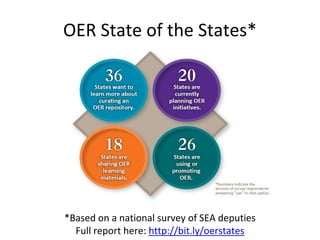
OER State of the States*
*Based on a national survey of SEA deputies
Full report here: http://bit.ly/oerstates
Selected State OER Initiatives
• Kentucky Learning Depot: P-20 Repository
(http://kylearningdepot.org)
• Minnesota Learning Commons: Statewide tools and TA around
OER https://www.oercommons.org/hubs/minnesota
– Minnesota OER Commons: Supports content creation
https://www.oercommons.org/hubs/minnesota
• Innovative Digital Education and Learning-New Mexico (IDEAL-
NM): Statewide eLearning program, LMS to share OER
http://idealnewmexico.org/
• Digital Learning Department Washington OSPI: OER Portal
http://digitallearning.k12.wa.us/oer/
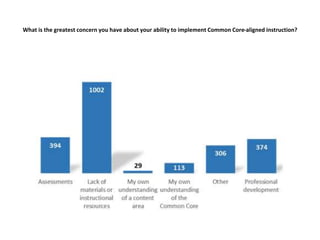
What is the greatest concern you have about your ability to implement Common Core-aligned instruction?
Why this project?
• Materials will be aligned to the Common Core
– Based on educator needs
– Enables states to collaborate
• Designed for digital
– Also, print-ready at a low cost
• Comprehensive materials
• Designed for long-term sustainability
• Openly licensed (CC BY 4.0)
• Coordinated effort of multiple states
Resources will:
• Address the CCSS Publisher’s Criteria for ELA and
Mathematics
• Include teacher materials providing strategies for
instruction for varying student needs
• Provide assessment strategies and tools that
provide sufficient guidance for interpreting
student performance
• Incorporate interactive and multimedia elements
that support quality teaching and learning
We’ll use an RFP to identify vendors
• Best way to find high-quality vendors, for best
price and timeline
• Open to all content developers
• Developers can build on existing work (as long
as the result is CC BY licensed)
Rapid Prototypes
• Allows us to pick vendors based on actual
performance
• Gives teachers and content experts
opportunity to give detailed feedback at the
start of the project
How can you get involved?
• Potential vendors
• States or districts
– Letters of support
– Educators on review teams

K12 OER Collaborative

  • 1.
    K-12 OER Collaborative Attributionto: Jennifer Wolfe, The Learning Accelerator Layla Bonnot, Council of Chief State School Officers Karl Nelson, Washington Office of Superintendent of Public Instruction
  • 2.
  • 3.
    K-12 OER CollaborativeMembers States (12) • AZ, CA, GA, ID, MN, NC, NV, OR, UT, WA, WI Supporting organizations • Council of Chief State School Officers (CCSSO) • The Learning Accelerator (TLA) • Achieve • Creative Commons • Lumen Learning • State Educational Technology Directors Association (SETDA) • State Instructional Materials Review Association (SIMRA) • Association of State Supervisors of Mathematics (ASSM)
  • 4.
    Project Goal The K-12OER Collaborative will create: • comprehensive, • high-quality, • open educational resources (OER) supporting K-12 math and ELA, aligned with state learning standards.
  • 5.
    What is OER? Instructionalmaterials that have been released under an intellectual property license that allows for: – Reuse: use the work verbatim, just exactly as you found it – Rework: alter or transform the work so that it better meets your needs – Remix: combine the (verbatim or altered) work with other works to better meet your needs – Redistribute: share the verbatim work, the reworked work, or the remixed work with others – Retain: the right to make, own, and control copies of the content
  • 6.
    Why is OERimportant for K-12? • Lowers costs of instructional materials • Increases district/state control of content – Open licenses allow resources to be modified to meet local needs – Allows schools to retain content rather than locking content into annual licensing purchases • Improves quality and allows for frequent updates
  • 7.
    OER State ofthe States* *Based on a national survey of SEA deputies Full report here: http://bit.ly/oerstates
  • 8.
    Selected State OERInitiatives • Kentucky Learning Depot: P-20 Repository (http://kylearningdepot.org) • Minnesota Learning Commons: Statewide tools and TA around OER https://www.oercommons.org/hubs/minnesota – Minnesota OER Commons: Supports content creation https://www.oercommons.org/hubs/minnesota • Innovative Digital Education and Learning-New Mexico (IDEAL- NM): Statewide eLearning program, LMS to share OER http://idealnewmexico.org/ • Digital Learning Department Washington OSPI: OER Portal http://digitallearning.k12.wa.us/oer/
  • 9.
    What is thegreatest concern you have about your ability to implement Common Core-aligned instruction?
  • 10.
    Why this project? •Materials will be aligned to the Common Core – Based on educator needs – Enables states to collaborate • Designed for digital – Also, print-ready at a low cost • Comprehensive materials • Designed for long-term sustainability • Openly licensed (CC BY 4.0) • Coordinated effort of multiple states
  • 11.
    Resources will: • Addressthe CCSS Publisher’s Criteria for ELA and Mathematics • Include teacher materials providing strategies for instruction for varying student needs • Provide assessment strategies and tools that provide sufficient guidance for interpreting student performance • Incorporate interactive and multimedia elements that support quality teaching and learning
  • 12.
    We’ll use anRFP to identify vendors • Best way to find high-quality vendors, for best price and timeline • Open to all content developers • Developers can build on existing work (as long as the result is CC BY licensed)
  • 13.
    Rapid Prototypes • Allowsus to pick vendors based on actual performance • Gives teachers and content experts opportunity to give detailed feedback at the start of the project
  • 14.
    How can youget involved? • Potential vendors • States or districts – Letters of support – Educators on review teams

Editor's Notes

  • #2 [All] If small crowd, ask for audience introductions and what they are doing around OER.
  • #4 [Jennifer]
  • #5 [Jennifer]
  • #6 [Layla]
  • #7 [Layla] -decrease cost -increase control (local spin on existing OER if needed) -increase flexibility (change content, more up-to-date, etc.)
  • #8 [Layla]- 41 respondets from 38 states, ‘sharing’ is w/LEAs, k-12
  • #9 Layla -KY peer review process, Vetting, tagging, links to NROC -WA- portal links to suggested oer sites, resources, etc.; content review/alignment process of other sources
  • #10 [Karl] In April 2014, K–12 educators from Idaho, Utah, and Washington were surveyed. Data from 2,218 educators was collected about their most important instructional materials needs and Common Core State Standards implementation concerns.
  • #11 [Karl]
  • #12 [Karl]
  • #13 [Jennifer]
  • #14 [Jennifer]
  • #15 [Jennifer] Potential vendors: give us your contact information, and we’ll let you know the moment the RFP is launched.