



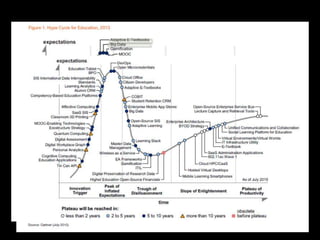
WHERE IS EDTECH HEADING?
Brian Stewart
Cybera Summit 2015
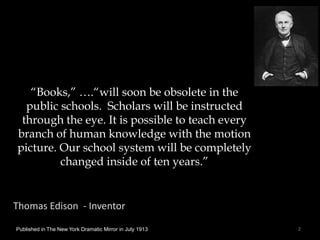
“Books,” ….“will soon be obsolete in the
public schools. Scholars will be instructed
through the eye. It is possible to teach every
branch of human knowledge with the motion
picture. Our school system will be completely
changed inside of ten years.”
Published in The New York Dramatic Mirror in July 1913
Thomas Edison - Inventor
2
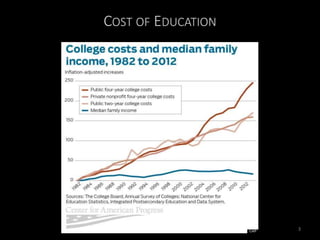
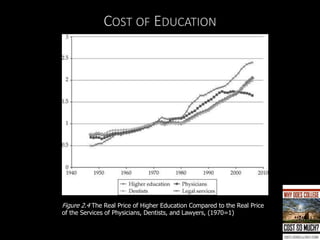
COST OF EDUCATION
3
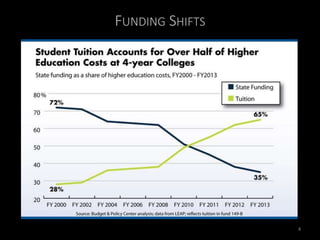
FUNDING SHIFTS
4
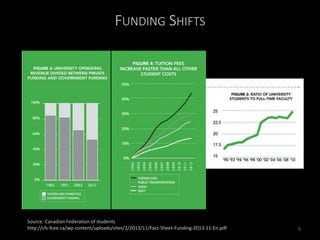
FUNDING SHIFTS
Source: Canadian Federation of students
http://cfs-fcee.ca/wp-content/uploads/sites/2/2013/11/Fact-Sheet-Funding-2013-11-En.pdf 5
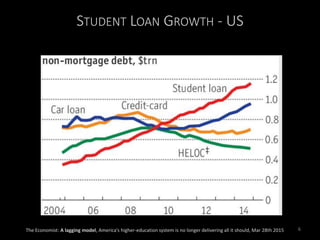
STUDENT LOAN GROWTH - US
The Economist: A lagging model, America’s higher-education system is no longer delivering all it should, Mar 28th 2015 6
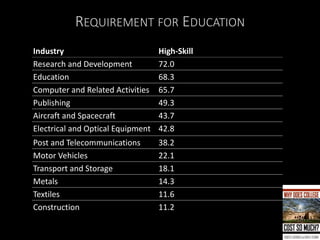
REQUIREMENT FOR EDUCATION
Industry High-Skill
Research and Development 72.0
Education 68.3
Computer and Related Activities 65.7
Publishing 49.3
Aircraft and Spacecraft 43.7
Electrical and Optical Equipment 42.8
Post and Telecommunications 38.2
Motor Vehicles 22.1
Transport and Storage 18.1
Metals 14.3
Textiles 11.6
Construction 11.2
Table 4.1 The Percentage of High-Skill Workers by Industry, 2005
7
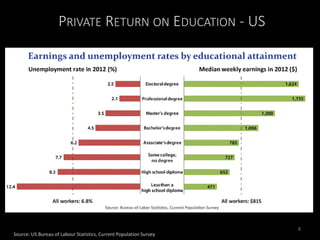
PRIVATE RETURN ON EDUCATION - US
Source: US Bureau of Labour Statistics, Current Population Survey
8
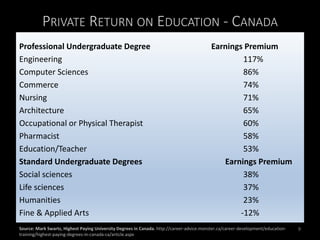
PRIVATE RETURN ON EDUCATION - CANADA
Professional Undergraduate Degree Earnings Premium
Engineering 117%
Computer Sciences 86%
Commerce 74%
Nursing 71%
Architecture 65%
Occupational or Physical Therapist 60%
Pharmacist 58%
Education/Teacher 53%
Standard Undergraduate Degrees Earnings Premium
Social sciences 38%
Life sciences 37%
Humanities 23%
Fine & Applied Arts -12%
Source: Mark Swartz, Highest Paying University Degrees in Canada. http://career-advice.monster.ca/career-development/education-
training/highest-paying-degrees-in-canada-ca/article.aspx
9
WHAT IS EDTECH
“the study and ethical practice of facilitating
learning and improving performance by
creating, using and managing appropriate
technological processes and resources.”
Source: Richey, R.C. (2008). Reflections on the 2008 AECT Definitions of the Field. TechTrends. 52(1) 24-25 10
WHAT IS ELEARNING?
“e-Learning can be defined as 'learning
facilitated and supported through the use of
information and communications
technology”.
Source: http://www.jisc.ac.uk/elearning Retrieved 2014-1-16
11
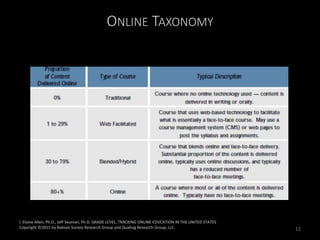
ONLINE TAXONOMY
I. Elaine Allen, Ph.D., Jeff Seaman, Ph.D. GRADE LEVEL, TRACKING ONLINE EDUCATION IN THE UNITED STATES
Copyright ©2015 by Babson Survey Research Group and Quahog Research Group, LLC. 12
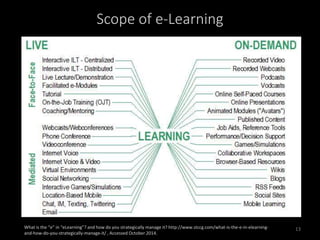
Scope of e-Learning
What is the “e” in “eLearning”? and how do you strategically manage it? http://www.stccg.com/what-is-the-e-in-elearning-
and-how-do-you-strategically-manage-it/ , Accessed October 2014.
13
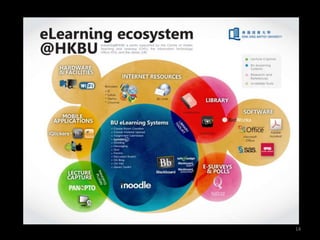
Source: http://chtl.hkbu.edu.hk/elearning/images/elearning_ecosystem.jpg
14
STUDENTS
http://gizmoninja.com/wp-content/uploads/2011/08/college-classroom-laptops.jpg
15
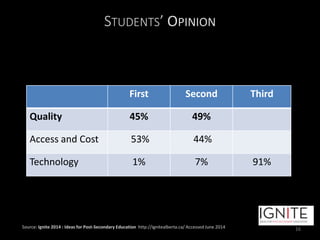
STUDENTS’ OPINION
Source: Ignite 2014 : Ideas for Post-Secondary Education http://ignitealberta.ca/ Accessed June 2014
First Second Third
Quality 45% 49%
Access and Cost 53% 44%
Technology 1% 7% 91%
16
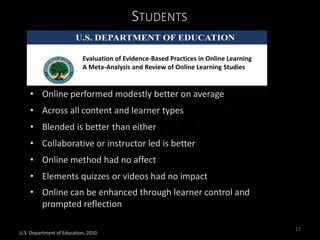
Evaluation of Evidence-Based Practices in Online Learning
A Meta-Analysis and Review of Online Learning Studies
STUDENTS
• Online performed modestly better on average
• Across all content and learner types
• Blended is better than either
• Collaborative or instructor led is better
• Online method had no affect
• Elements quizzes or videos had no impact
• Online can be enhanced through learner control and
prompted reflection
U.S. Department of Education, 2010
17
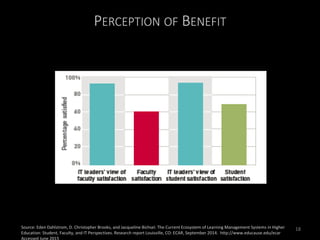
PERCEPTION OF BENEFIT
Source: Eden Dahlstrom, D. Christopher Brooks, and Jacqueline Bichsel. The Current Ecosystem of Learning Management Systems in Higher
Education: Student, Faculty, and IT Perspectives. Research report Louisville, CO: ECAR, September 2014. http://www.educause.edu/ecar
Accessed June 2015
18
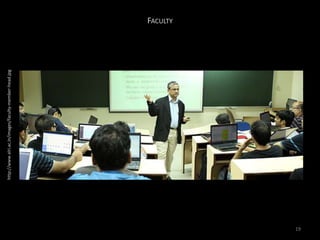
FACULTY
http://www.xlri.ac.in/images/faculty-member-head.jpg
19
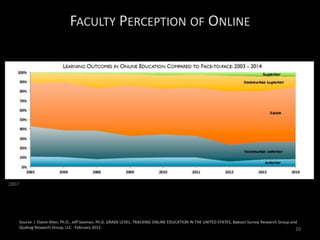
FACULTY PERCEPTION OF ONLINE
2807
Source: I. Elaine Allen, Ph.D., Jeff Seaman, Ph.D. GRADE LEVEL, TRACKING ONLINE EDUCATION IN THE UNITED STATES, Babson Survey Research Group and
Quahog Research Group, LLC. February 2015. 20
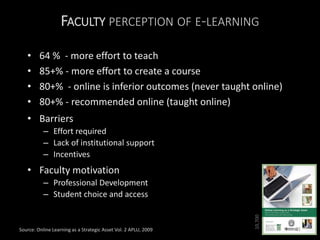
FACULTY PERCEPTION OF E-LEARNING
• 64 % - more effort to teach
• 85+% - more effort to create a course
• 80+% - online is inferior outcomes (never taught online)
• 80+% - recommended online (taught online)
• Barriers
– Effort required
– Lack of institutional support
– Incentives
• Faculty motivation
– Professional Development
– Student choice and access
Source: Online Learning as a Strategic Asset Vol. 2 APLU, 2009
10,700
21
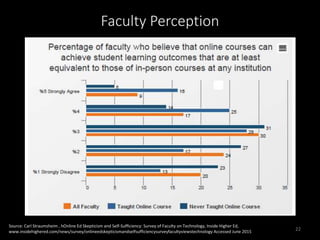
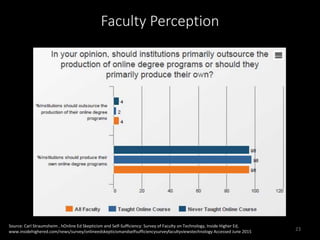
Faculty Perception
22
Source: Carl Straumsheim , hOnline Ed Skepticism and Self-Sufficiency: Survey of Faculty on Technology, Inside Higher Ed,
www.insidehighered.com/news/survey/onlineedskepticismandselfsufficiencysurveyfacultyviewstechnology Accessed June 2015
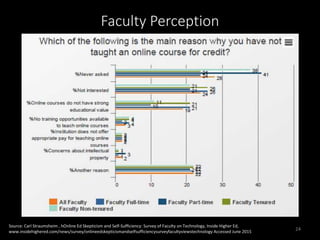
23
Source: Carl Straumsheim , hOnline Ed Skepticism and Self-Sufficiency: Survey of Faculty on Technology, Inside Higher Ed,
www.insidehighered.com/news/survey/onlineedskepticismandselfsufficiencysurveyfacultyviewstechnology Accessed June 2015
Faculty Perception
24
Source: Carl Straumsheim , hOnline Ed Skepticism and Self-Sufficiency: Survey of Faculty on Technology, Inside Higher Ed,
www.insidehighered.com/news/survey/onlineedskepticismandselfsufficiencysurveyfacultyviewstechnology Accessed June 2015
Faculty Perception
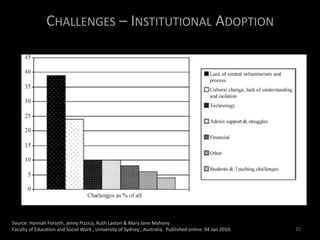
CHALLENGES – INSTITUTIONAL ADOPTION
Source: Hannah Forsyth, Jenny Pizzica, Ruth Laxton & Mary Jane Mahony
Faculty of Education and Social Work , University of Sydney , Australia. Published online: 04 Jan 2010. 25
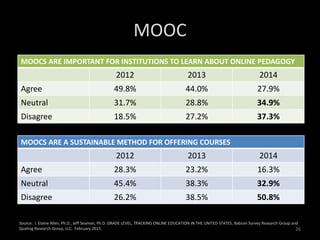
MOOC
MOOCS ARE A SUSTAINABLE METHOD FOR OFFERING COURSES
2012 2013 2014
Agree 28.3% 23.2% 16.3%
Neutral 45.4% 38.3% 32.9%
Disagree 26.2% 38.5% 50.8%
Source: I. Elaine Allen, Ph.D., Jeff Seaman, Ph.D. GRADE LEVEL, TRACKING ONLINE EDUCATION IN THE UNITED STATES, Babson Survey Research Group and
Quahog Research Group, LLC. February 2015.
MOOCS ARE IMPORTANT FOR INSTITUTIONS TO LEARN ABOUT ONLINE PEDAGOGY
2012 2013 2014
Agree 49.8% 44.0% 27.9%
Neutral 31.7% 28.8% 34.9%
Disagree 18.5% 27.2% 37.3%
26
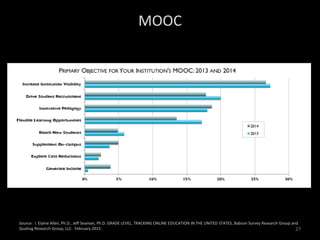
MOOC
Source: I. Elaine Allen, Ph.D., Jeff Seaman, Ph.D. GRADE LEVEL, TRACKING ONLINE EDUCATION IN THE UNITED STATES, Babson Survey Research Group and
Quahog Research Group, LLC. February 2015. 27
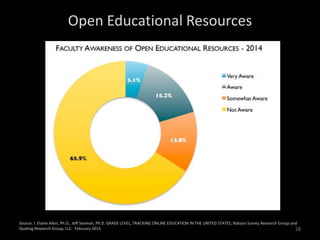
Open Educational Resources
Source: I. Elaine Allen, Ph.D., Jeff Seaman, Ph.D. GRADE LEVEL, TRACKING ONLINE EDUCATION IN THE UNITED STATES, Babson Survey Research Group and
Quahog Research Group, LLC. February 2015. 28
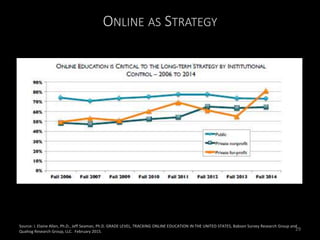
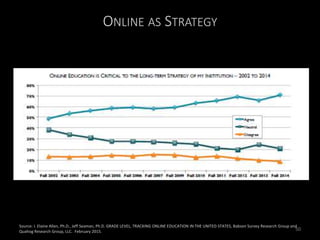
ONLINE AS STRATEGY
Source: I. Elaine Allen, Ph.D., Jeff Seaman, Ph.D. GRADE LEVEL, TRACKING ONLINE EDUCATION IN THE UNITED STATES, Babson Survey Research Group and
Quahog Research Group, LLC. February 2015. 29
Cultural Norms
• Technology Disrupts the relationships between
students and teachers. It moves from teacher centric
to a broader technology afforded enablement. The
teacher is no longer the chief protagonist
• This may be a reason the hybrid model is accepted, it
still keeps the teacher’s central role
• The adoption of EdTech is not just about teacher’s
ability to use technology
30
• Technology
31
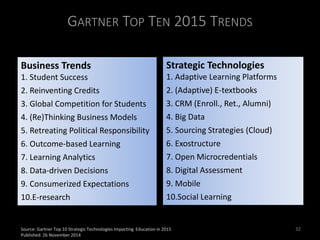
GARTNER TOP TEN 2015 TRENDS
Business Trends
1. Student Success
2. Reinventing Credits
3. Global Competition for Students
4. (Re)Thinking Business Models
5. Retreating Political Responsibility
6. Outcome-based Learning
7. Learning Analytics
8. Data-driven Decisions
9. Consumerized Expectations
10.E-research
Strategic Technologies
1. Adaptive Learning Platforms
2. (Adaptive) E-textbooks
3. CRM (Enroll., Ret., Alumni)
4. Big Data
5. Sourcing Strategies (Cloud)
6. Exostructure
7. Open Microcredentials
8. Digital Assessment
9. Mobile
10.Social Learning
Source: Gartner Top 10 Strategic Technologies Impacting Education in 2015
Published: 26 November 2014
32
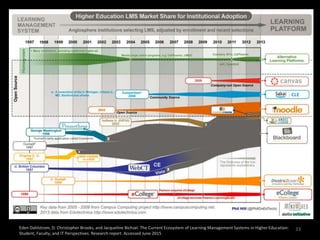
Eden Dahlstrom, D. Christopher Brooks, and Jacqueline Bichsel. The Current Ecosystem of Learning Management Systems in HigherEducation:
Student, Faculty, and IT Perspectives. Research report. Accessed June 2015
33
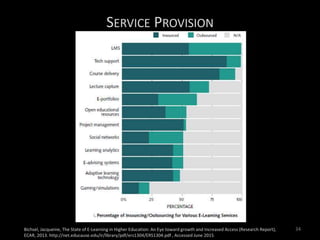
SERVICE PROVISION
Bichsel, Jacqueine, The State of E-Learning in Higher Education: An Eye toward growth and Increased Access (Research Report),
ECAR, 2013. http://net.educause.edu/ir/library/pdf/ers1304/ERS1304.pdf , Accessed June 2015
34
35
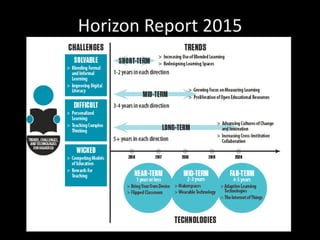
Horizon Report 2015
37http://www.ambientinsight.com/Resources/Documents/AmbientInsight_2015_Q1_Global_Edtech_InvestmentPatterns.pdf
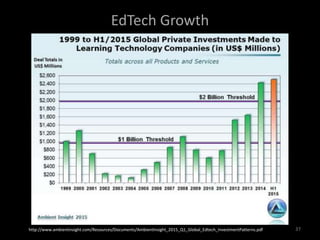
EdTech Growth
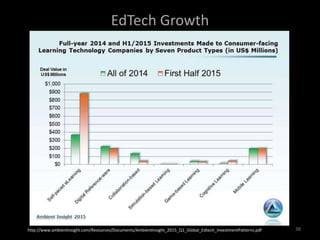
EdTech Growth
38http://www.ambientinsight.com/Resources/Documents/AmbientInsight_2015_Q1_Global_Edtech_InvestmentPatterns.pdf
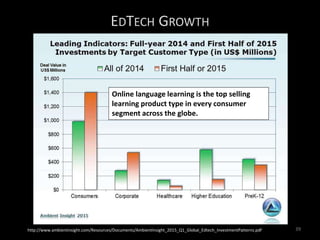
EDTECH GROWTH
39http://www.ambientinsight.com/Resources/Documents/AmbientInsight_2015_Q1_Global_Edtech_InvestmentPatterns.pdf
Online language learning is the top selling
learning product type in every consumer
segment across the globe.
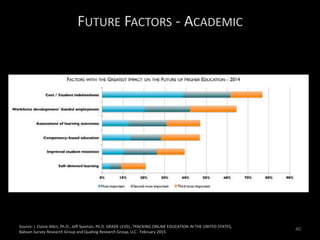
FUTURE FACTORS - ACADEMIC
Source: I. Elaine Allen, Ph.D., Jeff Seaman, Ph.D. GRADE LEVEL, TRACKING ONLINE EDUCATION IN THE UNITED STATES,
Babson Survey Research Group and Quahog Research Group, LLC. February 2015.
40
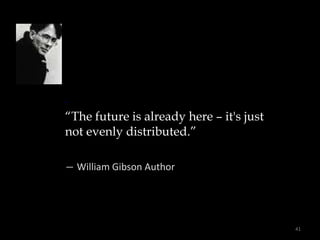
“The future is already here – it's just
not evenly distributed.”
― William Gibson Author
41
THANK YOU
BRIAN STEWART
brstewar@ualberta.ca
42
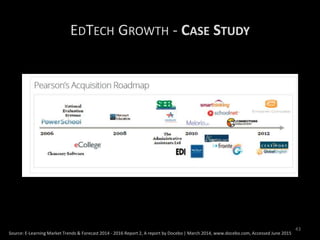
EDTECH GROWTH - CASE STUDY
Source: E-Learning Market Trends & Forecast 2014 - 2016 Report 2, A report by Docebo | March 2014, www.docebo.com, Accessed June 2015
43
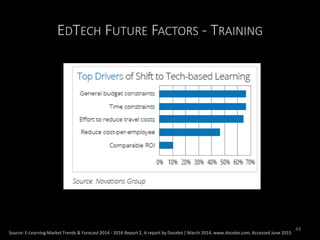
EDTECH FUTURE FACTORS - TRAINING
Source: E-Learning Market Trends & Forecast 2014 - 2016 Report 2, A report by Docebo | March 2014, www.docebo.com, Accessed June 2015
44
45
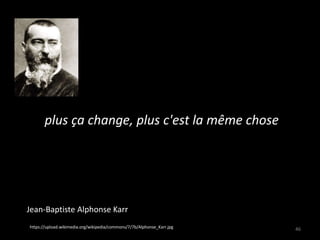
plus ça change, plus c'est la même chose
46https://upload.wikimedia.org/wikipedia/commons/7/7b/Alphonse_Karr.jpg
Jean-Baptiste Alphonse Karr
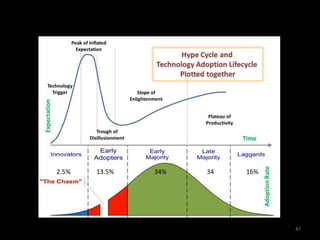
http://www.kurtsoeser.at/wp-content/uploads/2013/10/technology-adoption.png
2.5% 13.5% 34% 34 16%
47
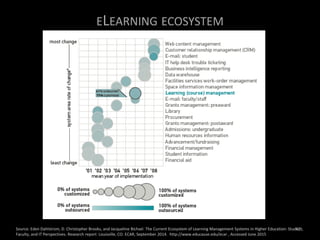
Source: Eden Dahlstrom, D. Christopher Brooks, and Jacqueline Bichsel. The Current Ecosystem of Learning Management Systems in Higher Education: Student,
Faculty, and IT Perspectives. Research report Louisville, CO: ECAR, September 2014. http://www.educause.edu/ecar , Accessed June 2015
ELEARNING ECOSYSTEM
48
COST OF EDUCATION
Figure 2.4 The Real Price of Higher Education Compared to the Real Price
of the Services of Physicians, Dentists, and Lawyers, (1970=1)
49
ONLINE AS STRATEGY
Source: I. Elaine Allen, Ph.D., Jeff Seaman, Ph.D. GRADE LEVEL, TRACKING ONLINE EDUCATION IN THE UNITED STATES, Babson Survey Research Group and
Quahog Research Group, LLC. February 2015. 50
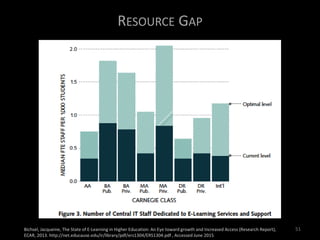
RESOURCE GAP
Bichsel, Jacqueine, The State of E-Learning in Higher Education: An Eye toward growth and Increased Access (Research Report),
ECAR, 2013. http://net.educause.edu/ir/library/pdf/ers1304/ERS1304.pdf , Accessed June 2015
51
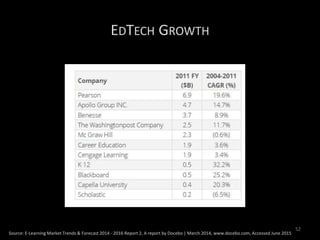
EDTECH GROWTH
Source: E-Learning Market Trends & Forecast 2014 - 2016 Report 2, A report by Docebo | March 2014, www.docebo.com, Accessed June 2015
52

Where is EdTech Heading?

  • 1.
    WHERE IS EDTECHHEADING? Brian Stewart Cybera Summit 2015
  • 2.
    “Books,” ….“will soonbe obsolete in the public schools. Scholars will be instructed through the eye. It is possible to teach every branch of human knowledge with the motion picture. Our school system will be completely changed inside of ten years.” Published in The New York Dramatic Mirror in July 1913 Thomas Edison - Inventor 2
  • 3.
  • 4.
  • 5.
    FUNDING SHIFTS Source: CanadianFederation of students http://cfs-fcee.ca/wp-content/uploads/sites/2/2013/11/Fact-Sheet-Funding-2013-11-En.pdf 5
  • 6.
    STUDENT LOAN GROWTH- US The Economist: A lagging model, America’s higher-education system is no longer delivering all it should, Mar 28th 2015 6
  • 7.
    REQUIREMENT FOR EDUCATION IndustryHigh-Skill Research and Development 72.0 Education 68.3 Computer and Related Activities 65.7 Publishing 49.3 Aircraft and Spacecraft 43.7 Electrical and Optical Equipment 42.8 Post and Telecommunications 38.2 Motor Vehicles 22.1 Transport and Storage 18.1 Metals 14.3 Textiles 11.6 Construction 11.2 Table 4.1 The Percentage of High-Skill Workers by Industry, 2005 7
  • 8.
    PRIVATE RETURN ONEDUCATION - US Source: US Bureau of Labour Statistics, Current Population Survey 8
  • 9.
    PRIVATE RETURN ONEDUCATION - CANADA Professional Undergraduate Degree Earnings Premium Engineering 117% Computer Sciences 86% Commerce 74% Nursing 71% Architecture 65% Occupational or Physical Therapist 60% Pharmacist 58% Education/Teacher 53% Standard Undergraduate Degrees Earnings Premium Social sciences 38% Life sciences 37% Humanities 23% Fine & Applied Arts -12% Source: Mark Swartz, Highest Paying University Degrees in Canada. http://career-advice.monster.ca/career-development/education- training/highest-paying-degrees-in-canada-ca/article.aspx 9
  • 10.
    WHAT IS EDTECH “thestudy and ethical practice of facilitating learning and improving performance by creating, using and managing appropriate technological processes and resources.” Source: Richey, R.C. (2008). Reflections on the 2008 AECT Definitions of the Field. TechTrends. 52(1) 24-25 10
  • 11.
    WHAT IS ELEARNING? “e-Learningcan be defined as 'learning facilitated and supported through the use of information and communications technology”. Source: http://www.jisc.ac.uk/elearning Retrieved 2014-1-16 11
  • 12.
    ONLINE TAXONOMY I. ElaineAllen, Ph.D., Jeff Seaman, Ph.D. GRADE LEVEL, TRACKING ONLINE EDUCATION IN THE UNITED STATES Copyright ©2015 by Babson Survey Research Group and Quahog Research Group, LLC. 12
  • 13.
    Scope of e-Learning Whatis the “e” in “eLearning”? and how do you strategically manage it? http://www.stccg.com/what-is-the-e-in-elearning- and-how-do-you-strategically-manage-it/ , Accessed October 2014. 13
  • 14.
  • 15.
  • 16.
    STUDENTS’ OPINION Source: Ignite2014 : Ideas for Post-Secondary Education http://ignitealberta.ca/ Accessed June 2014 First Second Third Quality 45% 49% Access and Cost 53% 44% Technology 1% 7% 91% 16
  • 17.
    Evaluation of Evidence-BasedPractices in Online Learning A Meta-Analysis and Review of Online Learning Studies STUDENTS • Online performed modestly better on average • Across all content and learner types • Blended is better than either • Collaborative or instructor led is better • Online method had no affect • Elements quizzes or videos had no impact • Online can be enhanced through learner control and prompted reflection U.S. Department of Education, 2010 17
  • 18.
    PERCEPTION OF BENEFIT Source:Eden Dahlstrom, D. Christopher Brooks, and Jacqueline Bichsel. The Current Ecosystem of Learning Management Systems in Higher Education: Student, Faculty, and IT Perspectives. Research report Louisville, CO: ECAR, September 2014. http://www.educause.edu/ecar Accessed June 2015 18
  • 19.
  • 20.
    FACULTY PERCEPTION OFONLINE 2807 Source: I. Elaine Allen, Ph.D., Jeff Seaman, Ph.D. GRADE LEVEL, TRACKING ONLINE EDUCATION IN THE UNITED STATES, Babson Survey Research Group and Quahog Research Group, LLC. February 2015. 20
  • 21.
    FACULTY PERCEPTION OFE-LEARNING • 64 % - more effort to teach • 85+% - more effort to create a course • 80+% - online is inferior outcomes (never taught online) • 80+% - recommended online (taught online) • Barriers – Effort required – Lack of institutional support – Incentives • Faculty motivation – Professional Development – Student choice and access Source: Online Learning as a Strategic Asset Vol. 2 APLU, 2009 10,700 21
  • 22.
    Faculty Perception 22 Source: CarlStraumsheim , hOnline Ed Skepticism and Self-Sufficiency: Survey of Faculty on Technology, Inside Higher Ed, www.insidehighered.com/news/survey/onlineedskepticismandselfsufficiencysurveyfacultyviewstechnology Accessed June 2015
  • 23.
    23 Source: Carl Straumsheim, hOnline Ed Skepticism and Self-Sufficiency: Survey of Faculty on Technology, Inside Higher Ed, www.insidehighered.com/news/survey/onlineedskepticismandselfsufficiencysurveyfacultyviewstechnology Accessed June 2015 Faculty Perception
  • 24.
    24 Source: Carl Straumsheim, hOnline Ed Skepticism and Self-Sufficiency: Survey of Faculty on Technology, Inside Higher Ed, www.insidehighered.com/news/survey/onlineedskepticismandselfsufficiencysurveyfacultyviewstechnology Accessed June 2015 Faculty Perception
  • 25.
    CHALLENGES – INSTITUTIONALADOPTION Source: Hannah Forsyth, Jenny Pizzica, Ruth Laxton & Mary Jane Mahony Faculty of Education and Social Work , University of Sydney , Australia. Published online: 04 Jan 2010. 25
  • 26.
    MOOC MOOCS ARE ASUSTAINABLE METHOD FOR OFFERING COURSES 2012 2013 2014 Agree 28.3% 23.2% 16.3% Neutral 45.4% 38.3% 32.9% Disagree 26.2% 38.5% 50.8% Source: I. Elaine Allen, Ph.D., Jeff Seaman, Ph.D. GRADE LEVEL, TRACKING ONLINE EDUCATION IN THE UNITED STATES, Babson Survey Research Group and Quahog Research Group, LLC. February 2015. MOOCS ARE IMPORTANT FOR INSTITUTIONS TO LEARN ABOUT ONLINE PEDAGOGY 2012 2013 2014 Agree 49.8% 44.0% 27.9% Neutral 31.7% 28.8% 34.9% Disagree 18.5% 27.2% 37.3% 26
  • 27.
    MOOC Source: I. ElaineAllen, Ph.D., Jeff Seaman, Ph.D. GRADE LEVEL, TRACKING ONLINE EDUCATION IN THE UNITED STATES, Babson Survey Research Group and Quahog Research Group, LLC. February 2015. 27
  • 28.
    Open Educational Resources Source:I. Elaine Allen, Ph.D., Jeff Seaman, Ph.D. GRADE LEVEL, TRACKING ONLINE EDUCATION IN THE UNITED STATES, Babson Survey Research Group and Quahog Research Group, LLC. February 2015. 28
  • 29.
    ONLINE AS STRATEGY Source:I. Elaine Allen, Ph.D., Jeff Seaman, Ph.D. GRADE LEVEL, TRACKING ONLINE EDUCATION IN THE UNITED STATES, Babson Survey Research Group and Quahog Research Group, LLC. February 2015. 29
  • 30.
    Cultural Norms • TechnologyDisrupts the relationships between students and teachers. It moves from teacher centric to a broader technology afforded enablement. The teacher is no longer the chief protagonist • This may be a reason the hybrid model is accepted, it still keeps the teacher’s central role • The adoption of EdTech is not just about teacher’s ability to use technology 30
  • 31.
  • 32.
    GARTNER TOP TEN2015 TRENDS Business Trends 1. Student Success 2. Reinventing Credits 3. Global Competition for Students 4. (Re)Thinking Business Models 5. Retreating Political Responsibility 6. Outcome-based Learning 7. Learning Analytics 8. Data-driven Decisions 9. Consumerized Expectations 10.E-research Strategic Technologies 1. Adaptive Learning Platforms 2. (Adaptive) E-textbooks 3. CRM (Enroll., Ret., Alumni) 4. Big Data 5. Sourcing Strategies (Cloud) 6. Exostructure 7. Open Microcredentials 8. Digital Assessment 9. Mobile 10.Social Learning Source: Gartner Top 10 Strategic Technologies Impacting Education in 2015 Published: 26 November 2014 32
  • 33.
    Eden Dahlstrom, D.Christopher Brooks, and Jacqueline Bichsel. The Current Ecosystem of Learning Management Systems in HigherEducation: Student, Faculty, and IT Perspectives. Research report. Accessed June 2015 33
  • 34.
    SERVICE PROVISION Bichsel, Jacqueine,The State of E-Learning in Higher Education: An Eye toward growth and Increased Access (Research Report), ECAR, 2013. http://net.educause.edu/ir/library/pdf/ers1304/ERS1304.pdf , Accessed June 2015 34
  • 35.
  • 36.
  • 37.
  • 38.
  • 39.
    EDTECH GROWTH 39http://www.ambientinsight.com/Resources/Documents/AmbientInsight_2015_Q1_Global_Edtech_InvestmentPatterns.pdf Online languagelearning is the top selling learning product type in every consumer segment across the globe.
  • 40.
    FUTURE FACTORS -ACADEMIC Source: I. Elaine Allen, Ph.D., Jeff Seaman, Ph.D. GRADE LEVEL, TRACKING ONLINE EDUCATION IN THE UNITED STATES, Babson Survey Research Group and Quahog Research Group, LLC. February 2015. 40
  • 41.
    “The future isalready here – it's just not evenly distributed.” ― William Gibson Author 41
  • 42.
  • 43.
    EDTECH GROWTH -CASE STUDY Source: E-Learning Market Trends & Forecast 2014 - 2016 Report 2, A report by Docebo | March 2014, www.docebo.com, Accessed June 2015 43
  • 44.
    EDTECH FUTURE FACTORS- TRAINING Source: E-Learning Market Trends & Forecast 2014 - 2016 Report 2, A report by Docebo | March 2014, www.docebo.com, Accessed June 2015 44
  • 45.
  • 46.
    plus ça change,plus c'est la même chose 46https://upload.wikimedia.org/wikipedia/commons/7/7b/Alphonse_Karr.jpg Jean-Baptiste Alphonse Karr
  • 47.
  • 48.
    Source: Eden Dahlstrom,D. Christopher Brooks, and Jacqueline Bichsel. The Current Ecosystem of Learning Management Systems in Higher Education: Student, Faculty, and IT Perspectives. Research report Louisville, CO: ECAR, September 2014. http://www.educause.edu/ecar , Accessed June 2015 ELEARNING ECOSYSTEM 48
  • 49.
    COST OF EDUCATION Figure2.4 The Real Price of Higher Education Compared to the Real Price of the Services of Physicians, Dentists, and Lawyers, (1970=1) 49
  • 50.
    ONLINE AS STRATEGY Source:I. Elaine Allen, Ph.D., Jeff Seaman, Ph.D. GRADE LEVEL, TRACKING ONLINE EDUCATION IN THE UNITED STATES, Babson Survey Research Group and Quahog Research Group, LLC. February 2015. 50
  • 51.
    RESOURCE GAP Bichsel, Jacqueine,The State of E-Learning in Higher Education: An Eye toward growth and Increased Access (Research Report), ECAR, 2013. http://net.educause.edu/ir/library/pdf/ers1304/ERS1304.pdf , Accessed June 2015 51
  • 52.
    EDTECH GROWTH Source: E-LearningMarket Trends & Forecast 2014 - 2016 Report 2, A report by Docebo | March 2014, www.docebo.com, Accessed June 2015 52

Editor's Notes

  • #9 Source: US Bureau of Labour Statistics, Current Population Survey, Retrieved 2014-3-05, http://www.bls.gov/emp/ep_chart_001.htm Studies put the IRR to a university education at 20% a 4:1 return on each invested dollar (UK) Parents are struggling to reconcile conflicting views about the value of higher education for their children: more than half believe that fees of up to £9,000 a year represent poor value for money, yet a majority still regard a traditional university education as the best route to a chosen career, according to a YouGov poll. The survey of parents across all social backgrounds of secondary school-age pupils in England and Wales, commissioned by the Guardian, shows that only 14% think tuition fees offer a good deal, while almost 60% think degrees aren't worth the money. It also suggests that parents are now open to cheaper alternatives to the conventional full-time university route: a majority (57%) said internet-based courses in which students watch lectures online are a good idea, and almost half were positive about apprenticeships. The poll also highlights the continuing social divide that determines whether a young person goes to university. Eight out of 10 families with an annual income of more than £50,000 expect their child to apply to university, but that falls to 56% where parents have an income below £20,000. The "hereditary" element to higher education persists: three-quarters of graduate parents think their children will apply, but only 46% of those who left school at 16 see their children at university.... Two-thirds of the 1,100 parents with a child aged 11 to 17 ranked a course delivered traditionally on-site at a university as a good route into a preferred job – placing a full-time degree well above other options such as an apprenticeship, online degree or vocational qualification. Support was not only about pragmatism: even more parents (69%) told pollsters they thought university should be valued for its own sake and not only as a route to a job. (YEAH!) http://www.theguardian.com/politics/2014/mar/04/michael-gove-education-secretary-child-state-secondary-school
  • #12 It can cover a spectrum of activities from the use of technology to support learning as part of a ‘blended’ approach (a combination of traditional and e-learning approaches), to learning that is delivered entirely online. Whatever the technology, however, learning is the vital element.”
  • #15 http://chtl.hkbu.edu.hk/elearning/images/elearning_ecosystem.jpg
  • #18 Evaluation of Evidence-Based Practices in Online Learning A Meta-Analysis and Review of Online Learning Studies, U.S. Department of Education, 2010 A meta-analysis of 50 study effects, 43 of which were drawn from research with older learners, found that: Students in online conditions performed modestly better, on average, than those learning the same material through traditional face-to-face instruction. Instruction combining online and face-to-face elements had a larger advantage relative to purely face-to-face instruction than did purely online instruction. Effect sizes were larger for studies in which the online instruction was collaborative or instructor-directed than in those studies where online learners worked independently Most of the variations in the way in which different studies implemented online learning did not affect student learning outcomes significantly. The effectiveness of online learning is apparent across different content and learner types. Elements such as video or online quizzes do not appear to influence the amount that students learn in online classes. Online learning can be enhanced by giving learners control of their interactions with media and prompting learner reflection.
  • #22  Jeff Seaman, Ph.D. Co-Director, Babson Survey Research Group Babson College Online Learning as a Strategic Asset Volume II: The Paradox of Faculty Voice: Views and Experiences with Online Learning 2009 Retrieved 2014-3-5 http://www.aplu.org/page.aspx?pid=1593#Online This two-volume report, Online Learning as a Strategic Asset, contains the results of 231 interviews conducted with administrators, faculty, and students at 45 public institutions across the country and more than 10,700 responses from faculty across the spectrum of teaching positions – tenure/non-tenure track; full- and part-time; and both those who have and those who have not taught online. The report was underwritten by a grant from the Alfred P. Sloan Foundation.
  • #28 STATUS OF MOOC OFFERINGS – 2012, 2013, AND 2014 2012 2013 2014 Have a MOOC 2.6% 5.0% 8.0% Planning a MOOC 9.4% 9.3% 5.6% STATUS OF MOOC OFFERINGS – 2012, 2013, AND 2014 2012 2013 2014 No Plans 33.7% 33.0% 46.5% Not Decided 54.2% 52.7% 39.9% PRIMARY OBJECTIVE FOR YOUR INSTITUTION'S MOOC – 2013 2013 2014 Generate Income .4% 3.8% Explore Cost Reductions 2.0% 2.4% Supplement On-campus 3.6% 4.9% Reach New Students 5.8% 4.8% Flexible Learning Opportunities 17.2% 13.5% Innovative Pedagogy 18.0% 18.7% Drive Student Recruitment 20.0% 17.8% Increase Institution Visibility 27.2% 26.6% MOOCS ARE A SUSTAINABLE METHOD FOR OFFERING COURSES –2012, 2013 AND 2014 2012 2013 2014 Disagree 26.2% 38.5% 50.8% Neutral 45.4% 38.3% 32.9% Agree 28.3% 23.2% 16.3% MOOCS ARE IMPORTANT FOR INSTITUTIONS TO LEARN ABOUT ONLINE PEDAGOGY – 2012, 2013 AND 2014 2012 2013 2014 Agree 49.8% 44.0% 27.9% Neutral 31.7% 28.8% 34.9% Disagree 18.5% 27.2% 37.3% The universe of active, degree-granting higher education institutions that are open to the public contains 4,891 institutions; a total of 2,807 survey responses were included in the analysis, representing 57.4% of the sample universe. Because non-responding institutions are predominately those with the smallest enrollments, the institutions included in the analysis represent 78.7% percent of higher education enrollments. The 2013 responses were merged with the data from the previous survey years (994 responses in 2003, 1,170 in 2004, 1,025 in 2005, 2,251 in 2006, 2,504 in 2007, 2,577 in 2008, 2,590 in 2009, 2,583 in 2010, 2,512 in 2011 2,820 in 2012, and 2,831 in 2013) for examination of changes over time.
  • #33  Exostructure strategy means acquiring the critical capability of interoperability as a deliberate strategy to leverage the increasing numbers of partnerships, tools and services in the education ecosystem.
  • #35 Bichsel, Jacqueine, The State of E-Learning in Higher Education: An Eye toward growth and Increased Access (Research Report), Louisville, Co: EDUCAUSE Center for Analytics and Research, June 2013 available from http://www.educuse.edu/ecar
  • #39 Digital Reference-ware is digital video, text, or audio reference content that includes academic content, "how to" content, technical reference, scientific abstracts, medical research, and market research content. Digital audiobooks, eBooks, eTextbooks, video Ambient Insight's 2012 Global Analysis of Learning Technology Investment Patterns For more information about this research, email: info@ambientinsight.com 9 course, and online technical manuals are common formats. The three top-funded Digital Reference-ware companies funded in 2012 were Echo360 (a lecture capture company), the Wikimedia Foundation, and Chegg, who garnered $31 million, $28 million, and $25 million, respectively
  • #48 Kurt Soser’s Blog