openpolicynetwork.org
WHY?
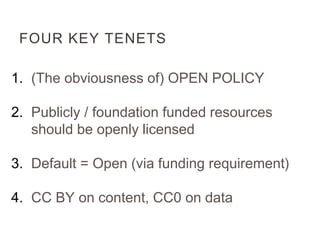
FOUR KEY TENETS
1. (The obviousness of) OPEN POLICY
2. Publicly / foundation funded resources
should be openly licensed
3. Default = Open (via funding requirement)
4. CC BY on content, CC0 on data
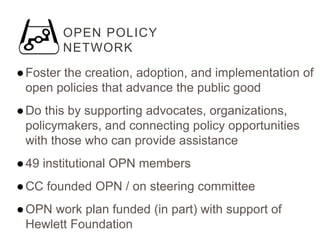
OPEN POLICY
NETWORK
●Foster the creation, adoption, and implementation of
open policies that advance the public good
●Do this by supporting advocates, organizations,
policymakers, and connecting policy opportunities
with those who can provide assistance
●49 institutional OPN members
●CC founded OPN / on steering committee
●OPN work plan funded (in part) with support of
Hewlett Foundation
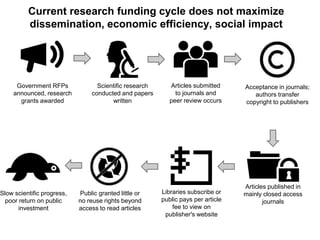
Current research funding cycle does not maximize
dissemination, economic efficiency, social impact
Government RFPs
announced, research
grants awarded
Scientific research
conducted and papers
written
Articles submitted
to journals and
peer review occurs
Acceptance in journals;
authors transfer
copyright to publishers
Articles published in
mainly closed access
journals
Libraries subscribe or
public pays per article
fee to view on
publisher's website
Public granted little or
no reuse rights beyond
access to read articles
Slow scientific progress,
poor return on public
investment
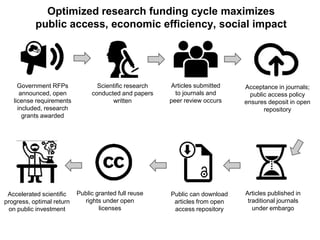
Optimized research funding cycle maximizes
public access, economic efficiency, social impact
Government RFPs
announced, open
license requirements
included, research
grants awarded
Scientific research
conducted and papers
written
Acceptance in journals;
public access policy
ensures deposit in open
repository
Articles published in
traditional journals
under embargo
Public can download
articles from open
access repository
Public granted full reuse
rights under open
licenses
Accelerated scientific
progress, optimal return
on public investment
Articles submitted
to journals and
peer review occurs
Publicly funded
resources should be
openly licensed
resources.
EXAMPLE
$2 billion over four years
CC BY required
● Warsaw CC Summit 2011
● OER on the radar of policymakers
● affiliates requested support
● current efforts decentralized and uncoordinated
● need a network to share and discuss
● need best data, toolkits, arguments
● let’s not miss opportunities that arise!
IDEA
MISSION
● Foster the creation, adoption, and
implementation of open policies that advance
the public good.
● Do this by supporting advocates,
organizations, policymakers, and connecting
policy opportunities with those who can
provide assistance.
PRINCIPLES
● ‘Open Policy’: publicly funded resources are
openly licensed resources
● Default aim for policy licensing: Open Definition (with
preference for CC BY and CC0).
● Do not recreate the wheel; leverage expertise
● Work from existing policy recommendations: Paris
OER, BOAI, Panton Principles, Communia, etc.
● Free for anyone to join. Contribute and abide by
mission and guiding principles.
WORK PLAN
● Link to, catalog, and curate existing policy resources.
● Build new resources and/or services only where
capacity or expertise does not currently exist.
● Connect policy makers to experts.
● Provide baseline level of assistance for all
opportunities.
● Share information with openly with members and the
public, using open licenses (of course), multiple
languages, transparent fashion.
opn@creativecommons.org
Credits
● Institution - by Thibault Geffroy from the Noun Project - CC BY
● Big idea - from the Noun Project, Public Domain
● Blueprint - by Dimitry Sokolov from The Noun Project - CC BY
● Check List - by fabrice dubuy from The Noun Project - CC BY
● Hackathon - by Iconathon 2012 - CC0
This work is dedicated to the public domain.
https://creativecommons.org/publicdomain/zero/1.0/.
Attribution is optional, but if desired, please attribute to Creative Commons. Some
content such as screenshots may appear here under exceptions and limitations to
copyright and trademark law--such as fair use--and may not be covered by CC0.

Open Policy Network #oeglobal

  • 1.
  • 2.
  • 3.
    FOUR KEY TENETS 1.(The obviousness of) OPEN POLICY 2. Publicly / foundation funded resources should be openly licensed 3. Default = Open (via funding requirement) 4. CC BY on content, CC0 on data
  • 4.
    OPEN POLICY NETWORK ●Foster thecreation, adoption, and implementation of open policies that advance the public good ●Do this by supporting advocates, organizations, policymakers, and connecting policy opportunities with those who can provide assistance ●49 institutional OPN members ●CC founded OPN / on steering committee ●OPN work plan funded (in part) with support of Hewlett Foundation
  • 5.
    Current research fundingcycle does not maximize dissemination, economic efficiency, social impact Government RFPs announced, research grants awarded Scientific research conducted and papers written Articles submitted to journals and peer review occurs Acceptance in journals; authors transfer copyright to publishers Articles published in mainly closed access journals Libraries subscribe or public pays per article fee to view on publisher's website Public granted little or no reuse rights beyond access to read articles Slow scientific progress, poor return on public investment
  • 6.
    Optimized research fundingcycle maximizes public access, economic efficiency, social impact Government RFPs announced, open license requirements included, research grants awarded Scientific research conducted and papers written Acceptance in journals; public access policy ensures deposit in open repository Articles published in traditional journals under embargo Public can download articles from open access repository Public granted full reuse rights under open licenses Accelerated scientific progress, optimal return on public investment Articles submitted to journals and peer review occurs
  • 7.
    Publicly funded resources shouldbe openly licensed resources.
  • 8.
  • 9.
    $2 billion overfour years CC BY required
  • 10.
    ● Warsaw CCSummit 2011 ● OER on the radar of policymakers ● affiliates requested support ● current efforts decentralized and uncoordinated ● need a network to share and discuss ● need best data, toolkits, arguments ● let’s not miss opportunities that arise! IDEA
  • 11.
    MISSION ● Foster thecreation, adoption, and implementation of open policies that advance the public good. ● Do this by supporting advocates, organizations, policymakers, and connecting policy opportunities with those who can provide assistance.
  • 12.
    PRINCIPLES ● ‘Open Policy’:publicly funded resources are openly licensed resources ● Default aim for policy licensing: Open Definition (with preference for CC BY and CC0). ● Do not recreate the wheel; leverage expertise ● Work from existing policy recommendations: Paris OER, BOAI, Panton Principles, Communia, etc. ● Free for anyone to join. Contribute and abide by mission and guiding principles.
  • 13.
    WORK PLAN ● Linkto, catalog, and curate existing policy resources. ● Build new resources and/or services only where capacity or expertise does not currently exist. ● Connect policy makers to experts. ● Provide baseline level of assistance for all opportunities. ● Share information with openly with members and the public, using open licenses (of course), multiple languages, transparent fashion.
  • 14.
  • 15.
    Credits ● Institution -by Thibault Geffroy from the Noun Project - CC BY ● Big idea - from the Noun Project, Public Domain ● Blueprint - by Dimitry Sokolov from The Noun Project - CC BY ● Check List - by fabrice dubuy from The Noun Project - CC BY ● Hackathon - by Iconathon 2012 - CC0 This work is dedicated to the public domain. https://creativecommons.org/publicdomain/zero/1.0/. Attribution is optional, but if desired, please attribute to Creative Commons. Some content such as screenshots may appear here under exceptions and limitations to copyright and trademark law--such as fair use--and may not be covered by CC0.

Editor's Notes

  • #4 big idea - change the rules on the money: Public gets access to what the public paid for (argument rarely loses). changes behavior: requires sharing as a condition of funding (on optional, discretionary grants / contracts) moves open education / science / data into mainstream - open becomes status quo when $$$ requires sharing moves the $ burden - for funding open - from foundations to government Hewlett funded OER for a over 10 years - 10s of millions … 1 US DOL grant - $2 Billion “Sustainability” ceases to be a problem - for open - when proper open policies are in place. OA example: Research grant - include article pub fee in budget - supports OA journal operations. (see NIH, Gates, Welcome Trust)
  • #5 No one org can do this alone. Changing global policy in all governments / all Foundations requires a global effort. openpolicynetwork.org open policy opportunities are rare - need immediate attention and support from the right experts NO failed open policy opportunities monthly video conferences - global updates State of Open Policy reports, openness guides, HELP on web site, global open policy registry