Digital + Open:
    This Changes Everything

                   Scott Dennis
WA State Board for Community & Technical Colleges
                    July, 2012


           Unless otherwise specified, this presentation is licensed
           under a Creative Commons Attribution Unported 3.0 License.
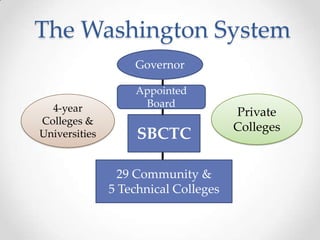
The Washington System
                   Governor

                   Appointed
  4-year            Board
                                      Private
Colleges &
                                      Colleges
Universities        SBCTC

                 29 Community &
               5 Technical Colleges
CC BY-NC-ND   Dreaming Girls Head By: Elfleda http://www.flickr.com/photos/carolinespics/1531
The Dream
That everyone have access to high quality,
affordable, accessible learning opportunities.
It will require we share the educational resources
we produce and that we spend our limited public
resources wisely.
The Need
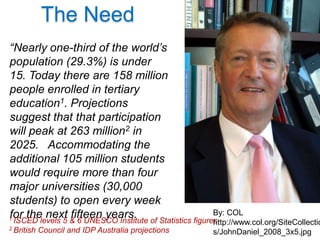
“Nearly one-third of the world’s
population (29.3%) is under
15. Today there are 158 million
people enrolled in tertiary
education1. Projections
suggest that that participation
will peak at 263 million2 in
2025. Accommodating the
additional 105 million students
would require more than four
major universities (30,000
students) to open every week
for the next fifteen years.                               By: COL
1 ISCED levels 5 & 6 UNESCO Institute of Statistics figures
                                                        http://www.col.org/SiteCollectio
2 British   Council and IDP Australia projections       s/JohnDaniel_2008_3x5.jpg
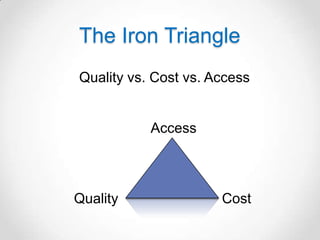
The Iron Triangle
Quality vs. Cost vs. Access


           Access


Quality               Cost
How do we maximize the
 potential of digital content
and networked technologies?
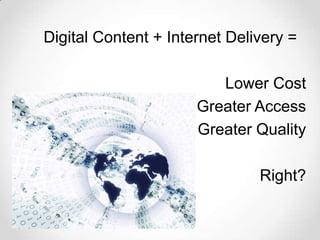
Digital Content + Internet Delivery =

                         Lower Cost
                      Greater Access
                      Greater Quality

                               Right?
Hold that
thought…
Education Is
  Sharing
Teachers Share
With Students
  knowledge and skills
 feedback and criticism
    encouragement
Students Share
With Teachers
     questions
    assignments
        tests
If There Is No
    Sharing
 there is no education
Successful
 Educators
share most completely
with the most students
Knowledge is
  Magical
can be given without being
        given away
Physical
 Expressions Are
      Not
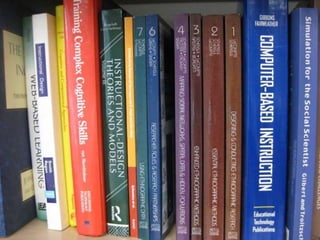
to give a book you must give it away
Expressions Are
   Different
  To give a book you must give it away
When Expressions
  Are Digital
  they also become magical
An Indescribable
    Advance
the first time in human history
Both Knowledge
and Expressions
can be given without giving away
Unprecedented
   Capacity
we can share as never before
Unprecedented
   Capacity
we can educate as never before
What Does
  “Share” Mean?
online it means copy and distribute
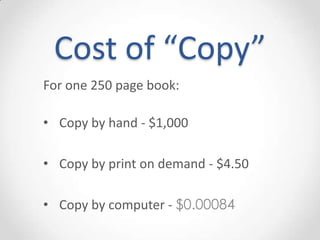
Cost of “Copy”
For one 250 page book:

• Copy by hand - $1,000

• Copy by print on demand - $4.50

• Copy by computer - $0.00084
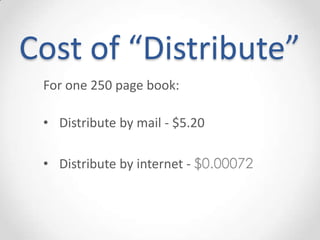
Cost of “Distribute”
 For one 250 page book:

 • Distribute by mail - $5.20

 • Distribute by internet - $0.00072
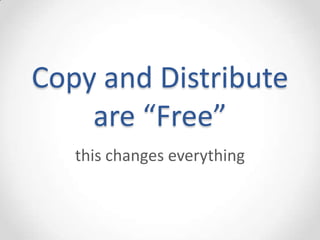
Copy and Distribute
    are “Free”
   this changes everything
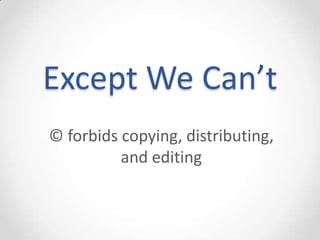
Except We Can’t
© forbids copying, distributing,
          and editing
© Cancels the
   Possibilities
of digital media and the internet
Internet            Copyright
Enables              Forbids
           what to do?
Use copyright to enable sharing
What is Creative Commons?

A simple, standardized way to grant
   copyright permissions to your
           creative work.
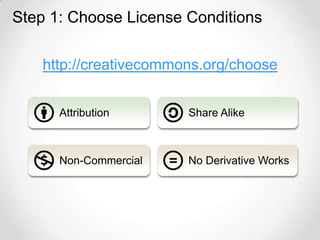
Step 1: Choose License Conditions

    http://creativecommons.org/choose


      Attribution           Share Alike


      Non-Commercial        No Derivative Works


                       34
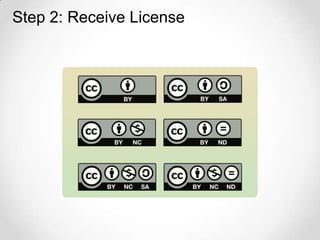
Step 2: Receive License


                   35
Digital + Open
diagnostic, adaptive, interactive
   free, full local control (4Rs)
       •   reuse
       •   revise
       •   remix
       •   redistribute
Digital + Open
Digital Content + Internet Delivery
+ Open License =

                           Lower Cost
                        Greater Access
                        Greater Quality
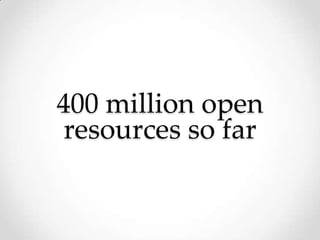
400 million open
resources so far
Higher Ed
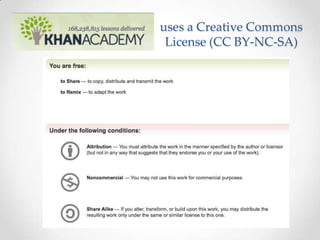
uses a Creative Commons
 License (CC BY-NC-SA)
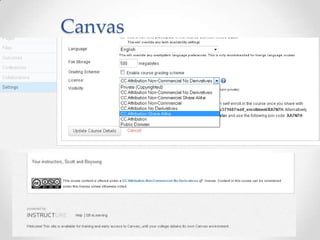
Canvas
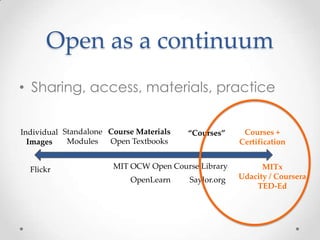
Open as a continuum
• Sharing, access, materials, practice

Individual Standalone Course Materials   “Courses”     Courses +
  Images    Modules   Open Textbooks                  Certification


  Flickr               MIT OCW Open Course Library          MITx
                           OpenLearn     Saylor.org   Udacity / Coursera
                                                          TED-Ed
OCL Logo Credits: Timothy Valentine & Leo Reynolds CC-BY-NC-SA


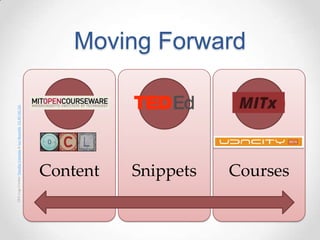
             Content
             Snippets
                                                                 Moving Forward


             Courses
What’s in it for me?
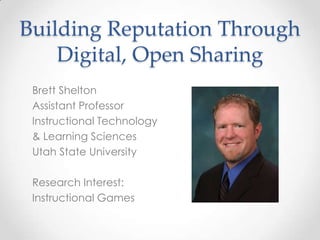
Building Reputation Through
    Digital, Open Sharing
 Brett Shelton
 Assistant Professor
 Instructional Technology
 & Learning Sciences
 Utah State University

 Research Interest:
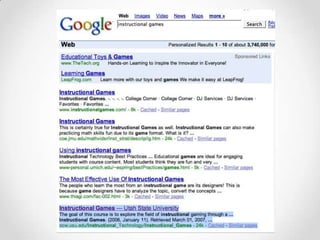
 Instructional Games
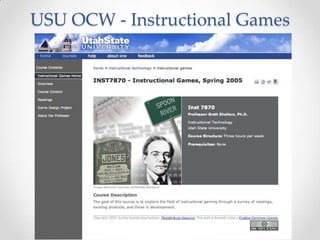
USU OCW - Instructional Games
Digital, Open Sharing 
     Discoverability 
    New Opportunities
How do you end up on the first page of a
     Google search in your field?

What kinds of professional opportunities
           could that yield?
http://techplan.sbctc.edu


“We will cultivate the culture and
practice of using and contributing to
open educational resources.”
State Board “Open” Policy

All digital software, educational
resources and knowledge produced
through competitive grants, offered
through and/or managed by the
SBCTC, will carry a Creative Commons
Attribution License (CC BY).
Open Course Library
  A collection of openly licensed (CC BY) educational
   materials for 81 high-enrollment college courses

     Project Goals:
     1. Lower textbook costs for students
     2. Improve course completion rates
     3. Provide new resources for faculty


           Credit: Timothy Valentine & Leo Reynolds CC-BY-NC-
           SA
        Please visit: http://opencourselibrary.org
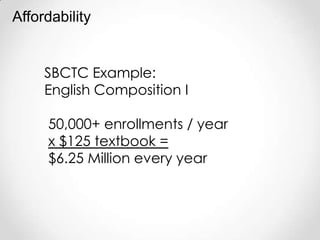
Affordability


     SBCTC Example:
     English Composition I

     50,000+ enrollments / year
     x $125 textbook =
     $6.25 Million every year
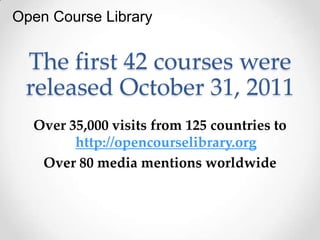
Open Course Library


 The first 42 courses were
 released October 31, 2011
  Over 35,000 visits from 125 countries to
        http://opencourselibrary.org
   Over 80 media mentions worldwide
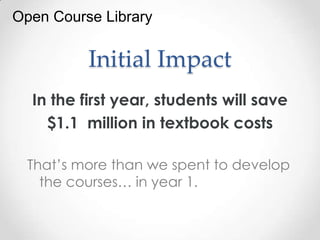
Open Course Library

          Initial Impact
  In the first year, students will save
    $1.1 million in textbook costs

  That’s more than we spent to develop
    the courses… in year 1.
Open Course Library

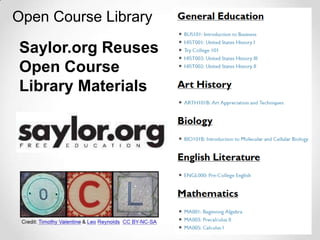
Saylor.org Reuses
Open Course
Library Materials
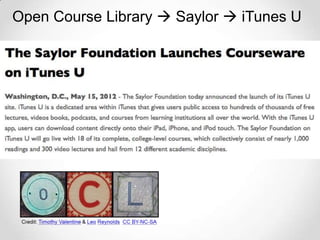
Open Course Library  Saylor  iTunes U
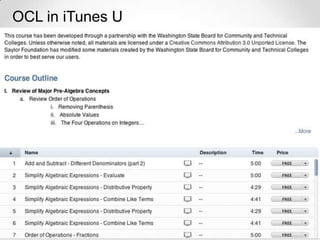
OCL in iTunes U
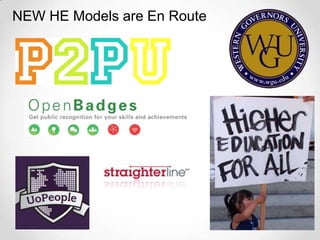
NEW HE Models are En Route
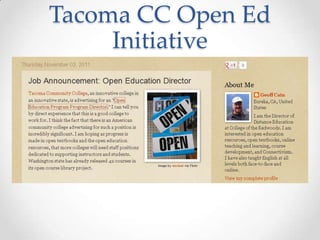
Tacoma CC Open Ed
     Initiative
Physical Expression are
         good too
At one medium sized Washington college in the 2010-
11 year students saved:
• "Math in a Sustainable Society" Pete Kaslik - $7920
  savings/year
• "Math in Society" David Lippman - $17K
  savings/year
• "Mathematics for Teachers of Young Children"
  Sharon Camner $2520 savings/year
• "Precalculus: an investigation of functions" David
  Lippman and Melonie Rasmussen - $28K-$99K
  savings/year
Conclusion
1. Digital + Open: Implement policies and
   solutions to encourage content that is both
   digital AND open (meaning free,
   shareable, adaptable, and editable)
2. Lifelong Learning: Allow course content
   to be persistent and discoverable with
   tools such as openly shared courses in
   Canvas (so students can preview lessons
   before they are officially enrolled and
   review them after).
Questions?

Scott Dennis
Email: sdennis@sbctc.edu
Twitter: @scottwdennis

Slides available at:
   http://www.slideshare.net/scottwdennis

           Unless otherwise specified, this presentation by is licensed
           under a Creative Commons Attribution Unported 3.0 License.

!2012 OER Talk

  • 1.
    Digital + Open: This Changes Everything Scott Dennis WA State Board for Community & Technical Colleges July, 2012 Unless otherwise specified, this presentation is licensed under a Creative Commons Attribution Unported 3.0 License.
  • 2.
    The Washington System Governor Appointed 4-year Board Private Colleges & Colleges Universities SBCTC 29 Community & 5 Technical Colleges
  • 3.
    CC BY-NC-ND Dreaming Girls Head By: Elfleda http://www.flickr.com/photos/carolinespics/1531
  • 4.
    The Dream That everyonehave access to high quality, affordable, accessible learning opportunities. It will require we share the educational resources we produce and that we spend our limited public resources wisely.
  • 5.
    The Need “Nearly one-thirdof the world’s population (29.3%) is under 15. Today there are 158 million people enrolled in tertiary education1. Projections suggest that that participation will peak at 263 million2 in 2025. Accommodating the additional 105 million students would require more than four major universities (30,000 students) to open every week for the next fifteen years. By: COL 1 ISCED levels 5 & 6 UNESCO Institute of Statistics figures http://www.col.org/SiteCollectio 2 British Council and IDP Australia projections s/JohnDaniel_2008_3x5.jpg
  • 6.
    The Iron Triangle Qualityvs. Cost vs. Access Access Quality Cost
  • 7.
    How do wemaximize the potential of digital content and networked technologies?
  • 8.
    Digital Content +Internet Delivery = Lower Cost Greater Access Greater Quality Right?
  • 9.
  • 10.
  • 11.
    Teachers Share With Students knowledge and skills feedback and criticism encouragement
  • 12.
    Students Share With Teachers questions assignments tests
  • 13.
    If There IsNo Sharing there is no education
  • 14.
    Successful Educators share mostcompletely with the most students
  • 15.
    Knowledge is Magical can be given without being given away
  • 16.
    Physical Expressions Are Not to give a book you must give it away
  • 17.
    Expressions Are Different To give a book you must give it away
  • 18.
    When Expressions Are Digital they also become magical
  • 21.
    An Indescribable Advance the first time in human history
  • 22.
    Both Knowledge and Expressions canbe given without giving away
  • 23.
    Unprecedented Capacity we can share as never before
  • 24.
    Unprecedented Capacity we can educate as never before
  • 25.
    What Does “Share” Mean? online it means copy and distribute
  • 26.
    Cost of “Copy” Forone 250 page book: • Copy by hand - $1,000 • Copy by print on demand - $4.50 • Copy by computer - $0.00084
  • 27.
    Cost of “Distribute” For one 250 page book: • Distribute by mail - $5.20 • Distribute by internet - $0.00072
  • 28.
    Copy and Distribute are “Free” this changes everything
  • 29.
    Except We Can’t ©forbids copying, distributing, and editing
  • 30.
    © Cancels the Possibilities of digital media and the internet
  • 31.
    Internet Copyright Enables Forbids what to do?
  • 32.
    Use copyright toenable sharing
  • 33.
    What is CreativeCommons? A simple, standardized way to grant copyright permissions to your creative work.
  • 34.
    Step 1: ChooseLicense Conditions http://creativecommons.org/choose Attribution Share Alike Non-Commercial No Derivative Works 34
  • 35.
    Step 2: ReceiveLicense 35
  • 36.
    Digital + Open diagnostic,adaptive, interactive free, full local control (4Rs) • reuse • revise • remix • redistribute
  • 37.
  • 38.
    Digital Content +Internet Delivery + Open License = Lower Cost Greater Access Greater Quality
  • 39.
  • 40.
  • 41.
    uses a CreativeCommons License (CC BY-NC-SA)
  • 42.
  • 43.
    Open as acontinuum • Sharing, access, materials, practice Individual Standalone Course Materials “Courses” Courses + Images Modules Open Textbooks Certification Flickr MIT OCW Open Course Library MITx OpenLearn Saylor.org Udacity / Coursera TED-Ed
  • 44.
    OCL Logo Credits:Timothy Valentine & Leo Reynolds CC-BY-NC-SA Content Snippets Moving Forward Courses
  • 45.
  • 46.
    Building Reputation Through Digital, Open Sharing Brett Shelton Assistant Professor Instructional Technology & Learning Sciences Utah State University Research Interest: Instructional Games
  • 47.
    USU OCW -Instructional Games
  • 49.
    Digital, Open Sharing Discoverability  New Opportunities How do you end up on the first page of a Google search in your field? What kinds of professional opportunities could that yield?
  • 50.
    http://techplan.sbctc.edu “We will cultivatethe culture and practice of using and contributing to open educational resources.”
  • 51.
    State Board “Open”Policy All digital software, educational resources and knowledge produced through competitive grants, offered through and/or managed by the SBCTC, will carry a Creative Commons Attribution License (CC BY).
  • 52.
    Open Course Library A collection of openly licensed (CC BY) educational materials for 81 high-enrollment college courses Project Goals: 1. Lower textbook costs for students 2. Improve course completion rates 3. Provide new resources for faculty Credit: Timothy Valentine & Leo Reynolds CC-BY-NC- SA Please visit: http://opencourselibrary.org
  • 53.
    Affordability SBCTC Example: English Composition I 50,000+ enrollments / year x $125 textbook = $6.25 Million every year
  • 54.
    Open Course Library The first 42 courses were released October 31, 2011 Over 35,000 visits from 125 countries to http://opencourselibrary.org Over 80 media mentions worldwide
  • 55.
    Open Course Library Initial Impact In the first year, students will save $1.1 million in textbook costs That’s more than we spent to develop the courses… in year 1.
  • 56.
    Open Course Library Saylor.orgReuses Open Course Library Materials
  • 57.
    Open Course Library Saylor  iTunes U
  • 58.
  • 59.
    NEW HE Modelsare En Route
  • 60.
    Tacoma CC OpenEd Initiative
  • 61.
    Physical Expression are good too At one medium sized Washington college in the 2010- 11 year students saved: • "Math in a Sustainable Society" Pete Kaslik - $7920 savings/year • "Math in Society" David Lippman - $17K savings/year • "Mathematics for Teachers of Young Children" Sharon Camner $2520 savings/year • "Precalculus: an investigation of functions" David Lippman and Melonie Rasmussen - $28K-$99K savings/year
  • 62.
    Conclusion 1. Digital +Open: Implement policies and solutions to encourage content that is both digital AND open (meaning free, shareable, adaptable, and editable) 2. Lifelong Learning: Allow course content to be persistent and discoverable with tools such as openly shared courses in Canvas (so students can preview lessons before they are officially enrolled and review them after).
  • 63.
    Questions? Scott Dennis Email: sdennis@sbctc.edu Twitter:@scottwdennis Slides available at: http://www.slideshare.net/scottwdennis Unless otherwise specified, this presentation by is licensed under a Creative Commons Attribution Unported 3.0 License.

Editor's Notes

  • #4 Many of us have a common dream: Thateveryone in the world can attain all the education they desire. That everyone have access to high quality, affordable, accessible learning opportunities.It will require we share the educational resources we produce and that we spend our limited public resources wisely.
  • #6 And just like the United States … the rest of the world needs this dream to come true … and quickly… if we are to meet the global demand for higher education.Sir John Daniel, President & CEO of the Commonwealth of Learning notes:What do you think the odds are the world will build four major universities (30,000 students) to open every week for the next fifteen years?
  • #7 The “iron triangle” suggests institutions are constrained in their ability to adapt.
  • #9 We start with the Internet. Internet connectivity is virtually everywhere, and it provides the greatest distribution channel we have ever known.When we add digital content to the World Wide Web, we should be able to lower costs, increase access, and increase quality… right?
  • #11 Slide Credit: David Wiley, BYU
  • #12 Slide Credit: David Wiley, BYU
  • #13 Slide Credit: David Wiley, BYU
  • #14 Slide Credit: David Wiley, BYU
  • #15 Slide Credit: David Wiley, BYU
  • #16 Slide Credit: David Wiley, BYU
  • #17 Slide Credit: David Wiley, BYU
  • #18 Slide Credit: David Wiley, BYUCC By Photo by David Wiley
  • #19 Slide Credit: David Wiley, BYU
  • #20 Slide Credit: David Wiley, BYUCC licensedphoto http://www.flickr.com/photos/62693815@N03/6277209256/
  • #21 Slide Credit: David Wiley, BYU
  • #22 Slide Credit: David Wiley, BYU
  • #23 Slide Credit: David Wiley, BYU
  • #24 Slide Credit: David Wiley, BYU
  • #25 Slide Credit: David Wiley, BYU
  • #26 Slide Credit: David Wiley, BYU
  • #27 Slide Credit: David Wiley, BYU
  • #28 Slide Credit: David Wiley, BYU
  • #29 Slide Credit: David Wiley, BYU
  • #30 Slide Credit: David Wiley, BYU
  • #31 Slide Credit: David Wiley, BYU
  • #32 Slide Credit: David Wiley, BYU
  • #37 Slide Credit: David Wiley, BYU
  • #44 Slide Credit: Brandon Muramatsu, MIT
  • #45 Slide Credit: Brandon Muramatsu, MIT
  • #52 In 2010 the State Board approved the first “open” policy.
  • #53 The Open Course Library is a collection of expertly developed educational materials – including textbooks, syllabi, course activities, readings, and assessments – for 81 high-enrollment college courses. 42 courses have been completed so far, providing faculty with a high-quality option that will cost students no more than $30 per course.