

What is your district’s 2020 headline? Developing a Shared Vision of Innovation for 21st Century Learning Julie Evans Chief Executive Officer Project Tomorrow April 19, 2010 © Project Tomorrow 2010 Leading Our Way Forward Edmonton Regional Learning Consortium
© Project Tomorrow 2010 Deconstructing our keynote topic  “ Developing a shared vision of innovation for 21st century learning”
© Project Tomorrow 2010 Deconstructing our keynote topic  Shared vision Innovation 21st century learning
© Project Tomorrow 2010 Defining shared vision  “ A shared vision is not an idea...it is rather,  a force in people's hearts ...at its simplest level, a shared vision is the answer to the question: What do we want to create?”  Peter Senge MIT Sloan School of Management
© Project Tomorrow 2010 Defining innovation  "Creativity is thinking up new things.  Innovation is doing new things ." Theodore Levitt Harvard Business School
© Project Tomorrow 2010 Defining 21st century learning  “ I believe that the purpose of education is not to make men carpenters, but to make carpenters men. To be competitive in a workplace that is changing and will change continuously throughout our careers,  my peers and I need to be able to read and understand new information at a level never before prevalent.  This should be, however, a familiar aim for the forces of academia, however,  since what we must learn, in essence, is to learn. I would ensure a broad and balanced education that exposes every student to rigorous inquiry in every discipline, from physics to pottery and makes them  active participants in the process of inquiry and learning.”   11 th  grade student Pittsburgh PA
© Project Tomorrow 2010 Deconstructing our keynote topic  “ What is your district’s  2020 headline?”
© Project Tomorrow 2010 Knowing where you are today  What is your district’s  2010  headline?
© Project Tomorrow 2010 Some 2010 Headlines About Education  “ NYC to End Rubber Rooms for Teachers Who Await Hearings” “ Teacher Training No Boom for Student Math Scores” “ Parents Reflect on Previous Edmonton School Closures” “ Public Schools Foundation Aims to Create Level Playing Field” “ Central Falls to Fire Every High School Teacher” “ High Speed Networking Changes How We Learn Our ABCs” “ Edmonton School Boards Tighten Belts in New Budgets” “ Eliminating School Boards a Good First Step” “ Calgary Classrooms Go Digital” “ Maybe It is Time to Fix Education System”
© Project Tomorrow 2010 Our discussion today  Inputs to your process: 5 most important questions  Meet today’s students  Sampling of key data findings from Speak Up 2009  What is your 2020 headline? Characteristics of the “New Visionary Administrator”
© Project Tomorrow 2010 “ Warm up worksheet”  Imagine you are designing the ultimate school for 21st century learners.  Which of these technology tools or strategies do you think holds the greatest potential for increasing student achievement and success?   Your point of view – check your top 5 responses from the list!  Micro blog your thoughts and comments!
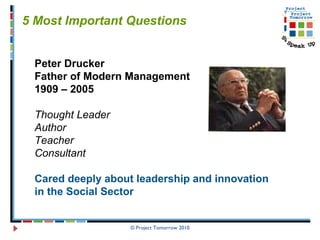
© Project Tomorrow 2010 5 Most Important Questions Peter Drucker Father of Modern Management 1909 – 2005 Thought Leader Author Teacher Consultant  Cared deeply about leadership and innovation in the Social Sector
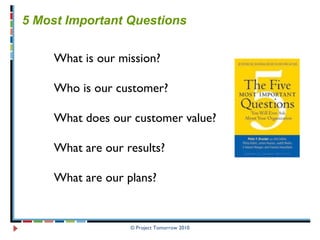
© Project Tomorrow 2010 5 Most Important Questions  What is our mission? Who is our customer? What does our customer value? What are our results? What are our plans?
© Project Tomorrow 2010 5 Most Important Questions   Who is our customer? Articulate who is your primary customer Identify all of the secondary customers Be in touch with changes in your customers Think about who must be satisfied for the  district to achieve success
© Project Tomorrow 2010 5 Most Important Questions   Who does our customer value? Understand your own assumptions & paradigms Listen deeply to your customer And then listen again and again
© Project Tomorrow 2010 5 Big Questions   “ Planning is not an event.  It is the  continuous process of  strengthening what works  and  abandoning what does not , of making  risk-taking decisions  with the greatest  knowledge of their potential effect , of setting  objectives , appraising  performance and results  through systemic  feedback , and making ongoing  adjustments  as conditions change.”  Peter Drucker
What forces are shaping your “customer’s expectations” for a 21st century learning environment? © Project Tomorrow 2010 Customer = Your Students
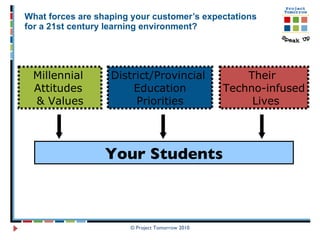
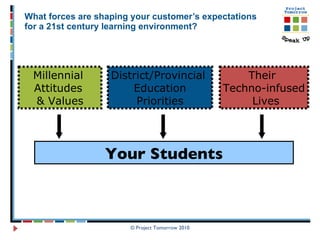
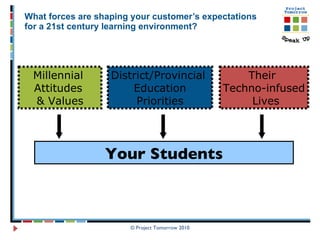
What forces are shaping your customer’s expectations for a 21st century learning environment? © Project Tomorrow 2010 Your Students District/Provincial  Education Priorities Millennial  Attitudes  & Values Their  Techno-infused Lives
© Project Tomorrow 2010 What the top 5 challenges that  “ wake you up in the middle of the night?”   District/Provincial Education Priorities
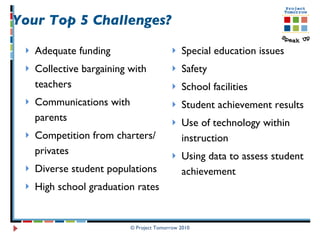
Adequate funding Collective bargaining with teachers Communications with parents Competition from charters/privates Diverse student populations High school graduation rates   Special education issues Safety School facilities Student achievement results Use of technology within instruction Using data to assess student achievement  © Project Tomorrow 2010 Your Top 5 Challenges?
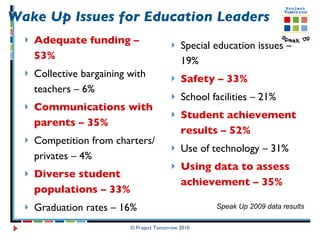
Adequate funding – 53% Collective bargaining with teachers – 6% Communications with parents – 35% Competition from charters/privates – 4% Diverse student populations – 33% Graduation rates – 16%  Special education issues – 19% Safety – 33% School facilities – 21% Student achievement results – 52% Use of technology – 31% Using data to assess  achievement – 35% © Project Tomorrow 2010 Wake Up Issues for Education Leaders   Speak Up 2009 data results
© Project Tomorrow 2010 How important is the effective implementation of technology  to your  district’s core mission ? District/Provincial Education Priorities
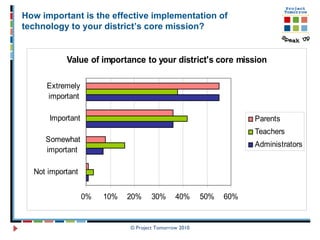
© Project Tomorrow 2010 How important is the effective implementation of technology to your district’s core mission?
What forces are shaping your customer’s expectations for a 21st century learning environment? © Project Tomorrow 2010 Your Students District/Provincial  Education Priorities Millennial  Attitudes  & Values Their  Techno-infused Lives
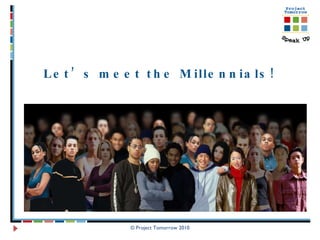
Let’s meet the Millennials!   © Project Tomorrow 2010
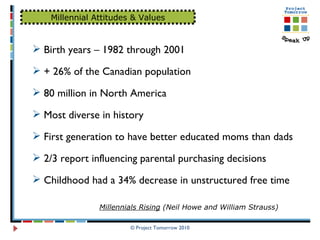
© Project Tomorrow 2010 Millennial Attitudes & Values Birth years – 1982 through 2001 + 26% of the Canadian population 80 million in North America Most diverse in history  First generation to have better educated moms than dads 2/3 report influencing parental purchasing decisions Childhood had a 34% decrease in unstructured free time Millennials Rising  (Neil Howe and William Strauss)
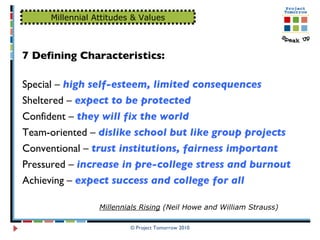
© Project Tomorrow 2010 Millennial Attitudes & Values 7 Defining Characteristics: Special –  high self-esteem, limited consequences   Sheltered –  expect to be protected   Confident –  they will fix the world   Team-oriented –  dislike school but like group projects Conventional –  trust institutions, fairness important Pressured –  increase in pre-college stress and burnout Achieving –  expect success and college for all Millennials Rising  (Neil Howe and William Strauss)
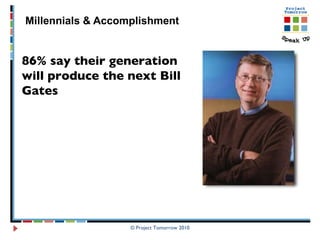
Millennials & Accomplishment © Project Tomorrow 2010 86% say their generation will produce the next Bill Gates
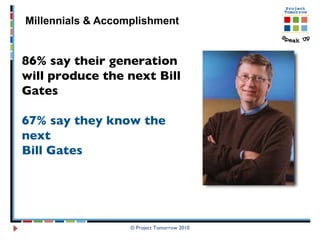
Millennials & Accomplishment © Project Tomorrow 2010 86% say their generation will produce the next Bill Gates 67% say they know the next  Bill Gates
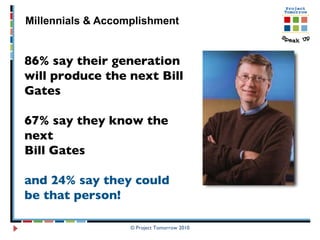
Millennials & Accomplishment © Project Tomorrow 2010 86% say their generation will produce the next Bill Gates 67% say they know the next  Bill Gates and 24% say they could  be that person!
© Project Tomorrow 2010 Millennial Attitudes & Values Collaboratively  Anytime, anyplace, anywhere, any pace Structured activities Relevancy with real world Millennials Rising  (Neil Howe and William Strauss) How do these students want to learn?
© Project Tomorrow 2010 Millennial Attitudes & Values Collaboratively  Anytime, anyplace, anywhere, any pace Structured activities Relevancy with real world And with all kinds of emerging technologies Millennials Rising  (Neil Howe and William Strauss) How do these students want to learn?
What forces are shaping your customer’s expectations for a 21st century learning environment? © Project Tomorrow 2010 Your Students District/Provincial  Education Priorities Millennial  Attitudes  & Values Their  Techno-infused Lives
What can we learn by listening to our customers? © Project Tomorrow 2010 Speak Up 2009 Selected Data Findings  Their Techno-infused Lives
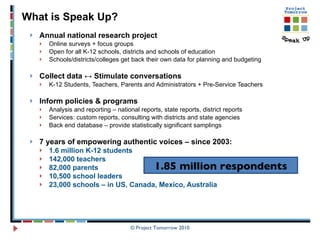
Annual national research project Online surveys + focus groups Open for all K-12 schools, districts and schools of education Schools/districts/colleges get back their own data for planning and budgeting Collect data  ↔ Stimulate conversations K-12 Students, Teachers, Parents and Administrators + Pre-Service Teachers  Inform policies & programs Analysis and reporting – national reports, state reports, district reports  Services: custom reports, consulting with districts and state agencies Back end database – provide statistically significant samplings  7 years of empowering authentic voices – since 2003:   1.6 million K-12 students 142,000 teachers 82,000 parents 10,500 school leaders 23,000 schools – in US, Canada, Mexico, Australia © Project Tomorrow 2010 What is Speak Up? 1.85 million respondents
Speak Up is facilitated annually  by  Project Tomorrow   © Project Tomorrow 2010 Project Tomorrow (www.tomorrow.org)  is the leading education nonprofit organization dedicated to the empowerment of student voices in education.
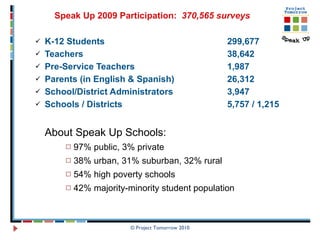
K-12 Students 299,677 Teachers 38,642 Pre-Service Teachers 1,987 Parents (in English & Spanish) 26,312 School/District Administrators 3,947 Schools / Districts 5,757 / 1,215 About Speak Up Schools: 97% public, 3% private 38% urban, 31% suburban, 32% rural 54% high poverty schools 42% majority-minority student population   © Project Tomorrow 2010 Speak Up 2009 Participation:  370,565 surveys
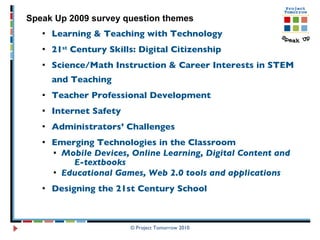
Learning & Teaching with Technology 21 st  Century Skills: Digital Citizenship Science/Math Instruction & Career Interests in STEM and Teaching  Teacher Professional Development Internet Safety Administrators’ Challenges Emerging Technologies in the Classroom Mobile Devices, Online Learning, Digital Content and  E-textbooks Educational Games, Web 2.0 tools and applications Designing the 21st Century School © Project Tomorrow 2010 Speak Up 2009 survey question themes
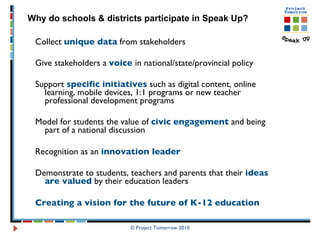
Collect  unique data  from stakeholders Give stakeholders a  voice  in national/state/provincial policy Support  specific initiatives  such as digital content, online learning, mobile devices, 1:1 programs or new teacher professional development programs Model for students the value of  civic engagement  and being part of a national discussion Recognition as an  innovation leader   Demonstrate to students, teachers and parents that their  ideas are valued  by their education leaders Creating a vision for the future of K-12 education © Project Tomorrow 2010 Why do schools & districts participate in Speak Up?
Speak Up Data Findings © Project Tomorrow 2010 Who am I?  Interactive Exercise
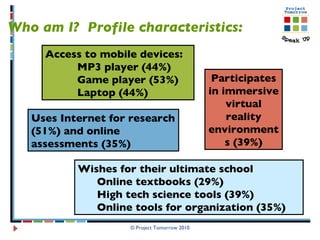
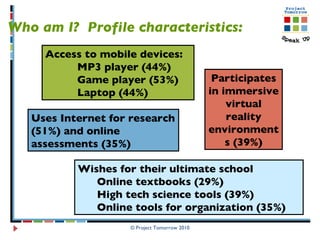
© Project Tomorrow 2010 Who am I?  Profile characteristics: Wishes for their ultimate school Online textbooks (29%) High tech science tools (39%)  Online tools for organization (35%)  Access to mobile devices: MP3 player (44%) Game player (53%) Laptop (44%) Participates in immersive virtual reality environments (39%) Uses Internet for research (51%) and online assessments (35%)
© Project Tomorrow 2010 Audience Response: Who am I?  Kindergarten Boy 3rd Grade Girl  7th Grade Boy 10th Grade Girl Teacher
© Project Tomorrow 2010 Who am I?
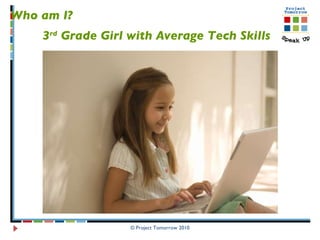
© Project Tomorrow 2010 Who am I?  3 rd  Grade Girl with Average Tech Skills
© Project Tomorrow 2010 Who am I?  Profile characteristics: Wishes for their ultimate school Online textbooks (29%) High tech science tools (39%)  Online tools for organization (35%)  Access to mobile devices: MP3 player (44%) Game player (53%) Laptop (44%) Participates in immersive virtual reality environments (39%) Uses Internet for research (51%) and online assessments (35%)
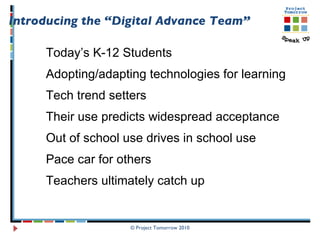
© Project Tomorrow 2010 Introducing the “Digital Advance Team” Today’s K-12 Students Adopting/adapting technologies for learning Tech trend setters  Their use predicts widespread acceptance Out of school use drives in school use Pace car for others Teachers ultimately catch up
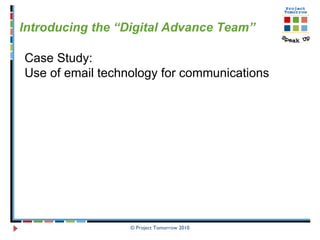
© Project Tomorrow 2010 Introducing the “Digital Advance Team” Case Study:  Use of email technology for communications
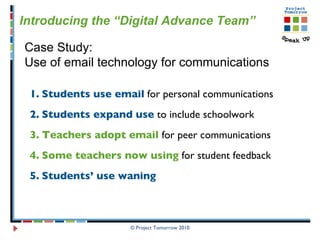
© Project Tomorrow 2010 Introducing the “Digital Advance Team” Case Study:  Use of email technology for communications Students use email  for personal communications Students expand use  to include schoolwork  Teachers adopt   email   for peer communications Some teachers now using  for student feedback Students’ use waning
© Project Tomorrow 2010 Introducing the “Digital Advance Team” Let’s listen in and learn!
“ Digital disconnect”   is alive & well:  the gap between how  today’s students learn and  how they live!   © Project Tomorrow 2010 Key findings from Speak Up data:
“ Digital disconnect” is alive & well:   Between students and teachers Between advanced tech students and other students Between girls and boys Between older and younger students © Project Tomorrow 2010 Key findings from Speak Up data:
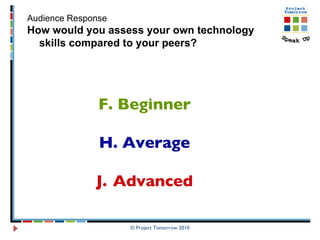
© Project Tomorrow 2010 Audience Response How would you assess your own technology skills compared to your peers? Beginner Average Advanced
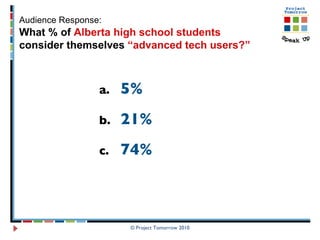
5% 21% 74% © Project Tomorrow 2010 Audience Response:   What % of  Alberta high school students   consider themselves  “advanced tech users?”
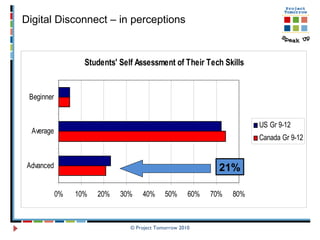
© Project Tomorrow 2010 Digital Disconnect – in perceptions  21%
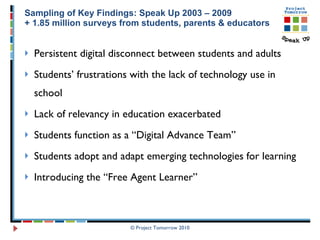
Sampling of Key Findings: Speak Up 2003 – 2009 + 1.85 million surveys from students, parents & educators Persistent digital disconnect between students and adults Students’ frustrations with the lack of technology use in school Lack of relevancy in education exacerbated  Students function as a “Digital Advance Team” Students adopt and adapt emerging technologies for learning Introducing the “Free Agent Learner”  © Project Tomorrow 2010
Result:  A new uniquely “student vision” for leveraging emerging technologies to drive achievement and educational productivity © Project Tomorrow 2010
Creating Our Future: Students Speak Up about their Vision for 21st Century Learning Three Essential Elements in the Student Vision Social–based learning Un–tethered learning  Digitally–rich learning   © Project Tomorrow 2010
Creating Our Future: Students Speak Up about their Vision for 21st Century Learning Three Essential Elements Social–based learning Students want to leverage emerging  communications and collaboration tools  to create personal networks of experts © Project Tomorrow 2010
Creating Our Future: Students Speak Up about their Vision for 21st Century Learning Three Essential Elements Un–tethered learning  Students envision technology-enabled  learning that transcends classroom walls © Project Tomorrow 2010
Creating Our Future: Students Speak Up about their Vision for 21st Century Learning Three Essential Elements Digitally–rich learning   Students see the use of relevancy-based  digital tools, content and resources as key  to education productivity © Project Tomorrow 2010
Creating Our Future: Students Speak Up about their Vision for 21st Century Learning Three Essential Elements Social–based learning © Project Tomorrow 2010
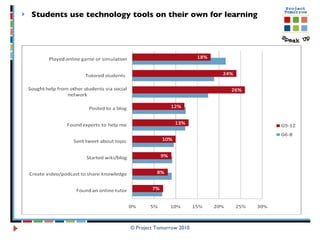
Students use technology tools on their own for learning © Project Tomorrow 2010
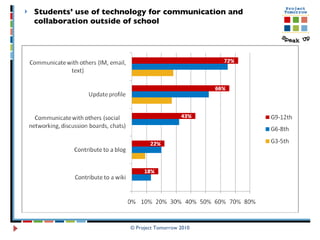
Students’ use of technology for communication and collaboration outside of school © Project Tomorrow 2010
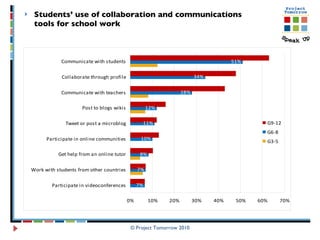
Students’ use of collaboration and communications tools for school work © Project Tomorrow 2010
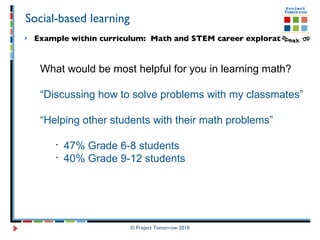
Social-based learning Example within curriculum:  Math and STEM career exploration © Project Tomorrow 2010 What would be most helpful for you in learning math?  “ Discussing how to solve problems with my classmates” “ Helping other students with their math problems”  47% Grade 6-8 students 40% Grade 9-12 students
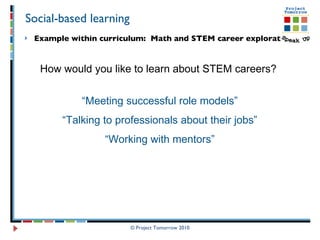
Social-based learning Example within curriculum:  Math and STEM career exploration © Project Tomorrow 2010 How would you like to learn about STEM careers?  “ Meeting successful role models” “ Talking to professionals about their jobs” “ Working with mentors”
Creating Our Future: Students Speak Up about their Vision for 21st Century Learning Three Essential Elements Un–tethered learning  © Project Tomorrow 2010
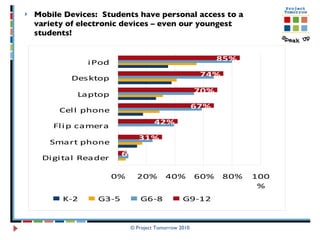
Mobile Devices:  Students have personal access to a variety of electronic devices – even our youngest students!  © Project Tomorrow 2010
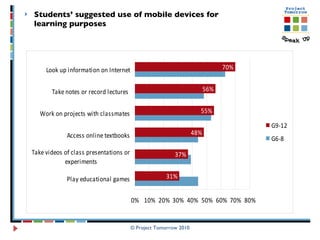
Students’ suggested use of mobile devices for learning purposes   © Project Tomorrow 2010
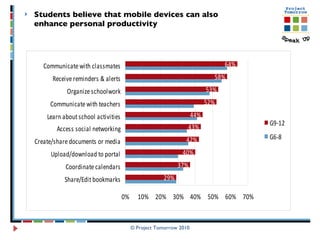
Students believe that mobile devices can also enhance personal productivity © Project Tomorrow 2010
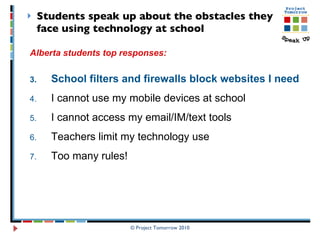
Students speak up about the obstacles they face using technology at school © Project Tomorrow 2010 Alberta students top responses: School filters and firewalls block websites I need  I cannot use my mobile devices at school I cannot access my email/IM/text tools  Teachers limit my technology use  Too many rules!
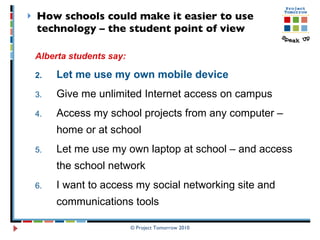
How schools could make it easier to use technology – the student point of view © Project Tomorrow 2010 Alberta students say:   Let me use my own mobile device  Give me unlimited Internet access on campus  Access my school projects from any computer – home or at school Let me use my own laptop at school – and access the school network I want to access my social networking site and communications tools
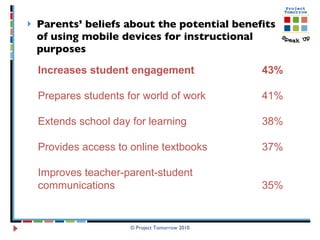
Parents’ beliefs about the potential benefits of using mobile devices for instructional purposes   © Project Tomorrow 2010 Increases student engagement 43% Prepares students for world of work 41% Extends school day for learning 38% Provides access to online textbooks 37% Improves teacher-parent-student  communications 35%
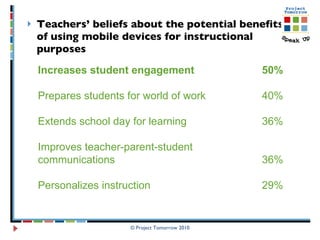
Teachers’ beliefs about the potential benefits of using mobile devices for instructional purposes   © Project Tomorrow 2010 Increases student engagement 50% Prepares students for world of work 40% Extends school day for learning 36% Improves teacher-parent-student  communications 36% Personalizes instruction 29%
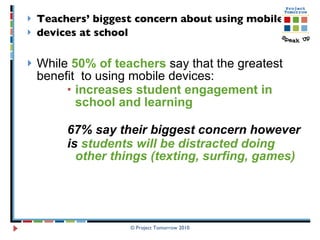
Teachers’ biggest concern about using mobile  devices at school   While  50% of teachers  say that the greatest benefit  to using mobile devices:  increases student engagement in school and learning  67% say their biggest concern however is  students will be distracted doing other things (texting, surfing, games) © Project Tomorrow 2010
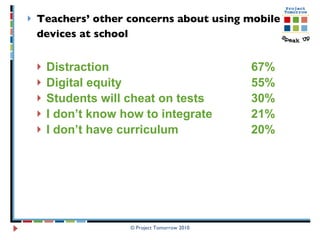
Teachers’ other concerns about using mobile  devices at school   Distraction  67% Digital equity 55% Students will cheat on tests 30% I don’t know how to integrate 21% I don’t have curriculum 20% © Project Tomorrow 2010
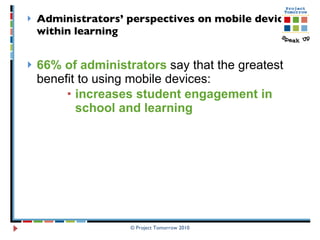
Administrators’ perspectives on mobile devices within learning   66% of administrators  say that the greatest benefit to using mobile devices:  increases student engagement in school and learning  © Project Tomorrow 2010
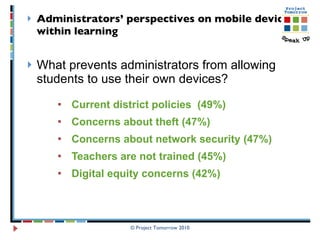
Administrators’ perspectives on mobile devices within learning   What prevents administrators from allowing students to use their own devices? Current district policies  (49%) Concerns about theft (47%) Concerns about network security (47%) Teachers are not trained (45%)  Digital equity concerns (42%)  © Project Tomorrow 2010
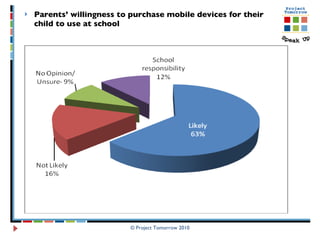
Parents’ willingness to purchase mobile devices for their child to use at school © Project Tomorrow 2010
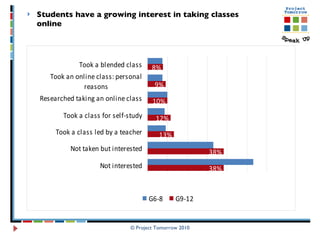
Students have a growing interest in taking classes online © Project Tomorrow 2010
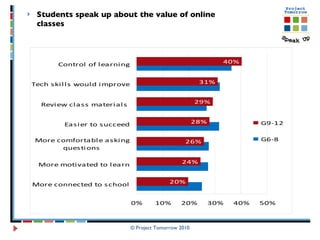
Students speak up about the value of online classes © Project Tomorrow 2010
Creating Our Future: Students Speak Up about their Vision for 21st Century Learning Three Essential Elements Digitally–rich learning   © Project Tomorrow 2010
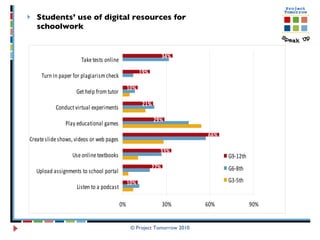
Students’ use of digital resources for schoolwork © Project Tomorrow 2010
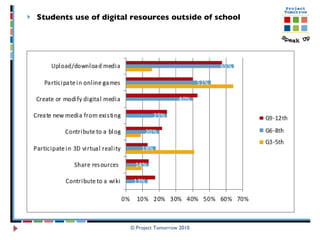
Students use of digital resources outside of school © Project Tomorrow 2010
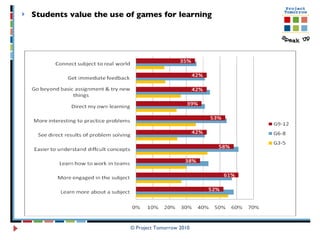
Students value the use of games for learning   © Project Tomorrow 2010
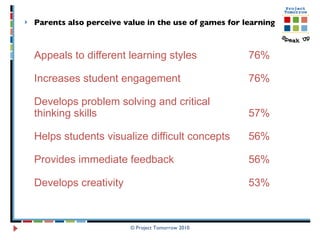
Parents also perceive value in the use of games for learning Appeals to different learning styles 76% Increases student engagement  76% Develops problem solving and critical thinking skills 57%  Helps students visualize difficult concepts 56% Provides immediate feedback 56% Develops creativity 53%   © Project Tomorrow 2010
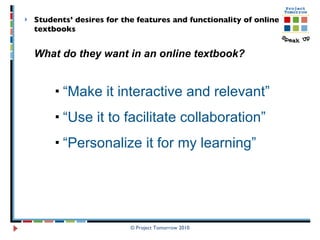
Students’ desires for the features and functionality of online textbooks What do they want in an online textbook? “ Make it interactive and relevant” “ Use it to facilitate collaboration” “ Personalize it for my learning” © Project Tomorrow 2010
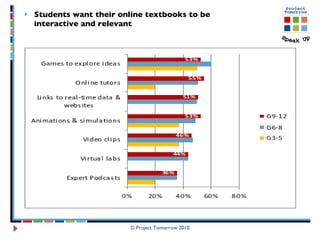
Students want their online textbooks to be interactive and relevant © Project Tomorrow 2010
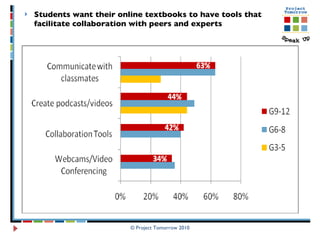
Students want their online textbooks to have tools that facilitate collaboration with peers and experts © Project Tomorrow 2010
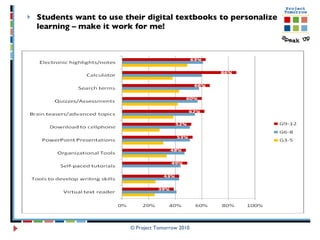
Students want to use their digital textbooks to personalize learning – make it work for me!  © Project Tomorrow 2010
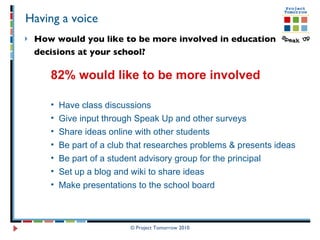
Having a voice How would you like to be more involved in education  decisions at your school?  © Project Tomorrow 2010 82% would like to be more involved Have class discussions Give input through Speak Up and other surveys Share ideas online with other students Be part of a club that researches problems & presents ideas Be part of a student advisory group for the principal  Set up a blog and wiki to share ideas Make presentations to the school board
Creating Our Future: Students Speak Up about their Vision for 21st Century Learning Three Essential Elements in the Student Vision Social–based learning Un–tethered learning  Digitally–rich learning   © Project Tomorrow 2010
Continuing “digital disconnects”  Spectrum of digital native-ness Multiple “computers” in the backpack Embracing & adapting new technologies Anytime, anyplace, anywhere, any pace learning Other trends we are watching © Project Tomorrow 2010
Self directed learning for student & teacher  Everyone is a content developer Make it relevant to me!  Blend of informal & formal learning opps Beyond engagement to productivity benefits “ Long tail” of training & education  Other trends we are watching © Project Tomorrow 2010
But what is the  #1 trend  we are watching with today’s K-12 students? Speak Up Data Findings © Project Tomorrow 2010
#1 trend Speak Up Data Findings © Project Tomorrow 2010 The era of the technology-enabled   Free Agent Learner
Introducing the Free Agent Learner Characteristics: Self directed learning Un-tethered to traditional education  Expert at personal data aggregation   Examples:  Online learning Control over knowledge authenticity Online “textbooks” Self-driven assessments © Project Tomorrow 2010
Introducing the Free Agent Learner Characteristics:  Power of connections Creating new communities Not tethered to physical networks Example:  Mobile devices  Web 2.0 tools/applications Social based learning  © Project Tomorrow 2010
Introducing the Free Agent Learner Characteristics:  Experiential learning – make it real  Content developers Process as important as knowledge gained ( sometimes more important ) Examples:  Gaming, simulations, animations Virtual/immersive environments Web 2.0 / Multimedia content Career exploration © Project Tomorrow 2010
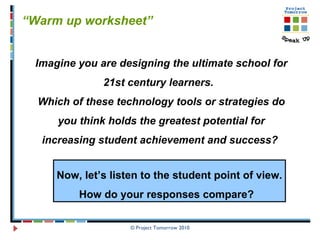
© Project Tomorrow 2010 “ Warm up worksheet”  Imagine you are designing the ultimate school for 21st century learners.  Which of these technology tools or strategies do you think holds the greatest potential for increasing student achievement and success?   Now, let’s listen to the student point of view. How do your responses compare?
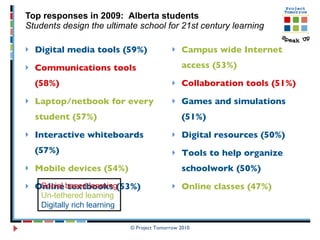
Top responses in 2009:   Alberta students Students design the ultimate school for 21st century learning Digital media tools (59%) Communications tools (58%) Laptop/netbook for every student (57%) Interactive whiteboards (57%) Mobile devices (54%) Online textbooks (53%) Campus wide Internet access (53%) Collaboration tools (51%) Games and simulations (51%) Digital resources (50%) Tools to help organize schoolwork (50%) Online classes (47%)   © Project Tomorrow 2010 Social based learning Un-tethered learning Digitally rich learning
© Project Tomorrow 2010 Recommendations from the “ Digital Advance Team”  Are we listening?  Are we ready?   Learning that is   Enabled Engaging Empowered
© Project Tomorrow 2010 Recommendations from the “ Digital Advance Team”  Are we listening?  Are we ready?   Learning that is   Enabled Engaging Empowered  How do we  get there?
© Project Tomorrow 2010 It all starts with you . . . today  “ Developing a shared vision of innovation for 21st century learning”
© Project Tomorrow 2010 Pretend it is April 19, 2020 today.
© Project Tomorrow 2010 Pretend it is April 19, 2020 today.  Congratulations!   CBC is here to report on your district’s success in creating a truly 21st century learning environment for all of your students.
© Project Tomorrow 2010 Pretend it is April 19, 2020 today.  What will be the lead story about  your district’s success? What will be the results that validate your success? Will you have achieved the shared vision  you developed in 2010?
© Project Tomorrow 2010 Pretend it is April 19, 2020 today.  What will be the lead story about  your district’s success? What will be the results that validate your success? Will you have achieved the shared vision  you developed in 2010? What will be your headline?
© Project Tomorrow 2010 5 Big Questions   “ Planning is not an event.  It is the  continuous process of  strengthening what works  and  abandoning what does not , of making  risk-taking decisions  with the greatest  knowledge of their potential effect , of setting  objectives , appraising  performance and results  through systemic  feedback , and making ongoing  adjustments  as conditions change.”  Peter Drucker
© Project Tomorrow 2010 Table Talk Exercise: Create your headline Pithy Tangible  Measurable  Representative Inspiring
© Project Tomorrow 2010 It all starts with you . . . today  “ Developing a shared vision of innovation for 21st century learning”
Introducing the new Visionary Administrator © Project Tomorrow 2010 Key finding from the Speak Up data:  There is a new cohort emerging of  visionary administrators  who share common behaviors, values & aspirations for 21 st  century learning . . .
Introducing the new Visionary Administrator © Project Tomorrow 2010 Key finding from the Speak Up data:  There is a new cohort emerging of  visionary administrators  who share common behaviors, values & aspirations for 21 st  century learning . . .  and they have more in common with  their students than their peers .
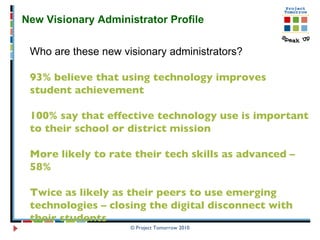
© Project Tomorrow 2010 New Visionary Administrator Profile  Who are these new visionary administrators? 93% believe that using technology improves student achievement 100% say that effective technology use is important to their school or district mission More likely to rate their tech skills as advanced – 58% Twice as likely as their peers to use emerging technologies – closing the digital disconnect with their students
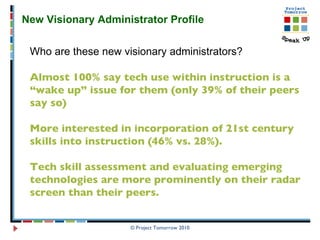
© Project Tomorrow 2010 New Visionary Administrator Profile  Who are these new visionary administrators? Almost 100% say tech use within instruction is a “wake up” issue for them (only 39% of their peers say so)  More interested in incorporation of 21st century skills into instruction (46% vs. 28%). Tech skill assessment and evaluating emerging technologies are more prominently on their radar screen than their peers.
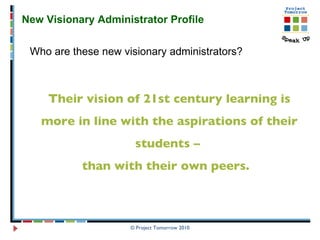
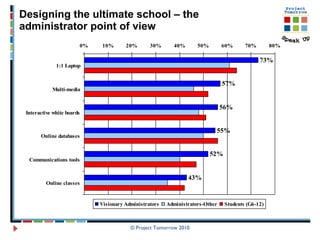
© Project Tomorrow 2010 New Visionary Administrator Profile  Who are these new visionary administrators? Their vision of 21st century learning is more in line with the aspirations of their students –  than with their own peers.
Designing the ultimate school – the administrator point of view © Project Tomorrow 2010
© Project Tomorrow 2010 What is your district’s 2020 headline? Are you a visionary administrator?
Webinars, podcasts and reports such as:  Speak Up 2009 Findings Students and Parents – available now Teachers, Administrators, Pre-service teachers – May 5th Learning in the 21 st  Century: A National Report of Online Learning  (Oct 2007, Updated Jun 2008, 2009) Inspiring the Next Generation of Innovators: Students, Teachers and Parents Speak Up about Science Education (Jun 2008) Leadership in the 21 st  Century:  The New Visionary Administrator  (Oct 2008)  Parents’ Perspectives, Parents’ Priorities  (Oct 2009) © Project Tomorrow 2010 More Speak Up?  www.tomorrow.org
Speak Up 2010 October - December Listen to your stakeholders!  New online surveys for students, teachers,  parents and administrators. Use the Speak Up data to drive new innovations in your district and inform your  vision for 21st century learning. Sign up to get Speak Up news  www.tomorrow.org/speakup/speakup_news_signup.html © Project Tomorrow 2010 Available to all schools in Alberta
© Project Tomorrow 2010 More data and reports are available on  our website:  www.tomorrow.org Julie Evans Project Tomorrow [email_address] 949-609-4660 x15 Copyright Project Tomorrow 2010.  This work is the intellectual property of the author. Permission is granted for this material to be shared for non-commercial, educational purposes, provided that this copyright statement appears on the reproduced materials and notice is given that the copying is by permission of the author. To disseminate otherwise or to republish requires written permission from the author. Thank you!

What is your district’s 2020 headline?

  • 1.
    What is yourdistrict’s 2020 headline? Developing a Shared Vision of Innovation for 21st Century Learning Julie Evans Chief Executive Officer Project Tomorrow April 19, 2010 © Project Tomorrow 2010 Leading Our Way Forward Edmonton Regional Learning Consortium
  • 2.
    © Project Tomorrow2010 Deconstructing our keynote topic “ Developing a shared vision of innovation for 21st century learning”
  • 3.
    © Project Tomorrow2010 Deconstructing our keynote topic Shared vision Innovation 21st century learning
  • 4.
    © Project Tomorrow2010 Defining shared vision “ A shared vision is not an idea...it is rather, a force in people's hearts ...at its simplest level, a shared vision is the answer to the question: What do we want to create?” Peter Senge MIT Sloan School of Management
  • 5.
    © Project Tomorrow2010 Defining innovation "Creativity is thinking up new things. Innovation is doing new things ." Theodore Levitt Harvard Business School
  • 6.
    © Project Tomorrow2010 Defining 21st century learning “ I believe that the purpose of education is not to make men carpenters, but to make carpenters men. To be competitive in a workplace that is changing and will change continuously throughout our careers, my peers and I need to be able to read and understand new information at a level never before prevalent. This should be, however, a familiar aim for the forces of academia, however, since what we must learn, in essence, is to learn. I would ensure a broad and balanced education that exposes every student to rigorous inquiry in every discipline, from physics to pottery and makes them active participants in the process of inquiry and learning.” 11 th grade student Pittsburgh PA
  • 7.
    © Project Tomorrow2010 Deconstructing our keynote topic “ What is your district’s 2020 headline?”
  • 8.
    © Project Tomorrow2010 Knowing where you are today What is your district’s 2010 headline?
  • 9.
    © Project Tomorrow2010 Some 2010 Headlines About Education “ NYC to End Rubber Rooms for Teachers Who Await Hearings” “ Teacher Training No Boom for Student Math Scores” “ Parents Reflect on Previous Edmonton School Closures” “ Public Schools Foundation Aims to Create Level Playing Field” “ Central Falls to Fire Every High School Teacher” “ High Speed Networking Changes How We Learn Our ABCs” “ Edmonton School Boards Tighten Belts in New Budgets” “ Eliminating School Boards a Good First Step” “ Calgary Classrooms Go Digital” “ Maybe It is Time to Fix Education System”
  • 10.
    © Project Tomorrow2010 Our discussion today Inputs to your process: 5 most important questions Meet today’s students Sampling of key data findings from Speak Up 2009 What is your 2020 headline? Characteristics of the “New Visionary Administrator”
  • 11.
    © Project Tomorrow2010 “ Warm up worksheet” Imagine you are designing the ultimate school for 21st century learners. Which of these technology tools or strategies do you think holds the greatest potential for increasing student achievement and success? Your point of view – check your top 5 responses from the list! Micro blog your thoughts and comments!
  • 12.
    © Project Tomorrow2010 5 Most Important Questions Peter Drucker Father of Modern Management 1909 – 2005 Thought Leader Author Teacher Consultant Cared deeply about leadership and innovation in the Social Sector
  • 13.
    © Project Tomorrow2010 5 Most Important Questions What is our mission? Who is our customer? What does our customer value? What are our results? What are our plans?
  • 14.
    © Project Tomorrow2010 5 Most Important Questions What is our mission? Who is our customer? What does our customer value? What are our results? What are our plans?
  • 15.
    © Project Tomorrow2010 5 Most Important Questions Who is our customer? Articulate who is your primary customer Identify all of the secondary customers Be in touch with changes in your customers Think about who must be satisfied for the district to achieve success
  • 16.
    © Project Tomorrow2010 5 Most Important Questions Who does our customer value? Understand your own assumptions & paradigms Listen deeply to your customer And then listen again and again
  • 17.
    © Project Tomorrow2010 5 Big Questions “ Planning is not an event. It is the continuous process of strengthening what works and abandoning what does not , of making risk-taking decisions with the greatest knowledge of their potential effect , of setting objectives , appraising performance and results through systemic feedback , and making ongoing adjustments as conditions change.” Peter Drucker
  • 18.
    What forces areshaping your “customer’s expectations” for a 21st century learning environment? © Project Tomorrow 2010 Customer = Your Students
  • 19.
    What forces areshaping your customer’s expectations for a 21st century learning environment? © Project Tomorrow 2010 Your Students District/Provincial Education Priorities Millennial Attitudes & Values Their Techno-infused Lives
  • 20.
    © Project Tomorrow2010 What the top 5 challenges that “ wake you up in the middle of the night?” District/Provincial Education Priorities
  • 21.
    Adequate funding Collectivebargaining with teachers Communications with parents Competition from charters/privates Diverse student populations High school graduation rates Special education issues Safety School facilities Student achievement results Use of technology within instruction Using data to assess student achievement © Project Tomorrow 2010 Your Top 5 Challenges?
  • 22.
    Adequate funding –53% Collective bargaining with teachers – 6% Communications with parents – 35% Competition from charters/privates – 4% Diverse student populations – 33% Graduation rates – 16% Special education issues – 19% Safety – 33% School facilities – 21% Student achievement results – 52% Use of technology – 31% Using data to assess achievement – 35% © Project Tomorrow 2010 Wake Up Issues for Education Leaders Speak Up 2009 data results
  • 23.
    © Project Tomorrow2010 How important is the effective implementation of technology to your district’s core mission ? District/Provincial Education Priorities
  • 24.
    © Project Tomorrow2010 How important is the effective implementation of technology to your district’s core mission?
  • 25.
    What forces areshaping your customer’s expectations for a 21st century learning environment? © Project Tomorrow 2010 Your Students District/Provincial Education Priorities Millennial Attitudes & Values Their Techno-infused Lives
  • 26.
    Let’s meet theMillennials! © Project Tomorrow 2010
  • 27.
    © Project Tomorrow2010 Millennial Attitudes & Values Birth years – 1982 through 2001 + 26% of the Canadian population 80 million in North America Most diverse in history First generation to have better educated moms than dads 2/3 report influencing parental purchasing decisions Childhood had a 34% decrease in unstructured free time Millennials Rising (Neil Howe and William Strauss)
  • 28.
    © Project Tomorrow2010 Millennial Attitudes & Values 7 Defining Characteristics: Special – high self-esteem, limited consequences Sheltered – expect to be protected Confident – they will fix the world Team-oriented – dislike school but like group projects Conventional – trust institutions, fairness important Pressured – increase in pre-college stress and burnout Achieving – expect success and college for all Millennials Rising (Neil Howe and William Strauss)
  • 29.
    Millennials & Accomplishment© Project Tomorrow 2010 86% say their generation will produce the next Bill Gates
  • 30.
    Millennials & Accomplishment© Project Tomorrow 2010 86% say their generation will produce the next Bill Gates 67% say they know the next Bill Gates
  • 31.
    Millennials & Accomplishment© Project Tomorrow 2010 86% say their generation will produce the next Bill Gates 67% say they know the next Bill Gates and 24% say they could be that person!
  • 32.
    © Project Tomorrow2010 Millennial Attitudes & Values Collaboratively Anytime, anyplace, anywhere, any pace Structured activities Relevancy with real world Millennials Rising (Neil Howe and William Strauss) How do these students want to learn?
  • 33.
    © Project Tomorrow2010 Millennial Attitudes & Values Collaboratively Anytime, anyplace, anywhere, any pace Structured activities Relevancy with real world And with all kinds of emerging technologies Millennials Rising (Neil Howe and William Strauss) How do these students want to learn?
  • 34.
    What forces areshaping your customer’s expectations for a 21st century learning environment? © Project Tomorrow 2010 Your Students District/Provincial Education Priorities Millennial Attitudes & Values Their Techno-infused Lives
  • 35.
    What can welearn by listening to our customers? © Project Tomorrow 2010 Speak Up 2009 Selected Data Findings Their Techno-infused Lives
  • 36.
    Annual national researchproject Online surveys + focus groups Open for all K-12 schools, districts and schools of education Schools/districts/colleges get back their own data for planning and budgeting Collect data ↔ Stimulate conversations K-12 Students, Teachers, Parents and Administrators + Pre-Service Teachers Inform policies & programs Analysis and reporting – national reports, state reports, district reports Services: custom reports, consulting with districts and state agencies Back end database – provide statistically significant samplings 7 years of empowering authentic voices – since 2003: 1.6 million K-12 students 142,000 teachers 82,000 parents 10,500 school leaders 23,000 schools – in US, Canada, Mexico, Australia © Project Tomorrow 2010 What is Speak Up? 1.85 million respondents
  • 37.
    Speak Up isfacilitated annually by Project Tomorrow © Project Tomorrow 2010 Project Tomorrow (www.tomorrow.org) is the leading education nonprofit organization dedicated to the empowerment of student voices in education.
  • 38.
    K-12 Students 299,677Teachers 38,642 Pre-Service Teachers 1,987 Parents (in English & Spanish) 26,312 School/District Administrators 3,947 Schools / Districts 5,757 / 1,215 About Speak Up Schools: 97% public, 3% private 38% urban, 31% suburban, 32% rural 54% high poverty schools 42% majority-minority student population © Project Tomorrow 2010 Speak Up 2009 Participation: 370,565 surveys
  • 39.
    Learning & Teachingwith Technology 21 st Century Skills: Digital Citizenship Science/Math Instruction & Career Interests in STEM and Teaching Teacher Professional Development Internet Safety Administrators’ Challenges Emerging Technologies in the Classroom Mobile Devices, Online Learning, Digital Content and E-textbooks Educational Games, Web 2.0 tools and applications Designing the 21st Century School © Project Tomorrow 2010 Speak Up 2009 survey question themes
  • 40.
    Collect uniquedata from stakeholders Give stakeholders a voice in national/state/provincial policy Support specific initiatives such as digital content, online learning, mobile devices, 1:1 programs or new teacher professional development programs Model for students the value of civic engagement and being part of a national discussion Recognition as an innovation leader Demonstrate to students, teachers and parents that their ideas are valued by their education leaders Creating a vision for the future of K-12 education © Project Tomorrow 2010 Why do schools & districts participate in Speak Up?
  • 41.
    Speak Up DataFindings © Project Tomorrow 2010 Who am I? Interactive Exercise
  • 42.
    © Project Tomorrow2010 Who am I? Profile characteristics: Wishes for their ultimate school Online textbooks (29%) High tech science tools (39%) Online tools for organization (35%) Access to mobile devices: MP3 player (44%) Game player (53%) Laptop (44%) Participates in immersive virtual reality environments (39%) Uses Internet for research (51%) and online assessments (35%)
  • 43.
    © Project Tomorrow2010 Audience Response: Who am I? Kindergarten Boy 3rd Grade Girl 7th Grade Boy 10th Grade Girl Teacher
  • 44.
    © Project Tomorrow2010 Who am I?
  • 45.
    © Project Tomorrow2010 Who am I? 3 rd Grade Girl with Average Tech Skills
  • 46.
    © Project Tomorrow2010 Who am I? Profile characteristics: Wishes for their ultimate school Online textbooks (29%) High tech science tools (39%) Online tools for organization (35%) Access to mobile devices: MP3 player (44%) Game player (53%) Laptop (44%) Participates in immersive virtual reality environments (39%) Uses Internet for research (51%) and online assessments (35%)
  • 47.
    © Project Tomorrow2010 Introducing the “Digital Advance Team” Today’s K-12 Students Adopting/adapting technologies for learning Tech trend setters Their use predicts widespread acceptance Out of school use drives in school use Pace car for others Teachers ultimately catch up
  • 48.
    © Project Tomorrow2010 Introducing the “Digital Advance Team” Case Study: Use of email technology for communications
  • 49.
    © Project Tomorrow2010 Introducing the “Digital Advance Team” Case Study: Use of email technology for communications Students use email for personal communications Students expand use to include schoolwork Teachers adopt email for peer communications Some teachers now using for student feedback Students’ use waning
  • 50.
    © Project Tomorrow2010 Introducing the “Digital Advance Team” Let’s listen in and learn!
  • 51.
    “ Digital disconnect” is alive & well: the gap between how today’s students learn and how they live! © Project Tomorrow 2010 Key findings from Speak Up data:
  • 52.
    “ Digital disconnect”is alive & well: Between students and teachers Between advanced tech students and other students Between girls and boys Between older and younger students © Project Tomorrow 2010 Key findings from Speak Up data:
  • 53.
    © Project Tomorrow2010 Audience Response How would you assess your own technology skills compared to your peers? Beginner Average Advanced
  • 54.
    5% 21% 74%© Project Tomorrow 2010 Audience Response: What % of Alberta high school students consider themselves “advanced tech users?”
  • 55.
    © Project Tomorrow2010 Digital Disconnect – in perceptions 21%
  • 56.
    Sampling of KeyFindings: Speak Up 2003 – 2009 + 1.85 million surveys from students, parents & educators Persistent digital disconnect between students and adults Students’ frustrations with the lack of technology use in school Lack of relevancy in education exacerbated Students function as a “Digital Advance Team” Students adopt and adapt emerging technologies for learning Introducing the “Free Agent Learner” © Project Tomorrow 2010
  • 57.
    Result: Anew uniquely “student vision” for leveraging emerging technologies to drive achievement and educational productivity © Project Tomorrow 2010
  • 58.
    Creating Our Future:Students Speak Up about their Vision for 21st Century Learning Three Essential Elements in the Student Vision Social–based learning Un–tethered learning Digitally–rich learning © Project Tomorrow 2010
  • 59.
    Creating Our Future:Students Speak Up about their Vision for 21st Century Learning Three Essential Elements Social–based learning Students want to leverage emerging communications and collaboration tools to create personal networks of experts © Project Tomorrow 2010
  • 60.
    Creating Our Future:Students Speak Up about their Vision for 21st Century Learning Three Essential Elements Un–tethered learning Students envision technology-enabled learning that transcends classroom walls © Project Tomorrow 2010
  • 61.
    Creating Our Future:Students Speak Up about their Vision for 21st Century Learning Three Essential Elements Digitally–rich learning Students see the use of relevancy-based digital tools, content and resources as key to education productivity © Project Tomorrow 2010
  • 62.
    Creating Our Future:Students Speak Up about their Vision for 21st Century Learning Three Essential Elements Social–based learning © Project Tomorrow 2010
  • 63.
    Students use technologytools on their own for learning © Project Tomorrow 2010
  • 64.
    Students’ use oftechnology for communication and collaboration outside of school © Project Tomorrow 2010
  • 65.
    Students’ use ofcollaboration and communications tools for school work © Project Tomorrow 2010
  • 66.
    Social-based learning Examplewithin curriculum: Math and STEM career exploration © Project Tomorrow 2010 What would be most helpful for you in learning math? “ Discussing how to solve problems with my classmates” “ Helping other students with their math problems” 47% Grade 6-8 students 40% Grade 9-12 students
  • 67.
    Social-based learning Examplewithin curriculum: Math and STEM career exploration © Project Tomorrow 2010 How would you like to learn about STEM careers? “ Meeting successful role models” “ Talking to professionals about their jobs” “ Working with mentors”
  • 68.
    Creating Our Future:Students Speak Up about their Vision for 21st Century Learning Three Essential Elements Un–tethered learning © Project Tomorrow 2010
  • 69.
    Mobile Devices: Students have personal access to a variety of electronic devices – even our youngest students! © Project Tomorrow 2010
  • 70.
    Students’ suggested useof mobile devices for learning purposes © Project Tomorrow 2010
  • 71.
    Students believe thatmobile devices can also enhance personal productivity © Project Tomorrow 2010
  • 72.
    Students speak upabout the obstacles they face using technology at school © Project Tomorrow 2010 Alberta students top responses: School filters and firewalls block websites I need I cannot use my mobile devices at school I cannot access my email/IM/text tools Teachers limit my technology use Too many rules!
  • 73.
    How schools couldmake it easier to use technology – the student point of view © Project Tomorrow 2010 Alberta students say: Let me use my own mobile device Give me unlimited Internet access on campus Access my school projects from any computer – home or at school Let me use my own laptop at school – and access the school network I want to access my social networking site and communications tools
  • 74.
    Parents’ beliefs aboutthe potential benefits of using mobile devices for instructional purposes © Project Tomorrow 2010 Increases student engagement 43% Prepares students for world of work 41% Extends school day for learning 38% Provides access to online textbooks 37% Improves teacher-parent-student communications 35%
  • 75.
    Teachers’ beliefs aboutthe potential benefits of using mobile devices for instructional purposes © Project Tomorrow 2010 Increases student engagement 50% Prepares students for world of work 40% Extends school day for learning 36% Improves teacher-parent-student communications 36% Personalizes instruction 29%
  • 76.
    Teachers’ biggest concernabout using mobile devices at school While 50% of teachers say that the greatest benefit to using mobile devices: increases student engagement in school and learning 67% say their biggest concern however is students will be distracted doing other things (texting, surfing, games) © Project Tomorrow 2010
  • 77.
    Teachers’ other concernsabout using mobile devices at school Distraction 67% Digital equity 55% Students will cheat on tests 30% I don’t know how to integrate 21% I don’t have curriculum 20% © Project Tomorrow 2010
  • 78.
    Administrators’ perspectives onmobile devices within learning 66% of administrators say that the greatest benefit to using mobile devices: increases student engagement in school and learning © Project Tomorrow 2010
  • 79.
    Administrators’ perspectives onmobile devices within learning What prevents administrators from allowing students to use their own devices? Current district policies (49%) Concerns about theft (47%) Concerns about network security (47%) Teachers are not trained (45%) Digital equity concerns (42%) © Project Tomorrow 2010
  • 80.
    Parents’ willingness topurchase mobile devices for their child to use at school © Project Tomorrow 2010
  • 81.
    Students have agrowing interest in taking classes online © Project Tomorrow 2010
  • 82.
    Students speak upabout the value of online classes © Project Tomorrow 2010
  • 83.
    Creating Our Future:Students Speak Up about their Vision for 21st Century Learning Three Essential Elements Digitally–rich learning © Project Tomorrow 2010
  • 84.
    Students’ use ofdigital resources for schoolwork © Project Tomorrow 2010
  • 85.
    Students use ofdigital resources outside of school © Project Tomorrow 2010
  • 86.
    Students value theuse of games for learning © Project Tomorrow 2010
  • 87.
    Parents also perceivevalue in the use of games for learning Appeals to different learning styles 76% Increases student engagement 76% Develops problem solving and critical thinking skills 57% Helps students visualize difficult concepts 56% Provides immediate feedback 56% Develops creativity 53% © Project Tomorrow 2010
  • 88.
    Students’ desires forthe features and functionality of online textbooks What do they want in an online textbook? “ Make it interactive and relevant” “ Use it to facilitate collaboration” “ Personalize it for my learning” © Project Tomorrow 2010
  • 89.
    Students want theironline textbooks to be interactive and relevant © Project Tomorrow 2010
  • 90.
    Students want theironline textbooks to have tools that facilitate collaboration with peers and experts © Project Tomorrow 2010
  • 91.
    Students want touse their digital textbooks to personalize learning – make it work for me! © Project Tomorrow 2010
  • 92.
    Having a voiceHow would you like to be more involved in education decisions at your school? © Project Tomorrow 2010 82% would like to be more involved Have class discussions Give input through Speak Up and other surveys Share ideas online with other students Be part of a club that researches problems & presents ideas Be part of a student advisory group for the principal Set up a blog and wiki to share ideas Make presentations to the school board
  • 93.
    Creating Our Future:Students Speak Up about their Vision for 21st Century Learning Three Essential Elements in the Student Vision Social–based learning Un–tethered learning Digitally–rich learning © Project Tomorrow 2010
  • 94.
    Continuing “digital disconnects” Spectrum of digital native-ness Multiple “computers” in the backpack Embracing & adapting new technologies Anytime, anyplace, anywhere, any pace learning Other trends we are watching © Project Tomorrow 2010
  • 95.
    Self directed learningfor student & teacher Everyone is a content developer Make it relevant to me! Blend of informal & formal learning opps Beyond engagement to productivity benefits “ Long tail” of training & education Other trends we are watching © Project Tomorrow 2010
  • 96.
    But what isthe #1 trend we are watching with today’s K-12 students? Speak Up Data Findings © Project Tomorrow 2010
  • 97.
    #1 trend SpeakUp Data Findings © Project Tomorrow 2010 The era of the technology-enabled Free Agent Learner
  • 98.
    Introducing the FreeAgent Learner Characteristics: Self directed learning Un-tethered to traditional education Expert at personal data aggregation Examples: Online learning Control over knowledge authenticity Online “textbooks” Self-driven assessments © Project Tomorrow 2010
  • 99.
    Introducing the FreeAgent Learner Characteristics: Power of connections Creating new communities Not tethered to physical networks Example: Mobile devices Web 2.0 tools/applications Social based learning © Project Tomorrow 2010
  • 100.
    Introducing the FreeAgent Learner Characteristics: Experiential learning – make it real Content developers Process as important as knowledge gained ( sometimes more important ) Examples: Gaming, simulations, animations Virtual/immersive environments Web 2.0 / Multimedia content Career exploration © Project Tomorrow 2010
  • 101.
    © Project Tomorrow2010 “ Warm up worksheet” Imagine you are designing the ultimate school for 21st century learners. Which of these technology tools or strategies do you think holds the greatest potential for increasing student achievement and success? Now, let’s listen to the student point of view. How do your responses compare?
  • 102.
    Top responses in2009: Alberta students Students design the ultimate school for 21st century learning Digital media tools (59%) Communications tools (58%) Laptop/netbook for every student (57%) Interactive whiteboards (57%) Mobile devices (54%) Online textbooks (53%) Campus wide Internet access (53%) Collaboration tools (51%) Games and simulations (51%) Digital resources (50%) Tools to help organize schoolwork (50%) Online classes (47%) © Project Tomorrow 2010 Social based learning Un-tethered learning Digitally rich learning
  • 103.
    © Project Tomorrow2010 Recommendations from the “ Digital Advance Team” Are we listening? Are we ready? Learning that is Enabled Engaging Empowered
  • 104.
    © Project Tomorrow2010 Recommendations from the “ Digital Advance Team” Are we listening? Are we ready? Learning that is Enabled Engaging Empowered How do we get there?
  • 105.
    © Project Tomorrow2010 It all starts with you . . . today “ Developing a shared vision of innovation for 21st century learning”
  • 106.
    © Project Tomorrow2010 Pretend it is April 19, 2020 today.
  • 107.
    © Project Tomorrow2010 Pretend it is April 19, 2020 today. Congratulations! CBC is here to report on your district’s success in creating a truly 21st century learning environment for all of your students.
  • 108.
    © Project Tomorrow2010 Pretend it is April 19, 2020 today. What will be the lead story about your district’s success? What will be the results that validate your success? Will you have achieved the shared vision you developed in 2010?
  • 109.
    © Project Tomorrow2010 Pretend it is April 19, 2020 today. What will be the lead story about your district’s success? What will be the results that validate your success? Will you have achieved the shared vision you developed in 2010? What will be your headline?
  • 110.
    © Project Tomorrow2010 5 Big Questions “ Planning is not an event. It is the continuous process of strengthening what works and abandoning what does not , of making risk-taking decisions with the greatest knowledge of their potential effect , of setting objectives , appraising performance and results through systemic feedback , and making ongoing adjustments as conditions change.” Peter Drucker
  • 111.
    © Project Tomorrow2010 Table Talk Exercise: Create your headline Pithy Tangible Measurable Representative Inspiring
  • 112.
    © Project Tomorrow2010 It all starts with you . . . today “ Developing a shared vision of innovation for 21st century learning”
  • 113.
    Introducing the newVisionary Administrator © Project Tomorrow 2010 Key finding from the Speak Up data: There is a new cohort emerging of visionary administrators who share common behaviors, values & aspirations for 21 st century learning . . .
  • 114.
    Introducing the newVisionary Administrator © Project Tomorrow 2010 Key finding from the Speak Up data: There is a new cohort emerging of visionary administrators who share common behaviors, values & aspirations for 21 st century learning . . . and they have more in common with their students than their peers .
  • 115.
    © Project Tomorrow2010 New Visionary Administrator Profile Who are these new visionary administrators? 93% believe that using technology improves student achievement 100% say that effective technology use is important to their school or district mission More likely to rate their tech skills as advanced – 58% Twice as likely as their peers to use emerging technologies – closing the digital disconnect with their students
  • 116.
    © Project Tomorrow2010 New Visionary Administrator Profile Who are these new visionary administrators? Almost 100% say tech use within instruction is a “wake up” issue for them (only 39% of their peers say so) More interested in incorporation of 21st century skills into instruction (46% vs. 28%). Tech skill assessment and evaluating emerging technologies are more prominently on their radar screen than their peers.
  • 117.
    © Project Tomorrow2010 New Visionary Administrator Profile Who are these new visionary administrators? Their vision of 21st century learning is more in line with the aspirations of their students – than with their own peers.
  • 118.
    Designing the ultimateschool – the administrator point of view © Project Tomorrow 2010
  • 119.
    © Project Tomorrow2010 What is your district’s 2020 headline? Are you a visionary administrator?
  • 120.
    Webinars, podcasts andreports such as: Speak Up 2009 Findings Students and Parents – available now Teachers, Administrators, Pre-service teachers – May 5th Learning in the 21 st Century: A National Report of Online Learning (Oct 2007, Updated Jun 2008, 2009) Inspiring the Next Generation of Innovators: Students, Teachers and Parents Speak Up about Science Education (Jun 2008) Leadership in the 21 st Century: The New Visionary Administrator (Oct 2008) Parents’ Perspectives, Parents’ Priorities (Oct 2009) © Project Tomorrow 2010 More Speak Up? www.tomorrow.org
  • 121.
    Speak Up 2010October - December Listen to your stakeholders! New online surveys for students, teachers, parents and administrators. Use the Speak Up data to drive new innovations in your district and inform your vision for 21st century learning. Sign up to get Speak Up news www.tomorrow.org/speakup/speakup_news_signup.html © Project Tomorrow 2010 Available to all schools in Alberta
  • 122.
    © Project Tomorrow2010 More data and reports are available on our website: www.tomorrow.org Julie Evans Project Tomorrow [email_address] 949-609-4660 x15 Copyright Project Tomorrow 2010. This work is the intellectual property of the author. Permission is granted for this material to be shared for non-commercial, educational purposes, provided that this copyright statement appears on the reproduced materials and notice is given that the copying is by permission of the author. To disseminate otherwise or to republish requires written permission from the author. Thank you!