Strategic Technology Plan Using Technology to  Take a Bite Out of  the Budget Crunch Cable Green eLearning Director
Technology Transformation Task Force The strategic technology plan is the product of an 18-month analysis conducted by the Technology Transformation Task Force of the SBCTC for the purpose of  creating a roadmap for how our system needs to leverage 21st century technologies to support student achievement. Conversation went something like this:  Video http://www.youtube.com/watch?v=e50YBu14j3U
http://techplan.sbctc.edu
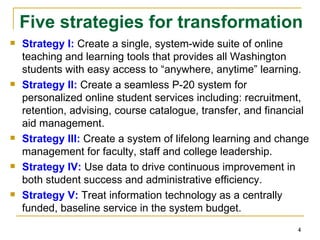
Strategy I:  Create a single, system-wide suite of online teaching and learning tools that provides all Washington students with easy access to “anywhere, anytime” learning. Strategy II:  Create a seamless P-20 system for personalized online student services including: recruitment, retention, advising, course catalogue, transfer, and financial aid management. Strategy III:  Create a system of lifelong learning and change management for faculty, staff and college leadership. Strategy IV:  Use data to drive continuous improvement in both student success and administrative efficiency. Strategy V:  Treat information technology as a centrally funded, baseline service in the system budget. Five strategies for transformation

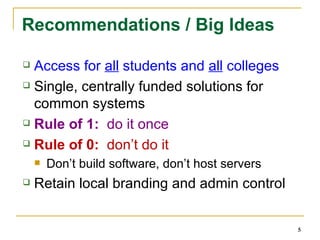
Recommendations / Big Ideas Access for  all  students and  all  colleges Single, centrally funded solutions for common systems Rule of 1:  do it once  Rule of 0:  don’t do it Don’t build software, don’t host servers Retain local branding and admin control
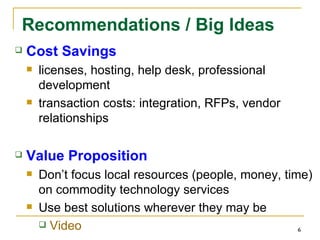
Recommendations / Big Ideas Cost Savings licenses, hosting, help desk, professional development transaction costs: integration, RFPs, vendor relationships Value Proposition Don’t focus local resources (people, money, time) on commodity technology services Use best solutions wherever they may be Video
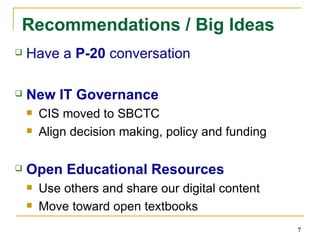
Recommendations / Big Ideas Have a  P-20  conversation New IT Governance CIS moved to SBCTC Align decision making, policy and funding Open Educational Resources Use others and share our digital content Move toward open textbooks
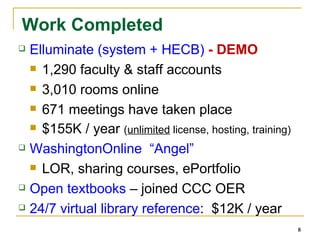
Work Completed Elluminate (system + HECB)  - DEMO 1,290 faculty & staff accounts 3,010 rooms online 671 meetings have taken place $155K / year  ( unlimited  license, hosting, training) WashingtonOnline  “Angel” LOR, sharing courses, ePortfolio Open textbooks  – joined CCC OER 24/7 virtual library reference :  $12K / year
Work Completed Reduced WashingtonOnline Technology Fee Old WAOL Technology Fee:  $8  / credit / student / course New WAOL Technology Fee:  $4  / user / quarter Unlimited use:  one or more ANGEL courses, ePortfolios and/or collaboration spaces Old:  Three 5-credit courses in WAOL was  $120 New:  Three (or more) 5-credit courses in WAOL is  $4
Work Completed CheckOutACollege http://checkoutacollege.com   Over 14,000 visitors in nine months; Nearly 100,000 page views Students are spending over 7.5 minutes per visit Over 28,000 have visited the career interest survey on the site
Ongoing Online Learning Growth 2004 annualized FTE = 9,372 2008 annualized FTE = 18,038 Over  83,000 students learn online each year eLearning enrollments  up more than 23%  (Fall 07 – Fall 08) Growth projections:  by 2019, 51% or 78,344 of system FTE will be enrolled in online or hybrid courses
Ongoing Online Learning Growth  45% of all CTC graduates earn 15 or more credits online or hybrid 2008 summer online enrollments increased between 30 and 216 percent 23 colleges offer 86 different degrees and certificates online 16 colleges offer an AA degree online Community and Technical Colleges teach over 80% of all online FTE in WA higher education
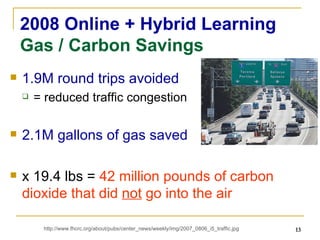
2008 Online + Hybrid Learning Gas / Carbon Savings 1.9M round trips avoided = reduced traffic congestion 2.1M gallons of gas saved x 19.4 lbs =  42 million pounds of carbon dioxide that did  not  go into the air http://www.fhcrc.org/about/pubs/center_news/weekly/img/2007_0806_i5_traffic.jpg
Presidents Understand the Need to Change Presidents voted  unanimously  to support the Strategic Technology Plan   WACTC Technology Committee track implementation of the Strategic Technology Plan:  “Score Card” communicate system solutions
Funding System Solutions is the Greatest Challenge Leverage the buying power of entire system Cost effective to use common systems and support services Large travel and per diem offsets using technology  Association Conference in Elluminate 1 ½ day Commission / Council meeting =  $10K+ Partnerships: Public and private
“ This plan represents our sense of extreme urgency to catch up, keep up and provide all colleges and students the technological tools and services they need to succeed in the 21 st  century.”
What is Next for  WashingtonOnline? Colleges looking at ANGEL  (lower tech fee) new capability to share content system-wide Use existing Pooled Enrollment In bad budget times – colleges close programs.  How will you deliver your students the courses they need? Enrolling College – keeps  all  FTE & Tuition Teaching College – gets $50/credit hour/student Student gets the course she needs! WashingtonOnline facilitates – takes no $
What is Next? Redesign and Open 100 courses Open textbooks, open courseware “ Go-Forward”  (administrative systems) Leveraging networked IT Services “in the cloud” Allows colleges to “go core” i.e., focus on learning and student services
Let’s Look @  Open Textbooks Dr. Judy Baker Dean, Foothill Global Access Director, Community College Consortium for Open Educational Resources (…next set of slides are “mashed up” Judy slides) www.collegeopentextbooks.org
Community College Consortium for Open Educational Resources Joint effort to develop and use open educational resources and open textbooks in community college courses cccoer.wordpress.com
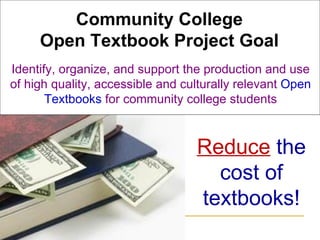
Community College Open Textbook Project Goal Identify, organize, and support the production and use of high quality, accessible and culturally relevant  Open Textbooks  for community college students Reduce  the cost of textbooks!
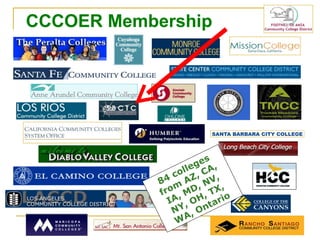
84 colleges from AZ, CA, IA, MD, NV, NY, OH, TX, WA, Ontario CCCOER Membership
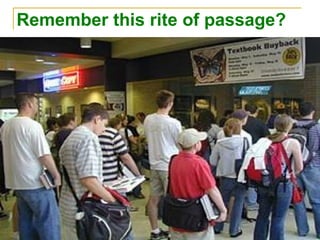
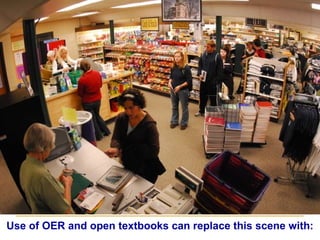
Remember this rite of passage?
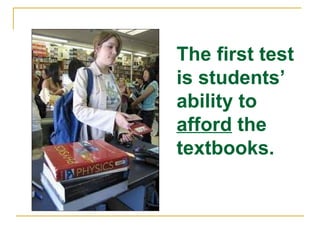
The first test is students’ ability to  afford  the textbooks.
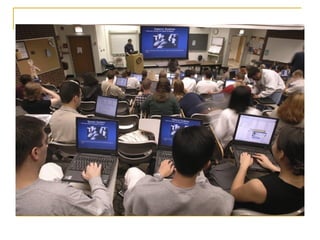
Use of OER and open textbooks can replace this scene with:
 
 
http://therawfeed.com/pix/the_raw_feed_on_kindle-BIG.jpg
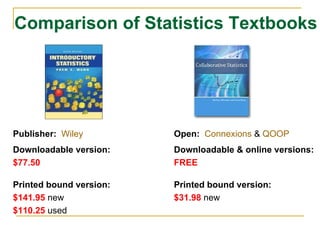
Comparison of Statistics Textbooks Publisher:   Wiley Open:   Connexions  &  QOOP Downloadable version:  $77.50 Downloadable & online versions:   FREE  Printed bound version:   $141.95  new  $110.25  used Printed bound version:   $31.98  new
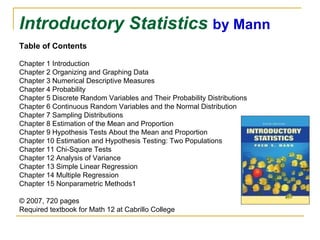
Introductory   Statistics  by Mann Table of Contents   Chapter 1 Introduction  Chapter 2 Organizing and Graphing Data  Chapter 3 Numerical Descriptive Measures  Chapter 4 Probability  Chapter 5 Discrete Random Variables and Their Probability Distributions  Chapter 6 Continuous Random Variables and the Normal Distribution  Chapter 7 Sampling Distributions  Chapter 8 Estimation of the Mean and Proportion  Chapter 9 Hypothesis Tests About the Mean and Proportion  Chapter 10 Estimation and Hypothesis Testing: Two Populations  Chapter 11 Chi-Square Tests  Chapter 12 Analysis of Variance  Chapter 13 Simple Linear Regression  Chapter 14 Multiple Regression  Chapter 15 Nonparametric Methods1  © 2007, 720 pages Required textbook for   Math 12 at   Cabrillo College
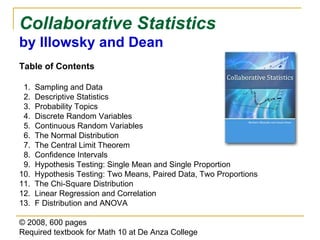
Collaborative Statistics  by Illowsky and Dean Table of Contents 1.  Sampling and Data 2.  Descriptive Statistics 3.  Probability Topics 4.  Discrete Random Variables 5.  Continuous Random Variables 6.  The Normal Distribution 7.  The Central Limit Theorem 8.  Confidence Intervals 9.  Hypothesis Testing: Single Mean and Single Proportion 10.  Hypothesis Testing: Two Means, Paired Data, Two Proportions 11.  The Chi-Square Distribution 12.  Linear Regression and Correlation 13.  F Distribution and ANOVA © 2008, 600 pages Required textbook   for Math 10 at De Anza College
Raise your hand if your college teaches  “Introductory Statistics”
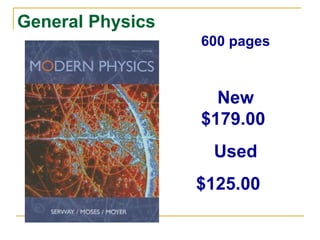
General Physics            600 pages New $179.00  Used $125.00  
 
Raise your hand if your college teaches  “Introductory Physics”
Raise your hand if your college teaches  Elementary Algebra
Do you want to go through the  rest  of your general education textbooks?
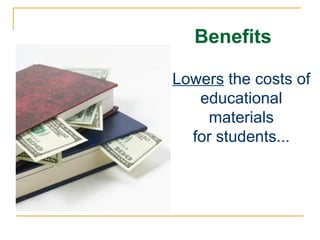
Benefits Lowers  the costs of educational materials for students...
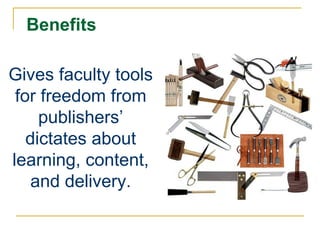
Benefits Gives faculty tools for freedom from publishers’ dictates about learning, content, and delivery.
Challenges Faculty and student  resistance to change   Limited availability  of high quality and  comprehensive  learning materials  in some disciplines  Inadequate access  to high-speed  Internet by students
Challenges Compliance with  accessibility  requirements Printing and  computer lab  demands on  campus  by students Coordination with  campus bookstores
Open Textbook Adoption Locate  open textbooks for consideration Evaluate  each textbook for selection Customize, remix, and  organize  selected  textbook Disseminate  in print  and digital formats  http://emharrington.com/rex/images/adoptadog/Adopt_Me.jpg
Locate  Open Textbooks for Consideration MERLOT Connexions Wikibooks OER Commons Global Text Project http://rtnl.files.wordpress.com/2007/01/thinker21.jpg
Evaluate  Each Textbook Quality Accessibility Cultural relevance Currency Authority of Source Reading level Depth and scope  Quality and Accuracy Articulation
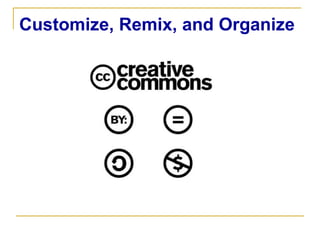
Customize, Remix, and Organize
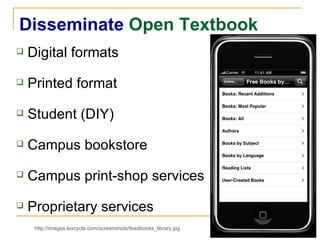
Disseminate  Open Textbook Digital formats  Printed format Student (DIY)  Campus bookstore  Campus print-shop services  Proprietary services http://images.lexcycle.com/screenshots/feedbooks_library.jpg
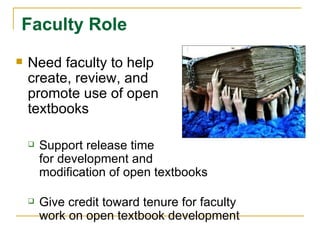
Faculty Role Need faculty to help  create, review, and  promote use of open  textbooks Support release time for development and  modification of open textbooks   Give credit toward tenure for faculty work on open textbook development
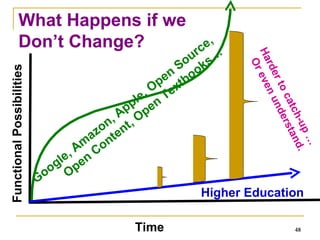
What Happens if we Don’t Change? Google, Amazon, Apple, Open Source, Open Content, Open Textbooks… Higher Education Functional Possibilities Time Harder to catch-up … Or even understand.
Higher Education’s  Future Role? “ I’ve been trying to gain a better sense of the role universities will play in society in the future. At one point, we thought  content  was the value point of universities. Wrong. MIT’s OpenCourseWare initiative changed that. Ok, then the  interaction with faculty  is the value point. And wrong again. Open communication and collaboration in online environments with networks of peers and experts gave us control over our interactions. Fine. Then the value point is  accreditation . Yes, for now. Our ability to rate, review, comment, and provide feedback has increased with the development of the read/write web. I’m not sure how long we can build education’s value on the concept of accreditation.” George Siemens: blog post:  explaining leads to information
Free Global Online University Will this new higher education model succeed?  http://www.uopeople.com/ NY Times Article But make no mistake… the powerful combination of digital open educational resources, social networking, retiring baby-boomer volunteers, falling technology and bandwidth prices, variable cost structures, and the billions of people globally who need / want access to a higher education … is real – and it will drive change.
Cable’s Answer … I think Our  new  role  (at least for now)  is to be synthesizers and leverage networked IT, networked knowledge, and networked expertise… and put together high quality, cost effective learning environments that help more students get to higher levels of education.
http://blog.oer.sbctc.edu  http://blog.elearning.sbctc.edu  Dr. Cable Green eLearning Director cgreen@sbctc.edu  (360) 704-4334

Trustees Presentation

  • 1.
    StrategicTechnology Plan Using Technology to Take a Bite Out of the Budget Crunch Cable Green eLearning Director
  • 2.
    Technology Transformation TaskForce The strategic technology plan is the product of an 18-month analysis conducted by the Technology Transformation Task Force of the SBCTC for the purpose of creating a roadmap for how our system needs to leverage 21st century technologies to support student achievement. Conversation went something like this: Video http://www.youtube.com/watch?v=e50YBu14j3U
  • 3.
  • 4.
    Strategy I: Create a single, system-wide suite of online teaching and learning tools that provides all Washington students with easy access to “anywhere, anytime” learning. Strategy II: Create a seamless P-20 system for personalized online student services including: recruitment, retention, advising, course catalogue, transfer, and financial aid management. Strategy III: Create a system of lifelong learning and change management for faculty, staff and college leadership. Strategy IV: Use data to drive continuous improvement in both student success and administrative efficiency. Strategy V: Treat information technology as a centrally funded, baseline service in the system budget. Five strategies for transformation
  • 5.
    Recommendations / BigIdeas Access for all students and all colleges Single, centrally funded solutions for common systems Rule of 1: do it once Rule of 0: don’t do it Don’t build software, don’t host servers Retain local branding and admin control
  • 6.
    Recommendations / BigIdeas Cost Savings licenses, hosting, help desk, professional development transaction costs: integration, RFPs, vendor relationships Value Proposition Don’t focus local resources (people, money, time) on commodity technology services Use best solutions wherever they may be Video
  • 7.
    Recommendations / BigIdeas Have a P-20 conversation New IT Governance CIS moved to SBCTC Align decision making, policy and funding Open Educational Resources Use others and share our digital content Move toward open textbooks
  • 8.
    Work Completed Elluminate(system + HECB) - DEMO 1,290 faculty & staff accounts 3,010 rooms online 671 meetings have taken place $155K / year ( unlimited license, hosting, training) WashingtonOnline “Angel” LOR, sharing courses, ePortfolio Open textbooks – joined CCC OER 24/7 virtual library reference : $12K / year
  • 9.
    Work Completed ReducedWashingtonOnline Technology Fee Old WAOL Technology Fee: $8 / credit / student / course New WAOL Technology Fee: $4 / user / quarter Unlimited use: one or more ANGEL courses, ePortfolios and/or collaboration spaces Old: Three 5-credit courses in WAOL was $120 New: Three (or more) 5-credit courses in WAOL is $4
  • 10.
    Work Completed CheckOutACollegehttp://checkoutacollege.com Over 14,000 visitors in nine months; Nearly 100,000 page views Students are spending over 7.5 minutes per visit Over 28,000 have visited the career interest survey on the site
  • 11.
    Ongoing Online LearningGrowth 2004 annualized FTE = 9,372 2008 annualized FTE = 18,038 Over 83,000 students learn online each year eLearning enrollments up more than 23% (Fall 07 – Fall 08) Growth projections: by 2019, 51% or 78,344 of system FTE will be enrolled in online or hybrid courses
  • 12.
    Ongoing Online LearningGrowth 45% of all CTC graduates earn 15 or more credits online or hybrid 2008 summer online enrollments increased between 30 and 216 percent 23 colleges offer 86 different degrees and certificates online 16 colleges offer an AA degree online Community and Technical Colleges teach over 80% of all online FTE in WA higher education
  • 13.
    2008 Online +Hybrid Learning Gas / Carbon Savings 1.9M round trips avoided = reduced traffic congestion 2.1M gallons of gas saved x 19.4 lbs = 42 million pounds of carbon dioxide that did not go into the air http://www.fhcrc.org/about/pubs/center_news/weekly/img/2007_0806_i5_traffic.jpg
  • 14.
    Presidents Understand theNeed to Change Presidents voted unanimously to support the Strategic Technology Plan   WACTC Technology Committee track implementation of the Strategic Technology Plan: “Score Card” communicate system solutions
  • 15.
    Funding System Solutionsis the Greatest Challenge Leverage the buying power of entire system Cost effective to use common systems and support services Large travel and per diem offsets using technology Association Conference in Elluminate 1 ½ day Commission / Council meeting = $10K+ Partnerships: Public and private
  • 16.
    “ This planrepresents our sense of extreme urgency to catch up, keep up and provide all colleges and students the technological tools and services they need to succeed in the 21 st century.”
  • 17.
    What is Nextfor WashingtonOnline? Colleges looking at ANGEL (lower tech fee) new capability to share content system-wide Use existing Pooled Enrollment In bad budget times – colleges close programs. How will you deliver your students the courses they need? Enrolling College – keeps all FTE & Tuition Teaching College – gets $50/credit hour/student Student gets the course she needs! WashingtonOnline facilitates – takes no $
  • 18.
    What is Next?Redesign and Open 100 courses Open textbooks, open courseware “ Go-Forward” (administrative systems) Leveraging networked IT Services “in the cloud” Allows colleges to “go core” i.e., focus on learning and student services
  • 19.
    Let’s Look @ Open Textbooks Dr. Judy Baker Dean, Foothill Global Access Director, Community College Consortium for Open Educational Resources (…next set of slides are “mashed up” Judy slides) www.collegeopentextbooks.org
  • 20.
    Community College Consortiumfor Open Educational Resources Joint effort to develop and use open educational resources and open textbooks in community college courses cccoer.wordpress.com
  • 21.
    Community College OpenTextbook Project Goal Identify, organize, and support the production and use of high quality, accessible and culturally relevant Open Textbooks for community college students Reduce the cost of textbooks!
  • 22.
    84 colleges fromAZ, CA, IA, MD, NV, NY, OH, TX, WA, Ontario CCCOER Membership
  • 23.
    Remember this riteof passage?
  • 24.
    The first testis students’ ability to afford the textbooks.
  • 25.
    Use of OERand open textbooks can replace this scene with:
  • 26.
  • 27.
  • 28.
  • 29.
    Comparison of StatisticsTextbooks Publisher: Wiley Open: Connexions & QOOP Downloadable version: $77.50 Downloadable & online versions: FREE Printed bound version: $141.95 new $110.25 used Printed bound version: $31.98 new
  • 30.
    Introductory Statistics by Mann Table of Contents Chapter 1 Introduction Chapter 2 Organizing and Graphing Data Chapter 3 Numerical Descriptive Measures Chapter 4 Probability Chapter 5 Discrete Random Variables and Their Probability Distributions Chapter 6 Continuous Random Variables and the Normal Distribution Chapter 7 Sampling Distributions Chapter 8 Estimation of the Mean and Proportion Chapter 9 Hypothesis Tests About the Mean and Proportion Chapter 10 Estimation and Hypothesis Testing: Two Populations Chapter 11 Chi-Square Tests Chapter 12 Analysis of Variance Chapter 13 Simple Linear Regression Chapter 14 Multiple Regression Chapter 15 Nonparametric Methods1 © 2007, 720 pages Required textbook for Math 12 at Cabrillo College
  • 31.
    Collaborative Statistics by Illowsky and Dean Table of Contents 1. Sampling and Data 2. Descriptive Statistics 3. Probability Topics 4. Discrete Random Variables 5. Continuous Random Variables 6. The Normal Distribution 7. The Central Limit Theorem 8. Confidence Intervals 9. Hypothesis Testing: Single Mean and Single Proportion 10. Hypothesis Testing: Two Means, Paired Data, Two Proportions 11. The Chi-Square Distribution 12. Linear Regression and Correlation 13. F Distribution and ANOVA © 2008, 600 pages Required textbook for Math 10 at De Anza College
  • 32.
    Raise your handif your college teaches “Introductory Statistics”
  • 33.
    General Physics           600 pages New $179.00  Used $125.00  
  • 34.
  • 35.
    Raise your handif your college teaches “Introductory Physics”
  • 36.
    Raise your handif your college teaches Elementary Algebra
  • 37.
    Do you wantto go through the rest of your general education textbooks?
  • 38.
    Benefits Lowers the costs of educational materials for students...
  • 39.
    Benefits Gives facultytools for freedom from publishers’ dictates about learning, content, and delivery.
  • 40.
    Challenges Faculty andstudent resistance to change Limited availability of high quality and comprehensive learning materials in some disciplines Inadequate access to high-speed Internet by students
  • 41.
    Challenges Compliance with accessibility requirements Printing and computer lab demands on campus by students Coordination with campus bookstores
  • 42.
    Open Textbook AdoptionLocate open textbooks for consideration Evaluate each textbook for selection Customize, remix, and organize selected textbook Disseminate in print and digital formats http://emharrington.com/rex/images/adoptadog/Adopt_Me.jpg
  • 43.
    Locate OpenTextbooks for Consideration MERLOT Connexions Wikibooks OER Commons Global Text Project http://rtnl.files.wordpress.com/2007/01/thinker21.jpg
  • 44.
    Evaluate EachTextbook Quality Accessibility Cultural relevance Currency Authority of Source Reading level Depth and scope Quality and Accuracy Articulation
  • 45.
  • 46.
    Disseminate OpenTextbook Digital formats Printed format Student (DIY) Campus bookstore Campus print-shop services Proprietary services http://images.lexcycle.com/screenshots/feedbooks_library.jpg
  • 47.
    Faculty Role Needfaculty to help create, review, and promote use of open textbooks Support release time for development and modification of open textbooks Give credit toward tenure for faculty work on open textbook development
  • 48.
    What Happens ifwe Don’t Change? Google, Amazon, Apple, Open Source, Open Content, Open Textbooks… Higher Education Functional Possibilities Time Harder to catch-up … Or even understand.
  • 49.
    Higher Education’s Future Role? “ I’ve been trying to gain a better sense of the role universities will play in society in the future. At one point, we thought content was the value point of universities. Wrong. MIT’s OpenCourseWare initiative changed that. Ok, then the interaction with faculty is the value point. And wrong again. Open communication and collaboration in online environments with networks of peers and experts gave us control over our interactions. Fine. Then the value point is accreditation . Yes, for now. Our ability to rate, review, comment, and provide feedback has increased with the development of the read/write web. I’m not sure how long we can build education’s value on the concept of accreditation.” George Siemens: blog post: explaining leads to information
  • 50.
    Free Global OnlineUniversity Will this new higher education model succeed? http://www.uopeople.com/ NY Times Article But make no mistake… the powerful combination of digital open educational resources, social networking, retiring baby-boomer volunteers, falling technology and bandwidth prices, variable cost structures, and the billions of people globally who need / want access to a higher education … is real – and it will drive change.
  • 51.
    Cable’s Answer …I think Our new role (at least for now) is to be synthesizers and leverage networked IT, networked knowledge, and networked expertise… and put together high quality, cost effective learning environments that help more students get to higher levels of education.
  • 52.
    http://blog.oer.sbctc.edu http://blog.elearning.sbctc.edu Dr. Cable Green eLearning Director cgreen@sbctc.edu (360) 704-4334