


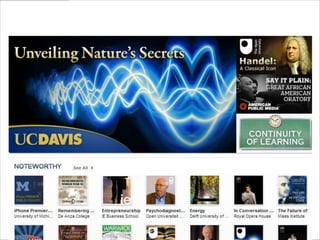
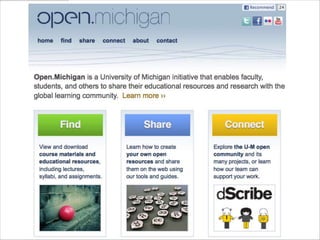
HowDigital Technologies & Open Educational Resources areDisrupting Higher Education
The “Iron Triangle” suggests institutions are constrained in their ability to adapt“In the view of many college and university presidents, the three main factors in higher education—cost, quality, and access—exist in what we call an iron triangle. These factors are linked in an unbreakable reciprocal relationship, such that any change in one will inevitably impact the others.”              - Public Agenda research on opinions of higher education presidentsSource:  The Iron Triangle:  College Presidents Talk About Costs, Access, and Quality, Public Agenda, October 2008.Source:  The Iron Triangle:  College Presidents Talk About Costs, Access, and Quality, Public Agenda, October 2008.
The Iron TriangleThree concepts dominate the concerns presidents: increasing cost of higher educationchallenge of providing accessneed to maintain and improve educational qualityThree missions in tension:Access up = quality down and/or costs upQuality up = access down and/or costs upCosts down = quality down and/or access down
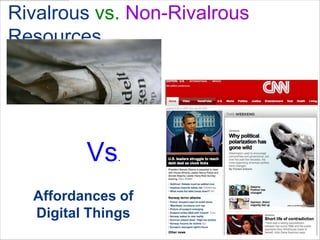
Rivalrous vs. Non-Rivalrous ResourcesVs.Affordances of Digital Things
How do we currentlyattempt to harness digital networked technologies?
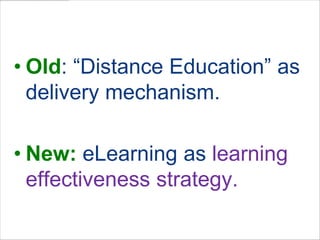
Shifting our Thinking…Old: “Distance Education” as delivery mechanism.New: eLearning as learning effectiveness strategy.
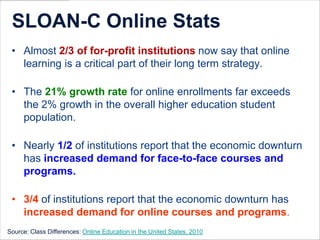
SLOAN-C Online StatsAlmost 2/3 of for-profit institutions now say that online learning is a critical part of their long term strategy.The 21% growth rate for online enrollments far exceeds the 2% growth in the overall higher education student population.Nearly 1/2of institutions report that the economic downturn has increased demand for face-to-face courses and programs.3/4of institutions report that the economic downturn has increased demand for online courses and programs.Source: Class Differences: Online Education in the United States, 2010
Why does this growth matter?
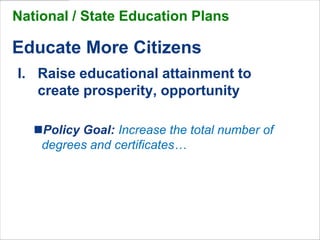
National / State Education PlansEducate More CitizensRaise educational attainment to create prosperity, opportunity Policy Goal: Increase the total number of degrees and certificates…eLearning… but what about sharing digital, non-rivalrouseducational resources?
We  have…
a problem...
TextGlobal Trends
TextGlobal Trends
TextGlobal Trends
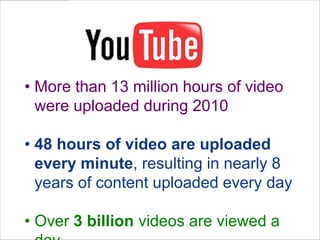
\More than 13 million hours of video were uploaded during 2010
48 hours of video are uploaded every minute, resulting in nearly 8 years of content uploaded every day
Over 3 billion videos are viewed a dayTextGlobal Trends
TextGlobal Trends
Global Trends
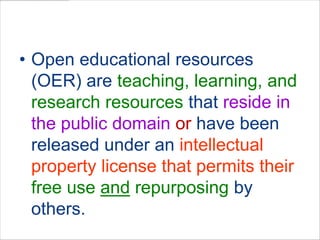
DOE: Definition of OEROpen educational resources (OER) are teaching, learning, and research resources that reside in the public domain or have been released under an intellectual property license that permits their free use and repurposingby others.
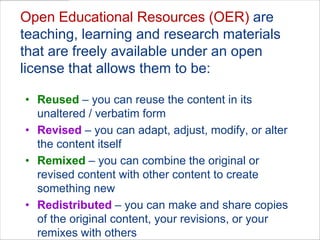
Open Educational Resources (OER) are teaching, learning and research materials that are freely available under an open license that allows them to be:Reused– you can reuse the content in its unaltered / verbatim form Revised– you can adapt, adjust, modify, or alter the content itself Remixed– you can combine the original or revised content with other content to create something new Redistributed– you can make and share copies of the original content, your revisions, or your remixes with others
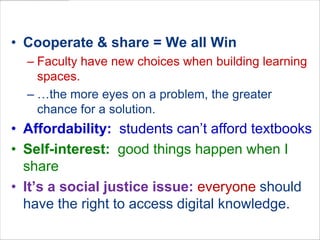
Why is “Open” Important?Cooperate & share = We all WinFaculty have new choices when building learning spaces.…the more eyes on a problem, the greater chance for a solution.Affordability:  students can’t afford textbooksSelf-interest:  good things happen when I shareIt’s a social justice issue: everyone should have the right to access digital knowledge.
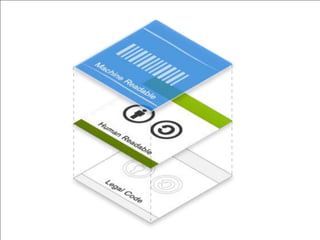
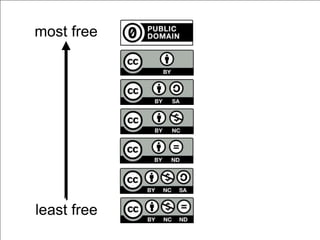
A simple, standardizedway to grant copyright permissions to your creative work.
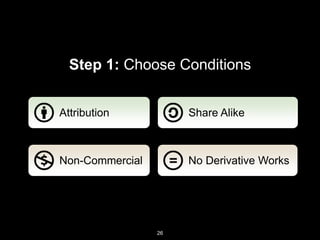
AttributionShare AlikeNon-CommercialNo Derivative WorksStep 1: Choose Conditions26
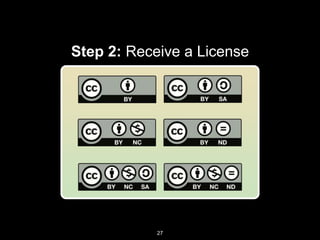
Step 2: Receive a License27
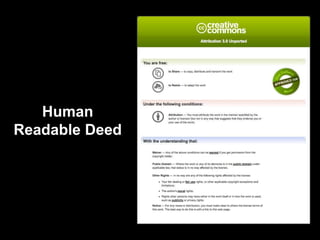
Human Readable Deed
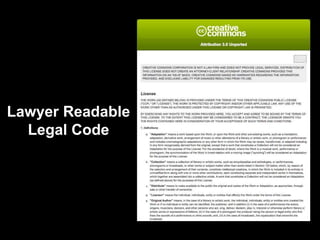
Lawyer Readable Legal Code
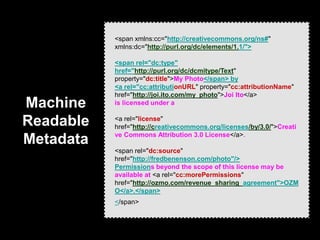
<span xmlns:cc="http://creativecommons.org/ns#" xmlns:dc="http://purl.org/dc/elements/1.1/"><span rel="dc:type" href="http://purl.org/dc/dcmitype/Text" property="dc:title">My Photo</span> by <a rel="cc:attributionURL" property="cc:attributionName" href="http://joi.ito.com/my_photo">Joi Ito</a> is licensed under a<a rel="license" href="http://creativecommons.org/licenses/by/3.0/">Creative Commons Attribution 3.0 License</a>.<span rel="dc:source" href="http://fredbenenson.com/photo"/>Permissions beyond the scope of this license may be available at <a rel="cc:morePermissions" href="http://ozmo.com/revenue_sharing_agreement">OZMO</a>.</span></span>Machine Readable Metadata
most freeleast free
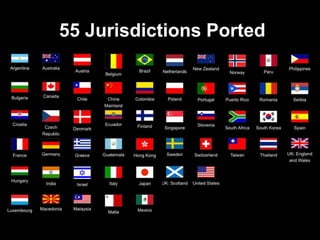
55 Jurisdictions Ported
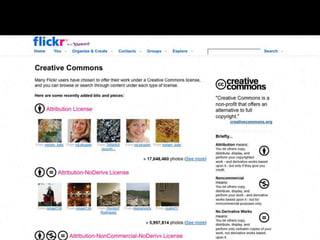
Over400 millionitems
175+ Million CC Licensed Photos on Flickr36
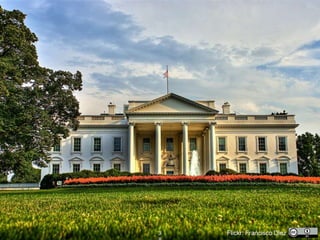
38Flickr: Francisco Diez
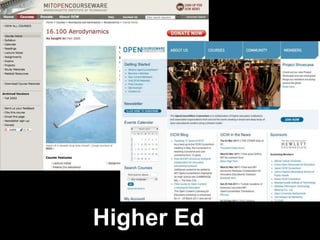
Higher Ed
Education grant making
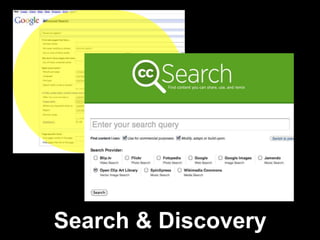
Search & Discovery
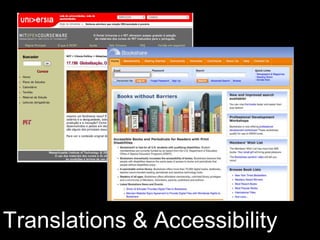
Translations & Accessibility
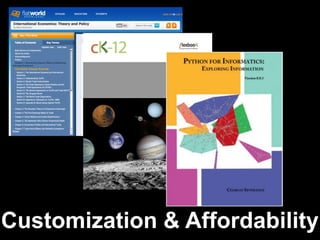
Customization & Affordability
http://techplan.sbctc.edu“We will cultivate the culture and practice of using and contributing to open educational resources.”
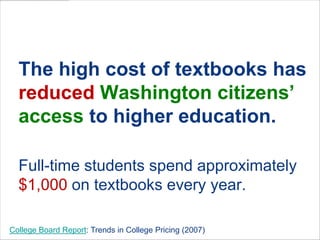
The high cost of textbooks has reduced Washington citizens’ access to higher education.Full-time students spend approximately $1,000 on textbooks every year. College Board Report: Trends in College Pricing (2007)
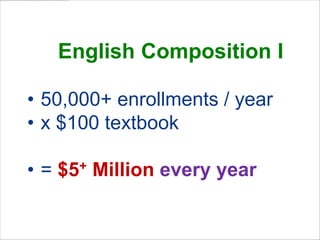
English Composition I 50,000+ enrollments / year x $100 textbook = $5+ Million every year
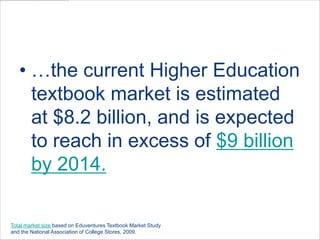
…the current Higher Education textbook market is estimated at $8.2 billion, and is expected to reach in excess of $9 billion by 2014.Total market size based on Eduventures Textbook Market Study and the National Association of College Stores, 2009.
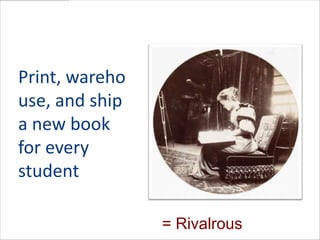
The Old EconomicsPrint, warehouse, and ship a new book for every student= Rivalrous
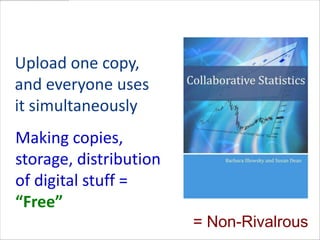
The New EconomicsUpload one copy, and everyone uses it simultaneouslyMaking copies, storage, distribution of digital stuff = “Free”= Non-Rivalrous
Legislative StrategyTextbook RFP? Higher EducationTextbooks for top 100 highest enrolled courses K-12Textbooks for 24 “Common Core” courses
Open EducationOpen Course Librarydesigning and sharing 81 high enrollment, gatekeeper coursesfor face-to-face, hybrid and/or online deliveryto improve course completion rateslower textbook costs for students (<$30)provide new resources for faculty to use in their coursesfor our college system to fully engage the global open educational resources discussion.
81 courses = 411,133 enrollments / year411,133 enrollments x $100 textbook = $41M+ in textbook costs / student debt per yearLimit on textbook costs in redesigned courses is $30.  If courses are adopted by 25% of the sections in the system (faculty decision), the savings to students will be $7.2M per year. Savings increase with increased adoptions and/or when courses use free, open textbooks.Open Education
New State Board “Open” PolicyOpen PolicyAll digital software, educational resources and knowledge produced through competitive grants, offered through and/or managed by the SBCTC, will carry a Creative Commons Attribution License.
Legislative StrategyPartner with Legislators who care about:(a) efficient use of state tax dollars &(b) saving students money.
WA  LegislationSSHB1025Faculty consider the least costly practices in assigning course materials, such as adopting the least expensive edition available, adopting free, open textbooks when available, and working with college librarians to put together collections of free online web and library resources, when educational content is comparable as determined by the faculty…
WA  LegislationSSHB1946 – two big ideas – share technology and share content.(v) Methods and open licensing options for effectively sharing digital content including but not limited to: Open courseware, open textbooks, open journals, and open learning objects…
Student AdvocacyWA CTC Student Voice Academy(1) CUTTING TEXTBOOK COSTS“The high cost of textbooks is a burden to students….”Top Issue three years running….
Hey Public K-20 Education!We must get rid of our “not invented here” attitude regarding others’ contentmove to: "proudly borrowed from there"Which textbook one uses is not a strategic advantageNor can we (or our students) afford it
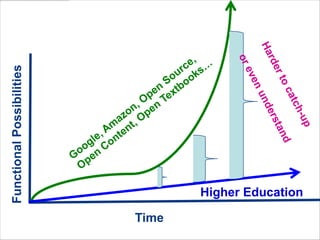
Harder to catch-upor even understandGoogle, Amazon, Open Source,Open Content, Open Textbooks…Functional PossibilitiesHigher EducationTime
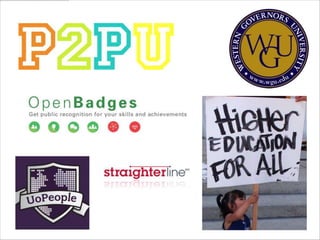
NEW HE Models are En Route
QuestionsWhat if all publicly funded educational content was open access? What kind of efficiencies could higher education yield? Simple idea: public access to publicly funded educational materials.
Trade Adjustment Assistance Community College andCareer Training Grants Program$2 Billion Department of Labor GrantAll $2B of programs / courses produced must be openly licensed (CC BY)YOUR Systems / Colleges can download, modify and use any of it!Simple idea: public access to publicly funded educational materials.
Only ONE thing Matters:Efficient use of public funds to increase student success and access to quality educational materials.  Everything else (including all existing business models) is secondary.Read: “Disrupting College…”
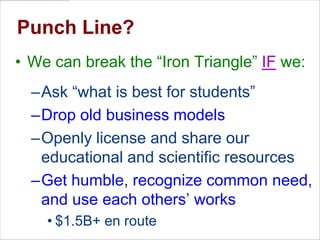
Punch Line?We can break the “Iron Triangle” IF we:Ask “what is best for students”Drop old business modelsOpenly license and share our educational and scientific resourcesGet humble, recognize common need, and use each others’ works$1.5B+ en route
Dr. Cable GreenDirector of Global Learningcable@creativecommons.orgtwitter: cgreen

Educause ELI (9/12/11)

  • 1.
    HowDigital Technologies &Open Educational Resources areDisrupting Higher Education
  • 2.
    The “Iron Triangle”suggests institutions are constrained in their ability to adapt“In the view of many college and university presidents, the three main factors in higher education—cost, quality, and access—exist in what we call an iron triangle. These factors are linked in an unbreakable reciprocal relationship, such that any change in one will inevitably impact the others.” - Public Agenda research on opinions of higher education presidentsSource: The Iron Triangle: College Presidents Talk About Costs, Access, and Quality, Public Agenda, October 2008.Source: The Iron Triangle: College Presidents Talk About Costs, Access, and Quality, Public Agenda, October 2008.
  • 3.
    The Iron TriangleThreeconcepts dominate the concerns presidents: increasing cost of higher educationchallenge of providing accessneed to maintain and improve educational qualityThree missions in tension:Access up = quality down and/or costs upQuality up = access down and/or costs upCosts down = quality down and/or access down
  • 4.
    Rivalrous vs. Non-RivalrousResourcesVs.Affordances of Digital Things
  • 5.
    How do wecurrentlyattempt to harness digital networked technologies?
  • 6.
    Shifting our Thinking…Old:“Distance Education” as delivery mechanism.New: eLearning as learning effectiveness strategy.
  • 7.
    SLOAN-C Online StatsAlmost2/3 of for-profit institutions now say that online learning is a critical part of their long term strategy.The 21% growth rate for online enrollments far exceeds the 2% growth in the overall higher education student population.Nearly 1/2of institutions report that the economic downturn has increased demand for face-to-face courses and programs.3/4of institutions report that the economic downturn has increased demand for online courses and programs.Source: Class Differences: Online Education in the United States, 2010
  • 8.
    Why does thisgrowth matter?
  • 9.
    National / StateEducation PlansEducate More CitizensRaise educational attainment to create prosperity, opportunity Policy Goal: Increase the total number of degrees and certificates…eLearning… but what about sharing digital, non-rivalrouseducational resources?
  • 10.
  • 11.
  • 12.
  • 13.
  • 14.
  • 15.
    \More than 13million hours of video were uploaded during 2010
  • 16.
    48 hours ofvideo are uploaded every minute, resulting in nearly 8 years of content uploaded every day
  • 17.
    Over 3 billionvideos are viewed a dayTextGlobal Trends
  • 18.
  • 19.
  • 21.
    DOE: Definition ofOEROpen educational resources (OER) are teaching, learning, and research resources that reside in the public domain or have been released under an intellectual property license that permits their free use and repurposingby others.
  • 22.
    Open Educational Resources(OER) are teaching, learning and research materials that are freely available under an open license that allows them to be:Reused– you can reuse the content in its unaltered / verbatim form Revised– you can adapt, adjust, modify, or alter the content itself Remixed– you can combine the original or revised content with other content to create something new Redistributed– you can make and share copies of the original content, your revisions, or your remixes with others
  • 23.
    Why is “Open”Important?Cooperate & share = We all WinFaculty have new choices when building learning spaces.…the more eyes on a problem, the greater chance for a solution.Affordability: students can’t afford textbooksSelf-interest: good things happen when I shareIt’s a social justice issue: everyone should have the right to access digital knowledge.
  • 25.
    A simple, standardizedwayto grant copyright permissions to your creative work.
  • 26.
  • 27.
    Step 2: Receivea License27
  • 29.
  • 30.
  • 31.
    <span xmlns:cc="http://creativecommons.org/ns#" xmlns:dc="http://purl.org/dc/elements/1.1/"><spanrel="dc:type" href="http://purl.org/dc/dcmitype/Text" property="dc:title">My Photo</span> by <a rel="cc:attributionURL" property="cc:attributionName" href="http://joi.ito.com/my_photo">Joi Ito</a> is licensed under a<a rel="license" href="http://creativecommons.org/licenses/by/3.0/">Creative Commons Attribution 3.0 License</a>.<span rel="dc:source" href="http://fredbenenson.com/photo"/>Permissions beyond the scope of this license may be available at <a rel="cc:morePermissions" href="http://ozmo.com/revenue_sharing_agreement">OZMO</a>.</span></span>Machine Readable Metadata
  • 32.
  • 33.
  • 34.
  • 36.
    175+ Million CCLicensed Photos on Flickr36
  • 38.
  • 39.
  • 40.
  • 41.
  • 42.
  • 43.
  • 44.
    http://techplan.sbctc.edu“We will cultivatethe culture and practice of using and contributing to open educational resources.”
  • 45.
    The high costof textbooks has reduced Washington citizens’ access to higher education.Full-time students spend approximately $1,000 on textbooks every year. College Board Report: Trends in College Pricing (2007)
  • 46.
    English Composition I50,000+ enrollments / year x $100 textbook = $5+ Million every year
  • 47.
    …the current HigherEducation textbook market is estimated at $8.2 billion, and is expected to reach in excess of $9 billion by 2014.Total market size based on Eduventures Textbook Market Study and the National Association of College Stores, 2009.
  • 48.
    The Old EconomicsPrint,warehouse, and ship a new book for every student= Rivalrous
  • 49.
    The New EconomicsUploadone copy, and everyone uses it simultaneouslyMaking copies, storage, distribution of digital stuff = “Free”= Non-Rivalrous
  • 50.
    Legislative StrategyTextbook RFP?Higher EducationTextbooks for top 100 highest enrolled courses K-12Textbooks for 24 “Common Core” courses
  • 51.
    Open EducationOpen CourseLibrarydesigning and sharing 81 high enrollment, gatekeeper coursesfor face-to-face, hybrid and/or online deliveryto improve course completion rateslower textbook costs for students (<$30)provide new resources for faculty to use in their coursesfor our college system to fully engage the global open educational resources discussion.
  • 52.
    81 courses =411,133 enrollments / year411,133 enrollments x $100 textbook = $41M+ in textbook costs / student debt per yearLimit on textbook costs in redesigned courses is $30.  If courses are adopted by 25% of the sections in the system (faculty decision), the savings to students will be $7.2M per year. Savings increase with increased adoptions and/or when courses use free, open textbooks.Open Education
  • 53.
    New State Board“Open” PolicyOpen PolicyAll digital software, educational resources and knowledge produced through competitive grants, offered through and/or managed by the SBCTC, will carry a Creative Commons Attribution License.
  • 54.
    Legislative StrategyPartner withLegislators who care about:(a) efficient use of state tax dollars &(b) saving students money.
  • 55.
    WA LegislationSSHB1025Facultyconsider the least costly practices in assigning course materials, such as adopting the least expensive edition available, adopting free, open textbooks when available, and working with college librarians to put together collections of free online web and library resources, when educational content is comparable as determined by the faculty…
  • 56.
    WA LegislationSSHB1946– two big ideas – share technology and share content.(v) Methods and open licensing options for effectively sharing digital content including but not limited to: Open courseware, open textbooks, open journals, and open learning objects…
  • 57.
    Student AdvocacyWA CTCStudent Voice Academy(1) CUTTING TEXTBOOK COSTS“The high cost of textbooks is a burden to students….”Top Issue three years running….
  • 58.
    Hey Public K-20Education!We must get rid of our “not invented here” attitude regarding others’ contentmove to: "proudly borrowed from there"Which textbook one uses is not a strategic advantageNor can we (or our students) afford it
  • 62.
    Harder to catch-uporeven understandGoogle, Amazon, Open Source,Open Content, Open Textbooks…Functional PossibilitiesHigher EducationTime
  • 63.
    NEW HE Modelsare En Route
  • 64.
    QuestionsWhat if allpublicly funded educational content was open access? What kind of efficiencies could higher education yield? Simple idea: public access to publicly funded educational materials.
  • 65.
    Trade Adjustment AssistanceCommunity College andCareer Training Grants Program$2 Billion Department of Labor GrantAll $2B of programs / courses produced must be openly licensed (CC BY)YOUR Systems / Colleges can download, modify and use any of it!Simple idea: public access to publicly funded educational materials.
  • 67.
    Only ONE thingMatters:Efficient use of public funds to increase student success and access to quality educational materials. Everything else (including all existing business models) is secondary.Read: “Disrupting College…”
  • 68.
    Punch Line?We canbreak the “Iron Triangle” IF we:Ask “what is best for students”Drop old business modelsOpenly license and share our educational and scientific resourcesGet humble, recognize common need, and use each others’ works$1.5B+ en route
  • 69.
    Dr. Cable GreenDirectorof Global Learningcable@creativecommons.orgtwitter: cgreen