Strategic Implications ofeLearningGrowth & Open Education
Shifting our Thinking…Old: eLearning as delivery mechanism.New: eLearning as learning effectiveness strategy.
Shifting our Thinking…Engaging broad segments of our population in higher education requireswe collectively recognize and use the immense power of digital technologies and shared educational resources to support 21st century teaching and learning.
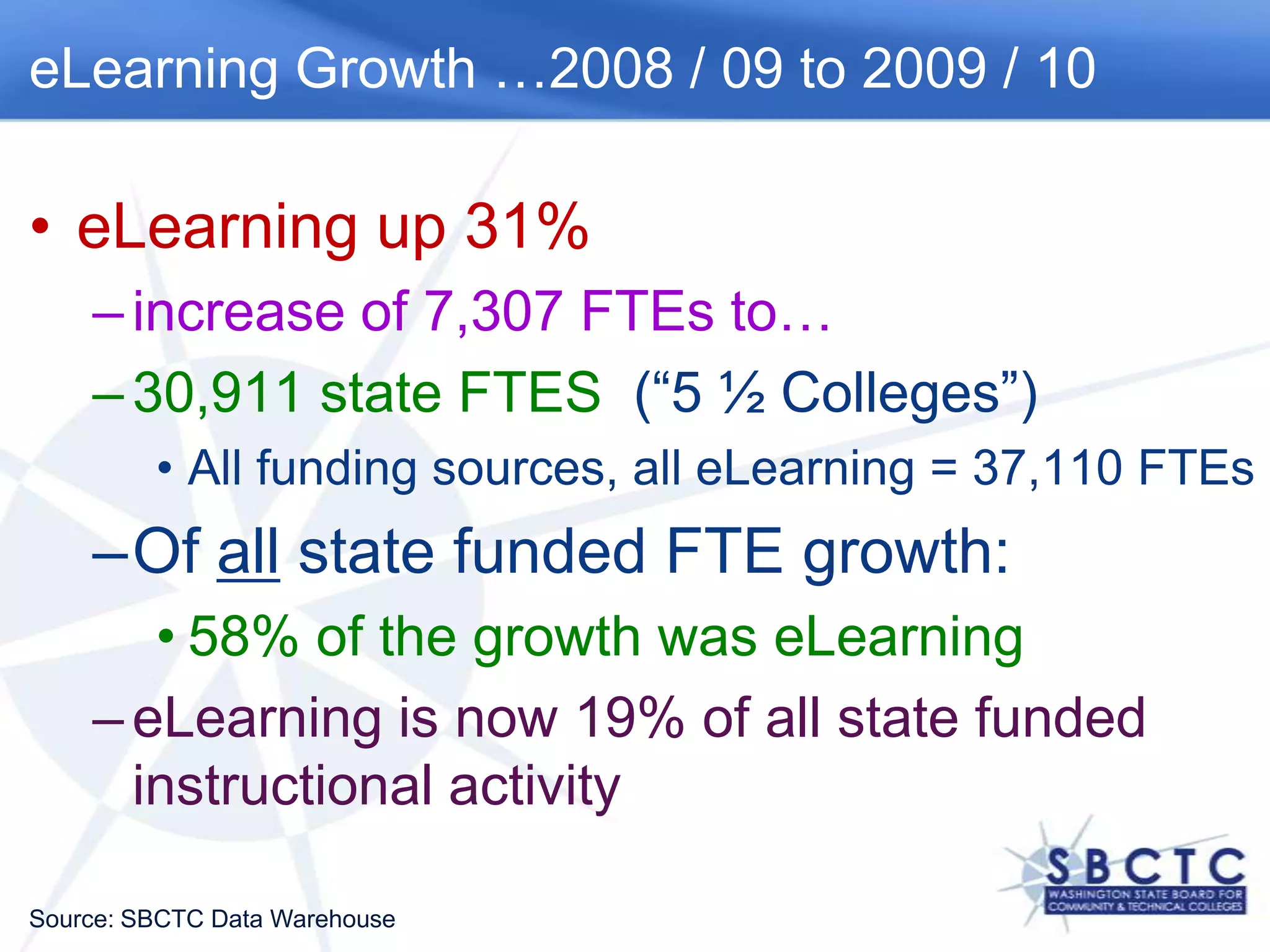
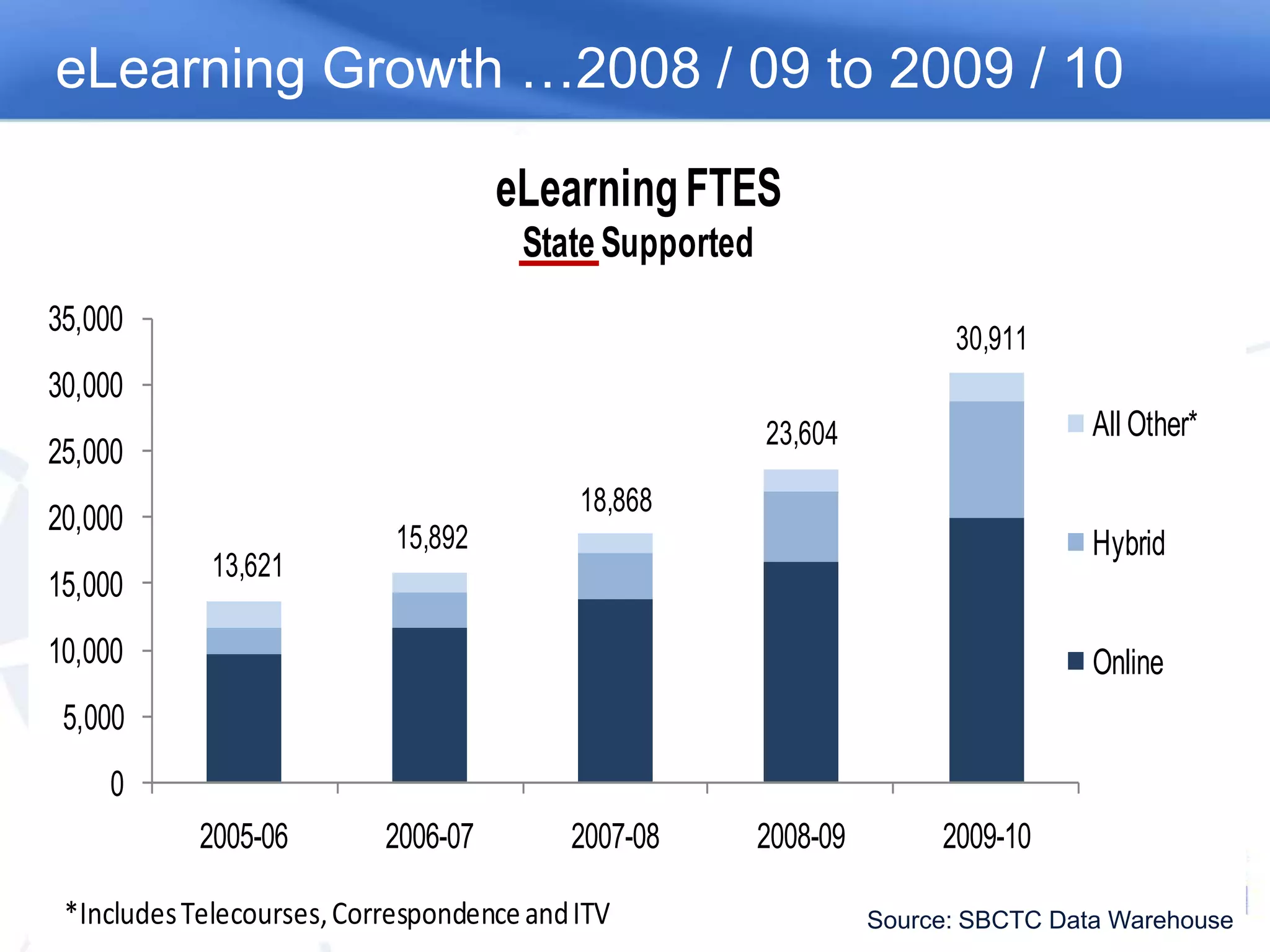
eLearning Growth …2008 / 09 to 2009 / 10eLearning up 31%increase of 7,307 FTEs to…30,911 state FTES  (“5 ½ Colleges”)All funding sources, all eLearning = 37,110 FTEsOf all state funded FTE growth: 58% of the growth was eLearningeLearning is now 19% of all state funded instructional activitySource: SBCTC Data Warehouse
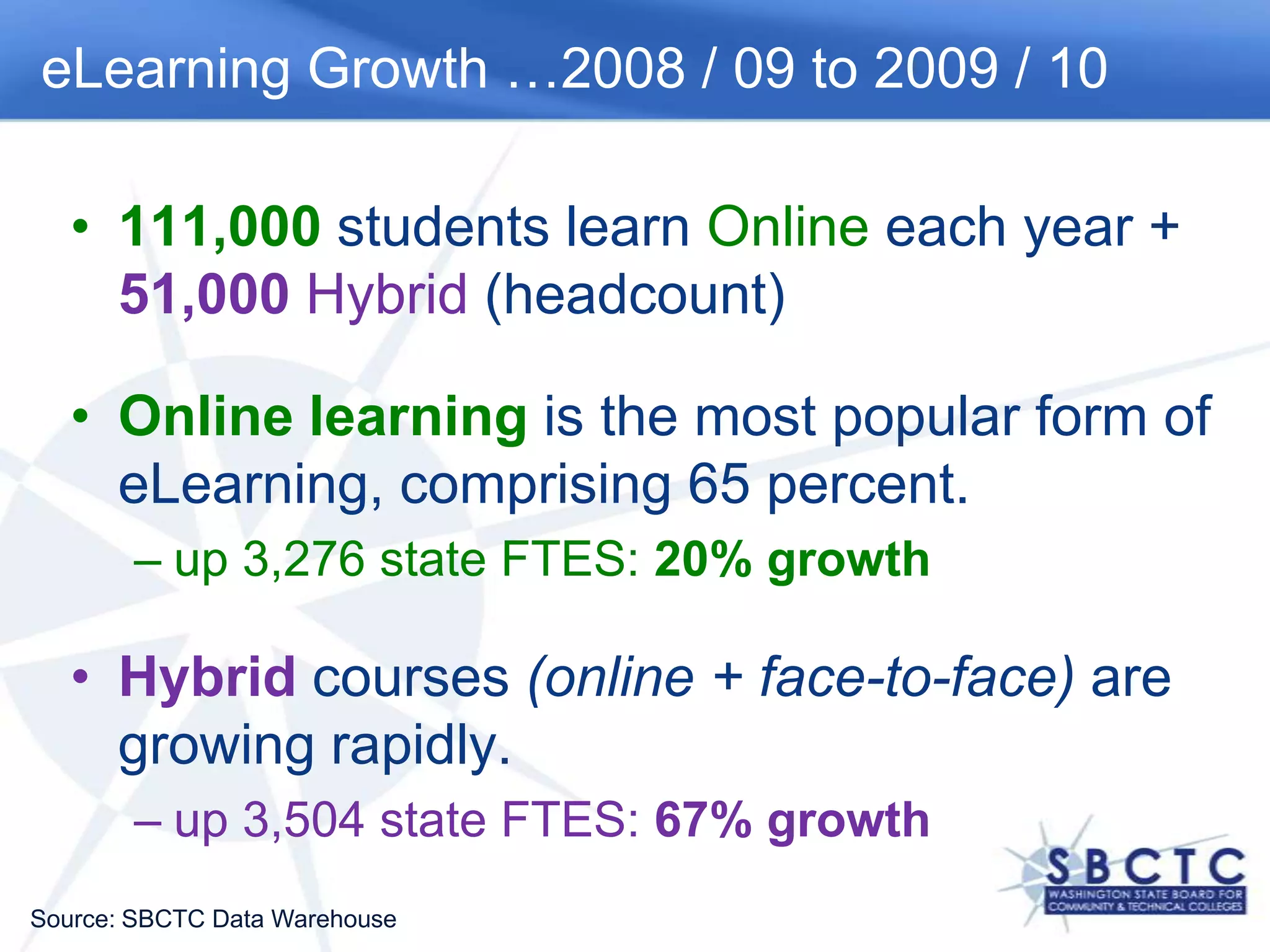
eLearning Growth …2008 / 09 to 2009 / 10111,000 students learn Onlineeach year + 51,000 Hybrid (headcount)Online learning is the most popular form of eLearning, comprising 65 percent. up 3,276 state FTES: 20% growthHybrid courses (online + face-to-face) are growing rapidly. up 3,504 state FTES: 67% growth Source: SBCTC Data Warehouse
eLearning Growth …2008 / 09 to 2009 / 10Source: SBCTC Data Warehouse
Why does this growth matter?
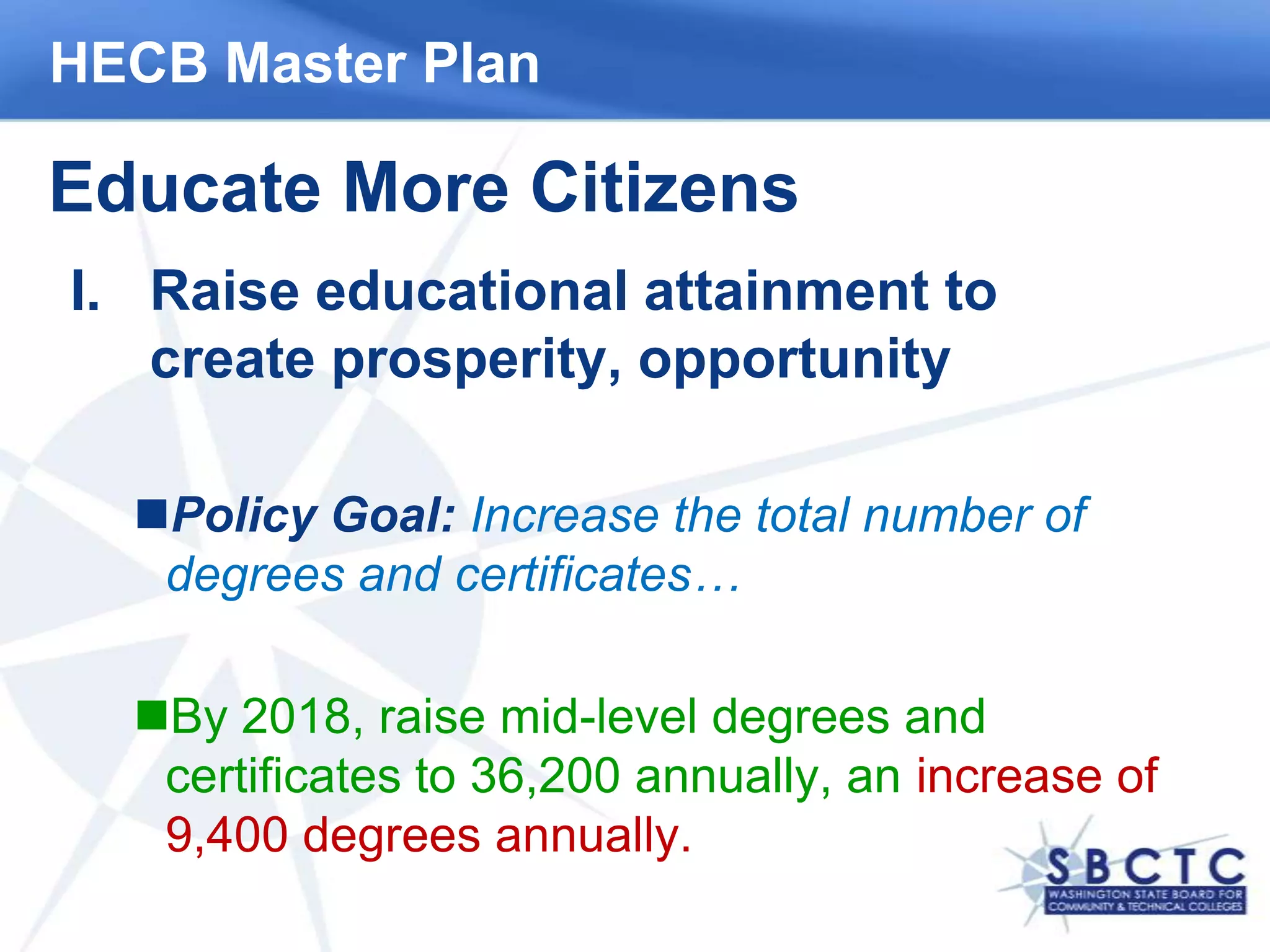
HECB Master PlanEducate More CitizensRaise educational attainment to create prosperity, opportunity Policy Goal: Increase the total number of degrees and certificates…
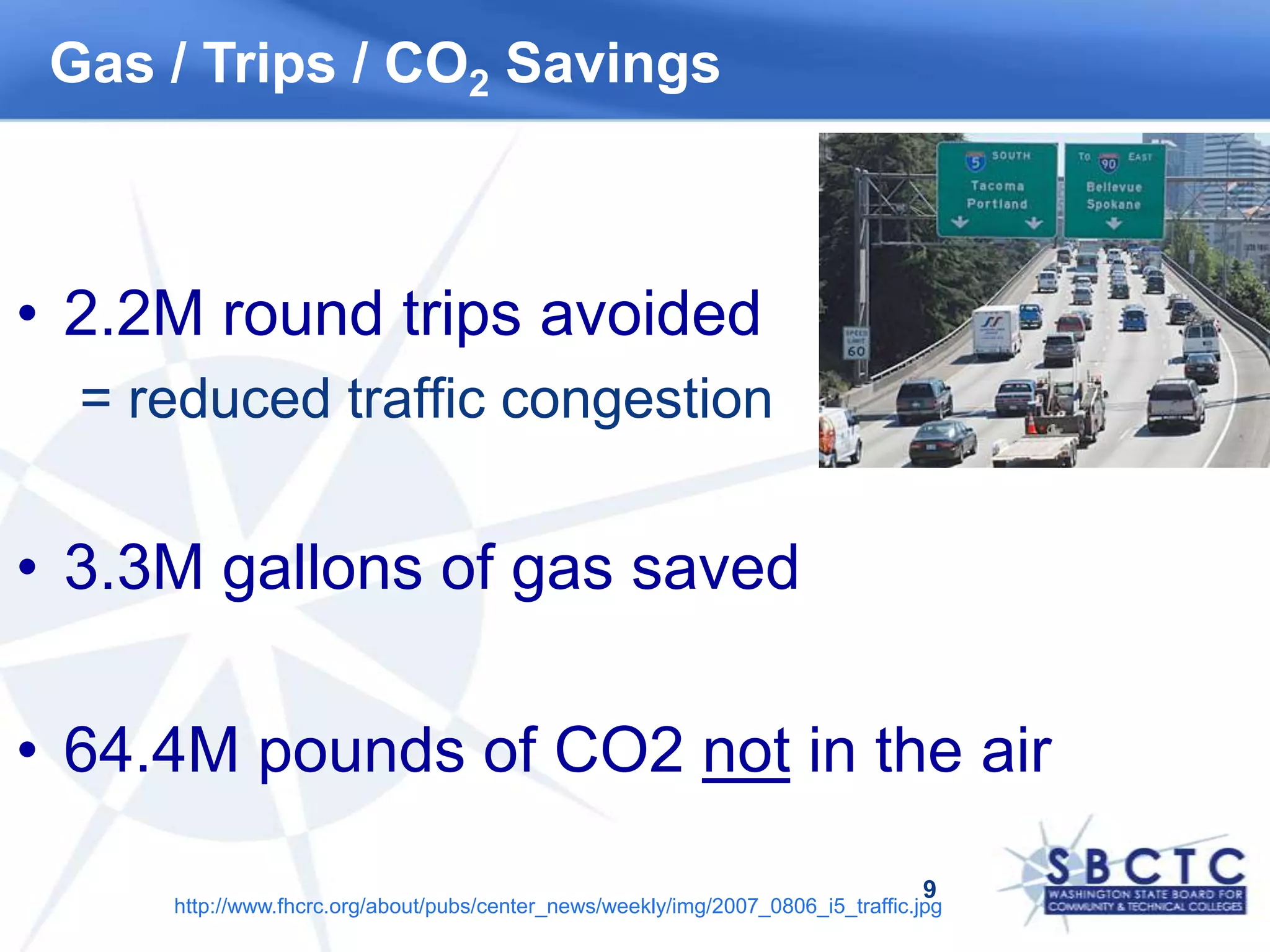
By 2018, raise mid-level degrees and certificates to 36,200 annually, an increase of 9,400 degrees annually.2.2M round trips avoided= reduced traffic congestion3.3M gallons of gas saved64.4M pounds of CO2 not in the air9Gas / Trips / CO2 Savingshttp://www.fhcrc.org/about/pubs/center_news/weekly/img/2007_0806_i5_traffic.jpg
http://techplan.sbctc.edu
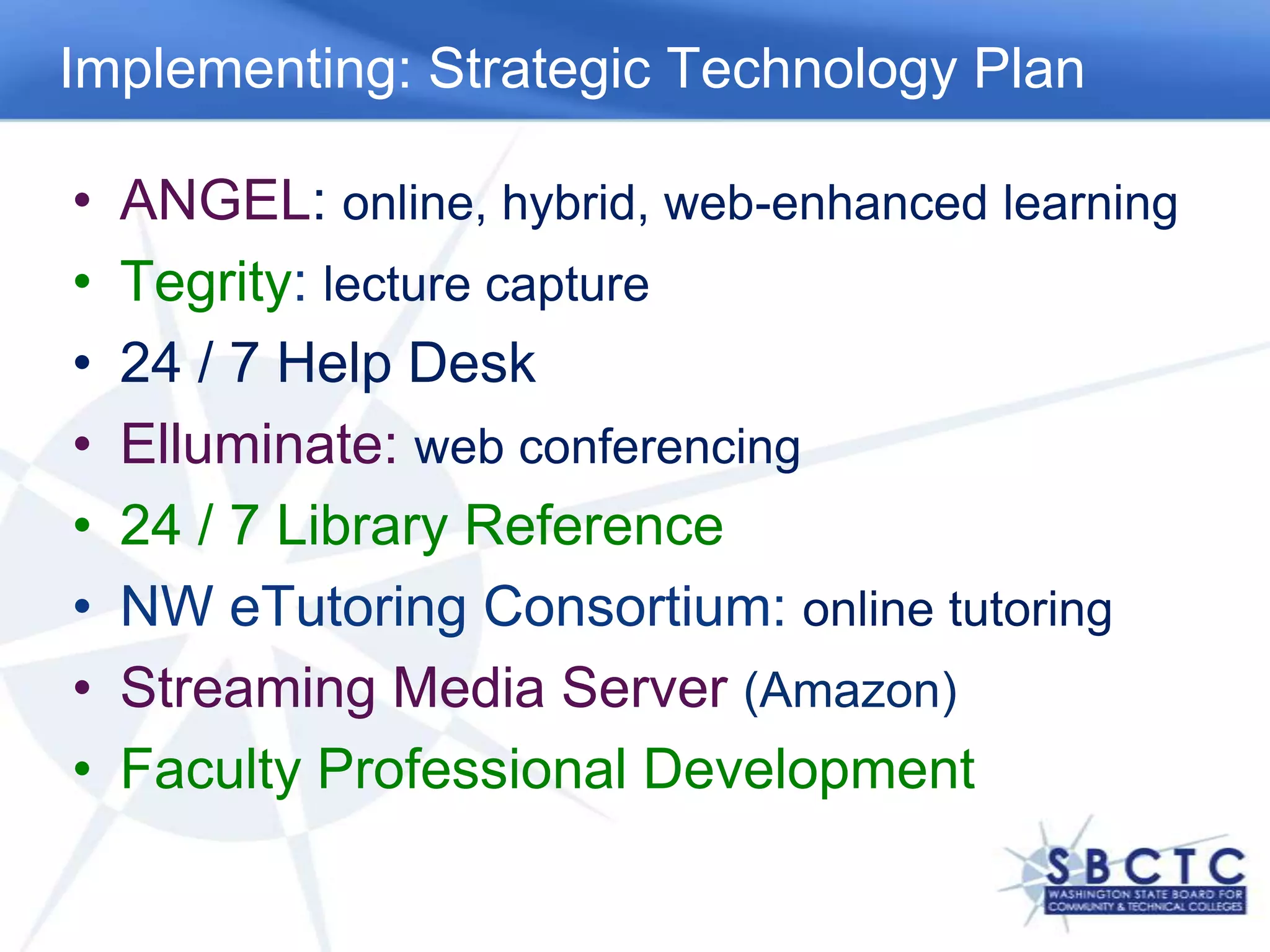
Implementing: Strategic Technology PlanANGEL: online, hybrid, web-enhanced learningTegrity: lecture capture24 / 7 Help DeskElluminate: web conferencing24 / 7 Library ReferenceNW eTutoring Consortium: online tutoringStreaming Media Server (Amazon)Faculty Professional Development
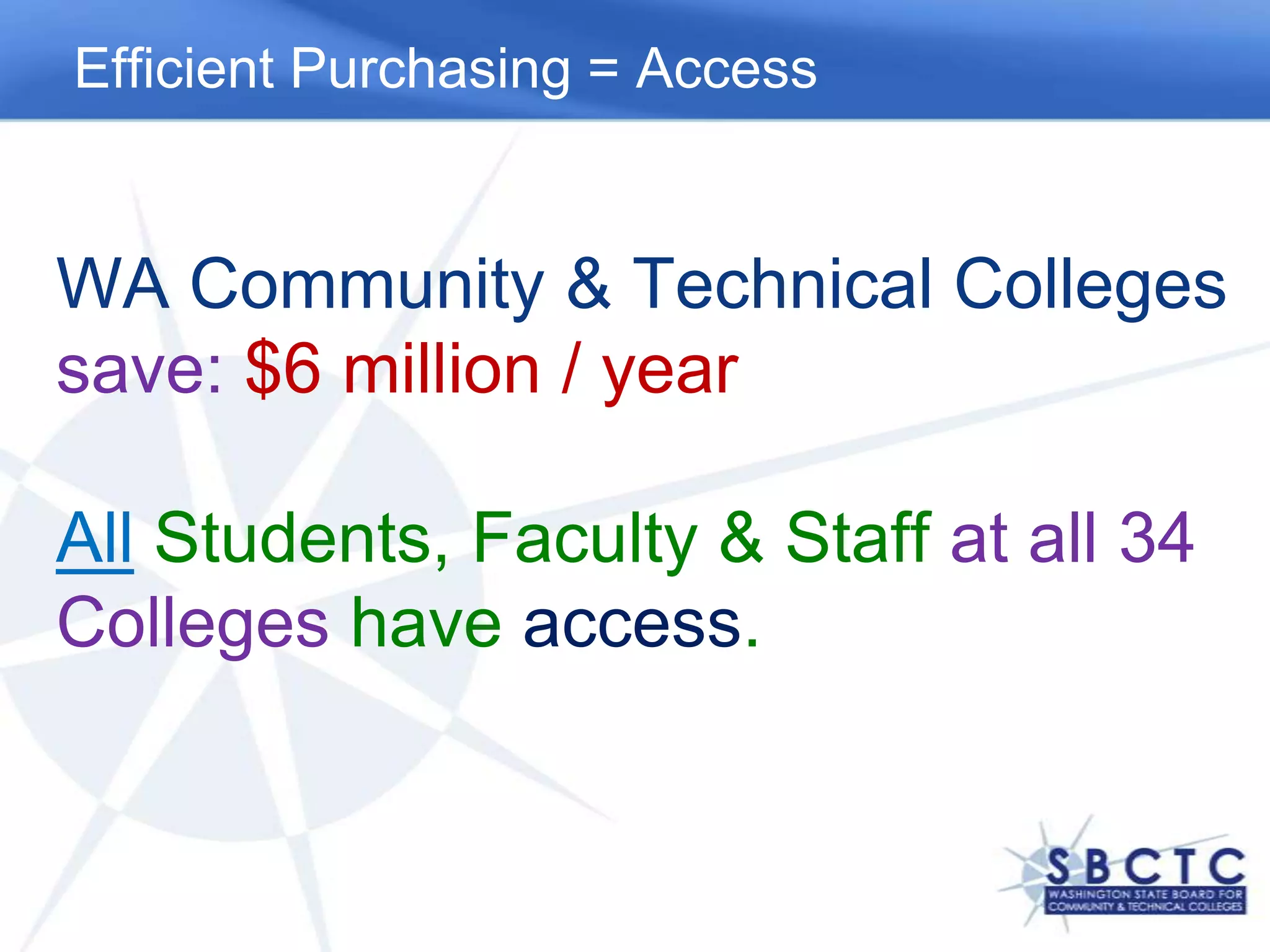
Efficient Purchasing = AccessWA Community & Technical Colleges save: $6 million / yearAll Students, Faculty & Staff at all 34 Colleges have access.
eLearning… but what about sharing digital content?
We  have…
a problem...
The high cost of textbooks has reduced Washington citizens’ access to higher education.Full-time students spend approximately $1,000 on textbooks every year. College Board Report: Trends in College Pricing (2007)
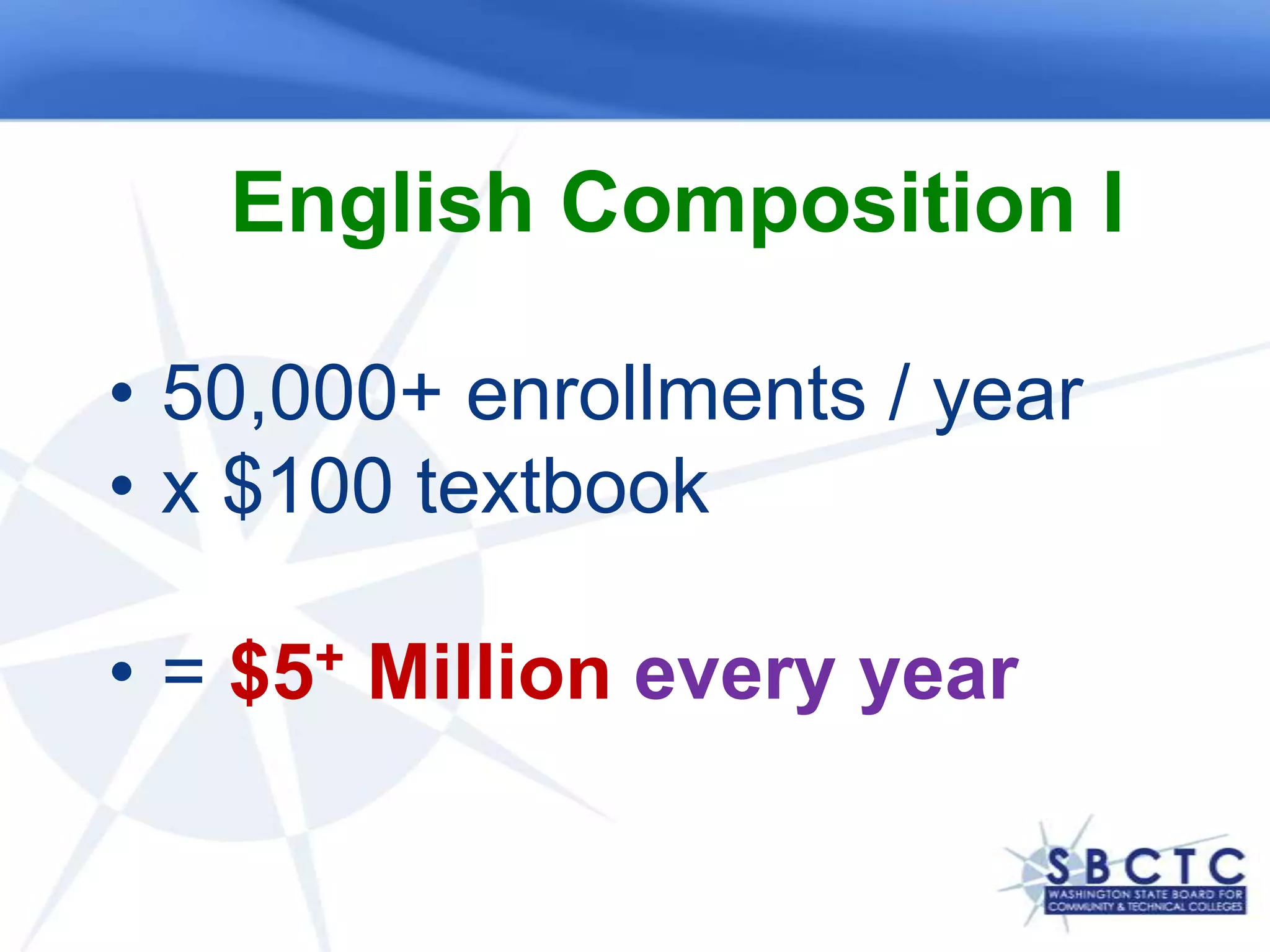
English Composition I 50,000+ enrollments / year x $100 textbook = $5+ Million every year
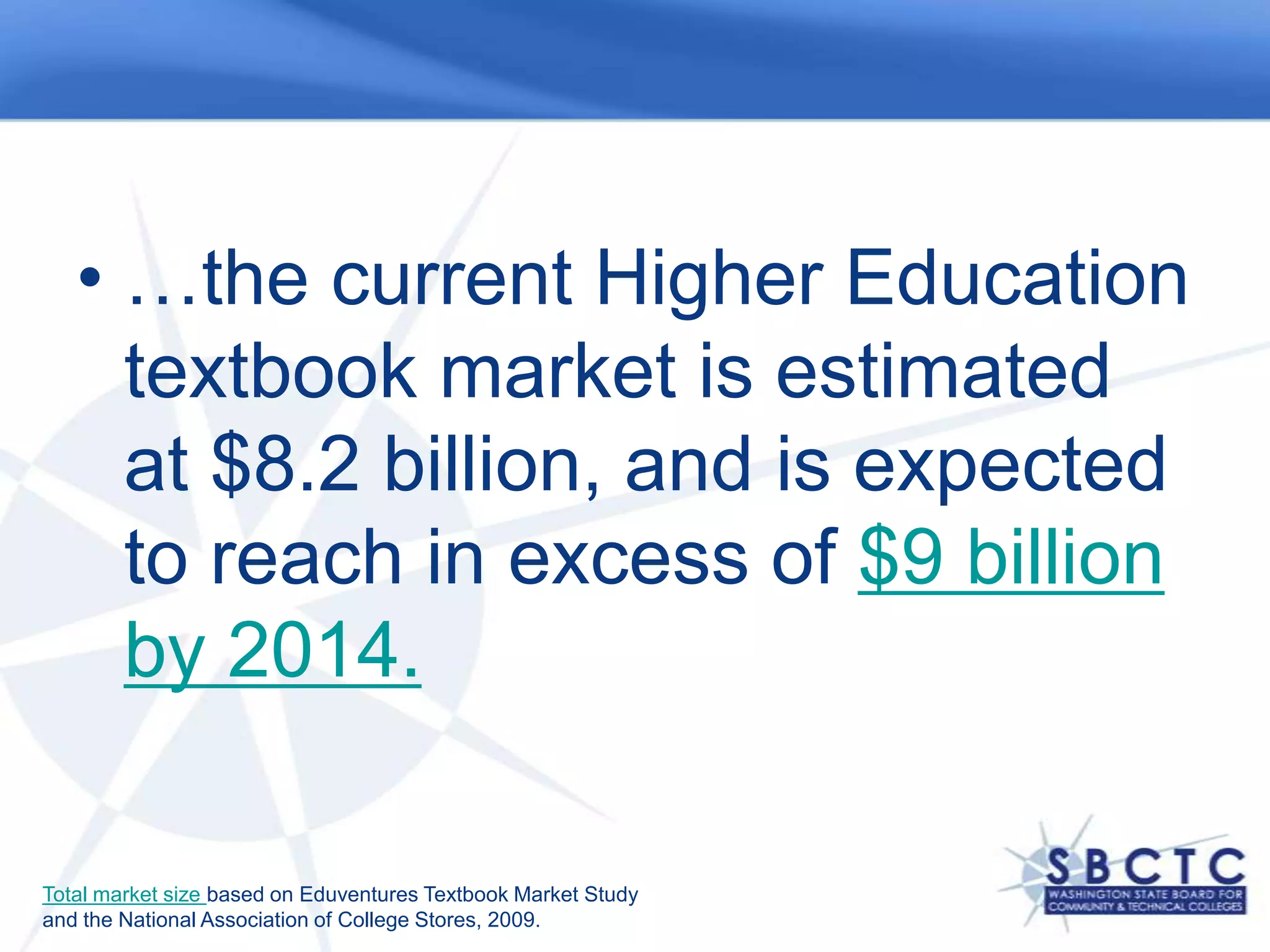
…the current Higher Education textbook market is estimated at $8.2 billion, and is expected to reach in excess of $9 billion by 2014.Total market size based on Eduventures Textbook Market Study and the National Association of College Stores, 2009.
Open EducationOpen Education Goal: increase access and completion by providing high quality, affordable, openly licensed educational resources.
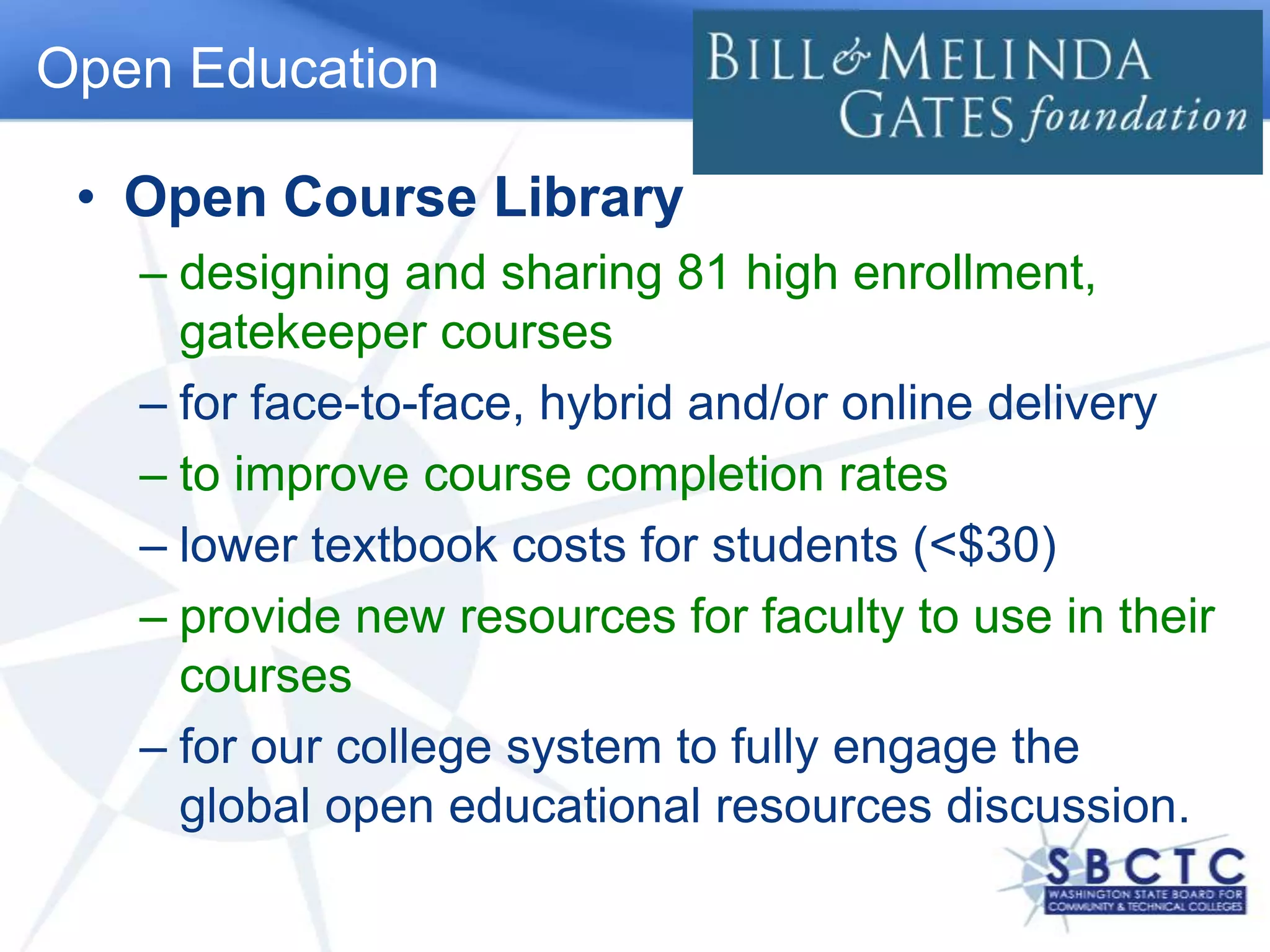
Open EducationOpen Course Librarydesigning and sharing 81 high enrollment, gatekeeper coursesfor face-to-face, hybrid and/or online deliveryto improve course completion rateslower textbook costs for students (<$30)provide new resources for faculty to use in their coursesfor our college system to fully engage the global open educational resources discussion.
New State Board “Open” PolicyAll digital software, educational resources and knowledge produced through competitive grants, offered through and/or managed by the SBCTC, will carry a Creative Commons Attribution License.
So what’s next?What are the kinds of decisions that will lead us to optimal use of technologies, content and talent to support student achievement for all Washingtonians?
QuestionsWhat would happen to the quality of curriculum if all system digital content was shared and course (re)design was data driven?How can we use technologies and shared content to significantly increase completion rates?
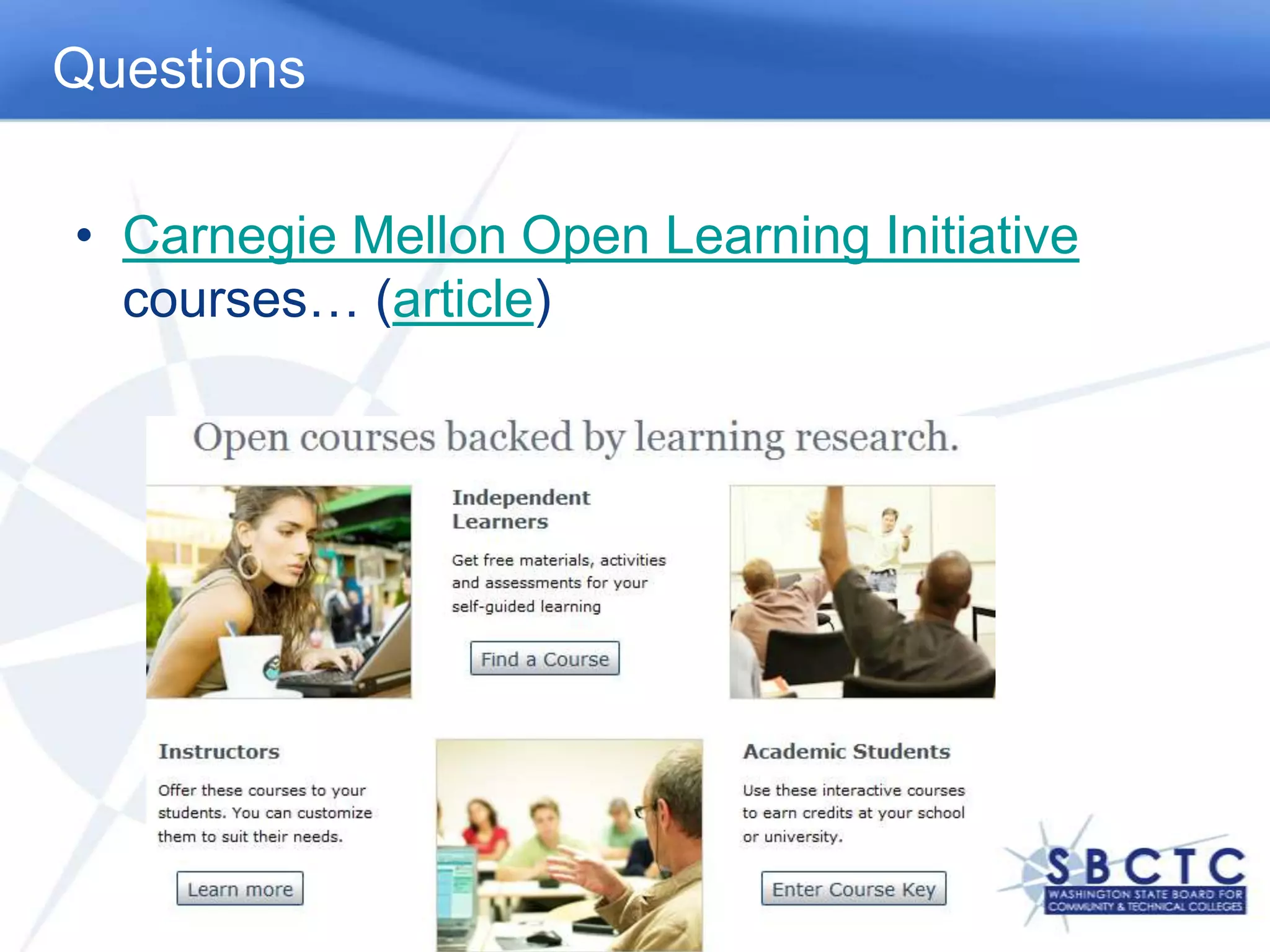
QuestionsCarnegie Mellon Open Learning Initiative courses… (article)
QuestionsOLI Research Results:OLI students completed course in half the time with half the number of in-person meetingsAccelerated learning study (Statistics):             33% more content, learning gain in standardized test 13% OLI vs 2% in traditional face-to-face class.OLI Online vs. traditional.  OLI 99% completion rate vs 41% completion rate traditional.Lovett, M., Meyer, O., & Thille, C. (2008).  The Open Learning Initiative: Measuring the effectiveness of the OLI statistics course in accelerating student learning. Journal of Interactive Media in Education.
QuestionsWhat if all state funded educational content was open access?  What kind of efficiencies could higher education yield? Simple idea: public access to publicly funded educational materials. NIH & DOE are leading the federal government to do just that.
Trade Adjustment Assistance Community College andCareer Training Grants Program$2 Billion Department of Labor GrantAll $2B of programs / courses produced must be openly licensed (CC BY)WA Colleges can download, modify and use any of it!Simple idea: public access to publicly funded educational materials.
Dr. Cable GreenDirector of eLearning & Open EducationSBCTC360-704-4334cgreen@sbctc.edutwitter: cgreenblog.oer.sbctc.edu

Technology Alliance (4-13-11)

  • 1.
  • 2.
    Shifting our Thinking…Old:eLearning as delivery mechanism.New: eLearning as learning effectiveness strategy.
  • 3.
    Shifting our Thinking…Engagingbroad segments of our population in higher education requireswe collectively recognize and use the immense power of digital technologies and shared educational resources to support 21st century teaching and learning.
  • 4.
    eLearning Growth …2008/ 09 to 2009 / 10eLearning up 31%increase of 7,307 FTEs to…30,911 state FTES (“5 ½ Colleges”)All funding sources, all eLearning = 37,110 FTEsOf all state funded FTE growth: 58% of the growth was eLearningeLearning is now 19% of all state funded instructional activitySource: SBCTC Data Warehouse
  • 5.
    eLearning Growth …2008/ 09 to 2009 / 10111,000 students learn Onlineeach year + 51,000 Hybrid (headcount)Online learning is the most popular form of eLearning, comprising 65 percent. up 3,276 state FTES: 20% growthHybrid courses (online + face-to-face) are growing rapidly. up 3,504 state FTES: 67% growth Source: SBCTC Data Warehouse
  • 6.
    eLearning Growth …2008/ 09 to 2009 / 10Source: SBCTC Data Warehouse
  • 7.
    Why does thisgrowth matter?
  • 8.
    HECB Master PlanEducateMore CitizensRaise educational attainment to create prosperity, opportunity Policy Goal: Increase the total number of degrees and certificates…
  • 9.
    By 2018, raisemid-level degrees and certificates to 36,200 annually, an increase of 9,400 degrees annually.2.2M round trips avoided= reduced traffic congestion3.3M gallons of gas saved64.4M pounds of CO2 not in the air9Gas / Trips / CO2 Savingshttp://www.fhcrc.org/about/pubs/center_news/weekly/img/2007_0806_i5_traffic.jpg
  • 10.
  • 11.
    Implementing: Strategic TechnologyPlanANGEL: online, hybrid, web-enhanced learningTegrity: lecture capture24 / 7 Help DeskElluminate: web conferencing24 / 7 Library ReferenceNW eTutoring Consortium: online tutoringStreaming Media Server (Amazon)Faculty Professional Development
  • 12.
    Efficient Purchasing =AccessWA Community & Technical Colleges save: $6 million / yearAll Students, Faculty & Staff at all 34 Colleges have access.
  • 13.
    eLearning… but whatabout sharing digital content?
  • 14.
  • 15.
  • 16.
    The high costof textbooks has reduced Washington citizens’ access to higher education.Full-time students spend approximately $1,000 on textbooks every year. College Board Report: Trends in College Pricing (2007)
  • 17.
    English Composition I50,000+ enrollments / year x $100 textbook = $5+ Million every year
  • 18.
    …the current HigherEducation textbook market is estimated at $8.2 billion, and is expected to reach in excess of $9 billion by 2014.Total market size based on Eduventures Textbook Market Study and the National Association of College Stores, 2009.
  • 19.
    Open EducationOpen EducationGoal: increase access and completion by providing high quality, affordable, openly licensed educational resources.
  • 20.
    Open EducationOpen CourseLibrarydesigning and sharing 81 high enrollment, gatekeeper coursesfor face-to-face, hybrid and/or online deliveryto improve course completion rateslower textbook costs for students (<$30)provide new resources for faculty to use in their coursesfor our college system to fully engage the global open educational resources discussion.
  • 21.
    New State Board“Open” PolicyAll digital software, educational resources and knowledge produced through competitive grants, offered through and/or managed by the SBCTC, will carry a Creative Commons Attribution License.
  • 22.
    So what’s next?Whatare the kinds of decisions that will lead us to optimal use of technologies, content and talent to support student achievement for all Washingtonians?
  • 23.
    QuestionsWhat would happento the quality of curriculum if all system digital content was shared and course (re)design was data driven?How can we use technologies and shared content to significantly increase completion rates?
  • 24.
    QuestionsCarnegie Mellon OpenLearning Initiative courses… (article)
  • 25.
    QuestionsOLI Research Results:OLIstudents completed course in half the time with half the number of in-person meetingsAccelerated learning study (Statistics): 33% more content, learning gain in standardized test 13% OLI vs 2% in traditional face-to-face class.OLI Online vs. traditional. OLI 99% completion rate vs 41% completion rate traditional.Lovett, M., Meyer, O., & Thille, C. (2008).  The Open Learning Initiative: Measuring the effectiveness of the OLI statistics course in accelerating student learning. Journal of Interactive Media in Education.
  • 26.
    QuestionsWhat if allstate funded educational content was open access?  What kind of efficiencies could higher education yield? Simple idea: public access to publicly funded educational materials. NIH & DOE are leading the federal government to do just that.
  • 27.
    Trade Adjustment AssistanceCommunity College andCareer Training Grants Program$2 Billion Department of Labor GrantAll $2B of programs / courses produced must be openly licensed (CC BY)WA Colleges can download, modify and use any of it!Simple idea: public access to publicly funded educational materials.
  • 29.
    Dr. Cable GreenDirectorof eLearning & Open EducationSBCTC360-704-4334cgreen@sbctc.edutwitter: cgreenblog.oer.sbctc.edu