advancing formal and informal learning through the
                              worldwide sharing and use of free, open, high-quality
                              education materials organized as courses.


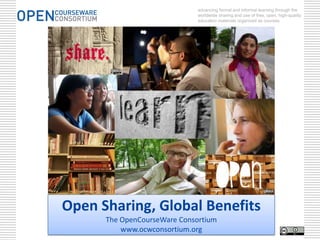
Open Sharing, Global Benefits
      The OpenCourseWare Consortium
          www.ocwconsortium.org
Willem van Valkenburg
          Director TU Delft OpenCourseWare
          OCW.tudelft.nl

          Assistant to the President of the
          OpenCourseWare Consortium

          Projectleader EU-project
          OCW in the European HE context
  twitter.com/wfvanvalkenburg   slideshare.net/wfvanvalkenburg
Opening education:
    What, Who, Why?
(and how libraries can lead)
What is happening?
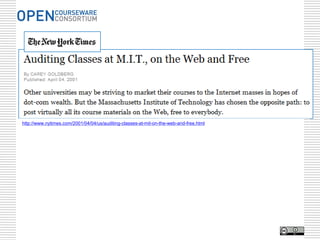
http://www.nytimes.com/2001/04/04/us/auditing-classes-at-mit-on-the-web-and-free.html
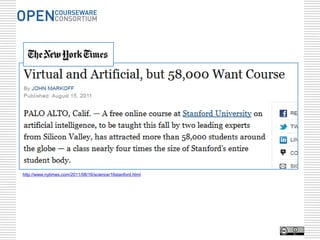
http://www.nytimes.com/2011/08/16/science/16stanford.html
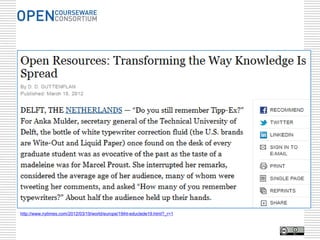
http://www.nytimes.com/2012/03/19/world/europe/19iht-educlede19.html?_r=1
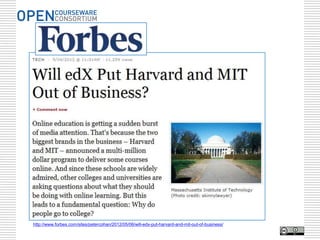
http://www.forbes.com/sites/petercohan/2012/05/06/will-edx-put-harvard-and-mit-out-of-business/
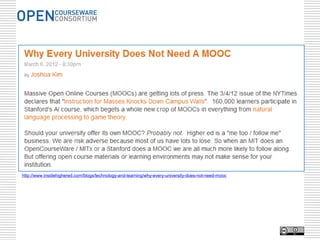
http://www.insidehighered.com/blogs/technology-and-learning/why-every-university-does-not-need-mooc
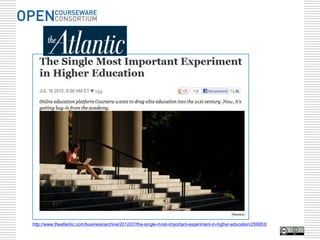
http://www.theatlantic.com/business/archive/2012/07/the-single-most-important-experiment-in-higher-education/259953/
What are all those
 abbreviations?
What is “Open”?
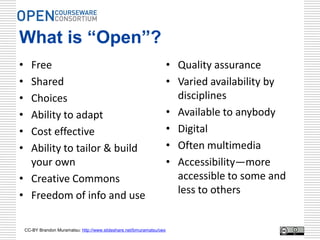
• Free                                                                  • Quality assurance
• Shared                                                                • Varied availability by
• Choices                                                                 disciplines
• Ability to adapt                                                      • Available to anybody
• Cost effective                                                        • Digital
• Ability to tailor & build                                             • Often multimedia
  your own                                                              • Accessibility—more
• Creative Commons                                                        accessible to some and
• Freedom of info and use                                                 less to others


    CC-BY Brandon Muramatsu: http://www.slideshare.net/bmuramatsu/oex
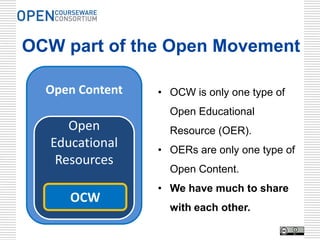
OCW part of the Open Movement

  Open Content   • OCW is only one type of
                   Open Educational
     Open          Resource (OER).
  Educational    • OERs are only one type of
   Resources
                   Open Content.
                 • We have much to share
     OCW
                   with each other.
What are Open Educational Resources?

• Shared educational materials
• Openly licensed for distribution, re-use and
  modification
• Available to anyone via the internet (and often
  other means)
What is OpenCourseWare?
• High quality educational materials organized
  as courses
 A course is package of educational materials starting a
 particular point in the knowledge spectrum, designed to lead
 to greater understanding of the issue or topic


• Openly licensed for distribution, re-use and
  modification, available to all on the internet
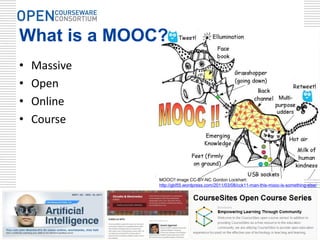
What is a MOOC
•   Massive
•   Open
•   Online
•   Course


       Image CC-BY-NC Gordon Lockhart:
       http://gbl55.wordpress.com/2011/03/08/cck11-man-this-mooc-is-something-else/
Massive
• Stanford University – Artificial Intelligence
  course
  – 160,000 students
• MIT – Circuits and Electronics course
  – 120,000 students
• Indiana – Instructional Ideas and Technology
  Tools for Online Success
  – 4,000 students
Open
• Everybody can participate
• But more important, there are many ways to
  participate:
  – ‘open’ means being able to watch
  – ‘open’ means being able to participate at your
    own level
  – ‘open’ means participating publicly, so other can
    watch

   Source: http://www.slideshare.net/Downes/education-as-platform
   Image CC-BY-NC-SA: http://www.flickr.com/photos/marcwathieu/2412755417/
Online
• Means that it is connective,
  interactive
• You can’t put a MOOC on a DVD
• The MOOC is the process
• It is a process that is greatly aided by being
  online:
   – Many tasks are automated, scaffolded
   – Much greater communicative capacity
   – More access to data, calculations
    Source: http://www.slideshare.net/Downes/education-as-platform
    Image CC-BY-NC-SA: http://www.flickr.com/photos/gforsythe/5552385806/
Kind of MOOCs
Mechanical MOOC


               Exercises &
 Content         Quizzes


E-mail Lists   Study Groups
advancing formal and informal learning through the
                                     worldwide sharing and use of free, open, high-quality
                                     education materials organized as courses.


What are OpenCourseWare projects?
• Institutions that have committed to sharing some of their
  educational materials with the world
• Can be text only – reproduction of materials used for
  classroom lectures
• Can include video, recordings, materials developed
  especially for internet learning
• Can be translations of courses already on OCW sites
• Can be remixes of materials from various courses and
  local contexts
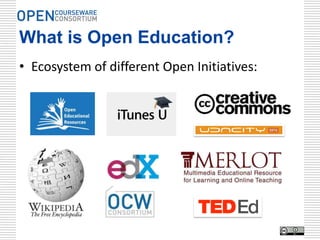
What is Open Education?
• Ecosystem of different Open Initiatives:
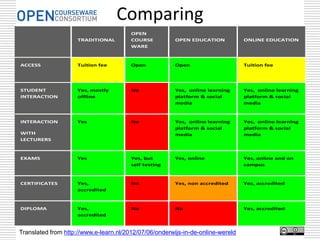
Comparing
                                        OPEN
                     TRADITIONAL        COURSE          OPEN EDUCATION           ONLINE EDUCATION
                                        WARE


ACCESS               Tuition fee        Open            Open                     Tuition fee


STUDENT              Yes, mostly        No              Yes, online learning     Yes, online learning
INTERACTION          offline                            platform & social        platform & social
                                                        media                    media


INTERACTION          Yes                No              Yes, online learning     Yes, online learning
                                                        platform & social        platform & social
WITH                                                    media                    media
LECTURERS


EXAMS                Yes                Yes, but        Yes, online              Yes, online and on
                                        self testing                             campus


CERTIFICATES         Yes,               No              Yes, non accredited      Yes, accredited
                     accredited


DIPLOMA              Yes,               No              No                       Yes, accredited
                     accredited


Translated from http://www.e-learn.nl/2012/07/06/onderwijs-in-de-online-wereld
Why Open Education Matters
advancing formal and informal learning through the
              worldwide sharing and use of free, open, high-quality
              education materials organized as courses.


What is behind this?
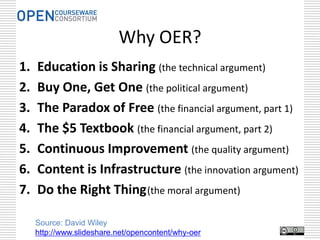
Why OER?
  Education            Buy One,               Paradox              The $5
  is Sharing           Get One                of Free             Textbook

technical argument   political argument    financial argument   financial argument


Facilitate the        Continuous            Content is          Do the Right
Unexpected           Improvement          Infrastructure           Thing

   serendipity        quality argument    innovation argument    moral argument
    argument


CC BY David Wiley:
http://www.slideshare.net/opencontent/openness-arguments-and-examples
1. Education is Sharing
• Teachers Share With Students
• Students Share With Teachers
• Knowledge is Magical:
  – Can be given without being given away
• Educational Sharing also means adapting or
  editing
  – but copyright forbids this
2. Buy One, Get One
Who Pays for Research?
• Publishers make 2% of the investment, then
  take © and charge you for access
• Public (Who Paid) Has No Access


All taxpayer-funded educational resources
should be OER
3. The Paradox of Free

 Won’t people stop paying for the
course materials or books if they’re
              free?
Research from David Wiley
• Over 2% of people who access open online
  courses become paying customers
• Downloads of free online books correlate
  strongly with sales of print books
• A for-profit business can be financially
  successful using CC licenses on its textbooks


  Source: davidwiley.org
4. The $5 Textbook
4. The $5 Textbook
• Open Textbooks: FlatWorldKnowledge.com
  – Pay $35 instead of $150 - $200 per book
  – http://opencontent.org/calculator
5. Facilitate the Unexpected
http://openeducation.us/
Mechanical MOOC
6. Continuous Improvement

 Almost every industry (1) gathers
 and (2) uses data more effectively
            than we do
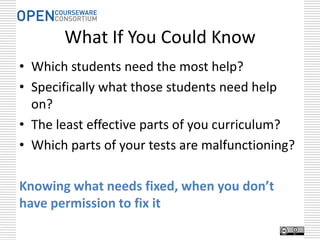
What If You Could Know
• Which students need the most help?
• Specifically what those students need help
  on?
• The least effective parts of you curriculum?
• Which parts of your tests are malfunctioning?

Knowing what needs fixed, when you don’t
have permission to fix it
Openness

Gives us permission to make
changes and improvements
7. Content is Infrastructure
• To speed innovation, increase quality and
  decrease cost of infrastructure
• Content is Critical
  – An important part of every educational
    institution’s infrastructure
• Examples
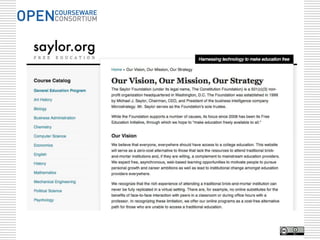
  –   Openstudy.com
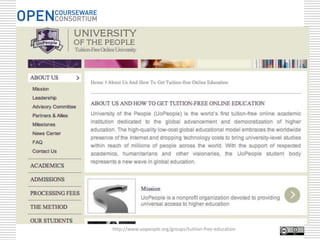
  –   University of the People: tuition-free online university
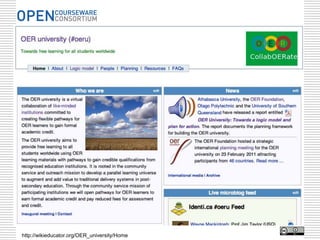
  –   OER University
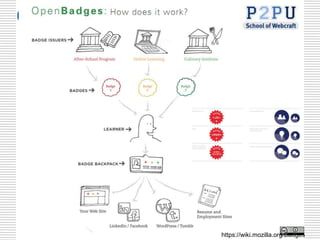
  –   Mozilla Badges
8. Do the Right Thing
Consider Our Responsibility

   What kind of ethical or moral
    responsibility do we have?

   Who are you accountable to?
Who we are
advancing formal and informal learning through the
                           worldwide sharing and use of free, open, high-quality
                           education materials organized as courses.


            Our mission
to advance formal and informal learning
through the worldwide sharing and use of
free, open, high-quality education materials
organized as courses.
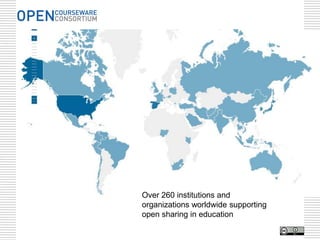
Over 260 institutions and
organizations worldwide supporting
open sharing in education
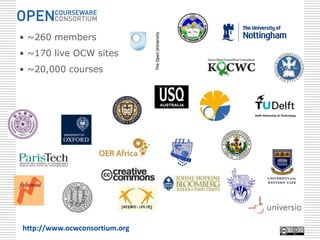
• ~260 members
• ~170 live OCW sites
• ~20,000 courses


http://www.ocwconsortium.org
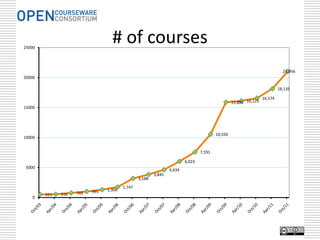
25000
                                  # of courses
                                                                                                                            21,056
20000

                                                                                                                          18,135

                                                                                                                 16,574
                                                                                                 15,885 16,123
15000


                                                                                        10,550
10000


                                                                                7,591

                                                                        6,023
5000
                                                                4,634
                                                        3,845
                                                3,188
                                        1,747
                          995   1,306
        511   550   760
    0
Why do Universities participate
    in OpenCourseWare?
Why? Philosophical

• Expanding access to education & knowledge
• Building on others’ ideas
• Creating possibilities for new educational
  systems
• Maximizing educational euros
Why? Institutional benefits

• Showcasing existing courses and educational
  quality

   transparency = respect & trust

   good public relations
Why? Institutional benefits
• Strengthen teaching and learning outcomes
  – Provide examples of excellence for faculty and
    students
  – Professional development
  – Supports student learning
  – Can lead to
    partnerships, collaborations, recognition
Why? Outreach benefits
• Bridge between secondary and higher
  education
  – Skill and knowledge courses available to prepare
    students for higher education
  – Assist disadvantaged learners and those returning
    to education
  – Insure good fit between student and institution
Why? Outreach benefits
• Workforce development
   – Updating skills
   – Retraining sectors that are downsizing or
     becoming dated
   – Pathways to short courses or certificates


US Department of Labor $2,000,000,000 TAA grant specifically to support
creation of job retraining OER
Why? Innovation

  • Current global higher ed system can’t reach
    everyone who wants an education.
  • Cost and access barriers to current system.
  • Systems don’t serve everyone equally well.

   UNESCO's world conference on Higher Education projects that post-
   secondary education will need to provide places for an additional 98
   million learners over the next 15 years. Stated differently, this would
   require "require more than four major universities (30,000 students)
   to open every week for the next fifteen years". (Daniel 2011.)
Some examples
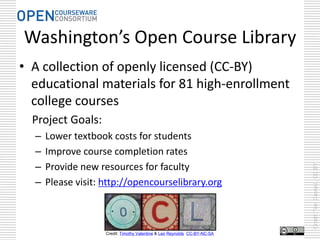
Washington’s Open Course Library
• A collection of openly licensed (CC-BY)
  educational materials for 81 high-enrollment
  college courses
  Project Goals:
  –   Lower textbook costs for students
  –   Improve course completion rates
  –   Provide new resources for faculty


                                                                           Credit: Tom Caswell, CC BY
  –   Please visit: http://opencourselibrary.org


                    Credit: Timothy Valentine & Leo Reynolds CC-BY-NC-SA
http://www.uopeople.org/groups/tuition-free-education
http://wikieducator.org/OER_university/Home
https://wiki.mozilla.org/Badges
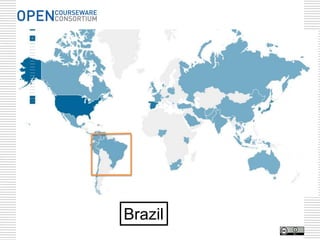
300+ institutions and organizations worldwide


  Brazil
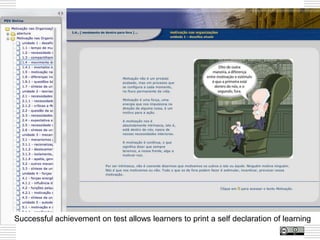
Successful achievement on test allows learners to print a self declaration of learning
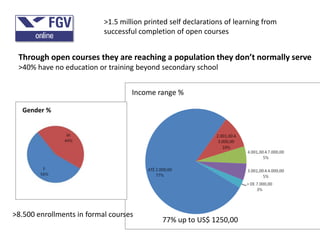
>1.5 million printed self declarations of learning from
                           successful completion of open courses


 Through open courses they are reaching a population they don’t normally serve
 >40% have no education or training beyond secondary school


                                   Income range %

  Gender %


>8.500 enrollments in formal courses
                                             77% up to US$ 1250,00
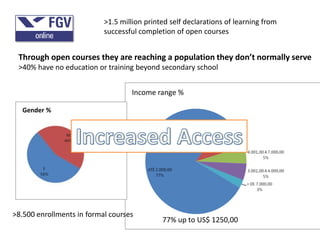
>1.5 million printed self declarations of learning from
                           successful completion of open courses


 Through open courses they are reaching a population they don’t normally serve
 >40% have no education or training beyond secondary school


                                   Income range %

  Gender %


>8.500 enrollments in formal courses
                                             77% up to US$ 1250,00
How can libraries lead?
Characteristics of a library
• Materials repository
• Archive
• Evolving hub for knowledge
• Houses different collections
• Serves a variety of users
• Users can select what is relevant to them, modify for their use
  and can contribute to the body of knowledge and materials
• Supports educational pursuits
• Community center for idea exchange
• Public good
Characteristics of a library
• Materials repository
• Archive
• Evolving hub for knowledge
• Houses different collections
• Serves a variety of users
• Users can select what is relevant to them, modify for their use
  and can contribute to the body of knowledge and materials
• Supports educational pursuits
• Community center for idea exchange
• Public good
These also describe Open Educational Resources
.


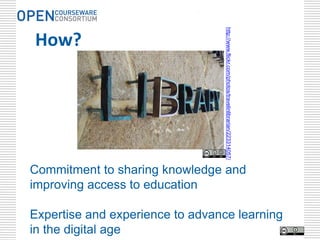
                                  http://www.flickr.com/photos/travelinlibrarian/223314057/
How?


Commitment to sharing knowledge and
improving access to education

Expertise and experience to advance learning
in the digital age
.


How?
Infrastructure expertise:
    •Copyright
    •Metadata
    •Indexing
    •Storage
    •Search and discovery
    •Creating and maintaining repositories
    •Sharing resources among disbursed
    repositories
.


How?
Relationships:

  •Libraries sit at the heart of universities –
   have unbiased relationships with all
   departments and units
  •Librarians are trusted partners in
   academics
  •Already doing outreach with
   faculty, staff, students on available
   resources
.


How?
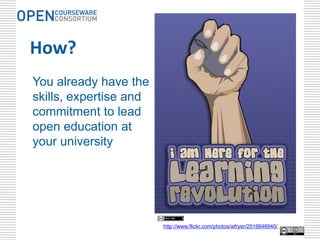
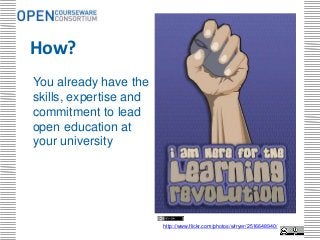
You already have the
skills, expertise and
commitment to lead
open education at
your university


                        http://www.flickr.com/photos/wfryer/2516648940/
advancing formal and informal learning through the
                                                                        worldwide sharing and use of free, open, high-quality
                                                                        education materials organized as courses.


                                                          Resources:

                                                          www.ocwconsortium.org/communities/toolkit

                                                           Reaching the Heart of the
                                                           University: Libraries and the
                                                           Future of OER

                                                           Pieter Keymeer, Molly Kleinman, Ted
                                                           Hanss (U Michigan)
                                                           http://hdl.handle.net/2027.42/78006


                     “Open” by Loop_oh

http://www.flickr.com/photos/loop_oh/4493818473/sizes/m/in/ph
                          otostream/
advancing formal and informal learning through the
                              worldwide sharing and use of free, open, high-quality
                              education materials organized as courses.


Open Sharing, Global Benefits
      The OpenCourseWare Consortium
          www.ocwconsortium.org
advancing formal and informal learning through the
                                                                               worldwide sharing and use of free, open, high-quality
                                                                               education materials organized as courses.


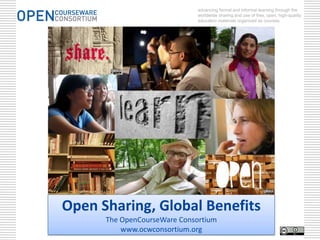
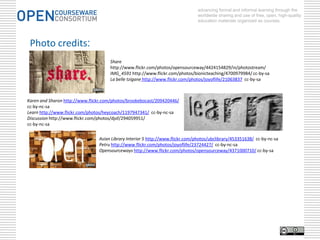
 Photo credits:
                                     Share
                                     http://www.flickr.com/photos/opensourceway/4424154829/in/photostream/
                                     IMG_4591 http://www.flickr.com/photos/bionicteaching/4700979984/ cc-by-sa
                                     La belle tzigane http://www.flickr.com/photos/joyoflife/21063837 cc-by-sa


Karen and Sharon http://www.flickr.com/photos/brookebocast/209420446/
cc-by-nc-sa
Learn http://www.flickr.com/photos/heycoach/1197947341/ cc-by-nc-sa
Discussion http://www.flickr.com/photos/djof/294059951/
cc-by-nc-sa

                                Asian Library Interior 5 http://www.flickr.com/photos/ubclibrary/453351638/ cc-by-nc-sa
                                Petru http://www.flickr.com/photos/joyoflife/23724427/ cc-by-nc-sa
                                Opensourceways http://www.flickr.com/photos/opensourceway/4371000710/ cc-by-sa
advancing formal and informal learning through the
                                                           worldwide sharing and use of free, open, high-quality
                                                           education materials organized as courses.


Activities of the OpenCourseWare Consortium are generously supported by:

The William and Flora Hewlett Foundation

Sustaining Members of the OCW Consortium:
         The African Virtual University
         China Open Resources for Education
         Delft University of Technology
         Fundação Getulio Vargas
         Japan OpenCourseWare Consortium
         Johns Hopkins Bloomburg School of Public Health
         Korea OpenCourseWare Consortium
         Massachusetts Institute of Technology
         Netease Information Technology Co.
         Open Universiteit
         Tecnológico de Monterrey
         Tufts University
         Universia
         Universidad Politécnica de Madrid
         University of California, Irvine
         University of Michigan
         University of the Western Cape

And contributions of member organizations
advancing formal and informal learning through the
                                 worldwide sharing and use of free, open, high-quality
                                 education materials organized as courses.


            www.ocwconsortium.org

                   ocw.tudelft.nl
Twitter.com/wfvanvalkenburg
Slideshare.net/wfvanvalkenburg
E-learn.nl

Open Education for Ticer Summerschool

  • 1.
    advancing formal andinformal learning through the worldwide sharing and use of free, open, high-quality education materials organized as courses. Open Sharing, Global Benefits The OpenCourseWare Consortium www.ocwconsortium.org
  • 2.
    Willem van Valkenburg Director TU Delft OpenCourseWare OCW.tudelft.nl Assistant to the President of the OpenCourseWare Consortium Projectleader EU-project OCW in the European HE context twitter.com/wfvanvalkenburg slideshare.net/wfvanvalkenburg
  • 3.
    Opening education: What, Who, Why? (and how libraries can lead)
  • 4.
  • 5.
  • 6.
  • 7.
  • 8.
  • 9.
  • 10.
  • 11.
    What are allthose abbreviations?
  • 12.
    What is “Open”? •Free • Quality assurance • Shared • Varied availability by • Choices disciplines • Ability to adapt • Available to anybody • Cost effective • Digital • Ability to tailor & build • Often multimedia your own • Accessibility—more • Creative Commons accessible to some and • Freedom of info and use less to others CC-BY Brandon Muramatsu: http://www.slideshare.net/bmuramatsu/oex
  • 13.
    OCW part ofthe Open Movement Open Content • OCW is only one type of Open Educational Open Resource (OER). Educational • OERs are only one type of Resources Open Content. • We have much to share OCW with each other.
  • 14.
    What are OpenEducational Resources? • Shared educational materials • Openly licensed for distribution, re-use and modification • Available to anyone via the internet (and often other means)
  • 15.
    What is OpenCourseWare? •High quality educational materials organized as courses A course is package of educational materials starting a particular point in the knowledge spectrum, designed to lead to greater understanding of the issue or topic • Openly licensed for distribution, re-use and modification, available to all on the internet
  • 16.
    What is aMOOC • Massive • Open • Online • Course Image CC-BY-NC Gordon Lockhart: http://gbl55.wordpress.com/2011/03/08/cck11-man-this-mooc-is-something-else/
  • 17.
    Massive • Stanford University– Artificial Intelligence course – 160,000 students • MIT – Circuits and Electronics course – 120,000 students • Indiana – Instructional Ideas and Technology Tools for Online Success – 4,000 students
  • 18.
    Open • Everybody canparticipate • But more important, there are many ways to participate: – ‘open’ means being able to watch – ‘open’ means being able to participate at your own level – ‘open’ means participating publicly, so other can watch Source: http://www.slideshare.net/Downes/education-as-platform Image CC-BY-NC-SA: http://www.flickr.com/photos/marcwathieu/2412755417/
  • 19.
    Online • Means thatit is connective, interactive • You can’t put a MOOC on a DVD • The MOOC is the process • It is a process that is greatly aided by being online: – Many tasks are automated, scaffolded – Much greater communicative capacity – More access to data, calculations Source: http://www.slideshare.net/Downes/education-as-platform Image CC-BY-NC-SA: http://www.flickr.com/photos/gforsythe/5552385806/
  • 20.
  • 21.
    Mechanical MOOC Exercises & Content Quizzes E-mail Lists Study Groups
  • 22.
    advancing formal andinformal learning through the worldwide sharing and use of free, open, high-quality education materials organized as courses. What are OpenCourseWare projects? • Institutions that have committed to sharing some of their educational materials with the world • Can be text only – reproduction of materials used for classroom lectures • Can include video, recordings, materials developed especially for internet learning • Can be translations of courses already on OCW sites • Can be remixes of materials from various courses and local contexts
  • 23.
    What is OpenEducation? • Ecosystem of different Open Initiatives:
  • 24.
    Comparing OPEN TRADITIONAL COURSE OPEN EDUCATION ONLINE EDUCATION WARE ACCESS Tuition fee Open Open Tuition fee STUDENT Yes, mostly No Yes, online learning Yes, online learning INTERACTION offline platform & social platform & social media media INTERACTION Yes No Yes, online learning Yes, online learning platform & social platform & social WITH media media LECTURERS EXAMS Yes Yes, but Yes, online Yes, online and on self testing campus CERTIFICATES Yes, No Yes, non accredited Yes, accredited accredited DIPLOMA Yes, No No Yes, accredited accredited Translated from http://www.e-learn.nl/2012/07/06/onderwijs-in-de-online-wereld
  • 25.
  • 26.
    advancing formal andinformal learning through the worldwide sharing and use of free, open, high-quality education materials organized as courses. What is behind this?
  • 27.
    Why OER? Education Buy One, Paradox The $5 is Sharing Get One of Free Textbook technical argument political argument financial argument financial argument Facilitate the Continuous Content is Do the Right Unexpected Improvement Infrastructure Thing serendipity quality argument innovation argument moral argument argument CC BY David Wiley: http://www.slideshare.net/opencontent/openness-arguments-and-examples
  • 28.
  • 29.
    1. Education isSharing • Teachers Share With Students • Students Share With Teachers • Knowledge is Magical: – Can be given without being given away • Educational Sharing also means adapting or editing – but copyright forbids this
  • 30.
    2. Buy One,Get One
  • 31.
    Who Pays forResearch? • Publishers make 2% of the investment, then take © and charge you for access • Public (Who Paid) Has No Access All taxpayer-funded educational resources should be OER
  • 32.
    3. The Paradoxof Free Won’t people stop paying for the course materials or books if they’re free?
  • 33.
    Research from DavidWiley • Over 2% of people who access open online courses become paying customers • Downloads of free online books correlate strongly with sales of print books • A for-profit business can be financially successful using CC licenses on its textbooks Source: davidwiley.org
  • 34.
    4. The $5Textbook
  • 35.
    4. The $5Textbook • Open Textbooks: FlatWorldKnowledge.com – Pay $35 instead of $150 - $200 per book – http://opencontent.org/calculator
  • 36.
  • 38.
  • 39.
  • 40.
    6. Continuous Improvement Almost every industry (1) gathers and (2) uses data more effectively than we do
  • 41.
    What If YouCould Know • Which students need the most help? • Specifically what those students need help on? • The least effective parts of you curriculum? • Which parts of your tests are malfunctioning? Knowing what needs fixed, when you don’t have permission to fix it
  • 42.
    Openness Gives us permissionto make changes and improvements
  • 43.
    7. Content isInfrastructure
  • 44.
    • To speedinnovation, increase quality and decrease cost of infrastructure • Content is Critical – An important part of every educational institution’s infrastructure • Examples – Openstudy.com – University of the People: tuition-free online university – OER University – Mozilla Badges
  • 45.
    8. Do theRight Thing
  • 46.
    Consider Our Responsibility What kind of ethical or moral responsibility do we have? Who are you accountable to?
  • 47.
  • 48.
    advancing formal andinformal learning through the worldwide sharing and use of free, open, high-quality education materials organized as courses. Our mission to advance formal and informal learning through the worldwide sharing and use of free, open, high-quality education materials organized as courses.
  • 49.
    Over 260 institutionsand organizations worldwide supporting open sharing in education
  • 50.
    • ~260 members •~170 live OCW sites • ~20,000 courses http://www.ocwconsortium.org
  • 51.
    25000 # of courses 21,056 20000 18,135 16,574 15,885 16,123 15000 10,550 10000 7,591 6,023 5000 4,634 3,845 3,188 1,747 995 1,306 511 550 760 0
  • 52.
    Why do Universitiesparticipate in OpenCourseWare?
  • 53.
    Why? Philosophical • Expandingaccess to education & knowledge • Building on others’ ideas • Creating possibilities for new educational systems • Maximizing educational euros
  • 54.
    Why? Institutional benefits •Showcasing existing courses and educational quality  transparency = respect & trust  good public relations
  • 55.
    Why? Institutional benefits •Strengthen teaching and learning outcomes – Provide examples of excellence for faculty and students – Professional development – Supports student learning – Can lead to partnerships, collaborations, recognition
  • 56.
    Why? Outreach benefits •Bridge between secondary and higher education – Skill and knowledge courses available to prepare students for higher education – Assist disadvantaged learners and those returning to education – Insure good fit between student and institution
  • 57.
    Why? Outreach benefits •Workforce development – Updating skills – Retraining sectors that are downsizing or becoming dated – Pathways to short courses or certificates US Department of Labor $2,000,000,000 TAA grant specifically to support creation of job retraining OER
  • 58.
    Why? Innovation • Current global higher ed system can’t reach everyone who wants an education. • Cost and access barriers to current system. • Systems don’t serve everyone equally well. UNESCO's world conference on Higher Education projects that post- secondary education will need to provide places for an additional 98 million learners over the next 15 years. Stated differently, this would require "require more than four major universities (30,000 students) to open every week for the next fifteen years". (Daniel 2011.)
  • 59.
  • 60.
    Washington’s Open CourseLibrary • A collection of openly licensed (CC-BY) educational materials for 81 high-enrollment college courses Project Goals: – Lower textbook costs for students – Improve course completion rates – Provide new resources for faculty Credit: Tom Caswell, CC BY – Please visit: http://opencourselibrary.org Credit: Timothy Valentine & Leo Reynolds CC-BY-NC-SA
  • 61.
  • 63.
  • 64.
  • 66.
    300+ institutions andorganizations worldwide Brazil
  • 67.
    Successful achievement ontest allows learners to print a self declaration of learning
  • 68.
    >1.5 million printedself declarations of learning from successful completion of open courses Through open courses they are reaching a population they don’t normally serve >40% have no education or training beyond secondary school Income range % Gender % >8.500 enrollments in formal courses 77% up to US$ 1250,00
  • 69.
    >1.5 million printedself declarations of learning from successful completion of open courses Through open courses they are reaching a population they don’t normally serve >40% have no education or training beyond secondary school Income range % Gender % >8.500 enrollments in formal courses 77% up to US$ 1250,00
  • 70.
  • 71.
    Characteristics of alibrary • Materials repository • Archive • Evolving hub for knowledge • Houses different collections • Serves a variety of users • Users can select what is relevant to them, modify for their use and can contribute to the body of knowledge and materials • Supports educational pursuits • Community center for idea exchange • Public good
  • 72.
    Characteristics of alibrary • Materials repository • Archive • Evolving hub for knowledge • Houses different collections • Serves a variety of users • Users can select what is relevant to them, modify for their use and can contribute to the body of knowledge and materials • Supports educational pursuits • Community center for idea exchange • Public good These also describe Open Educational Resources
  • 73.
    . http://www.flickr.com/photos/travelinlibrarian/223314057/ How? Commitment to sharing knowledge and improving access to education Expertise and experience to advance learning in the digital age
  • 74.
    . How? Infrastructure expertise: •Copyright •Metadata •Indexing •Storage •Search and discovery •Creating and maintaining repositories •Sharing resources among disbursed repositories
  • 75.
    . How? Relationships: •Librariessit at the heart of universities – have unbiased relationships with all departments and units •Librarians are trusted partners in academics •Already doing outreach with faculty, staff, students on available resources
  • 76.
    . How? You already havethe skills, expertise and commitment to lead open education at your university http://www.flickr.com/photos/wfryer/2516648940/
  • 77.
    advancing formal andinformal learning through the worldwide sharing and use of free, open, high-quality education materials organized as courses. Resources: www.ocwconsortium.org/communities/toolkit Reaching the Heart of the University: Libraries and the Future of OER Pieter Keymeer, Molly Kleinman, Ted Hanss (U Michigan) http://hdl.handle.net/2027.42/78006 “Open” by Loop_oh http://www.flickr.com/photos/loop_oh/4493818473/sizes/m/in/ph otostream/
  • 78.
    advancing formal andinformal learning through the worldwide sharing and use of free, open, high-quality education materials organized as courses. Open Sharing, Global Benefits The OpenCourseWare Consortium www.ocwconsortium.org
  • 79.
    advancing formal andinformal learning through the worldwide sharing and use of free, open, high-quality education materials organized as courses. Photo credits: Share http://www.flickr.com/photos/opensourceway/4424154829/in/photostream/ IMG_4591 http://www.flickr.com/photos/bionicteaching/4700979984/ cc-by-sa La belle tzigane http://www.flickr.com/photos/joyoflife/21063837 cc-by-sa Karen and Sharon http://www.flickr.com/photos/brookebocast/209420446/ cc-by-nc-sa Learn http://www.flickr.com/photos/heycoach/1197947341/ cc-by-nc-sa Discussion http://www.flickr.com/photos/djof/294059951/ cc-by-nc-sa Asian Library Interior 5 http://www.flickr.com/photos/ubclibrary/453351638/ cc-by-nc-sa Petru http://www.flickr.com/photos/joyoflife/23724427/ cc-by-nc-sa Opensourceways http://www.flickr.com/photos/opensourceway/4371000710/ cc-by-sa
  • 80.
    advancing formal andinformal learning through the worldwide sharing and use of free, open, high-quality education materials organized as courses. Activities of the OpenCourseWare Consortium are generously supported by: The William and Flora Hewlett Foundation Sustaining Members of the OCW Consortium: The African Virtual University China Open Resources for Education Delft University of Technology Fundação Getulio Vargas Japan OpenCourseWare Consortium Johns Hopkins Bloomburg School of Public Health Korea OpenCourseWare Consortium Massachusetts Institute of Technology Netease Information Technology Co. Open Universiteit Tecnológico de Monterrey Tufts University Universia Universidad Politécnica de Madrid University of California, Irvine University of Michigan University of the Western Cape And contributions of member organizations
  • 81.
    advancing formal andinformal learning through the worldwide sharing and use of free, open, high-quality education materials organized as courses. www.ocwconsortium.org ocw.tudelft.nl Twitter.com/wfvanvalkenburg Slideshare.net/wfvanvalkenburg E-learn.nl

Editor's Notes

  • #16 OpenCourseWare is part of Open Educational Resources, but while OER can be a single object, OpenCourseWare is a package of course materials, such as syllabi, tests, lecture notes, videos of lectures, recordings, reading lists, etc.
  • #23 Institutions are the stewards of the collectionDoesn’t mean that anything can go upOCW can be used to advance particular objectives of an institution
  • #26 Embed the video of http://vimeo.com/43437812
  • #61 The Open Course Library is a collection of expertly developed educational materials – including textbooks, syllabi, course activities, readings, and assessments – for 81 high-enrollment college courses. 42 courses have been completed so far, providing faculty with a high-quality option that will cost students no more than $30 per course.
  • #62 Some institutions that are using OCW and OERs to broaden access and offer alternatives to the current educational systems.
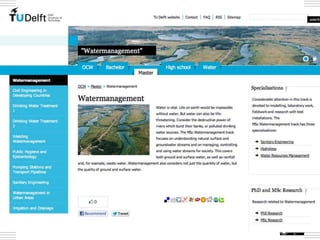
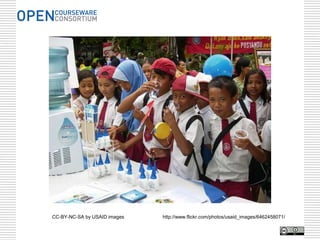
  • #66 Another interesting activity being undertaken in Indonesia is the use of OER in formal educational program. The University of Bandun wanted to develop programs in water management. As you know, developing new courses and programs requires a significant financial and time commitment. Rather than investing in faculty developing theoretical lectures, they decided to use these lectures freely and openly offered by Delft University of Technology in the Netherlands, and focus their development efforts on contextualizing theoretical and practical approaches in Indonesian environments and society.
  • #67 Moving to the other side of the world, I would like to make a few comments on an OER activity in Brazil that speaks to the question of increasing access to higher education that was highlighted by many of the Ministers this morning.
  • #68 Fundação Getulio Vargas (FGV) is Brazil’s largest non-governmental provider of distance education, serving approximately 90,000 online students. They offer a number of their courses as open educational resources. Students can complete these courses with no registration or fees, and, if they achieve passing marks on the embedded test, they are able to print a self declaration of learning. This certificate carries no credit and does not complete any degree requirements, but nonetheless, they have had over 1.5 million of these certificates printed. There are no fees for the certificate, rather, they require these learners to fill out a survey before printing the self declaration. This has given them considerable data.
  • #69 The data collected has shown that they are reaching learners that they do not reach with their for credit, paid course offerings. In particular, 40% nave no post-secondary training or education, nearly 55% of leaners are women, and the vast majority are low income learners.
  • #70 In short, FGV has found that their open courses has resulted in increased access.Also of note, FGV has been able to directly attribute more than 8500 enrollments in formal courses to learners following open courses, so there has been financial benefit to the institution in addition to mission benefit.
  • #77 Since librarians have the skills, expertise and commitment to lead open education, perhaps all that’s missing is support.
  • #79 We hope you’ll join us – thank you – flip through the next three slides rather quickly