Bioadhesion Drug Delivery
system
By. Sachin Chandankar
Research Scholar
M. Pharmacy(Pharmaceutics) & PGD-IPR
• Bioadhesion can be defined as the ability of a drug carrier
system (synthetic or biological) to adhere to a biological
substrate for an extended period of time.
•The biological surface can be epithelial tissue (skin) or the
mucous coat on the surface of a tissue.
•If the adhesive attachment is to a mucous coat, the
phenomenon is referred to as mucoadhesion.
Bioadhesion technique used to optimize either local or
systemic drug delivery for various routes of administration
by:
a. Extension of Contact Time:
prolong contact time of a drug delivery system to biological
tissue can improve drug therapy.
b. Localization of Drug Delivery System:
Some drugs are preferentially absorbed in a specified region
"window for absorption". e.g., iron, riboflavin, chlorothiazide.
Importance of Bioadhesion in Drug delivery
mucoadhesive dosage forms should be:
• not cause irritation
• small and flexible enough to be accepted by the patient.
These requirements can be met by using hydrogels.
Hydrogels : are hydrophilic matrices that are capable of
swelling when placed in aqueous media.
• As water is absorbed into hydrogels, chain relaxation
occurs and drug molecules are released through the spaces
or channels within the hydrogel network.
• Hydrogels matrices include natural gums and cellulose
derivatives.
Mucoadhesion
The major constituents of mucus is mucin are the high molecular
weight glycoproteins, Mucin also has different charge density
Depending on the pH.
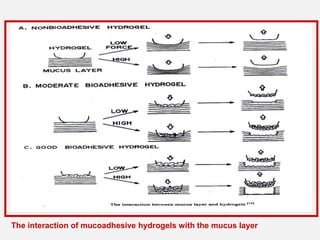
 For a good bioadhesive hydrogel , such as polycarbophil, the
penetration into the mucus layer is dependent on the initial
applied pressure.
 A moderately bioadhesive hydrogel, like polymethacrylate, shows
a capability to entangle with the mucus layer.
 A poor bioadhesive hydrogel, like polyhydroxy ethyl methacrylate
(PHEMA), shows little penetration into the mucus layer.
Mechanism of mucoadhesion
The interaction of mucoadhesive hydrogels with the mucus layer
1. Diffusion Theory:
The diffusion theory describes interpenetration of the
mucoadhesive (polymer) and substrate (mucin) to a
sufficient depth and creation of a semipermanent adhesive
bond by physical entanglement which is dependent on the
molecular weight of the polymer and flexibility and chain
segment mobility of the mucoadhesive polymer
Theories of mucoadhesion, depending on the chemical
nature of adhesive/adherent combinations :
2. Adsorption Theory:
It is a surface force where surface molecules of adhesive
and adherent are in contact.
According to adsorption theory, bioadhesive systems adhere
to tissue due to bond formation.
* Primary Chemical Bonds
Many bioadhesives can form primary chemical covalent
bonds with functional chemical groups in mucin:
Aldehydes and alkylating agents can readily react with
amino groups and sulfhydryl groups.
Acylating agents react with amino and hydroxyl groups of
serine or tyrosine.
* Secondary chemical bonds:
Hydrogen bonding, electrostatic forces or Van-der Waals
attractions are sufficient to contribute adhesive joints.
3. Electronic Theory:
indicate that electronic transfer on contact of the
bioadhesive polymer and the mucin glycoprotein, which lead
to the formation of a double layer of electrical charge at the
bioadhesive interface.
4. Wetting Theory:
the ability of the adhesive to spread on mucin influences the
contact between the mucoadhesive & mucin, that
consequently influences mucoadhesive strength. Thus work
of adhesion is a function of the surface tensions of surfaces
in contact, as well as the interfacial tension. A small
interfacial tension means more contact between the two
surfaces.
5. Mechanical Theory:
the adhesive flow into the pores and interstices to create
mechanical embedding embedded adhesive solidifies and
becomes inextractable. The mechanical theory depends on
irregularities of the surface and Highly fluid adhesives which
are able to penetrate into the cracks and crevices of the
adherent create mechanical embedding.
To generalize the bioadhesion phenomenon:
The First Step: (wetting theory or contact steps)
A close contact between the mucoadhesive and adherent
occur by a good wetting of the mucoadhesive surface
(mucin layer) and the swelling of the mucoadhesive
polymer with a sufficient spreading to assure a contact at
the molecular level between the mucoadhesive and the
membrane.
The Second Step: Consolidation steps (Mechanical and
diffusion Theories)
Once contact is established, penetration of the
mucoadhesive into the crevices of the tissue surface.
Hydrated polymer chains are free to move and stretch and
become entangled or twisted when become into close
contact with the substrate.
The Third Step: (Adsorption and Electronic Theories)
Once entangled is established, the bioadhesives match their
active adhesive sites with those on the substrate to form an
adhesive bond; or the free entangled molecules form
cohesive bonds.
The test methods for bioadhesion measurements can be
classified into two categories:
A. In-Vitro (Ex-Vivo) methods:
1. Detachment force
2. Detachment weight method
3. Wash-off test
4. Electrical Conductance
B. In- Vivo methods
1. X-ray photography
2. Scintigraphic method
Evaluation Of Bioadhesive Properties
1. Detachment force:
It is useful technique for adhesive characterization of
bioadhesive solid and semisolid dosage forms.
The adhesive force is determined by the work to break
adhesive extensions off the adhesive mass.
 test using one tissue layer was used for the bioadhesive
characterization of solid dosage forms
test using two tissue layers was used for the bioadhesive
characterization of semisolid dosage forms.
A. In-Vitro (Ex-Vivo) methods
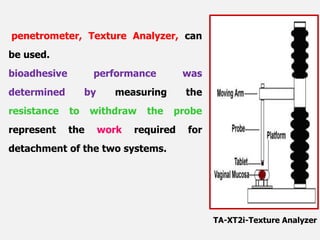
penetrometer, Texture Analyzer, can
be used.
bioadhesive performance was
determined by measuring the
resistance to withdraw the probe
represent the work required for
detachment of the two systems.
TA-XT2i-Texture Analyzer
2. Detachment weight method:
Bioadhesive force is determined by the
following equation:
Detachment stress (dyne/cm2) x 102 = m * g / A
Where: m = The minimal weight added to the balance cause detach (g).
g = Acceleration due to gravity (980 cm/sec 2).
A = Area of tissue exposed (π r2 ).
Force of adhesion (N)= Bioadhesive strength X 9.81
1000
3. Wash-off test:
•The method is used for the evaluation of mucoadhesion
properties of microparticles
Pieces of mucosal tissue were mounted onto glass slide.
About 100 microparticles, with mucoadhesive polymer are
spread onto wet tissue specimen. hold onto the arm of a USP
tablet-disintegration tester, permitting a slow, regular up
and down movement (30 min) in a test fluid kept at 37°C.
Mucoadhesive force of the tested polymer= Resistant to
hydrodynamic shear
4. Electrical Conductance:
• In the presence of adhesive material, the conductance was
comparatively low.
•As the adhesive was removed, the value increased to a
maximum value corresponding to the conductance of the
saliva, which indicated the absence of adhesion.
B. In- Vivo methods:
Based on the measurement of the residence time of
bioadhesives at the application site.
1. X-ray photography:
Barium sulfate (BaSO4) matrix dosage form, containing the
polymer whose bioadhesive properties want to be tested,
can be administered to the volunteer, who is subjected to X-
ray studies. X-ray photographs show the extent of
mucoadhesion of the polymeric dosage form.
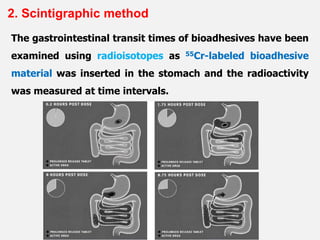
The gastrointestinal transit times of bioadhesives have been
examined using radioisotopes as 55Cr-labeled bioadhesive
material was inserted in the stomach and the radioactivity
was measured at time intervals.
2. Scintigraphic method
Nature of Polymer:
Hydration of adhesives
Flexibility of adhesives
Molecular weight and size of adhesives
Function Groups of Adhesives
Charge Sign of the Adhesives
Charge density of adhesives
Physiological Variables:
Hydration of Biological Substrates
Turnover of Adherent
Nature of Surrounding Media :
pH of the Surrounding Media
FACTORS INFLUENCING BIOADHESION
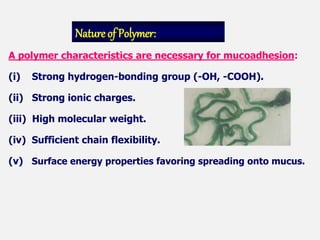
A polymer characteristics are necessary for mucoadhesion:
(i) Strong hydrogen-bonding group (-OH, -COOH).
(ii) Strong ionic charges.
(iii) High molecular weight.
(iv) Sufficient chain flexibility.
(v) Surface energy properties favoring spreading onto mucus.
Nature of Polymer:
Hydration of Adhesives
Many hydrocolloids, such as vegetable gums and
hydrogels, such as polycarbophil become adhesive after
hydration.
 Swelling state is an important factor for adhesiveness
where the swollen polymer allows the relaxation of the
molecules, exposing their adhesive sites and facilitating
interpenetration to a sufficient depth in order to create
adhesive bonds.
However, there is an optimum water concentration for
the hydrocolloid particles to develop maximum adhesive
strength where excessive water may cause slippery
nonadhesive mucilage.
Flexibilityof Adhesives
 There is a relationship between structure and adhesion
of mucoadhesive polymers where bioadhesives should
possess optimal flexibility , to allow interpenetration of
polymer and mucus to take place, that permit the adhesive
to conform to the adherent.
 The flexibility of a polymer backbone is influenced by the
steric effect of substituent side groups.
As the size of the substituted side group becomes larger,
chain flexibility is decreased.
If side chains are flexible, they give internal
plasticization to the whole polymer structure with
suitable adhesiveness.
Increased cross-linking reduces chain flexibility that
decreases bioadhesive performance
As acrylic acid hydrogels (as Carbopol) contain coiled
macromolecules, unable to form an elastic polymer
network as a result of the repulsion of negative charges
and many of the adhesively active groups are shielded
inside the coils and do not actively participate in the
adhesion process.
Thus, it is necessary to neutralize the produced anionic
liquid gels to help in the formation of an expanded gel
network.
 triethanolamine was preferred as neutralizing agent,
since relatively higher viscosity could be obtained using
organic amines than using inorganic bases (as sod.
Hydroxide) where cations generated by amines, resulting in
greater steric expansion of the polymer molecules than the
smaller sodium cations which leads to lower hydration of
the polymer.
Molecular Weight and Size of Adhesives:
Higher molecular weight leads to higher cohesive strength
and reduces creep (move), due to the greater degree of
chain entanglement resulting from longer chains.
Adhesive force increases as polymer molecular weight
increases, until a plateau value is reached.
• At higher than optimum molecular weight, adhesion may
be reduced due to reduced penetration of the adherent
surface by adhesive polymers due to their low mobility.
Function Groups of Adhesives:
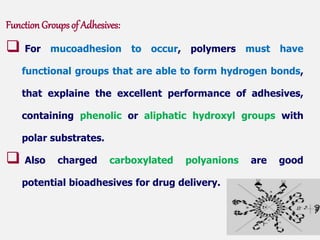
 For mucoadhesion to occur, polymers must have
functional groups that are able to form hydrogen bonds,
that explaine the excellent performance of adhesives,
containing phenolic or aliphatic hydroxyl groups with
polar substrates.
 Also charged carboxylated polyanions are good
potential bioadhesives for drug delivery.
Charge Sign of the Adhesives:
Polymers commonly used can be classified as following:
Non-ionic polymers; as Hydoxypropyl cellulose (HPC) and
hydoxypropyl methylcellulose (HPMC).
Polycationic polymers; as Chitosan.
Polyanionic polymers; as Polyacrylic acid (PAA)
derivatives, e.g., carbopols (CP) and polycarbophils
Cationic and anionic polymers bind more effectively with
the epithelium than the neutral polymers.
Positively charged polymeric hydrogels have additional
molecular-attractive forces due to the electrostatic
interactions with negatively charged mucosal surfaces
Also anionic polymers with sulphate groups bind more
effectively than those with carboxylic groups.
Charge Density of Adhesives:
It explain the mechanism whereby negative charge
polymers can bind to a mucus surface of the same charge
sign by the increase in the number of carboxyl or sulfonate
groups on the surface, which cause increase in wettability.
The reason for the excellent bioadhesive property of
Polycarbophil or Carbopol is due to that, they are both
polyanions with high charge density.
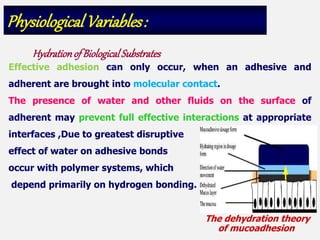
Effective adhesion can only occur, when an adhesive and
adherent are brought into molecular contact.
The presence of water and other fluids on the surface of
adherent may prevent full effective interactions at appropriate
interfaces ,Due to greatest disruptive
effect of water on adhesive bonds
occur with polymer systems, which
depend primarily on hydrogen bonding.
Physiological Variables:
Hydrationof BiologicalSubstrates
The dehydration theory
of mucoadhesion
Turnoverof Adherent:
Mucus covering epithelial cells in the GIT ,
Nasal or eye is continuously secreted and eliminated.
The continuous renewal of the adherent as in soft tissue
bioadhesion , allow failure of a strong adhesive bond.
Thus bioadhesives which bind to this mucus layer are
expected to be removed at the same time when mucin
turnover regardless of the adhesive strength.
 Mucous has a different charge density, depending on pH,
due to differences in dissociation of functional groups on the
carbohydrate & in the amino acids of polypeptide backbone.
 As the pH of the adherent medium increased, charge
repulsion is increase with decrease in adhesion.
 The absorption of water by a polymer and its swelling,
depends on the pH.
 The interaction of polycarbophil with intestinal tissue was
negligible compared to that with stomach tissue due to the
difference in pH.
Natureof SurroundingMedia :
pH of the Surrounding Media:
Applications of bioadhesion
Mucoadhesion
Transmucosal routes of drug delivery (i.e., the mucosal
linings of the eyes, nasal, rectal, vaginal and buccal
cavities) offer advantages for systemic drug delivery
include:
1. Bypass of first pass effect,
2. avoidance of presystemic elimination within the
gastrointestinal tract.
Advantages Of Buccal Adhesive Drug Delivery Systems
1. The mucosa is relatively permeable (4-4000) times greater
than that of the skin with a rich blood supply that render
buccal adhesive drug delivery systems gained interest in
systemic delivery of drugs undergoing hepatic first-pass
metabolism within the gastrointestinal tract.
2. Drug can be easily applied and localized to the application site
and can be removed.
3. Buccal cavity is highly acceptable by patients.
1. Buccal mucoadhesives
1. the environmental factors such as the exposure of the oral
mucosa to salivary flow, shearing forces of tongue
movement and swallowing which can act to displace and
wash away an adhering vehicle
Disadvantages Of Buccal Adhesive Drug Delivery Systems
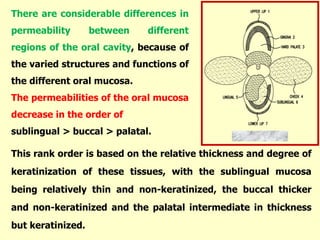
This rank order is based on the relative thickness and degree of
keratinization of these tissues, with the sublingual mucosa
being relatively thin and non-keratinized, the buccal thicker
and non-keratinized and the palatal intermediate in thickness
but keratinized.
There are considerable differences in
permeability between different
regions of the oral cavity, because of
the varied structures and functions of
the different oral mucosa.
The permeabilities of the oral mucosa
decrease in the order of
sublingual > buccal > palatal.
(ii) Local delivery
Drug delivery into the oral cavity has a number of
applications including, the treatment of toothaches,
periodontal diseases, aphthous and dental stomatitis.
(iii) Buccal delivery,
which is drug administration through the mucosal
membranes lining the cheeks (buccal mucosa).
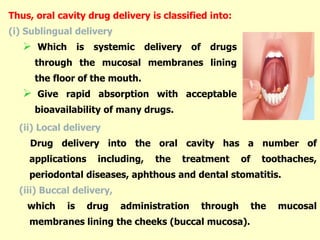
Thus, oral cavity drug delivery is classified into:
(i) Sublingual delivery
 Which is systemic delivery of drugs
through the mucosal membranes lining
the floor of the mouth.
 Give rapid absorption with acceptable
bioavailability of many drugs.
2. Oral Mucoadhesion
to localize a drug and increase its residence time at a
certain site in the GIT.
Oesophageal Mucoadhesion:
• Oesophageal mucoadhesion is used for prolonged
retention of drugs within the oesophagus for treatment
of upper gastro-oesophageal disorders.
• Alginate solution can form a coat for localization of
drugs within the oesophageal tissue for prolonged
periods of time.
Gastric Mucoadhesion:
 Gastric residence of a conventional dosage form is typically
short and transit rapidly through the small intestine. This
diminish the extent of absorption of many drugs.
The Gastric mucoadhesive most commonly used system for
prolonged residence time in stomach to improve the efficacy
of antibiotics to penetrate through the gastric mucus layer in
cases of gastritis, gastric ulcer and gastric carcinoma due to
Helicobacter pylori.
Potential drug candidates for gastro-mucoadhesive :
a. Drugs that have absorption windows in the upper part of
the gastrointestinal tract.
b. All drugs that are intended for local action on the gastro-
duodenal wall, as in case of ulcerous diseases.
 Carbomers and HPMC have good properties with the
gastric mucoadhesion.
 Mucoadhesive chitosan microspheres interact with
sialic acid in the gastric mucus by electrostatic
interaction that improve the gastric residence time of a
drug. Also provide pH-responsive release profile by
swelling in acidic environment of the gastric fluid.
Intestinal Mucoadhesion:
Mucoadhesive microspheres applied into the intestine using
Chitosan as a cationic mucoadhesive polymers can resist
hydrodynamic shear leading to in vivo absorption
enhancement of orally administered drugs.
 Chitosan microspheres can be used for the oral delivery
of vaccines, based on its bioadhesive properties and
biodegradability.
 Polycarbophyl beads, as an anionic bioadhesive are
washed-off very rapidly.
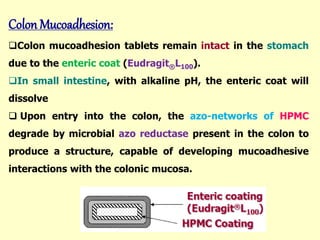
Colon Mucoadhesion:
Colon mucoadhesion tablets remain intact in the stomach
due to the enteric coat (Eudragit®L100).
In small intestine, with alkaline pH, the enteric coat will
dissolve
 Upon entry into the colon, the azo-networks of HPMC
degrade by microbial azo reductase present in the colon to
produce a structure, capable of developing mucoadhesive
interactions with the colonic mucosa.
3. Rectal Bioadhesion:
Anatomically, the upper part of the rectal venous drainage
is connected with the portal system, while the lower part
directly with the general circulation.
solid suppository have hepatic first-pass elimination of
the drugs following rectal administration.
 Liquid suppositories containing mucoadhesive polymers
were administered intrarectally to avoiding first-pass
hepatic elimination of the drug and avoid the
hepatotoxicity of some drugs as antifungal
ketoconazole.
 Mucoadhesive polymers sodium alginate were added to
liquid suppository bases Poloxamers (pluronic 407 and
P 188) to exhibit great mucoadhesive characterization
with no irritation of the rectal mucosal membrane and
diminish the migration distance of the suppository in
rectum without leakage after administration.
4. Vaginal Bioadhesion:
 Vaginal delivery is useful for systemic drug absorption as
well as local action.
 A numbers of factors including changes in vaginal
environment cause some problems for drugs. Bioadhesive
systems of sodium alginate and Chitosan may overcome
these problems by yielding safe vaginal delivery systems as
contraceptive vaginal formulations.
5. Transurethral Bioadhesion:
The most common treatment method for carcinoma of the
bladder is known as the transurethral resection (TUR).
 to obtain desired attachment onto the bladder wall for
pharmacotherapy after TUR, mucoadhesive chitosan carrier
was prepared in the form of cylindrical geometry.
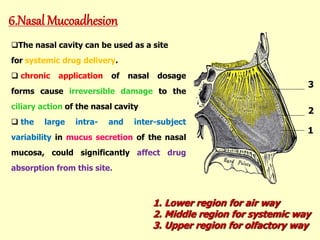
6.Nasal Mucoadhesion
3
1
2
1. Lower region for air way
2. Middle region for systemic way
3. Upper region for olfactory way
The nasal cavity can be used as a site
for systemic drug delivery.
 chronic application of nasal dosage
forms cause irreversible damage to the
ciliary action of the nasal cavity
 the large intra- and inter-subject
variability in mucus secretion of the nasal
mucosa, could significantly affect drug
absorption from this site.
Advantages
 intranasal drug delivery is ease of administration
 rapid drug absorption
 avoidance of hepatic first-pass metabolism.
The richly supplied vascular nature of the nasal mucosa
with its high drug permeation, makes the nasal route of
administration attractive for many drugs.
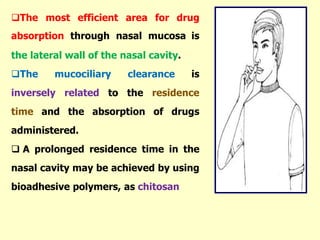
The most efficient area for drug
absorption through nasal mucosa is
the lateral wall of the nasal cavity.
The mucociliary clearance is
inversely related to the residence
time and the absorption of drugs
administered.
 A prolonged residence time in the
nasal cavity may be achieved by using
bioadhesive polymers, as chitosan
7. Pulmonary Bioadhesion (Airway Delivery):
Advantege:
 prolonging drug action and reducing drug dosage can be
ashieved by using Pulmonary Bioadhesion .
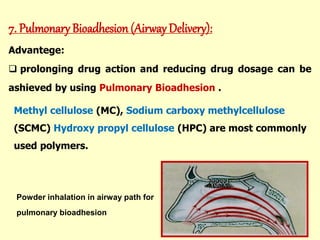
Powder inhalation in airway path for
pulmonary bioadhesion
Methyl cellulose (MC), Sodium carboxy methylcellulose
(SCMC) Hydroxy propyl cellulose (HPC) are most commonly
used polymers.
Topically applied drugs are rapidly eliminated from the
precorneal area. lost within 15-30 sec. due to reflex tearing
and drainage via the nasolacrimal duct.
The cornea is considered as an effective barrier to drug
penetration, since the corneal epithelium has tight junctions
which completely surround and effectively seal the superficial
epithelial cell.
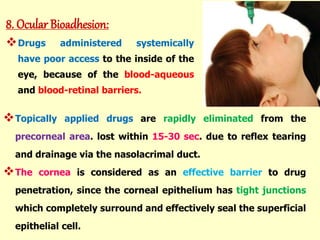
8. Ocular Bioadhesion:
Drugs administered systemically
have poor access to the inside of the
eye, because of the blood-aqueous
and blood-retinal barriers.
Some polymers have the capacity to adhere to the mucin
coat covering the conjunctiva and the corneal surface of
the eye prolonging the residence time of a drug.
 At physiological pH of tears, the mucus network usually
carries a significant negative charge because of the
presence of sialic acid and sulfate residues.
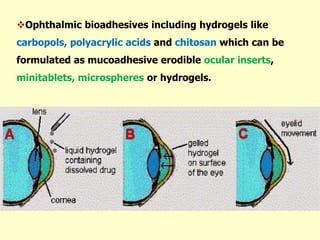
Ophthalmic bioadhesives including hydrogels like
carbopols, polyacrylic acids and chitosan which can be
formulated as mucoadhesive erodible ocular inserts,
minitablets, microspheres or hydrogels.
9. Hemostasis and Wound Dressing Bioadhesion
Bioadhesives have been used as
haemostatic and wound healing agents.
Requirements for good Bioadhesive polymers
for haemostatic and wound healing.
Have the ability to spread on tissue surfaces
Must be rapidly and uniformly adhere and conform to
wound bed topography and contour to prevent air or fluid
pocket formation.
Prevents peripheral channeling into the wound by
bacteria and promotes bonding to tissues.
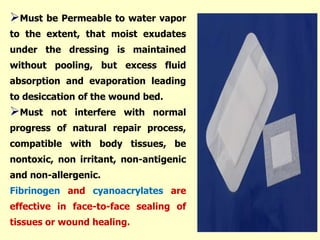
Must be Permeable to water vapor
to the extent, that moist exudates
under the dressing is maintained
without pooling, but excess fluid
absorption and evaporation leading
to desiccation of the wound bed.
Must not interfere with normal
progress of natural repair process,
compatible with body tissues, be
nontoxic, non irritant, non-antigenic
and non-allergenic.
Fibrinogen and cyanoacrylates are
effective in face-to-face sealing of
tissues or wound healing.
Chitosan could be dissolved in organic acids, such as lactic
acid and acetic acid and casted into films forming soft,
flexible and pliable bioadhesive wound healing bandages
able to effectively bind and agglutinate a wide variety of
mammalian cell types.
Cross-linked gelatin films were bonded to heart muscle and
to lung pleura and parenchyma, using the electrical
discharge of an argon beam radio-frequency coagulator.
denatured protein constituents of both gelatin and tissue
protein chains create a fluidized state that rapidly coalesced.
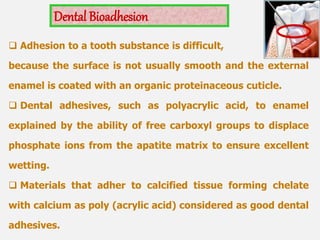
 Adhesion to a tooth substance is difficult,
because the surface is not usually smooth and the external
enamel is coated with an organic proteinaceous cuticle.
 Dental adhesives, such as polyacrylic acid, to enamel
explained by the ability of free carboxyl groups to displace
phosphate ions from the apatite matrix to ensure excellent
wetting.
 Materials that adher to calcified tissue forming chelate
with calcium as poly (acrylic acid) considered as good dental
adhesives.
Dental Bioadhesion
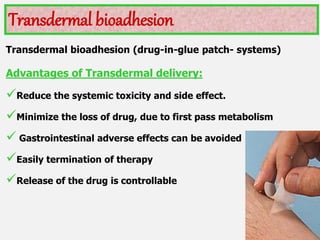
Transdermal bioadhesion (drug-in-glue patch- systems)
Advantages of Transdermal delivery:
Reduce the systemic toxicity and side effect.
Minimize the loss of drug, due to first pass metabolism
 Gastrointestinal adverse effects can be avoided
Easily termination of therapy
Release of the drug is controllable
Transdermal bioadhesion
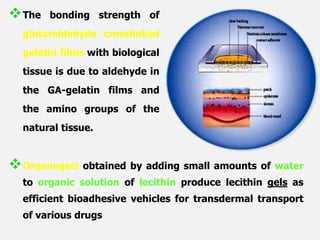
The bonding strength of
glutaraldehyde crosslinked
gelatin films with biological
tissue is due to aldehyde in
the GA-gelatin films and
the amino groups of the
natural tissue.
Organogels obtained by adding small amounts of water
to organic solution of lecithin produce lecithin gels as
efficient bioadhesive vehicles for transdermal transport
of various drugs
References-
1. Harris D, Robinson JR. Drug delivery via the mucous membranes of the
oral cavity. J. Pharm. Sci. 1992;81:1–10.
2. Rojanasakul Y, Wang LY, Bhat M, Glover DD, Malanga CJ, Ma JKH. The
transport barrier of epithelia: a comparative study on membrane
permeability and charge selectivity in the rabbit. Pharm. Res. 1992;9:1029–
1034.
3.Walker GF, Langoth N, Bernkop-Schnurch A. Peptidase activity on the
surface of the porcine buccal mucosa. Int. J. Pharm. 2002;233:141–147.
4. Walker GF, Langoth N, Bernkop-Schnurch A. Peptidase activity on the
surface of the porcine buccal mucosa. Int. J. Pharm. 2002;233:141–147.
4. Ahuja RP, Khar JA. Mucoadhesive drug delivery systems. Drug Dev. Ind.
Pharm. 1997;23:489–515. 29. Gu JM, Robinson JR, Leung SHS. Binding of
acrylic polymers to mucin/epithelial surfaces: structure- property
relationships. Crit. Rev. Ther. Drug Carr. Syst. 1998;5:21–67. 30.
5. Khanvilkar K, Donovan MD, Flanagan DR. Drug transfer through
mucus. Adv. Drug Del. Rev. 2001;48(2-3):173–193.
6. Clark MA, Hirst B, Jepson M. Lectin-mediated mucosal delivery of drugs
and microparticles. Adv. Drug Deliv. Rev. 2000;43:207–223.
7. Ponchel G, Irache JM. Specific and nonspecific bioadhesive particular
systems for oral delivery to the gastrointestinal tract. Adv. Drug Del.
Rev. 1998;34(2-3):191–219.
Thank you

Bioadhesion Drug Delivery system

  • 1.
    Bioadhesion Drug Delivery system By.Sachin Chandankar Research Scholar M. Pharmacy(Pharmaceutics) & PGD-IPR
  • 2.
    • Bioadhesion canbe defined as the ability of a drug carrier system (synthetic or biological) to adhere to a biological substrate for an extended period of time. •The biological surface can be epithelial tissue (skin) or the mucous coat on the surface of a tissue. •If the adhesive attachment is to a mucous coat, the phenomenon is referred to as mucoadhesion.
  • 3.
    Bioadhesion technique usedto optimize either local or systemic drug delivery for various routes of administration by: a. Extension of Contact Time: prolong contact time of a drug delivery system to biological tissue can improve drug therapy. b. Localization of Drug Delivery System: Some drugs are preferentially absorbed in a specified region "window for absorption". e.g., iron, riboflavin, chlorothiazide. Importance of Bioadhesion in Drug delivery
  • 4.
    mucoadhesive dosage formsshould be: • not cause irritation • small and flexible enough to be accepted by the patient. These requirements can be met by using hydrogels. Hydrogels : are hydrophilic matrices that are capable of swelling when placed in aqueous media. • As water is absorbed into hydrogels, chain relaxation occurs and drug molecules are released through the spaces or channels within the hydrogel network. • Hydrogels matrices include natural gums and cellulose derivatives. Mucoadhesion
  • 5.
    The major constituentsof mucus is mucin are the high molecular weight glycoproteins, Mucin also has different charge density Depending on the pH.  For a good bioadhesive hydrogel , such as polycarbophil, the penetration into the mucus layer is dependent on the initial applied pressure.  A moderately bioadhesive hydrogel, like polymethacrylate, shows a capability to entangle with the mucus layer.  A poor bioadhesive hydrogel, like polyhydroxy ethyl methacrylate (PHEMA), shows little penetration into the mucus layer. Mechanism of mucoadhesion
  • 6.
    The interaction ofmucoadhesive hydrogels with the mucus layer
  • 7.
    1. Diffusion Theory: Thediffusion theory describes interpenetration of the mucoadhesive (polymer) and substrate (mucin) to a sufficient depth and creation of a semipermanent adhesive bond by physical entanglement which is dependent on the molecular weight of the polymer and flexibility and chain segment mobility of the mucoadhesive polymer Theories of mucoadhesion, depending on the chemical nature of adhesive/adherent combinations :
  • 8.
    2. Adsorption Theory: Itis a surface force where surface molecules of adhesive and adherent are in contact. According to adsorption theory, bioadhesive systems adhere to tissue due to bond formation. * Primary Chemical Bonds Many bioadhesives can form primary chemical covalent bonds with functional chemical groups in mucin: Aldehydes and alkylating agents can readily react with amino groups and sulfhydryl groups. Acylating agents react with amino and hydroxyl groups of serine or tyrosine.
  • 9.
    * Secondary chemicalbonds: Hydrogen bonding, electrostatic forces or Van-der Waals attractions are sufficient to contribute adhesive joints.
  • 10.
    3. Electronic Theory: indicatethat electronic transfer on contact of the bioadhesive polymer and the mucin glycoprotein, which lead to the formation of a double layer of electrical charge at the bioadhesive interface. 4. Wetting Theory: the ability of the adhesive to spread on mucin influences the contact between the mucoadhesive & mucin, that consequently influences mucoadhesive strength. Thus work of adhesion is a function of the surface tensions of surfaces in contact, as well as the interfacial tension. A small interfacial tension means more contact between the two surfaces.
  • 11.
    5. Mechanical Theory: theadhesive flow into the pores and interstices to create mechanical embedding embedded adhesive solidifies and becomes inextractable. The mechanical theory depends on irregularities of the surface and Highly fluid adhesives which are able to penetrate into the cracks and crevices of the adherent create mechanical embedding.
  • 12.
    To generalize thebioadhesion phenomenon: The First Step: (wetting theory or contact steps) A close contact between the mucoadhesive and adherent occur by a good wetting of the mucoadhesive surface (mucin layer) and the swelling of the mucoadhesive polymer with a sufficient spreading to assure a contact at the molecular level between the mucoadhesive and the membrane.
  • 13.
    The Second Step:Consolidation steps (Mechanical and diffusion Theories) Once contact is established, penetration of the mucoadhesive into the crevices of the tissue surface. Hydrated polymer chains are free to move and stretch and become entangled or twisted when become into close contact with the substrate. The Third Step: (Adsorption and Electronic Theories) Once entangled is established, the bioadhesives match their active adhesive sites with those on the substrate to form an adhesive bond; or the free entangled molecules form cohesive bonds.
  • 14.
    The test methodsfor bioadhesion measurements can be classified into two categories: A. In-Vitro (Ex-Vivo) methods: 1. Detachment force 2. Detachment weight method 3. Wash-off test 4. Electrical Conductance B. In- Vivo methods 1. X-ray photography 2. Scintigraphic method Evaluation Of Bioadhesive Properties
  • 15.
    1. Detachment force: Itis useful technique for adhesive characterization of bioadhesive solid and semisolid dosage forms. The adhesive force is determined by the work to break adhesive extensions off the adhesive mass.  test using one tissue layer was used for the bioadhesive characterization of solid dosage forms test using two tissue layers was used for the bioadhesive characterization of semisolid dosage forms. A. In-Vitro (Ex-Vivo) methods
  • 16.
    penetrometer, Texture Analyzer,can be used. bioadhesive performance was determined by measuring the resistance to withdraw the probe represent the work required for detachment of the two systems. TA-XT2i-Texture Analyzer
  • 17.
    2. Detachment weightmethod: Bioadhesive force is determined by the following equation: Detachment stress (dyne/cm2) x 102 = m * g / A Where: m = The minimal weight added to the balance cause detach (g). g = Acceleration due to gravity (980 cm/sec 2). A = Area of tissue exposed (π r2 ). Force of adhesion (N)= Bioadhesive strength X 9.81 1000
  • 18.
    3. Wash-off test: •Themethod is used for the evaluation of mucoadhesion properties of microparticles Pieces of mucosal tissue were mounted onto glass slide. About 100 microparticles, with mucoadhesive polymer are spread onto wet tissue specimen. hold onto the arm of a USP tablet-disintegration tester, permitting a slow, regular up and down movement (30 min) in a test fluid kept at 37°C. Mucoadhesive force of the tested polymer= Resistant to hydrodynamic shear
  • 19.
    4. Electrical Conductance: •In the presence of adhesive material, the conductance was comparatively low. •As the adhesive was removed, the value increased to a maximum value corresponding to the conductance of the saliva, which indicated the absence of adhesion.
  • 20.
    B. In- Vivomethods: Based on the measurement of the residence time of bioadhesives at the application site. 1. X-ray photography: Barium sulfate (BaSO4) matrix dosage form, containing the polymer whose bioadhesive properties want to be tested, can be administered to the volunteer, who is subjected to X- ray studies. X-ray photographs show the extent of mucoadhesion of the polymeric dosage form.
  • 21.
    The gastrointestinal transittimes of bioadhesives have been examined using radioisotopes as 55Cr-labeled bioadhesive material was inserted in the stomach and the radioactivity was measured at time intervals. 2. Scintigraphic method
  • 22.
    Nature of Polymer: Hydrationof adhesives Flexibility of adhesives Molecular weight and size of adhesives Function Groups of Adhesives Charge Sign of the Adhesives Charge density of adhesives Physiological Variables: Hydration of Biological Substrates Turnover of Adherent Nature of Surrounding Media : pH of the Surrounding Media FACTORS INFLUENCING BIOADHESION
  • 23.
    A polymer characteristicsare necessary for mucoadhesion: (i) Strong hydrogen-bonding group (-OH, -COOH). (ii) Strong ionic charges. (iii) High molecular weight. (iv) Sufficient chain flexibility. (v) Surface energy properties favoring spreading onto mucus. Nature of Polymer:
  • 24.
    Hydration of Adhesives Manyhydrocolloids, such as vegetable gums and hydrogels, such as polycarbophil become adhesive after hydration.  Swelling state is an important factor for adhesiveness where the swollen polymer allows the relaxation of the molecules, exposing their adhesive sites and facilitating interpenetration to a sufficient depth in order to create adhesive bonds. However, there is an optimum water concentration for the hydrocolloid particles to develop maximum adhesive strength where excessive water may cause slippery nonadhesive mucilage.
  • 25.
    Flexibilityof Adhesives  Thereis a relationship between structure and adhesion of mucoadhesive polymers where bioadhesives should possess optimal flexibility , to allow interpenetration of polymer and mucus to take place, that permit the adhesive to conform to the adherent.  The flexibility of a polymer backbone is influenced by the steric effect of substituent side groups. As the size of the substituted side group becomes larger, chain flexibility is decreased.
  • 26.
    If side chainsare flexible, they give internal plasticization to the whole polymer structure with suitable adhesiveness. Increased cross-linking reduces chain flexibility that decreases bioadhesive performance As acrylic acid hydrogels (as Carbopol) contain coiled macromolecules, unable to form an elastic polymer network as a result of the repulsion of negative charges and many of the adhesively active groups are shielded inside the coils and do not actively participate in the adhesion process.
  • 27.
    Thus, it isnecessary to neutralize the produced anionic liquid gels to help in the formation of an expanded gel network.  triethanolamine was preferred as neutralizing agent, since relatively higher viscosity could be obtained using organic amines than using inorganic bases (as sod. Hydroxide) where cations generated by amines, resulting in greater steric expansion of the polymer molecules than the smaller sodium cations which leads to lower hydration of the polymer.
  • 28.
    Molecular Weight andSize of Adhesives: Higher molecular weight leads to higher cohesive strength and reduces creep (move), due to the greater degree of chain entanglement resulting from longer chains. Adhesive force increases as polymer molecular weight increases, until a plateau value is reached. • At higher than optimum molecular weight, adhesion may be reduced due to reduced penetration of the adherent surface by adhesive polymers due to their low mobility.
  • 29.
    Function Groups ofAdhesives:  For mucoadhesion to occur, polymers must have functional groups that are able to form hydrogen bonds, that explaine the excellent performance of adhesives, containing phenolic or aliphatic hydroxyl groups with polar substrates.  Also charged carboxylated polyanions are good potential bioadhesives for drug delivery.
  • 30.
    Charge Sign ofthe Adhesives: Polymers commonly used can be classified as following: Non-ionic polymers; as Hydoxypropyl cellulose (HPC) and hydoxypropyl methylcellulose (HPMC). Polycationic polymers; as Chitosan. Polyanionic polymers; as Polyacrylic acid (PAA) derivatives, e.g., carbopols (CP) and polycarbophils
  • 31.
    Cationic and anionicpolymers bind more effectively with the epithelium than the neutral polymers. Positively charged polymeric hydrogels have additional molecular-attractive forces due to the electrostatic interactions with negatively charged mucosal surfaces Also anionic polymers with sulphate groups bind more effectively than those with carboxylic groups.
  • 32.
    Charge Density ofAdhesives: It explain the mechanism whereby negative charge polymers can bind to a mucus surface of the same charge sign by the increase in the number of carboxyl or sulfonate groups on the surface, which cause increase in wettability. The reason for the excellent bioadhesive property of Polycarbophil or Carbopol is due to that, they are both polyanions with high charge density.
  • 33.
    Effective adhesion canonly occur, when an adhesive and adherent are brought into molecular contact. The presence of water and other fluids on the surface of adherent may prevent full effective interactions at appropriate interfaces ,Due to greatest disruptive effect of water on adhesive bonds occur with polymer systems, which depend primarily on hydrogen bonding. Physiological Variables: Hydrationof BiologicalSubstrates The dehydration theory of mucoadhesion
  • 34.
    Turnoverof Adherent: Mucus coveringepithelial cells in the GIT , Nasal or eye is continuously secreted and eliminated. The continuous renewal of the adherent as in soft tissue bioadhesion , allow failure of a strong adhesive bond. Thus bioadhesives which bind to this mucus layer are expected to be removed at the same time when mucin turnover regardless of the adhesive strength.
  • 35.
     Mucous hasa different charge density, depending on pH, due to differences in dissociation of functional groups on the carbohydrate & in the amino acids of polypeptide backbone.  As the pH of the adherent medium increased, charge repulsion is increase with decrease in adhesion.  The absorption of water by a polymer and its swelling, depends on the pH.  The interaction of polycarbophil with intestinal tissue was negligible compared to that with stomach tissue due to the difference in pH. Natureof SurroundingMedia : pH of the Surrounding Media:
  • 36.
    Applications of bioadhesion Mucoadhesion Transmucosalroutes of drug delivery (i.e., the mucosal linings of the eyes, nasal, rectal, vaginal and buccal cavities) offer advantages for systemic drug delivery include: 1. Bypass of first pass effect, 2. avoidance of presystemic elimination within the gastrointestinal tract.
  • 37.
    Advantages Of BuccalAdhesive Drug Delivery Systems 1. The mucosa is relatively permeable (4-4000) times greater than that of the skin with a rich blood supply that render buccal adhesive drug delivery systems gained interest in systemic delivery of drugs undergoing hepatic first-pass metabolism within the gastrointestinal tract. 2. Drug can be easily applied and localized to the application site and can be removed. 3. Buccal cavity is highly acceptable by patients. 1. Buccal mucoadhesives
  • 38.
    1. the environmentalfactors such as the exposure of the oral mucosa to salivary flow, shearing forces of tongue movement and swallowing which can act to displace and wash away an adhering vehicle Disadvantages Of Buccal Adhesive Drug Delivery Systems
  • 39.
    This rank orderis based on the relative thickness and degree of keratinization of these tissues, with the sublingual mucosa being relatively thin and non-keratinized, the buccal thicker and non-keratinized and the palatal intermediate in thickness but keratinized. There are considerable differences in permeability between different regions of the oral cavity, because of the varied structures and functions of the different oral mucosa. The permeabilities of the oral mucosa decrease in the order of sublingual > buccal > palatal.
  • 40.
    (ii) Local delivery Drugdelivery into the oral cavity has a number of applications including, the treatment of toothaches, periodontal diseases, aphthous and dental stomatitis. (iii) Buccal delivery, which is drug administration through the mucosal membranes lining the cheeks (buccal mucosa). Thus, oral cavity drug delivery is classified into: (i) Sublingual delivery  Which is systemic delivery of drugs through the mucosal membranes lining the floor of the mouth.  Give rapid absorption with acceptable bioavailability of many drugs.
  • 41.
    2. Oral Mucoadhesion tolocalize a drug and increase its residence time at a certain site in the GIT. Oesophageal Mucoadhesion: • Oesophageal mucoadhesion is used for prolonged retention of drugs within the oesophagus for treatment of upper gastro-oesophageal disorders. • Alginate solution can form a coat for localization of drugs within the oesophageal tissue for prolonged periods of time.
  • 42.
    Gastric Mucoadhesion:  Gastricresidence of a conventional dosage form is typically short and transit rapidly through the small intestine. This diminish the extent of absorption of many drugs. The Gastric mucoadhesive most commonly used system for prolonged residence time in stomach to improve the efficacy of antibiotics to penetrate through the gastric mucus layer in cases of gastritis, gastric ulcer and gastric carcinoma due to Helicobacter pylori.
  • 43.
    Potential drug candidatesfor gastro-mucoadhesive : a. Drugs that have absorption windows in the upper part of the gastrointestinal tract. b. All drugs that are intended for local action on the gastro- duodenal wall, as in case of ulcerous diseases.  Carbomers and HPMC have good properties with the gastric mucoadhesion.  Mucoadhesive chitosan microspheres interact with sialic acid in the gastric mucus by electrostatic interaction that improve the gastric residence time of a drug. Also provide pH-responsive release profile by swelling in acidic environment of the gastric fluid.
  • 44.
    Intestinal Mucoadhesion: Mucoadhesive microspheresapplied into the intestine using Chitosan as a cationic mucoadhesive polymers can resist hydrodynamic shear leading to in vivo absorption enhancement of orally administered drugs.  Chitosan microspheres can be used for the oral delivery of vaccines, based on its bioadhesive properties and biodegradability.  Polycarbophyl beads, as an anionic bioadhesive are washed-off very rapidly.
  • 45.
    Colon Mucoadhesion: Colon mucoadhesiontablets remain intact in the stomach due to the enteric coat (Eudragit®L100). In small intestine, with alkaline pH, the enteric coat will dissolve  Upon entry into the colon, the azo-networks of HPMC degrade by microbial azo reductase present in the colon to produce a structure, capable of developing mucoadhesive interactions with the colonic mucosa.
  • 46.
    3. Rectal Bioadhesion: Anatomically,the upper part of the rectal venous drainage is connected with the portal system, while the lower part directly with the general circulation. solid suppository have hepatic first-pass elimination of the drugs following rectal administration.  Liquid suppositories containing mucoadhesive polymers were administered intrarectally to avoiding first-pass hepatic elimination of the drug and avoid the hepatotoxicity of some drugs as antifungal ketoconazole.
  • 47.
     Mucoadhesive polymerssodium alginate were added to liquid suppository bases Poloxamers (pluronic 407 and P 188) to exhibit great mucoadhesive characterization with no irritation of the rectal mucosal membrane and diminish the migration distance of the suppository in rectum without leakage after administration.
  • 48.
    4. Vaginal Bioadhesion: Vaginal delivery is useful for systemic drug absorption as well as local action.  A numbers of factors including changes in vaginal environment cause some problems for drugs. Bioadhesive systems of sodium alginate and Chitosan may overcome these problems by yielding safe vaginal delivery systems as contraceptive vaginal formulations.
  • 49.
    5. Transurethral Bioadhesion: Themost common treatment method for carcinoma of the bladder is known as the transurethral resection (TUR).  to obtain desired attachment onto the bladder wall for pharmacotherapy after TUR, mucoadhesive chitosan carrier was prepared in the form of cylindrical geometry.
  • 50.
    6.Nasal Mucoadhesion 3 1 2 1. Lowerregion for air way 2. Middle region for systemic way 3. Upper region for olfactory way The nasal cavity can be used as a site for systemic drug delivery.  chronic application of nasal dosage forms cause irreversible damage to the ciliary action of the nasal cavity  the large intra- and inter-subject variability in mucus secretion of the nasal mucosa, could significantly affect drug absorption from this site.
  • 51.
    Advantages  intranasal drugdelivery is ease of administration  rapid drug absorption  avoidance of hepatic first-pass metabolism. The richly supplied vascular nature of the nasal mucosa with its high drug permeation, makes the nasal route of administration attractive for many drugs.
  • 52.
    The most efficientarea for drug absorption through nasal mucosa is the lateral wall of the nasal cavity. The mucociliary clearance is inversely related to the residence time and the absorption of drugs administered.  A prolonged residence time in the nasal cavity may be achieved by using bioadhesive polymers, as chitosan
  • 53.
    7. Pulmonary Bioadhesion(Airway Delivery): Advantege:  prolonging drug action and reducing drug dosage can be ashieved by using Pulmonary Bioadhesion . Powder inhalation in airway path for pulmonary bioadhesion Methyl cellulose (MC), Sodium carboxy methylcellulose (SCMC) Hydroxy propyl cellulose (HPC) are most commonly used polymers.
  • 54.
    Topically applied drugsare rapidly eliminated from the precorneal area. lost within 15-30 sec. due to reflex tearing and drainage via the nasolacrimal duct. The cornea is considered as an effective barrier to drug penetration, since the corneal epithelium has tight junctions which completely surround and effectively seal the superficial epithelial cell. 8. Ocular Bioadhesion: Drugs administered systemically have poor access to the inside of the eye, because of the blood-aqueous and blood-retinal barriers.
  • 55.
    Some polymers havethe capacity to adhere to the mucin coat covering the conjunctiva and the corneal surface of the eye prolonging the residence time of a drug.  At physiological pH of tears, the mucus network usually carries a significant negative charge because of the presence of sialic acid and sulfate residues.
  • 56.
    Ophthalmic bioadhesives includinghydrogels like carbopols, polyacrylic acids and chitosan which can be formulated as mucoadhesive erodible ocular inserts, minitablets, microspheres or hydrogels.
  • 57.
    9. Hemostasis andWound Dressing Bioadhesion Bioadhesives have been used as haemostatic and wound healing agents. Requirements for good Bioadhesive polymers for haemostatic and wound healing. Have the ability to spread on tissue surfaces Must be rapidly and uniformly adhere and conform to wound bed topography and contour to prevent air or fluid pocket formation. Prevents peripheral channeling into the wound by bacteria and promotes bonding to tissues.
  • 58.
    Must be Permeableto water vapor to the extent, that moist exudates under the dressing is maintained without pooling, but excess fluid absorption and evaporation leading to desiccation of the wound bed. Must not interfere with normal progress of natural repair process, compatible with body tissues, be nontoxic, non irritant, non-antigenic and non-allergenic. Fibrinogen and cyanoacrylates are effective in face-to-face sealing of tissues or wound healing.
  • 59.
    Chitosan could bedissolved in organic acids, such as lactic acid and acetic acid and casted into films forming soft, flexible and pliable bioadhesive wound healing bandages able to effectively bind and agglutinate a wide variety of mammalian cell types. Cross-linked gelatin films were bonded to heart muscle and to lung pleura and parenchyma, using the electrical discharge of an argon beam radio-frequency coagulator. denatured protein constituents of both gelatin and tissue protein chains create a fluidized state that rapidly coalesced.
  • 60.
     Adhesion toa tooth substance is difficult, because the surface is not usually smooth and the external enamel is coated with an organic proteinaceous cuticle.  Dental adhesives, such as polyacrylic acid, to enamel explained by the ability of free carboxyl groups to displace phosphate ions from the apatite matrix to ensure excellent wetting.  Materials that adher to calcified tissue forming chelate with calcium as poly (acrylic acid) considered as good dental adhesives. Dental Bioadhesion
  • 61.
    Transdermal bioadhesion (drug-in-gluepatch- systems) Advantages of Transdermal delivery: Reduce the systemic toxicity and side effect. Minimize the loss of drug, due to first pass metabolism  Gastrointestinal adverse effects can be avoided Easily termination of therapy Release of the drug is controllable Transdermal bioadhesion
  • 62.
    The bonding strengthof glutaraldehyde crosslinked gelatin films with biological tissue is due to aldehyde in the GA-gelatin films and the amino groups of the natural tissue. Organogels obtained by adding small amounts of water to organic solution of lecithin produce lecithin gels as efficient bioadhesive vehicles for transdermal transport of various drugs
  • 63.
    References- 1. Harris D,Robinson JR. Drug delivery via the mucous membranes of the oral cavity. J. Pharm. Sci. 1992;81:1–10. 2. Rojanasakul Y, Wang LY, Bhat M, Glover DD, Malanga CJ, Ma JKH. The transport barrier of epithelia: a comparative study on membrane permeability and charge selectivity in the rabbit. Pharm. Res. 1992;9:1029– 1034. 3.Walker GF, Langoth N, Bernkop-Schnurch A. Peptidase activity on the surface of the porcine buccal mucosa. Int. J. Pharm. 2002;233:141–147. 4. Walker GF, Langoth N, Bernkop-Schnurch A. Peptidase activity on the surface of the porcine buccal mucosa. Int. J. Pharm. 2002;233:141–147.
  • 64.
    4. Ahuja RP,Khar JA. Mucoadhesive drug delivery systems. Drug Dev. Ind. Pharm. 1997;23:489–515. 29. Gu JM, Robinson JR, Leung SHS. Binding of acrylic polymers to mucin/epithelial surfaces: structure- property relationships. Crit. Rev. Ther. Drug Carr. Syst. 1998;5:21–67. 30. 5. Khanvilkar K, Donovan MD, Flanagan DR. Drug transfer through mucus. Adv. Drug Del. Rev. 2001;48(2-3):173–193. 6. Clark MA, Hirst B, Jepson M. Lectin-mediated mucosal delivery of drugs and microparticles. Adv. Drug Deliv. Rev. 2000;43:207–223. 7. Ponchel G, Irache JM. Specific and nonspecific bioadhesive particular systems for oral delivery to the gastrointestinal tract. Adv. Drug Del. Rev. 1998;34(2-3):191–219.
  • 65.