Darwin’s
Theory of Natural Selection:
A Mechanism For Evolution
Be careful not to suggest…
    Organisms can acquire/change
     characteristics during their
     lifetime based on NEED
    These characteristics can only be
     passed on genetically.
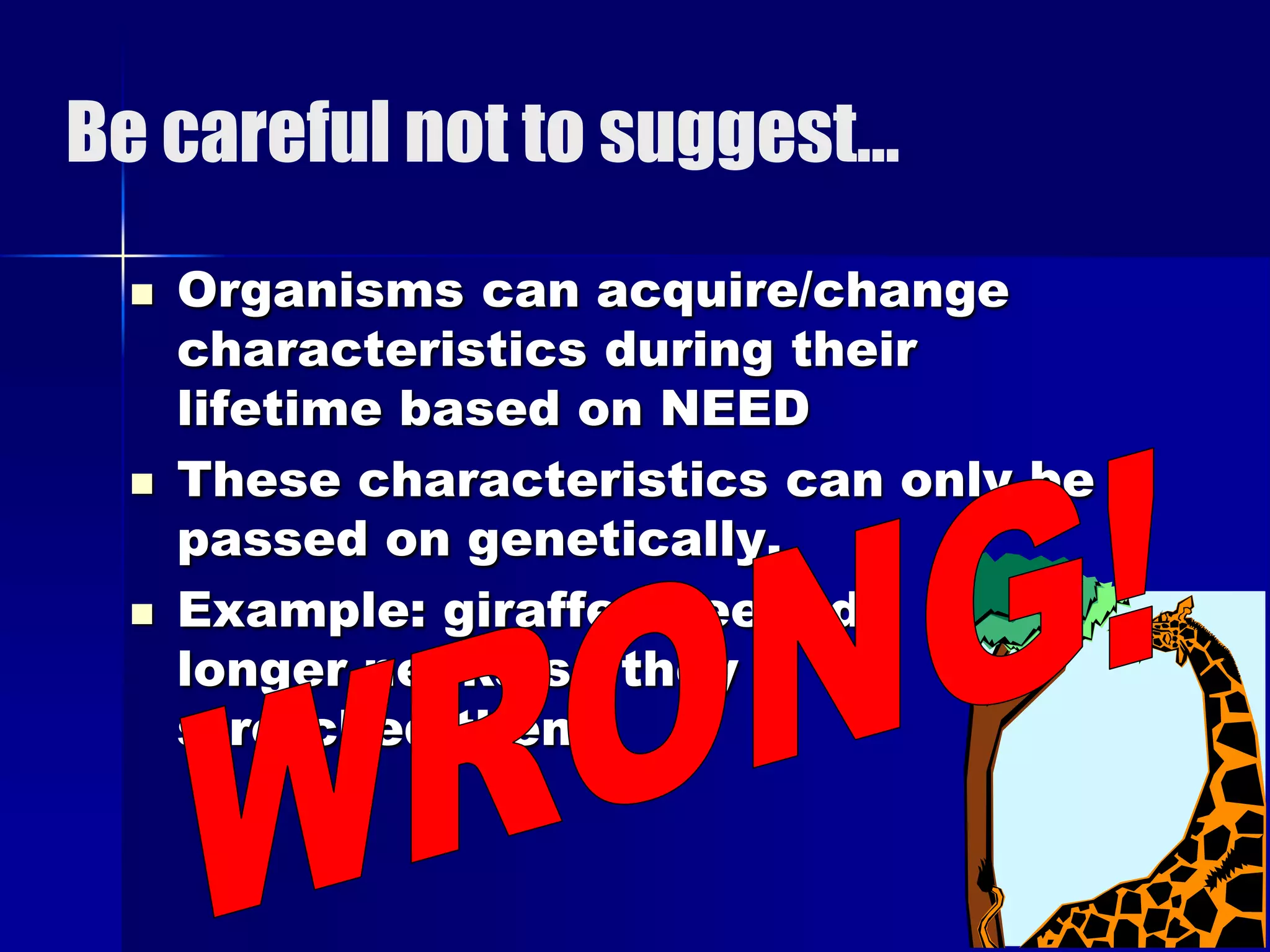
    Example: giraffes needed
     longer necks so they
     stretched them!
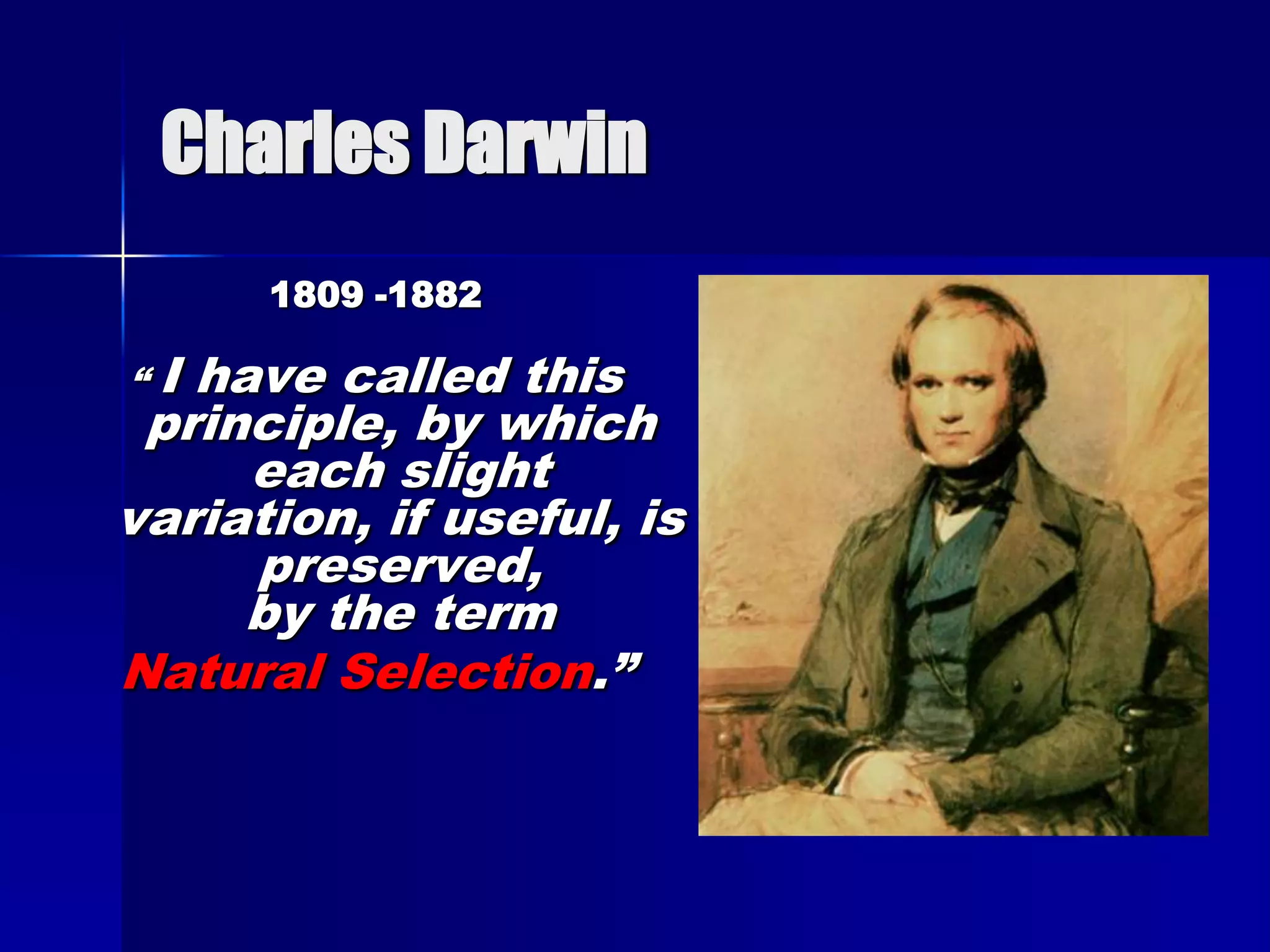
Charles Darwin
       1809 -1882

“I have called this
 principle, by which
     each slight
variation, if useful, is
     preserved,
     by the term
Natural Selection.”
Important Features of Darwin’s


Theory of
Natural Selection:
A Mechanism for
Evolution
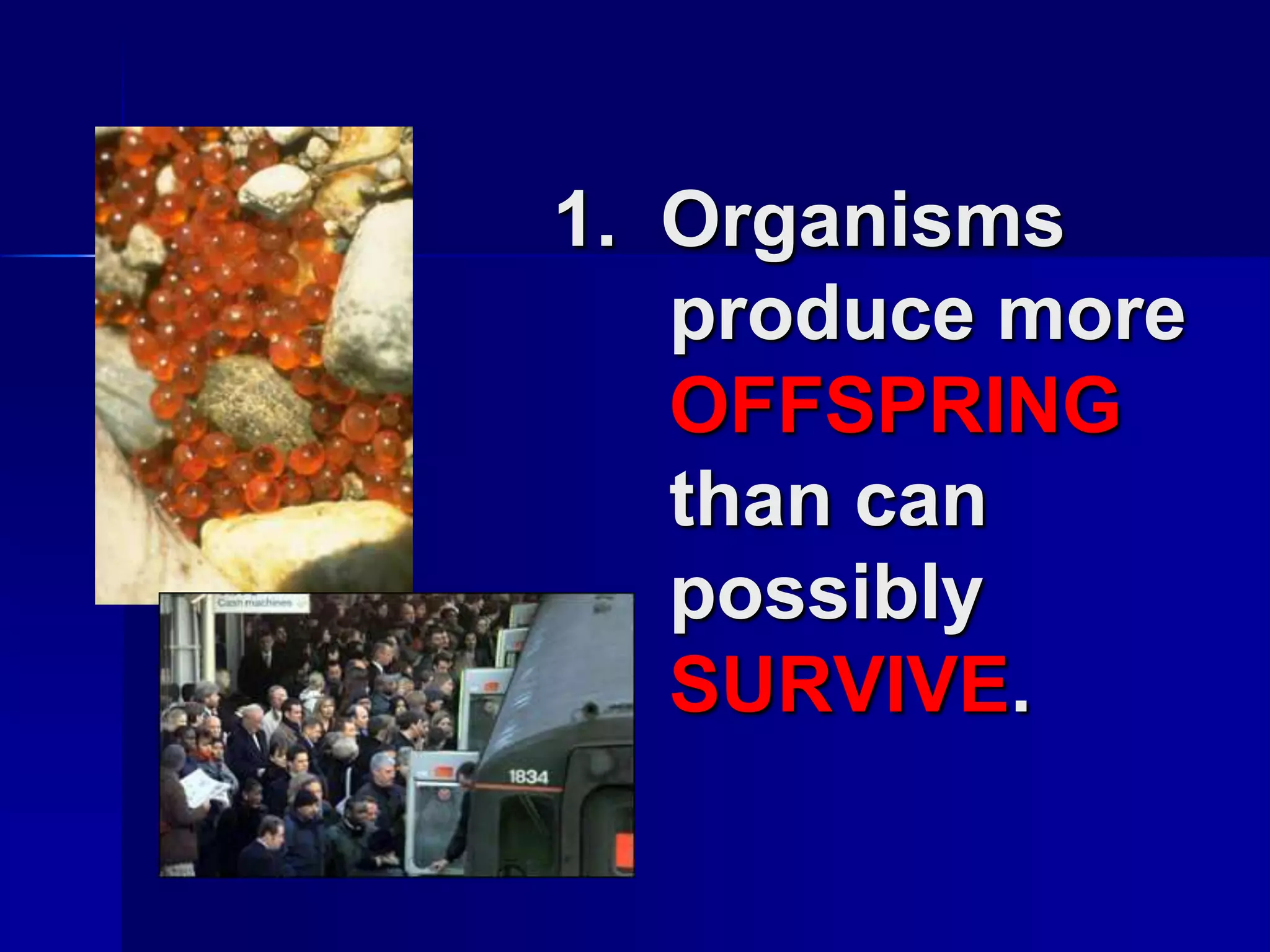
1. Organisms
   produce more
   OFFSPRING
   than can
   possibly
   SURVIVE.
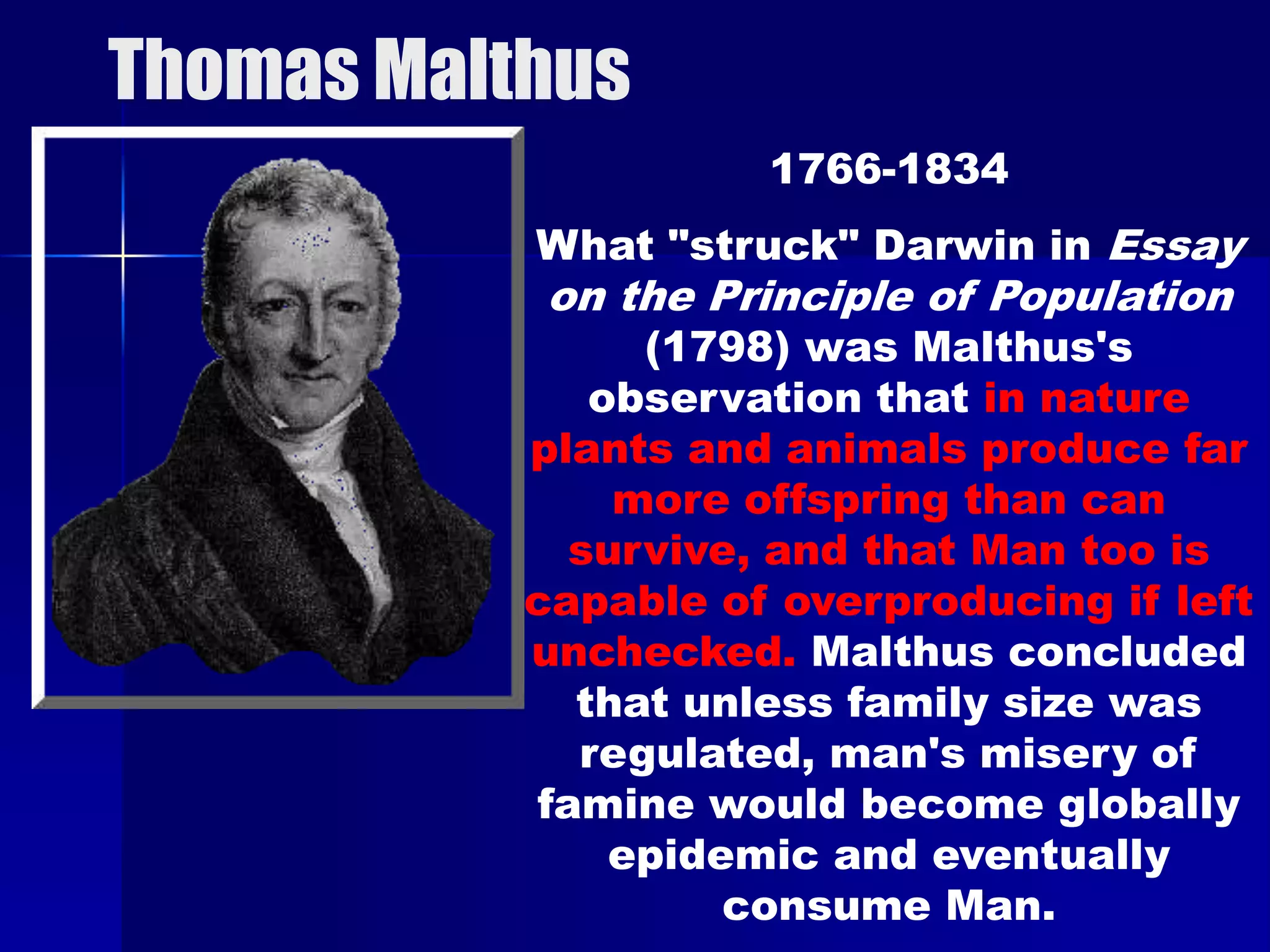
Thomas Malthus
                     1766-1834
           What "struck" Darwin in Essay
           on the Principle of Population
                (1798) was Malthus's
              observation that in nature
           plants and animals produce far
               more offspring than can
             survive, and that Man too is
           capable of overproducing if left
           unchecked. Malthus concluded
             that unless family size was
             regulated, man's misery of
           famine would become globally
               epidemic and eventually
                    consume Man.
REMEMBER…

    Overproduction
        (of Offspring)
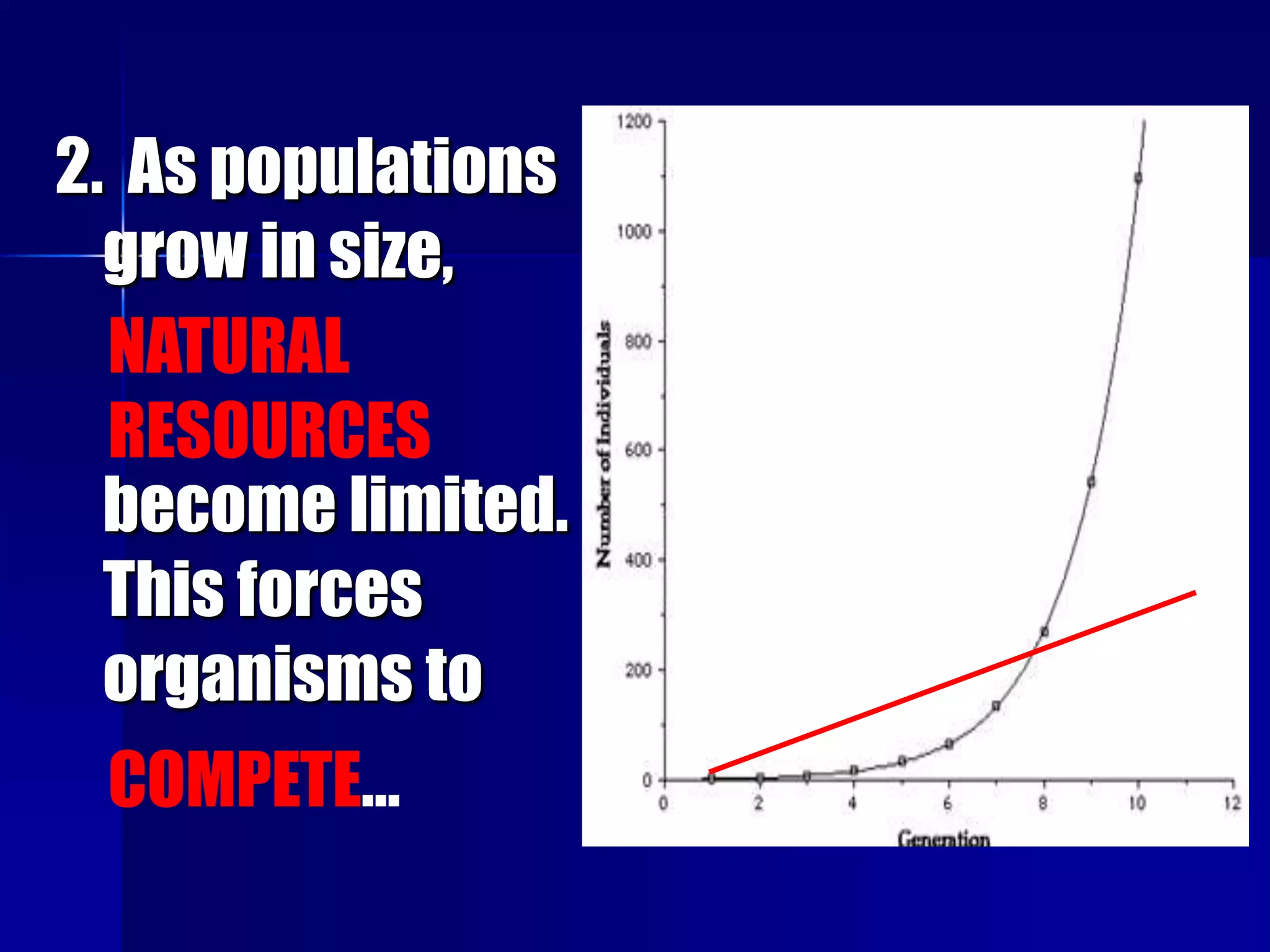
2. As populations
  grow in size,
  NATURAL
  RESOURCES
  become limited.
  This forces
  organisms to
 COMPETE…
What do lions & hyenas
compete for?
   Food
   Water
   Shelter – bear & raise young
   Space – hunt, travel
What else to lions compete
for with other lions?
   Mates
   Do all lions mate?
REMEMBER…

      Competition
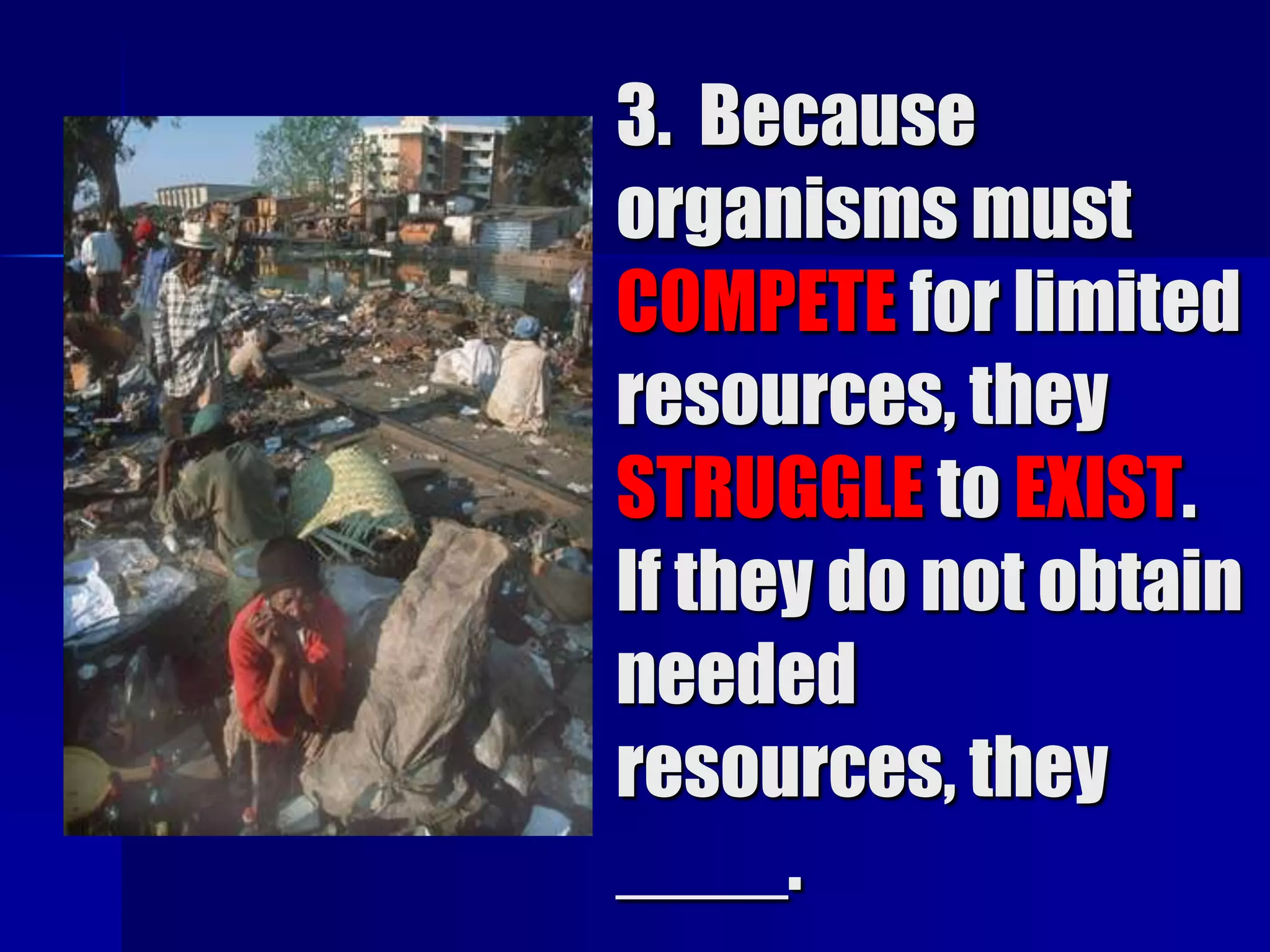
3. Because
organisms must
COMPETE for limited
resources, they
STRUGGLE to EXIST.
If they do not obtain
needed
resources, they
____.
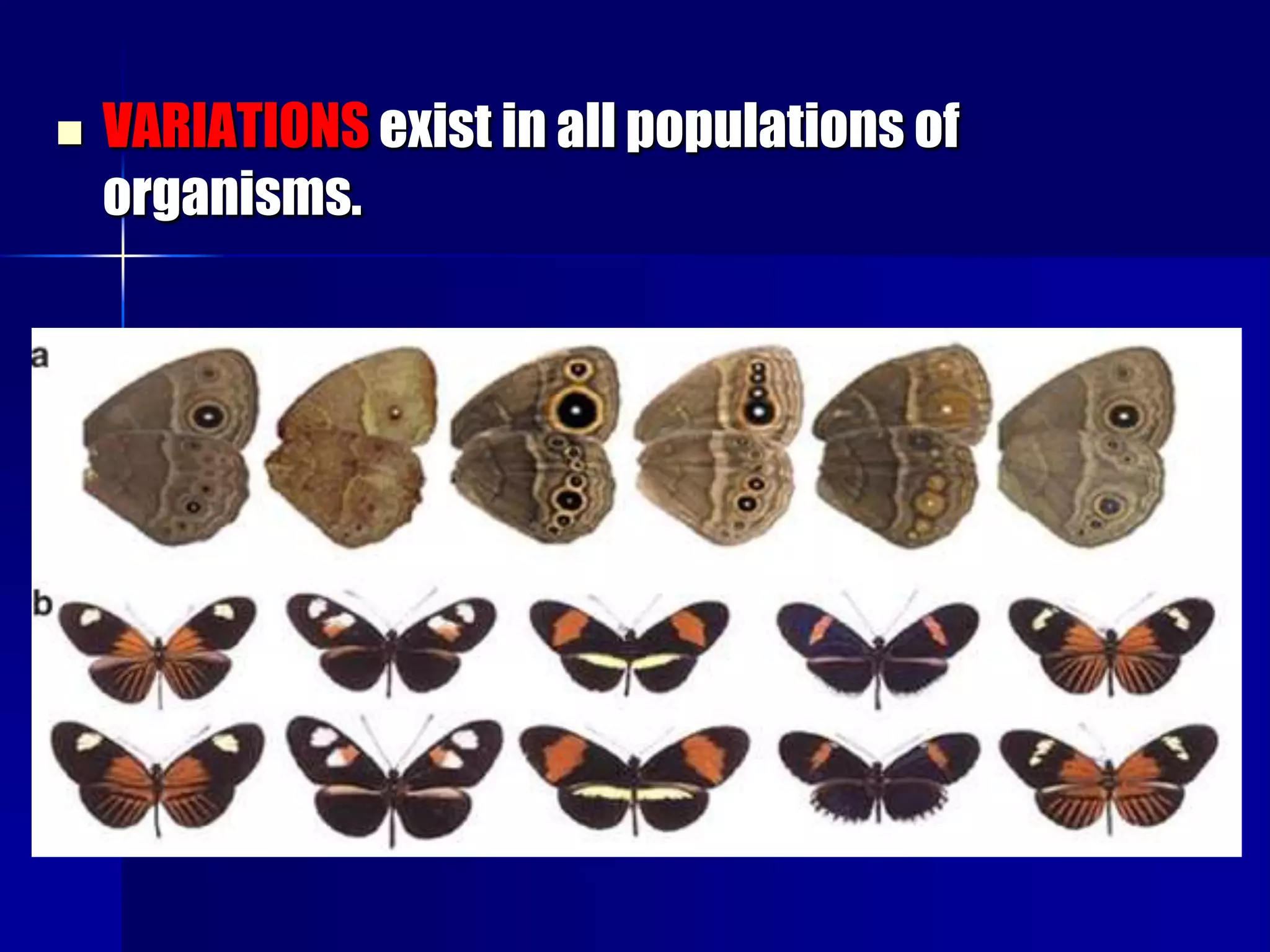
   VARIATIONS exist in all populations of
    organisms.

    The 2 causes of these differences can be
     attributed to:
      – Mutation
      – Meiosis (crossing-over, unique
        combination of chromosomes in
        egg/sperm)
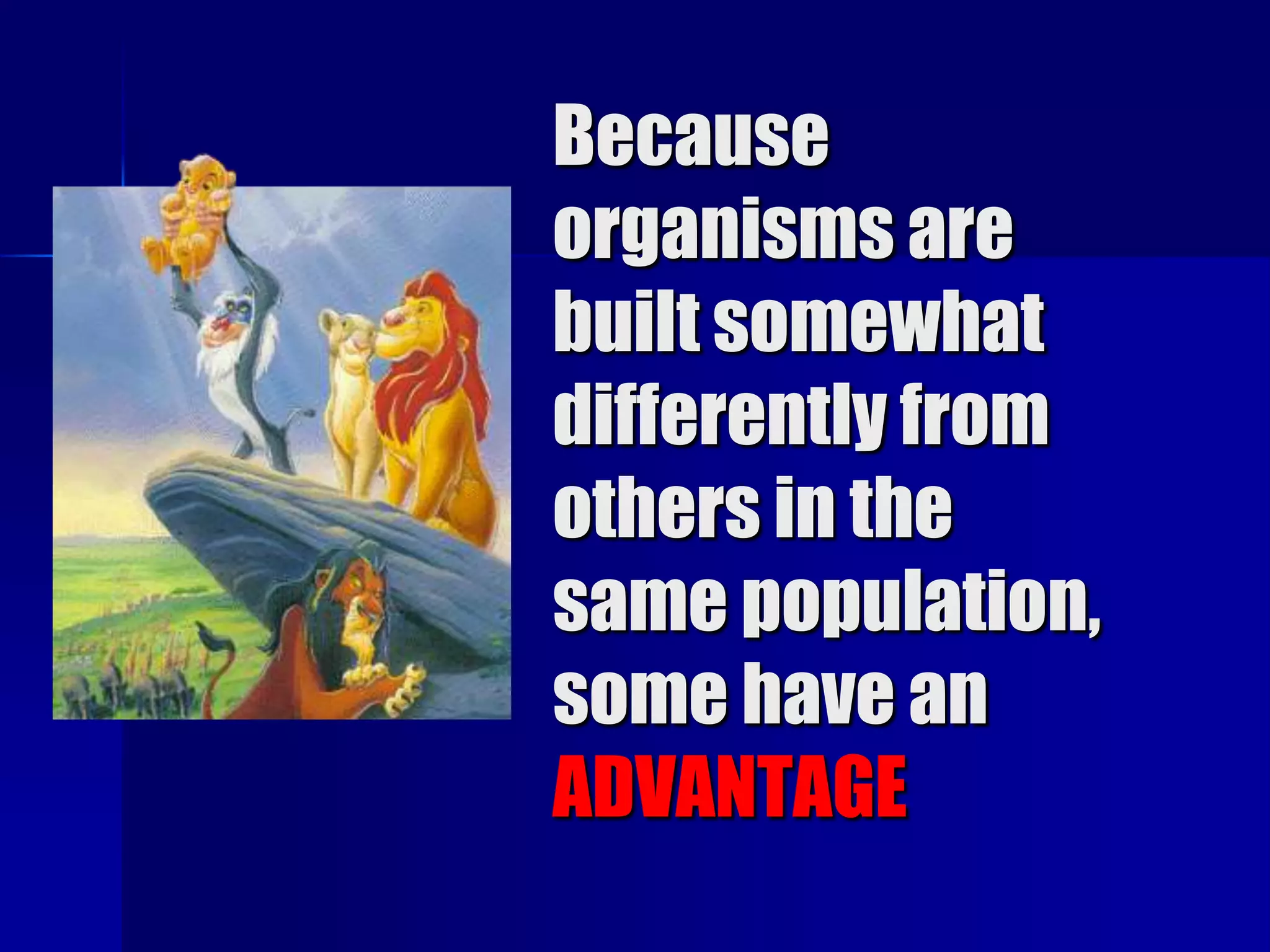
Because
organisms are
built somewhat
differently from
others in the
same population,
some have an
ADVANTAGE
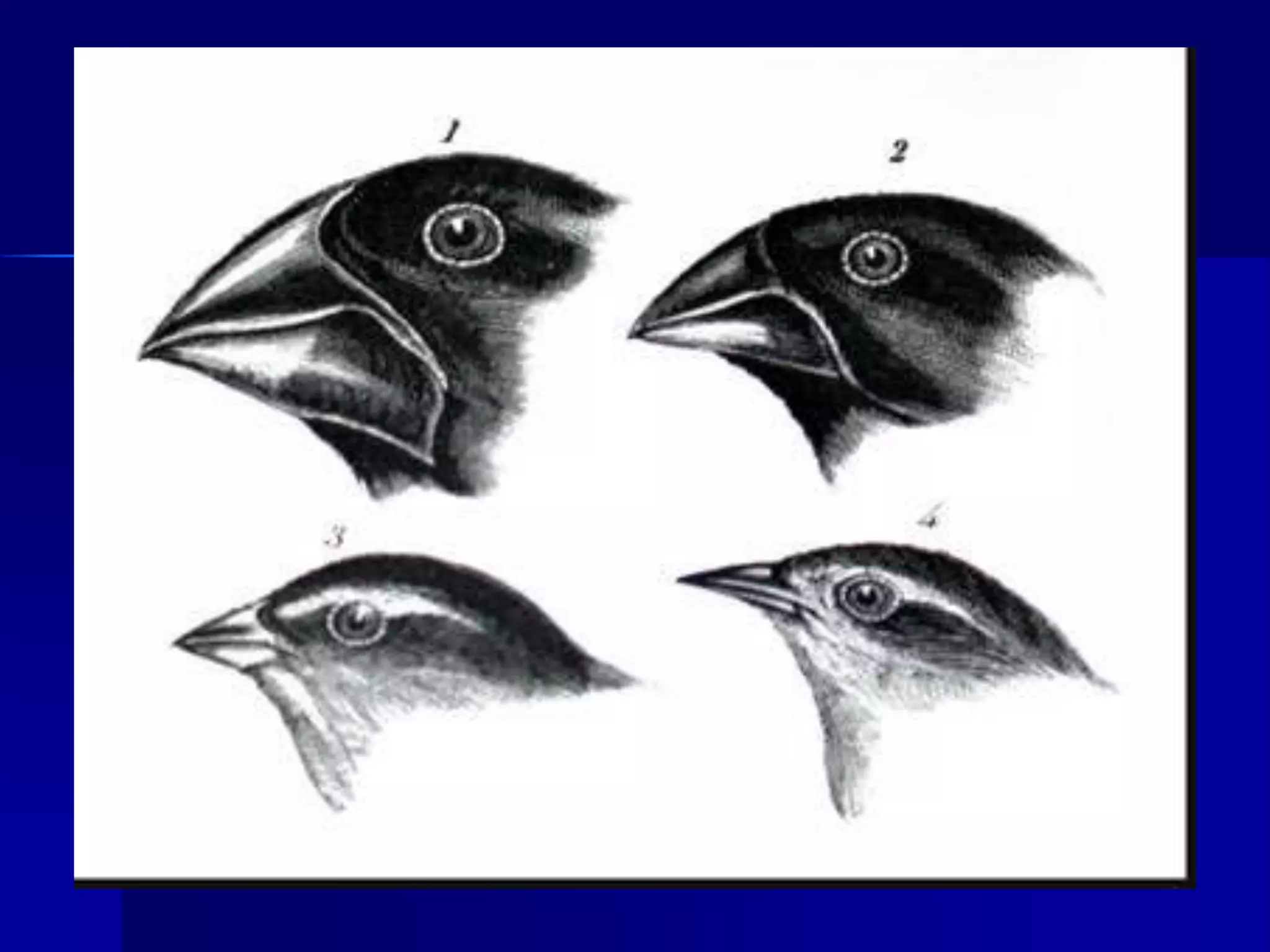
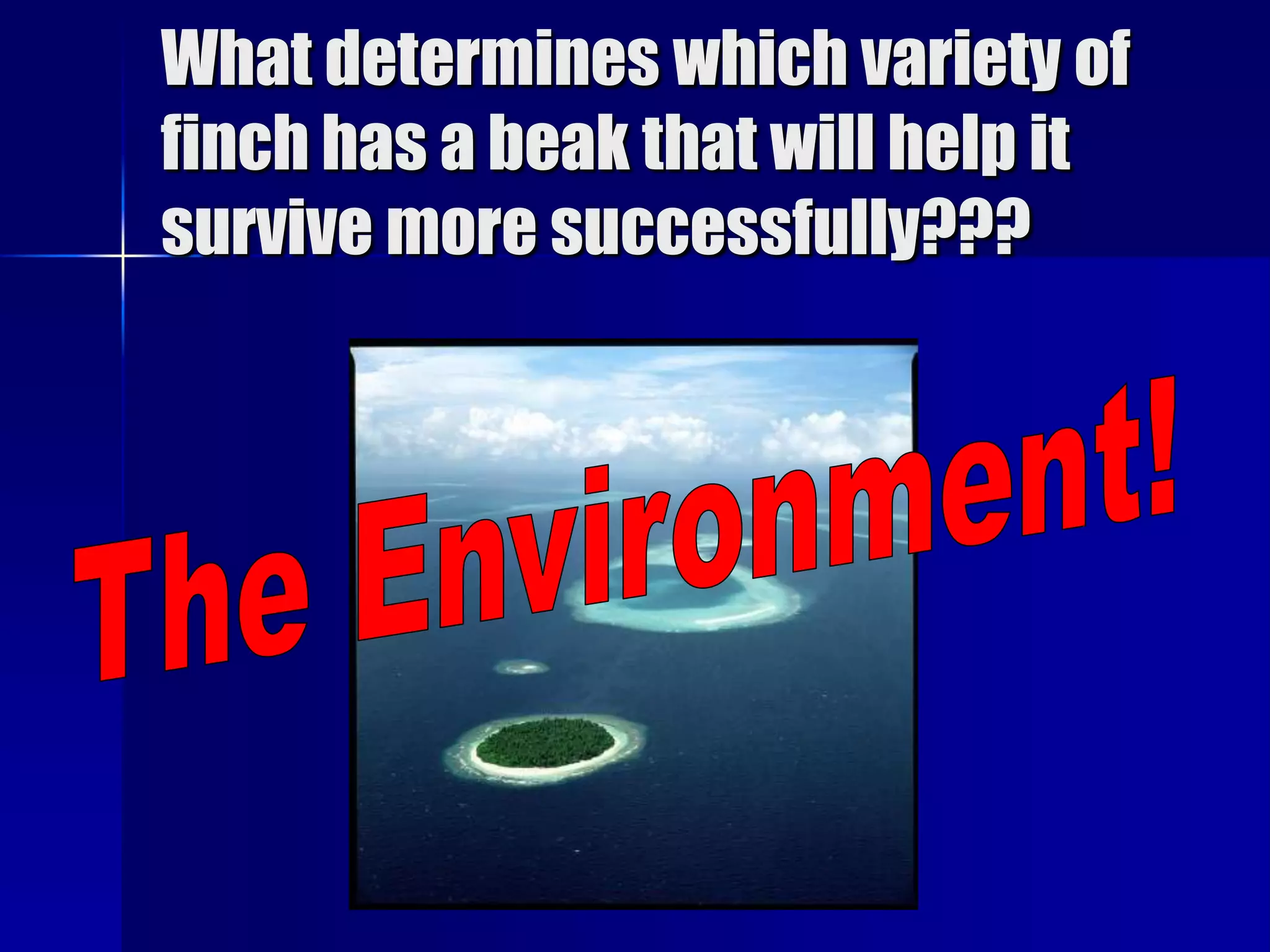
What determines which variety of
finch has a beak that will help it
survive more successfully???
Adaptations make an
organism FIT for the
environment.
 Fitness can be described as
  the ability to survive (out
  compete) and reproduce.
 Why not just survive?
REMEMBER…

        Survival
         Of The
         Fittest
Environment creates
challenges & opportunities
   Selective Pressures are applied to each
    population of organisms making it
    difficult for them to survive.
REMEMBER…

    The environment
        applies a
   Selective pressure
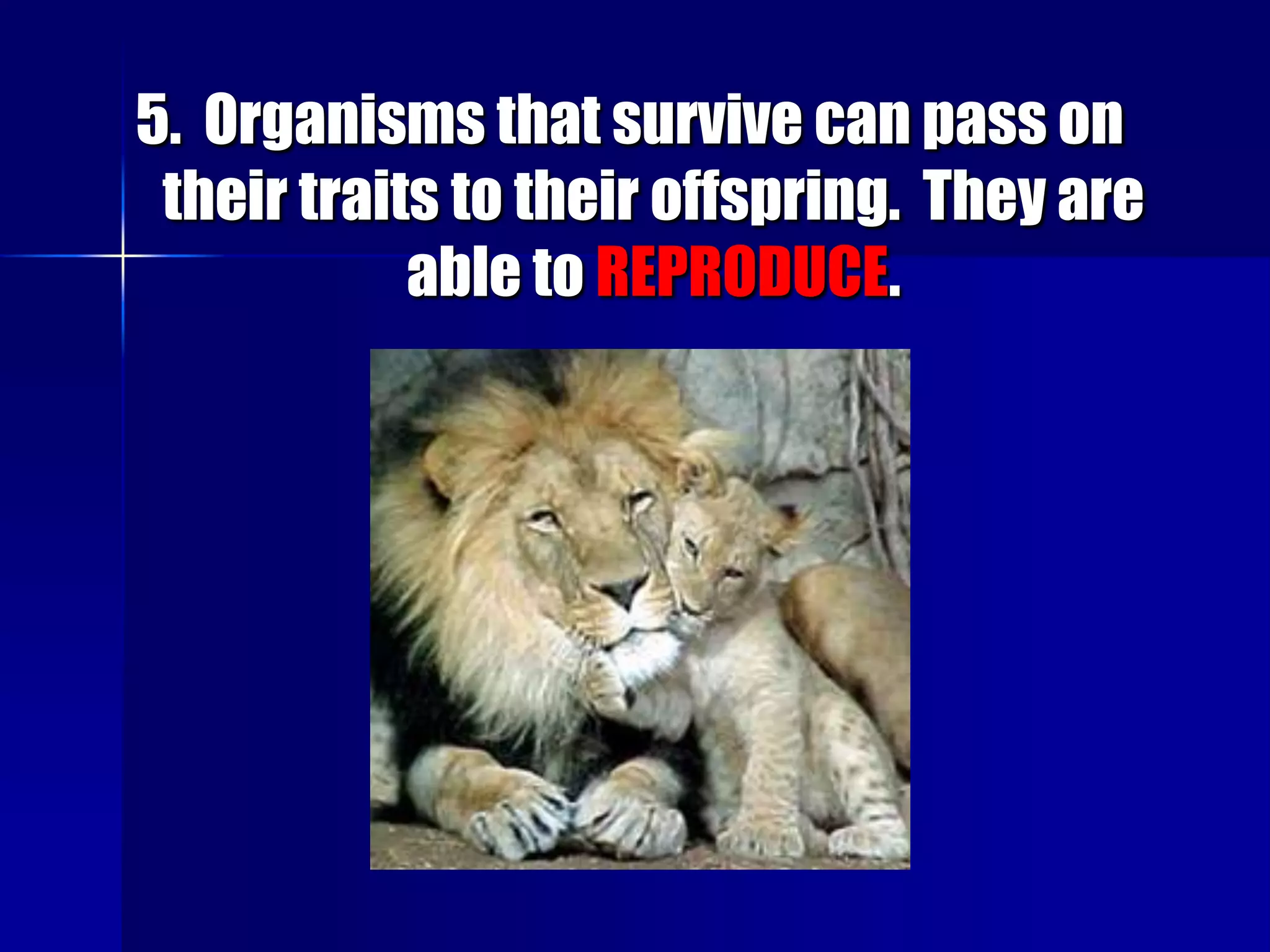
5. Organisms that survive can pass on
 their traits to their offspring. They are
            able to REPRODUCE.
WHY?
Remember:

   Reproductive Advantage
How much change?

   Populations of organisms may change
    but not evolve into a new species.
   Evolution does not mean that new
    species must arise, just that they can
    if enough changes take place.
REMEMBER…

  Darwin referred to this as:

        Descent
          with
       Modification
6. Over time,
hundreds or thousands of
       generations, the
characteristics (VARIATIONS)
 of a population change.
If members of the same species
     can no longer reproduce
    successfully (their offspring can reproduce),
   they are considered to be two
         distinct species.
REMEMBER…

          Speciation -
   Over time, members of a
    species may become SO
  different that they are now 2
        different species
     How does evolution really work?
Overview

1.   Overproduction of offspring
2.   Competition for limited resources
3.   Variations exist which are inherited
     from their parents.
4.   Those more fit for the environment
     have a selective advantage
5.   Reproductive advantage
6.   Population characteristics may change

Natural selection 2-12

  • 1.
    Darwin’s Theory of NaturalSelection: A Mechanism For Evolution
  • 2.
    Be careful notto suggest…  Organisms can acquire/change characteristics during their lifetime based on NEED  These characteristics can only be passed on genetically.  Example: giraffes needed longer necks so they stretched them!
  • 3.
    Charles Darwin 1809 -1882 “I have called this principle, by which each slight variation, if useful, is preserved, by the term Natural Selection.”
  • 4.
    Important Features ofDarwin’s Theory of Natural Selection: A Mechanism for Evolution
  • 5.
    1. Organisms produce more OFFSPRING than can possibly SURVIVE.
  • 6.
    Thomas Malthus 1766-1834 What "struck" Darwin in Essay on the Principle of Population (1798) was Malthus's observation that in nature plants and animals produce far more offspring than can survive, and that Man too is capable of overproducing if left unchecked. Malthus concluded that unless family size was regulated, man's misery of famine would become globally epidemic and eventually consume Man.
  • 7.
    REMEMBER… Overproduction (of Offspring)
  • 8.
    2. As populations grow in size, NATURAL RESOURCES become limited. This forces organisms to COMPETE…
  • 9.
    What do lions& hyenas compete for?  Food  Water  Shelter – bear & raise young  Space – hunt, travel
  • 10.
    What else tolions compete for with other lions?  Mates  Do all lions mate?
  • 11.
    REMEMBER… Competition
  • 12.
    3. Because organisms must COMPETEfor limited resources, they STRUGGLE to EXIST. If they do not obtain needed resources, they ____.
  • 13.
    VARIATIONS exist in all populations of organisms. The 2 causes of these differences can be attributed to: – Mutation – Meiosis (crossing-over, unique combination of chromosomes in egg/sperm)
  • 14.
    Because organisms are built somewhat differentlyfrom others in the same population, some have an ADVANTAGE
  • 16.
    What determines whichvariety of finch has a beak that will help it survive more successfully???
  • 17.
    Adaptations make an organismFIT for the environment.  Fitness can be described as the ability to survive (out compete) and reproduce.  Why not just survive?
  • 18.
    REMEMBER… Survival Of The Fittest
  • 19.
    Environment creates challenges &opportunities  Selective Pressures are applied to each population of organisms making it difficult for them to survive.
  • 20.
    REMEMBER… The environment applies a Selective pressure
  • 21.
    5. Organisms thatsurvive can pass on their traits to their offspring. They are able to REPRODUCE.
  • 22.
  • 23.
    Remember: Reproductive Advantage
  • 24.
    How much change?  Populations of organisms may change but not evolve into a new species.  Evolution does not mean that new species must arise, just that they can if enough changes take place.
  • 25.
    REMEMBER… Darwinreferred to this as: Descent with Modification
  • 26.
    6. Over time, hundredsor thousands of generations, the characteristics (VARIATIONS) of a population change.
  • 27.
    If members ofthe same species can no longer reproduce successfully (their offspring can reproduce), they are considered to be two distinct species.
  • 28.
    REMEMBER… Speciation - Over time, members of a species may become SO different that they are now 2 different species How does evolution really work?
  • 29.
    Overview 1. Overproduction of offspring 2. Competition for limited resources 3. Variations exist which are inherited from their parents. 4. Those more fit for the environment have a selective advantage 5. Reproductive advantage 6. Population characteristics may change