Evolution
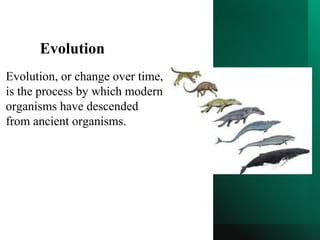
Evolution, or change over time,
is the process by which modern
organisms have descended
from ancient organisms.
What is
Evolution?
Evolution is the change in
inheritable traits in a
population over generations.
Change in traits is caused by
changes in the genes (in DNA)
that code for those traits.
Natural selection tends to
increase favorable traits in a
population and decrease
unfavorable traits.
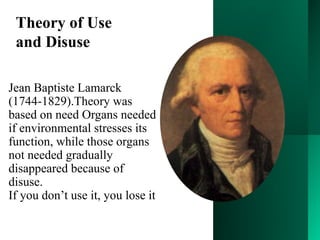
Jean Baptiste Lamarck
(1744-1829).Theory was
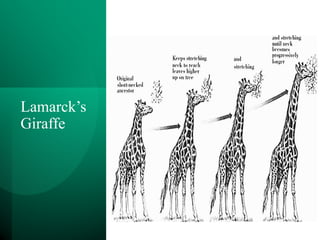
based on need Organs needed
if environmental stresses its
function, while those organs
not needed gradually
disappeared because of
disuse.
If you don’t use it, you lose it
Theory of Use
and Disuse
Lamarck’s
Giraffe
Disproving
Lamarck
Experiments were conducted to
try to prove Lamarck’s ideas, but
none of them were successful
– Female waist (corsets) and
feet
– Tails of mice
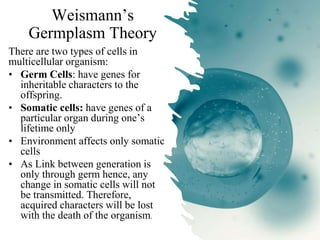
Weismann’s
Germplasm Theory
There are two types of cells in
multicellular organism:
• Germ Cells: have genes for
inheritable characters to the
offspring.
• Somatic cells: have genes of a
particular organ during one’s
lifetime only
• Environment affects only somatic
cells
• As Link between generation is
only through germ hence, any
change in somatic cells will not
be transmitted. Therefore,
acquired characters will be lost
with the death of the organism.
Darwin’s
Theory of
Natural
Selection
occurs in
four steps:
–Overproduction
–Variation
–Competition
–Selection
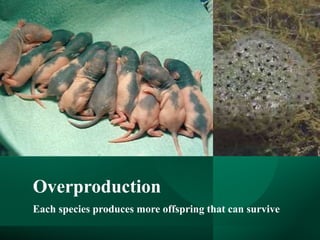
Overproduction
Each species produces more offspring that can survive
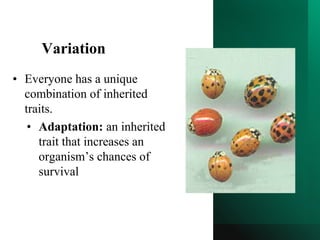
Variation
• Everyone has a unique
combination of inherited
traits.
• Adaptation: an inherited
trait that increases an
organism’s chances of
survival
Why is Variation Important?
Because the environment
changes.
The more variation within a species,
the more likely it will survive
• EX: If everyone is the same, they are
all vulnerable to the same
environmental changes or diseases
The more variation of types of
species in a habitat, the more
likely at least some will survive
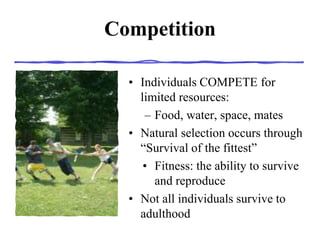
Competition
• Individuals COMPETE for
limited resources:
– Food, water, space, mates
• Natural selection occurs through
“Survival of the fittest”
• Fitness: the ability to survive
and reproduce
• Not all individuals survive to
adulthood
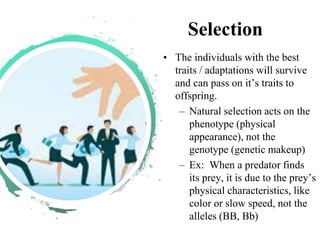
Selection
• The individuals with the best
traits / adaptations will survive
and can pass on it’s traits to
offspring.
– Natural selection acts on the
phenotype (physical
appearance), not the
genotype (genetic makeup)
– Ex: When a predator finds
its prey, it is due to the prey’s
physical characteristics, like
color or slow speed, not the
alleles (BB, Bb)
Natural
Selection is
Survival of
the fittest
• This does not mean that the biggest gets
to live.
• “He who has the BEST trait/adaptation
to survive has the best chance of doing
so.”
• Using Germ-X kills 99% of the bacteria,
it’s the 1% that continues to live on. They
possess a gene that makes them resilient to
Germ-X and that gene is therefore passes
on to the next generation.
• Natural Selection is a mixture of both
Chance and necessity
• Organisms that are best adapted to an
environment survive and reproduce more
than others.
NATURAL SELECTION
IT IS NOT THE
STRONGEST OF
THE SPECIES
THAT SURVIVE
NOR THE MOST
INTELLIGENT
BUT THE MOST
RESPONSIVE
TO CHANGE
THAT SURVIVE
NOBODY!!
• There is no agent involved in natural
selection.
• Natural selection is a process of
elimination.
• Individuals that have traits that are best
adapted for the current environment are the
ones that survive to breed and pass on their
genes to the next generation.
• Organisms not possessing the beneficial
traits either die or don’t have as many
offspring
• Natural Selection is Survival of the fittest
Modern Synthetic Theory
• Natural selection encourages those
genes that assure highest degree of
adaptive efficiency between
population and environment
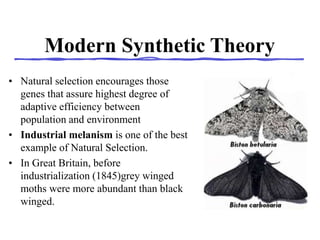
• Industrial melanism is one of the best
example of Natural Selection.
• In Great Britain, before
industrialization (1845)grey winged
moths were more abundant than black
winged.
Mutation
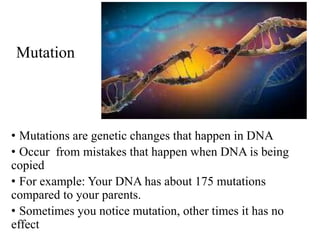
• Mutations are genetic changes that happen in DNA
• Occur from mistakes that happen when DNA is being
copied
• For example: Your DNA has about 175 mutations
compared to your parents.
• Sometimes you notice mutation, other times it has no
effect
Mutations
can be…
• Harmful: Cause diseases or
deformities
• Helpful: organism is better
able to survive
• Neutral: organism is
unaffected
Evolution
occurs
when…
• Individuals with traits that are
not well suited to their
environment either die or
leave few offspring.
• Evolution occurs when good
traits build up in a
population over many
generations and bad traits are
eliminated by the death of the
individuals.
Misconceptions
about Evolution
• Evolution does not tell us about
how life first appeared on Earth
• Individuals do not evolve. Only
populations can evolve.
• Not all changes are “good”
• Changes that happen to a person in
their lifetime do not always get
passed on to their children
• Evolution is not a ladder working
towards a better species

Concepts of Evolution.pptx

  • 1.
    Evolution Evolution, or changeover time, is the process by which modern organisms have descended from ancient organisms.
  • 2.
    What is Evolution? Evolution isthe change in inheritable traits in a population over generations. Change in traits is caused by changes in the genes (in DNA) that code for those traits. Natural selection tends to increase favorable traits in a population and decrease unfavorable traits.
  • 3.
    Jean Baptiste Lamarck (1744-1829).Theorywas based on need Organs needed if environmental stresses its function, while those organs not needed gradually disappeared because of disuse. If you don’t use it, you lose it Theory of Use and Disuse
  • 4.
  • 5.
    Disproving Lamarck Experiments were conductedto try to prove Lamarck’s ideas, but none of them were successful – Female waist (corsets) and feet – Tails of mice
  • 6.
    Weismann’s Germplasm Theory There aretwo types of cells in multicellular organism: • Germ Cells: have genes for inheritable characters to the offspring. • Somatic cells: have genes of a particular organ during one’s lifetime only • Environment affects only somatic cells • As Link between generation is only through germ hence, any change in somatic cells will not be transmitted. Therefore, acquired characters will be lost with the death of the organism.
  • 7.
    Darwin’s Theory of Natural Selection occurs in foursteps: –Overproduction –Variation –Competition –Selection
  • 8.
    Overproduction Each species producesmore offspring that can survive
  • 9.
    Variation • Everyone hasa unique combination of inherited traits. • Adaptation: an inherited trait that increases an organism’s chances of survival
  • 10.
    Why is VariationImportant? Because the environment changes. The more variation within a species, the more likely it will survive • EX: If everyone is the same, they are all vulnerable to the same environmental changes or diseases The more variation of types of species in a habitat, the more likely at least some will survive
  • 11.
    Competition • Individuals COMPETEfor limited resources: – Food, water, space, mates • Natural selection occurs through “Survival of the fittest” • Fitness: the ability to survive and reproduce • Not all individuals survive to adulthood
  • 12.
    Selection • The individualswith the best traits / adaptations will survive and can pass on it’s traits to offspring. – Natural selection acts on the phenotype (physical appearance), not the genotype (genetic makeup) – Ex: When a predator finds its prey, it is due to the prey’s physical characteristics, like color or slow speed, not the alleles (BB, Bb)
  • 13.
    Natural Selection is Survival of thefittest • This does not mean that the biggest gets to live. • “He who has the BEST trait/adaptation to survive has the best chance of doing so.” • Using Germ-X kills 99% of the bacteria, it’s the 1% that continues to live on. They possess a gene that makes them resilient to Germ-X and that gene is therefore passes on to the next generation. • Natural Selection is a mixture of both Chance and necessity • Organisms that are best adapted to an environment survive and reproduce more than others.
  • 14.
    NATURAL SELECTION IT ISNOT THE STRONGEST OF THE SPECIES THAT SURVIVE NOR THE MOST INTELLIGENT BUT THE MOST RESPONSIVE TO CHANGE THAT SURVIVE
  • 15.
    NOBODY!! • There isno agent involved in natural selection. • Natural selection is a process of elimination. • Individuals that have traits that are best adapted for the current environment are the ones that survive to breed and pass on their genes to the next generation. • Organisms not possessing the beneficial traits either die or don’t have as many offspring • Natural Selection is Survival of the fittest
  • 16.
    Modern Synthetic Theory •Natural selection encourages those genes that assure highest degree of adaptive efficiency between population and environment • Industrial melanism is one of the best example of Natural Selection. • In Great Britain, before industrialization (1845)grey winged moths were more abundant than black winged.
  • 17.
    Mutation • Mutations aregenetic changes that happen in DNA • Occur from mistakes that happen when DNA is being copied • For example: Your DNA has about 175 mutations compared to your parents. • Sometimes you notice mutation, other times it has no effect
  • 18.
    Mutations can be… • Harmful:Cause diseases or deformities • Helpful: organism is better able to survive • Neutral: organism is unaffected
  • 19.
    Evolution occurs when… • Individuals withtraits that are not well suited to their environment either die or leave few offspring. • Evolution occurs when good traits build up in a population over many generations and bad traits are eliminated by the death of the individuals.
  • 20.
    Misconceptions about Evolution • Evolutiondoes not tell us about how life first appeared on Earth • Individuals do not evolve. Only populations can evolve. • Not all changes are “good” • Changes that happen to a person in their lifetime do not always get passed on to their children • Evolution is not a ladder working towards a better species