DARWINISM
DARWINISM
Darwinism:
Darwinism is a theory of biological evolution developed by the English
naturalist Charles Darwin (1809–1882) and others, stating that all species
of organisms arise and develop through the natural selection of small,
inherited variations that increase the individual's ability to compete,
survive and reproduce.
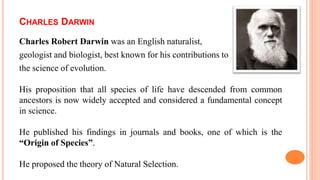
CHARLES DARWIN
Charles Robert Darwin was an English naturalist,
geologist and biologist, best known for his contributions to
the science of evolution.
His proposition that all species of life have descended from common
ancestors is now widely accepted and considered a fundamental concept
in science.
He published his findings in journals and books, one of which is the
“Origin of Species”.
He proposed the theory of Natural Selection.
Theory of natural selection can be briefly summarized in following
observed facts:
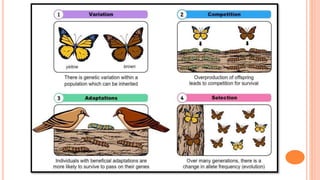
1. Over production or Enormous fertility:
Overproduction by definition, in biology, means that each generation has
more offspring than can be supported by the environment. Because of this,
competition takes place for limited resources. Individuals have traits that are
passed down to offspring.
If all the off springs of any species remain alive and reproduce they would
soon over crowde the earth and would destroy all other species. Because of
environmental checks , the no. of progeny is kept within the reasonable
limit.
2. Struggle for Existence:
According to Darwin there is an ever lasting competition between
the individuals; intraspecific or interspecific or evironmental struggle for
existence.
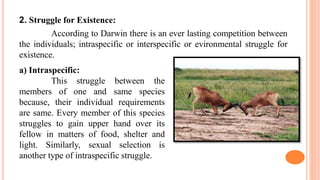
a) Intraspecific:
This struggle between the
members of one and same species
because, their individual requirements
are same. Every member of this species
struggles to gain upper hand over its
fellow in matters of food, shelter and
light. Similarly, sexual selection is
another type of intraspecific struggle.
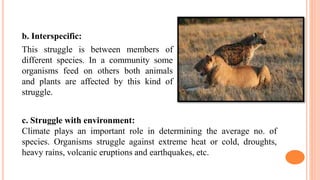
b. Interspecific:
This struggle is between members of
different species. In a community some
organisms feed on others both animals
and plants are affected by this kind of
struggle.
c. Struggle with environment:
Climate plays an important role in determining the average no. of
species. Organisms struggle against extreme heat or cold, droughts,
heavy rains, volcanic eruptions and earthquakes, etc.
3. Variation and Heredity:
Organisms (within populations) exhibit individual variation in appearance
and behavior.
The competition among the organisms has compelled them to change
according to the conditions so that they can utilize the natural resources
and can survive.
Because of this tendency, some are better fitted than others to survive this
struggle for existence.
These variations which had proved to be of survival value will tend to be
passed onto next generation so that progeny is more suited to survive.
4. Survival of the Fittest:
Darwin concluded that certain variations are transmitted to next generations
to help in struggle for existence.
Those animals who tends to vary have favourable and better chanches of
survival can put their offspring in next population.
Hence fitness depends upon the adaptation of species to the particular
environment.
This idea of “Survival of the Fittest” is the core of the theory of natural
selection.
5. Natural Selection and Origin of New Species:
Natural selection is the process through which populations of living
organisms adapt and change.
The evolutionary change comes through the production of variation in each
generation and differential survival of individuals with different
combinations of these variable characters.
Those individuals with heritable traits better suited to the environment will
survive.
When reproductive isolation occurs new species forms.
Objections to Darwinism:
1. Darwinism does not explain the effect of use and disuse and the presence
of vestigial organs.
2. It does not explain the origin of variations.
3. Darwinism explains the survival of the fittest but not the arrival of the
fittest.
4. Darwin indirectly accepted the Lamarckian idea of inheritance of
acquired characters in the form of pangenesis hypothesis, which cannot be
accepted in the light of knowledge of genetics today.
Thank
You!

Darwinism.pptx

  • 1.
  • 2.
    DARWINISM Darwinism: Darwinism is atheory of biological evolution developed by the English naturalist Charles Darwin (1809–1882) and others, stating that all species of organisms arise and develop through the natural selection of small, inherited variations that increase the individual's ability to compete, survive and reproduce.
  • 3.
    CHARLES DARWIN Charles RobertDarwin was an English naturalist, geologist and biologist, best known for his contributions to the science of evolution. His proposition that all species of life have descended from common ancestors is now widely accepted and considered a fundamental concept in science. He published his findings in journals and books, one of which is the “Origin of Species”. He proposed the theory of Natural Selection.
  • 4.
    Theory of naturalselection can be briefly summarized in following observed facts: 1. Over production or Enormous fertility: Overproduction by definition, in biology, means that each generation has more offspring than can be supported by the environment. Because of this, competition takes place for limited resources. Individuals have traits that are passed down to offspring. If all the off springs of any species remain alive and reproduce they would soon over crowde the earth and would destroy all other species. Because of environmental checks , the no. of progeny is kept within the reasonable limit.
  • 5.
    2. Struggle forExistence: According to Darwin there is an ever lasting competition between the individuals; intraspecific or interspecific or evironmental struggle for existence. a) Intraspecific: This struggle between the members of one and same species because, their individual requirements are same. Every member of this species struggles to gain upper hand over its fellow in matters of food, shelter and light. Similarly, sexual selection is another type of intraspecific struggle.
  • 6.
    b. Interspecific: This struggleis between members of different species. In a community some organisms feed on others both animals and plants are affected by this kind of struggle. c. Struggle with environment: Climate plays an important role in determining the average no. of species. Organisms struggle against extreme heat or cold, droughts, heavy rains, volcanic eruptions and earthquakes, etc.
  • 7.
    3. Variation andHeredity: Organisms (within populations) exhibit individual variation in appearance and behavior. The competition among the organisms has compelled them to change according to the conditions so that they can utilize the natural resources and can survive. Because of this tendency, some are better fitted than others to survive this struggle for existence. These variations which had proved to be of survival value will tend to be passed onto next generation so that progeny is more suited to survive.
  • 8.
    4. Survival ofthe Fittest: Darwin concluded that certain variations are transmitted to next generations to help in struggle for existence. Those animals who tends to vary have favourable and better chanches of survival can put their offspring in next population. Hence fitness depends upon the adaptation of species to the particular environment. This idea of “Survival of the Fittest” is the core of the theory of natural selection.
  • 9.
    5. Natural Selectionand Origin of New Species: Natural selection is the process through which populations of living organisms adapt and change. The evolutionary change comes through the production of variation in each generation and differential survival of individuals with different combinations of these variable characters. Those individuals with heritable traits better suited to the environment will survive. When reproductive isolation occurs new species forms.
  • 11.
    Objections to Darwinism: 1.Darwinism does not explain the effect of use and disuse and the presence of vestigial organs. 2. It does not explain the origin of variations. 3. Darwinism explains the survival of the fittest but not the arrival of the fittest. 4. Darwin indirectly accepted the Lamarckian idea of inheritance of acquired characters in the form of pangenesis hypothesis, which cannot be accepted in the light of knowledge of genetics today.
  • 12.