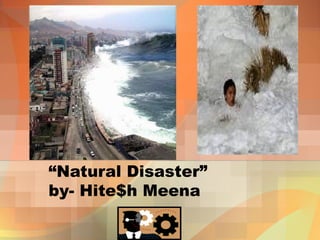
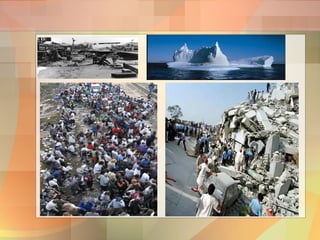
“Natural Disaster”
by- Hite$h Meena
What’s the Situation?
A disaster is any natural event that overwhelms a community,
district or country’s ability to respond. There are natural
catastrophes; events caused by natural forces and man-made
disasters events arising in conjunction with human activities:
- Natural: hurricanes, cyclones, earthquakes, tornados, floods,
tsunamis, droughts, volcano eruptions etc.
- Man-made: nuclear accident, chemical spill, conflicts, major fires
etc.
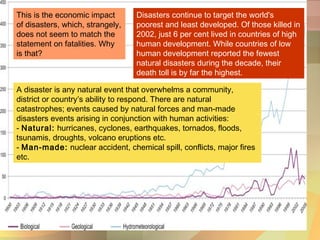
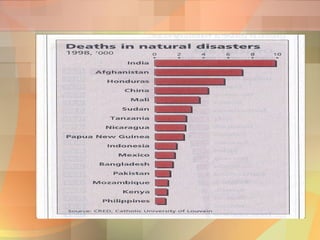
Disasters continue to target the world's
poorest and least developed. Of those killed in
2002, just 6 per cent lived in countries of high
human development. While countries of low
human development reported the fewest
natural disasters during the decade, their
death toll is by far the highest.
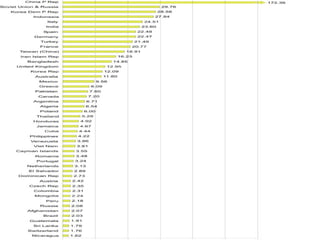
This is the economic impact
of disasters, which, strangely,
does not seem to match the
statement on fatalities. Why
is that?
Some statistical
considerations
• Are there more disasters, or do we
record them better? A consequence of
the “Information Age.”
• There are, of course, far more people
around now than there were in the
past, so there are more people to be
caught up in a disaster.
• Is the natural phenomenon getting
“worse” or is the environment’s
capacity to absorb shock being
undermined?
Is there a trend?
• Key statistics from the World Disasters Report
• From 1999 to 2003, reported disasters averaged 707 disasters each
year, up two-thirds from the previous five years. In countries of low
human development, the increase was 142 percent.
• For the last five years, an average of 303 million people were affected
by disasters, constituting a rise of more than 40 percent from a decade
ago.
• Weather-related and geophysical disasters are more frequent, by
about 60 percent, now than ten years ago.
• The death toll from disasters has actually been on the decline, with
2003 being a marked exception.
• Over half of all deaths in natural disasters are due to drought and
famine. Since 1994, they have claimed 275,000 lives.
• Drought and famine claim in excess of 1,000 lives per reported event,
compared to 370 per earthquake and 300 per extreme temperature
event.
• Heat waves kill more people in the United States than hurricanes,
tornadoes, earthquakes and floods combined.
A Great “Natural Disaster?”
• This raises the question: “What is a
Natural Disaster?”
• There are two words to consider here:
Natural and Disaster
• Something Natural implies that the
cause is Nature (An Act of God), and
in the West, we have never
considered ourselves part of Nature
(that’s why God gets the blame).
• A Disaster is something that has a serious
impact on the lives and livelihood of a lot of
people. (Flood, Drought, Earthquake)
How Natural?
• Our first response is to say that the Tsunami
was totally beyond human influence and
control—but was it?
• If global warming, which may be caused by
human activity (CO2), exists, then it could
cause the sea to expand, and that change of
weight could have caused the landslide???
• However, tsunamis and volcanoes are
almost totally natural in cause. Their
“disastrous” effect, however, has more to do
with man than Nature.
“Natural”
• In some way, the forces of Nature act
to threaten the lives and economies of
people by disrupting the “normal”
pattern of life.
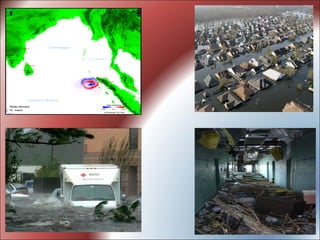
• Perhaps one of the most Natural
recent disasters was the December
26, 2004 Tsunami that killed over
250,000 people.
• What caused this?
The Tsunami
• There was a shift in the great
continental plates under the ocean off
the coast of Aceh, Indonesia.
• As a result, there was a huge
landslide under the sea displacing
billions of tons of water very
suddenly.
• This water moved at >500 k.p.h. as a
submarine force wave.
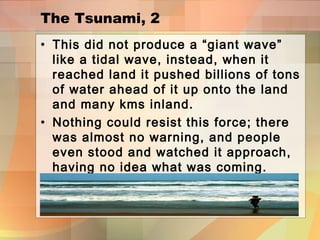
The Tsunami, 2
• This did not produce a “giant wave”
like a tidal wave, instead, when it
reached land it pushed billions of tons
of water ahead of it up onto the land
and many kms inland.
• Nothing could resist this force; there
was almost no warning, and people
even stood and watched it approach,
having no idea what was coming.
How Disastrous?
• The casualty numbers could be
influenced by: people living in
dangerous coastal areas; lack of
scientific warning; lack of emergency
procedures.
• The question is “How vulnerable, or
exposed are the people to the forces
of Nature.”
• The same size earthquake in Armenia
or the US, caused 29,000 deaths in
one case and 26 deaths in the other.
Why?
Part 2: What has any of this got to
do with the course?
• Excellent question
• First global climate change will
produce more extreme events,
because that is how Nature gets rid of
the extra energy trapped by Global
Warming.
• People in the tropics lack capital to
protect themselves, are isolated from
warnings, are very vulnerable when
the calamity strikes.
• So, the same Natural Calamity can
have very different effects.
How does this play out?
• If you attribute the disaster to some
“purely natural cause,” or the Hand of
God, then you conveniently separate
yourself from any responsibility.
• Second problem is to prove causality
—think of the discussions about
Global Warming.
• The question for the Tropics is “To
what extent does poverty create
vulnerability to Natural events?” For
others, the Q might be “To what
extent do the consequences of wealth
enhance the risk of Natural risk?”
One Consequence of defining the
problem
• If you define the problem as a
“Natural Disaster” then the emphasis
will be on “relief.”
• That does nothing to prevent the same
disaster happening the next time, or
worse.
• Relief addresses consequences, not
causes.
• Disasters may be alarm signals of a
much deeper process.
Key Concepts
• Vulnerability to risk—and that is not
just where you are
• The timely use of information
• The in-place availability of disaster-
management infrastructure
• Having more than words to deal with
the situation. The US had everybody
and everything it needed, but it fell
apart. Why?
• Do we learn from these experiences?
How?
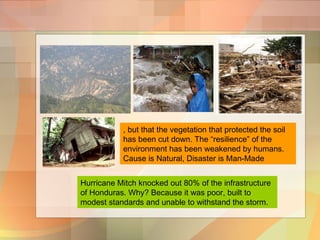
, but that the vegetation that protected the soil
has been cut down. The “resilience” of the
environment has been weakened by humans.
Cause is Natural, Disaster is Man-Made
Hurricane Mitch knocked out 80% of the infrastructure
of Honduras. Why? Because it was poor, built to
modest standards and unable to withstand the storm.
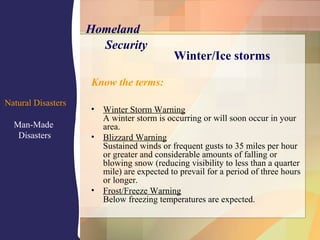
Know the terms:
• Winter Storm Warning
A winter storm is occurring or will soon occur in your
area.
• Blizzard Warning
Sustained winds or frequent gusts to 35 miles per hour
or greater and considerable amounts of falling or
blowing snow (reducing visibility to less than a quarter
mile) are expected to prevail for a period of three hours
or longer.
• Frost/Freeze Warning
Below freezing temperatures are expected.
Winter/Ice storms
Natural Disasters
Man-Made
Disasters
Homeland
Security
Natural disaster
Natural disaster
Natural disaster

Natural disaster

  • 1.
  • 2.
    What’s the Situation? Adisaster is any natural event that overwhelms a community, district or country’s ability to respond. There are natural catastrophes; events caused by natural forces and man-made disasters events arising in conjunction with human activities: - Natural: hurricanes, cyclones, earthquakes, tornados, floods, tsunamis, droughts, volcano eruptions etc. - Man-made: nuclear accident, chemical spill, conflicts, major fires etc. Disasters continue to target the world's poorest and least developed. Of those killed in 2002, just 6 per cent lived in countries of high human development. While countries of low human development reported the fewest natural disasters during the decade, their death toll is by far the highest. This is the economic impact of disasters, which, strangely, does not seem to match the statement on fatalities. Why is that?
  • 3.
    Some statistical considerations • Arethere more disasters, or do we record them better? A consequence of the “Information Age.” • There are, of course, far more people around now than there were in the past, so there are more people to be caught up in a disaster. • Is the natural phenomenon getting “worse” or is the environment’s capacity to absorb shock being undermined?
  • 4.
    Is there atrend? • Key statistics from the World Disasters Report • From 1999 to 2003, reported disasters averaged 707 disasters each year, up two-thirds from the previous five years. In countries of low human development, the increase was 142 percent. • For the last five years, an average of 303 million people were affected by disasters, constituting a rise of more than 40 percent from a decade ago. • Weather-related and geophysical disasters are more frequent, by about 60 percent, now than ten years ago. • The death toll from disasters has actually been on the decline, with 2003 being a marked exception. • Over half of all deaths in natural disasters are due to drought and famine. Since 1994, they have claimed 275,000 lives. • Drought and famine claim in excess of 1,000 lives per reported event, compared to 370 per earthquake and 300 per extreme temperature event. • Heat waves kill more people in the United States than hurricanes, tornadoes, earthquakes and floods combined.
  • 5.
    A Great “NaturalDisaster?” • This raises the question: “What is a Natural Disaster?” • There are two words to consider here: Natural and Disaster • Something Natural implies that the cause is Nature (An Act of God), and in the West, we have never considered ourselves part of Nature (that’s why God gets the blame). • A Disaster is something that has a serious impact on the lives and livelihood of a lot of people. (Flood, Drought, Earthquake)
  • 6.
    How Natural? • Ourfirst response is to say that the Tsunami was totally beyond human influence and control—but was it? • If global warming, which may be caused by human activity (CO2), exists, then it could cause the sea to expand, and that change of weight could have caused the landslide??? • However, tsunamis and volcanoes are almost totally natural in cause. Their “disastrous” effect, however, has more to do with man than Nature.
  • 8.
    “Natural” • In someway, the forces of Nature act to threaten the lives and economies of people by disrupting the “normal” pattern of life. • Perhaps one of the most Natural recent disasters was the December 26, 2004 Tsunami that killed over 250,000 people. • What caused this?
  • 9.
    The Tsunami • Therewas a shift in the great continental plates under the ocean off the coast of Aceh, Indonesia. • As a result, there was a huge landslide under the sea displacing billions of tons of water very suddenly. • This water moved at >500 k.p.h. as a submarine force wave.
  • 10.
    The Tsunami, 2 •This did not produce a “giant wave” like a tidal wave, instead, when it reached land it pushed billions of tons of water ahead of it up onto the land and many kms inland. • Nothing could resist this force; there was almost no warning, and people even stood and watched it approach, having no idea what was coming.
  • 11.
    How Disastrous? • Thecasualty numbers could be influenced by: people living in dangerous coastal areas; lack of scientific warning; lack of emergency procedures. • The question is “How vulnerable, or exposed are the people to the forces of Nature.” • The same size earthquake in Armenia or the US, caused 29,000 deaths in one case and 26 deaths in the other. Why?
  • 12.
    Part 2: Whathas any of this got to do with the course? • Excellent question • First global climate change will produce more extreme events, because that is how Nature gets rid of the extra energy trapped by Global Warming. • People in the tropics lack capital to protect themselves, are isolated from warnings, are very vulnerable when the calamity strikes. • So, the same Natural Calamity can have very different effects.
  • 13.
    How does thisplay out? • If you attribute the disaster to some “purely natural cause,” or the Hand of God, then you conveniently separate yourself from any responsibility. • Second problem is to prove causality —think of the discussions about Global Warming. • The question for the Tropics is “To what extent does poverty create vulnerability to Natural events?” For others, the Q might be “To what extent do the consequences of wealth enhance the risk of Natural risk?”
  • 14.
    One Consequence ofdefining the problem • If you define the problem as a “Natural Disaster” then the emphasis will be on “relief.” • That does nothing to prevent the same disaster happening the next time, or worse. • Relief addresses consequences, not causes. • Disasters may be alarm signals of a much deeper process.
  • 15.
    Key Concepts • Vulnerabilityto risk—and that is not just where you are • The timely use of information • The in-place availability of disaster- management infrastructure • Having more than words to deal with the situation. The US had everybody and everything it needed, but it fell apart. Why? • Do we learn from these experiences? How?
  • 17.
    , but thatthe vegetation that protected the soil has been cut down. The “resilience” of the environment has been weakened by humans. Cause is Natural, Disaster is Man-Made Hurricane Mitch knocked out 80% of the infrastructure of Honduras. Why? Because it was poor, built to modest standards and unable to withstand the storm.
  • 19.
    Know the terms: •Winter Storm Warning A winter storm is occurring or will soon occur in your area. • Blizzard Warning Sustained winds or frequent gusts to 35 miles per hour or greater and considerable amounts of falling or blowing snow (reducing visibility to less than a quarter mile) are expected to prevail for a period of three hours or longer. • Frost/Freeze Warning Below freezing temperatures are expected. Winter/Ice storms Natural Disasters Man-Made Disasters Homeland Security