Meaning & Conceptof Disaster
• The word disaster is derived from French word
desastre, which means badaster or badstar in
Greek.
• The roots of the word disaster came from the
astrological theme where they called
destruction of a star as a disaster.
• It was believed an action due to unfavorable
position of planets or the act of God
3.
Definitions of Disaster
•According to World Health Organization
(WHO), "A disaster can be defined as any
occurrence that causes damage, ecological
disruption, loss of human life or deterioration
of health and health services on a scale
extr
a
the
ordinary
affecte
d
sufficient to warrant an
response from outside
community or area."
4.
Definitions of Disaster
•According to American Red Cross (ARC), "A
disaster can be defined as an occurrence
either nature or manmade that causes human
suffering and creates human needs that
victims cannot alleviate without assistance“
• The Oxford English Dictionary defines disaster
as "anything that befalls of ruinous or
distressing nature;
mishap,
a sudden or
great or
misadventure; a
misfortune
, calamity"
5.
Definitions of Disaster
•The Disaster Management Act, 2005 defines
disaster as "a catastrophe, mishap, calamity or
grave occurrence in any area, arising from natural
or manmade causes, or by accident or negligence
which results in substantial loss of life or human
suffering or damage to, and destruction of,
property, or damage to, or degradation of,
environment, and is of such a nature or
magnitude as to be beyond the coping capacity of
the community of the affected area"
6.
Definitions of Disaster
•The United Nations defines disaster as "the
occurrence of sudden or major misfortune
which disrupts the basic fabric and normal
functioning of the society or community“
• A sudden event that causes large scale
damage to life, property & social aspects of a
nation or society is called as disaster.
7.
Definitions of Disaster
•Thus, these definitions emphasize
several features of disasters such as:
– They usually occur suddenly.
– Their impact is experienced over a long period.
– Overcoming the impact of disasters takes a
lot of effort.
– They can be natural or man-made.
– They lead to sudden disruption of normal life, causing
severe damage to life and property
– The available social and economic
protection mechanisms are inadequate to cope.
8.
Relationship between hazard,
vulnerabilityand disaster
• Hazard is a potentially damaging physical event.
• Vulnerability refers to susceptibility of a place,
the extent to which a community's structure,
services or environment are likely to be damaged
or disrupted by the impact of a hazard.
• Disaster is a result of a hazard impacting on a
vulnerable population and causing damage,
casualties and disruption,
i.e. Hazard × Vulnerability = Disaster
• When a hazard becomes uncontrolled and
damages population and property on large scale,
it becomes disaster.
9.
Management
• Management isa process of dealing with
or controlling a situation. It includes the
strategy of organizing and coordinating
the efforts to accomplish some
objectives through the application of
available resources, such as financial,
natural, technological and human.
10.
Disaster Management
• Disastermanagement is a plan that has
been framed strategically and a process
that has to be administered and
employed to protect critical assets
resulting from natural or human made
calamities.
11.
Disaster Management
• DisasterManagement can be defined as
the organization and management of
resources and responsibilities for dealing
with all humanitarian aspects of
emergencies, in particular preparedness,
response and recovery in order to bring
down the impact of disasters.
12.
Disaster Management
• DisasterManagement is the discipline of
dealing with and avoiding risks. It is a
discipline that involves preparing,
supporting and rebuilding when natural
or human made disasters occur.
13.
Disaster Management
• Disastermanagement is the prevention of
disaster or making arrangement to face it and to
attempt to minimize the losses caused due to
disaster.
• Disaster management means all such measures
that should be taken so that hazards can not
become disaster.
• We cannot prevent the coming of many natural
hazards, but can reduce their harmful effects
through proper management, so that the loss of
life and property can be minimized.
14.
Disaster Management
• Disastermanagement is a continuous and integrated
process of planning, organizing, coordinating and
implementing measures which are necessary for:
– prevention of danger or threat of any danger
– mitigation or reduction of risk of any disaster or its severity or
consequences
– capacity building
– preparedness to deal with any disaster
– prompt response to any threatening disaster
situation or disaster
– assessing the severity or magnitude of effects of any disaster
– evacuation, rescue and relief
– rehabilitation and reconstruction.
15.
Types of Disaster
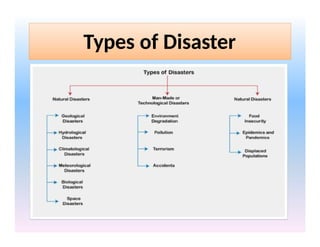
•Disasters can be categorized in various ways.
• As per severity, disasters are classified as minor
or major (in impact as per loss of life).
• The most common way of categorizing disasters
is based on the underlying cause or nature of
origin as - natural or man-made.
Natural Disaster
Naturaldisasters are those hazardous events which
occur naturally. They are caused by sudden changes in
the environment.
Natural disasters includes:
earthquakes,
cyclones,
volcanic eruptions,
forest fires,
tornadoes,
hailstorms,
thunderstorm,
very heavy snowfall,
very heavy rainfalls,
heat and cold waves,
floods,
Droughts, etc
22.
Natural Disaster
Naturaldisaster can cause heavy loss of life and damage to
physical structures, leading to huge financial losses.
Every area is susceptible (likely to influenced) to its own set
of natural disasters and thus it is important to take
preventive measures accordingly. For example, the areas
where tectonic plates are too close would be susceptible to
earthquakes, whereas areas near volcanic formations would
be more likely to suffer from volcanic eruptions.
Governments must make necessary arrangements to protect
people from area-specific natural disasters. This would
ensure minimum damage.
One effective way to reduce the impact of disasters is to use
latest technology. For example, infrastructure and buildings
can be strengthened to withstand natural disasters by using
new construction technology and materials.
Earthquakes
Earthquakes arecaused by a sudden shift or movement deep underground in the Earth’s
tectonic plates, causing the Earth’s crust to shake violently, with vibrations varying in
magnitude.
On the surface, we see this as the shaking of the ground, causing damage to poorly built
structures.
Earthquake is the result of a sudden release of energy in the Earth's crust that creates
seismic waves.
Earthquakes occur unpredictably along fault lines and are capable of killing thousands of
people.
The most powerful earthquakes can destroy even the best built structures.
Earthquakes can also cause other disasters including tsunamis and volcanic eruptions.
In the past, seismologists used to estimate earthquake intensity using the Richter scale
developed by Charles Richter.
An American scientist, Charles F. Richter, developed a scale in 1935, based on indices,
which could measure the intensity of an earthquake; this scale is called as “Richter Scale”.
The instrument used for measuring the intensity of an earthquake is called a
“Seismograph”.
However, today, the moment magnitude scale, which is an improved version of the Richter
scale, is used by seismologists to measure the size of earthquakes in terms of the energy
released.
25.
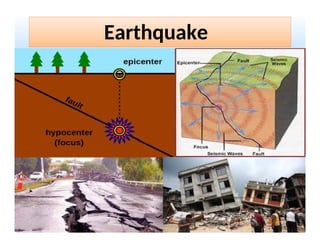
An earthquakehas a point of origin underground called ‘focus’ or hypocenter.
The point directly above the focus on the surface is called the ‘epicenter’.
• Most earthquakes occur on or near the edges of the earth tectonic plates, at cracks in the crust called as
“faults”.
Earthquakes by themselves rarely kill people or wildlife. It is usually the secondary events that they trigger,
such as building collapse, fires, tsunami (seismic sea waves) and volcano.
• It is estimated that nearly 20,000 earthquakes occur every year in the world.
• Many earthquakes occur on the north east cost of Asia. This is at the boundary of two of the earth’s
tectonic plates. A few countries that are more earthquakes prone are China, Japan, Russia, Pakistan and
India.
Many of these could possibly be avoided by better construction, safety systems, early warning and
planning.
Some of the most recent and disastrous earthquakes in recent times are:
The 2011 Japanese Earthquake, registering a magnitude of 9.0, triggered a massive tsunami. Over
15,000 people were killed in the disaster.
The 2010 Haiti Earthquake, registering a magnitude of 7.0, killed an estimated 100,000-150,000
people.
The 2004 Indian Ocean earthquake, the third largest earthquake in recorded history, registered a
moment magnitude of 9.3. The huge tsunami triggered by the earthquake cost the lives of at least
229,000 people in 14 countries.
The 2001 Gujarat Earthquake, measuring 7.7 on the moment magnitude scale, killed at least 20,000
people.
Earthquakes
1) The earthtectonic plates: Most of the earthquakes are caused due to movement
at the boundary of the tectonic plates below the earth’s crust. The slightest
movement along the boundary of tectonic plates can cause minor or major
earthquake at the epicenter.
2) Volcanic eruption: Many times due to volcanic eruption earth’s surface get
vibrated which results in earthquake.
3) Pressure of Lava: The center of the earth contains hot lava, which comprises of
minerals and metals in a molten, semi-liquid form. Due to the high temperature,
pressure is entered on the rock layer and this pressure can cause raptures
(cracks) in the earth’s surface.
4) Mining and deep construction: Activities such as intensive mining and
construction of huge dams can lead to imbalance and pressure on the surface of
the earth there by causing earthquakes.
5) Change in the underground rocks: Due to the pressure on the underground
rocks, these rocks can breaks down which causes vibrations and results in
earthquakes.
6) Nuclear Tests: Activities like atomic experiments or nuclear tests and mine-
blasting can also cause earthquakes.
Causes of Earthquakes
28.
1) Shaking andGround Raptures: One of the common effects of earthquake is
shaking of the earth’s surface and ground raptures. Ground rapture is a visible
breaking and displacement of the Earth surface along the trace of the fault
which may be of several meters in the case of major earthquake. Ground
raptures is a major risk for large engineering structures such as dams bridges
and nuclear power stations. This basically results in more or less severe damage
to buildings and other rigid structures. The magnitude of the effects depends
on the earthquake magnitude, the distance from the epicenter, etc.
2) Landslides: Earthquake can lead to losing of the soil of hills and mountains and
causes big landslides. The danger of landslides remains even after the
earthquake occurs and can hamper rescue operations.
3) Fires: Earthquake can cause fires by damaging electrical power or gas lines. In
the case of ruptured (cracked) water mains (Pipe lines) and a loss of pressure in
it, it may become difficult to stop the spread of a fire once it has started.
Effects of Earthquakes
29.
4) Tsunami: Tsunamisare long sea-waves produced by the sudden or abrupt moment of
large volumes of water, including when an earthquake occurs at sea. Tsunami can travel
600 to 800 km per hour depending on water depth. Large waves produced by an
earthquake can over-run nearby coastal areas in a matter of minutes. Tsunami can also
travel thousands of kilometers across open ocean and cause destruction on large scale.
5) Floods: Floods may be secondary effect of earthquakes, if dams are damaged.
Earthquakes may cause landslips to river dams, which collapse and cause floods.
6) Change in water level / direction: Due to earthquake many times the water level under
the earth’s surface decreases or increases. It may also cause change in the direction of
the flow of rivers.
7) Loss of human life: An earthquake may cause injury and loss of human, animal and
plant life.
8) Loss of property: An earthquake may cause destruction of infrastructure like buildings
Bridges, roads, railway tracks and general property damage. It also causes different
diseases, lack of basic necessities, economic imbalance, etc.
Effects of Earthquakes
30.
Floods
• Floods arethe most common and frequently occurring natural disaster in all
parts of the world.
• Heavy or prolonged rainfall is one of the main reasons of floods.
• A flood is an overflow of water onto land. When the quantity of water
flowing in the river increases beyond its capacity, it starts flowing into
nearby areas. This area gets submerged, and this leads to loss of life and
property.
• Generally, occurrences of floods are more frequent in low-lying lands. People
living in the low lying areas have to vacate their houses and seek shelters at
higher level.
• Floods present a significant danger with enough force to sweep away
massive objects such as houses, cars and trees.
• Flood can occur quickly, or over a long period and may last days, weeks or
longer.
31.
Floods
• Sometimes, alongwith heavy rains, the drainage system gets choked,
due to which the water gets logged and find no outlet. The water
level then starts rising and submerges the area and caused flood. This
was happened in Mumbai, on 26th July, 2005. The damage was as
much due to rain as it was due to poor drainage system.
• There is a growing feeling that the incidence and intensity of floods
has grown alarmingly over the years. A major cause is the increased
encroachment of flood plains because of development and
population pressure.
• Among all the natural disasters affecting India, frequent river floods
are the most devastating, which cause maximum damages of life and
property. Total flood prone areas in India are 40 million hectares, out
of which 9.4 per cent falls in Assam. Besides draught, about 90 per
cent damages to crops are only due to flood.
32.
Causes of Floods
1)Heavy rain in low-lying area or catchment area.
2) Melting of snow and ice on a large scale due to which the
level of water in the rivers increases.
3) Overflowing dams, or a crack in them, or an earthquake in
an area where a dam is built can cause heavy flooding.
4) When soil becomes loose due to lack of trees and
vegetation and get deposited in the river due to soil
erosion, which is caused by deforestation. There is a change
in the river-basin due to excessive soil deposits carried by
the rain into the river. The river then throws the excess
water out of the river-basin.
5) Closing of drainage system, especially in urban areas.
6) Floods are also caused by storms or cyclone or tsunamis
created in the sea, which cause huge waves to floods the
shore areas.
33.
Effects of Floods
1)Floods cause a lot of destruction to human, animal and plant life.
Humans and animals get drowned and trees get uprooted in the
flood water.
2) Loss of property: Flood water cause damage to buildings and
houses, shops and offices. Goods stores in shops and houses are
also spoilt due to flood water.
3) Roads and railway tracks are washed away due to which transport
and communication is disrupted.
4) Flood affected areas are an ideal breeding ground for mosquitoes,
flies and other insects and there is also a danger of epidemic
spreading in such areas.
5) Floods destroy crops on a large scale, this can cause shortage of
food.
6) Due to flood water, the upper layer of fertile land is washed away.
This makes the land infertile and barren.
7) Soil erosion.
34.
DRAUGHT
S
• Inadequate (less)or no rainfall leads to acute shortage of water, which situation is
referred to as a draught.
• A drought is an event of prolonged shortage in the water supply, whether
atmospheric surface water (sea, ocean, rivers, lakes, etc) or groundwater.
• Drought is unusual dryness of soil, resulting in crop failure and shortage of water for
other uses, caused by significantly lower rainfall than average over a prolonged
period. Hot dry winds, high temperatures and consequent evaporation of moisture
from the ground can contribute to conditions of drought.
• A drought can last for a month or years. Drought is a recurring feature of the climate
in most parts of the world.
• The outcome of drought is “famine” that is an acute shortage of food and water,
which leads to loss of human, animal and plant life.
• Droughts happen when there is not enough rain for a long period of time.
• Sometimes, a drought takes decades to develop fully, and they are very difficult to
predict.
35.
DRAUGHT
S
• Unlike othernatural disasters, drought happen very slowly over a period of
time.
• Environmental phenomena like climate change, increase in temperature and
change in the local landscape (deforestation) makes a difference when it
comes to droughts.
• Droughts can be very dangerous for people living in area with not enough
food or water.
• Deaths can occur from lack of food and water and there are lots of health
problems too when there is not enough water, crops, which means there
isn't enough food for people.
• It also means that farmers lose money and the area can become very poor.
Where a region is very poor, and doesn't have enough food or water,
arguments can happen over who should be able to get the limited food,
which can escalate into rights and wars.
• Although droughts can persist for several years, even a short, intense
drought can cause significant damage and harm the local economy.
36.
Causes of DRAUGHTS
1)Low level of rainfall: Little or no rain is one of the major cause of drought. Lower than average
level of rainfall over a long period of time can dry the soil and lead to crop failures. Climate
disturbance like extremely high temperatures and changes in wind pattern can lead to lower
than normal rainfall in an area. Droughts are usually common in places where normal levels of
rainfall are generally low.
2) Dry season: Droughts are common in areas experiencing long dry seasons. Since humidity level
are low during this season, water evaporation rate are high. As a result, water bodies like lakes
and rivers dry up completely. Vegetation cover and agricultural crops dependent on these water
bodies also die due to the absence of water. Higher temperature during the dry season further
promote the evaporation of water and thus worsen the droughts.
3) Human activities: Human activity can directly trigger exacerbating factors of droughts such as
over-farming, excessive irrigation, deforestation, and erosion adversely impacting the ability of
the land to capture and hold water.
4) Geographical location: Droughts can also be caused due to the geographical location of an area.
For a person who lives near a place where most of the water used comes from a river, a draught
can be caused due to places upstream not receiving enough water.
5) Global warming: Global warming or climate change, is a major factor causing droughts. It is
unfortunate that human activities contribute to the emission of greenhouse gases, which in turn
cause the abnormal rise of global temperature. This directly contributes to dry conditions, dryer
weather and droughts.
37.
Effects of DRAUGHTS
1)It is impossible to live without food and water. There is a large scale loss
of human life, animal life and plant life.
2) People, and particularly children suffer from malnutrition.
3) Droughts lead to the drying up of wells, springs, lakes and other sources
of water.
4) Depletion (lowering) in the level of groundwater due to less rainfall. It
causes the drying up of wells and tube-wells.
5) Drying up of land causes the land to become barren and uncultivable.
6) Sometimes, people hold food illegally, and create artificial shortage of
food. They then sell this food at inflated prices and spread insecurity in the
society.
7) Industrial growth is adversely affected due to destruction of crops. The
agro-based industries are the worst affected. This, in turn, leads to
unemployment and large scale migration and regional imbalance.
8) Wildfire risk: Drought conditions increase wildfire risk. As plants and trees
wither and die from a lack of rainfall, all of which are associated with
drought- they becomes fuel for wildfires, which affect the economy, the
environment and the society in many ways.
38.
Effects of DRAUGHTS
•Periods of drought can have significant environmental, agricultural, health-
related economic and social Consequences or effects. The effect varies according
to vulnerability.
• A few common consequences of drought include:
Diminished crop growth or yield productions and carrying capacity for
livestock
Dust storms occur when drought hits an area suffering from desertification
and erosion
Habitat damage, affecting both terrestrial and aquatic wildlife
Malnutrition, dehydration and related diseases
Mass migration, resulting in internal displacement and international refugees
Reduced electricity production due to insufficient available coolant for
power stations and reduced water flow through hydroelectric dams
Shortages of water for industrial users
Social unrest
War over natural resources, including water and food
Wildfires, such as Australian bushfires, are more common during times of
drought
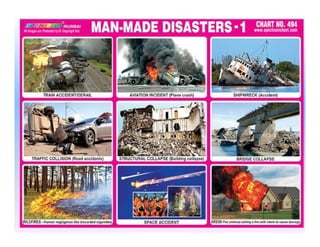
Man-made Disaster
Theseare the hazards that are caused by humans
or their action either deliberately or by accident.
Man-made disasters includes:
industrial and chemical accident
road and railway accidents
aviation disasters
building collapse
communal violence
bomb blasts
Explosions
Fires
accidents,
electricity failure,
chemical and
nuclear radiation,
terrorism,
war, etc
41.
Man-made Disaster
Someof the disasters can be associated with human activities such as:
industrialization,
deforestation,
urbanization
This invariably produce air pollution, water pollution those in turn cause
global warming, climate change, depletion of glaciers, depletion of ozone
layer, increase in ultraviolet radiation, avalanches, flash floods and water-
logging in low lying areas.
These may be dangerous to life, physical elements or economic components
of the environment and the resultant damage could prove disastrous for the
whole economy.
Better technology, sufficient precautions and careful working with
technology are the only steps which can prevent or lessen the damage from
technology-related disasters.
43.
Terrorism
• Terrorism isa controversial term with varied definitions. One
definition means a violent action targeting civilians exclusively.
Another definition is the use or threatened use of violence for the
purpose of creating fear in order to achieve a political, religious, or
ideological goal. Under the second definition, the targets of terrorist
acts can be anyone, including civilians, government officials, military
personnel, or people serving the interests of governments.
• Definitions of terrorism may also vary geographically. In Australia, the
Security Legislation Amendment (Terrorism) Act 2002, defines
terrorism as "an action to advance a political, religious or ideological
cause and with the intention of coercing the government or
intimidating the public", while the United States Department of State
operationally describes it as "premeditated, politically-motivated
violence perpetrated against non-combatant targets by sub national
groups or clandestine agents, usually intended to influence an
audience".[2]
44.
STAGES/ PHASES OFDISASTER
MANAGEMENT
• Generally, from the view of normal community, disaster management
is an organization, which supports for the community only in relief
operation and rehabilitation activities. But apart from the relief
operation the main motto of the organization is to visualize the worst
situation in prior and plan for the appropriate mitigation measures.
• Disaster Management implies the systematic process of using
administrative decisions, organization, operational skills, and
capacities to implement policies, strategies and coping capacities of
the society and communities to lessen the impact of natural hazards
and related environmental and technological disasters.
• These comprise all forms all activities including structural and non-
structural measures to avoid (prevention) or to limit (mitigation and
preparedness) adverse effects to hazards
45.
STAGES/ PHASES OFDISASTER
MANAGEMENT
• The phases of disaster are the sequence in which disaster
occurs laying its effects and this makes its management more needed.
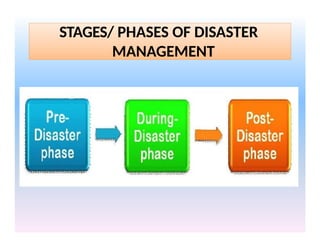
• The phases of disaster are broadly classified into three types namely,
pre-disaster phase, during disaster phase and post disaster phase.
• There are three key stages of activities in disaster management:
1) Before a disaster: to reduce the potential for human, material, or
environmental losses caused by hazards and to ensure that these
losses are minimized when disaster strikes;
2) During a disaster: to ensure that the needs and provisions of
victims are met to alleviate and minimize suffering; and
3) After a disaster: to achieve rapid and durable recovery which
does not reproduce the original vulnerable conditions.
STAGES/ PHASES OFDISASTER
MANAGEMENT
The three key stages or phases of activities that are taken up within disaster management
are:
1) Pre-Disaster Phase:
This phase meant before the disastrous event for which the proactive action plan is
taken for the reduction of potential impact to the human as well as damage to the
environment. This action plan taken before the disaster ensures the losses and
damages to the minimal level. This phase comprises of certain systems to be adapted
for the reduction of risk in case of disaster they are as follows:
i) Prevention: The misleading concept engulfed to the community is with the term prevention, it
doesn't mean that preventing the natural hazard or man-made disaster. This system of prevention
is adapted in pre- disaster phase to reduce the intensity of impact and lessen the damage to the
environment and human.
Ii) Mitigation: The reduction of risk in any disaster includes the vital activities of reducing the risk
to the acceptable level and reducing the scale of impact of disaster to the least level. The system
mitigation is put forth for the elimination of root cause and the reduction of vulnerable condition
to the minimal level. Further adding, the mitigation measures also aims to reduce the vulnerability
level in terms of physical, social and economic threats. Therefore, mitigation involves of varied
levels of proactive measures implemented with help the experts like medical professionals,
engineers, relief force and other authorized persons. Hence the scale and severity of natural
hazards are reduced with the adaptation of various engineering strategies known as Mitigation.
48.
STAGES/ PHASES OFDISASTER
MANAGEMENT
iii) Preparedness: This system plays a vital role in this phase which involves the
government, vulnerable communities and each and every individual responsibility
to enact accordingly to manage the disastrous situations efficiently. This phase of
system implements the suitable emergency plans, effective communication to the
responders and sensitize the public with mock drill. The system also enhances the
layout of rescue operations and evacuations plans from the vulnerable areas to
the safest heaven. This system can be success only if there is proper planning,
coordination and apportionment of responsibilities with sufficient financial
support from the government.
iv) Early Warning: This system encrypts the process of monitoring closely the
existing situation and effectively communicates to the community approaching to
the vulnerable area. The early warning system shall be activated in different
perspective by various departments. The Indian Meteorological Department is one
of most sensitive department who provides early warning to the community
abruptly in accordance to the weather pattern.
v) Disaster Effect: This states an instantaneous event of natural hazard taking
place and affecting the vulnerable elements. The duration of disastrous event
directly depends on the type of hazard occurred at the existing level.
49.
STAGES/ PHASES OFDISASTER
MANAGEMENT
2. During a Disaster (Disaster Occurrence): Initiatives taken to ensure
that the needs and provisions of victims are met and suffering is
minimized. Activities taken under this stage are called emergency
response activities. This is a critical phase to ensure the victim to be
responded immediately with a relief force and also provide the victim
with the basic needs to minimize the level of pain.
i) Response: This system aims to provide an instantaneous response to
protect the life of the victim, enhance the affected population with
the support in terms of both mentally and physically. This response
system is the aid provided to the victim in limited manner which
might be mandate for their survival. The limited aids provided by the
response team are first aid to the victim, emergency shelter for the
affected community, food and drinking water facilities and
transportation of vulnerable refugees to the safe heaven. To the
greater extent this also have the capability to provide the temporary
repairs to infrastructure damaged in any disasters.
50.
STAGES/ PHASES OFDISASTER
MANAGEMENT
3. After a Disaster (Post-Disaster): Initiatives taken in response to a disaster with a purpose to
achieve early recovery and rehabilitation of affected communities, immediately after a disaster
strikes. These are called as response and recovery activities. This is a reactive phase where the
system starts to work only aftermath of any disasters. After the phase of response, the hasty
recovery is mandate for the affected community. The relief personnel should ensure that all the
affected victims are rescued and provided them with all basic needs. After the calm of disaster,
this system must provide the affected community with reconstruction of their houses and
rehabilitation support for the affected victim.
i) Recovery: This phase implements the activities to recover the affected victim from the place
where the incident occurred. The recovery of fatalities also needed for the operation team to be
executed after the disaster. This system aims to ensure that the affected population should restore
their lives in all aspects. This activity continues until the systems returns back to the normal.
ii) Rehabilitation: This system includes assisting the affected victim with basic essential needs,
temporary public services and also temporary shelter. This system should also be capable of
providing short term measure to assist them for the recovery in long term.
iii) Reconstruction: This phase challenges to bring back the community as more resilient by
repairing the damaged buildings, reconstruction of retrofitting structures, and other emergency
facilities. This system enables the long term development of community in more sustainable
manner, so that if the disaster strikes again the loss shall be acceptable and minimal.
51.
UNIT NO. 3: DISASTER RISK REDUCTION
• What is DISASTER RISK REDUCTION (DRR)?
•Disaster risk reduction is the concept and practice of
reducing disaster risks through systematic efforts to
analyze and reduce the causal factors of disasters.
•Disaster risk reduction (DRR) is a systematic approach
to identifying, assessing and reducing the risks of
disaster.
•Disaster risk reduction (DRR) is the process of
protecting the livelihoods and assets of communities and
individuals from the impact of hazards.
52.
The purpose ofdisaster risk reduction is to minimize
vulnerabilities and disaster risks throughout a society in
order to avoid or to limit the adverse impacts of natural
hazards, and facilitate sustainable development.
The hazards can be natural or human derived, and
include earthquakes, floods, cyclones, droughts, price
spikes, conflict and contagious diseases. DRR limits the
negative impacts of these events by working to reduce
their size, strength or how often they occur, and
building the capacity of the people exposed to these
hazards to anticipate, survive, and recover from them.
53.
DISASTER RISKREDUCTION IN SCHOOLS AND COLLEGES:
Schools are densely populated places that may have youths and small
children, who are among the most vulnerable groups in society. It has been seen
that during disasters schools and school children are the most affected. To
reduce this vulnerability, particularly for schools, it is important to have a
School Disaster Management Plan.
National Disaster Management Authority, of the Ministry of Home Affairs,
strongly feels that there has to be a structural, as well as non-structural
intervention, to ensure the safety of the children. Structural intervention would
include strict check on the guidelines set up for school buildings, while non-
structural would mean educating the staff, teachers, and students about disaster
management.
The Ministry insists that every school adopt a school safety programme
targeting the educational institutions, emergency officials, teachers, students and
even the community at large. Under this programme, the students learn about
safety measures, thus becoming future disaster managers, while a disaster
resilient society is built by way of educating the community.
54.
S omeof the ways and means of educating the child are:
• Building awareness by way of campaigns, rallies etc
• Conducting mock drills for fire disasters and earthquakes
• First aid training
•A clear picture of command and control, so that in case of an
emergency there is no chaos
• Use of the fire extinguisher
With terror attacks on schools all over the world, India should
also prepare itself for any such eventualities. The schools must
take necessary precautions against entry of unknown individuals
to schools by issuing an identity card even for the parents. The
security checks should be strict. The students may be given some
tips as to how to behave in a hostage situation by professional
counselors.
56.
AG ENCIESFOR DISATER MANAGEMENT AT STATE LEVEL:
The Disaster Management Act 2005 provides the legal and
institutional framework for disaster management in India at the
national, state and district levels. In the National policy of India the
primary responsibility of disaster management vests with the State
Governments. The Central Government lays down policies and
guidelines and provides technical, financial and logistic support
while the state and district administration carries out most of the
operations in collaboration with central and state level agencies.
The DM Act, 2005 mandates the State Governments, inter alia,
to take measures for preparation of state DM plans, integration of
measures for prevention of disasters or mitigation into state
development plans, allocation of funds, establishment of early
warning systems and to assist the Central Government and other
agencies in various aspects of DM.
57.
State DisasterManagement Authority (SDMA):
•Section 14 of National DM Act 2005 mandates each State to
establish State Disaster Management Authority (SDMA).
•At the State Level the SDMA, headed by the Chief Minister,
lays down policies and plans for disaster management.
•It is also responsible to coordinate the implementation of the
State Plan, recommend provision of funds for mitigation and
preparedness measures and review the developmental plans of
the different departments of the State to ensure integration of
prevention, preparedness and mitigation measures.
•The Maharashtra State Disaster Management Authority was
constituted in 2006.
58.
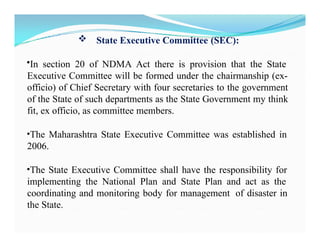
State ExecutiveCommittee (SEC):
•In section 20 of NDMA Act there is provision that the State
Executive Committee will be formed under the chairmanship (ex-
officio) of Chief Secretary with four secretaries to the government
of the State of such departments as the State Government my think
fit, ex officio, as committee members.
•The Maharashtra State Executive Committee was established in
2006.
•The State Executive Committee shall have the responsibility for
implementing the National Plan and State Plan and act as the
coordinating and monitoring body for management of disaster in
the State.
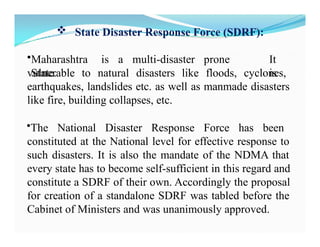
59.
State DisasterResponse Force (SDRF):
•Maharashtra is a multi-disaster prone
State.
It
is
vulnerable to natural disasters like floods, cyclones,
earthquakes, landslides etc. as well as manmade disasters
like fire, building collapses, etc.
•The National Disaster Response Force has been
constituted at the National level for effective response to
such disasters. It is also the mandate of the NDMA that
every state has to become self-sufficient in this regard and
constitute a SDRF of their own. Accordingly the proposal
for creation of a standalone SDRF was tabled before the
Cabinet of Ministers and was unanimously approved.
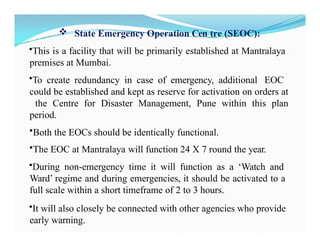
60.
State EmergencyOperation Cen tre (SEOC):
•This is a facility that will be primarily established at Mantralaya
premises at Mumbai.
•To create redundancy in case of emergency, additional EOC
could be established and kept as reserve for activation on orders at
the Centre for Disaster Management, Pune within this plan
period.
•Both the EOCs should be identically functional.
•The EOC at Mantralaya will function 24 X 7 round the year.
•During non-emergency time it will function as a ‘Watch and
Ward’ regime and during emergencies, it should be activated to a
full scale within a short timeframe of 2 to 3 hours.
•It will also closely be connected with other agencies who provide
early warning.
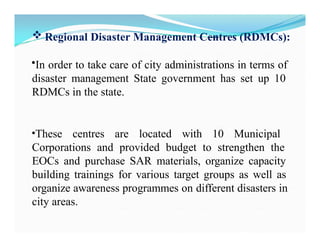
61.
Regional DisasterManagement Centres (RDMCs):
•In order to take care of city administrations in terms of
disaster management State government has set up 10
RDMCs in the state.
•These centres are located with 10 Municipal
Corporations and provided budget to strengthen the
EOCs and purchase SAR materials, organize capacity
building trainings for various target groups as well as
organize awareness programmes on different disasters in
city areas.
62.
District DisasterManagement Authority (DDMA):
•At the District level, DDMAs will act as the planning, coordinating
and implementing body for DM and will take all measures for the
purposes of DM in the respective Districts in accordance with the
guidelines laid down by National Disaster Management Authority
(NDMA).
•The DDMA, not exceeding seven members, headed by district
collector will deal with all disaster management issues at district
level including preparedness, mitigation, response and recovery
works.
•At the time of emergency the district administration may take help
of State administration for relief and rescue operation.
63.
DDMCs andDDMOs:
•Under the Maharashtra Disaster Risk Reduction Programme the
State government has appointed Divisional Disaster Management
Coordinators (DDMCs) in all divisions and District Disaster
Management Officers (DDMOs) in all districts on contractual basis.
•The DDMOs are responsible to District Disaster Management
Authorities (DDMAs) and implement the MDRM programme at
district level.
•All DDMAs are provided funds by State government for
strengthening EOCs, organizing capacity building trainings and
public awareness programmes.
•Appointments of DDMOs are part of institutional development of
disaster management in the State.
64.
Local Authorities:
•Localauthorities like Panchayati Raj Institutions (PRIs),
Municipal Corporations, Municipalities, District and
Town Planning Authorities are duly associated in disaster
management process.
•These bodies will prepare DM Plans following the
Guidelines of NDMA, SDMAs and DDMAs and will
ensure capacity building of their officers and employees
for managing disasters, carry out relief, rehabilitation and
reconstruction activities in the affected areas.















![Terrorism
• Terrorism is a controversial term with varied definitions. One
definition means a violent action targeting civilians exclusively.
Another definition is the use or threatened use of violence for the
purpose of creating fear in order to achieve a political, religious, or
ideological goal. Under the second definition, the targets of terrorist
acts can be anyone, including civilians, government officials, military
personnel, or people serving the interests of governments.
• Definitions of terrorism may also vary geographically. In Australia, the
Security Legislation Amendment (Terrorism) Act 2002, defines
terrorism as "an action to advance a political, religious or ideological
cause and with the intention of coercing the government or
intimidating the public", while the United States Department of State
operationally describes it as "premeditated, politically-motivated
violence perpetrated against non-combatant targets by sub national
groups or clandestine agents, usually intended to influence an
audience".[2]](https://image.slidesharecdn.com/disastermanagementslides-250914170231-9710d0c5/85/Disaster-Management-Slides-pptx-43-320.jpg)