Social, Cultural and Political
Aspects of Earthquake
Disaster Mitigation
David Alexander
University College London
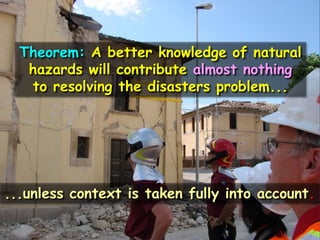
Theorem: A better knowledge of natural
hazards will contribute almost nothing
to resolving the disasters problem...
...unless context is taken fully into account.
The Problem
Gertrude Stein,
1913 [adapted]
A disaster is
a disaster is
a disaster...
Its "disastrousness" is not
defined by its causal agent.
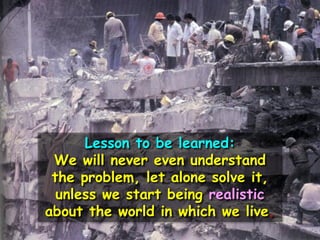
Lesson to be learned:
We will never even understand
the problem, let alone solve it,
unless we start being realistic
about the world in which we live.
Analysis
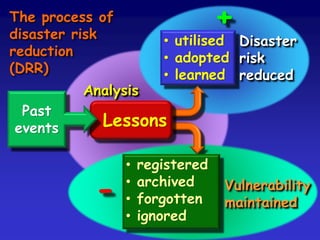
• registered
• archived
• forgotten
• ignored
Vulnerability
maintained
-
• utilised
• adopted
• learned
Disaster
risk
reduced
+
Lessons
Past
events
The process of
disaster risk
reduction
(DRR)
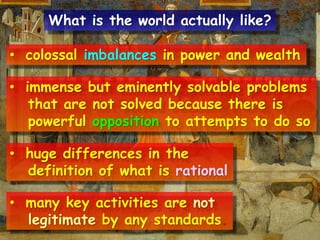
• colossal imbalances in power and wealth
• immense but eminently solvable problems
that are not solved because there is
powerful opposition to attempts to do so
• huge differences in the
definition of what is rational
• many key activities are not
legitimate by any standards.
What is the world actually like?
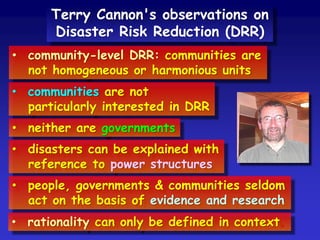
• community-level DRR: communities are
not homogeneous or harmonious units
• communities are not
particularly interested in DRR
• neither are governments
• disasters can be explained with
reference to power structures
Terry Cannon's observations on
Disaster Risk Reduction (DRR)
• people, governments & communities seldom
act on the basis of evidence and research
• rationality can only be defined in context.
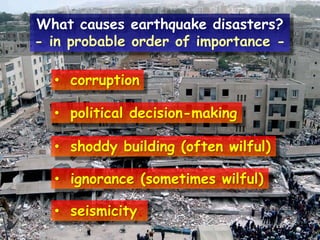
• corruption
• political decision-making
• shoddy building (often wilful)
• ignorance (sometimes wilful)
• seismicity.
What causes earthquake disasters?
- in probable order of importance -
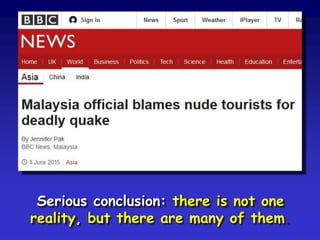
Serious conclusion: there is not one
reality, but there are many of them.
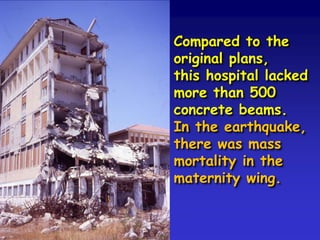
Compared to the
original plans,
this hospital lacked
more than 500
concrete beams.
In the earthquake,
there was mass
mortality in the
maternity wing.
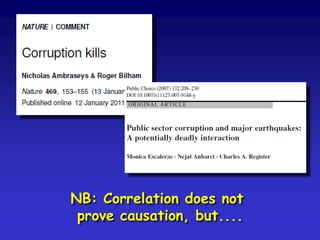
NB: Correlation does not
prove causation, but....
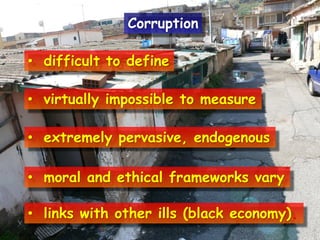
• difficult to define
• virtually impossible to measure
• extremely pervasive, endogenous
• moral and ethical frameworks vary
• links with other ills (black economy).
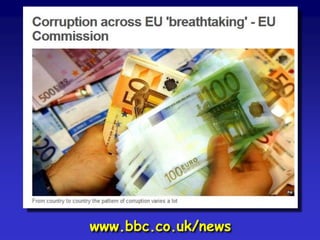
Corruption
www.bbc.co.uk/news
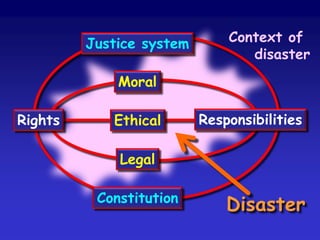
Justice system
Rights Responsibilities
Moral
Ethical
Legal
Constitution
Disaster
Context of
disaster
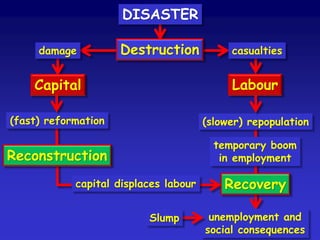
DISASTER
Destructiondamage casualties
Capital Labour
(fast) reformation (slower) repopulation
temporary boom
in employmentReconstruction
Recoverycapital displaces labour
unemployment and
social consequences
Slump
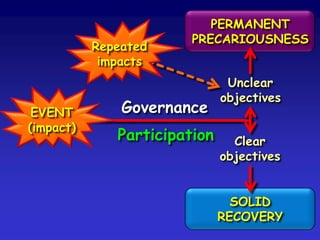
EVENT
(impact)
Participation
Governance
Unclear
objectives
Clear
objectives
SOLID
RECOVERY
PERMANENT
PRECARIOUSNESS
Repeated
impacts
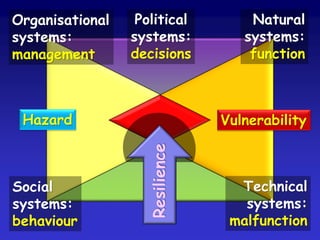
Organisational
systems:
management
Social
systems:
behaviour
Natural
systems:
function
Technical
systems:
malfunction
VulnerabilityHazard
Resilience
Political
systems:
decisions
What is
resilience?
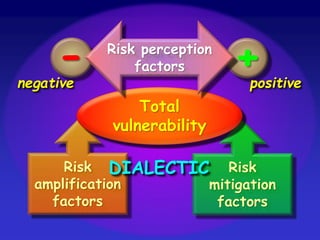
Risk
amplification
factors
Risk
mitigation
factors
Total
vulnerability
Risk perception
factors- +positivenegative
DIALECTIC
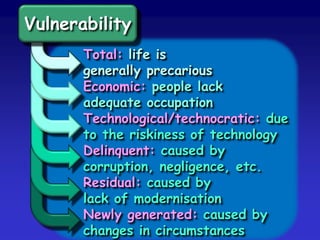
Vulnerability
Total: life is
generally precarious
Economic: people lack
adequate occupation
Technological/technocratic: due
to the riskiness of technology
Delinquent: caused by
corruption, negligence, etc.
Residual: caused by
lack of modernisation
Newly generated: caused by
changes in circumstances
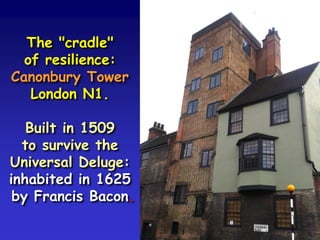
The "cradle"
of resilience:
Canonbury Tower
London N1.
Built in 1509
to survive the
Universal Deluge:
inhabited in 1625
by Francis Bacon.
Francis Bacon
Sylva Sylvarum, 1625
[Are we to criticise him for using
the "greengrocer's apostrophe"?]
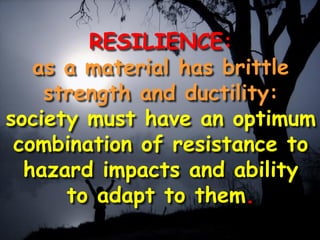
RESILIENCE:
as a material has brittle
strength and ductility:
society must have an optimum
combination of resistance to
hazard impacts and ability
to adapt to them.
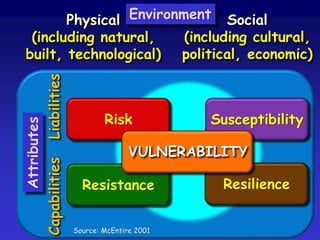
ResilienceResistance
Risk Susceptibility
Physical
(including natural,
built, technological)
Social
(including cultural,
political, economic)
Environment
Attributes
Source: McEntire 2001
LiabilitiesCapabilities
VULNERABILITY
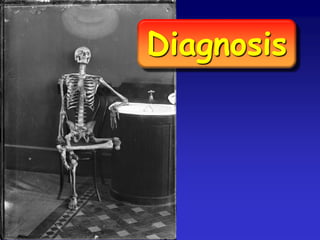
Diagnosis
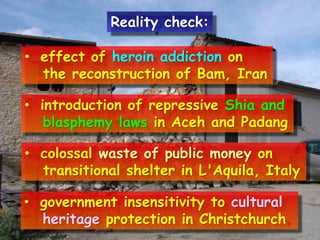
• effect of heroin addiction on
the reconstruction of Bam, Iran
• introduction of repressive Shia and
blasphemy laws in Aceh and Padang
• colossal waste of public money on
transitional shelter in L'Aquila, Italy
• government insensitivity to cultural
heritage protection in Christchurch.
Reality check:
• widening wealth gap since 1970
• failure to divert resources from
response to prevention and mitigation
• half of world trade goes
through 78 tax havens
• one fifth of world trade is illicit
(drugs, armaments, people, species)
• relationship of proxy wars to aid.
More reality check:
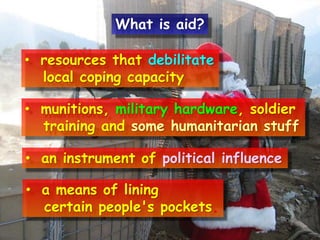
• resources that debilitate
local coping capacity
• munitions, military hardware, soldier
training and some humanitarian stuff
• an instrument of political influence
• a means of lining
certain people's pockets.
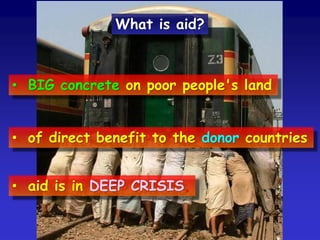
What is aid?
• BIG concrete on poor people's land
• of direct benefit to the donor countries
• aid is in DEEP CRISIS.
What is aid?
" Experts talk of "building back better", of
concepts like "resilience" and "sustainability",
of crisis being opportunity in the way that it
was for the devastated cities of Germany
and Japan in 1945. ... The practice …
can be very different; piecemeal,
dilatory, bureaucratic, venal even.
Urban planners, it seems, never miss
an opportunity to miss an opportunity.
But occasionally, just occasionally, they
surprise on the upside too, and reimagine
the city in ways that might have been
impossible had disaster not struck."
www.theguardian.com/cities/series/cities-back-from-the-brink
The catastrophic earthquakes that have
occurred since 1999, in Turkey, Taiwan,
Sumatra, Kashmir and Sichuan,
demonstrate that elementary engineering
guidelines for earthquake resistance in
crucial civil structures (schools, hospitals
and fire stations,) have been alien
concepts to local authorities, or have
been ignored.
Roger Bilham, Nature
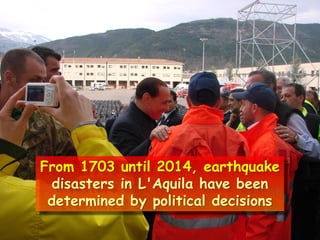
From 1703 until 2014, earthquake
disasters in L'Aquila have been
determined by political decisions
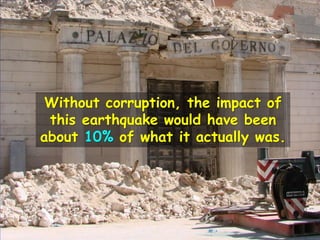
Without corruption, the impact of
this earthquake would have been
about 10% of what it actually was.
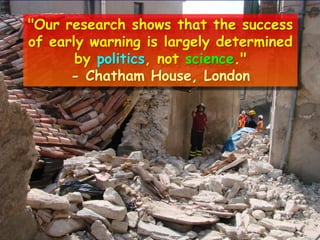
"Our research shows that the success
of early warning is largely determined
by politics, not science."
- Chatham House, London
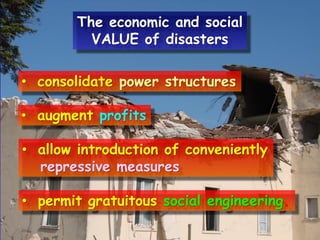
• consolidate power structures
• augment profits
• allow introduction of conveniently
repressive measures
• permit gratuitous social engineering.
The economic and social
VALUE of disasters
BENIGN (healthy)
at the service of the people
MALIGN (corrupt)
at the service of vested interests
interplay dialectic
Justification Development
[spiritual, cultural, political, economic]
IDEOLOGY CULTURE
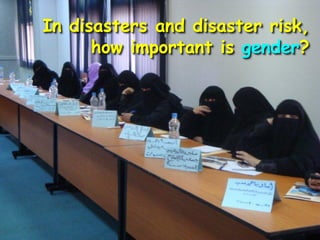
In disasters and disaster risk,
how important is gender?
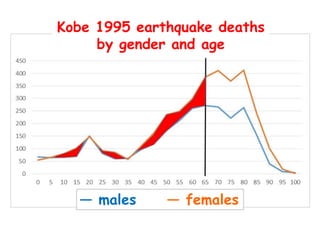
Kobe 1995 earthquake deaths
by gender and age
― males ― females
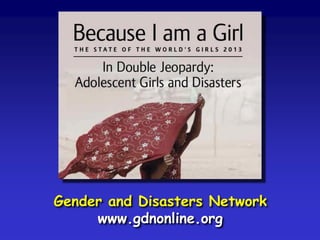
Gender and Disasters Network
www.gdnonline.org
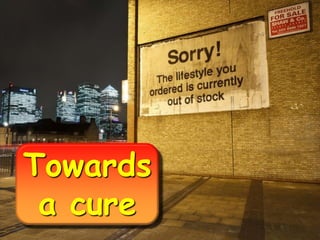
Towards
a cure
• advances in knowledge
have had a positive impact
• the whole problem is better
known than ever before
• interdisciplinary research and problem-
solving have made some progress
• but the balance is still weighted heavily
in favour of a worsening situation.
Correcting a one-sided picture:-
• science must not be allowed to be the
justification for political malpractice
• if you supply data, methods or
results you have some responsibility
for how they are used
• accept that the primary effect of
hazards is determined by vulnerability.
Some precepts
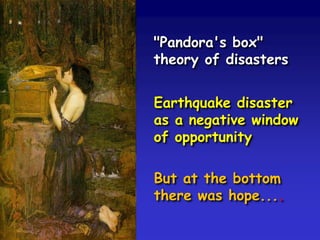
Earthquake disaster
as a negative window
of opportunity
But at the bottom
there was hope....
"Pandora's box"
theory of disasters
• realism helps
• transparency is necessary
• gross inequality is in no one's interest
• national policies are needed and can work
• cultivate a flexible attitude.
The positive messages
Thank you for
your attention!
david.alexander@ucl.ac.uk
emergency-planning.blogspot.com
www.slideshare.net/dealexander

Earthquake Disaster Mitigation

  • 1.
    Social, Cultural andPolitical Aspects of Earthquake Disaster Mitigation David Alexander University College London
  • 2.
    Theorem: A betterknowledge of natural hazards will contribute almost nothing to resolving the disasters problem... ...unless context is taken fully into account.
  • 3.
  • 4.
    Gertrude Stein, 1913 [adapted] Adisaster is a disaster is a disaster... Its "disastrousness" is not defined by its causal agent.
  • 5.
    Lesson to belearned: We will never even understand the problem, let alone solve it, unless we start being realistic about the world in which we live.
  • 6.
    Analysis • registered • archived •forgotten • ignored Vulnerability maintained - • utilised • adopted • learned Disaster risk reduced + Lessons Past events The process of disaster risk reduction (DRR)
  • 7.
    • colossal imbalancesin power and wealth • immense but eminently solvable problems that are not solved because there is powerful opposition to attempts to do so • huge differences in the definition of what is rational • many key activities are not legitimate by any standards. What is the world actually like?
  • 8.
    • community-level DRR:communities are not homogeneous or harmonious units • communities are not particularly interested in DRR • neither are governments • disasters can be explained with reference to power structures Terry Cannon's observations on Disaster Risk Reduction (DRR) • people, governments & communities seldom act on the basis of evidence and research • rationality can only be defined in context.
  • 9.
    • corruption • politicaldecision-making • shoddy building (often wilful) • ignorance (sometimes wilful) • seismicity. What causes earthquake disasters? - in probable order of importance -
  • 10.
    Serious conclusion: thereis not one reality, but there are many of them.
  • 11.
    Compared to the originalplans, this hospital lacked more than 500 concrete beams. In the earthquake, there was mass mortality in the maternity wing.
  • 12.
    NB: Correlation doesnot prove causation, but....
  • 13.
    • difficult todefine • virtually impossible to measure • extremely pervasive, endogenous • moral and ethical frameworks vary • links with other ills (black economy). Corruption
  • 15.
  • 17.
  • 18.
    DISASTER Destructiondamage casualties Capital Labour (fast)reformation (slower) repopulation temporary boom in employmentReconstruction Recoverycapital displaces labour unemployment and social consequences Slump
  • 19.
  • 20.
  • 21.
  • 22.
  • 23.
    Vulnerability Total: life is generallyprecarious Economic: people lack adequate occupation Technological/technocratic: due to the riskiness of technology Delinquent: caused by corruption, negligence, etc. Residual: caused by lack of modernisation Newly generated: caused by changes in circumstances
  • 24.
    The "cradle" of resilience: CanonburyTower London N1. Built in 1509 to survive the Universal Deluge: inhabited in 1625 by Francis Bacon.
  • 25.
    Francis Bacon Sylva Sylvarum,1625 [Are we to criticise him for using the "greengrocer's apostrophe"?]
  • 26.
    RESILIENCE: as a materialhas brittle strength and ductility: society must have an optimum combination of resistance to hazard impacts and ability to adapt to them.
  • 27.
    ResilienceResistance Risk Susceptibility Physical (including natural, built,technological) Social (including cultural, political, economic) Environment Attributes Source: McEntire 2001 LiabilitiesCapabilities VULNERABILITY
  • 28.
  • 29.
    • effect ofheroin addiction on the reconstruction of Bam, Iran • introduction of repressive Shia and blasphemy laws in Aceh and Padang • colossal waste of public money on transitional shelter in L'Aquila, Italy • government insensitivity to cultural heritage protection in Christchurch. Reality check:
  • 30.
    • widening wealthgap since 1970 • failure to divert resources from response to prevention and mitigation • half of world trade goes through 78 tax havens • one fifth of world trade is illicit (drugs, armaments, people, species) • relationship of proxy wars to aid. More reality check:
  • 31.
    • resources thatdebilitate local coping capacity • munitions, military hardware, soldier training and some humanitarian stuff • an instrument of political influence • a means of lining certain people's pockets. What is aid?
  • 32.
    • BIG concreteon poor people's land • of direct benefit to the donor countries • aid is in DEEP CRISIS. What is aid?
  • 33.
    " Experts talkof "building back better", of concepts like "resilience" and "sustainability", of crisis being opportunity in the way that it was for the devastated cities of Germany and Japan in 1945. ... The practice … can be very different; piecemeal, dilatory, bureaucratic, venal even. Urban planners, it seems, never miss an opportunity to miss an opportunity. But occasionally, just occasionally, they surprise on the upside too, and reimagine the city in ways that might have been impossible had disaster not struck." www.theguardian.com/cities/series/cities-back-from-the-brink
  • 34.
    The catastrophic earthquakesthat have occurred since 1999, in Turkey, Taiwan, Sumatra, Kashmir and Sichuan, demonstrate that elementary engineering guidelines for earthquake resistance in crucial civil structures (schools, hospitals and fire stations,) have been alien concepts to local authorities, or have been ignored. Roger Bilham, Nature
  • 35.
    From 1703 until2014, earthquake disasters in L'Aquila have been determined by political decisions
  • 36.
    Without corruption, theimpact of this earthquake would have been about 10% of what it actually was.
  • 38.
    "Our research showsthat the success of early warning is largely determined by politics, not science." - Chatham House, London
  • 39.
    • consolidate powerstructures • augment profits • allow introduction of conveniently repressive measures • permit gratuitous social engineering. The economic and social VALUE of disasters
  • 40.
    BENIGN (healthy) at theservice of the people MALIGN (corrupt) at the service of vested interests interplay dialectic Justification Development [spiritual, cultural, political, economic] IDEOLOGY CULTURE
  • 43.
    In disasters anddisaster risk, how important is gender?
  • 44.
    Kobe 1995 earthquakedeaths by gender and age ― males ― females
  • 45.
    Gender and DisastersNetwork www.gdnonline.org
  • 46.
  • 47.
    • advances inknowledge have had a positive impact • the whole problem is better known than ever before • interdisciplinary research and problem- solving have made some progress • but the balance is still weighted heavily in favour of a worsening situation. Correcting a one-sided picture:-
  • 48.
    • science mustnot be allowed to be the justification for political malpractice • if you supply data, methods or results you have some responsibility for how they are used • accept that the primary effect of hazards is determined by vulnerability. Some precepts
  • 49.
    Earthquake disaster as anegative window of opportunity But at the bottom there was hope.... "Pandora's box" theory of disasters
  • 50.
    • realism helps •transparency is necessary • gross inequality is in no one's interest • national policies are needed and can work • cultivate a flexible attitude. The positive messages
  • 51.
    Thank you for yourattention! david.alexander@ucl.ac.uk emergency-planning.blogspot.com www.slideshare.net/dealexander