
ALL INDIA INSTITUTE OF LOCAL SELF
GOVERNMENT
DELHI
“NATIONAL LEPROSY ERADICATION
PROGRAMME”
BY- Dr. P.P.SINGH
Faculty AIILSGD
Ex Medical Superintendent Cum Consultant pathologist HRH
Delhi
Ex. Director India Population Project 8 Delhi..
Introduction
 Leprosy is a chronic infectious disease
caused by M.Leprae. It affect mainly the
peripheral Nerves and Skin, Muscles ,Eye
,Bones, testis & internal organs.
Leprosy is Clinically characterized by one or
more of following:-
 Hypo pigmented patches.
Partial or total cutaneous sensation in
the affected area.
Presence of thickened Nerves.
Presence of Acid Fast Bacilli in the skin
or Nasal smear.
Magnitude
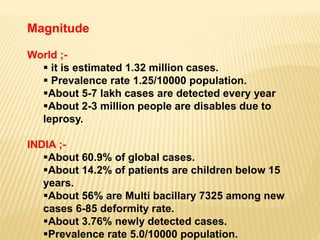
World ;-
 it is estimated 1.32 million cases.
 Prevalence rate 1.25/10000 population.
About 5-7 lakh cases are detected every year
About 2-3 million people are disables due to
leprosy.
INDIA ;-
About 60.9% of global cases.
About 14.2% of patients are children below 15
years.
About 56% are Multi bacillary 7325 among new
cases 6-85 deformity rate.
About 3.76% newly detected cases.
Prevalence rate 5.0/10000 population.
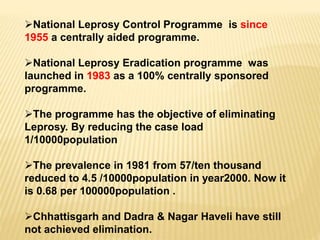
National Leprosy Control Programme is since
1955 a centrally aided programme.
National Leprosy Eradication programme was
launched in 1983 as a 100% centrally sponsored
programme.
The programme has the objective of eliminating
Leprosy. By reducing the case load
1/10000population
The prevalence in 1981 from 57/ten thousand
reduced to 4.5 /10000population in year2000. Now it
is 0.68 per 100000population .
Chhattisgarh and Dadra & Nagar Haveli have still
not achieved elimination.
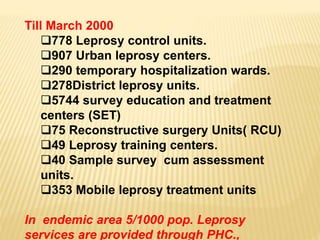
Till March 2000
778 Leprosy control units.
907 Urban leprosy centers.
290 temporary hospitalization wards.
278District leprosy units.
5744 survey education and treatment
centers (SET)
75 Reconstructive surgery Units( RCU)
49 Leprosy training centers.
40 Sample survey cum assessment
units.
353 Mobile leprosy treatment units
In endemic area 5/1000 pop. Leprosy
services are provided through PHC.,
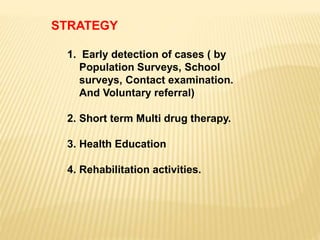
STRATEGY
1. Early detection of cases ( by
Population Surveys, School
surveys, Contact examination.
And Voluntary referral)
2. Short term Multi drug therapy.
3. Health Education
4. Rehabilitation activities.
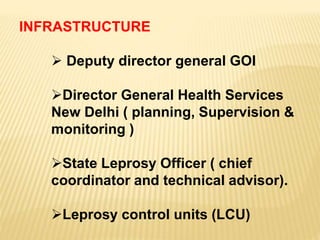
INFRASTRUCTURE
 Deputy director general GOI
Director General Health Services
New Delhi ( planning, Supervision &
monitoring )
State Leprosy Officer ( chief
coordinator and technical advisor).
Leprosy control units (LCU)
Programme implemented through LUC,SET,ULCs
1. Leprosy control units (LCU) in endemic area
MO 1, Non medical supervisor 2 each unit per4.5 lakh population,
20 paramedical workers (PMW) 15-20K population and expected
to examine 8000 per year house to house survey.
2.Area with endemic less than 5per 1000 population- one SET
attached to MO of PHC., PMW -20-25 K population , Non medical
supervisor for every 5 PMWs.
3.One Leprosy centre for 50000 population.
4. Research is also part of activities.
 Central JALMA institute Leprosy Agra.
 Central leprosy Teaching & Training Institute Chingleput
Chennai.
 Regional Training and Referral institute at Aska Orissa.,
Raipur (MP) & Gouripur (WB)
5.Foreign assistance from SIDA,DANIDA,WHO,UNICEF Damien
Foundation., 285 voluntary organizations are engaged
Agent Factors
a) Agent is M.LEPROSY an Acid Fast Bacilli,
occurs in host both Extra & intra cellular,
They occur in clumps or bundles (called
GLOBI).
b) Source of infection – Multibacillary cases (
Lepromatous & Border line Lepromatous )
or any Leprosy case.
c) Portal of Entry – Nose is a major portal of
exit also, Ulcerated or broken skin .
d) Infectivity – Highly infective but low
pathogenically.
Host Factors.
a) Disease is acquired during Infancy &
childhood peak between 10-20 years.
b) Both sex are involved but more in males. At
least in below 15 years age.
c) Migration ;- From rural to Urban area
d) Immunity :- Abortive and self limiting but cell
mediated (CMI) is responsible for problem.
e) Genetic Factors :- Now there is evidence that
HLA – linked gene influence the type of
immune response.
ENVIORNMENTAL FACTORS.
a) The presence of infectious cases in the
area.
b) Humidity. M.Leprae bacilli can remain
viable for 9 days in dried nasal
secretions & 46 days in moist soil.
c) Over crowding & lack of ventilation.
d) Social factor , close contact.
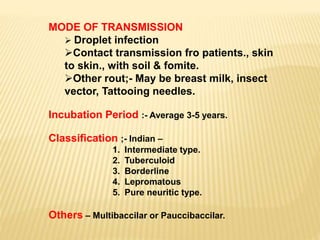
MODE OF TRANSMISSION
 Droplet infection
Contact transmission fro patients., skin
to skin., with soil & fomite.
Other rout;- May be breast milk, insect
vector, Tattooing needles.
Incubation Period :- Average 3-5 years.
Classification ;- Indian –
1. Intermediate type.
2. Tuberculoid
3. Borderline
4. Lepromatous
5. Pure neuritic type.
Others – Multibaccilar or Pauccibaccilar.
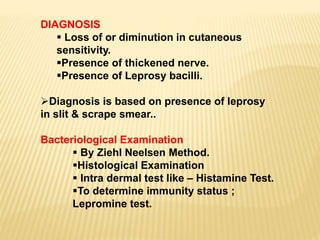
DIAGNOSIS
 Loss of or diminution in cutaneous
sensitivity.
Presence of thickened nerve.
Presence of Leprosy bacilli.
Diagnosis is based on presence of leprosy
in slit & scrape smear..
Bacteriological Examination
 By Ziehl Neelsen Method.
Histological Examination
 Intra dermal test like – Histamine Test.
To determine immunity status ;
Lepromine test.
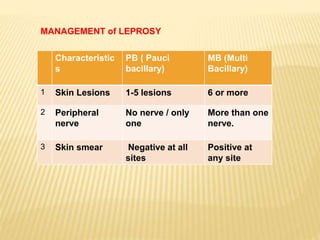
MANAGEMENT of LEPROSY
Characteristic
s
PB ( Pauci
bacillary)
MB (Multi
Bacillary)
1 Skin Lesions 1-5 lesions 6 or more
2 Peripheral
nerve
No nerve / only
one
More than one
nerve.
3 Skin smear Negative at all
sites
Positive at
any site
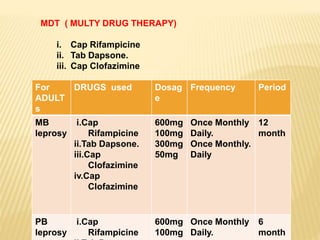
MDT ( MULTY DRUG THERAPY)
i. Cap Rifampicine
ii. Tab Dapsone.
iii. Cap Clofazimine
For
ADULT
s
DRUGS used Dosag
e
Frequency Period
MB
leprosy
i.Cap
Rifampicine
ii.Tab Dapsone.
iii.Cap
Clofazimine
iv.Cap
Clofazimine
600mg
100mg
300mg
50mg
Once Monthly
Daily.
Once Monthly.
Daily
12
month
PB
leprosy
i.Cap
Rifampicine
600mg
100mg
Once Monthly
Daily.
6
month
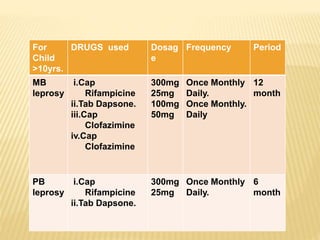
For
Child
>10yrs.
DRUGS used Dosag
e
Frequency Period
MB
leprosy
i.Cap
Rifampicine
ii.Tab Dapsone.
iii.Cap
Clofazimine
iv.Cap
Clofazimine
300mg
25mg
100mg
50mg
Once Monthly
Daily.
Once Monthly.
Daily
12
month
PB
leprosy
i.Cap
Rifampicine
ii.Tab Dapsone.
300mg
25mg
Once Monthly
Daily.
6
month
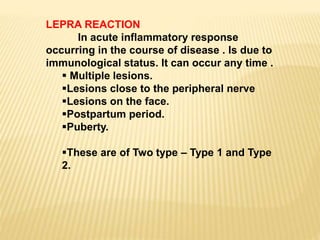
LEPRA REACTION
In acute inflammatory response
occurring in the course of disease . Is due to
immunological status. It can occur any time .
 Multiple lesions.
Lesions close to the peripheral nerve
Lesions on the face.
Postpartum period.
Puberty.
These are of Two type – Type 1 and Type
2.
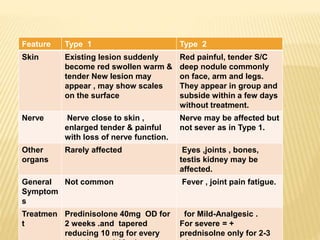
Feature Type 1 Type 2
Skin Existing lesion suddenly
become red swollen warm &
tender New lesion may
appear , may show scales
on the surface
Red painful, tender S/C
deep nodule commonly
on face, arm and legs.
They appear in group and
subside within a few days
without treatment.
Nerve Nerve close to skin ,
enlarged tender & painful
with loss of nerve function.
Nerve may be affected but
not sever as in Type 1.
Other
organs
Rarely affected Eyes ,joints , bones,
testis kidney may be
affected.
General
Symptom
s
Not common Fever , joint pain fatigue.
Treatmen
t
Predinisolone 40mg OD for
2 weeks .and tapered
reducing 10 mg for every
for Mild-Analgesic .
For severe = +
prednisolne only for 2-3
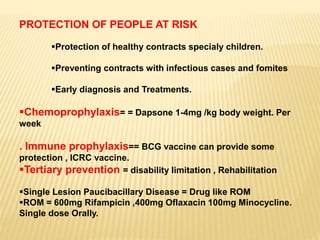
PROTECTION OF PEOPLE AT RISK
Protection of healthy contracts specialy children.
Preventing contracts with infectious cases and fomites
Early diagnosis and Treatments.
Chemoprophylaxis= = Dapsone 1-4mg /kg body weight. Per
week
. Immune prophylaxis== BCG vaccine can provide some
protection , ICRC vaccine.
Tertiary prevention = disability limitation , Rehabilitation
Single Lesion Paucibacillary Disease = Drug like ROM
ROM = 600mg Rifampicin ,400mg Oflaxacin 100mg Minocycline.
Single dose Orally.
ROLE OF paramedical health worker;-
To understand the social and cultural aspect of
patient.
To spread the correct information of leprosy.
Motivate people to get examined and help in early
detection.
Remove fear and social stigma and help to change
the attitude of people.
Encourage the affected person to take regular
treatment and lead a normal life,
Active surveillance for detection of new cases
National Leprosy Eradication Programme

National Leprosy Eradication Programme

  • 1.
    ALL INDIA INSTITUTEOF LOCAL SELF GOVERNMENT DELHI “NATIONAL LEPROSY ERADICATION PROGRAMME” BY- Dr. P.P.SINGH Faculty AIILSGD Ex Medical Superintendent Cum Consultant pathologist HRH Delhi Ex. Director India Population Project 8 Delhi..
  • 2.
    Introduction  Leprosy isa chronic infectious disease caused by M.Leprae. It affect mainly the peripheral Nerves and Skin, Muscles ,Eye ,Bones, testis & internal organs. Leprosy is Clinically characterized by one or more of following:-  Hypo pigmented patches. Partial or total cutaneous sensation in the affected area. Presence of thickened Nerves. Presence of Acid Fast Bacilli in the skin or Nasal smear.
  • 3.
    Magnitude World ;-  itis estimated 1.32 million cases.  Prevalence rate 1.25/10000 population. About 5-7 lakh cases are detected every year About 2-3 million people are disables due to leprosy. INDIA ;- About 60.9% of global cases. About 14.2% of patients are children below 15 years. About 56% are Multi bacillary 7325 among new cases 6-85 deformity rate. About 3.76% newly detected cases. Prevalence rate 5.0/10000 population.
  • 4.
    National Leprosy ControlProgramme is since 1955 a centrally aided programme. National Leprosy Eradication programme was launched in 1983 as a 100% centrally sponsored programme. The programme has the objective of eliminating Leprosy. By reducing the case load 1/10000population The prevalence in 1981 from 57/ten thousand reduced to 4.5 /10000population in year2000. Now it is 0.68 per 100000population . Chhattisgarh and Dadra & Nagar Haveli have still not achieved elimination.
  • 5.
    Till March 2000 778Leprosy control units. 907 Urban leprosy centers. 290 temporary hospitalization wards. 278District leprosy units. 5744 survey education and treatment centers (SET) 75 Reconstructive surgery Units( RCU) 49 Leprosy training centers. 40 Sample survey cum assessment units. 353 Mobile leprosy treatment units In endemic area 5/1000 pop. Leprosy services are provided through PHC.,
  • 6.
    STRATEGY 1. Early detectionof cases ( by Population Surveys, School surveys, Contact examination. And Voluntary referral) 2. Short term Multi drug therapy. 3. Health Education 4. Rehabilitation activities.
  • 7.
    INFRASTRUCTURE  Deputy directorgeneral GOI Director General Health Services New Delhi ( planning, Supervision & monitoring ) State Leprosy Officer ( chief coordinator and technical advisor). Leprosy control units (LCU)
  • 8.
    Programme implemented throughLUC,SET,ULCs 1. Leprosy control units (LCU) in endemic area MO 1, Non medical supervisor 2 each unit per4.5 lakh population, 20 paramedical workers (PMW) 15-20K population and expected to examine 8000 per year house to house survey. 2.Area with endemic less than 5per 1000 population- one SET attached to MO of PHC., PMW -20-25 K population , Non medical supervisor for every 5 PMWs. 3.One Leprosy centre for 50000 population. 4. Research is also part of activities.  Central JALMA institute Leprosy Agra.  Central leprosy Teaching & Training Institute Chingleput Chennai.  Regional Training and Referral institute at Aska Orissa., Raipur (MP) & Gouripur (WB) 5.Foreign assistance from SIDA,DANIDA,WHO,UNICEF Damien Foundation., 285 voluntary organizations are engaged
  • 9.
    Agent Factors a) Agentis M.LEPROSY an Acid Fast Bacilli, occurs in host both Extra & intra cellular, They occur in clumps or bundles (called GLOBI). b) Source of infection – Multibacillary cases ( Lepromatous & Border line Lepromatous ) or any Leprosy case. c) Portal of Entry – Nose is a major portal of exit also, Ulcerated or broken skin . d) Infectivity – Highly infective but low pathogenically.
  • 10.
    Host Factors. a) Diseaseis acquired during Infancy & childhood peak between 10-20 years. b) Both sex are involved but more in males. At least in below 15 years age. c) Migration ;- From rural to Urban area d) Immunity :- Abortive and self limiting but cell mediated (CMI) is responsible for problem. e) Genetic Factors :- Now there is evidence that HLA – linked gene influence the type of immune response.
  • 11.
    ENVIORNMENTAL FACTORS. a) Thepresence of infectious cases in the area. b) Humidity. M.Leprae bacilli can remain viable for 9 days in dried nasal secretions & 46 days in moist soil. c) Over crowding & lack of ventilation. d) Social factor , close contact.
  • 12.
    MODE OF TRANSMISSION Droplet infection Contact transmission fro patients., skin to skin., with soil & fomite. Other rout;- May be breast milk, insect vector, Tattooing needles. Incubation Period :- Average 3-5 years. Classification ;- Indian – 1. Intermediate type. 2. Tuberculoid 3. Borderline 4. Lepromatous 5. Pure neuritic type. Others – Multibaccilar or Pauccibaccilar.
  • 13.
    DIAGNOSIS  Loss ofor diminution in cutaneous sensitivity. Presence of thickened nerve. Presence of Leprosy bacilli. Diagnosis is based on presence of leprosy in slit & scrape smear.. Bacteriological Examination  By Ziehl Neelsen Method. Histological Examination  Intra dermal test like – Histamine Test. To determine immunity status ; Lepromine test.
  • 14.
    MANAGEMENT of LEPROSY Characteristic s PB( Pauci bacillary) MB (Multi Bacillary) 1 Skin Lesions 1-5 lesions 6 or more 2 Peripheral nerve No nerve / only one More than one nerve. 3 Skin smear Negative at all sites Positive at any site
  • 15.
    MDT ( MULTYDRUG THERAPY) i. Cap Rifampicine ii. Tab Dapsone. iii. Cap Clofazimine For ADULT s DRUGS used Dosag e Frequency Period MB leprosy i.Cap Rifampicine ii.Tab Dapsone. iii.Cap Clofazimine iv.Cap Clofazimine 600mg 100mg 300mg 50mg Once Monthly Daily. Once Monthly. Daily 12 month PB leprosy i.Cap Rifampicine 600mg 100mg Once Monthly Daily. 6 month
  • 16.
    For Child >10yrs. DRUGS used Dosag e FrequencyPeriod MB leprosy i.Cap Rifampicine ii.Tab Dapsone. iii.Cap Clofazimine iv.Cap Clofazimine 300mg 25mg 100mg 50mg Once Monthly Daily. Once Monthly. Daily 12 month PB leprosy i.Cap Rifampicine ii.Tab Dapsone. 300mg 25mg Once Monthly Daily. 6 month
  • 17.
    LEPRA REACTION In acuteinflammatory response occurring in the course of disease . Is due to immunological status. It can occur any time .  Multiple lesions. Lesions close to the peripheral nerve Lesions on the face. Postpartum period. Puberty. These are of Two type – Type 1 and Type 2.
  • 18.
    Feature Type 1Type 2 Skin Existing lesion suddenly become red swollen warm & tender New lesion may appear , may show scales on the surface Red painful, tender S/C deep nodule commonly on face, arm and legs. They appear in group and subside within a few days without treatment. Nerve Nerve close to skin , enlarged tender & painful with loss of nerve function. Nerve may be affected but not sever as in Type 1. Other organs Rarely affected Eyes ,joints , bones, testis kidney may be affected. General Symptom s Not common Fever , joint pain fatigue. Treatmen t Predinisolone 40mg OD for 2 weeks .and tapered reducing 10 mg for every for Mild-Analgesic . For severe = + prednisolne only for 2-3
  • 19.
    PROTECTION OF PEOPLEAT RISK Protection of healthy contracts specialy children. Preventing contracts with infectious cases and fomites Early diagnosis and Treatments. Chemoprophylaxis= = Dapsone 1-4mg /kg body weight. Per week . Immune prophylaxis== BCG vaccine can provide some protection , ICRC vaccine. Tertiary prevention = disability limitation , Rehabilitation Single Lesion Paucibacillary Disease = Drug like ROM ROM = 600mg Rifampicin ,400mg Oflaxacin 100mg Minocycline. Single dose Orally.
  • 20.
    ROLE OF paramedicalhealth worker;- To understand the social and cultural aspect of patient. To spread the correct information of leprosy. Motivate people to get examined and help in early detection. Remove fear and social stigma and help to change the attitude of people. Encourage the affected person to take regular treatment and lead a normal life, Active surveillance for detection of new cases