
ALL INDIA INSTITUTE OF LOCAL SELF
GOVERNMENT
DELHI
“GENERAL EPIDEMIOLOGY OF COMMUNICABLE
DISEASES”
For Para medicals
By
Dr. P.P.SINGH
Faculty AIILSGD
Ex Medical Superintendent Cum Consultant pathologist HRH
Delhi
Ex. Director India Population Project 8 Delhi..
DR.P.P.SINGH
GENERAL EPIDEMIOLOGY OF
COMMUNICABLE DISEASES
1. Any deviation from Normal.
2. Health is a dynamic concept.
3. to measure the extent of mortality &
morbidity.
4. How disease occurs , spreads ?.
5. How to controlled , prevented and
eradicated?
DEFINATION
The study of distribution and determinants
(causes) of disease or health related events is
called Epidemiology.
Epidemiological studies helps to seek
answer to;
WHY. Where ,How When & Who. With
reference to the disease.
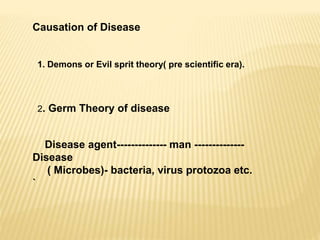
Causation of Disease
1. Demons or Evil sprit theory( pre scientific era).
2. Germ Theory of disease
Disease agent-------------- man --------------
Disease
( Microbes)- bacteria, virus protozoa etc.
`
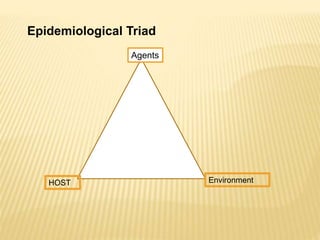
Epidemiological Triad
Agents
HOST Environment
MULTI-FACTORIAL CAUSATION OF DISEASE
Petten Koefer of Munich proposed this
theory.
It has been Now realised that both
communicable or non communicable diseases are
of multiple factors ( RISK FACTORS)
Thus populations can be grouped in 3
groups.
1. Diseased group.
2. Population group at risk of developing
disease.
3. Normal healthy group.
Natural History of Disease
1. Pre Pathogenesis Phase ; the process
in Environment.
2. pathogenesis Phase : the process in
man .
Pre Pathogenesis phase ;- This is the period
before the onset of disease in man . The agent has not
entered but factors favoring entry are existing in the
environment. ( Man exposed to high risk factors).
Pathogenesis Phase ;- This begin with entry of
agent in susceptible host -- incubation period - sub
clinical stage – Clinical stage – recovery stage/
mortality or carrier or normal stage.
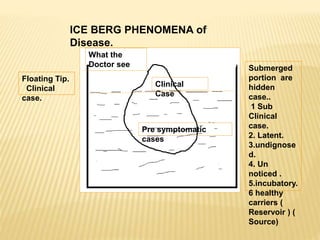
ICE BERG PHENOMENA of
Disease.
Clinical
Case
Pre symptomatic
cases
What the
Doctor see
Floating Tip.
Clinical
case.
Submerged
portion are
hidden
case..
1 Sub
Clinical
case.
2. Latent.
3.undignose
d.
4. Un
noticed .
5.incubatory.
6 healthy
carriers (
Reservoir ) (
Source)
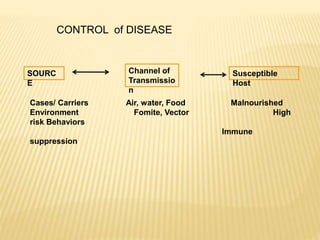
CONTROL of DISEASE
SOURC
E
Channel of
Transmissio
n
Susceptible
Host
Cases/ Carriers Air, water, Food Malnourished
Environment Fomite, Vector High
risk Behaviors
Immune
suppression
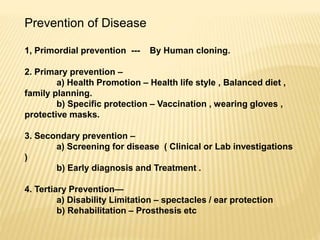
Prevention of Disease
1, Primordial prevention --- By Human cloning.
2. Primary prevention –
a) Health Promotion – Health life style , Balanced diet ,
family planning.
b) Specific protection – Vaccination , wearing gloves ,
protective masks.
3. Secondary prevention –
a) Screening for disease ( Clinical or Lab investigations
)
b) Early diagnosis and Treatment .
4. Tertiary Prevention—
a) Disability Limitation – spectacles / ear protection
b) Rehabilitation – Prosthesis etc
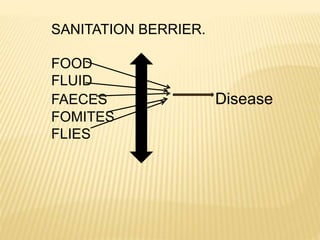
SANITATION BERRIER.
FOOD
FLUID
FAECES Disease
FOMITES
FLIES
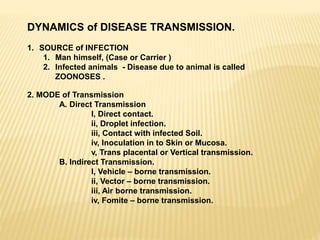
DYNAMICS of DISEASE TRANSMISSION.
1. SOURCE of INFECTION
1. Man himself, (Case or Carrier )
2. Infected animals - Disease due to animal is called
ZOONOSES .
2. MODE of Transmission
A. Direct Transmission
I, Direct contact.
ii, Droplet infection.
iii, Contact with infected Soil.
iv, Inoculation in to Skin or Mucosa.
v, Trans placental or Vertical transmission.
B. Indirect Transmission.
I, Vehicle – borne transmission.
ii, Vector – borne transmission.
iii, Air borne transmission.
iv, Fomite – borne transmission.
Direct contact --- Kissing , Sexual eg. Syphilis,
HIV/AIDS , scabies Skin Sepsis.
Droplet infection – Small fine saliva particles
containing micro organism while coughing,
sneezing, talking laughing etc eg, Diphtheria,
whooping cough tuberculosis etc.
Contact of soil. Eg Tetanus , hook worm ,
strongyloides .
Inoculation into Skin – through Bite , Injection eg
Hepatitis B. Rabies
Trans placental - from mother to chiled . Also
known as vertical eg Toxoplasma ,rubella, hepatitis
AIDS,
1.Vehicle borne Transmission - water , milk food ,
blood serum plasma & other biological products. Eg .
Cholera, typhoid, GE, Hepatitis etc.
2.Vector borne transmission – Mosquitoes, Flea,
bugs sand flies etc eg Malaria, kala azar , Plague
3.Air borne transmission –I, Droplet ii, Infected dust eg
pneumonia, tuberculosis strepto- staphylococcal
infections .
4.Fomite borne transmission - handkerchief ,
glasses door handles towels clothing , toys etc.
IMMUNITY
Definition
Ability of Body to recognise , destroy and
eliminate antigenic (Foreign ) material is called
Immunity.
ANTIGEN – is the substance that stimulate the
formation of antibodies.
ANTIBODIES – are immunoglobulin (Proteins)
formed in response to the antigens.
Types Of Immunity.
A. Humeral. –
I, - are based on the production of antibodies.
ii, - These react with same antigen .
iii,-These recognise and stick to specific
antigen.
iv, - The combined antigen & antibodies are
engulfed by Macrophages destroyed and eliminated from
the body.
v, - The antibodies circulate in blood & body
fluid keeping vigil for same antigen
B. Cellular.
CELLILAR IMMUNITY
.It is more complex . It is based on a type
of White cell( W B C ), known as T cell
Lymphocyte.
. The T cells are activated against the
pathogenic agent which are intracellular .
The Humoral and Cellular components both
cooperate each other and help to resist many
infections.
Classification of Immunity.
A.Natural Immunity. – Inherited Immunity
comes by virtue of genetic make up. This is the
reason some diseases which occur in animal
do not occur in Man (eg Rinderpest) similarly
some man’s disease do not effect the animal eg
Typhoid.
B.Acquired immunity
Acquired immunity
(a) Active immunity ;-
It is the immunity develops as a result of infection by
pathogen or their toxic products .
The antibodies are produced by body to fight the
infection .
Once the antibodies develops the person is immune to
further infection by the same organism for various period ,
some time for whole life.
MAY be acquired by :-
i, An attack of disease e.g. Chicken pox , measles.
ii, Subclinical infection e.g. Polio , diphtheria.
iii, Artificially induced - by Vaccines
B. Passive Immunity
When antibodies produced in one person are
transferred to another to give the protection is called “
Passive immunity “ ( Body does not produce its own
antibodies).
Passive immunity is short lived and declines in few
days or week and disappear
May be acquired in following ways:-
I, Injection antisera e.g. Diphtheria anti toxin for
diphtheria.
ii, Injection of Gamma globulins- immunoglobulin's
obtained from immune person e.g. measles , hepatitis A.
iii, Maternal antibodies - Through placenta , Milk
Human gamma globulin.
These preparation are of two types.
(i) Human normal immunoglobulin
– large pool of human plasma of multiple donors –
available as 16.5% solution for subcutaneous /
intramuscular use.
(ii) Human specific
immunoglobulin - prepared from donors who
have been immunized against or recovered from
specific diseases .
e.g . Tetanus , rabies , and mumps.
The immunity by GG is passive and
temporary.
Antisera or Antitoxin .
These are prepared from animal
such as horse , against tetanus , diphtheria,
botulism , gas gangrene and snake bite.
In the absence and non availability
of human immunoglobulin , antisera are still
in preparation and treatment of many
diseases.
Precaution must be taken for
Anaphylactic shock.
Hypersensitivity
It is an allergy reaction to any foreign
substance is introduced in the body. These are Tow
types.
(a) Immediate or antibody mediated –
eg. Anaphylactic shock.,
(b) Delayed or cell mediated
Anaphylactic reactions are two types – systemic
and local.
( SYSTEMIC - eg Penicillin or ATS reaction are
immediate with symptoms of Dyspnoea, bronchial
spasm , fall of BP, skin rash and occasionally death
& best example of LOCAL is Asthma , Urticaria ).
The examples of delayed types are Tuberculin ,
allergy to fungi , skin graft etc.
Immunizing Agents.
May be classified as Vaccines , Immunoglobulin
and Antisera.
VACCINES
vaccines are a preparation of disease agent or its
toxic products which are administrated stimulates specific
antibodies formation . --- Vaccines induces active
immunity.
Vaccines are prepared from :-
(a) Live attenuated organisms e.g. Polio ,
(b) Killed Organisms e.g. cholera , typhoid
,
( c ) A combination of above.
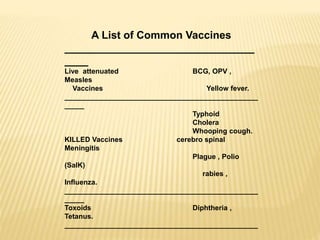
A List of Common Vaccines
________________________________
____
Live attenuated BCG, OPV ,
Measles
Vaccines Yellow fever.
_________________________________________________
_____
Typhoid
Cholera
Whooping cough.
KILLED Vaccines cerebro spinal
Meningitis
Plague , Polio
(SalK)
rabies ,
Influenza.
_________________________________________________
_____
Toxoids Diphtheria ,
Tetanus.
_________________________________________________
_____
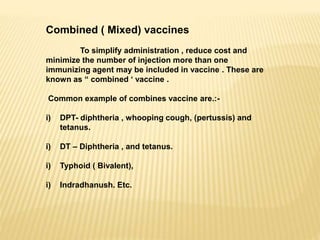
Combined ( Mixed) vaccines
To simplify administration , reduce cost and
minimize the number of injection more than one
immunizing agent may be included in vaccine . These are
known as “ combined ‘ vaccine .
Common example of combines vaccine are.:-
i) DPT- diphtheria , whooping cough, (pertussis) and
tetanus.
i) DT – Diphtheria , and tetanus.
i) Typhoid ( Bivalent),
i) Indradhanush. Etc.
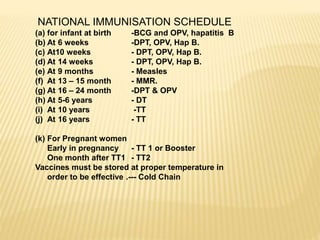
NATIONAL IMMUNISATION SCHEDULE
(a) for infant at birth -BCG and OPV, hapatitis B
(b) At 6 weeks -DPT, OPV, Hap B.
(c) At10 weeks - DPT, OPV, Hap B.
(d) At 14 weeks - DPT, OPV, Hap B.
(e) At 9 months - Measles
(f) At 13 – 15 month - MMR.
(g) At 16 – 24 month -DPT & OPV
(h) At 5-6 years - DT
(i) At 10 years -TT
(j) At 16 years - TT
(k) For Pregnant women
Early in pregnancy - TT 1 or Booster
One month after TT1 - TT2
Vaccines must be stored at proper temperature in
order to be effective .--- Cold Chain
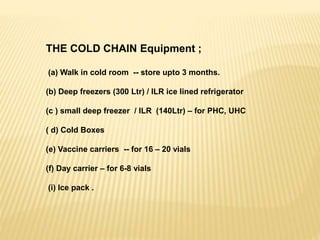
THE COLD CHAIN Equipment ;
(a) Walk in cold room -- store upto 3 months.
(b) Deep freezers (300 Ltr) / ILR ice lined refrigerator
(c ) small deep freezer / ILR (140Ltr) – for PHC, UHC
( d) Cold Boxes
(e) Vaccine carriers -- for 16 – 20 vials
(f) Day carrier – for 6-8 vials
(i) Ice pack .
PORTAL OF EXIT FOR DISEASE.
1, Nose and Throat secretions, eg. TB, diphtheria,
mumps, common cold measels
2, Faeces eg. Salmonella, Shigella.Polio ,Hepatitis.
3. Urine eg. S.typhi.
4.Skin eg. Through wound STD agents , Lepra
bacilli, scabies etc.
5. Vomit , Body fluid .
General Measures for Control of Infectious
Diseases
1. Controlling the Source or Reservoir of infection.
a, early & accurate diagnosis.
b, Notification.
c, Isolation.
d. Surveillance
e, Disinfection.
2.Blocking the channels of transmission
a, Disinfection of water supply.
b. Safe disposal of excreta.
c, Control of Insects and Rodents.
d, Improving the standard of Food Hygiene
etc.
3. Protecting the susceptible population.
a, Immunization – booster dose to have “Herd
immunity”.
b, Health Education
C, Nutrition
INVESTIGATION OF an EPIDEMIC of UNKNOWN
AETIOLOGY.
Epidemics are of Two kinds
1. Progressive - also known as multiple exposure,
repeated or continuous Epidemic. – The disease is all ready
in community in endemic form .
2. Point Source epidemic - also known as
common or single exposure .
Investigation of an epidemic has four steps.
a, Investigation proper,
b, treatment of Patients.
c, Analysis and interpretation .
d, feedback reporting , and follow up.
INVESTIGATION PROPER.
Each patient ,contact
Name , Age , Sex , Occupation and Income.
The Condition of house, sources of water , presence
of sanitary latrine , method of disposal of waste.
The source of milk ,meat , fish in case of food
poisoning .
The history of visits to pilgrimage ,or any place.
The of bite of insect , rodent , dog or other animal.
The symptoms and signs.
Follow up / revisit to see any change
Sample collection.
Depending upon the nature of epidemic ;-
 Stool.
Vomit.
Blood.
Food
Water
Etc.
Alcohol
Matched control from neighborhood.
Treatment
Patient is given supportive treatment
Isolation at home or in separate wards of
Hospital.
All persons attending on them or
transporting their blood or any specimen are
protected .
Analysis and Interpretation
About incubation period.
General attack rate , specific attack rate by
age, sex, economic , occupation and month
of year. Etc.
Geographic distribution
Source of water or milk
While Interpreting .
Infectious diseases trend to occur in children.
Milk borne diseases is common in upper income
group.
Nutritional deficiency disease is common in
rainy season. ( they affect, women and children
more ).
All the cases of food poisoning occur together.
An exotic disease first affects the person who
had returned from visit out and limited to the
contact.
Laboratory investigation will help for chemical
or infectious diseases..
The cases do not respond to any antibiotics are
likely to be viral
General epidemiology.

General epidemiology.

  • 1.
    ALL INDIA INSTITUTEOF LOCAL SELF GOVERNMENT DELHI “GENERAL EPIDEMIOLOGY OF COMMUNICABLE DISEASES” For Para medicals By Dr. P.P.SINGH Faculty AIILSGD Ex Medical Superintendent Cum Consultant pathologist HRH Delhi Ex. Director India Population Project 8 Delhi.. DR.P.P.SINGH
  • 2.
    GENERAL EPIDEMIOLOGY OF COMMUNICABLEDISEASES 1. Any deviation from Normal. 2. Health is a dynamic concept. 3. to measure the extent of mortality & morbidity. 4. How disease occurs , spreads ?. 5. How to controlled , prevented and eradicated?
  • 3.
    DEFINATION The study ofdistribution and determinants (causes) of disease or health related events is called Epidemiology. Epidemiological studies helps to seek answer to; WHY. Where ,How When & Who. With reference to the disease.
  • 4.
    Causation of Disease 1.Demons or Evil sprit theory( pre scientific era). 2. Germ Theory of disease Disease agent-------------- man -------------- Disease ( Microbes)- bacteria, virus protozoa etc. `
  • 5.
  • 6.
    MULTI-FACTORIAL CAUSATION OFDISEASE Petten Koefer of Munich proposed this theory. It has been Now realised that both communicable or non communicable diseases are of multiple factors ( RISK FACTORS) Thus populations can be grouped in 3 groups. 1. Diseased group. 2. Population group at risk of developing disease. 3. Normal healthy group.
  • 7.
    Natural History ofDisease 1. Pre Pathogenesis Phase ; the process in Environment. 2. pathogenesis Phase : the process in man . Pre Pathogenesis phase ;- This is the period before the onset of disease in man . The agent has not entered but factors favoring entry are existing in the environment. ( Man exposed to high risk factors). Pathogenesis Phase ;- This begin with entry of agent in susceptible host -- incubation period - sub clinical stage – Clinical stage – recovery stage/ mortality or carrier or normal stage.
  • 8.
    ICE BERG PHENOMENAof Disease. Clinical Case Pre symptomatic cases What the Doctor see Floating Tip. Clinical case. Submerged portion are hidden case.. 1 Sub Clinical case. 2. Latent. 3.undignose d. 4. Un noticed . 5.incubatory. 6 healthy carriers ( Reservoir ) ( Source)
  • 9.
    CONTROL of DISEASE SOURC E Channelof Transmissio n Susceptible Host Cases/ Carriers Air, water, Food Malnourished Environment Fomite, Vector High risk Behaviors Immune suppression
  • 10.
    Prevention of Disease 1,Primordial prevention --- By Human cloning. 2. Primary prevention – a) Health Promotion – Health life style , Balanced diet , family planning. b) Specific protection – Vaccination , wearing gloves , protective masks. 3. Secondary prevention – a) Screening for disease ( Clinical or Lab investigations ) b) Early diagnosis and Treatment . 4. Tertiary Prevention— a) Disability Limitation – spectacles / ear protection b) Rehabilitation – Prosthesis etc
  • 11.
  • 12.
    DYNAMICS of DISEASETRANSMISSION. 1. SOURCE of INFECTION 1. Man himself, (Case or Carrier ) 2. Infected animals - Disease due to animal is called ZOONOSES . 2. MODE of Transmission A. Direct Transmission I, Direct contact. ii, Droplet infection. iii, Contact with infected Soil. iv, Inoculation in to Skin or Mucosa. v, Trans placental or Vertical transmission. B. Indirect Transmission. I, Vehicle – borne transmission. ii, Vector – borne transmission. iii, Air borne transmission. iv, Fomite – borne transmission.
  • 13.
    Direct contact ---Kissing , Sexual eg. Syphilis, HIV/AIDS , scabies Skin Sepsis. Droplet infection – Small fine saliva particles containing micro organism while coughing, sneezing, talking laughing etc eg, Diphtheria, whooping cough tuberculosis etc. Contact of soil. Eg Tetanus , hook worm , strongyloides . Inoculation into Skin – through Bite , Injection eg Hepatitis B. Rabies Trans placental - from mother to chiled . Also known as vertical eg Toxoplasma ,rubella, hepatitis AIDS,
  • 14.
    1.Vehicle borne Transmission- water , milk food , blood serum plasma & other biological products. Eg . Cholera, typhoid, GE, Hepatitis etc. 2.Vector borne transmission – Mosquitoes, Flea, bugs sand flies etc eg Malaria, kala azar , Plague 3.Air borne transmission –I, Droplet ii, Infected dust eg pneumonia, tuberculosis strepto- staphylococcal infections . 4.Fomite borne transmission - handkerchief , glasses door handles towels clothing , toys etc.
  • 15.
    IMMUNITY Definition Ability of Bodyto recognise , destroy and eliminate antigenic (Foreign ) material is called Immunity. ANTIGEN – is the substance that stimulate the formation of antibodies. ANTIBODIES – are immunoglobulin (Proteins) formed in response to the antigens.
  • 16.
    Types Of Immunity. A.Humeral. – I, - are based on the production of antibodies. ii, - These react with same antigen . iii,-These recognise and stick to specific antigen. iv, - The combined antigen & antibodies are engulfed by Macrophages destroyed and eliminated from the body. v, - The antibodies circulate in blood & body fluid keeping vigil for same antigen B. Cellular.
  • 17.
    CELLILAR IMMUNITY .It ismore complex . It is based on a type of White cell( W B C ), known as T cell Lymphocyte. . The T cells are activated against the pathogenic agent which are intracellular . The Humoral and Cellular components both cooperate each other and help to resist many infections.
  • 18.
    Classification of Immunity. A.NaturalImmunity. – Inherited Immunity comes by virtue of genetic make up. This is the reason some diseases which occur in animal do not occur in Man (eg Rinderpest) similarly some man’s disease do not effect the animal eg Typhoid. B.Acquired immunity
  • 19.
    Acquired immunity (a) Activeimmunity ;- It is the immunity develops as a result of infection by pathogen or their toxic products . The antibodies are produced by body to fight the infection . Once the antibodies develops the person is immune to further infection by the same organism for various period , some time for whole life. MAY be acquired by :- i, An attack of disease e.g. Chicken pox , measles. ii, Subclinical infection e.g. Polio , diphtheria. iii, Artificially induced - by Vaccines
  • 20.
    B. Passive Immunity Whenantibodies produced in one person are transferred to another to give the protection is called “ Passive immunity “ ( Body does not produce its own antibodies). Passive immunity is short lived and declines in few days or week and disappear May be acquired in following ways:- I, Injection antisera e.g. Diphtheria anti toxin for diphtheria. ii, Injection of Gamma globulins- immunoglobulin's obtained from immune person e.g. measles , hepatitis A. iii, Maternal antibodies - Through placenta , Milk
  • 21.
    Human gamma globulin. Thesepreparation are of two types. (i) Human normal immunoglobulin – large pool of human plasma of multiple donors – available as 16.5% solution for subcutaneous / intramuscular use. (ii) Human specific immunoglobulin - prepared from donors who have been immunized against or recovered from specific diseases . e.g . Tetanus , rabies , and mumps. The immunity by GG is passive and temporary.
  • 22.
    Antisera or Antitoxin. These are prepared from animal such as horse , against tetanus , diphtheria, botulism , gas gangrene and snake bite. In the absence and non availability of human immunoglobulin , antisera are still in preparation and treatment of many diseases. Precaution must be taken for Anaphylactic shock.
  • 23.
    Hypersensitivity It is anallergy reaction to any foreign substance is introduced in the body. These are Tow types. (a) Immediate or antibody mediated – eg. Anaphylactic shock., (b) Delayed or cell mediated Anaphylactic reactions are two types – systemic and local. ( SYSTEMIC - eg Penicillin or ATS reaction are immediate with symptoms of Dyspnoea, bronchial spasm , fall of BP, skin rash and occasionally death & best example of LOCAL is Asthma , Urticaria ). The examples of delayed types are Tuberculin , allergy to fungi , skin graft etc.
  • 24.
    Immunizing Agents. May beclassified as Vaccines , Immunoglobulin and Antisera. VACCINES vaccines are a preparation of disease agent or its toxic products which are administrated stimulates specific antibodies formation . --- Vaccines induces active immunity. Vaccines are prepared from :- (a) Live attenuated organisms e.g. Polio , (b) Killed Organisms e.g. cholera , typhoid , ( c ) A combination of above.
  • 25.
    A List ofCommon Vaccines ________________________________ ____ Live attenuated BCG, OPV , Measles Vaccines Yellow fever. _________________________________________________ _____ Typhoid Cholera Whooping cough. KILLED Vaccines cerebro spinal Meningitis Plague , Polio (SalK) rabies , Influenza. _________________________________________________ _____ Toxoids Diphtheria , Tetanus. _________________________________________________ _____
  • 26.
    Combined ( Mixed)vaccines To simplify administration , reduce cost and minimize the number of injection more than one immunizing agent may be included in vaccine . These are known as “ combined ‘ vaccine . Common example of combines vaccine are.:- i) DPT- diphtheria , whooping cough, (pertussis) and tetanus. i) DT – Diphtheria , and tetanus. i) Typhoid ( Bivalent), i) Indradhanush. Etc.
  • 27.
    NATIONAL IMMUNISATION SCHEDULE (a)for infant at birth -BCG and OPV, hapatitis B (b) At 6 weeks -DPT, OPV, Hap B. (c) At10 weeks - DPT, OPV, Hap B. (d) At 14 weeks - DPT, OPV, Hap B. (e) At 9 months - Measles (f) At 13 – 15 month - MMR. (g) At 16 – 24 month -DPT & OPV (h) At 5-6 years - DT (i) At 10 years -TT (j) At 16 years - TT (k) For Pregnant women Early in pregnancy - TT 1 or Booster One month after TT1 - TT2 Vaccines must be stored at proper temperature in order to be effective .--- Cold Chain
  • 28.
    THE COLD CHAINEquipment ; (a) Walk in cold room -- store upto 3 months. (b) Deep freezers (300 Ltr) / ILR ice lined refrigerator (c ) small deep freezer / ILR (140Ltr) – for PHC, UHC ( d) Cold Boxes (e) Vaccine carriers -- for 16 – 20 vials (f) Day carrier – for 6-8 vials (i) Ice pack .
  • 29.
    PORTAL OF EXITFOR DISEASE. 1, Nose and Throat secretions, eg. TB, diphtheria, mumps, common cold measels 2, Faeces eg. Salmonella, Shigella.Polio ,Hepatitis. 3. Urine eg. S.typhi. 4.Skin eg. Through wound STD agents , Lepra bacilli, scabies etc. 5. Vomit , Body fluid .
  • 30.
    General Measures forControl of Infectious Diseases 1. Controlling the Source or Reservoir of infection. a, early & accurate diagnosis. b, Notification. c, Isolation. d. Surveillance e, Disinfection. 2.Blocking the channels of transmission a, Disinfection of water supply. b. Safe disposal of excreta. c, Control of Insects and Rodents. d, Improving the standard of Food Hygiene etc. 3. Protecting the susceptible population. a, Immunization – booster dose to have “Herd immunity”. b, Health Education C, Nutrition
  • 31.
    INVESTIGATION OF anEPIDEMIC of UNKNOWN AETIOLOGY. Epidemics are of Two kinds 1. Progressive - also known as multiple exposure, repeated or continuous Epidemic. – The disease is all ready in community in endemic form . 2. Point Source epidemic - also known as common or single exposure . Investigation of an epidemic has four steps. a, Investigation proper, b, treatment of Patients. c, Analysis and interpretation . d, feedback reporting , and follow up.
  • 32.
    INVESTIGATION PROPER. Each patient,contact Name , Age , Sex , Occupation and Income. The Condition of house, sources of water , presence of sanitary latrine , method of disposal of waste. The source of milk ,meat , fish in case of food poisoning . The history of visits to pilgrimage ,or any place. The of bite of insect , rodent , dog or other animal. The symptoms and signs. Follow up / revisit to see any change
  • 33.
    Sample collection. Depending uponthe nature of epidemic ;-  Stool. Vomit. Blood. Food Water Etc. Alcohol Matched control from neighborhood.
  • 34.
    Treatment Patient is givensupportive treatment Isolation at home or in separate wards of Hospital. All persons attending on them or transporting their blood or any specimen are protected . Analysis and Interpretation About incubation period. General attack rate , specific attack rate by age, sex, economic , occupation and month of year. Etc. Geographic distribution Source of water or milk
  • 35.
    While Interpreting . Infectiousdiseases trend to occur in children. Milk borne diseases is common in upper income group. Nutritional deficiency disease is common in rainy season. ( they affect, women and children more ). All the cases of food poisoning occur together. An exotic disease first affects the person who had returned from visit out and limited to the contact. Laboratory investigation will help for chemical or infectious diseases.. The cases do not respond to any antibiotics are likely to be viral