
ALL INDIA INSTITUTE OF LOCAL SELF
GOVERNMENT
DELHI
“ METERNAL HEALTH CARE for paramedics“
DR.P.P.SINGH
By
Dr. P.P.SINGH
Faculty AIILSGD
Ex Medical Superintendent Cum Consultant pathologist HRH
Delhi
Ex. Director India Population Project 8 Delhi..
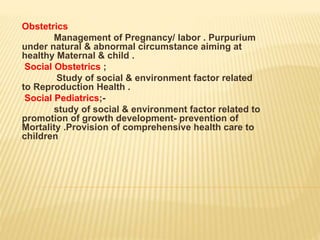
Obstetrics
Management of Pregnancy/ labor . Purpurium
under natural & abnormal circumstance aiming at
healthy Maternal & child .
Social Obstetrics ;
Study of social & environment factor related
to Reproduction Health .
Social Pediatrics;-
study of social & environment factor related to
promotion of growth development- prevention of
Mortality .Provision of comprehensive health care to
children
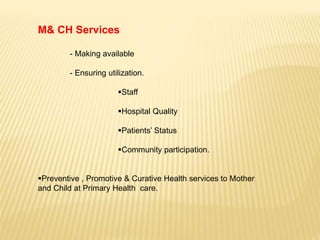
M& CH Services
- Making available
- Ensuring utilization.
Staff
Hospital Quality
Patients’ Status
Community participation.
Preventive , Promotive & Curative Health services to Mother
and Child at Primary Health care.
Need for specialized PHS for M & Child
1. Large Section of Population.
Mother 22%
Child 42%
Total 65%.
2. High Risk group
MMR – 4-5/1000
Morbid in community.
80% life scar – child bearing ,
child rearing
2/3rd Anemic Mother
½ anemic Non pregnant.
Early marriage
Early Menarche
Repeated Pregnancy – High rate
of complications
First few year following Menarche
1.Anemia – Incomplete Pelvic Growth
- Obstructed Labor
2.90% Indian Women are high Risk.
-Anemia
--short Stature
-- Bad Obstetric history.
-Child Hood – period of growth / development , personality
formation
3.Child survival
4.Disease/ Environment
-5.Quality & availability of Health , community servicers .
-- 6.high IMR -80/1000---- 2015 44/1000 . 50% ist week NNMR with in
48 hrs ( prenatal ) CDR under Five- 50/1000.
3. Preventable morbidity & mortality
-UIP
--ANC / PNC
-- Safe delivery.
-4. Physically compact Units
- MOTHER – HEALTHY – HEALTHY CHILD
-( Neonate , Child and Maternal care.)
-5. Unified , integrated , Simultaneous care of Women & children
-- ANC/PNC
--Infant
-- Under Five care.
-6. Unified Training of all those involved
- Logistic for Intervention, Simultaneous Supervision , management
/ evaluation is possible & feasible
7. Socio-economic Factors
Contribute to Reproduction are Controlable - 57% Girl married 15- 19
years.
11% Below 15 years.
Assessment Need for MCH
1. Birth Rate – helps to find base line – ANC 28/1000.
2. MMR – 2/3rd are preventable by hospital intervention ( Anemia, APH,PPH
Puerperal infections)
3. Prenatal mortality Rate --- 50/1000
28 weeks of pregnancy – 7 days of birth
BITWA --- Birth Injury, Infection , Trauma Weight – poor. Asphyxia
4. Place of Delivery . Large number at Home 95% are normal – needs
Environment , Transport &emergency OC.
5. Attendant at delivery – DAI / TBA
6. Prematurity – 25% premature either – Gestational or Weeks IUGR ( Intra
Uterine Growth Retardation) 50% cases are due to Poor Habits, Smoking,
Poverty , Undernourished Toxemia
7. ANC – Crux of MCH , Complete regular Check up , Minimum 3 visits., early
registration.
8. Resources
Rural area – 4% need Doctor, 1% need Hospital
Well trained Para medical One PHC – One Medical Officer.for 30
thousand population –
In one year- 40 delivery ,1000 care of Infant 5000 Child under
Five.
MPW at sub center 5000 population
Look after 160 ANC / year
TBA – per 1000 population.
Eligible Couple & Expected ANC
• Family Welfare.
•Post partum programme
•Medical Termination of
Pregnancy Act 1971.
•Training TBA.
•Urban Revamping Scheme.
•Free education to Girls.
Reservation in occupation
employment paid leaves.
Special Nutrition programme.
ICDS , Prevention of
Nutritional Anemia
 UIP
Mid day meal .
Act of Marriage age.
National policies for child
etc.
National Programmes
TARGET POPULATION
Pregnant women – 3.2%
Live birth --- > 3%
Post Natal --- > 3%
 INFANT --- 92% ( PXB 1000-1)
Child ( 9months to 3yrs) --- 8%
Under Five ---- 13%
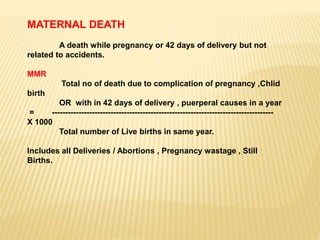
MATERNAL DEATH
A death while pregnancy or 42 days of delivery but not
related to accidents.
MMR
Total no of death due to complication of pregnancy ,Chlid
birth
OR with in 42 days of delivery , puerperal causes in a year
= -----------------------------------------------------------------------------------
X 1000
Total number of Live births in same year.
Includes all Deliveries / Abortions , Pregnancy wastage , Still
Births.
CAUSES OF MATERNAL DEATHS.
I Obstetric cause, Hemorrhage APH /PPH , Infections , Toxemia (
Pre eclampsia/ Eclampsia)
II Non Obstetric causes. Anemia , Accidents Diseases –
Tuberculosis, Malaria , Malnutrition, RHD, diabetes , hyper tension
, Pelvic inflammation.
III Social Causes
 Early& late marriage
Grand Multi para.
Repeated pregnancies.
Large family size.
Poor Nutrition.
Lack of Health services .
Poor sanitation
Transportation
Communication
Education
High incidence of Communicable diseases
Low status of Women
Shortage of Medical / paramedical staff.
Poor working & managerial ability
PREVENTIVE MEASURES of MMR
Preconception – Knowledge – priority intervention for
Safe Mother hood.
Ist Priority – Intervention.
2nd priority - Improving nutrition & Education
3rd priority – Increase over all socio economic up
lift of women.
Early Registration --- ANC
Timely Referral
Intra partum care.
Post natal care (PNC)
A . Essential care for all
 Early Registration of ANC – before 12- 16 weeks.
Minimum three visits 12, 32, & 36 Weeks.
Prevention of Nutritional Anemia ( PANA) Prophylactic IFA (
100 mg Iron & 0.5 mg Folic acid ) two tab daily / 100days.
Therapeutic – three tablet / day 100days. , Deworming in 3rd
trimester
B Immuinisation – TT – two doses at the interval of one month, 3
weeks before expected date of delivery.
C. Ensure – FIVE cleans – HAND, Surface, Cord , Thread &
Blade.
D. Post natal Care – to avoid sepsis, hemorrhage , Spacing advice
.
E. Early detection of Complication ;- Anemia, APH ,PPH,
Toxemia ( Wt gain > 5 Kg in month, BP > 150mmof Hg.
F. Emergency care ;- vacuum extraction, Anesthesia., Blood
transfusion , Caesarian Sections, Manual removal of Placenta.
Suction curettage
Sterilization
F Care of Women in reproductive age ;; No Conception below 20
years and above 30 /35 years.
ANTE NATAL CARE
Three Trimester – 280 days
LMP – 12 Wk. –Ist Trimester
13wk – 28 wks – IInd trimester
29wk – 40 wks – IIIrd trimester
Purpose of ANC
 Checkup to monitor ,progress & to identify the
complications.
To make aware about FRU
To have advance arrangements for transport,
anticipate Emergency.
Blood donor
Number of Visits
At least three visits 20,32 & 38 wks. More often
in Third trimester
First Contact Examination
1. Registration – Bio data
2. History of Pregnancy
• LMP – EDD
• Problem Anemia's etc
• Iron folic acid
• H/O infestation ,Radiation ,Drugs and Diet etc
3. History of Previous Pregnancy
 ANC, Place of delivery. ( Home ? Institutional)
 H/O hemorrhage , immunization , Abortion contraception
practice.
4. General Examination
 Weight, ( 2kg / month) Height ( 140 Cm) HB- > 10 gram%
 Lymph adenopathy, Neck veins Thyroid, Peritoneal edema
,
 Pulse , BP ( any change 30/15 mm in Systolic/diastolic ),
Jaundice
5. Systemic Examination for
o Diabetes , Hypertension, Goiter ,RHD, Hepatitis –
STD/AIDS.
o PID or Malignancies
o Family history – Twines, congenital abnormalities
Obstetric Examination
1. Confirm Pregnancy.
2. Breast Size
 Erectile hyper pigmented Areola.
 Montgomery’s tubercles on areola.
 Nipple secretions – 12th weeks onward
 Chlosma gravidonn face.
 Linea Vigra from xephisternum to pubic
symphysis.
 Striao graviodorum
3. Per Abdomen Examination
 Fundal height
 16 wks – half way pubis/ umbilicus
 28wks at umbilicus.
 32 wks upper 1/3rd / lower third 2/3rd
 38 wks side bulge by 40 wks.
4. Foetal parts – active movements 20 wks
5. Foetal Heart (FHS) 18-20 wks. Rate 120-140/minutes
6. Per Vaginal Examination – pap smear prepared.
BASE LINE INVESTIGATION
o HB, Peripheral Smear.
oUrine – albumin / sugar
oBP
oPap smear
oBlood group- RH status
oSerological test – VDRL
oBlood sugar
oAustralia antigen / HIV
ADVICE/SERVICESS
 Subsequent visit.
Identify high risk – APH ,Spotting,Multy para ,
Primigravida, Previous C/S , Hieght, Twins, Hydroamnios ,
Anaemia.
Examination /Investigations
Diet – 300 calories extra.,14gram Protein, IFA, Iodine,
green leafy vegitables , 1gram Calcium Lactate.( Social
ceremony – DOHAL -Jewan
Personal Hygiene - cleaniliness, Exercise, sleep , rest
after meal, avoid tobacco/alcohol radiation and hand
scrubs.
Immunisation – TT- 5th & 7th month. Earlier in first
pregnancy.
About Warning Signals – bleeding , discharge, Abdominal
or pelvic pain, fever, swellingof feet, blurring of vision,
dizziness , reduction of urine out put, nauseating vometing
, headache / fluctuating BP, loss of foetal movements.
Contraception & child rearing. Breast feeding etc.
Home visit
Stress.
IDENTIFYING HIGH RISK
 Primi gravid - <15 years or > 35 yrs.
Height below 140 cm.
Multi para – 4 or more
Bad obstetric history--- Abortion, still birth ,
premature ,ectopic, C/S , PPH, APH.
Medical conditions – TB, Diabetes, Hypertension ,
Heart disease.
Conceived after infertility treatment.
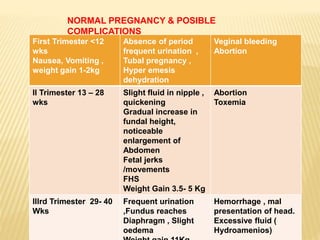
First Trimester <12
wks
Nausea, Vomiting ,
weight gain 1-2kg
Absence of period
frequent urination ,
Tubal pregnancy ,
Hyper emesis
dehydration
Veginal bleeding
Abortion
II Trimester 13 – 28
wks
Slight fluid in nipple ,
quickening
Gradual increase in
fundal height,
noticeable
enlargement of
Abdomen
Fetal jerks
/movements
FHS
Weight Gain 3.5- 5 Kg
Abortion
Toxemia
IIIrd Trimester 29- 40
Wks
Frequent urination
,Fundus reaches
Diaphragm , Slight
oedema
Hemorrhage , mal
presentation of head.
Excessive fluid (
Hydroamenios)
NORMAL PREGNANCY & POSIBLE
COMPLICATIONS
TBA _ Trained/ Traditional Birth Attendant
Training at PHC – 8 days Theory & 22 days practice
General Anatomy & Physiology
Labor Diagnosis & Pregnancy.
High risk identification
Identification of danger sign
About Referral system
Care of Cord.
Removal of Placenta.
.
WARNNING SIGNALS
Sluggish Pains -- Slow progress.
Cord or hand prolapse ---Sudden Change in FHS
Poor progress of good uterine contractions
Mucconium Stain --- Sever Headache
Fever & Convulsions. ----Bleeding APH or PPH
Placenta not separated with in 30 minutes.
Deterioration of condition
Sever Anemia leads to CHF.
Preparation of Labour
DDK-- Disposable Delivery Kit
Five cleans – Surface, Hands , Blade ,Thread & cord.
LABOUR STAGES – THREE
I- From time of pain start to time CX fully dilated .
II- Full dilatation of Cx to delivery of baby.
III – Delivery of baby to delivery of Placenta
P.S. ;- 12- 13 hrs in Prime gravid. ½ in multi gravid
PARTO GRAPH
Useful clinical guide for early detection of mother
who are not likely deliver normally needs medical assistance.
Following point are to be recorded;-
1. FHS
2. Cervical dilatation.
3. Descent of Head
4. Uterine contractions
5. Maternal vital conditions.
Recognition of;-
1. Obstructed labour
2. Uterine rupture
3. PPH
PS;-1.if All above are recognized early can reduce the
MMR .
2. If No increase in cervical dilatation or blood
loss more than ½ liters case needs to be referred to PHC or
District Hospital
Ist Stage of Labour
 labour pains Regular / Strong uterus become
hard.
Period 10 hrs in Primi / 5 hrs in second
Encourage – emptying of bladder
Give soap and water enema.
Can walk till bag of water is broken
Membrane brake in later should not move
about chances of cord prolapse.
II nd stage of Labour
o1-2 hrs.
oEncourage to push only during pains.
oShe must relax in between
oProvide support to perineum with pad of clean
cloth.
oWhen baby head is about to come till mother to
stop pusing and take deep breath – deliver head
slowly
oCut cord 2.5 inches from the umblicus
Harmful Practice
 women should not push in Ist stage.
Uterus should not be massaged or pushed
Do not give any medicine / inj in Iind stage.
III rd stage of Labour –
 10 – 15 minutes normal
Dry baby & put to the breast.
Always ensure Five clean.
Signs of separation of Placenta.
Uterus is hard & globular.
Sudden gush of blood
Extra valval portion of cord lengthen.
If fundus of uterus is gently pushed up forward umblicus
cord will not reced in to the vagina.
Check the placenta as soon as delivered , if it is not
complete – refer immediately.
MATERNAL HEALTH CARE

MATERNAL HEALTH CARE

  • 1.
    ALL INDIA INSTITUTEOF LOCAL SELF GOVERNMENT DELHI “ METERNAL HEALTH CARE for paramedics“ DR.P.P.SINGH By Dr. P.P.SINGH Faculty AIILSGD Ex Medical Superintendent Cum Consultant pathologist HRH Delhi Ex. Director India Population Project 8 Delhi..
  • 2.
    Obstetrics Management of Pregnancy/labor . Purpurium under natural & abnormal circumstance aiming at healthy Maternal & child . Social Obstetrics ; Study of social & environment factor related to Reproduction Health . Social Pediatrics;- study of social & environment factor related to promotion of growth development- prevention of Mortality .Provision of comprehensive health care to children
  • 3.
    M& CH Services -Making available - Ensuring utilization. Staff Hospital Quality Patients’ Status Community participation. Preventive , Promotive & Curative Health services to Mother and Child at Primary Health care.
  • 4.
    Need for specializedPHS for M & Child 1. Large Section of Population. Mother 22% Child 42% Total 65%. 2. High Risk group MMR – 4-5/1000 Morbid in community. 80% life scar – child bearing , child rearing 2/3rd Anemic Mother ½ anemic Non pregnant. Early marriage Early Menarche Repeated Pregnancy – High rate of complications
  • 5.
    First few yearfollowing Menarche 1.Anemia – Incomplete Pelvic Growth - Obstructed Labor 2.90% Indian Women are high Risk. -Anemia --short Stature -- Bad Obstetric history. -Child Hood – period of growth / development , personality formation 3.Child survival 4.Disease/ Environment -5.Quality & availability of Health , community servicers . -- 6.high IMR -80/1000---- 2015 44/1000 . 50% ist week NNMR with in 48 hrs ( prenatal ) CDR under Five- 50/1000.
  • 6.
    3. Preventable morbidity& mortality -UIP --ANC / PNC -- Safe delivery. -4. Physically compact Units - MOTHER – HEALTHY – HEALTHY CHILD -( Neonate , Child and Maternal care.) -5. Unified , integrated , Simultaneous care of Women & children -- ANC/PNC --Infant -- Under Five care. -6. Unified Training of all those involved - Logistic for Intervention, Simultaneous Supervision , management / evaluation is possible & feasible 7. Socio-economic Factors Contribute to Reproduction are Controlable - 57% Girl married 15- 19 years. 11% Below 15 years.
  • 7.
    Assessment Need forMCH 1. Birth Rate – helps to find base line – ANC 28/1000. 2. MMR – 2/3rd are preventable by hospital intervention ( Anemia, APH,PPH Puerperal infections) 3. Prenatal mortality Rate --- 50/1000 28 weeks of pregnancy – 7 days of birth BITWA --- Birth Injury, Infection , Trauma Weight – poor. Asphyxia 4. Place of Delivery . Large number at Home 95% are normal – needs Environment , Transport &emergency OC. 5. Attendant at delivery – DAI / TBA 6. Prematurity – 25% premature either – Gestational or Weeks IUGR ( Intra Uterine Growth Retardation) 50% cases are due to Poor Habits, Smoking, Poverty , Undernourished Toxemia 7. ANC – Crux of MCH , Complete regular Check up , Minimum 3 visits., early registration.
  • 8.
    8. Resources Rural area– 4% need Doctor, 1% need Hospital Well trained Para medical One PHC – One Medical Officer.for 30 thousand population – In one year- 40 delivery ,1000 care of Infant 5000 Child under Five. MPW at sub center 5000 population Look after 160 ANC / year TBA – per 1000 population. Eligible Couple & Expected ANC
  • 9.
    • Family Welfare. •Postpartum programme •Medical Termination of Pregnancy Act 1971. •Training TBA. •Urban Revamping Scheme. •Free education to Girls. Reservation in occupation employment paid leaves. Special Nutrition programme. ICDS , Prevention of Nutritional Anemia  UIP Mid day meal . Act of Marriage age. National policies for child etc. National Programmes
  • 10.
    TARGET POPULATION Pregnant women– 3.2% Live birth --- > 3% Post Natal --- > 3%  INFANT --- 92% ( PXB 1000-1) Child ( 9months to 3yrs) --- 8% Under Five ---- 13%
  • 11.
    MATERNAL DEATH A deathwhile pregnancy or 42 days of delivery but not related to accidents. MMR Total no of death due to complication of pregnancy ,Chlid birth OR with in 42 days of delivery , puerperal causes in a year = ----------------------------------------------------------------------------------- X 1000 Total number of Live births in same year. Includes all Deliveries / Abortions , Pregnancy wastage , Still Births.
  • 12.
    CAUSES OF MATERNALDEATHS. I Obstetric cause, Hemorrhage APH /PPH , Infections , Toxemia ( Pre eclampsia/ Eclampsia) II Non Obstetric causes. Anemia , Accidents Diseases – Tuberculosis, Malaria , Malnutrition, RHD, diabetes , hyper tension , Pelvic inflammation. III Social Causes  Early& late marriage Grand Multi para. Repeated pregnancies. Large family size. Poor Nutrition. Lack of Health services . Poor sanitation Transportation Communication Education High incidence of Communicable diseases Low status of Women Shortage of Medical / paramedical staff. Poor working & managerial ability
  • 13.
    PREVENTIVE MEASURES ofMMR Preconception – Knowledge – priority intervention for Safe Mother hood. Ist Priority – Intervention. 2nd priority - Improving nutrition & Education 3rd priority – Increase over all socio economic up lift of women. Early Registration --- ANC Timely Referral Intra partum care. Post natal care (PNC)
  • 14.
    A . Essentialcare for all  Early Registration of ANC – before 12- 16 weeks. Minimum three visits 12, 32, & 36 Weeks. Prevention of Nutritional Anemia ( PANA) Prophylactic IFA ( 100 mg Iron & 0.5 mg Folic acid ) two tab daily / 100days. Therapeutic – three tablet / day 100days. , Deworming in 3rd trimester B Immuinisation – TT – two doses at the interval of one month, 3 weeks before expected date of delivery. C. Ensure – FIVE cleans – HAND, Surface, Cord , Thread & Blade. D. Post natal Care – to avoid sepsis, hemorrhage , Spacing advice . E. Early detection of Complication ;- Anemia, APH ,PPH, Toxemia ( Wt gain > 5 Kg in month, BP > 150mmof Hg. F. Emergency care ;- vacuum extraction, Anesthesia., Blood transfusion , Caesarian Sections, Manual removal of Placenta. Suction curettage Sterilization F Care of Women in reproductive age ;; No Conception below 20 years and above 30 /35 years.
  • 15.
    ANTE NATAL CARE ThreeTrimester – 280 days LMP – 12 Wk. –Ist Trimester 13wk – 28 wks – IInd trimester 29wk – 40 wks – IIIrd trimester Purpose of ANC  Checkup to monitor ,progress & to identify the complications. To make aware about FRU To have advance arrangements for transport, anticipate Emergency. Blood donor Number of Visits At least three visits 20,32 & 38 wks. More often in Third trimester
  • 16.
    First Contact Examination 1.Registration – Bio data 2. History of Pregnancy • LMP – EDD • Problem Anemia's etc • Iron folic acid • H/O infestation ,Radiation ,Drugs and Diet etc 3. History of Previous Pregnancy  ANC, Place of delivery. ( Home ? Institutional)  H/O hemorrhage , immunization , Abortion contraception practice. 4. General Examination  Weight, ( 2kg / month) Height ( 140 Cm) HB- > 10 gram%  Lymph adenopathy, Neck veins Thyroid, Peritoneal edema ,  Pulse , BP ( any change 30/15 mm in Systolic/diastolic ), Jaundice 5. Systemic Examination for o Diabetes , Hypertension, Goiter ,RHD, Hepatitis – STD/AIDS. o PID or Malignancies o Family history – Twines, congenital abnormalities
  • 17.
    Obstetric Examination 1. ConfirmPregnancy. 2. Breast Size  Erectile hyper pigmented Areola.  Montgomery’s tubercles on areola.  Nipple secretions – 12th weeks onward  Chlosma gravidonn face.  Linea Vigra from xephisternum to pubic symphysis.  Striao graviodorum 3. Per Abdomen Examination  Fundal height  16 wks – half way pubis/ umbilicus  28wks at umbilicus.  32 wks upper 1/3rd / lower third 2/3rd  38 wks side bulge by 40 wks. 4. Foetal parts – active movements 20 wks 5. Foetal Heart (FHS) 18-20 wks. Rate 120-140/minutes 6. Per Vaginal Examination – pap smear prepared.
  • 18.
    BASE LINE INVESTIGATION oHB, Peripheral Smear. oUrine – albumin / sugar oBP oPap smear oBlood group- RH status oSerological test – VDRL oBlood sugar oAustralia antigen / HIV
  • 19.
    ADVICE/SERVICESS  Subsequent visit. Identifyhigh risk – APH ,Spotting,Multy para , Primigravida, Previous C/S , Hieght, Twins, Hydroamnios , Anaemia. Examination /Investigations Diet – 300 calories extra.,14gram Protein, IFA, Iodine, green leafy vegitables , 1gram Calcium Lactate.( Social ceremony – DOHAL -Jewan Personal Hygiene - cleaniliness, Exercise, sleep , rest after meal, avoid tobacco/alcohol radiation and hand scrubs. Immunisation – TT- 5th & 7th month. Earlier in first pregnancy. About Warning Signals – bleeding , discharge, Abdominal or pelvic pain, fever, swellingof feet, blurring of vision, dizziness , reduction of urine out put, nauseating vometing , headache / fluctuating BP, loss of foetal movements. Contraception & child rearing. Breast feeding etc. Home visit Stress.
  • 20.
    IDENTIFYING HIGH RISK Primi gravid - <15 years or > 35 yrs. Height below 140 cm. Multi para – 4 or more Bad obstetric history--- Abortion, still birth , premature ,ectopic, C/S , PPH, APH. Medical conditions – TB, Diabetes, Hypertension , Heart disease. Conceived after infertility treatment.
  • 21.
    First Trimester <12 wks Nausea,Vomiting , weight gain 1-2kg Absence of period frequent urination , Tubal pregnancy , Hyper emesis dehydration Veginal bleeding Abortion II Trimester 13 – 28 wks Slight fluid in nipple , quickening Gradual increase in fundal height, noticeable enlargement of Abdomen Fetal jerks /movements FHS Weight Gain 3.5- 5 Kg Abortion Toxemia IIIrd Trimester 29- 40 Wks Frequent urination ,Fundus reaches Diaphragm , Slight oedema Hemorrhage , mal presentation of head. Excessive fluid ( Hydroamenios) NORMAL PREGNANCY & POSIBLE COMPLICATIONS
  • 22.
    TBA _ Trained/Traditional Birth Attendant Training at PHC – 8 days Theory & 22 days practice General Anatomy & Physiology Labor Diagnosis & Pregnancy. High risk identification Identification of danger sign About Referral system Care of Cord. Removal of Placenta. .
  • 23.
    WARNNING SIGNALS Sluggish Pains-- Slow progress. Cord or hand prolapse ---Sudden Change in FHS Poor progress of good uterine contractions Mucconium Stain --- Sever Headache Fever & Convulsions. ----Bleeding APH or PPH Placenta not separated with in 30 minutes. Deterioration of condition Sever Anemia leads to CHF.
  • 24.
    Preparation of Labour DDK--Disposable Delivery Kit Five cleans – Surface, Hands , Blade ,Thread & cord. LABOUR STAGES – THREE I- From time of pain start to time CX fully dilated . II- Full dilatation of Cx to delivery of baby. III – Delivery of baby to delivery of Placenta P.S. ;- 12- 13 hrs in Prime gravid. ½ in multi gravid
  • 25.
    PARTO GRAPH Useful clinicalguide for early detection of mother who are not likely deliver normally needs medical assistance. Following point are to be recorded;- 1. FHS 2. Cervical dilatation. 3. Descent of Head 4. Uterine contractions 5. Maternal vital conditions. Recognition of;- 1. Obstructed labour 2. Uterine rupture 3. PPH PS;-1.if All above are recognized early can reduce the MMR . 2. If No increase in cervical dilatation or blood loss more than ½ liters case needs to be referred to PHC or District Hospital
  • 26.
    Ist Stage ofLabour  labour pains Regular / Strong uterus become hard. Period 10 hrs in Primi / 5 hrs in second Encourage – emptying of bladder Give soap and water enema. Can walk till bag of water is broken Membrane brake in later should not move about chances of cord prolapse. II nd stage of Labour o1-2 hrs. oEncourage to push only during pains. oShe must relax in between oProvide support to perineum with pad of clean cloth. oWhen baby head is about to come till mother to stop pusing and take deep breath – deliver head slowly oCut cord 2.5 inches from the umblicus
  • 27.
    Harmful Practice  womenshould not push in Ist stage. Uterus should not be massaged or pushed Do not give any medicine / inj in Iind stage. III rd stage of Labour –  10 – 15 minutes normal Dry baby & put to the breast. Always ensure Five clean. Signs of separation of Placenta. Uterus is hard & globular. Sudden gush of blood Extra valval portion of cord lengthen. If fundus of uterus is gently pushed up forward umblicus cord will not reced in to the vagina. Check the placenta as soon as delivered , if it is not complete – refer immediately.