ALL INDIA INSTITUTE OF LOCAL SELF
GOVERNMENT
DELHI
“NATIONAL AIDS CONTROL PROGRAMME “
DR.P.P.SINGH
By
Dr. P.P.SINGH
Faculty AIILSGD
Ex Medical Superintendent Cum Consultant pathologist HRH
Delhi
Ex. Director India Population Project 8 Delhi..
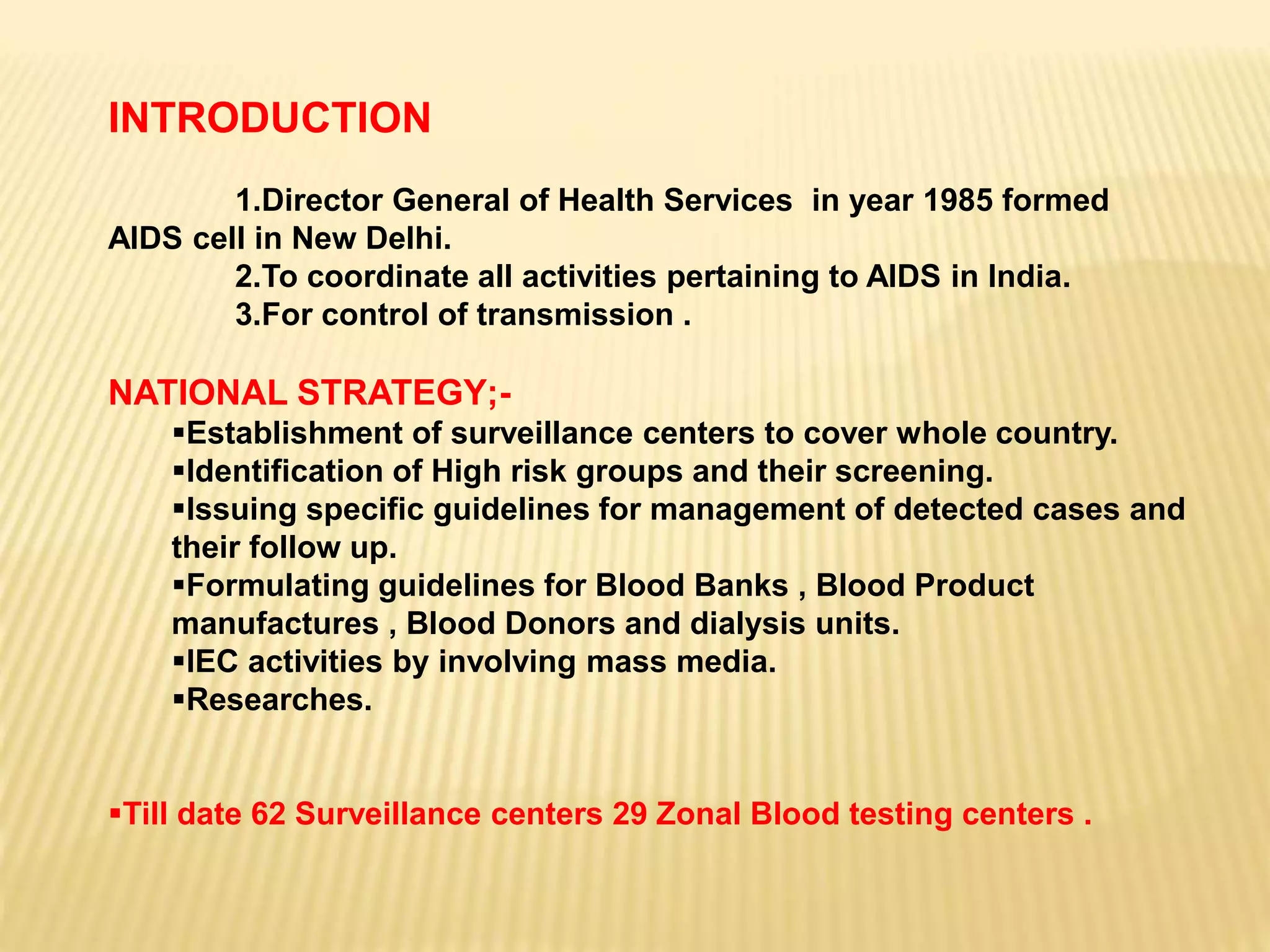
INTRODUCTION
1.Director General of Health Services in year 1985 formed
AIDS cell in New Delhi.
2.To coordinate all activities pertaining to AIDS in India.
3.For control of transmission .
NATIONAL STRATEGY;-
Establishment of surveillance centers to cover whole country.
Identification of High risk groups and their screening.
Issuing specific guidelines for management of detected cases and
their follow up.
Formulating guidelines for Blood Banks , Blood Product
manufactures , Blood Donors and dialysis units.
IEC activities by involving mass media.
Researches.
Till date 62 Surveillance centers 29 Zonal Blood testing centers .
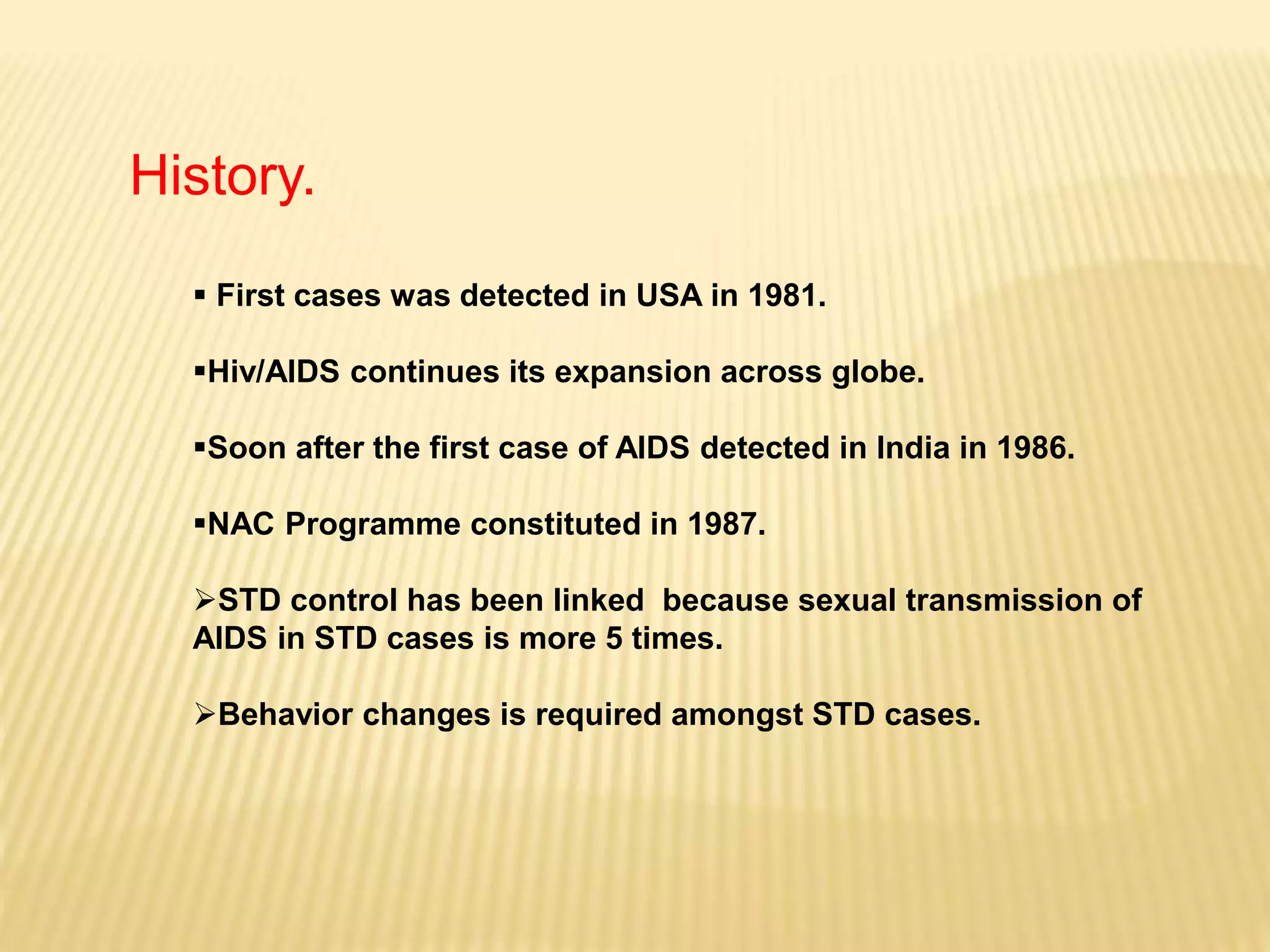
History.
 First cases was detected in USA in 1981.
Hiv/AIDS continues its expansion across globe.
Soon after the first case of AIDS detected in India in 1986.
NAC Programme constituted in 1987.
STD control has been linked because sexual transmission of
AIDS in STD cases is more 5 times.
Behavior changes is required amongst STD cases.
NACO – FOCUSSED
Increasing awareness of HIV/AIDS.
Screening of Blood for HIV.
Testing of Individuals practicing High risk behaviours.
NACO was established in Year 1992 under the MOHFW
with the assistance of World Bank ( 84 million US $ ).
WHO gave the assistance of 1.5 million US $.
The available indicates that ;-
1. The highest Number of HIV infection – Maharashtra and Tamil
Nadu and amongst inject able drug users in Manipur.
2. Predominant mode of transmission –
 Hetro sexual contact
 Blood transfusion
 Blood Products.
 Inject able Drugs Users
1. Male account78.6% and Female 21.4% out of AIDS cases of age
group of 15 – 49 years.
2. Trend is in two ways – From risk group to general population ,
from urban area to rural area. ( data from ANC clinics & among
children)
3. The major opportunistic infection is tuberculosis. Thus dual
epidemic of TB & AIDS is predicted.
4. There are about 4 Million HIV Positive cases in India.
ALL INDIA INSTITUTE OF LOCAL SELF
GOVERNMENT
DELHI
“PPTCT
DR.P.P.SINGH
By
Dr. P.P.SINGH
Faculty AIILSGD
Ex Medical Superintendent Cum Consultant pathologist HRH
Delhi
Ex. Director India Population Project 8 Delhi..
PREVENTION from PARENT TO CHILD TRANSMISSION
PROGRAMME.
ELEMENTS
Primary Prevention of HIV in Young people & women of child
bearing age through :-
Promotion & Provision of free , subsidized or
commercially marketed CONDOM.
Provide diagnosis of STD.
Behavior Change Communication effort to reduce
individual at risk.
To inform about PTCT during pregnancy, delivery , breast
feeding .
To encourage for VCT counselor or health provider.
Prevention of unintended pregnancies in HIV cases.
Through RCH & FP.
Prevention of transmission from HIV positive women to
her child through anti retroviral (ARV) prophylaxis and
safer delivery.
 Care and support services to HIV infected women.
Comprehensive PPTCT service include 4
prongs.
1. Prong 1 – Primary prevention of HIV infection.
2. Prong 2 – Prevention of unintended pregnancies
among HIV infected women..
3. Prong 3 - Prevention of HIV transmission from HIV
infected women to their infants.
4. Prong 4- Provision of care and support to HIV infected
women ,their infants and their families.
RATIONALE for PPTCT in INDIA.
27 million pregnancies per year.
162000 infected pregnancies.
Cohort of 48600 infected newborns per year.
0.6% prevalence.
30% transmission,
Most of these children die with in 2-5 years.
PPTCT Interventions
To decrease Risk of HIV transmission to
Infant.
During pregnancy.
Decrease viral load ( ARV
prophylaxis & treatment).
Monitor and treat infections.
Support optional Nutrition.
PPTCT : Interventions to decrease Risk
 Avoid :
During labour and delivery.
Premature rupture of membranes.
Invasive delivery techniques.
Unresolved infections such as STIs.
PROVIDE.:-
Elective caesarean section when safe and
feasible.
Promote safer infant feeding.
Replacement feeding.
Exclusive Breast feeding for limited time.
TREATMENT ( New prophylaxis )
A 200 mg pill is givin to the mother during labour
and a spoonful of syrup to baby with in 72 hrs of birth.
ALL INDIA INSTITUTE OF LOCAL SELF
GOVERNMENT
DELHI
“NATIONAL STD CONTROL PROGRAMME “
DR.P.P.SINGH
By
Dr. P.P.SINGH
Faculty AIILSGD
Ex Medical Superintendent Cum Consultant pathologist HRH
Delhi
Ex. Director India Population Project 8 Delhi..
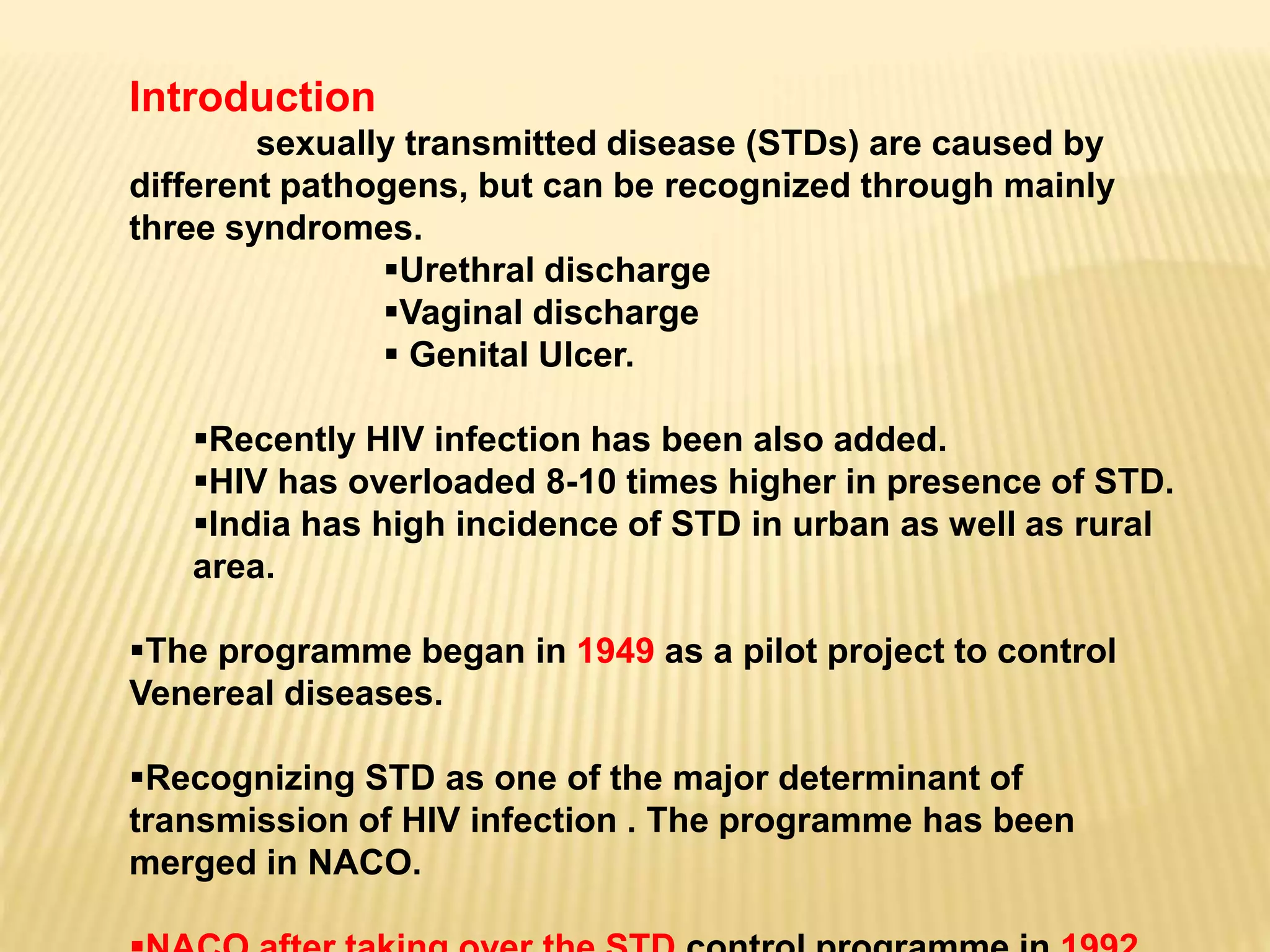
Introduction
sexually transmitted disease (STDs) are caused by
different pathogens, but can be recognized through mainly
three syndromes.
Urethral discharge
Vaginal discharge
 Genital Ulcer.
Recently HIV infection has been also added.
HIV has overloaded 8-10 times higher in presence of STD.
India has high incidence of STD in urban as well as rural
area.
The programme began in 1949 as a pilot project to control
Venereal diseases.
Recognizing STD as one of the major determinant of
transmission of HIV infection . The programme has been
merged in NACO.
STD Organism Type of Parasite
Syphilis Trepenoma
pallidum
Spirocheate
bacteria.
Chancroid Haemophilus
duceyi.
gram negative
coco bacilli.
Herpes genitalis Herpes simplex
virus 1&2
Virus
Denovanosis Calymmatobacter
ium granulomatis
Gram negative
bacilli Bacteria
LGV
(Lymphogranulo
ma Venerum )
Chlamydia
trachomatis
Bacteria
intracellular
parasite
Gonorrhoea Neisseria
gonorrhoeae
Gram negative
cocci.
`STD distribution
````````
Male are more infected.
Syphilis ,Gonorrhea , painless syphilis ,
Chancre in females.
Age group 21- 35 yrs.
Prostitutes , Industrial workers.
OBJECTIVES
To reduce transmission of STD /HIV by reducing
risk factors.
To prevent the development of short & long term
Morbidity /Mortality due to STD.
STRATEGIES
IEC for awareness and Promotion of Health Care
seeking behaviour. For safer sex and use of Condom.
Adequate Management - Comprehensive case
management .
Increasing access to health care.
To establishing 5 Regional training Centers ( Mumbai,
Calcutta, Delhi, Madras & Hyderabad.)
Development of 5 Regional Laboratories & 5 Regional
reference centers.
All medical collages as Skin Leprosy –STD clinics and
STD district hospital.
CONTROL MEASURES:-
 Case detection .
Laboratory Support.
Treatment.
Case Holding and Follow up.
Special measures for High risk groups.
Removal of Devdasi system.
Legislation
Political awerness.
National AIDS & STD control programme of India

National AIDS & STD control programme of India

  • 1.
    ALL INDIA INSTITUTEOF LOCAL SELF GOVERNMENT DELHI “NATIONAL AIDS CONTROL PROGRAMME “ DR.P.P.SINGH By Dr. P.P.SINGH Faculty AIILSGD Ex Medical Superintendent Cum Consultant pathologist HRH Delhi Ex. Director India Population Project 8 Delhi..
  • 2.
    INTRODUCTION 1.Director General ofHealth Services in year 1985 formed AIDS cell in New Delhi. 2.To coordinate all activities pertaining to AIDS in India. 3.For control of transmission . NATIONAL STRATEGY;- Establishment of surveillance centers to cover whole country. Identification of High risk groups and their screening. Issuing specific guidelines for management of detected cases and their follow up. Formulating guidelines for Blood Banks , Blood Product manufactures , Blood Donors and dialysis units. IEC activities by involving mass media. Researches. Till date 62 Surveillance centers 29 Zonal Blood testing centers .
  • 3.
    History.  First caseswas detected in USA in 1981. Hiv/AIDS continues its expansion across globe. Soon after the first case of AIDS detected in India in 1986. NAC Programme constituted in 1987. STD control has been linked because sexual transmission of AIDS in STD cases is more 5 times. Behavior changes is required amongst STD cases.
  • 4.
    NACO – FOCUSSED Increasingawareness of HIV/AIDS. Screening of Blood for HIV. Testing of Individuals practicing High risk behaviours. NACO was established in Year 1992 under the MOHFW with the assistance of World Bank ( 84 million US $ ). WHO gave the assistance of 1.5 million US $.
  • 5.
    The available indicatesthat ;- 1. The highest Number of HIV infection – Maharashtra and Tamil Nadu and amongst inject able drug users in Manipur. 2. Predominant mode of transmission –  Hetro sexual contact  Blood transfusion  Blood Products.  Inject able Drugs Users 1. Male account78.6% and Female 21.4% out of AIDS cases of age group of 15 – 49 years. 2. Trend is in two ways – From risk group to general population , from urban area to rural area. ( data from ANC clinics & among children) 3. The major opportunistic infection is tuberculosis. Thus dual epidemic of TB & AIDS is predicted. 4. There are about 4 Million HIV Positive cases in India.
  • 6.
    ALL INDIA INSTITUTEOF LOCAL SELF GOVERNMENT DELHI “PPTCT DR.P.P.SINGH By Dr. P.P.SINGH Faculty AIILSGD Ex Medical Superintendent Cum Consultant pathologist HRH Delhi Ex. Director India Population Project 8 Delhi..
  • 7.
    PREVENTION from PARENTTO CHILD TRANSMISSION PROGRAMME. ELEMENTS Primary Prevention of HIV in Young people & women of child bearing age through :- Promotion & Provision of free , subsidized or commercially marketed CONDOM. Provide diagnosis of STD. Behavior Change Communication effort to reduce individual at risk. To inform about PTCT during pregnancy, delivery , breast feeding . To encourage for VCT counselor or health provider. Prevention of unintended pregnancies in HIV cases. Through RCH & FP. Prevention of transmission from HIV positive women to her child through anti retroviral (ARV) prophylaxis and safer delivery.  Care and support services to HIV infected women.
  • 8.
    Comprehensive PPTCT serviceinclude 4 prongs. 1. Prong 1 – Primary prevention of HIV infection. 2. Prong 2 – Prevention of unintended pregnancies among HIV infected women.. 3. Prong 3 - Prevention of HIV transmission from HIV infected women to their infants. 4. Prong 4- Provision of care and support to HIV infected women ,their infants and their families.
  • 9.
    RATIONALE for PPTCTin INDIA. 27 million pregnancies per year. 162000 infected pregnancies. Cohort of 48600 infected newborns per year. 0.6% prevalence. 30% transmission, Most of these children die with in 2-5 years.
  • 10.
    PPTCT Interventions To decreaseRisk of HIV transmission to Infant. During pregnancy. Decrease viral load ( ARV prophylaxis & treatment). Monitor and treat infections. Support optional Nutrition.
  • 11.
    PPTCT : Interventionsto decrease Risk  Avoid : During labour and delivery. Premature rupture of membranes. Invasive delivery techniques. Unresolved infections such as STIs. PROVIDE.:- Elective caesarean section when safe and feasible. Promote safer infant feeding. Replacement feeding. Exclusive Breast feeding for limited time. TREATMENT ( New prophylaxis ) A 200 mg pill is givin to the mother during labour and a spoonful of syrup to baby with in 72 hrs of birth.
  • 12.
    ALL INDIA INSTITUTEOF LOCAL SELF GOVERNMENT DELHI “NATIONAL STD CONTROL PROGRAMME “ DR.P.P.SINGH By Dr. P.P.SINGH Faculty AIILSGD Ex Medical Superintendent Cum Consultant pathologist HRH Delhi Ex. Director India Population Project 8 Delhi..
  • 13.
    Introduction sexually transmitted disease(STDs) are caused by different pathogens, but can be recognized through mainly three syndromes. Urethral discharge Vaginal discharge  Genital Ulcer. Recently HIV infection has been also added. HIV has overloaded 8-10 times higher in presence of STD. India has high incidence of STD in urban as well as rural area. The programme began in 1949 as a pilot project to control Venereal diseases. Recognizing STD as one of the major determinant of transmission of HIV infection . The programme has been merged in NACO.
  • 14.
    STD Organism Typeof Parasite Syphilis Trepenoma pallidum Spirocheate bacteria. Chancroid Haemophilus duceyi. gram negative coco bacilli. Herpes genitalis Herpes simplex virus 1&2 Virus Denovanosis Calymmatobacter ium granulomatis Gram negative bacilli Bacteria LGV (Lymphogranulo ma Venerum ) Chlamydia trachomatis Bacteria intracellular parasite Gonorrhoea Neisseria gonorrhoeae Gram negative cocci.
  • 15.
    `STD distribution ```````` Male aremore infected. Syphilis ,Gonorrhea , painless syphilis , Chancre in females. Age group 21- 35 yrs. Prostitutes , Industrial workers. OBJECTIVES To reduce transmission of STD /HIV by reducing risk factors. To prevent the development of short & long term Morbidity /Mortality due to STD.
  • 16.
    STRATEGIES IEC for awarenessand Promotion of Health Care seeking behaviour. For safer sex and use of Condom. Adequate Management - Comprehensive case management . Increasing access to health care. To establishing 5 Regional training Centers ( Mumbai, Calcutta, Delhi, Madras & Hyderabad.) Development of 5 Regional Laboratories & 5 Regional reference centers. All medical collages as Skin Leprosy –STD clinics and STD district hospital.
  • 17.
    CONTROL MEASURES:-  Casedetection . Laboratory Support. Treatment. Case Holding and Follow up. Special measures for High risk groups. Removal of Devdasi system. Legislation Political awerness.