SUBMITTED TO: SUBMITTED BY:
MRS. ASHA MA’AM MANJEET KAUR
CON,SJH
 AIDS is defined as the most severe form of a
continuum of illnesses associated with human
immunodeficiency disease(HIV) infection .
 HIV: belongs to a group of viruses known as
RETROVIRUSES ( type of viruses that carry their
genetic material in the form of ribonucleic
acid[RNA] rather than deoxyribonucleic
acid[DNA] ).
 The immunodeficiency virus(HIV) principally
attacks CD4 T-cells, a vital part of the human
immune system . As a result , the body’s ability to
resist opportunistic viral, bacterial , bacterial ,
fungal , and other infection is greatly weakened .
 HIV is retrovirus.
 CLASSIFICATION OF STATES:
1. High prevalence : >5% in HRG & >1% in ANC
Maharashtra , TN , Andhra Pradesh , Karnataka ,
Nagaland.
2. Moderate prevalence : >5% in HRG & 1% in ANC
Gujarat , Pondicherry , Goa .
3. Low prevalence : >5% in HRG & 1% in ANC
all other states and UTs
 12,70,678 people are on ART.
 21,16,581 people were living with HIV.
 75,948 people became newly infected with HIV.
 67,612 deaths due to AIDS.
 35,255 pregnant woman needs PPTCT.
 INTRODUCTION
 HIV infection s first detected in 1986, when 10
HIV positive samples were found from a group of
102 female sex workers from Chennai.
62 AIDS surveillance centres were gradually
established nationwide .
 The milestones of the programme are
summarized as follows
1986- - first case of HIV detected
- AIDS task force setup by the ICMR
- national AIDS committee established
under the ministry of health.
 1990- -mid term plan launched for from states
and the four metros.
 1992- - NACP 1 launched to show down the spread of
HIV infection
- national AIDS control board constituted
- NACO setup
 1999- - NACP 2 begins focusing on behaviour change ,
increased decentralization and NGO involvement.
- state AIDS control societies developed .
 2002- - national AIDS control policy adopted.
- national blood policy adopted.
 2004- - antiretroviral treatment initiated .
 2006- - national council on AIDS constituted under
chairmanship of prime minister.
- national policy on paediatric ART formulated.
 2007- - NACP 3 launched for years (2007-2012)
 2012- - NACP 4 launched for next 5 years
NATIONAL AIDS CONTROL
PROGRAME -1
OBJECTIVES: Slow and prevent the spread of HIV
through a major effort to prevent HIV
transmission.
KEY STRATEGIES:
Focus on raising awareness , blood safety ,
prevention among high risk populations.
Improving surveillance
ACHIEVEMENTS:
National AIDS response structures at both
national and state levels and provided critical
financing
Strong partnership with the WHO and later
helped mobilized additional donor resources
Established the state AIDS control cells.
NATIONAL AIDS CONTROL
PROGRAMME-2
OBJECTIVE: Reduce the spread of HIV infection in
India through behaviour change and increase
capacity to respond to HIV on a long-term basis.
KAY STRATEGIES:
Targeted interventions for high risk groups.
Preventive interventions for general populations.
Involvement of NGOs.
Institutional strengthening.
ACHIEVEMENTS:
At the operational level 1,033 targeted
interventions setup, 875 voluntary counselling and
testing centres (VCTC) and 679 STF clinics at the
district level.
National wide and state level behaviour
surveillance surveys(BSS) were conducted .
PPTCT expanded.
A computerized management information
system(CMIS) created .
HIV prevention and care and support organisation
and networks were strengthened
Support from partner agencies increased
substantially.
NATIONAL AIDS CONTROL
PROGRAMME-3
OBJECTIVES: Reduce the rate of incidence by 60%
in the first year of the programme.
KEY STRATEGIES:
 Prevention – targeted intervention (TI) , ICTC ,
blood safety.
 Care support and treatment
 Capacity building- establishment , support and
capacity
 Strategic information management monitoring
and evaluation.
PROGRAMME PRIORITIES
 Considering that more than 99% of the population
in the country is free fro the infection , NACP-3
has place the highest priority on prevention efforts
while, at the same time seeking to integrate
prevention with care, support and treatment .
 Sub population that have the highest risk of
exposure to HIV will receive the highest priority
for intervention .
 Those in general population who have greater
need for accessing prevention services such as
treatment of STIs.
 Ensures who need treatment would have access to
prophylaxis and management of opportunistic
infection.
 Provision of services for prevention of parent to
child transmission of disease.
 Impact of HIV will be mitigated through welfare
agencies providing nutritional support.
 Invest in community care centres to provide
psycho-social support.
 Socio-economic determinants that make a person
vulnerable also increase the risk of infection.
ACHIEVEMENTS:
 There were 306 fully functional ART centres .
 Nearby 12.5 Lacs PLHIV were registered and
420000 patients were on ART .
 612 link ART centres(LAC) had been established
wherein , 26023 PLHIV were taking services .
 There were 10 centres of excellence.
 7 regional paediatric centres also functional.
 259 community care centres across the country.
 6000 condoms and 6000 village information
centres established.
 3000 red ribbon clubs established.
 Link workers training module updated .
NATIONAL AIDS CONTROL
PROGRAMME-4
Launched on 12 February 2014.
Total budget outlet Rs. 1429 crores.
Goal: accelerate reversal and integrate response .
OBJECTIVES:
Reduce new infection by 50% (2007 baseline of
NACP-3)
Provide comprehensive care and support to all
persons living with HIV/AIDS.
STRATEGIES:
Intensify and consolidate preventive services .
Increase assess and promote comprehensive care,
support & treatment.
Expanding IEC services.
Capacity building .
Strengthening strategic information management
system.
KEY PRIORITIES UNDER NACP-4
Preventing new infections by sustaining the reach
of current interventions and effectively addressing
emerging epidemics.
Prevention to parent to child transmission
Focusing on IEC
Providing comprehensive care , support and
treatment to eligible PLHIV.
 Reducing stigma
 De-centralizing rollout of services including technical
support.
 Ensuring effective use of strategic information at all
levels of programme.
 Building capacities of NGO and civil society partners
especially in states with emerging epidemics.
Integrating HIV services with health system in a
phased manner.
Mainstreaming of HIV/AIDS activities.
PREVENTION SERVICES:
Targeted interventions for high risk group and
bridge population.
Needle-syringe exchange programme(NSEP) and
opioids substitution therapy (OST) for IDUs.
Prevention intervention for migrant population at
source , transit and destination.
Link worker scheme (LWS) for HRGs and
vulnerable population in rural areas .
Prevention & control of sexually transmitted
infection/reproductive tract infections.
Blood safety
 HIV counselling and testing services .
 Prevention to parent to child transmission.
 Condom promotion.
 Information , education and communication(IEC) &
behaviour change communication(BCC).
 Surveillance are being carried out to detect spread
of the disease & to make appropriate strategy for
prevention and control i.e. by area specific target
interventions & best practice approach .
 Types of surveillance:
HIV sentinel surveillance
HIV sero-surveillance
AIDS case surveillance
STD surveillance
Behavioural surveillance
Integration with surveillance of other disease like TB
etc.
• Out of above most effective surveillance is HIV
sentinel surveillance .
• The main aim of the surveillance is confined to
monitor the trend of HIV infection.
OBJECTIVES OF THE SURVILLANCE :
To determine the level of HIV infection among general
population as well as HRGs in different states
To uderstand the trend of HIV epidemic .
 To understand the geographical spread of infection
and to identify emerging pockets.
 To provide information for prioritization of the
program resources & evaluation of program impact
 To estimate prevalence & HIV burden in the country .
 It is done in same place over few years by anonymous
serological tests i.e. HIV testing is done without
identification for purposes eg. VDRL , STD clinics.
 The demerit of the test is that +ve person is not
identified.
 In 1994 it was started with 55 sentinel sites and
become 180 in 1998
 The number of HRG of people increased in HIV
sentinel sites .
 THE KEY FEATURES OF SURVEILLANCE ARE
1. Inclusion of data from high risk population through
targeted intervention sites
2. Adding rural samples through antenatal clinics
 The strategy adopted was whatever be the sentinel
site and amount of sample collected – the duration ,
frequency and age group of people in the surveillance
should be same in all HRG , bridge population and
general population.
Counselling and HIV testing services :
1. ICTC
2. Prevention of parent to child transmission
3. HIV/TB collaborative activities
4. Care, support & treatment services.
5. Guidelines for HIV and infant feeding
6. STD control programme
1. Integrated counselling and testing services :-
 This is available to increase access to HIV
diagnosis.
 It includes testing services & community
approaches at various level of health system in
India like state, district, sub-district, &
village/community level.
 Functions:
 Early detection of HIV.
Provision of basic information on modes of
transmission, prevention of HIV for promoting
behavioural change and reducing vulnerability and
liking the PLHIV to care , support & treatment .
 Two types of ICTC:
1. Fixed facility ICTC
2. Mobile ICTC
All HIV testing services must follow the WHO-
recommended principles known as the “5 Cs”:
 informed Consent
 Confidentiality
 Counseling
 Correct test results
 Connection (linkage to care, treatment and other
services).
2. Prevention of parent to child transmission:-
 The prevention of parent to child transmission of
HIV/AIDS(PPTCT) program was started in 2002.
 Currently there are more then 15000 ICTCs in
country which offer PPTCT services to pregnant
women.
 The aim of the PPTCT program is to offer HIV
testing to every pregnant woman (universal
Coverage ) in the country , so as to cover all
estimated HIV positive pregnant women and
eliminate transmission of HIV from mother o
child.
 In India , PPTCT interventions under NACP was
started in 2002 , using SD-NVP prophylaxis for
HIV positive women during labour and also for her
new born child immediately after birth.
 The PPTCT services provide access to all pregnant
women for HIV diagnosis prevention , care and
treatment services.
3. HIV/TB collaborative activities :-
 NACP-4 covers the HIV testing of TB patients.
 It is combined work of NACP & RNTCP.
 State with high prevalence covers about 90% of
TB patients for HIV testing.
 There is expected detection of HIV within 2-4
weeks of TB positivity.
 This service was started in 2002 in Karnataka
followed by Maharashtra , Andhra Pradesh &
Tamil Nadu.
4. Guidelines for HIV and infant feeding :-
 Till 2009, WHO advise HIV positive mothers to
avoid breast feeding if they were able to afford
and store formula milk safely.
 On 30th November 2009 ,WHO released new
recommendations on infant feeding by HIV
positive mothers .
 HIV positive mothers or their infants take anti
retroviral drugs throughout the period of breast
Feeding and until the infant is 12 months old.
 Child can benefit from breast feeding with every little
risk of becoming infected with HIV.
5. Care, support & treatment services:-
 Laboratory services for CD4 testing and other
investigations .
 Free first line & second line ART through ART
centers and link ART centers , centers of
excellence & ART plus centers .
 Pediatric ART for children
 Early infant diagnosis for HIV exposed infants
And children below 18 months .
 HIV/TB coordination ( cross , referral , detection
and treatment of co-infection).
 Treatment of opportunistic infections .
 Drop-in centers for PLHIV networks.
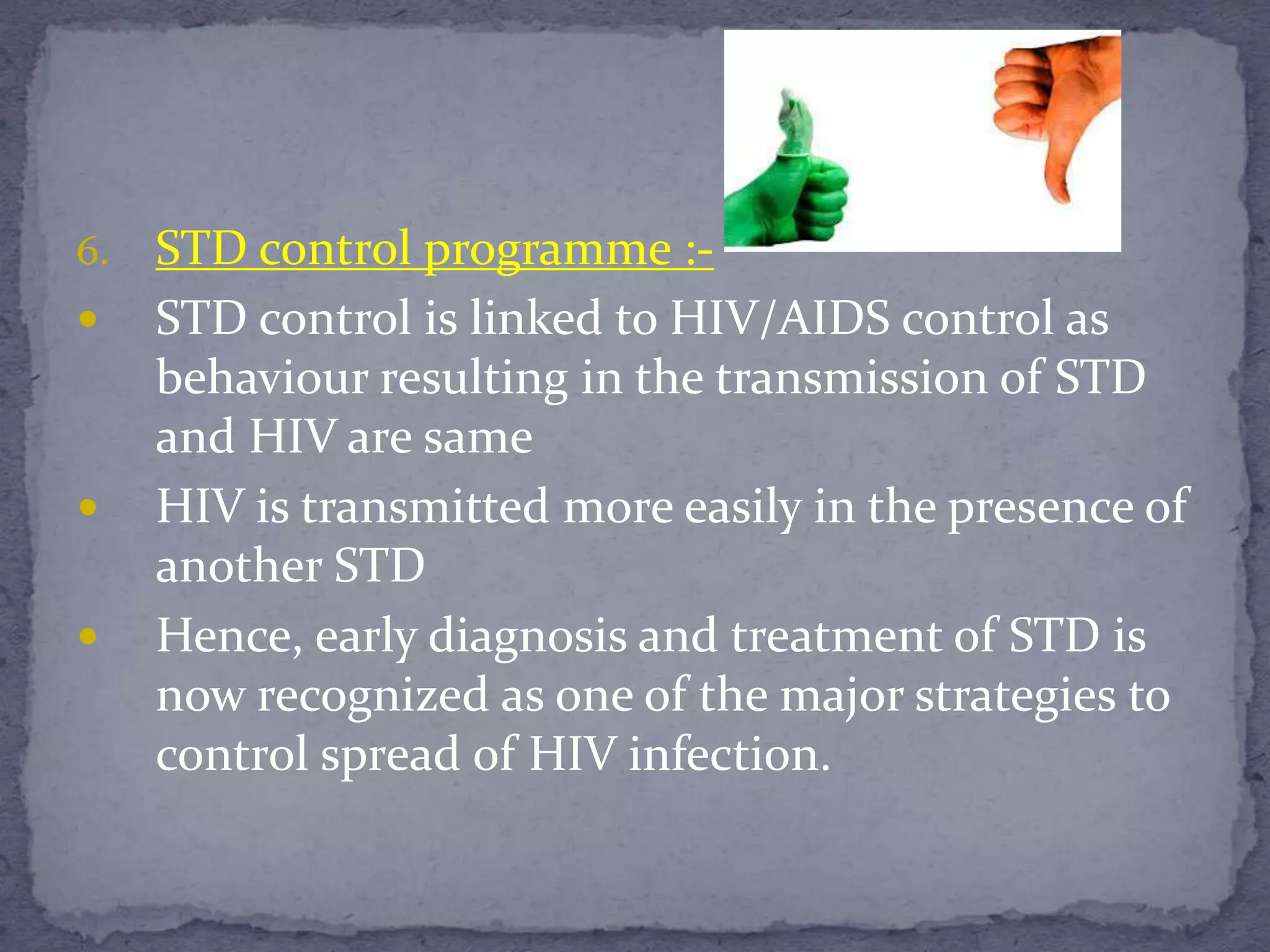
6. STD control programme :-
 STD control is linked to HIV/AIDS control as
behaviour resulting in the transmission of STD
and HIV are same
 HIV is transmitted more easily in the presence of
another STD
 Hence, early diagnosis and treatment of STD is
now recognized as one of the major strategies to
control spread of HIV infection.
we have studied , what is AIDS and HIV ?
Sign and symptoms of AIDS , Indian statistics of
AIDS , National AIDS Control Program ,
milestones of NACP , its four phases , services
under NACP to control the spread of AIDS like
ICTC , Prevention of parent to child transmission
, HIV/TB collaborative activities , Care, support
& treatment services , Guidelines for HIV and
infant feeding ,STD control programme.
 http://naco.gov.in/nacp
 http://en.m.wikipedia.org/wiki/national_AIDS_Contr
ol_Organisation
 K. Park, K. Parks text book of Preventive And Social
Medicine, New Delhi , Bhanot Publications, page no.
343-355 ,431-438.
NATIONAL AIDS CONTROL PROGRAMME  (NACP)

NATIONAL AIDS CONTROL PROGRAMME (NACP)

  • 1.
    SUBMITTED TO: SUBMITTEDBY: MRS. ASHA MA’AM MANJEET KAUR CON,SJH
  • 2.
     AIDS isdefined as the most severe form of a continuum of illnesses associated with human immunodeficiency disease(HIV) infection .  HIV: belongs to a group of viruses known as RETROVIRUSES ( type of viruses that carry their genetic material in the form of ribonucleic acid[RNA] rather than deoxyribonucleic acid[DNA] ).
  • 3.
     The immunodeficiencyvirus(HIV) principally attacks CD4 T-cells, a vital part of the human immune system . As a result , the body’s ability to resist opportunistic viral, bacterial , bacterial , fungal , and other infection is greatly weakened .
  • 4.
     HIV isretrovirus.
  • 7.
     CLASSIFICATION OFSTATES: 1. High prevalence : >5% in HRG & >1% in ANC Maharashtra , TN , Andhra Pradesh , Karnataka , Nagaland. 2. Moderate prevalence : >5% in HRG & 1% in ANC Gujarat , Pondicherry , Goa . 3. Low prevalence : >5% in HRG & 1% in ANC all other states and UTs
  • 8.
     12,70,678 peopleare on ART.  21,16,581 people were living with HIV.  75,948 people became newly infected with HIV.  67,612 deaths due to AIDS.  35,255 pregnant woman needs PPTCT.
  • 9.
     INTRODUCTION  HIVinfection s first detected in 1986, when 10 HIV positive samples were found from a group of 102 female sex workers from Chennai. 62 AIDS surveillance centres were gradually established nationwide .
  • 10.
     The milestonesof the programme are summarized as follows 1986- - first case of HIV detected - AIDS task force setup by the ICMR - national AIDS committee established under the ministry of health.  1990- -mid term plan launched for from states and the four metros.
  • 11.
     1992- -NACP 1 launched to show down the spread of HIV infection - national AIDS control board constituted - NACO setup  1999- - NACP 2 begins focusing on behaviour change , increased decentralization and NGO involvement. - state AIDS control societies developed .  2002- - national AIDS control policy adopted. - national blood policy adopted.
  • 12.
     2004- -antiretroviral treatment initiated .  2006- - national council on AIDS constituted under chairmanship of prime minister. - national policy on paediatric ART formulated.  2007- - NACP 3 launched for years (2007-2012)  2012- - NACP 4 launched for next 5 years
  • 13.
    NATIONAL AIDS CONTROL PROGRAME-1 OBJECTIVES: Slow and prevent the spread of HIV through a major effort to prevent HIV transmission. KEY STRATEGIES: Focus on raising awareness , blood safety , prevention among high risk populations.
  • 14.
    Improving surveillance ACHIEVEMENTS: National AIDSresponse structures at both national and state levels and provided critical financing Strong partnership with the WHO and later helped mobilized additional donor resources Established the state AIDS control cells.
  • 15.
    NATIONAL AIDS CONTROL PROGRAMME-2 OBJECTIVE:Reduce the spread of HIV infection in India through behaviour change and increase capacity to respond to HIV on a long-term basis. KAY STRATEGIES: Targeted interventions for high risk groups. Preventive interventions for general populations. Involvement of NGOs. Institutional strengthening.
  • 16.
    ACHIEVEMENTS: At the operationallevel 1,033 targeted interventions setup, 875 voluntary counselling and testing centres (VCTC) and 679 STF clinics at the district level. National wide and state level behaviour surveillance surveys(BSS) were conducted . PPTCT expanded. A computerized management information system(CMIS) created .
  • 17.
    HIV prevention andcare and support organisation and networks were strengthened Support from partner agencies increased substantially.
  • 18.
    NATIONAL AIDS CONTROL PROGRAMME-3 OBJECTIVES:Reduce the rate of incidence by 60% in the first year of the programme. KEY STRATEGIES:  Prevention – targeted intervention (TI) , ICTC , blood safety.  Care support and treatment  Capacity building- establishment , support and capacity
  • 19.
     Strategic informationmanagement monitoring and evaluation. PROGRAMME PRIORITIES  Considering that more than 99% of the population in the country is free fro the infection , NACP-3 has place the highest priority on prevention efforts while, at the same time seeking to integrate prevention with care, support and treatment .
  • 20.
     Sub populationthat have the highest risk of exposure to HIV will receive the highest priority for intervention .  Those in general population who have greater need for accessing prevention services such as treatment of STIs.  Ensures who need treatment would have access to prophylaxis and management of opportunistic infection.
  • 21.
     Provision ofservices for prevention of parent to child transmission of disease.  Impact of HIV will be mitigated through welfare agencies providing nutritional support.  Invest in community care centres to provide psycho-social support.  Socio-economic determinants that make a person vulnerable also increase the risk of infection.
  • 22.
    ACHIEVEMENTS:  There were306 fully functional ART centres .  Nearby 12.5 Lacs PLHIV were registered and 420000 patients were on ART .  612 link ART centres(LAC) had been established wherein , 26023 PLHIV were taking services .  There were 10 centres of excellence.  7 regional paediatric centres also functional.  259 community care centres across the country.
  • 23.
     6000 condomsand 6000 village information centres established.  3000 red ribbon clubs established.  Link workers training module updated .
  • 24.
    NATIONAL AIDS CONTROL PROGRAMME-4 Launchedon 12 February 2014. Total budget outlet Rs. 1429 crores. Goal: accelerate reversal and integrate response . OBJECTIVES: Reduce new infection by 50% (2007 baseline of NACP-3) Provide comprehensive care and support to all persons living with HIV/AIDS.
  • 25.
    STRATEGIES: Intensify and consolidatepreventive services . Increase assess and promote comprehensive care, support & treatment. Expanding IEC services. Capacity building . Strengthening strategic information management system.
  • 26.
    KEY PRIORITIES UNDERNACP-4 Preventing new infections by sustaining the reach of current interventions and effectively addressing emerging epidemics. Prevention to parent to child transmission Focusing on IEC Providing comprehensive care , support and treatment to eligible PLHIV.
  • 27.
     Reducing stigma De-centralizing rollout of services including technical support.  Ensuring effective use of strategic information at all levels of programme.  Building capacities of NGO and civil society partners especially in states with emerging epidemics.
  • 28.
    Integrating HIV serviceswith health system in a phased manner. Mainstreaming of HIV/AIDS activities. PREVENTION SERVICES: Targeted interventions for high risk group and bridge population. Needle-syringe exchange programme(NSEP) and opioids substitution therapy (OST) for IDUs.
  • 29.
    Prevention intervention formigrant population at source , transit and destination. Link worker scheme (LWS) for HRGs and vulnerable population in rural areas . Prevention & control of sexually transmitted infection/reproductive tract infections. Blood safety
  • 30.
     HIV counsellingand testing services .  Prevention to parent to child transmission.  Condom promotion.  Information , education and communication(IEC) & behaviour change communication(BCC).
  • 31.
     Surveillance arebeing carried out to detect spread of the disease & to make appropriate strategy for prevention and control i.e. by area specific target interventions & best practice approach .  Types of surveillance: HIV sentinel surveillance HIV sero-surveillance AIDS case surveillance STD surveillance Behavioural surveillance
  • 32.
    Integration with surveillanceof other disease like TB etc. • Out of above most effective surveillance is HIV sentinel surveillance . • The main aim of the surveillance is confined to monitor the trend of HIV infection. OBJECTIVES OF THE SURVILLANCE : To determine the level of HIV infection among general population as well as HRGs in different states To uderstand the trend of HIV epidemic .
  • 33.
     To understandthe geographical spread of infection and to identify emerging pockets.  To provide information for prioritization of the program resources & evaluation of program impact  To estimate prevalence & HIV burden in the country .  It is done in same place over few years by anonymous serological tests i.e. HIV testing is done without identification for purposes eg. VDRL , STD clinics.  The demerit of the test is that +ve person is not identified.
  • 34.
     In 1994it was started with 55 sentinel sites and become 180 in 1998  The number of HRG of people increased in HIV sentinel sites .  THE KEY FEATURES OF SURVEILLANCE ARE 1. Inclusion of data from high risk population through targeted intervention sites 2. Adding rural samples through antenatal clinics  The strategy adopted was whatever be the sentinel site and amount of sample collected – the duration , frequency and age group of people in the surveillance should be same in all HRG , bridge population and general population.
  • 35.
    Counselling and HIVtesting services : 1. ICTC 2. Prevention of parent to child transmission 3. HIV/TB collaborative activities 4. Care, support & treatment services. 5. Guidelines for HIV and infant feeding 6. STD control programme
  • 36.
    1. Integrated counsellingand testing services :-  This is available to increase access to HIV diagnosis.  It includes testing services & community approaches at various level of health system in India like state, district, sub-district, & village/community level.  Functions:  Early detection of HIV.
  • 37.
    Provision of basicinformation on modes of transmission, prevention of HIV for promoting behavioural change and reducing vulnerability and liking the PLHIV to care , support & treatment .  Two types of ICTC: 1. Fixed facility ICTC 2. Mobile ICTC
  • 38.
    All HIV testingservices must follow the WHO- recommended principles known as the “5 Cs”:  informed Consent  Confidentiality  Counseling  Correct test results  Connection (linkage to care, treatment and other services).
  • 39.
    2. Prevention ofparent to child transmission:-  The prevention of parent to child transmission of HIV/AIDS(PPTCT) program was started in 2002.  Currently there are more then 15000 ICTCs in country which offer PPTCT services to pregnant women.  The aim of the PPTCT program is to offer HIV testing to every pregnant woman (universal Coverage ) in the country , so as to cover all estimated HIV positive pregnant women and eliminate transmission of HIV from mother o child.
  • 40.
     In India, PPTCT interventions under NACP was started in 2002 , using SD-NVP prophylaxis for HIV positive women during labour and also for her new born child immediately after birth.  The PPTCT services provide access to all pregnant women for HIV diagnosis prevention , care and treatment services.
  • 41.
    3. HIV/TB collaborativeactivities :-  NACP-4 covers the HIV testing of TB patients.  It is combined work of NACP & RNTCP.  State with high prevalence covers about 90% of TB patients for HIV testing.  There is expected detection of HIV within 2-4 weeks of TB positivity.  This service was started in 2002 in Karnataka followed by Maharashtra , Andhra Pradesh & Tamil Nadu.
  • 42.
    4. Guidelines forHIV and infant feeding :-  Till 2009, WHO advise HIV positive mothers to avoid breast feeding if they were able to afford and store formula milk safely.  On 30th November 2009 ,WHO released new recommendations on infant feeding by HIV positive mothers .  HIV positive mothers or their infants take anti retroviral drugs throughout the period of breast
  • 43.
    Feeding and untilthe infant is 12 months old.  Child can benefit from breast feeding with every little risk of becoming infected with HIV.
  • 44.
    5. Care, support& treatment services:-  Laboratory services for CD4 testing and other investigations .  Free first line & second line ART through ART centers and link ART centers , centers of excellence & ART plus centers .  Pediatric ART for children  Early infant diagnosis for HIV exposed infants
  • 45.
    And children below18 months .  HIV/TB coordination ( cross , referral , detection and treatment of co-infection).  Treatment of opportunistic infections .  Drop-in centers for PLHIV networks.
  • 46.
    6. STD controlprogramme :-  STD control is linked to HIV/AIDS control as behaviour resulting in the transmission of STD and HIV are same  HIV is transmitted more easily in the presence of another STD  Hence, early diagnosis and treatment of STD is now recognized as one of the major strategies to control spread of HIV infection.
  • 47.
    we have studied, what is AIDS and HIV ? Sign and symptoms of AIDS , Indian statistics of AIDS , National AIDS Control Program , milestones of NACP , its four phases , services under NACP to control the spread of AIDS like ICTC , Prevention of parent to child transmission , HIV/TB collaborative activities , Care, support & treatment services , Guidelines for HIV and infant feeding ,STD control programme.
  • 48.
     http://naco.gov.in/nacp  http://en.m.wikipedia.org/wiki/national_AIDS_Contr ol_Organisation K. Park, K. Parks text book of Preventive And Social Medicine, New Delhi , Bhanot Publications, page no. 343-355 ,431-438.