1
SOLID WASTE
Some terms we need to know
REFUSE:
Solid or semisolid waste matter produced in the normal course of
human activities. Generated from street sweepings, markets, stable
litter, industrial refuse, commercial refuse, etc.
RUBBISH:
Solid wastes originating in houses, commercial establishments,
industries, excluding garbage and ash.
GARBAGE:
Animal & vegetable wastes resulting from the handling, storage,
sale, preparation, cooking and serving of food.
ASH:
Residue from burning of wood, coal, charcoal and other combustible
materials used for cooking and heating purposes in houses, industries
etc.
• Street refuse
• Market refuse
• Stable litter
• Industrial refuse
• Domestic refuse
Sources of solid wastes
In most of the countries the per
capita daily solid waste produced is
between 0.25 to 2.5 Kg
• Galvanized steel dust bin with cover (for
households) – 0.05 to 0.1 cubic feet per capita
per day.
– A bin with capacity of 1.5 cubic feet for a family of 5
members if collection is done every 3 days.
• Public bins.
Storage of solid wastes
• House-to-house collection
• Mechanical transport
• Dustless refuse collector
Collection of solid wastes
Methods of solid waste disposal
INSANITARY METHODS
1. Hog feeding
2. Dumping
SANITARY METHODS
1. Sanitary landfill/ Controlled tipping
2. Composting
3. Incineration
4. Manure pits
5. Burial
6. Biogas plant
SANITARY METHODS
Methods of solid waste disposal
INSANITARY METHODS
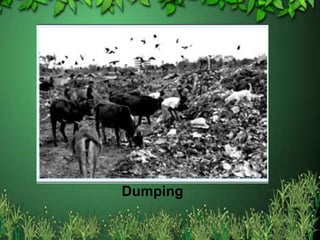
Dumping
– Refuse dumped in low lying areas
– Bacterial action over time, decreases volume of refuse
which is gradually converted into humus
– Disadvantages
• Smell
• Unsightly appearance
• Free access to flies, rodents, hogs, dogs etc.
• Dispersal by wind
• Pollution of surface and ground water
Dumping
1. Sanitary landfill / Controlled
tipping
–Laying of dry and condensed refuse in a
trench or other prepared area with
intervening earth coverings.
–Anaerobic digestion of the refuse takes
place. The process takes 4-6 months to
complete.
SANITARY METHODS
2-3meter
4-12 meter
• Trench method
– Level ground
– Trenches 4-12 m wide, 2-3 m deep
– Refuse is compacted and then covered with
excavated earth
• Ramp method
– Sloping terrain
• Area method
– Land depressions, disused quarries, pits
– May need soil from outside sources to cover the
compacted refuse
2. Composting
–Method of combined disposal of refuse
and nightsoil or sludge.
–Organic matter breaks down under
bacterial action, producing “compost” –
used as manure.
SANITARY METHODS
BANGALORE
METHOD
MECHANICA
L
COMPOSTIN
G
VERMI-
COMPOSTIN
G
Three methods of composting
Bangalore method
Anaerobic composting; also called “Hot
fermentation process”
IISc, Bangalore – Indian Council of Agriculture
Research
800 metre
90
cm
4.5 – 10 m
A Trench excavated for
composting
Anaerobic
4-6 months
Humus
NIGHTSOIL
15
cm
5
cm
15
cm
5
cm
25
cm
REFUS
E
REFUS
E
NIGHTSOIL
REFUS
E
Earth
NIGHTSOIL
Mechanical composting
Refus
e
Pulverizing
equipment
Pulverized refuse +
Sewage/Sludge/Nightsoil
Incubation
(Temperature, pH, Aeration, Moisture controlled)
Complete
composting
Screening
4-6 weeks
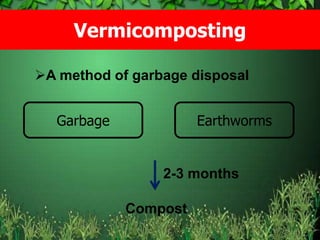
Vermicomposting
A method of garbage disposal
Garbage Earthworms
2-3 months
Compost
3. Incineration
–Suitable for areas where land is not
available for sanitary landfill
–Example: Hospitals
–Disadvantages:
•Expensive
•No useful by-product
•Air pollution
SANITARY METHODS
4. Manure pits
–Used in rural households
–Covered with earth after each days
dumping
–Two pits
–Within 5-6 months decomposed refuse
which is used as fertilizer
SANITARY METHODS
5. Burial
–Suitable for small settlements/camps
–Decomposed matter may be ready for
use as manure within 4-6 months
SANITARY METHODS
1.5 m
2m
20-30
cm
40 cm
1 m
200 persons
1 week
6. Biogas plant
• Biogas is produced by the
anaerobic breakdown of
solid waste /excreta.
• Biogas (Methane, CO2,
Hydrogen) can be used as a
fuel for any heating purpose,
such as cooking.
SANITARY METHODS
EXCRETA
Spread of disease from excreta
Sanitation barrier
Methods of excreta disposal
INSANITARY METHODS
1. Bucket type
2. Conservancy system/Cartage
SANITARY METHODS
WATER CARRIAGE SYSTEM
1. Bore hole latrine
SANITARY METHODS
Methods of excreta disposal
2.Dug well/pit latrine
3. Water seal type
of latrine
a) P.R.A.I
b) R.C.A
c) Sulabh
sauchalya
4. Septic tank
5. Aqua privy
13-03-2015 Free template from
www.brainybetty.com
32
3.latrine suitable for
camps
i. Shallow trench
latrines
ii. Deep trench latrine
iii.Pit latrine
iv.Bore hole latrine
Water carriage system and
sewage treatment
A) PRIMARY TREATMENT
• screening
• Removal of grit
• Plain sedimentation
B ) SECONDARY TREATMENT
• Trickling filters
• Activated sludge process
c) OTHER METHODS
a) Sea outfall b) river outfall
c) Sewage farming d) oxidation ponds 33
INSANITARY METHODS OF
EXCRETA DISPOSAL
1. Open defecation
2. Cartage (Conservancy
system)
•Example: Bucket latrine
•Disadvantages:
Smell
Flies
Health risk to people handling
the excreta
Health risk from food crops
fertilized with raw excreta
Bucket
latrine
SANITARY METHODS OF
EXCRETA DISPOSAL
9b. Bore Hole Latrine
• Introduced in India by Rockefeller Foundation in
1930’s as a component of hookworm control
programme.
• Consists of a circular hole dug by an equipment
called “auger”.
20feet
16 feet
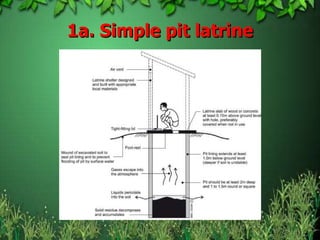
1a. Simple pit latrine
Locationofapitlatrine
Advantages&
Disadvantages
• Advantages:
– Easy and cheap to construct
– Slab and shelter can be reused
– Excreta are isolated
• Disadvantages:
– Unpleasant odors
– Flies
• A circular pit about 75cm in diameter
and 3-3.5m deep is dug into ground for
reception of nightsoil.
• The pit lined with pottery rings to
prevent of soil reenter.
• Concrete squatting plate is placed on
top.
• Merits: 1. easy to construct
• 2. longer life
1b. Dug well latrine
0.5 m
Semi
dark
Shelter
Water Seal Latrine:
• Hand flushed water seal latrine.
• Water seal
• Types of water seal:
44
Waterseallatrine
The Water Seal
2a. Direct & Indirect WS
Latrine
Direct Indirect
2c. PRAI & RCA Latrine
• PRAI Latrine was developed by the Planning,
Research & Action Institute, Lucknow
• RCA latrine was developed by the Research
Cum Action project of the Ministry of Health
The RCA Latrine
1. Location
2. Squatting plate
3. Pan
4. Trap
5. Connecting pipe
6. The pit
7. Superstructure
8. Maintenance
9. Modifications
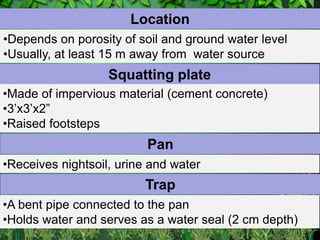
Location
•Depends on porosity of soil and ground water level
•Usually, at least 15 m away from water source
Squatting plate
•Made of impervious material (cement concrete)
•3’x3’x2”
•Raised footsteps
Pan
•Receives nightsoil, urine and water
Trap
•A bent pipe connected to the pan
•Holds water and serves as a water seal (2 cm depth)
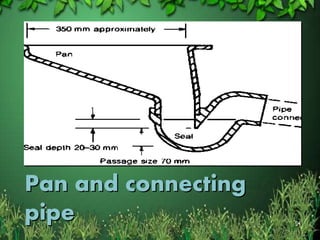
Connecting pipe
•Needed when pit is sited away from squatting plate
•Not needed in Direct type RCA Latrine
•3.5” diameter with a bend at the end
The pit
•Covered, rectangular/circular
•75 cm diameter, 3-3.5 m deep
• Underneath squatting plate(Direct) or offset (Indirect)
Superstructure
Maintenance
•Regular cleaning of the squatting plate
•Flushing with 1-2 lts of water after every use
Modifications
•Using prefabricated squatting plate/pan made of china
clay
•Using a septic tank instead of the pit
Squatting plate
13-03-2015 Free template from
www.brainybetty.com
53
Pan and connecting
pipe 54
• The aquaprivy is a water tight tank filled with
water into which excreta fall via a drop pipe,
connected to a seepage pit (soakaway) to
dispose of sullage and effluent.
• Drop pipe must reach below surface of the
water.
• Night soil undergoes purification by anerobic
digestion
Vent open on top
Sludge removed at end.
4. Aqua privy
The AQUAPRIVY
Advantages&
Disadvantages • Advantages:
– Cannot be blocked with bulky anal cleaning
material
– Nil problem with odor or flies
– Can be connected to a sewerage system at a
later date
• Disadvantages:
– Expensive to build
– Need large volumes of water to work
– Water seal may be hard to maintain
– Tanks must be emptied about every 3 years
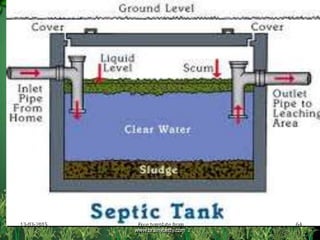
• Septic tanks are watertight chambers (single,
double or multi chambered) which receive
excreta and wastewater.
• They are connected to a soakaway which
receives liquid overflowing from the tank.
5. Septic Tank
WorkingofSepticTank
• Solids (“sludge”) settle down and are
purified by anaerobic digestion.
• The liquids (“effluent”) undergoes
aerobic oxidation in the upper layers of
the soil, outside the septic tank proper.
• The sludge is reduced in volume and a portion of
solids is transferred to liquids and gases which
rises to surface forming bubble.
• Liquid passes out called effluent which percolates
into soil by open ended pipes laid in trenches.
• Aerobic bacteria attack organic matter and
convert to end products .
•
• Complete purification of sewage.
62
Advantages&
Disadvantages • Advantages:
– Isolation and treatment of excreta
– No odor or fly problems
– May be connected to sewerage system at a
later date
• Disadvantages:
– High cost of construction
– Need for periodic mechanical emptying
– Need for large volumes of flushing water
– Only suitable where flush toilets are used
13-03-2015 Free template from
www.brainybetty.com
64
• A low cost, water seal type of latrine connected
to a 3’x3’x3’ pit. It is a modified handflush latrine
with a specially designed pan and trap – needs
very little water for flushing.
• Sulabh International, an NGO, maintains Sulabh
Community Latrines – ‘pay-and-use system – in
many parts of India.
6. Sulabh Shauchalaya
SHALLOW TRENCH
LATRINE
• Simple trench dug with ordinary
tools.
• Trench is 30cm wide 90-150cm
deep.
• Separate for men and women
• Earth piled up a side and people
instructed to cover up earth after
each defecation.13-03-2015 Free template from
www.brainybetty.com
66
Shallow Trench latrine
Access
path
Handwashing
facility
Dug soil (for back filling)
Trench depth
approx. 150
mm
Poles to attach
screening
Security screening
Superstructure
Plan View
1.5m
5 m 4 m
Approx
.
300mm
DEEP TRENCH LATRINE:
• Used for camps in longer duration
• Trench is 1.8-2.5m
• 75-90cm wide
• Squatting plate is provided.
13-03-2015 Free template from
www.brainybetty.com
69
DeepTrenchlatrine
Superstructure
Modern sewage treatment.
• A) primary treatment
• B) secondary treatment
•
• PRIMARY TREATMENT
• 1.Screening
• 2. Grit Chamber
• 3. Primary Sedimentation.
13-03-2015 Free template from
www.brainybetty.com
72
13-03-2015 Free template from
www.brainybetty.com
73
• Sewage made flow across tank , spends 6-8hrs in
tank
• Purification takes place mainly by sedimentation
• 50-70% settle down under influence of gravity.
Coli form organism formed called ‘sludge’
Biological action takes place were micro-organism
attack sewage
Sewage attack complex organic solids and break them
74
• Simpler soluble substance ammonia
• Contain grease and fat that come up
called scum
• Then it is treated with lime ,aluminium
sulpahte and ferrous sulphate.
13-03-2015 Free template from
www.brainybetty.com
75
Secondary treatment:
• Types
76
ACTIVATED
SLUDGE
PROCESS
Oxygen pond
13-03-2015 Free template from
www.brainybetty.com
77
13-03-2015 Free template from
www.brainybetty.com
78

Solid waste and waste management

  • 1.
  • 2.
  • 3.
    Some terms weneed to know REFUSE: Solid or semisolid waste matter produced in the normal course of human activities. Generated from street sweepings, markets, stable litter, industrial refuse, commercial refuse, etc. RUBBISH: Solid wastes originating in houses, commercial establishments, industries, excluding garbage and ash. GARBAGE: Animal & vegetable wastes resulting from the handling, storage, sale, preparation, cooking and serving of food. ASH: Residue from burning of wood, coal, charcoal and other combustible materials used for cooking and heating purposes in houses, industries etc.
  • 4.
    • Street refuse •Market refuse • Stable litter • Industrial refuse • Domestic refuse Sources of solid wastes In most of the countries the per capita daily solid waste produced is between 0.25 to 2.5 Kg
  • 5.
    • Galvanized steeldust bin with cover (for households) – 0.05 to 0.1 cubic feet per capita per day. – A bin with capacity of 1.5 cubic feet for a family of 5 members if collection is done every 3 days. • Public bins. Storage of solid wastes
  • 6.
    • House-to-house collection •Mechanical transport • Dustless refuse collector Collection of solid wastes
  • 7.
    Methods of solidwaste disposal INSANITARY METHODS 1. Hog feeding 2. Dumping SANITARY METHODS
  • 8.
    1. Sanitary landfill/Controlled tipping 2. Composting 3. Incineration 4. Manure pits 5. Burial 6. Biogas plant SANITARY METHODS Methods of solid waste disposal
  • 9.
    INSANITARY METHODS Dumping – Refusedumped in low lying areas – Bacterial action over time, decreases volume of refuse which is gradually converted into humus – Disadvantages • Smell • Unsightly appearance • Free access to flies, rodents, hogs, dogs etc. • Dispersal by wind • Pollution of surface and ground water
  • 10.
  • 11.
    1. Sanitary landfill/ Controlled tipping –Laying of dry and condensed refuse in a trench or other prepared area with intervening earth coverings. –Anaerobic digestion of the refuse takes place. The process takes 4-6 months to complete. SANITARY METHODS
  • 13.
  • 14.
    • Trench method –Level ground – Trenches 4-12 m wide, 2-3 m deep – Refuse is compacted and then covered with excavated earth • Ramp method – Sloping terrain • Area method – Land depressions, disused quarries, pits – May need soil from outside sources to cover the compacted refuse
  • 15.
    2. Composting –Method ofcombined disposal of refuse and nightsoil or sludge. –Organic matter breaks down under bacterial action, producing “compost” – used as manure. SANITARY METHODS
  • 16.
  • 17.
    Bangalore method Anaerobic composting;also called “Hot fermentation process” IISc, Bangalore – Indian Council of Agriculture Research
  • 18.
  • 19.
    90 cm 4.5 – 10m A Trench excavated for composting
  • 20.
  • 21.
    Mechanical composting Refus e Pulverizing equipment Pulverized refuse+ Sewage/Sludge/Nightsoil Incubation (Temperature, pH, Aeration, Moisture controlled) Complete composting Screening 4-6 weeks
  • 22.
    Vermicomposting A method ofgarbage disposal Garbage Earthworms 2-3 months Compost
  • 23.
    3. Incineration –Suitable forareas where land is not available for sanitary landfill –Example: Hospitals –Disadvantages: •Expensive •No useful by-product •Air pollution SANITARY METHODS
  • 24.
    4. Manure pits –Usedin rural households –Covered with earth after each days dumping –Two pits –Within 5-6 months decomposed refuse which is used as fertilizer SANITARY METHODS
  • 25.
    5. Burial –Suitable forsmall settlements/camps –Decomposed matter may be ready for use as manure within 4-6 months SANITARY METHODS 1.5 m 2m 20-30 cm 40 cm 1 m 200 persons 1 week
  • 26.
    6. Biogas plant •Biogas is produced by the anaerobic breakdown of solid waste /excreta. • Biogas (Methane, CO2, Hydrogen) can be used as a fuel for any heating purpose, such as cooking. SANITARY METHODS
  • 27.
  • 28.
    Spread of diseasefrom excreta
  • 29.
  • 30.
    Methods of excretadisposal INSANITARY METHODS 1. Bucket type 2. Conservancy system/Cartage SANITARY METHODS WATER CARRIAGE SYSTEM
  • 31.
    1. Bore holelatrine SANITARY METHODS Methods of excreta disposal 2.Dug well/pit latrine 3. Water seal type of latrine a) P.R.A.I b) R.C.A c) Sulabh sauchalya 4. Septic tank 5. Aqua privy
  • 32.
    13-03-2015 Free templatefrom www.brainybetty.com 32 3.latrine suitable for camps i. Shallow trench latrines ii. Deep trench latrine iii.Pit latrine iv.Bore hole latrine
  • 33.
    Water carriage systemand sewage treatment A) PRIMARY TREATMENT • screening • Removal of grit • Plain sedimentation B ) SECONDARY TREATMENT • Trickling filters • Activated sludge process c) OTHER METHODS a) Sea outfall b) river outfall c) Sewage farming d) oxidation ponds 33
  • 34.
  • 35.
    1. Open defecation 2.Cartage (Conservancy system) •Example: Bucket latrine •Disadvantages: Smell Flies Health risk to people handling the excreta Health risk from food crops fertilized with raw excreta Bucket latrine
  • 36.
  • 37.
    9b. Bore HoleLatrine • Introduced in India by Rockefeller Foundation in 1930’s as a component of hookworm control programme. • Consists of a circular hole dug by an equipment called “auger”.
  • 38.
  • 39.
  • 40.
  • 41.
    Advantages& Disadvantages • Advantages: – Easyand cheap to construct – Slab and shelter can be reused – Excreta are isolated • Disadvantages: – Unpleasant odors – Flies
  • 42.
    • A circularpit about 75cm in diameter and 3-3.5m deep is dug into ground for reception of nightsoil. • The pit lined with pottery rings to prevent of soil reenter. • Concrete squatting plate is placed on top. • Merits: 1. easy to construct • 2. longer life 1b. Dug well latrine
  • 43.
  • 44.
    Water Seal Latrine: •Hand flushed water seal latrine. • Water seal • Types of water seal: 44
  • 45.
  • 46.
  • 47.
    2a. Direct &Indirect WS Latrine Direct Indirect
  • 48.
    2c. PRAI &RCA Latrine • PRAI Latrine was developed by the Planning, Research & Action Institute, Lucknow • RCA latrine was developed by the Research Cum Action project of the Ministry of Health
  • 49.
    The RCA Latrine 1.Location 2. Squatting plate 3. Pan 4. Trap 5. Connecting pipe 6. The pit 7. Superstructure 8. Maintenance 9. Modifications
  • 50.
    Location •Depends on porosityof soil and ground water level •Usually, at least 15 m away from water source Squatting plate •Made of impervious material (cement concrete) •3’x3’x2” •Raised footsteps Pan •Receives nightsoil, urine and water Trap •A bent pipe connected to the pan •Holds water and serves as a water seal (2 cm depth)
  • 51.
    Connecting pipe •Needed whenpit is sited away from squatting plate •Not needed in Direct type RCA Latrine •3.5” diameter with a bend at the end The pit •Covered, rectangular/circular •75 cm diameter, 3-3.5 m deep • Underneath squatting plate(Direct) or offset (Indirect) Superstructure Maintenance •Regular cleaning of the squatting plate •Flushing with 1-2 lts of water after every use
  • 52.
    Modifications •Using prefabricated squattingplate/pan made of china clay •Using a septic tank instead of the pit
  • 53.
    Squatting plate 13-03-2015 Freetemplate from www.brainybetty.com 53
  • 54.
  • 55.
    • The aquaprivyis a water tight tank filled with water into which excreta fall via a drop pipe, connected to a seepage pit (soakaway) to dispose of sullage and effluent. • Drop pipe must reach below surface of the water. • Night soil undergoes purification by anerobic digestion Vent open on top Sludge removed at end. 4. Aqua privy
  • 56.
  • 57.
    Advantages& Disadvantages • Advantages: –Cannot be blocked with bulky anal cleaning material – Nil problem with odor or flies – Can be connected to a sewerage system at a later date • Disadvantages: – Expensive to build – Need large volumes of water to work – Water seal may be hard to maintain – Tanks must be emptied about every 3 years
  • 58.
    • Septic tanksare watertight chambers (single, double or multi chambered) which receive excreta and wastewater. • They are connected to a soakaway which receives liquid overflowing from the tank. 5. Septic Tank
  • 61.
    WorkingofSepticTank • Solids (“sludge”)settle down and are purified by anaerobic digestion. • The liquids (“effluent”) undergoes aerobic oxidation in the upper layers of the soil, outside the septic tank proper.
  • 62.
    • The sludgeis reduced in volume and a portion of solids is transferred to liquids and gases which rises to surface forming bubble. • Liquid passes out called effluent which percolates into soil by open ended pipes laid in trenches. • Aerobic bacteria attack organic matter and convert to end products . • • Complete purification of sewage. 62
  • 63.
    Advantages& Disadvantages • Advantages: –Isolation and treatment of excreta – No odor or fly problems – May be connected to sewerage system at a later date • Disadvantages: – High cost of construction – Need for periodic mechanical emptying – Need for large volumes of flushing water – Only suitable where flush toilets are used
  • 64.
    13-03-2015 Free templatefrom www.brainybetty.com 64
  • 65.
    • A lowcost, water seal type of latrine connected to a 3’x3’x3’ pit. It is a modified handflush latrine with a specially designed pan and trap – needs very little water for flushing. • Sulabh International, an NGO, maintains Sulabh Community Latrines – ‘pay-and-use system – in many parts of India. 6. Sulabh Shauchalaya
  • 66.
    SHALLOW TRENCH LATRINE • Simpletrench dug with ordinary tools. • Trench is 30cm wide 90-150cm deep. • Separate for men and women • Earth piled up a side and people instructed to cover up earth after each defecation.13-03-2015 Free template from www.brainybetty.com 66
  • 67.
    Shallow Trench latrine Access path Handwashing facility Dugsoil (for back filling) Trench depth approx. 150 mm Poles to attach screening Security screening Superstructure
  • 68.
    Plan View 1.5m 5 m4 m Approx . 300mm
  • 69.
    DEEP TRENCH LATRINE: •Used for camps in longer duration • Trench is 1.8-2.5m • 75-90cm wide • Squatting plate is provided. 13-03-2015 Free template from www.brainybetty.com 69
  • 70.
  • 72.
    Modern sewage treatment. •A) primary treatment • B) secondary treatment • • PRIMARY TREATMENT • 1.Screening • 2. Grit Chamber • 3. Primary Sedimentation. 13-03-2015 Free template from www.brainybetty.com 72
  • 73.
    13-03-2015 Free templatefrom www.brainybetty.com 73
  • 74.
    • Sewage madeflow across tank , spends 6-8hrs in tank • Purification takes place mainly by sedimentation • 50-70% settle down under influence of gravity. Coli form organism formed called ‘sludge’ Biological action takes place were micro-organism attack sewage Sewage attack complex organic solids and break them 74
  • 75.
    • Simpler solublesubstance ammonia • Contain grease and fat that come up called scum • Then it is treated with lime ,aluminium sulpahte and ferrous sulphate. 13-03-2015 Free template from www.brainybetty.com 75
  • 76.
  • 77.
    Oxygen pond 13-03-2015 Freetemplate from www.brainybetty.com 77
  • 78.
    13-03-2015 Free templatefrom www.brainybetty.com 78