NATIONAL PROGRAMME FOR PREVENTION
AND CONTROL OF CANCER,
DIABETES, CARDIOVASCULAR DISEASES
AND STROKE
By Ms. Arushi Negi
M.Sc. Nursing Ist year
(NPCDCS)
INTRODUCTION
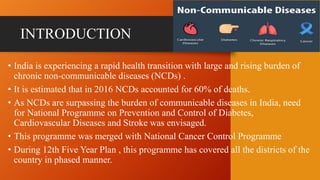
• India is experiencing a rapid health transition with large and rising burden of
chronic non-communicable diseases (NCDs) .
• It is estimated that in 2016 NCDs accounted for 60% of deaths.
• As NCDs are surpassing the burden of communicable diseases in India, need
for National Programme on Prevention and Control of Diabetes,
Cardiovascular Diseases and Stroke was envisaged.
• This programme was merged with National Cancer Control Programme
• During 12th Five Year Plan , this programme has covered all the districts of the
country in phased manner.
National Cancer Control Programme
• Every year about 4 lakh deaths occur due to cancer.
• Cancers of oral and lungs in males and cervix and breast in females account for over 50% of
all cancer deaths in India.
• In 1975-76 National Cancer Control Programme was launched with priorities given for
equipping the premier cancer hospital/institutions.
National Cancer Registry Programme (NCRP):
• Initiated in 1982 by ICMR, which gives a picture of the magnitude and patterns of cancer.
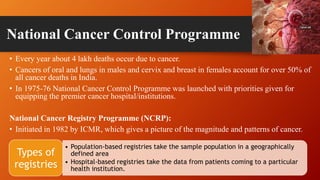
• Population-based registries take the sample population in a geographically
defined area
• Hospital-based registries take the data from patients coming to a particular
health institution.
Types of
registries
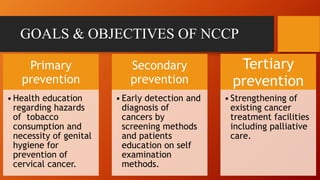
GOALS & OBJECTIVES OF NCCP
Primary
prevention
•Health education
regarding hazards
of tobacco
consumption and
necessity of genital
hygiene for
prevention of
cervical cancer.
Secondary
prevention
•Early detection and
diagnosis of
cancers by
screening methods
and patients
education on self
examination
methods.
Tertiary
prevention
•Strengthening of
existing cancer
treatment facilities
including palliative
care.
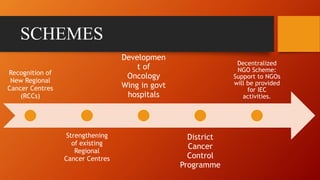
SCHEMES
Recognition of
New Regional
Cancer Centres
(RCCs)
Strengthening
of existing
Regional
Cancer Centres
Developmen
t of
Oncology
Wing in govt
hospitals
District
Cancer
Control
Programme
Decentralized
NGO Scheme:
Support to NGOs
will be provided
for IEC
activities.
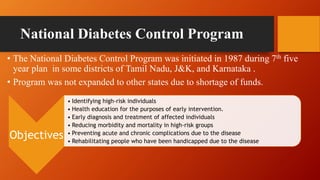
National Diabetes Control Program
• The National Diabetes Control Program was initiated in 1987 during 7th five
year plan in some districts of Tamil Nadu, J&K, and Karnataka .
• Program was not expanded to other states due to shortage of funds.
Objectives
• Identifying high-risk individuals
• Health education for the purposes of early intervention.
• Early diagnosis and treatment of affected individuals
• Reducing morbidity and mortality in high-risk groups
• Preventing acute and chronic complications due to the disease
• Rehabilitating people who have been handicapped due to the disease
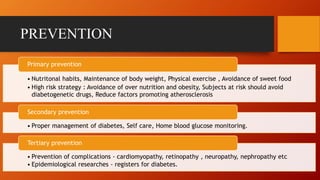
PREVENTION
• Nutritonal habits, Maintenance of body weight, Physical exercise , Avoidance of sweet food
• High risk strategy : Avoidance of over nutrition and obesity, Subjects at risk should avoid
diabetogenetic drugs, Reduce factors promoting atherosclerosis
Primary prevention
• Proper management of diabetes, Self care, Home blood glucose monitoring.
Secondary prevention
• Prevention of complications - cardiomyopathy, retinopathy , neuropathy, nephropathy etc
• Epidemiological researches - registers for diabetes.
Tertiary prevention
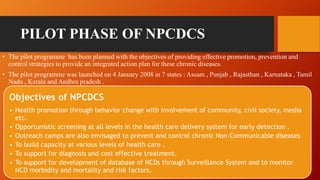
PILOT PHASE OF NPCDCS
• The pilot programme has been planned with the objectives of providing effective promotion, prevention and
control strategies to provide an integrated action plan for these chronic diseases.
• The pilot programme was launched on 4 January 2008 in 7 states : Assam , Punjab , Rajasthan , Karnataka , Tamil
Nadu , Kerala and Andhra pradesh .
Objectives of NPCDCS
• Health promotion through behavior change with involvement of community, civil society, media
etc.
• Opportunistic screening at all levels in the health care delivery system for early detection .
• Outreach camps are also envisaged to prevent and control chronic Non-Communicable diseases
• To build capacity at various levels of health care .
• To support for diagnosis and cost effective treatment.
• To support for development of database of NCDs through Surveillance System and to monitor
NCD morbidity and mortality and risk factors.
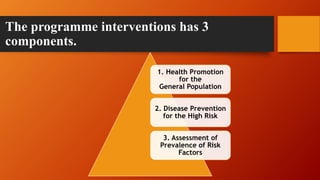
The programme interventions has 3
components.
1. Health Promotion
for the
General Population
2. Disease Prevention
for the High Risk
3. Assessment of
Prevalence of Risk
Factors
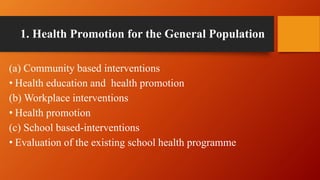
1. Health Promotion for the General Population
(a) Community based interventions
• Health education and health promotion
(b) Workplace interventions
• Health promotion
(c) School based-interventions
• Evaluation of the existing school health programme
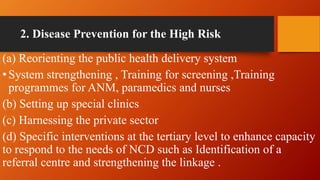
2. Disease Prevention for the High Risk
(a) Reorienting the public health delivery system
•System strengthening , Training for screening ,Training
programmes for ANM, paramedics and nurses
(b) Setting up special clinics
(c) Harnessing the private sector
(d) Specific interventions at the tertiary level to enhance capacity
to respond to the needs of NCD such as Identification of a
referral centre and strengthening the linkage .
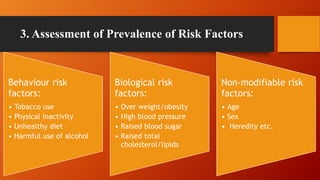
3. Assessment of Prevalence of Risk Factors
Behaviour risk
factors:
• Tobacco use
• Physical inactivity
• Unhealthy diet
• Harmful use of alcohol
Biological risk
factors:
• Over weight/obesity
• High blood pressure
• Raised blood sugar
• Raised total
cholesterol/lipids
Non-modifiable risk
factors:
• Age
• Sex
• Heredity etc.
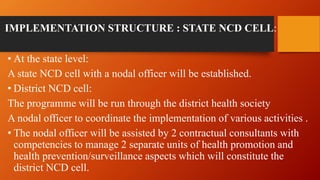
IMPLEMENTATION STRUCTURE : STATE NCD CELL:
• At the state level:
A state NCD cell with a nodal officer will be established.
• District NCD cell:
The programme will be run through the district health society
A nodal officer to coordinate the implementation of various activities .
• The nodal officer will be assisted by 2 contractual consultants with
competencies to manage 2 separate units of health promotion and
health prevention/surveillance aspects which will constitute the
district NCD cell.
Diabetes, Cardiovascular Diseases and Stroke
(DCS) Component
The major objectives of the programme are follows
• Prevent and control common NCDs through behaviour and lifestyle
changes.
• Provide early diagnosis and management of common NCDs.
• Build capacity at various levels of health care prevention, diagnosis
and treatment of common NCD.
• Train human resource within the public health set up viz doctors,
paramedics and nursing staff to cope the increasing burden of NCDs
• Establish and develop capacity for palliative rehabilitative care.
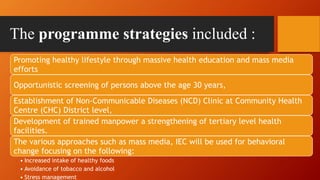
The programme strategies included :
Promoting healthy lifestyle through massive health education and mass media
efforts
Opportunistic screening of persons above the age 30 years,
Establishment of Non-Communicable Diseases (NCD) Clinic at Community Health
Centre (CHC) District level,
Development of trained manpower a strengthening of tertiary level health
facilities.
The various approaches such as mass media, IEC will be used for behavioral
change focusing on the following:
• Increased intake of healthy foods
• Avoidance of tobacco and alcohol
• Stress management
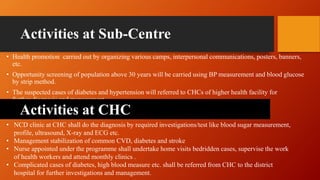
Activities at Sub-Centre
• Health promotion carried out by organizing various camps, interpersonal communications, posters, banners,
etc.
• Opportunity screening of population above 30 years will be carried using BP measurement and blood glucose
by strip method.
• The suspected cases of diabetes and hypertension will referred to CHCs of higher health facility for
further diagnosis and management.
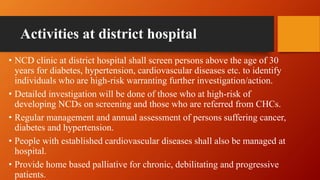
• NCD clinic at CHC shall do the diagnosis by required investigations/test like blood sugar measurement,
profile, ultrasound, X-ray and ECG etc.
• Management stabilization of common CVD, diabetes and stroke
• Nurse appointed under the programme shall undertake home visits bedridden cases, supervise the work
of health workers and attend monthly clinics .
• Complicated cases of diabetes, high blood measure etc. shall be referred from CHC to the district
hospital for further investigations and management.
Activities at CHC
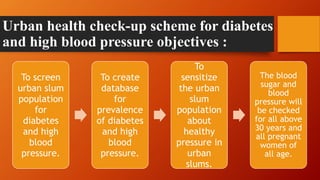
Activities at district hospital
• NCD clinic at district hospital shall screen persons above the age of 30
years for diabetes, hypertension, cardiovascular diseases etc. to identify
individuals who are high-risk warranting further investigation/action.
• Detailed investigation will be done of those who at high-risk of
developing NCDs on screening and those who are referred from CHCs.
• Regular management and annual assessment of persons suffering cancer,
diabetes and hypertension.
• People with established cardiovascular diseases shall also be managed at
hospital.
• Provide home based palliative for chronic, debilitating and progressive
patients.
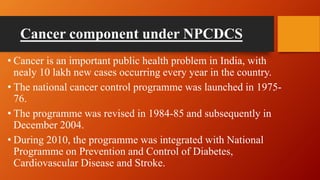
Urban health check-up scheme for diabetes
and high blood pressure objectives :
To screen
urban slum
population
for
diabetes
and high
blood
pressure.
To create
database
for
prevalence
of diabetes
and high
blood
pressure.
To
sensitize
the urban
slum
population
about
healthy
pressure in
urban
slums.
The blood
sugar and
blood
pressure will
be checked
for all above
30 years and
all pregnant
women of
all age.
Cancer component under NPCDCS
• Cancer is an important public health problem in India, with
nealy 10 lakh new cases occurring every year in the country.
• The national cancer control programme was launched in 1975-
76.
• The programme was revised in 1984-85 and subsequently in
December 2004.
• During 2010, the programme was integrated with National
Programme on Prevention and Control of Diabetes,
Cardiovascular Disease and Stroke.
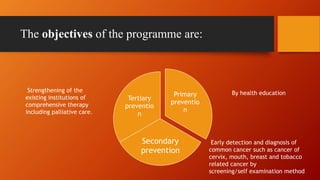
The objectives of the programme are:
Primary
preventio
n
Secondary
prevention
Tertiary
preventio
n
By health education
Early detection and diagnosis of
common cancer such as cancer of
cervix, mouth, breast and tobacco
related cancer by
screening/self examination method
Strengthening of the
existing institutions of
comprehensive therapy
including palliative care.
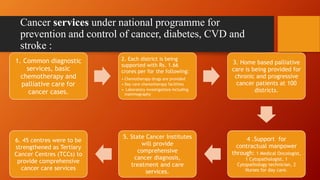
Cancer services under national programme for
prevention and control of cancer, diabetes, CVD and
stroke :
1. Common diagnostic
services, basic
chemotherapy and
palliative care for
cancer cases.
2. Each district is being
supported with Rs. 1.66
crores per for the following:
• Chemotherapy drugs are provided
• Day care chemotherapy facilities
• Laboratory investigations including
mammography
3. Home based palliative
care is being provided for
chronic and progressive
cancer patients at 100
districts.
4 .Support for
contractual manpower
through: 1 Medical Oncologist,
1 Cytopathologist, 1
Cytopathology technician, 2
Nurses for day care.
5. State Cancer Institutes
will provide
comprehensive
cancer diagnosis,
treatment and care
services.
6. 45 centres were to be
strengthened as Tertiary
Cancer Centres (TCCs) to
provide comprehensive
cancer care services
RECENT INITIATIVES UNDER NPCDCS :
• Inclusion of guidelines for prevention and management of Chronic Obstructive Pulmonary
Disease (COPD) and Chronic Kidney Disease (CKD) under NPCDCS.
• For early detection of NCD, guidelines are being issued to the States for initiating
“Population-based Screening of common NCDs” utilising the services of the Frontline-
workers and Health-workers.
• Pilot project on ‘Integration of AYUSH with NPCDCS’ has been initiated in six districts in
the country
• Pilot intervention has been initiated for the prevention and control of Rheumatic Fever and
Rheumatic Heart Disease under the platforms of NPCDCS and RBSK (Rashtriya Bal
Swasthya Karyakram).
• Another initiative is the integration of RNTCP with NPCDCS, wherein the “National
Framework for Joint Tuberculosis-Diabetes collaborative activities” has been developed
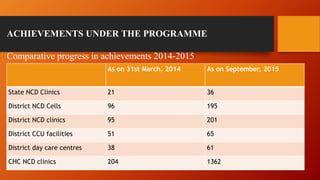
ACHIEVEMENTS UNDER THE PROGRAMME
Comparative progress in achievements 2014-2015
As on 31st March, 2014 As on September, 2015
State NCD Clinics 21 36
District NCD Cells 96 195
District NCD clinics 95 201
District CCU facilities 51 65
District day care centres 38 61
CHC NCD clinics 204 1362
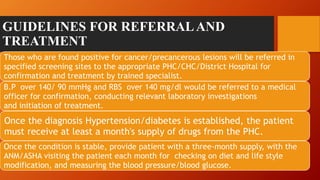
GUIDELINES FOR REFERRALAND
TREATMENT
Those who are found positive for cancer/precancerous lesions will be referred in
specified screening sites to the appropriate PHC/CHC/District Hospital for
confirmation and treatment by trained specialist.
B.P over 140/ 90 mmHg and RBS over 140 mg/dl would be referred to a medical
officer for confirmation, conducting relevant laboratory investigations
and initiation of treatment.
Once the diagnosis Hypertension/diabetes is established, the patient
must receive at least a month's supply of drugs from the PHC.
Once the condition is stable, provide patient with a three-month supply, with the
ANM/ASHA visiting the patient each month for checking on diet and life style
modification, and measuring the blood pressure/blood glucose.
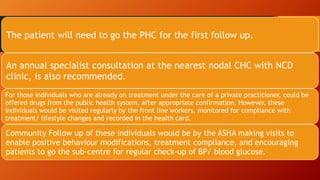
The patient will need to go the PHC for the first follow up.
An annual specialist consultation at the nearest nodal CHC with NCD
clinic, is also recommended.
For those individuals who are already on treatment under the care of a private practitioner, could be
offered drugs from the public health system, after appropriate confirmation. However, these
individuals would be visited regularly by the front line workers, monitored for compliance with
treatment/ lifestyle changes and recorded in the health card.
Community Follow up of these individuals would be by the ASHA making visits to
enable positive behaviour modifications, treatment compliance, and encouraging
patients to go the sub-centre for regular check-up of BP/ blood glucose.
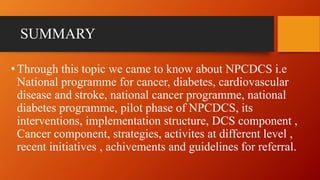
SUMMARY
•Through this topic we came to know about NPCDCS i.e
National programme for cancer, diabetes, cardiovascular
disease and stroke, national cancer programme, national
diabetes programme, pilot phase of NPCDCS, its
interventions, implementation structure, DCS component ,
Cancer component, strategies, activites at different level ,
recent initiatives , achivements and guidelines for referral.
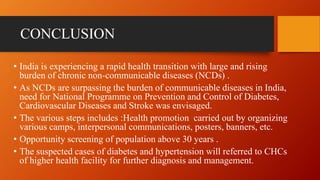
CONCLUSION
• India is experiencing a rapid health transition with large and rising
burden of chronic non-communicable diseases (NCDs) .
• As NCDs are surpassing the burden of communicable diseases in India,
need for National Programme on Prevention and Control of Diabetes,
Cardiovascular Diseases and Stroke was envisaged.
• The various steps includes :Health promotion carried out by organizing
various camps, interpersonal communications, posters, banners, etc.
• Opportunity screening of population above 30 years .
• The suspected cases of diabetes and hypertension will referred to CHCs
of higher health facility for further diagnosis and management.
BIBLIOGRAPHY
• Park K., Park’s textbook of preventive and social medicine ,
26th edition, 2021, Banarsidas Bhanot publishers, page no 528-
531.
• NPCDCS by NHM , available at :
https://nhm.gov.in/index1.php?lang=1&level=2&sublinkid=1048
&lid=604
Npcdcs ppt

Npcdcs ppt

  • 1.
    NATIONAL PROGRAMME FORPREVENTION AND CONTROL OF CANCER, DIABETES, CARDIOVASCULAR DISEASES AND STROKE By Ms. Arushi Negi M.Sc. Nursing Ist year (NPCDCS)
  • 2.
    INTRODUCTION • India isexperiencing a rapid health transition with large and rising burden of chronic non-communicable diseases (NCDs) . • It is estimated that in 2016 NCDs accounted for 60% of deaths. • As NCDs are surpassing the burden of communicable diseases in India, need for National Programme on Prevention and Control of Diabetes, Cardiovascular Diseases and Stroke was envisaged. • This programme was merged with National Cancer Control Programme • During 12th Five Year Plan , this programme has covered all the districts of the country in phased manner.
  • 3.
    National Cancer ControlProgramme • Every year about 4 lakh deaths occur due to cancer. • Cancers of oral and lungs in males and cervix and breast in females account for over 50% of all cancer deaths in India. • In 1975-76 National Cancer Control Programme was launched with priorities given for equipping the premier cancer hospital/institutions. National Cancer Registry Programme (NCRP): • Initiated in 1982 by ICMR, which gives a picture of the magnitude and patterns of cancer. • Population-based registries take the sample population in a geographically defined area • Hospital-based registries take the data from patients coming to a particular health institution. Types of registries
  • 4.
    GOALS & OBJECTIVESOF NCCP Primary prevention •Health education regarding hazards of tobacco consumption and necessity of genital hygiene for prevention of cervical cancer. Secondary prevention •Early detection and diagnosis of cancers by screening methods and patients education on self examination methods. Tertiary prevention •Strengthening of existing cancer treatment facilities including palliative care.
  • 5.
    SCHEMES Recognition of New Regional CancerCentres (RCCs) Strengthening of existing Regional Cancer Centres Developmen t of Oncology Wing in govt hospitals District Cancer Control Programme Decentralized NGO Scheme: Support to NGOs will be provided for IEC activities.
  • 6.
    National Diabetes ControlProgram • The National Diabetes Control Program was initiated in 1987 during 7th five year plan in some districts of Tamil Nadu, J&K, and Karnataka . • Program was not expanded to other states due to shortage of funds. Objectives • Identifying high-risk individuals • Health education for the purposes of early intervention. • Early diagnosis and treatment of affected individuals • Reducing morbidity and mortality in high-risk groups • Preventing acute and chronic complications due to the disease • Rehabilitating people who have been handicapped due to the disease
  • 7.
    PREVENTION • Nutritonal habits,Maintenance of body weight, Physical exercise , Avoidance of sweet food • High risk strategy : Avoidance of over nutrition and obesity, Subjects at risk should avoid diabetogenetic drugs, Reduce factors promoting atherosclerosis Primary prevention • Proper management of diabetes, Self care, Home blood glucose monitoring. Secondary prevention • Prevention of complications - cardiomyopathy, retinopathy , neuropathy, nephropathy etc • Epidemiological researches - registers for diabetes. Tertiary prevention
  • 8.
    PILOT PHASE OFNPCDCS • The pilot programme has been planned with the objectives of providing effective promotion, prevention and control strategies to provide an integrated action plan for these chronic diseases. • The pilot programme was launched on 4 January 2008 in 7 states : Assam , Punjab , Rajasthan , Karnataka , Tamil Nadu , Kerala and Andhra pradesh . Objectives of NPCDCS • Health promotion through behavior change with involvement of community, civil society, media etc. • Opportunistic screening at all levels in the health care delivery system for early detection . • Outreach camps are also envisaged to prevent and control chronic Non-Communicable diseases • To build capacity at various levels of health care . • To support for diagnosis and cost effective treatment. • To support for development of database of NCDs through Surveillance System and to monitor NCD morbidity and mortality and risk factors.
  • 9.
    The programme interventionshas 3 components. 1. Health Promotion for the General Population 2. Disease Prevention for the High Risk 3. Assessment of Prevalence of Risk Factors
  • 10.
    1. Health Promotionfor the General Population (a) Community based interventions • Health education and health promotion (b) Workplace interventions • Health promotion (c) School based-interventions • Evaluation of the existing school health programme
  • 11.
    2. Disease Preventionfor the High Risk (a) Reorienting the public health delivery system •System strengthening , Training for screening ,Training programmes for ANM, paramedics and nurses (b) Setting up special clinics (c) Harnessing the private sector (d) Specific interventions at the tertiary level to enhance capacity to respond to the needs of NCD such as Identification of a referral centre and strengthening the linkage .
  • 12.
    3. Assessment ofPrevalence of Risk Factors Behaviour risk factors: • Tobacco use • Physical inactivity • Unhealthy diet • Harmful use of alcohol Biological risk factors: • Over weight/obesity • High blood pressure • Raised blood sugar • Raised total cholesterol/lipids Non-modifiable risk factors: • Age • Sex • Heredity etc.
  • 13.
    IMPLEMENTATION STRUCTURE :STATE NCD CELL: • At the state level: A state NCD cell with a nodal officer will be established. • District NCD cell: The programme will be run through the district health society A nodal officer to coordinate the implementation of various activities . • The nodal officer will be assisted by 2 contractual consultants with competencies to manage 2 separate units of health promotion and health prevention/surveillance aspects which will constitute the district NCD cell.
  • 15.
    Diabetes, Cardiovascular Diseasesand Stroke (DCS) Component The major objectives of the programme are follows • Prevent and control common NCDs through behaviour and lifestyle changes. • Provide early diagnosis and management of common NCDs. • Build capacity at various levels of health care prevention, diagnosis and treatment of common NCD. • Train human resource within the public health set up viz doctors, paramedics and nursing staff to cope the increasing burden of NCDs • Establish and develop capacity for palliative rehabilitative care.
  • 16.
    The programme strategiesincluded : Promoting healthy lifestyle through massive health education and mass media efforts Opportunistic screening of persons above the age 30 years, Establishment of Non-Communicable Diseases (NCD) Clinic at Community Health Centre (CHC) District level, Development of trained manpower a strengthening of tertiary level health facilities. The various approaches such as mass media, IEC will be used for behavioral change focusing on the following: • Increased intake of healthy foods • Avoidance of tobacco and alcohol • Stress management
  • 17.
    Activities at Sub-Centre •Health promotion carried out by organizing various camps, interpersonal communications, posters, banners, etc. • Opportunity screening of population above 30 years will be carried using BP measurement and blood glucose by strip method. • The suspected cases of diabetes and hypertension will referred to CHCs of higher health facility for further diagnosis and management. • NCD clinic at CHC shall do the diagnosis by required investigations/test like blood sugar measurement, profile, ultrasound, X-ray and ECG etc. • Management stabilization of common CVD, diabetes and stroke • Nurse appointed under the programme shall undertake home visits bedridden cases, supervise the work of health workers and attend monthly clinics . • Complicated cases of diabetes, high blood measure etc. shall be referred from CHC to the district hospital for further investigations and management. Activities at CHC
  • 18.
    Activities at districthospital • NCD clinic at district hospital shall screen persons above the age of 30 years for diabetes, hypertension, cardiovascular diseases etc. to identify individuals who are high-risk warranting further investigation/action. • Detailed investigation will be done of those who at high-risk of developing NCDs on screening and those who are referred from CHCs. • Regular management and annual assessment of persons suffering cancer, diabetes and hypertension. • People with established cardiovascular diseases shall also be managed at hospital. • Provide home based palliative for chronic, debilitating and progressive patients.
  • 19.
    Urban health check-upscheme for diabetes and high blood pressure objectives : To screen urban slum population for diabetes and high blood pressure. To create database for prevalence of diabetes and high blood pressure. To sensitize the urban slum population about healthy pressure in urban slums. The blood sugar and blood pressure will be checked for all above 30 years and all pregnant women of all age.
  • 20.
    Cancer component underNPCDCS • Cancer is an important public health problem in India, with nealy 10 lakh new cases occurring every year in the country. • The national cancer control programme was launched in 1975- 76. • The programme was revised in 1984-85 and subsequently in December 2004. • During 2010, the programme was integrated with National Programme on Prevention and Control of Diabetes, Cardiovascular Disease and Stroke.
  • 21.
    The objectives ofthe programme are: Primary preventio n Secondary prevention Tertiary preventio n By health education Early detection and diagnosis of common cancer such as cancer of cervix, mouth, breast and tobacco related cancer by screening/self examination method Strengthening of the existing institutions of comprehensive therapy including palliative care.
  • 22.
    Cancer services undernational programme for prevention and control of cancer, diabetes, CVD and stroke : 1. Common diagnostic services, basic chemotherapy and palliative care for cancer cases. 2. Each district is being supported with Rs. 1.66 crores per for the following: • Chemotherapy drugs are provided • Day care chemotherapy facilities • Laboratory investigations including mammography 3. Home based palliative care is being provided for chronic and progressive cancer patients at 100 districts. 4 .Support for contractual manpower through: 1 Medical Oncologist, 1 Cytopathologist, 1 Cytopathology technician, 2 Nurses for day care. 5. State Cancer Institutes will provide comprehensive cancer diagnosis, treatment and care services. 6. 45 centres were to be strengthened as Tertiary Cancer Centres (TCCs) to provide comprehensive cancer care services
  • 23.
    RECENT INITIATIVES UNDERNPCDCS : • Inclusion of guidelines for prevention and management of Chronic Obstructive Pulmonary Disease (COPD) and Chronic Kidney Disease (CKD) under NPCDCS. • For early detection of NCD, guidelines are being issued to the States for initiating “Population-based Screening of common NCDs” utilising the services of the Frontline- workers and Health-workers. • Pilot project on ‘Integration of AYUSH with NPCDCS’ has been initiated in six districts in the country • Pilot intervention has been initiated for the prevention and control of Rheumatic Fever and Rheumatic Heart Disease under the platforms of NPCDCS and RBSK (Rashtriya Bal Swasthya Karyakram). • Another initiative is the integration of RNTCP with NPCDCS, wherein the “National Framework for Joint Tuberculosis-Diabetes collaborative activities” has been developed
  • 24.
    ACHIEVEMENTS UNDER THEPROGRAMME Comparative progress in achievements 2014-2015 As on 31st March, 2014 As on September, 2015 State NCD Clinics 21 36 District NCD Cells 96 195 District NCD clinics 95 201 District CCU facilities 51 65 District day care centres 38 61 CHC NCD clinics 204 1362
  • 25.
    GUIDELINES FOR REFERRALAND TREATMENT Thosewho are found positive for cancer/precancerous lesions will be referred in specified screening sites to the appropriate PHC/CHC/District Hospital for confirmation and treatment by trained specialist. B.P over 140/ 90 mmHg and RBS over 140 mg/dl would be referred to a medical officer for confirmation, conducting relevant laboratory investigations and initiation of treatment. Once the diagnosis Hypertension/diabetes is established, the patient must receive at least a month's supply of drugs from the PHC. Once the condition is stable, provide patient with a three-month supply, with the ANM/ASHA visiting the patient each month for checking on diet and life style modification, and measuring the blood pressure/blood glucose.
  • 26.
    The patient willneed to go the PHC for the first follow up. An annual specialist consultation at the nearest nodal CHC with NCD clinic, is also recommended. For those individuals who are already on treatment under the care of a private practitioner, could be offered drugs from the public health system, after appropriate confirmation. However, these individuals would be visited regularly by the front line workers, monitored for compliance with treatment/ lifestyle changes and recorded in the health card. Community Follow up of these individuals would be by the ASHA making visits to enable positive behaviour modifications, treatment compliance, and encouraging patients to go the sub-centre for regular check-up of BP/ blood glucose.
  • 27.
    SUMMARY •Through this topicwe came to know about NPCDCS i.e National programme for cancer, diabetes, cardiovascular disease and stroke, national cancer programme, national diabetes programme, pilot phase of NPCDCS, its interventions, implementation structure, DCS component , Cancer component, strategies, activites at different level , recent initiatives , achivements and guidelines for referral.
  • 28.
    CONCLUSION • India isexperiencing a rapid health transition with large and rising burden of chronic non-communicable diseases (NCDs) . • As NCDs are surpassing the burden of communicable diseases in India, need for National Programme on Prevention and Control of Diabetes, Cardiovascular Diseases and Stroke was envisaged. • The various steps includes :Health promotion carried out by organizing various camps, interpersonal communications, posters, banners, etc. • Opportunity screening of population above 30 years . • The suspected cases of diabetes and hypertension will referred to CHCs of higher health facility for further diagnosis and management.
  • 29.
    BIBLIOGRAPHY • Park K.,Park’s textbook of preventive and social medicine , 26th edition, 2021, Banarsidas Bhanot publishers, page no 528- 531. • NPCDCS by NHM , available at : https://nhm.gov.in/index1.php?lang=1&level=2&sublinkid=1048 &lid=604