PRESENTER : NK
BSC (HONS) NURSING III YEAR
OUTLINE
Diabetes : - Definition, Indian scenario, Causes, Types, Common
symptoms, Criteria for diagnosis, Management, Prevention
National programme for control of diabetes, 1987 :
1. Introduction and objectives
2. NPDCS, 2008 – objectives, interventions, components
3. NPCDCS, 2010 – objectives, strategies
4. Package of services at different levels
5. Expected outcomes
6. Population based screening and its process
7. Tasks of ASHAs in prevention and control of diabetes
8. Newer initiatives
INTRODUCTION
Diabetes is one of the major causes of
premature illness and death worldwide.
Diabetes prevalence is increasing in every
country in the world, and the toll is
climbing in terms of human lives as well as
the costs to society.
Diabetes is a metabolic disease which is characterised by high blood sugar levels i.e. hyperglycemia
resulting from defects in insulin secretion, insulin action or both.
It is one of the common ‘lifestyle diseases’ which is plaguing people in the developed countries.
The chronic hyperglycemia of diabetes is associated with long-term damage, dysfunction, and
failure of various organs, especially the eyes, kidneys, nerves, heart and blood vessels.
DEFINITION
INDIANSCENARIO
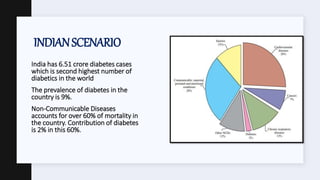
India has 6.51 crore diabetes cases
which is second highest number of
diabetics in the world
The prevalence of diabetes in the
country is 9%.
Non-Communicable Diseases
accounts for over 60% of mortality in
the country. Contribution of diabetes
is 2% in this 60%.
Destruction of beta cells of pancreas with consequent insulin deficiency to abnormalities that
result in resistance to insulin action.
Deficient insulin actions results from inadequate insulin secretion and/or diminished tissue
responses to insulin at one or more points in the complex pathways of hormone action.
Host factors - Age (middle age), Gender (male), Genetic factors (family history), Obesity,
Pregnancy.
Environment factors
CAUSES
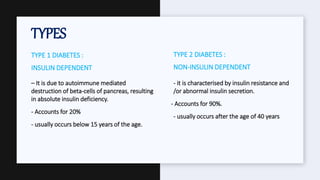
TYPE 1 DIABETES :
INSULIN DEPENDENT
– It is due to autoimmune mediated
destruction of beta-cells of pancreas, resulting
in absolute insulin deficiency.
- Accounts for 20%
- usually occurs below 15 years of the age.
TYPE 2 DIABETES :
NON-INSULIN DEPENDENT
- it is characterised by insulin resistance and
/or abnormal insulin secretion.
- Accounts for 90%.
-- usually occurs after the age of 40 years
TYPES
SYMPTOMS
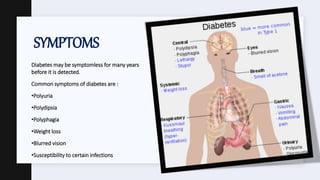
Diabetes may be symptomless for many years
before it is detected.
Common symptoms of diabetes are :
•Polyuria
•Polydipsia
•Polyphagia
•Weight loss
•Blurred vision
•Susceptibility to certain infections
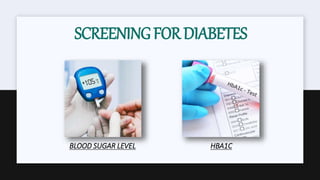
BLOOD SUGAR LEVEL HBA1C
SCREENINGFORDIABETES
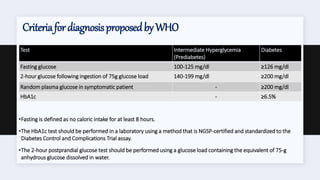
CriteriafordiagnosisproposedbyWHO
•Fasting is defined as no caloric intake for at least 8 hours.
•The HbA1c test should be performed in a laboratory using a method that is NGSP-certified and standardized to the
Diabetes Control and Complications Trial assay.
•The 2-hour postprandial glucose test should be performed using a glucose load containing the equivalent of 75-g
anhydrous glucose dissolved in water.
Test Intermediate Hyperglycemia
(Prediabetes)
Diabetes
Fasting glucose 100-125 mg/dl ≥126 mg/dl
2-hour glucose following ingestion of 75g glucose load 140-199 mg/dl ≥200 mg/dl
Random plasma glucose in symptomatic patient - ≥200 mg/dl
HbA1c - ≥6.5%
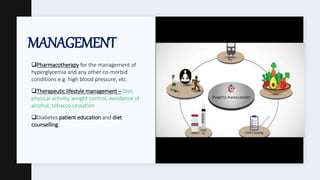
MANAGEMENT
Pharmacotherapy for the management of
hyperglycemia and any other co-morbid
conditions e.g. high blood pressure, etc.
Therapeutic lifestyle management – Diet,
physical activity, weight control, avoidance of
alcohol, tobacco cessation
Diabetes patient education and diet
counselling.
PREVENTION
 Primary
 Secondary
 Tertiary
POPULATION STRATEGY
•Nutritional habits
•Maintenance of body weight
•Physical exercise
•Avoidance of sweet food
HIGH RISK STRATEGY
•Avoidance of over nutrition and obesity
•Subjects at risk should avoid diabetogenetic drugs
•Reduce factors promoting atherosclerosis.
PRIMARY
•Proper management of diabetes
•Self care
•Home blood glucose monitoring
SECONDARY
•Prevention of complications – cardiomyopathy, retinopathy, neuropathy, nephropathy etc.
•Epidemiological researches – registers for diabetes.
TERTIARY
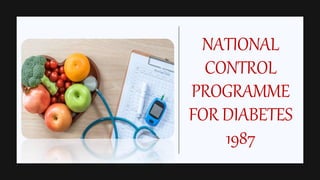
NATIONAL
CONTROL
PROGRAMME
FOR DIABETES
1987
Based on the alarming figures of the diabetes, government of India started
National Diabetes Control Programme on pilot basis during the 7th Five year plan in
1987 in some districts of Tamil Nadu, Jammu and Kashmir and Karnataka.
But due to paucity of funds in subsequent years this programme could not be
expanded further in remaining states.
However, during 1995-96, a sum of 12 lakh rupees was allocated for the
programme and subsequently in 1997-98 an allocation of one crore was made.
INTRODUCTION
Prevention of diabetes through identification of high risk subjects and early intervention
in the form of health education.
Early diagnosis of disease and appropriate treatment, reduction of morbidity and
mortality with reference to high risk group.
Prevention of acute ad chronic metabolic, cardiovascular, renal and ocular complications
of the disease.
Provision of equal opportunities for physical attainment and scholastic achievement for
the diabetic patients.
Rehabilitation of those partially or totally handicapped diabetes people.
OBJECTIVES
NATIONALPROGRAMMEONPREVENTIONANDCONTROL
OFDIABETES,CARDIOVASCULARDISEASEANDSTROKE
NPDCS,2008
To contain the increasing burden of Non-communicable Diseases, Ministry Of Health And
Family Welfare, Government Of India, has launched the National Programme On Prevention
And Control Of Diabetes, Cardiovascular Diseases And Stroke (NPDCS) on 8th January 2008
with the following objectives :
Prevention and control of NCDs including Diabetes.
Awareness generation on lifestyle changes
Early detection of Diabetes
Capacity building of health systems to tackle NCDs. Including Diabetes.
A pilot phase has been launched in 10 districts in 10 states focused on health promotion and
health education advocacy at various settings.
OBJECTIVES OF NPDCS
Health promotion and health education for the community
Early detection of persons with high levels of risk factors (at the risk of developing disease)
through screening; and
Strengthening health systems at all levels to tackle NCDs and improvement of quality of care
including treatment of sleep disorders and augmenting facilities of dialysis.
INTERVENTIONS PLANNED IN NPDCS
•District NPDCS programme (626 districts)
•Non-Communicable Diseases (NCDs) Focal Centres at Medical College (54 Medical Colleges)
•State/union Territory NCD cell (35)
•National NCD Cell at centre
•Information education and communication (IEC) / Behavior change Communication (BCC)
•Capacity building and Research
•Inter-sectoral convergence
•Monitoring (including Management Information System) and Evaluation
COMPONENTS ENVISAGED IN THE NPDCS
The programme shall be implemented in 626 districts in all states/Uts in India with the
interventions at medical colleges (54), district hospitals (626), Community Health Centres (CHCs)
(3035), Primary Health Centres (PHCs) (16778) and all Sub-Centres (SCs) through community level
activities,
The programme shall be leveraging the strengths of the National Rural Health Mission (NRHM) at
the primary and secondary health care set up (SC/PHC/CHC/District Hospitals) through
convergence, need based training, Private Public Partnership and NGO interventions in school,
workplace and community settings.
Urban Social Health Activist (USHA) or any other available health worker as well as NGOs and
private practitioners shall be roped in for providing effective promotion, prevention and control
strategies on diabetes and its risk factors for urban areas.
NATIONALPROGRAMMEFORTHEPREVENTIONANDCONTROL
OFCANCER,DIABETES,CARDIOVASCULARDISEASESAND
STROKE
NPCDCS,2010
The National Programme for the Prevention and control of Cancer, Diabetes, Cardiovascular
Diseases and Stroke (NPCDCS) was initiated in 100 districts in 2010 and it was integrated with the
National Health Mission in 2013 with the focus to enable opportunistic screening for common
non-communicable diseases, at District and CHC levels, through NCD clinics.
Health promotion through behaviour change with involvement of community, civil society, community
based organizations, media etc.
Screening at all levels in the health care delivery system from sub-centre and above for early detection
of diseases covered under the program including management and follow up
To build capacity at various levels of health care for prevention, early diagnosis, treatment,
rehabilitation, IEC/BCC, operational research and rehabilitation
To provide logistic support for diagnosis and cost effective treatment at primary, secondary and tertiary
levels of health care.
To support for development of database of NCDs through Surveillance System and to monitor NCD
morbidity and mortality and risk factors.
OBJECTIVES
The strategies for prevention, control and treatment of diabetes would have following components
:
Health promotion awareness generation and promotion of healthy lifestyle
Screening and early detection
Timely affordable and accurate diagnosis
Access to affordable treatment
Rehabilitation
STRATEGIES
PACKAGEOFSERVICES
The package of services at various levels are mentioned :-
Sub centre
Primary
Health
Centre
Community
Health Centre
District
hospital
Medical
college
[As per the new guidelines of 2017]
•Health promotion for behaviour change and counselling. ‘population based/opportunistic’
screening of diabetes.
•Awareness generation of early waring signals and other risk factors of diabetes.
•Referral of suspected cases to PHC/CHC/ nearby health facility. Follow up of patient put on
treatment.
1. SUB CENTRE
•Population based / opportunistic screening of diabetes,
•Clinical diagnosis and treatment of diabetes, referral of complicated cases of DM to CHC/DH
•Identification of early waring signals.
•Referral of suspected cases to CHC/DH and follow up of patient put on treatment.
2. PRIMARY HEALTH CENTRE [PHC]
•Prevention and health promotion including counselling. Early diagnosis through clinical and
laboratory investigations.
•Diagnostics facilities – blood sugar, total cholesterol, lipid profile, blood urea, creatinine, X-ray, etc.
‘Opportunistic’ screening of diabetes.
•Management of diabetes.
•Referral of complicated cases to district hospital / higher health care facility
3. COMMUNITY HEALTH CENTRE / FIRST REFERRAL UNITS [CHC/FRU]
•Diagnosis and management of cases of diabetes including emergency services.
•Laboratory investigations and diagnostics :- Blood sugar, Lipid profile, KFT, LFT, X-ray etc.
•Referral of complicated cases to higher health care facility. Health promotion for behaviour change
and counselling. ‘Opportunistic’ screening of diabetes.
•Follow up for the patient on treatment.
4. DISTRICT HOSPITALS
•Mentoring of district hospitals, early diagnosis and management of diabetes and complicated
cases.
•Training of health personnel, Operational Research.
5. MEDICAL COLLEGE
The programme and interventions would establish a comprehensive sustainable system for reducing the rapid
rise of diabetes, disabilities and deaths due to diabetes.
Broadly, following outcomes are expected :-
Reduction in exposure to risk factors, life style changes leading to reduction in diabetes.
Improves quality of life,
Early detection & timely treatment leading to increase in cure rate /control & survival
Reduction in prevalence of physical disabilities including blindness.
Providing user friendly health services to the elderly population of the country
Reduction in deaths and disability due to trauma, disasters, etc.
Reduction in out-of-pocket expenditure on management of diabetes and thereby preventing catastrophic
implication on affected individual.
EXPECTEDOUTCOMES
•Under NHM, population based screening for diabetes is being initiated as a part of comprehensive
care which would complement the National Programme For Control Of Diabetes.
•Instituting PBS at the sub centre for Diabetes would be particularly beneficial to women, given
current low levels of care seeking among them and limited access to health services.
•Also address the issue of equity, since PBS would also enable reach to the marginalised.
•PBS will also serve the purpose of increasing awareness in the community about Diabetes, its risk
factors and the need for periodic screening.
POPULATION BASED SCREENING (PBS)
1. The first step is the active enumeration of the population and registration of families through
individual health cards placed within a family health folder.
•Enumeration of eligible couples, women and children in need of health services, already exists.
•Such listing will be expanded to include all members over 30 years.
•The initial enumeration would also list existing health issues/diseases/disabilities and exposure to
risk factors among individuals to estimate disease/risk burden; which can be utilized to prioritize
health interventions.
PROCESS OF PBS
2. ASHAs will undertake completion of the health cards. If they are not available in some urban
areas, the ANM will undertake such enumeration.
Each HC/sub centre would maintain these family folders to ensure that the population within its
coverage area is registered.
Any person resident in the area, for more than six months, would qualify to be registered.
3. The family and individual member would be allocated unique health ID; which will help
identification of family members.
The health cards issued to each family member would be used to document health events
(screening/treatment/complications etc.) and would also help in generation of population based
statistics.
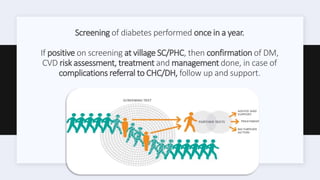
Screening of diabetes performed once in a year.
If positive on screening at village SC/PHC, then confirmation of DM,
CVD risk assessment, treatment and management done, in case of
complications referral to CHC/DH, follow up and support.
TASKSOFASHAIN
PREVENTIONAND
CONTROLOFDIABETES
1. Listing of all adults above the age of 30 years.
2. Completing the community based assessment
checklist
3. Organizing a screening day
4. Undertaking health promotion activity in the
community
5. Undertaking follow up for treatment adherence
and enabling lifestyle changes
6. Creating Patient Support Groups.
Population based screening for NCDs including Diabetes has been expanded to more districts.
Screening is being provided through trained frontline workers (ASHA & ANM) and suspected cases
are referred to Medical Officers at PHC.
Initiation of NCD App for capturing patient wise data and further follow up from PBS districts.
Integration of AYUSH with NPCDCS
Integration of RNTCP with NPCDCS to articulate a National Strategy for Management of TB and
Diabetes morbidities in India.
Opportunistic screening of common NCDs including Diabetes is being done among the attendees
of the India International Trade Fair (IITF) at Pragati Maidan, New Delhi during 14-27 November,
every year.
NEWERINITIATIVES
ACHIEVEMENTS BY
MARCH 2020
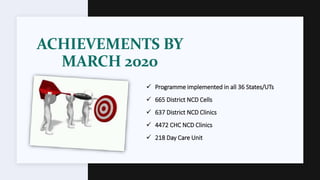
 Programme implemented in all 36 States/UTs
 665 District NCD Cells
 637 District NCD Clinics
 4472 CHC NCD Clinics
 218 Day Care Unit
Diabetes is a metabolic disease that causes high blood glucose level. It is a major disease in our
country, leading to devastating complications if not treated well.
Government of India launched National Control Programme For Diabetes in 1983 to prevent the
diabetes and control its prevalence. This programme undergone many changes and developed at
large level to strengthen the facilities and approach to a large scale population.
Its objective is to early diagnosis, providing appropriate treatment and refer complicated cases to
higher level health centre and to aware the population.
CONCLUSION
https://www.ncbi.nlm.nih.gov/pmc/articles/PMC3395295/
https://www.slideshare.net/maheswarijaikumar/diabetes-control-programmeindia
https://ncdc.gov.in/WriteReadData/linkimages/cdalert0616262925183.pdf
https://nhm.gov.in/index1.php?lang=1&level=2&sublinkid=1048&lid=604
https://www.researchgate.net/publication/230589944_National_programme_on_prevention_an
d_control_of_diabetes_in_India_Need_to_focus
REFERENCES
National control programme for diabetes

National control programme for diabetes

  • 1.
    PRESENTER : NK BSC(HONS) NURSING III YEAR
  • 2.
    OUTLINE Diabetes : -Definition, Indian scenario, Causes, Types, Common symptoms, Criteria for diagnosis, Management, Prevention National programme for control of diabetes, 1987 : 1. Introduction and objectives 2. NPDCS, 2008 – objectives, interventions, components 3. NPCDCS, 2010 – objectives, strategies 4. Package of services at different levels 5. Expected outcomes 6. Population based screening and its process 7. Tasks of ASHAs in prevention and control of diabetes 8. Newer initiatives
  • 3.
    INTRODUCTION Diabetes is oneof the major causes of premature illness and death worldwide. Diabetes prevalence is increasing in every country in the world, and the toll is climbing in terms of human lives as well as the costs to society.
  • 5.
    Diabetes is ametabolic disease which is characterised by high blood sugar levels i.e. hyperglycemia resulting from defects in insulin secretion, insulin action or both. It is one of the common ‘lifestyle diseases’ which is plaguing people in the developed countries. The chronic hyperglycemia of diabetes is associated with long-term damage, dysfunction, and failure of various organs, especially the eyes, kidneys, nerves, heart and blood vessels. DEFINITION
  • 6.
    INDIANSCENARIO India has 6.51crore diabetes cases which is second highest number of diabetics in the world The prevalence of diabetes in the country is 9%. Non-Communicable Diseases accounts for over 60% of mortality in the country. Contribution of diabetes is 2% in this 60%.
  • 7.
    Destruction of betacells of pancreas with consequent insulin deficiency to abnormalities that result in resistance to insulin action. Deficient insulin actions results from inadequate insulin secretion and/or diminished tissue responses to insulin at one or more points in the complex pathways of hormone action. Host factors - Age (middle age), Gender (male), Genetic factors (family history), Obesity, Pregnancy. Environment factors CAUSES
  • 8.
    TYPE 1 DIABETES: INSULIN DEPENDENT – It is due to autoimmune mediated destruction of beta-cells of pancreas, resulting in absolute insulin deficiency. - Accounts for 20% - usually occurs below 15 years of the age. TYPE 2 DIABETES : NON-INSULIN DEPENDENT - it is characterised by insulin resistance and /or abnormal insulin secretion. - Accounts for 90%. -- usually occurs after the age of 40 years TYPES
  • 9.
    SYMPTOMS Diabetes may besymptomless for many years before it is detected. Common symptoms of diabetes are : •Polyuria •Polydipsia •Polyphagia •Weight loss •Blurred vision •Susceptibility to certain infections
  • 10.
    BLOOD SUGAR LEVELHBA1C SCREENINGFORDIABETES
  • 11.
    CriteriafordiagnosisproposedbyWHO •Fasting is definedas no caloric intake for at least 8 hours. •The HbA1c test should be performed in a laboratory using a method that is NGSP-certified and standardized to the Diabetes Control and Complications Trial assay. •The 2-hour postprandial glucose test should be performed using a glucose load containing the equivalent of 75-g anhydrous glucose dissolved in water. Test Intermediate Hyperglycemia (Prediabetes) Diabetes Fasting glucose 100-125 mg/dl ≥126 mg/dl 2-hour glucose following ingestion of 75g glucose load 140-199 mg/dl ≥200 mg/dl Random plasma glucose in symptomatic patient - ≥200 mg/dl HbA1c - ≥6.5%
  • 12.
    MANAGEMENT Pharmacotherapy for themanagement of hyperglycemia and any other co-morbid conditions e.g. high blood pressure, etc. Therapeutic lifestyle management – Diet, physical activity, weight control, avoidance of alcohol, tobacco cessation Diabetes patient education and diet counselling.
  • 13.
  • 14.
    POPULATION STRATEGY •Nutritional habits •Maintenanceof body weight •Physical exercise •Avoidance of sweet food HIGH RISK STRATEGY •Avoidance of over nutrition and obesity •Subjects at risk should avoid diabetogenetic drugs •Reduce factors promoting atherosclerosis. PRIMARY
  • 15.
    •Proper management ofdiabetes •Self care •Home blood glucose monitoring SECONDARY
  • 16.
    •Prevention of complications– cardiomyopathy, retinopathy, neuropathy, nephropathy etc. •Epidemiological researches – registers for diabetes. TERTIARY
  • 17.
  • 18.
    Based on thealarming figures of the diabetes, government of India started National Diabetes Control Programme on pilot basis during the 7th Five year plan in 1987 in some districts of Tamil Nadu, Jammu and Kashmir and Karnataka. But due to paucity of funds in subsequent years this programme could not be expanded further in remaining states. However, during 1995-96, a sum of 12 lakh rupees was allocated for the programme and subsequently in 1997-98 an allocation of one crore was made. INTRODUCTION
  • 19.
    Prevention of diabetesthrough identification of high risk subjects and early intervention in the form of health education. Early diagnosis of disease and appropriate treatment, reduction of morbidity and mortality with reference to high risk group. Prevention of acute ad chronic metabolic, cardiovascular, renal and ocular complications of the disease. Provision of equal opportunities for physical attainment and scholastic achievement for the diabetic patients. Rehabilitation of those partially or totally handicapped diabetes people. OBJECTIVES
  • 20.
    NATIONALPROGRAMMEONPREVENTIONANDCONTROL OFDIABETES,CARDIOVASCULARDISEASEANDSTROKE NPDCS,2008 To contain theincreasing burden of Non-communicable Diseases, Ministry Of Health And Family Welfare, Government Of India, has launched the National Programme On Prevention And Control Of Diabetes, Cardiovascular Diseases And Stroke (NPDCS) on 8th January 2008 with the following objectives :
  • 21.
    Prevention and controlof NCDs including Diabetes. Awareness generation on lifestyle changes Early detection of Diabetes Capacity building of health systems to tackle NCDs. Including Diabetes. A pilot phase has been launched in 10 districts in 10 states focused on health promotion and health education advocacy at various settings. OBJECTIVES OF NPDCS
  • 22.
    Health promotion andhealth education for the community Early detection of persons with high levels of risk factors (at the risk of developing disease) through screening; and Strengthening health systems at all levels to tackle NCDs and improvement of quality of care including treatment of sleep disorders and augmenting facilities of dialysis. INTERVENTIONS PLANNED IN NPDCS
  • 23.
    •District NPDCS programme(626 districts) •Non-Communicable Diseases (NCDs) Focal Centres at Medical College (54 Medical Colleges) •State/union Territory NCD cell (35) •National NCD Cell at centre •Information education and communication (IEC) / Behavior change Communication (BCC) •Capacity building and Research •Inter-sectoral convergence •Monitoring (including Management Information System) and Evaluation COMPONENTS ENVISAGED IN THE NPDCS
  • 24.
    The programme shallbe implemented in 626 districts in all states/Uts in India with the interventions at medical colleges (54), district hospitals (626), Community Health Centres (CHCs) (3035), Primary Health Centres (PHCs) (16778) and all Sub-Centres (SCs) through community level activities, The programme shall be leveraging the strengths of the National Rural Health Mission (NRHM) at the primary and secondary health care set up (SC/PHC/CHC/District Hospitals) through convergence, need based training, Private Public Partnership and NGO interventions in school, workplace and community settings. Urban Social Health Activist (USHA) or any other available health worker as well as NGOs and private practitioners shall be roped in for providing effective promotion, prevention and control strategies on diabetes and its risk factors for urban areas.
  • 25.
    NATIONALPROGRAMMEFORTHEPREVENTIONANDCONTROL OFCANCER,DIABETES,CARDIOVASCULARDISEASESAND STROKE NPCDCS,2010 The National Programmefor the Prevention and control of Cancer, Diabetes, Cardiovascular Diseases and Stroke (NPCDCS) was initiated in 100 districts in 2010 and it was integrated with the National Health Mission in 2013 with the focus to enable opportunistic screening for common non-communicable diseases, at District and CHC levels, through NCD clinics.
  • 26.
    Health promotion throughbehaviour change with involvement of community, civil society, community based organizations, media etc. Screening at all levels in the health care delivery system from sub-centre and above for early detection of diseases covered under the program including management and follow up To build capacity at various levels of health care for prevention, early diagnosis, treatment, rehabilitation, IEC/BCC, operational research and rehabilitation To provide logistic support for diagnosis and cost effective treatment at primary, secondary and tertiary levels of health care. To support for development of database of NCDs through Surveillance System and to monitor NCD morbidity and mortality and risk factors. OBJECTIVES
  • 27.
    The strategies forprevention, control and treatment of diabetes would have following components : Health promotion awareness generation and promotion of healthy lifestyle Screening and early detection Timely affordable and accurate diagnosis Access to affordable treatment Rehabilitation STRATEGIES
  • 28.
    PACKAGEOFSERVICES The package ofservices at various levels are mentioned :- Sub centre Primary Health Centre Community Health Centre District hospital Medical college [As per the new guidelines of 2017]
  • 29.
    •Health promotion forbehaviour change and counselling. ‘population based/opportunistic’ screening of diabetes. •Awareness generation of early waring signals and other risk factors of diabetes. •Referral of suspected cases to PHC/CHC/ nearby health facility. Follow up of patient put on treatment. 1. SUB CENTRE
  • 30.
    •Population based /opportunistic screening of diabetes, •Clinical diagnosis and treatment of diabetes, referral of complicated cases of DM to CHC/DH •Identification of early waring signals. •Referral of suspected cases to CHC/DH and follow up of patient put on treatment. 2. PRIMARY HEALTH CENTRE [PHC]
  • 31.
    •Prevention and healthpromotion including counselling. Early diagnosis through clinical and laboratory investigations. •Diagnostics facilities – blood sugar, total cholesterol, lipid profile, blood urea, creatinine, X-ray, etc. ‘Opportunistic’ screening of diabetes. •Management of diabetes. •Referral of complicated cases to district hospital / higher health care facility 3. COMMUNITY HEALTH CENTRE / FIRST REFERRAL UNITS [CHC/FRU]
  • 32.
    •Diagnosis and managementof cases of diabetes including emergency services. •Laboratory investigations and diagnostics :- Blood sugar, Lipid profile, KFT, LFT, X-ray etc. •Referral of complicated cases to higher health care facility. Health promotion for behaviour change and counselling. ‘Opportunistic’ screening of diabetes. •Follow up for the patient on treatment. 4. DISTRICT HOSPITALS
  • 33.
    •Mentoring of districthospitals, early diagnosis and management of diabetes and complicated cases. •Training of health personnel, Operational Research. 5. MEDICAL COLLEGE
  • 34.
    The programme andinterventions would establish a comprehensive sustainable system for reducing the rapid rise of diabetes, disabilities and deaths due to diabetes. Broadly, following outcomes are expected :- Reduction in exposure to risk factors, life style changes leading to reduction in diabetes. Improves quality of life, Early detection & timely treatment leading to increase in cure rate /control & survival Reduction in prevalence of physical disabilities including blindness. Providing user friendly health services to the elderly population of the country Reduction in deaths and disability due to trauma, disasters, etc. Reduction in out-of-pocket expenditure on management of diabetes and thereby preventing catastrophic implication on affected individual. EXPECTEDOUTCOMES
  • 35.
    •Under NHM, populationbased screening for diabetes is being initiated as a part of comprehensive care which would complement the National Programme For Control Of Diabetes. •Instituting PBS at the sub centre for Diabetes would be particularly beneficial to women, given current low levels of care seeking among them and limited access to health services. •Also address the issue of equity, since PBS would also enable reach to the marginalised. •PBS will also serve the purpose of increasing awareness in the community about Diabetes, its risk factors and the need for periodic screening. POPULATION BASED SCREENING (PBS)
  • 36.
    1. The firststep is the active enumeration of the population and registration of families through individual health cards placed within a family health folder. •Enumeration of eligible couples, women and children in need of health services, already exists. •Such listing will be expanded to include all members over 30 years. •The initial enumeration would also list existing health issues/diseases/disabilities and exposure to risk factors among individuals to estimate disease/risk burden; which can be utilized to prioritize health interventions. PROCESS OF PBS
  • 37.
    2. ASHAs willundertake completion of the health cards. If they are not available in some urban areas, the ANM will undertake such enumeration. Each HC/sub centre would maintain these family folders to ensure that the population within its coverage area is registered. Any person resident in the area, for more than six months, would qualify to be registered. 3. The family and individual member would be allocated unique health ID; which will help identification of family members. The health cards issued to each family member would be used to document health events (screening/treatment/complications etc.) and would also help in generation of population based statistics.
  • 38.
    Screening of diabetesperformed once in a year. If positive on screening at village SC/PHC, then confirmation of DM, CVD risk assessment, treatment and management done, in case of complications referral to CHC/DH, follow up and support.
  • 39.
    TASKSOFASHAIN PREVENTIONAND CONTROLOFDIABETES 1. Listing ofall adults above the age of 30 years. 2. Completing the community based assessment checklist 3. Organizing a screening day 4. Undertaking health promotion activity in the community 5. Undertaking follow up for treatment adherence and enabling lifestyle changes 6. Creating Patient Support Groups.
  • 40.
    Population based screeningfor NCDs including Diabetes has been expanded to more districts. Screening is being provided through trained frontline workers (ASHA & ANM) and suspected cases are referred to Medical Officers at PHC. Initiation of NCD App for capturing patient wise data and further follow up from PBS districts. Integration of AYUSH with NPCDCS Integration of RNTCP with NPCDCS to articulate a National Strategy for Management of TB and Diabetes morbidities in India. Opportunistic screening of common NCDs including Diabetes is being done among the attendees of the India International Trade Fair (IITF) at Pragati Maidan, New Delhi during 14-27 November, every year. NEWERINITIATIVES
  • 41.
    ACHIEVEMENTS BY MARCH 2020 Programme implemented in all 36 States/UTs  665 District NCD Cells  637 District NCD Clinics  4472 CHC NCD Clinics  218 Day Care Unit
  • 42.
    Diabetes is ametabolic disease that causes high blood glucose level. It is a major disease in our country, leading to devastating complications if not treated well. Government of India launched National Control Programme For Diabetes in 1983 to prevent the diabetes and control its prevalence. This programme undergone many changes and developed at large level to strengthen the facilities and approach to a large scale population. Its objective is to early diagnosis, providing appropriate treatment and refer complicated cases to higher level health centre and to aware the population. CONCLUSION
  • 43.