
NATIONAL PROGRAMME FOR
BLINDNESS CONTROL
Ms. Rajosi Khanra
M.Sc. Nursing 2nd year
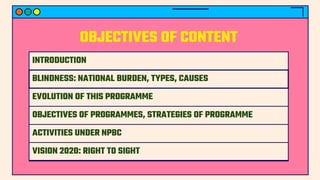
OBJECTIVES OF CONTENT
INTRODUCTION
BLINDNESS: NATIONAL BURDEN, TYPES, CAUSES
EVOLUTION OF THIS PROGRAMME
OBJECTIVES OF PROGRAMMES, STRATEGIES OF PROGRAMME
ACTIVITIES UNDER NPBC
VISION 2020: RIGHT TO SIGHT
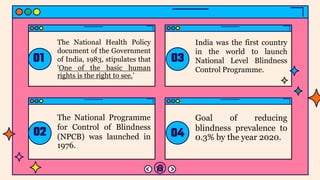
The National Health Policy
document of the Government
of India, 1983, stipulates that
'One of the basic human
rights is the right to see.’
India was the first country
in the world to launch
National Level Blindness
Control Programme.
The National Programme
for Control of Blindness
(NPCB) was launched in
1976.
Goal of reducing
blindness prevalence to
0.3% by the year 2020.
03
04
01
02
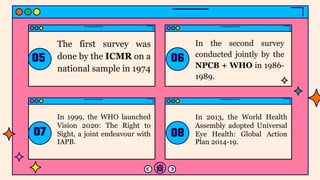
The first survey was
done by the ICMR on a
national sample in 1974
In the second survey
conducted jointly by the
NPCB + WHO in 1986-
1989.
In 1999, the WHO launched
Vision 2020: The Right to
Sight, a joint endeavour with
IAPB.
In 2013, the World Health
Assembly adopted Universal
Eye Health: Global Action
Plan 2014-19.
06
08
05
07
prevalence of blindness is
0.36% of the population (8
billion).
Estimated prevalence of
visual impairment
● Mild: 40 million
● Moderate: 25 million
● Severe: 4.8 million
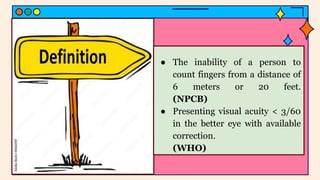
● The inability of a person to
count fingers from a distance of
6 meters or 20 feet.
(NPCB)
● Presenting visual acuity < 3/60
in the better eye with available
correction.
(WHO)
CAUSES OF BLINDNESS OR VISUAL IMPAIRMENT
● Cataract
● Refractive error
● Glaucoma
● Age-related macular degeneration
● Diabetic retinopathy
● Posterior Segment Disorder
● Post Capsular Opacification
● Corneal Blindness/ opacity
● Surgical Complications
TYPES OF BLINDNESS
SOCIAL
BLINDNESS
AVOIDABLE
BLINDNESS
CURABLE
BLINDNESS
ECONOMICAL
BLINDNESS
PREVENTABLE
BLINDNESS
MANIFEST
BLINDNESS
ABSOLUTE
BLINDNESS
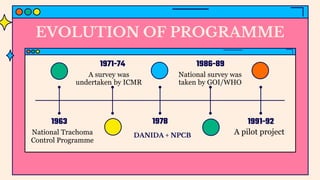
EVOLUTION OF PROGRAMME
DANIDA + NPCB
1963
National Trachoma
Control Programme
1978 1991-92
A pilot project
1971-74
A survey was
undertaken by ICMR
1986-89
National survey was
taken by GOI/WHO
1994-95
● World Bank-assisted cataract
blindness control project was
launched.
● A Government of India project
in Jammu and Kashmir and a
DANIDA project in Karnataka
were also launched.
EVOLUTION OF PROGRAMME
1997 1999
1997-98
Mega eye camp
launched
DANIDA project 3
was started.
Under NPCB, a goal is set to be
achieved to reduce the prevalence
of blindness from 1.49%- 0.3%.
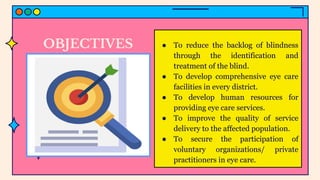
OBJECTIVES ● To reduce the backlog of blindness
through the identification and
treatment of the blind.
● To develop comprehensive eye care
facilities in every district.
● To develop human resources for
providing eye care services.
● To improve the quality of service
delivery to the affected population.
● To secure the participation of
voluntary organizations/ private
practitioners in eye care.
● To enhance community awareness of eye care.
● To provide the best possible treatment for
curable blindness available in the district/region.
● To enhance and expand research for the
prevention of blindness and visual impairment.
● To secure the participation of voluntary
organizations/ private practitioners in delivering
eye care.
ORGANIZATIONAL
STRUCTURE
NATIONAL LEVEL
DGHS, MoHFW
STATE LEVEL
OPHTHALMOLOGY
CELL
DISTRICT LEVEL
DISTRICT BLINDNESS
CONTROL SOCIETY
OPHTHALMIC
SECTION
ADMINISTRATIVE
WING
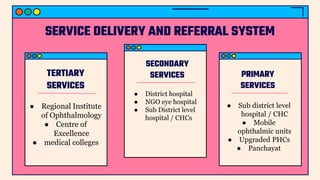
SERVICE DELIVERY AND REFERRAL SYSTEM
TERTIARY
SERVICES
● Regional Institute
of Ophthalmology
● Centre of
Excellence
● medical colleges
SECONDARY
SERVICES
● District hospital
● NGO eye hospital
● Sub District level
hospital / CHCs
PRIMARY
SERVICES
● Sub district level
hospital / CHC
● Mobile
ophthalmic units
● Upgraded PHCs
● Panchayat
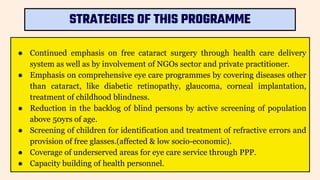
STRATEGIES OF THIS PROGRAMME
● Continued emphasis on free cataract surgery through health care delivery
system as well as by involvement of NGOs sector and private practitioner.
● Emphasis on comprehensive eye care programmes by covering diseases other
than cataract, like diabetic retinopathy, glaucoma, corneal implantation,
treatment of childhood blindness.
● Reduction in the backlog of blind persons by active screening of population
above 50yrs of age.
● Screening of children for identification and treatment of refractive errors and
provision of free glasses.(affected & low socio-economic).
● Coverage of underserved areas for eye care service through PPP.
● Capacity building of health personnel.
● Strengthening of Regional institute of Ophthalmology and
medical colleges of state. So they can be upgraded as Center of
Excellence in the region.
● IEC activities for creating awareness on eye care within
community.
● District hospitals to be strengthen by upgrading infrastructure,
equipment’s, and providing adequate manpower.
● Emphasis on (eye care) by establishing vision center in all
primary health care PHC.
● Multipurpose District Mobile Ophthalmic Units for better
coverage.
ACTIVITIES UNDER NPCB
A. CATARACT OPERATIONS
● Identification of bilaterally blind persons
● Preparation of blind registers,
● Screening for operable cataracts,
● Performing surgery and follow-up services.
The surgical services are available in the government, NGO, private
fixed facilities (hospitals/institutions) as well as in eye camps.
These services are free of cost for those who cannot afford the cost.
B. INVOLVEMENT OF NGOS
● Voluntary Organisations play an
important role in implementing
various activities under the
programme.
● For expansion/upgradation of eye
care units in tribal and backward
rural areas a grant in aid of Rs 25
lakhs is provided through State
Blindness Control Societies.
C. IEC ACTIVITIES
Special campaigns for mass awareness are
taken up
 during eye donation fortnight (25th
August to 8th September)
 ‘World Sight Day’ (2nd Thursday of
October).
At the central level, the IEC prototype
material is produced and disseminated to
states.
D. MANAGEMENT OF INFORMATION SYSTEM
● To facilitate monitoring of trends in performance and analysing
epidemiological situation on blindness.
● A computerized information system has been set up in the form of 25
Sentinel Surveillance Units located in medical colleges.
● The cataract surgery data is stratified for gender, social status, type and
place of surgery.
E. SCHOOL EYE SCREENING PROGRAMME
● Training of teachers to screen children for refractive errors.
● Screening done annually.
● Confirmation by Ophthalmic assistants.
● Free spectacles provided to non-affording.
F. COLLECTION AND UTILIZATION OF DONATED EYES
● Donated eyes need to be removed within 6 hours of death of the individual.
It is to be preserved in specific solutions in eye banks and utilized for
transplantation within 72 hours.
● Eye donation fortnight is organized from 25th August to 8th September
every year to promote eye donation/eye banking.
G. CONTROL OF VIT A DEFICIENCY
H. MONITORING AND EVALUATION BY SURVEY
Launched on 1999 by WHO
& the International Agency
for the Prevention of
Blindness(IAPB), a global
initiative to reduce avoidable
(preventable and curable)
blindness by the year 2020.
VISION 2020:
RIGHT TO SIGHT
TARGETED DISEASES
Cataract
Refractive
errors
Childhood
blindness
GLAUCOMA
Corneal
blindness
Diabetic retinopathy
UPDATE ON NPCB
Under National Programme for
Control of Blindness and Visual
Impairment (NPCBVI), a Mission
Mode Cataract Surgery campaign
(Netra Jyoti Abhiyan) was launched
(2022-2025) to clear backlog of
eligible cataract cases by allotting
yearly targets to each State and Union
Territory
In 2017, the Nomenclature of the
programme was also changed
from the National Programme for
Control of Blindness to the
National Programme for Control
of Blindness & Visual Impairment.
The programme strengthened its
infrastructure and human
resources by establishing more eye
banks, satellite centres, screening
camps, and training programmes.
The programme expanded its coverage to
include all kinds of visual impairment,
such as glaucoma, diabetic retinopathy,
corneal transplantation, and childhood
blindness.
The programme collaborated with
various NGOs, private practitioners,
medical colleges, and other
stakeholders to improve the quality
and accessibility of eye care
services.
SUMMARY
ANY Q??
Blindness is a great public health problem.
NPCB started in 1976, mainly to achieve
goal reduction in prevalence of blindness
from 1.4 % to <0.3% by 2020 Activities
carried out to achieve goals through
cataract surgeries, NGOs, screening of
school children, eye camps, IEC for eye
donation, MDMOUs etc. In preventing
Preventable Blindness, and treating Curable
Blindness. Vision 2020 the Right to Sight
will be achieved by the help of 3 levels of
eye care.
CONCLUSION
Magnitude, causes and management of avoidable blindness:
A cross-sectional study in Pravara Rural Hospital of Rural Medical
College, Maharashtra, India.
Globally, an estimated 180 million people are affected by visual impairment,
with nearly 45 million experiencing blindness, and the majority residing in
developing countries. Notably, four out of five blind individuals live in these
developing nations. Within the South-East Asia Region, which is home to one-
third of the world's blind population (15 million) and half of the world's blind
children (0.7 million), approximately 90% of blindness cases are deemed
avoidable. This study, conducted at the Pravara Rural Hospital of Rural Medical
College Loni in Maharashtra, India, aimed to assess the prevalence of
preventable causes of blindness and investigate the various factors contributing
to blindness, along with the corresponding treatments provided.
In January 2011, the ophthalmology department of the tertiary health center
examined 703 patients, revealing that 588 individuals (83.6%) suffered from
avoidable blindness—525 from the outpatient department and 63 from the
inpatient department. Cataracts were identified as the most common cause,
accounting for 60.95% of cases, followed by refractive errors at 26%.
Conversely, vitamin A deficiency and retinopathy were identified as the least
common causes of avoidable blindness in this study. The baseline data
provided by this study regarding the prevalence, causes, and management of
avoidable blindness is expected to contribute to the success of the 'Vision
2020' initiative.
A Study to Evaluate the Causes of Delayed Presentation for Cataract
Surgery at a Tertiary Eye Centre, Odisha, India.
Despite receiving medical advice and having access to various health schemes provided by
the Government of India for the economically disadvantaged, individuals still tend to delay
surgery, leading to potential complications. This study aims to investigate the reasons
behind the delayed cataract surgery among Below Poverty Line (BPL) patients at a tertiary
healthcare center in Eastern India. This hospital-based, cross-sectional study involved 58
patients who sought care at the outpatient and emergency departments between December
2020 and April 2021. During their presentation, a detailed history was obtained, and
patients were queried about the causes of delay, categorized into barriers related to patient
attitudes, as well as those associated with cost, affordability, and service delivery. Each
patient underwent a comprehensive ophthalmological examination, and routine blood
investigations required for cataract surgery were conducted. All surgeries were performed
by a single surgeon, with any intraocular complications noted.
The study revealed a higher representation of females (57%) compared to males
(43%), predominantly from semi-urban areas (13.79%). A significant proportion
(60%) depended on family members for financial support, despite 94.8% having
government insurance schemes. Financial constraints persisted, causing delayed
presentation. A substantial percentage (70.7%) did not seek hospital care due to
negative peer group influences, and almost 84.5% lacked direct means of
transportation to the hospital. Fear of surgery (96.6%) and concerns about
contracting COVID-19 (94.8%) were additional factors contributing to delayed
presentation for surgery.
In conclusion, this study identifies various potential reasons, encompassing social,
economic, and individual factors such as fear of surgery, negative peer pressure,
and financial constraints, contributing to the delayed acceptance of cataract
surgery in this population. Understanding these factors is crucial for developing
targeted interventions to promote timely access to essential surgical care in
similar settings.
REFERENCES
● Key Findings [Internet]. Available from:
https://npcbvi.mohfw.gov.in/writeReadData/mainlinkFile/File341.pdf.
● National programme for control of blindness and vision 2020 [Internet]. www.slideshare.net. 2020 [cited
2023 Dec 25]. Available from: https://www.slideshare.net/ObaidurRehman74/national-programme-for-
control-of-blindness-and-vision-2020
● National Programme For Control of Blindness [Internet]. www.slideshare.net. 2021 [cited 2023 Dec 25].
Available from: https://www.slideshare.net/ShubhangiHedau/national-programme-for-control-of-
blindness-244371540.
● National programme for control of blindness [Internet]. www.slideshare.net. 2017 [cited 2023 Dec 25].
Available from: https://www.slideshare.net/DocSantoshSoren/national-programme-for-control-of-
blindness-80650317.
● · NPCB.pptx [Internet]. www.slideshare.net. 2022 [cited 2023 Dec 25]. Available from:
https://www.slideshare.net/AlmiAlmi1/npcbpptx.
● · Vision 2020 [Internet]. www.slideshare.net. 2015 [cited 2023 Dec 25]. Available from:
https://www.slideshare.net/sssihmspg/vision-2020-54296753.
● Krishna N. NATIONAL PROGRAMME FOR CONTROL OF BLINDNESS(NPCB) [Internet].
[cited 2023 Dec 25]. Available from:
https://www.kimsmedicalcollege.org/cme/NAVYA%20KRISHNA-
NATIONAL%20PROGRAMME%20FOR%20CONTROL%20OF%20BLINDNESS.pdf.
● Avachat, Shubhada & Kamble, Suchit & Phalke, Deepak & Bangal, Surekha & Zambare,
Mrinal. (2013). Magnitude causes and management of avoidable blindness: A cross-
sectional study in Pravara Rural Hospital of Rural Medical College, Maharashtra, India.
South East Asia Journal of Public Health.
● JCDR - A Study to Evaluate the Causes of Delayed Presentation for Cataract Surgery at a
Tertiary Eye Centre, Odisha, India [Internet]. www.jcdr.net. [cited 2023 Dec 25]. Available
from: https://www.jcdr.net/article_abstract.asp?issn=0973-
709x&year=2022&volume=16&issue=1&page=NC01&issn=0973-709x&id=15867
THANK YOU !!

national blindness control programme.pptx

  • 2.
    NATIONAL PROGRAMME FOR BLINDNESSCONTROL Ms. Rajosi Khanra M.Sc. Nursing 2nd year
  • 3.
    OBJECTIVES OF CONTENT INTRODUCTION BLINDNESS:NATIONAL BURDEN, TYPES, CAUSES EVOLUTION OF THIS PROGRAMME OBJECTIVES OF PROGRAMMES, STRATEGIES OF PROGRAMME ACTIVITIES UNDER NPBC VISION 2020: RIGHT TO SIGHT
  • 4.
    The National HealthPolicy document of the Government of India, 1983, stipulates that 'One of the basic human rights is the right to see.’ India was the first country in the world to launch National Level Blindness Control Programme. The National Programme for Control of Blindness (NPCB) was launched in 1976. Goal of reducing blindness prevalence to 0.3% by the year 2020. 03 04 01 02
  • 5.
    The first surveywas done by the ICMR on a national sample in 1974 In the second survey conducted jointly by the NPCB + WHO in 1986- 1989. In 1999, the WHO launched Vision 2020: The Right to Sight, a joint endeavour with IAPB. In 2013, the World Health Assembly adopted Universal Eye Health: Global Action Plan 2014-19. 06 08 05 07
  • 6.
    prevalence of blindnessis 0.36% of the population (8 billion). Estimated prevalence of visual impairment ● Mild: 40 million ● Moderate: 25 million ● Severe: 4.8 million
  • 7.
    ● The inabilityof a person to count fingers from a distance of 6 meters or 20 feet. (NPCB) ● Presenting visual acuity < 3/60 in the better eye with available correction. (WHO)
  • 8.
    CAUSES OF BLINDNESSOR VISUAL IMPAIRMENT ● Cataract ● Refractive error ● Glaucoma ● Age-related macular degeneration ● Diabetic retinopathy ● Posterior Segment Disorder ● Post Capsular Opacification ● Corneal Blindness/ opacity ● Surgical Complications
  • 9.
  • 10.
  • 11.
    EVOLUTION OF PROGRAMME DANIDA+ NPCB 1963 National Trachoma Control Programme 1978 1991-92 A pilot project 1971-74 A survey was undertaken by ICMR 1986-89 National survey was taken by GOI/WHO
  • 12.
    1994-95 ● World Bank-assistedcataract blindness control project was launched. ● A Government of India project in Jammu and Kashmir and a DANIDA project in Karnataka were also launched.
  • 13.
    EVOLUTION OF PROGRAMME 19971999 1997-98 Mega eye camp launched DANIDA project 3 was started. Under NPCB, a goal is set to be achieved to reduce the prevalence of blindness from 1.49%- 0.3%.
  • 14.
    OBJECTIVES ● Toreduce the backlog of blindness through the identification and treatment of the blind. ● To develop comprehensive eye care facilities in every district. ● To develop human resources for providing eye care services. ● To improve the quality of service delivery to the affected population. ● To secure the participation of voluntary organizations/ private practitioners in eye care.
  • 15.
    ● To enhancecommunity awareness of eye care. ● To provide the best possible treatment for curable blindness available in the district/region. ● To enhance and expand research for the prevention of blindness and visual impairment. ● To secure the participation of voluntary organizations/ private practitioners in delivering eye care.
  • 16.
    ORGANIZATIONAL STRUCTURE NATIONAL LEVEL DGHS, MoHFW STATELEVEL OPHTHALMOLOGY CELL DISTRICT LEVEL DISTRICT BLINDNESS CONTROL SOCIETY OPHTHALMIC SECTION ADMINISTRATIVE WING
  • 17.
    SERVICE DELIVERY ANDREFERRAL SYSTEM TERTIARY SERVICES ● Regional Institute of Ophthalmology ● Centre of Excellence ● medical colleges SECONDARY SERVICES ● District hospital ● NGO eye hospital ● Sub District level hospital / CHCs PRIMARY SERVICES ● Sub district level hospital / CHC ● Mobile ophthalmic units ● Upgraded PHCs ● Panchayat
  • 18.
    STRATEGIES OF THISPROGRAMME ● Continued emphasis on free cataract surgery through health care delivery system as well as by involvement of NGOs sector and private practitioner. ● Emphasis on comprehensive eye care programmes by covering diseases other than cataract, like diabetic retinopathy, glaucoma, corneal implantation, treatment of childhood blindness. ● Reduction in the backlog of blind persons by active screening of population above 50yrs of age. ● Screening of children for identification and treatment of refractive errors and provision of free glasses.(affected & low socio-economic). ● Coverage of underserved areas for eye care service through PPP. ● Capacity building of health personnel.
  • 19.
    ● Strengthening ofRegional institute of Ophthalmology and medical colleges of state. So they can be upgraded as Center of Excellence in the region. ● IEC activities for creating awareness on eye care within community. ● District hospitals to be strengthen by upgrading infrastructure, equipment’s, and providing adequate manpower. ● Emphasis on (eye care) by establishing vision center in all primary health care PHC. ● Multipurpose District Mobile Ophthalmic Units for better coverage.
  • 20.
    ACTIVITIES UNDER NPCB A.CATARACT OPERATIONS ● Identification of bilaterally blind persons ● Preparation of blind registers, ● Screening for operable cataracts, ● Performing surgery and follow-up services. The surgical services are available in the government, NGO, private fixed facilities (hospitals/institutions) as well as in eye camps. These services are free of cost for those who cannot afford the cost.
  • 21.
    B. INVOLVEMENT OFNGOS ● Voluntary Organisations play an important role in implementing various activities under the programme. ● For expansion/upgradation of eye care units in tribal and backward rural areas a grant in aid of Rs 25 lakhs is provided through State Blindness Control Societies. C. IEC ACTIVITIES Special campaigns for mass awareness are taken up  during eye donation fortnight (25th August to 8th September)  ‘World Sight Day’ (2nd Thursday of October). At the central level, the IEC prototype material is produced and disseminated to states.
  • 22.
    D. MANAGEMENT OFINFORMATION SYSTEM ● To facilitate monitoring of trends in performance and analysing epidemiological situation on blindness. ● A computerized information system has been set up in the form of 25 Sentinel Surveillance Units located in medical colleges. ● The cataract surgery data is stratified for gender, social status, type and place of surgery. E. SCHOOL EYE SCREENING PROGRAMME ● Training of teachers to screen children for refractive errors. ● Screening done annually. ● Confirmation by Ophthalmic assistants. ● Free spectacles provided to non-affording.
  • 23.
    F. COLLECTION ANDUTILIZATION OF DONATED EYES ● Donated eyes need to be removed within 6 hours of death of the individual. It is to be preserved in specific solutions in eye banks and utilized for transplantation within 72 hours. ● Eye donation fortnight is organized from 25th August to 8th September every year to promote eye donation/eye banking. G. CONTROL OF VIT A DEFICIENCY H. MONITORING AND EVALUATION BY SURVEY
  • 24.
    Launched on 1999by WHO & the International Agency for the Prevention of Blindness(IAPB), a global initiative to reduce avoidable (preventable and curable) blindness by the year 2020. VISION 2020: RIGHT TO SIGHT
  • 25.
  • 27.
    UPDATE ON NPCB UnderNational Programme for Control of Blindness and Visual Impairment (NPCBVI), a Mission Mode Cataract Surgery campaign (Netra Jyoti Abhiyan) was launched (2022-2025) to clear backlog of eligible cataract cases by allotting yearly targets to each State and Union Territory In 2017, the Nomenclature of the programme was also changed from the National Programme for Control of Blindness to the National Programme for Control of Blindness & Visual Impairment.
  • 28.
    The programme strengthenedits infrastructure and human resources by establishing more eye banks, satellite centres, screening camps, and training programmes. The programme expanded its coverage to include all kinds of visual impairment, such as glaucoma, diabetic retinopathy, corneal transplantation, and childhood blindness. The programme collaborated with various NGOs, private practitioners, medical colleges, and other stakeholders to improve the quality and accessibility of eye care services.
  • 29.
  • 30.
  • 31.
    Blindness is agreat public health problem. NPCB started in 1976, mainly to achieve goal reduction in prevalence of blindness from 1.4 % to <0.3% by 2020 Activities carried out to achieve goals through cataract surgeries, NGOs, screening of school children, eye camps, IEC for eye donation, MDMOUs etc. In preventing Preventable Blindness, and treating Curable Blindness. Vision 2020 the Right to Sight will be achieved by the help of 3 levels of eye care. CONCLUSION
  • 32.
    Magnitude, causes andmanagement of avoidable blindness: A cross-sectional study in Pravara Rural Hospital of Rural Medical College, Maharashtra, India. Globally, an estimated 180 million people are affected by visual impairment, with nearly 45 million experiencing blindness, and the majority residing in developing countries. Notably, four out of five blind individuals live in these developing nations. Within the South-East Asia Region, which is home to one- third of the world's blind population (15 million) and half of the world's blind children (0.7 million), approximately 90% of blindness cases are deemed avoidable. This study, conducted at the Pravara Rural Hospital of Rural Medical College Loni in Maharashtra, India, aimed to assess the prevalence of preventable causes of blindness and investigate the various factors contributing to blindness, along with the corresponding treatments provided.
  • 33.
    In January 2011,the ophthalmology department of the tertiary health center examined 703 patients, revealing that 588 individuals (83.6%) suffered from avoidable blindness—525 from the outpatient department and 63 from the inpatient department. Cataracts were identified as the most common cause, accounting for 60.95% of cases, followed by refractive errors at 26%. Conversely, vitamin A deficiency and retinopathy were identified as the least common causes of avoidable blindness in this study. The baseline data provided by this study regarding the prevalence, causes, and management of avoidable blindness is expected to contribute to the success of the 'Vision 2020' initiative.
  • 34.
    A Study toEvaluate the Causes of Delayed Presentation for Cataract Surgery at a Tertiary Eye Centre, Odisha, India. Despite receiving medical advice and having access to various health schemes provided by the Government of India for the economically disadvantaged, individuals still tend to delay surgery, leading to potential complications. This study aims to investigate the reasons behind the delayed cataract surgery among Below Poverty Line (BPL) patients at a tertiary healthcare center in Eastern India. This hospital-based, cross-sectional study involved 58 patients who sought care at the outpatient and emergency departments between December 2020 and April 2021. During their presentation, a detailed history was obtained, and patients were queried about the causes of delay, categorized into barriers related to patient attitudes, as well as those associated with cost, affordability, and service delivery. Each patient underwent a comprehensive ophthalmological examination, and routine blood investigations required for cataract surgery were conducted. All surgeries were performed by a single surgeon, with any intraocular complications noted.
  • 35.
    The study revealeda higher representation of females (57%) compared to males (43%), predominantly from semi-urban areas (13.79%). A significant proportion (60%) depended on family members for financial support, despite 94.8% having government insurance schemes. Financial constraints persisted, causing delayed presentation. A substantial percentage (70.7%) did not seek hospital care due to negative peer group influences, and almost 84.5% lacked direct means of transportation to the hospital. Fear of surgery (96.6%) and concerns about contracting COVID-19 (94.8%) were additional factors contributing to delayed presentation for surgery. In conclusion, this study identifies various potential reasons, encompassing social, economic, and individual factors such as fear of surgery, negative peer pressure, and financial constraints, contributing to the delayed acceptance of cataract surgery in this population. Understanding these factors is crucial for developing targeted interventions to promote timely access to essential surgical care in similar settings.
  • 36.
    REFERENCES ● Key Findings[Internet]. Available from: https://npcbvi.mohfw.gov.in/writeReadData/mainlinkFile/File341.pdf. ● National programme for control of blindness and vision 2020 [Internet]. www.slideshare.net. 2020 [cited 2023 Dec 25]. Available from: https://www.slideshare.net/ObaidurRehman74/national-programme-for- control-of-blindness-and-vision-2020 ● National Programme For Control of Blindness [Internet]. www.slideshare.net. 2021 [cited 2023 Dec 25]. Available from: https://www.slideshare.net/ShubhangiHedau/national-programme-for-control-of- blindness-244371540. ● National programme for control of blindness [Internet]. www.slideshare.net. 2017 [cited 2023 Dec 25]. Available from: https://www.slideshare.net/DocSantoshSoren/national-programme-for-control-of- blindness-80650317. ● · NPCB.pptx [Internet]. www.slideshare.net. 2022 [cited 2023 Dec 25]. Available from: https://www.slideshare.net/AlmiAlmi1/npcbpptx. ● · Vision 2020 [Internet]. www.slideshare.net. 2015 [cited 2023 Dec 25]. Available from: https://www.slideshare.net/sssihmspg/vision-2020-54296753.
  • 37.
    ● Krishna N.NATIONAL PROGRAMME FOR CONTROL OF BLINDNESS(NPCB) [Internet]. [cited 2023 Dec 25]. Available from: https://www.kimsmedicalcollege.org/cme/NAVYA%20KRISHNA- NATIONAL%20PROGRAMME%20FOR%20CONTROL%20OF%20BLINDNESS.pdf. ● Avachat, Shubhada & Kamble, Suchit & Phalke, Deepak & Bangal, Surekha & Zambare, Mrinal. (2013). Magnitude causes and management of avoidable blindness: A cross- sectional study in Pravara Rural Hospital of Rural Medical College, Maharashtra, India. South East Asia Journal of Public Health. ● JCDR - A Study to Evaluate the Causes of Delayed Presentation for Cataract Surgery at a Tertiary Eye Centre, Odisha, India [Internet]. www.jcdr.net. [cited 2023 Dec 25]. Available from: https://www.jcdr.net/article_abstract.asp?issn=0973- 709x&year=2022&volume=16&issue=1&page=NC01&issn=0973-709x&id=15867
  • 38.