BLINDNESS
Dr. Veena Shahi
Department of HDFS
College of Community Science
RPCAU. Pusa
Definition and Meaning
 Blindness can be temporary
or permanent. Demand to any
portion of the eye, the optic
nerve, or the area of the brain
responsible for vision can lead
blindness.
 Blindness is a lack of vision. It
may also refers to a loss of
vision that cannot be corrected
with glasses or contact lenses.
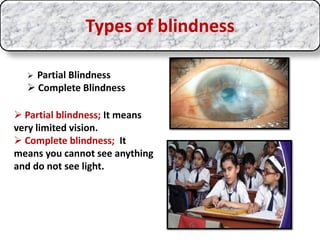
Types of blindness
 Partial Blindness
 Complete Blindness
 Partial blindness; It means
very limited vision.
 Complete blindness; It
means you cannot see anything
and do not see light.
 Refractive error
• Hyperopia or farsightedness
• Myopia or nearsightedness
• Astigmatism
 Defect of muscle function
• Strabismus or crossed eye
• Heterophoria
 Developmental anomalies
• Albinism
Characteristics
 The primary function of the ocular lens is to transmit
light and to focus it on the retina.
 A cataract occurs when the lens loses its clarity such
that visual acuity is compromised.
 Cataracts can result from genetic, metabolic,
nutritional, or environmental insults or can be
secondary to other ocular or systemic conditions, such
as diabetes.
 The most important risk factor is age; age-related
cataract constitutes the great majority of all cataracts.
 Cataract remains the leading cause of blindness
globally.
 Restricted mobility.
 Control their own environment and
themselve in relation to it.
 Due to poor and negative attitude.
 Low self concept.
 Due to neglect and ignoring attitude.
 Natural demand.
 No differences in communication and
language skill.
 No sociometice study is found.
Characteristics
Causes of Blindness
 Infectious diseases – Mostly 60 to 70 % become blind
due to infectious diseases. Blood disorder can also cause
blindness.
 Accident or injury - Lack of security and guidance, fight
or accident causes blindness.
 Hereditary - Sometimes, blindness is inherited
however the frequency of such occurrences is very
insignificant.
 Common diseases- Blindness also occurs due to
various physical diseases, such as diabetes, vitamin
deficiency etc.
 Effect of poisons – Effect of poison is also one of the
factors that account for blindness.
common Causes of Blindness
 In children while playing with sharp edged toys, knife,
compass, scissors, needles etc.
 During the festivity season playing with water balloons
during Holi, bow and arrow during dusshera and crackers
during Diwali.
 Sport injuries e.g. With ball , gully- danda, boxing, air-
gun, etc.
 Vehicular inguries e.g . In road, rail, or air accidents.
 Injuries with sharp weapons and explosive weapons
during fights and wars.
 Retinal burns due to solar eclipse.
 Eye injuries due to industrial accidents.
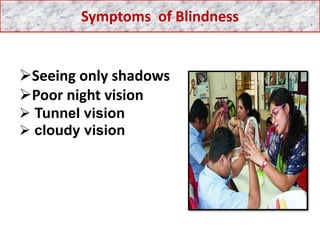
Symptoms of Blindness
Seeing only shadows
Poor night vision
 Tunnel vision
 cloudy vision
Facts of Blindness
According to WHO:
 It is estimated that over seven million people
become blind every year.
 75% of blindness is avoidable
 80% of visual impairment is avoidable
 63% of those with low vision and 82% of blind
people are over 50 years of age
 Of the six WHO regions, South East Asia and
Western Pacific account for 73% of moderate to
severe visual impairment and 58% of blindness.
Prevention of Blindness
 Regulation and control in the manufacture of proper toys.
 Use of protective glasses.
 Use of protective deices in sports and change of rules
whenever necessary and possible.
 Proper illumination of industries.
 Bold display of measures for eye protection in various
industries.
 Banning of dangerous objects like water balloons, Gulli-
danda, bow and arrow and dangerous crackers.
 Students and people using chemicals should be
instructed as how to open a bottle –containing chemical.
Ammonia should always be kept cool.
Educational Provision
1. Braille
2. Use of equipment
 Braille writer, slate and stylus
 Abacus
 Raised line drawing board
 Raised line paper
 Talking book and other recorded programs
3. Orientation and mobility
4. Social skills
5. Daily living skills
6. Sensory training
7. Least restrictive environment
Blindness

Blindness

  • 1.
    BLINDNESS Dr. Veena Shahi Departmentof HDFS College of Community Science RPCAU. Pusa
  • 2.
    Definition and Meaning Blindness can be temporary or permanent. Demand to any portion of the eye, the optic nerve, or the area of the brain responsible for vision can lead blindness.  Blindness is a lack of vision. It may also refers to a loss of vision that cannot be corrected with glasses or contact lenses.
  • 3.
    Types of blindness Partial Blindness  Complete Blindness  Partial blindness; It means very limited vision.  Complete blindness; It means you cannot see anything and do not see light.
  • 4.
     Refractive error •Hyperopia or farsightedness • Myopia or nearsightedness • Astigmatism  Defect of muscle function • Strabismus or crossed eye • Heterophoria  Developmental anomalies • Albinism
  • 5.
    Characteristics  The primaryfunction of the ocular lens is to transmit light and to focus it on the retina.  A cataract occurs when the lens loses its clarity such that visual acuity is compromised.  Cataracts can result from genetic, metabolic, nutritional, or environmental insults or can be secondary to other ocular or systemic conditions, such as diabetes.  The most important risk factor is age; age-related cataract constitutes the great majority of all cataracts.  Cataract remains the leading cause of blindness globally.
  • 6.
     Restricted mobility. Control their own environment and themselve in relation to it.  Due to poor and negative attitude.  Low self concept.  Due to neglect and ignoring attitude.  Natural demand.  No differences in communication and language skill.  No sociometice study is found. Characteristics
  • 7.
    Causes of Blindness Infectious diseases – Mostly 60 to 70 % become blind due to infectious diseases. Blood disorder can also cause blindness.  Accident or injury - Lack of security and guidance, fight or accident causes blindness.  Hereditary - Sometimes, blindness is inherited however the frequency of such occurrences is very insignificant.  Common diseases- Blindness also occurs due to various physical diseases, such as diabetes, vitamin deficiency etc.  Effect of poisons – Effect of poison is also one of the factors that account for blindness.
  • 8.
    common Causes ofBlindness  In children while playing with sharp edged toys, knife, compass, scissors, needles etc.  During the festivity season playing with water balloons during Holi, bow and arrow during dusshera and crackers during Diwali.  Sport injuries e.g. With ball , gully- danda, boxing, air- gun, etc.  Vehicular inguries e.g . In road, rail, or air accidents.  Injuries with sharp weapons and explosive weapons during fights and wars.  Retinal burns due to solar eclipse.  Eye injuries due to industrial accidents.
  • 9.
    Symptoms of Blindness Seeingonly shadows Poor night vision  Tunnel vision  cloudy vision
  • 10.
    Facts of Blindness Accordingto WHO:  It is estimated that over seven million people become blind every year.  75% of blindness is avoidable  80% of visual impairment is avoidable  63% of those with low vision and 82% of blind people are over 50 years of age  Of the six WHO regions, South East Asia and Western Pacific account for 73% of moderate to severe visual impairment and 58% of blindness.
  • 11.
    Prevention of Blindness Regulation and control in the manufacture of proper toys.  Use of protective glasses.  Use of protective deices in sports and change of rules whenever necessary and possible.  Proper illumination of industries.  Bold display of measures for eye protection in various industries.  Banning of dangerous objects like water balloons, Gulli- danda, bow and arrow and dangerous crackers.  Students and people using chemicals should be instructed as how to open a bottle –containing chemical. Ammonia should always be kept cool.
  • 12.
    Educational Provision 1. Braille 2.Use of equipment  Braille writer, slate and stylus  Abacus  Raised line drawing board  Raised line paper  Talking book and other recorded programs 3. Orientation and mobility 4. Social skills 5. Daily living skills 6. Sensory training 7. Least restrictive environment