Presented by : Neethu liza jose
Msc nursing first year
Apollo college of nursing
INTRODUCTION
Family planning is the term given for pre-pregnancy
planning and action to delay, prevent or actualize a
pregnancy.
DEFINITION:
Family planning is a way of thinking and living that is adopted
voluntarily, upon the bases of knowledge, attitude and
responsible decision by individuals and couples in order to
promote the health and welfare of family group and thus
contribute effectively to the social development of country
-B T BASVANTHAPPA
OBJECTIVES
( WHO ) “the use of a range of methods of a fertility
regulation to help individuals or couples attain certain
objectives:
 avoid unwanted birth.
 bring about wanted birth.
 Produce a change in the no. of children born.
 Regulate the intervals between pregnancies.
 Control time at which birth occur.”
No. of
pregnanci
es
Proper
timing
Proper
spacing
Elements of family planning
3 important elements in family planning:
Benefits
Benefits to Mother
 Reduce the health risk
 Below 20y, And above 35 y. At risk of developing complications
during pregnancy.
physical strain of child bearing.
 reduce number of maternal death.
 reduce the risk of ovarian cysts.
Health Benefits to Children:
Ensures better chance of survival at birth.
 Promote better childhood nutrition.
 Promote physical growth and development.
 Prevent birth defects.
Health Benefits to Father
 Allows father to keep a constant balance between
their physical, mental, social well –being.
Increase father sense of respect because he is able to
provide the type of education and home environment.
Benefits to Whole Family
Health
 Benefits to Whole Family Health - help the family
enjoy the better kind of life.
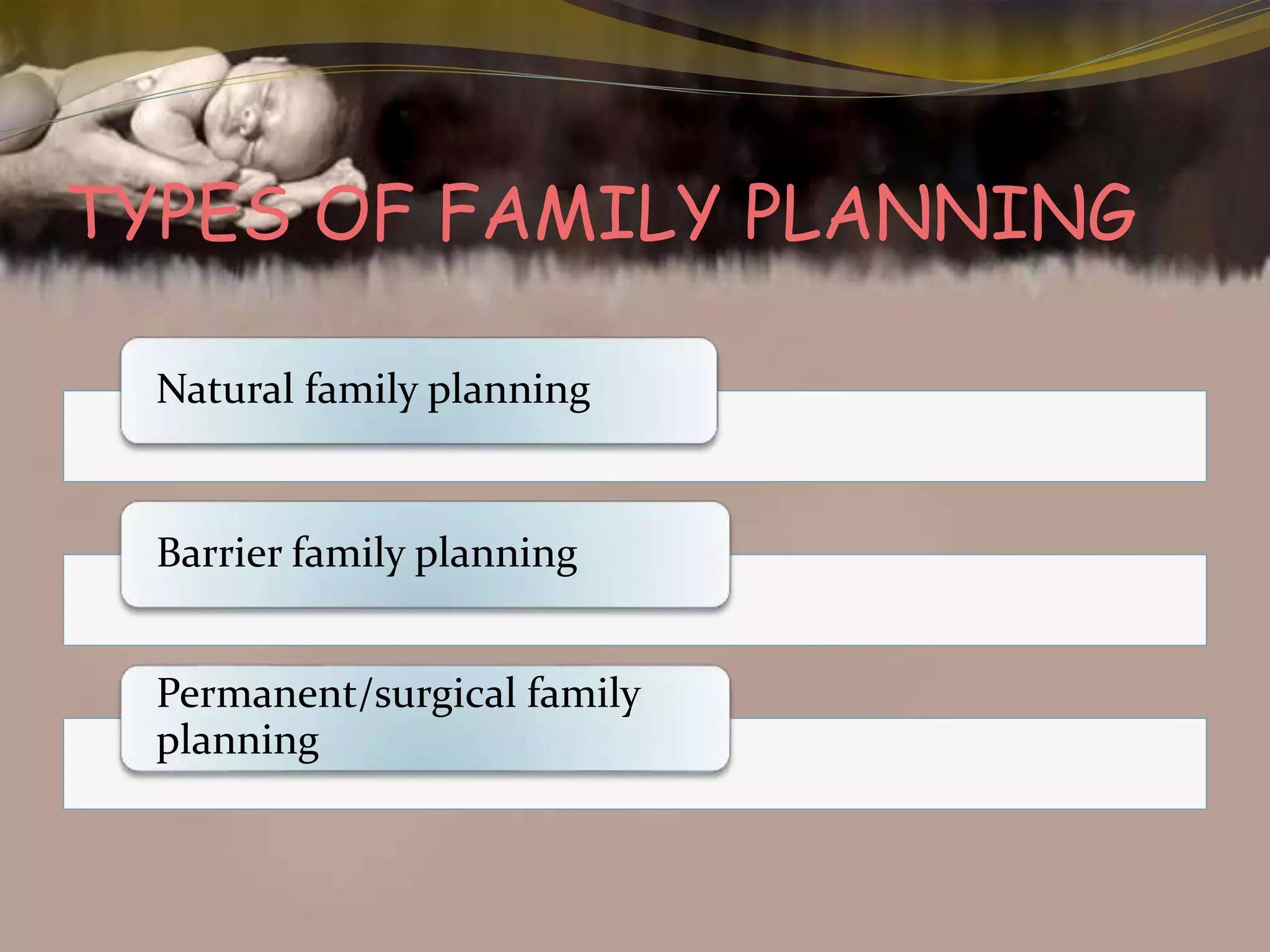
TYPES OF FAMILY PLANNING
Natural family planning
Barrier family planning
Permanent/surgical family
planning
INTRODUCTION OF NATURAL
FAMILY PLANNING
 No introduction of chemical of foreign material into
the body.
 Practice may be due to religious belief, “natural” way
is best for them.
 Effectiveness varies greatly, depends on couples ability
to refrain from having intercourse on fertile days.
 Failure Rates: about 25% Poses no risk to fetus
NATURAL FAMILY PLANNING
Rhythm (Calendar) method
Basal Body Temperature (BBT)
Ovulation or Cervical Mucus Method
Symptothermal method
Coitus Interruptus
Lactation amennorhea
 The rhythm method, also called the fertility
awareness method, is a form of pregnancy
prevention where couples calculate a woman's fertile
time using a calendar .
 Abstaining from coitus on the days of menstrual cycle
when a woman is most likely to conceive (3 or 4 days
before until 3 or 4 days after ovulation). Woman keeps
a diary of 6 menstrual cycles.
RHYTHM (Calendar)
METHOD
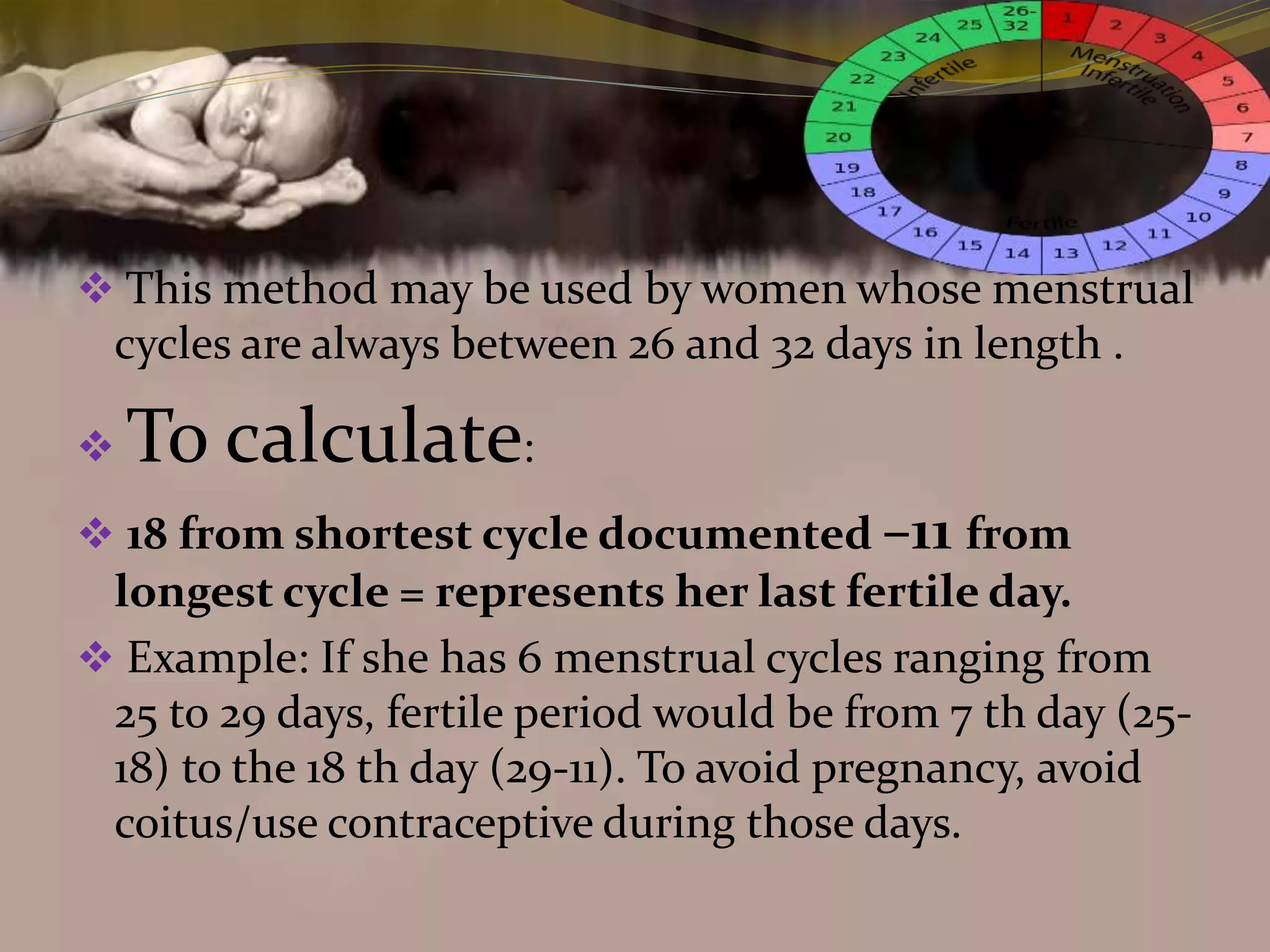
 This method may be used by women whose menstrual
cycles are always between 26 and 32 days in length .
 To calculate:
 18 from shortest cycle documented –11 from
longest cycle = represents her last fertile day.
 Example: If she has 6 menstrual cycles ranging from
25 to 29 days, fertile period would be from 7 th day (25-
18) to the 18 th day (29-11). To avoid pregnancy, avoid
coitus/use contraceptive during those days.
Disadvantages
Lifespan
of Sperm
Reliability
Failure of
method
. Basal Body Temperature (BBT)
 Identifying fertile and infertile period of a woman’s
cycle by daily taking and recording of the rise in body
temperature during and after ovulation.
 Just before ovulation, a woman’s BBT falls about 0.5ºF
At time of ovulation, her BBT rises a full degree
(influence of progesterone). This higher level is
maintained the rest of menstrual cycle.
DISADVATAGES
 NOT reliable method: of birth control, especially for
women with irregular cycles. Plus, outside factors,
such as a lack of sleep, can cause a woman’s
temperature to vary.
 Cervical mucus is a fluid produced by small glands
near the cervix
 This fluid changes throughout her cycle, from
scant and sticky, to cloudy and thick, to slick and
stringy.
 Each of these types of mucus is related to the
hormonal shifts that naturally occur during
the menstrual cycle as her body prepares for and
achieves ovulation.
Cervical Mucus/Ovulation
Right before ovulation, the mucus from the cervix
changes from being cloudy and scanty to being clear
and slippery.
The consistency of ovulation mucus is like that of an
egg white and it can be stretched between the fingers.
It is the peak of her fertility.
 After the ovulation, the mucus tends to dry up again.
These are also safe days.
Ideal Failure rate: 3%
DISADVANTAGES
 It is not a particularly reliable method of birth
control, especially for women with irregular cycles .
 Remember that cervical mucus does not let you know
when you will soon be ovulating, but sperm can live up
to seven days inside the vagina. Any sperm deposited
ahead of time can still impregnate the woman.
Symptothermal Method
 Combines the cervical mucus and BBT methods
Watches temp. daily and analyzes cervical mucus daily.
 Watch for midcycle abdominal pain Couple must
abstain from intercourse until 3 days after rise in temp.
or 4 th day after peak of mucus change.
 More effective than BBT or CM method alone Ideal
Failure rate: 2%
COITUS INTERRUPTUS
 One of oldest known methods of contraception
Couple proceeds with coitus until the moment of
ejaculation which Offers little protection.
LACTATION AMENNORRHEA
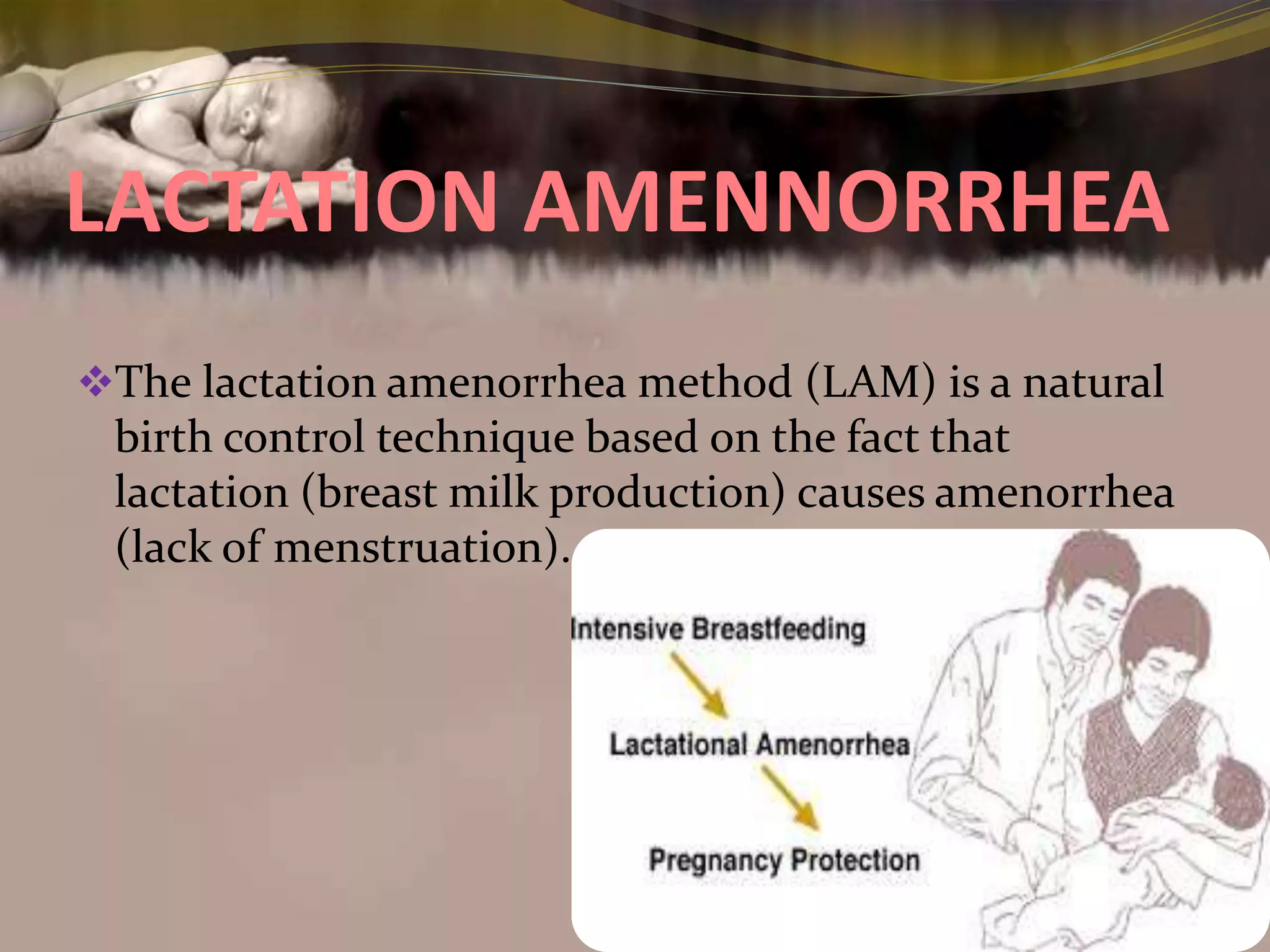
The lactation amenorrhea method (LAM) is a natural
birth control technique based on the fact that
lactation (breast milk production) causes amenorrhea
(lack of menstruation).
How it works:
Breastfeeding interferes with the release of the
hormones needed to trigger ovulation.
ADVANTAGES:
Breastfeeding on demand improves health for mother
and baby.
Nothing to buy or use.
DISADVANTAGES
 an use this method only for the first six months after
birth or until the first menstrual period.
 LAM does not provide protection against SEXUALLY
TRANSMITTED INFECTIONS.
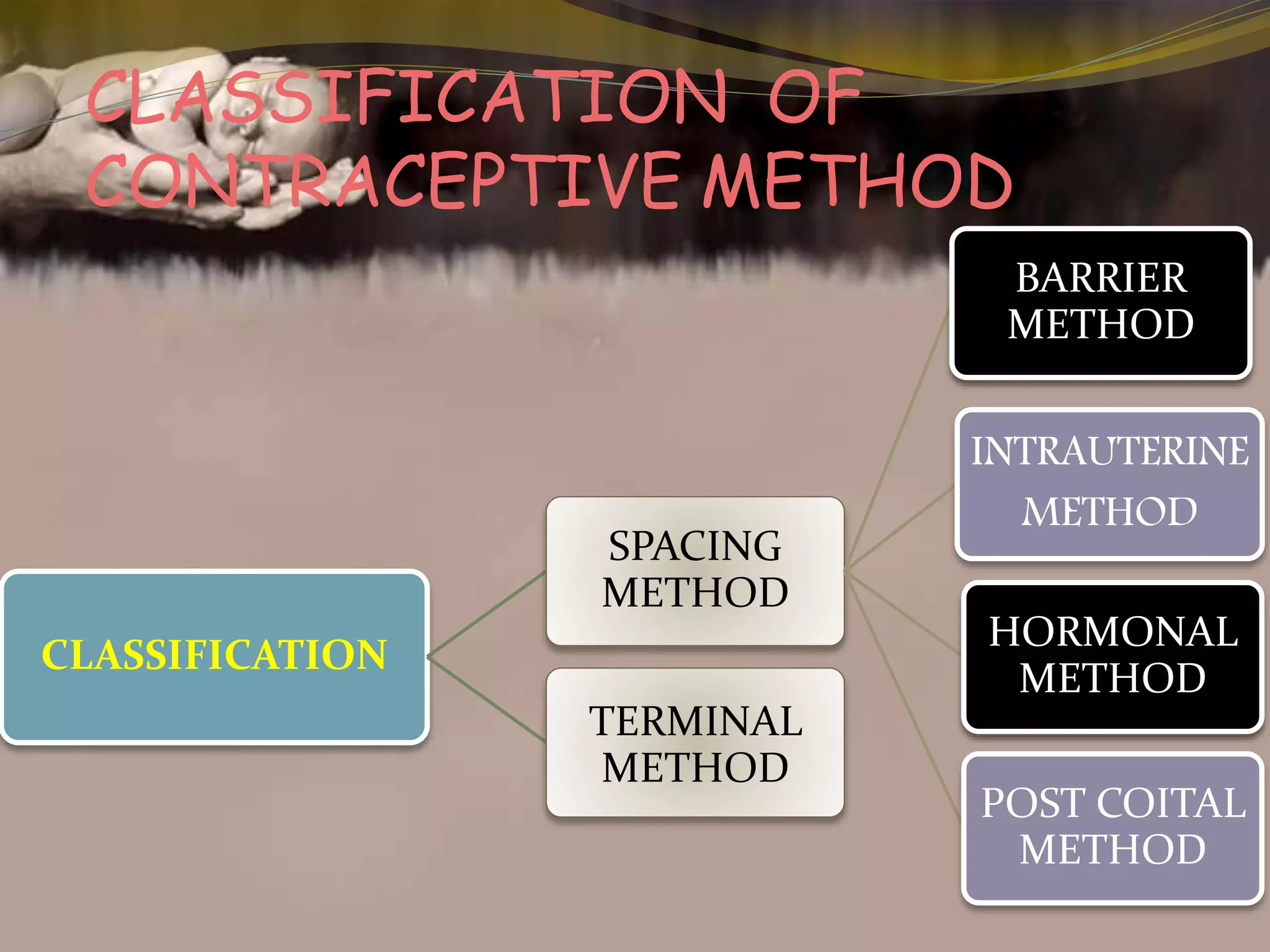
CLASSIFICATION OF
CONTRACEPTIVE METHOD
CLASSIFICATION
SPACING
METHOD
BARRIER
METHOD
INTRAUTERINE
METHOD
HORMONAL
METHOD
POST COITAL
METHOD
TERMINAL
METHOD
BARRIER METHODS
Condoms (male and female)
Spermicidal
 Sponge
 Diaphragm
Cervical cap
Male condoms:
 These are made up of polyurethane or latex.
 Silicon used now a days to produce semi dry pre-
lubricated forms.
 In India one particularly brand is widely marketed as
‘Nirodh’.
 Spermicidal – coated with nonoxynol on inner and
outer surfaces.
MALE CONDOM
ADVANTAGES:
 Simple spacing method
 No side effects
 Easily available, safe & inexpensive
 Protects against STDs
 DISADVANTAGES
Chances of slip off and tear off
Allergic reaction to latex
Failure rate: 16%
Female condoms:
 It is a pouch made up of polyurethane which lines the
vagina and also external genitalia.
 It is 17 cm in length with one flexible polyurethane
ring at each end.
ADVANTAGES:
Prevents STDs including HIV/AIDS
Not damaged by oils and other chemicals
 DISADVANTAGES:
 High motivation
 Only women who can use diaphragms can use female
condom
Slippage occurs
Expensive
 Failure rate 21% with typical use and 5% with correct
and consistent use.
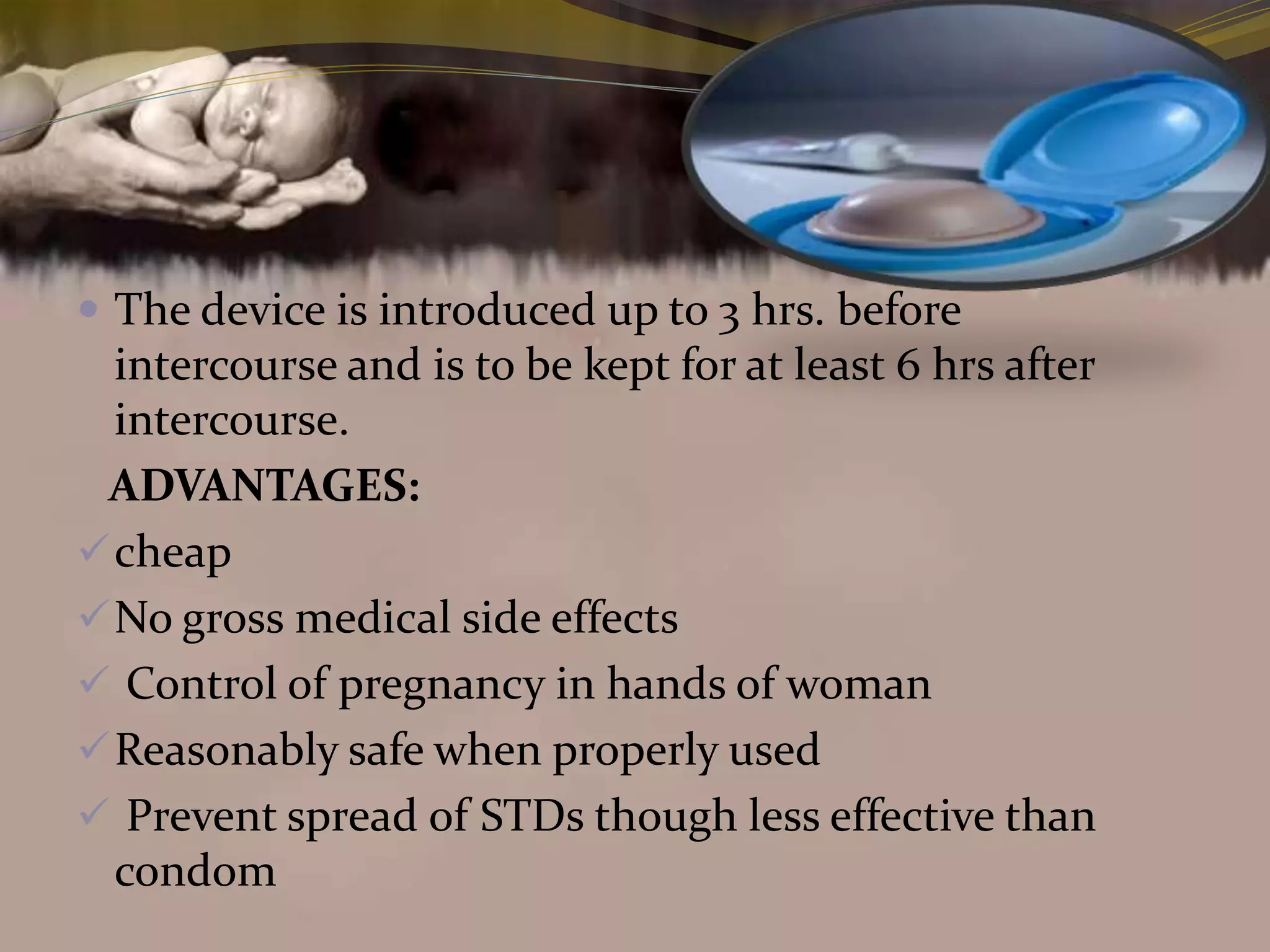
diaphragm
 Most common and easiest to fit and use .
 Thin, nearly hemispherical dome made of rubber or
latex material, with circular, covered metal spring at
periphery (flat type and coil type)

 External diameter of rim is size of diaphragm – 45 mm
diameter rising in steps of 5 mm to 105mm (most
common 60,65,70,75,80)
 The device is introduced up to 3 hrs. before
intercourse and is to be kept for at least 6 hrs after
intercourse.
ADVANTAGES:
cheap
No gross medical side effects
 Control of pregnancy in hands of woman
Reasonably safe when properly used
 Prevent spread of STDs though less effective than
condom
DIAPRAGHM
DISADVANTAGES:
 Requires help of doctor to measure the size required.
 Need high motivation
 Allergic reaction to rubber
 Erosion
 UTI’s
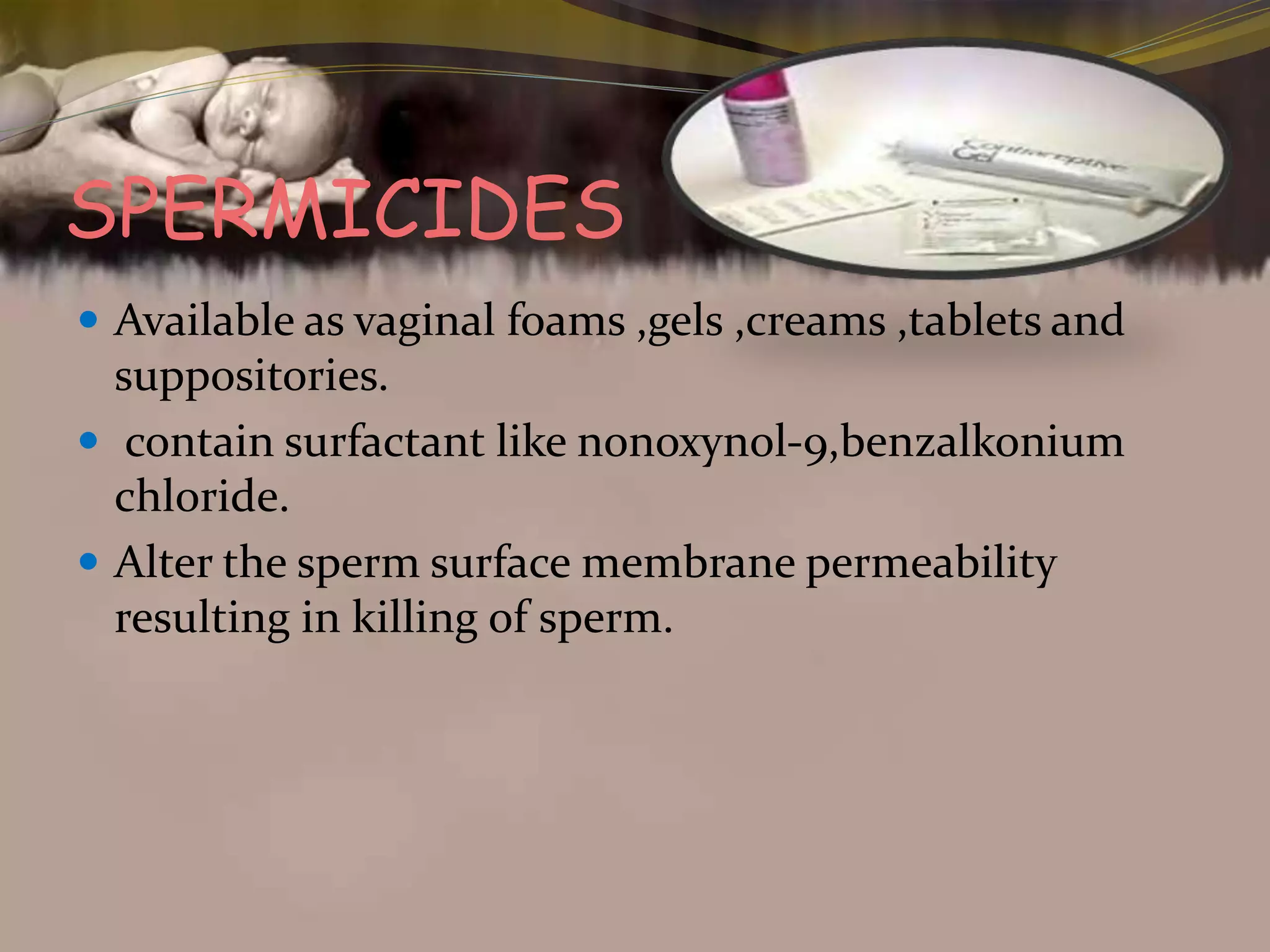
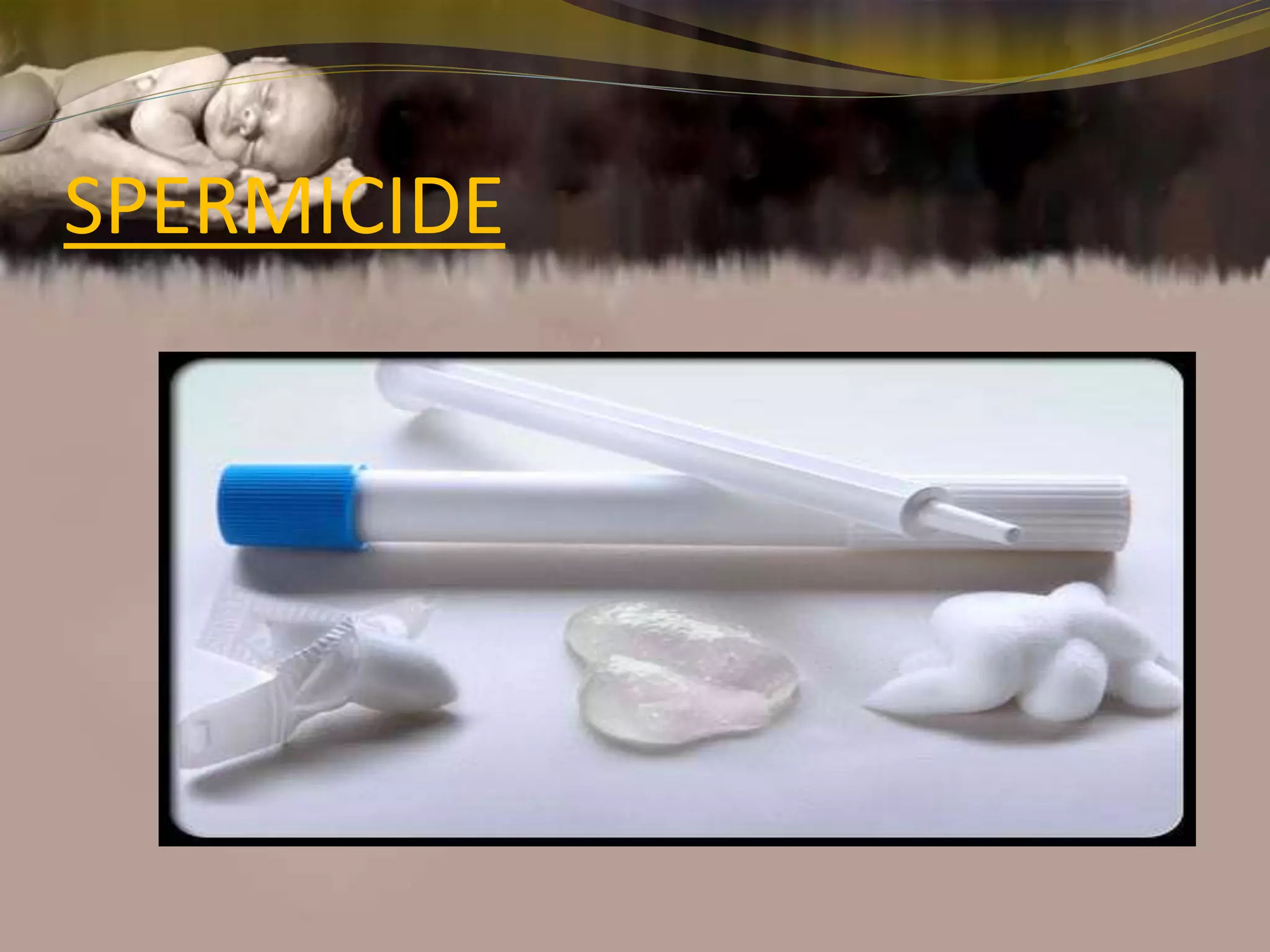
SPERMICIDES
 Available as vaginal foams ,gels ,creams ,tablets and
suppositories.
 contain surfactant like nonoxynol-9,benzalkonium
chloride.
 Alter the sperm surface membrane permeability
resulting in killing of sperm.
SPERMICIDE
ADVANTAGES:
 No instructions by doctors or nurses
 Easily available and easy to use
 No gross medical side effects
DISADVANTAGES
 Failure rate high when used alone
 Can increase spread of HIV infection by irritating
vaginal and cervical mucosa
Failure rate – 21% with typical use and 6%
Vaginal contraceptive sponge
(TODAY)
The sponge is a doughnut-shaped device made of soft
foam coated with spermicide.
Made up of polyurethane with 1gm of nonoxynol-9 as
a spermicide.
It releases spermicide during coitus, absorbs ejaculate
and blocks the entrance of cervical canal.
To use the sponge, it must be moistened with water.
Once inserted in the vagina, it covers the cervix and
blocks sperm from entering the uterus.
DISADVANTAGES
 May get broken
 difficult removal
 High pregnancy rate
 Allergic reactions
 Vaginal dryness, soreness
 May damage vaginal epithelium
 increase risk of HIV transmission
INTRAUTERINE DEVICES
 Intrauterine Device The IUD is a small, T-shaped,
plastic device that is inserted and left inside the uterus
to prevent pregnancy.
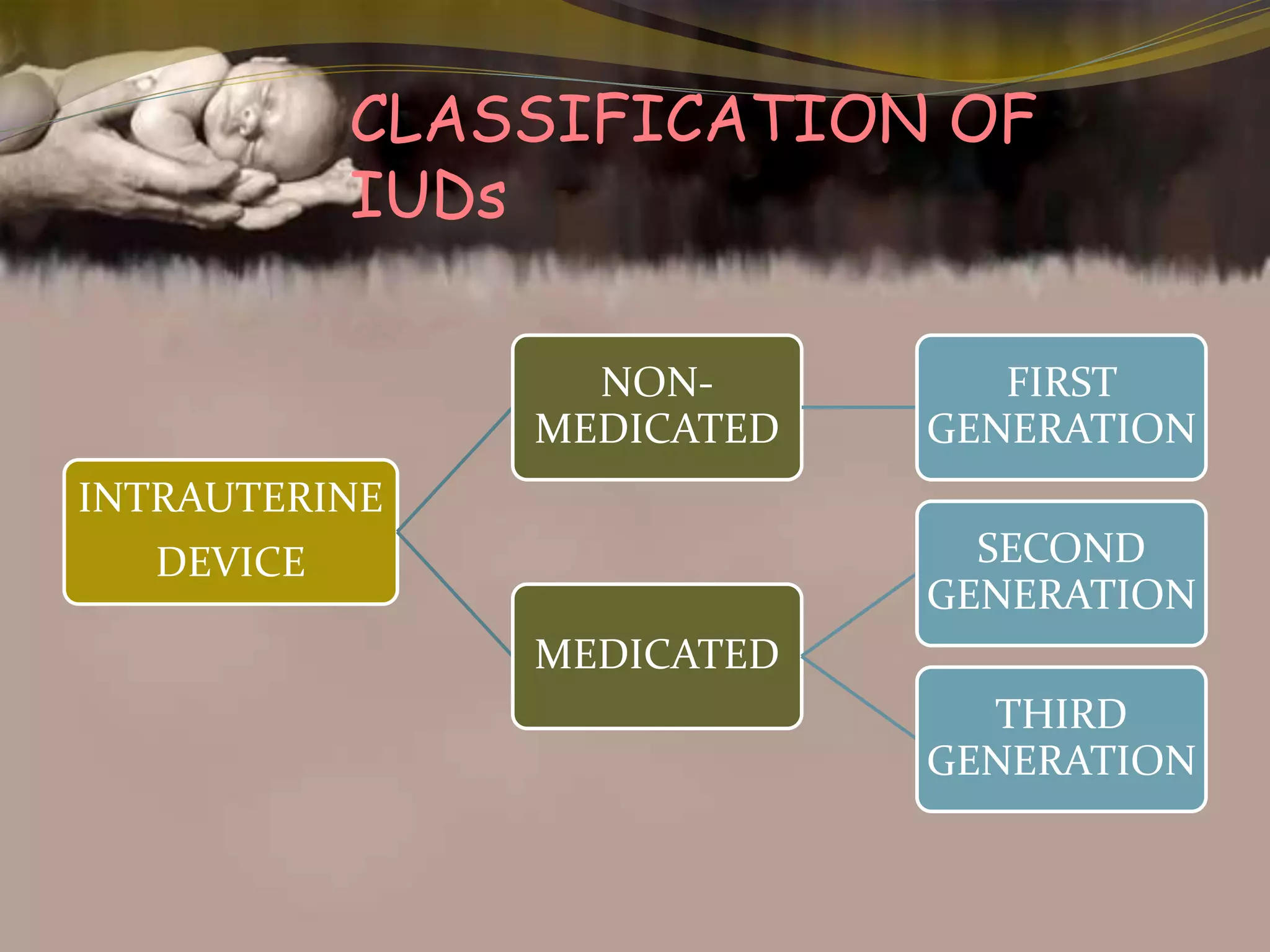
CLASSIFICATION OF
IUDs
INTRAUTERINE
DEVICE
NON-
MEDICATED
FIRST
GENERATION
MEDICATED
SECOND
GENERATION
THIRD
GENERATION
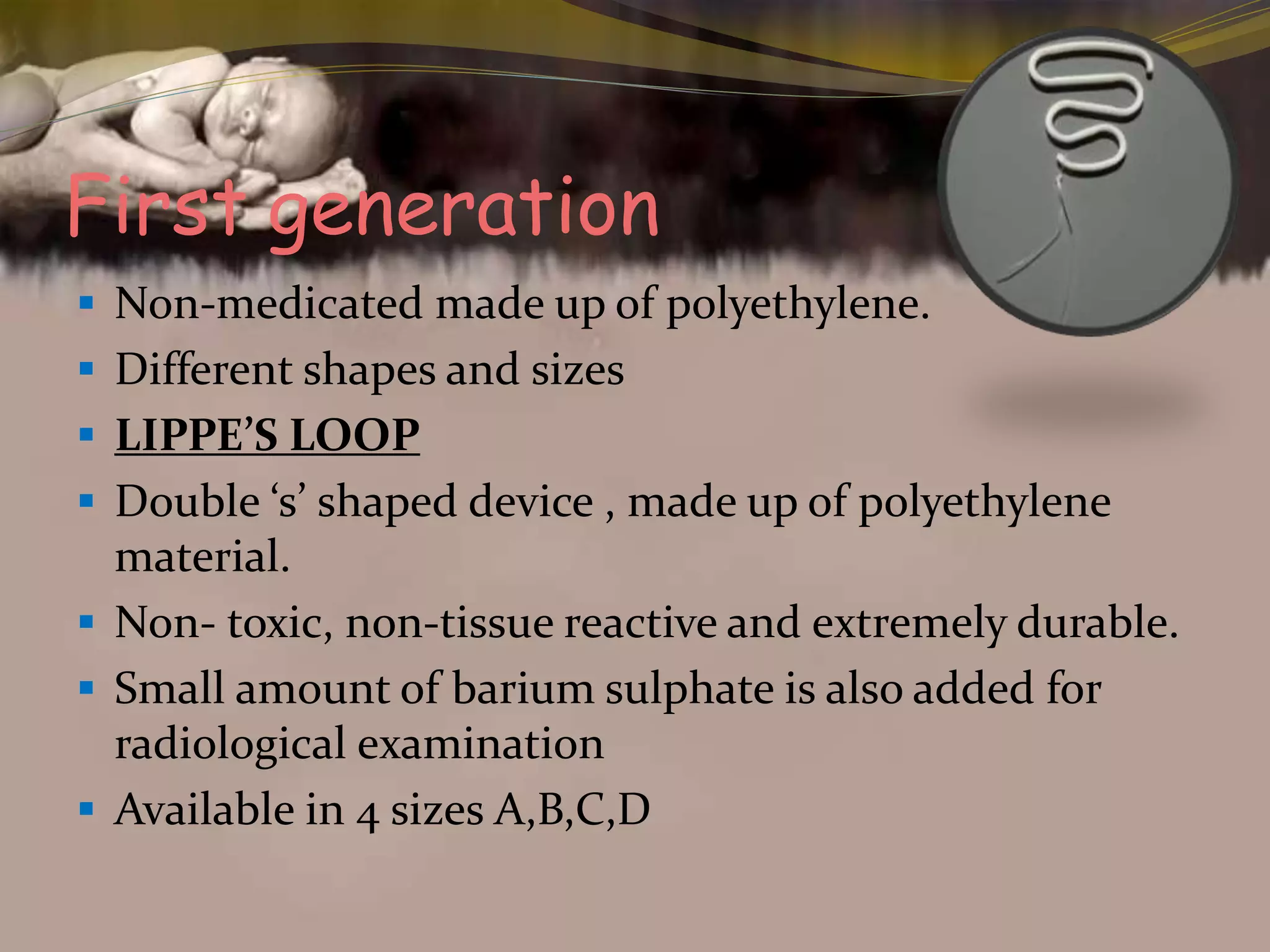
First generation
 Non-medicated made up of polyethylene.
 Different shapes and sizes
 LIPPE’S LOOP
 Double ‘s’ shaped device , made up of polyethylene
material.
 Non- toxic, non-tissue reactive and extremely durable.
 Small amount of barium sulphate is also added for
radiological examination
 Available in 4 sizes A,B,C,D
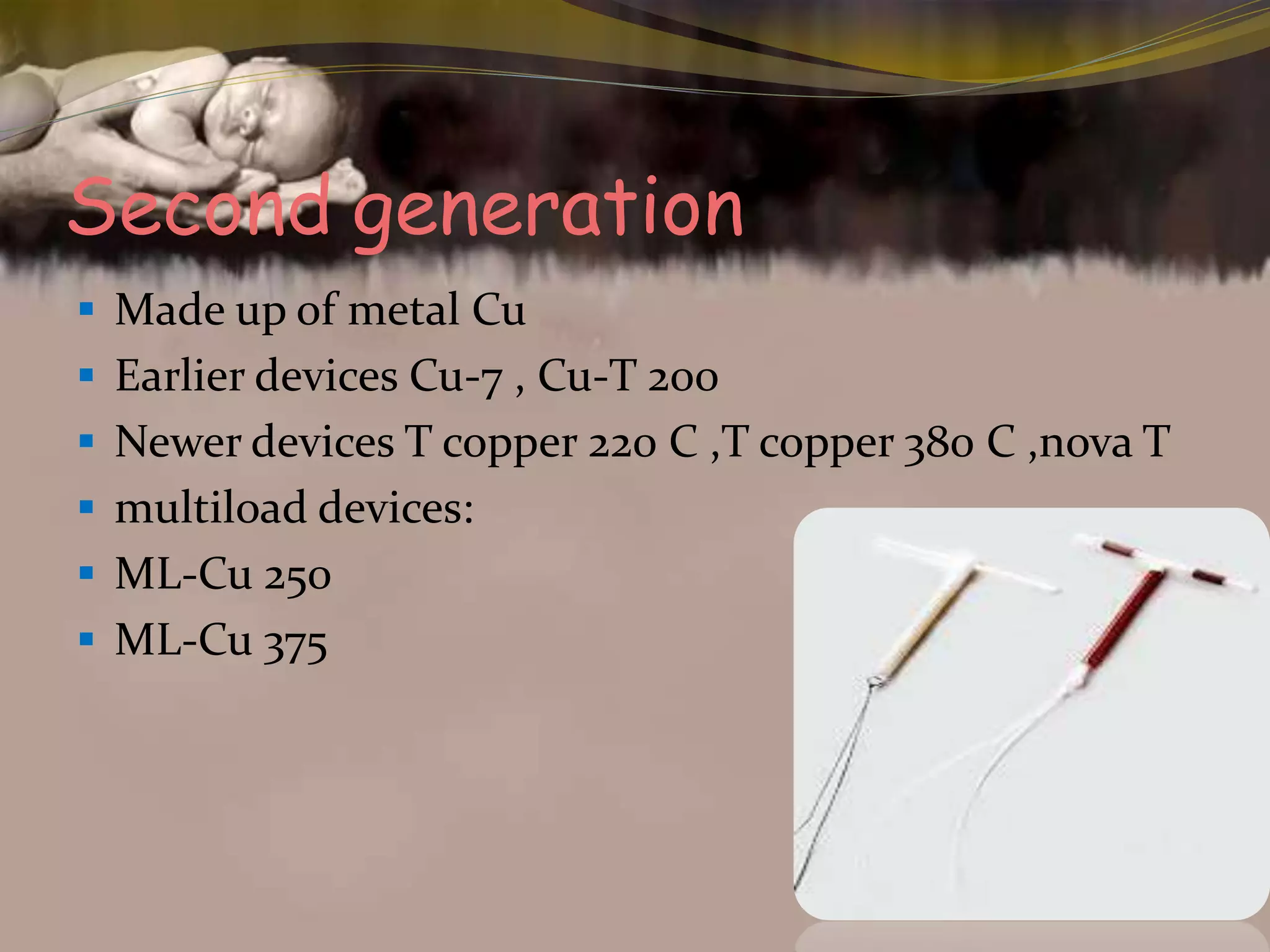
Second generation
 Made up of metal Cu
 Earlier devices Cu-7 , Cu-T 200
 Newer devices T copper 220 C ,T copper 380 C ,nova T
 multiload devices:
 ML-Cu 250
 ML-Cu 375
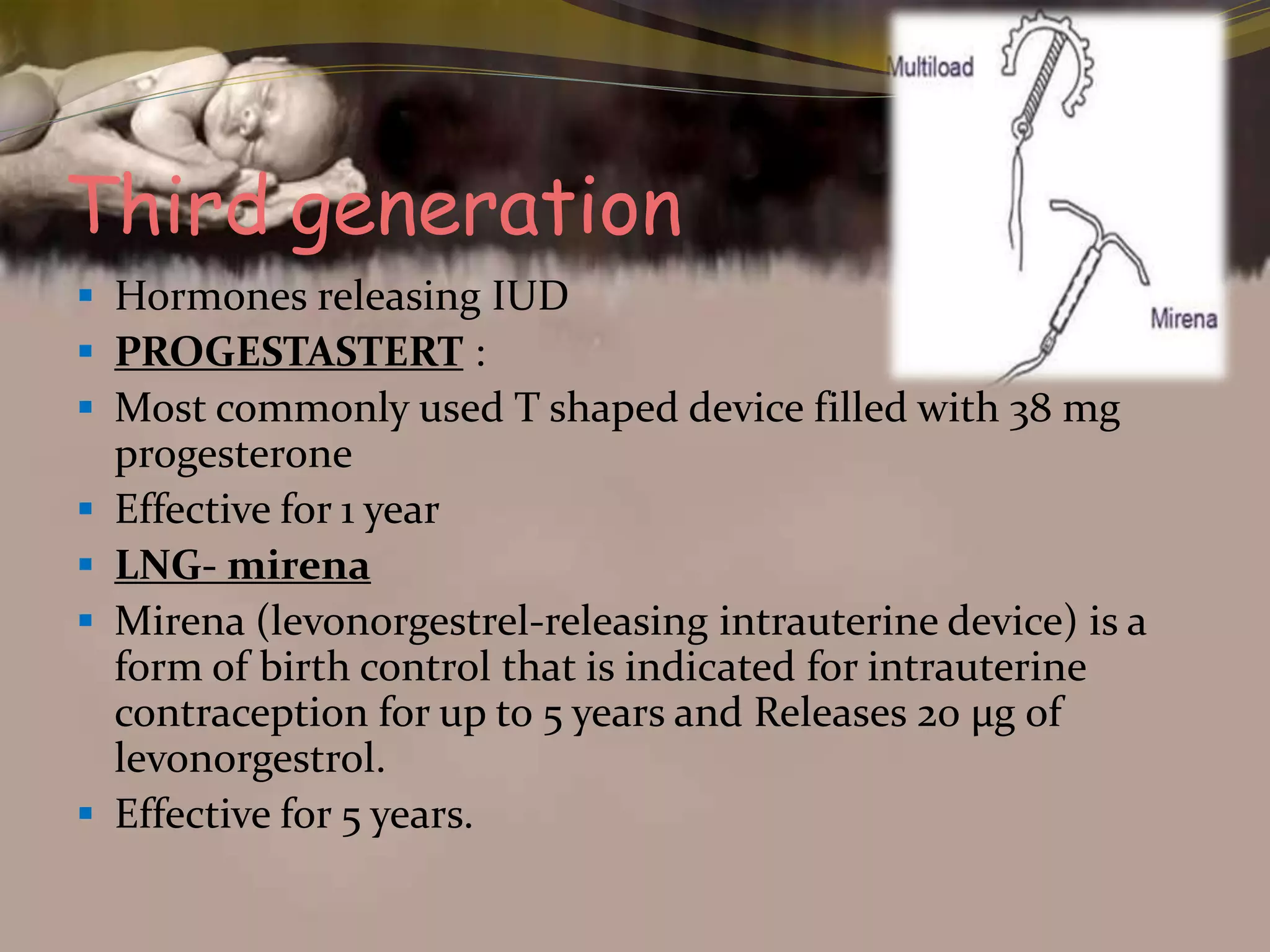
Third generation
 Hormones releasing IUD
 PROGESTASTERT :
 Most commonly used T shaped device filled with 38 mg
progesterone
 Effective for 1 year
 LNG- mirena
 Mirena (levonorgestrel-releasing intrauterine device) is a
form of birth control that is indicated for intrauterine
contraception for up to 5 years and Releases 20 µg of
levonorgestrol.
 Effective for 5 years.
SIDE EFFECTS
Amenorrhea
 Intermenstrual bleeding and spotting
Abdominal/pelvic pain
 Ovarian cysts
 Headache/migraine
 Acne
 depressed/altered mood.
ADVANTAGES OF IUD
 Safe
 effective , Reversible
 Long action ,Inexpensive
 DISADVANTAGES
 Heavy bleeding and pain
 Pelvic inflammatory diseases
 Ectopic pregnancy
 May come out accidently if not properly inserted.
CONTRAINDICATION
History of PID
Abnormal shaped uterus
Ectopic pregnancy
Menorrhagia
CLASSIFICATION OF HORMONAL
CONTRACEPTIVES
HORMONAL
CONTRACEPTIVES
ORAL
COMBINED
PREP.
SINGLE
PREP.
PARENTERAL
INJECTABLES
IMPLANTS
HORMONAL CONTRACEPTIVES
 With hormonal birth control , a women takes
hormones similar to those her body makes naturally .
 Hormonal contraceptives are mostly for female sex
steroids.
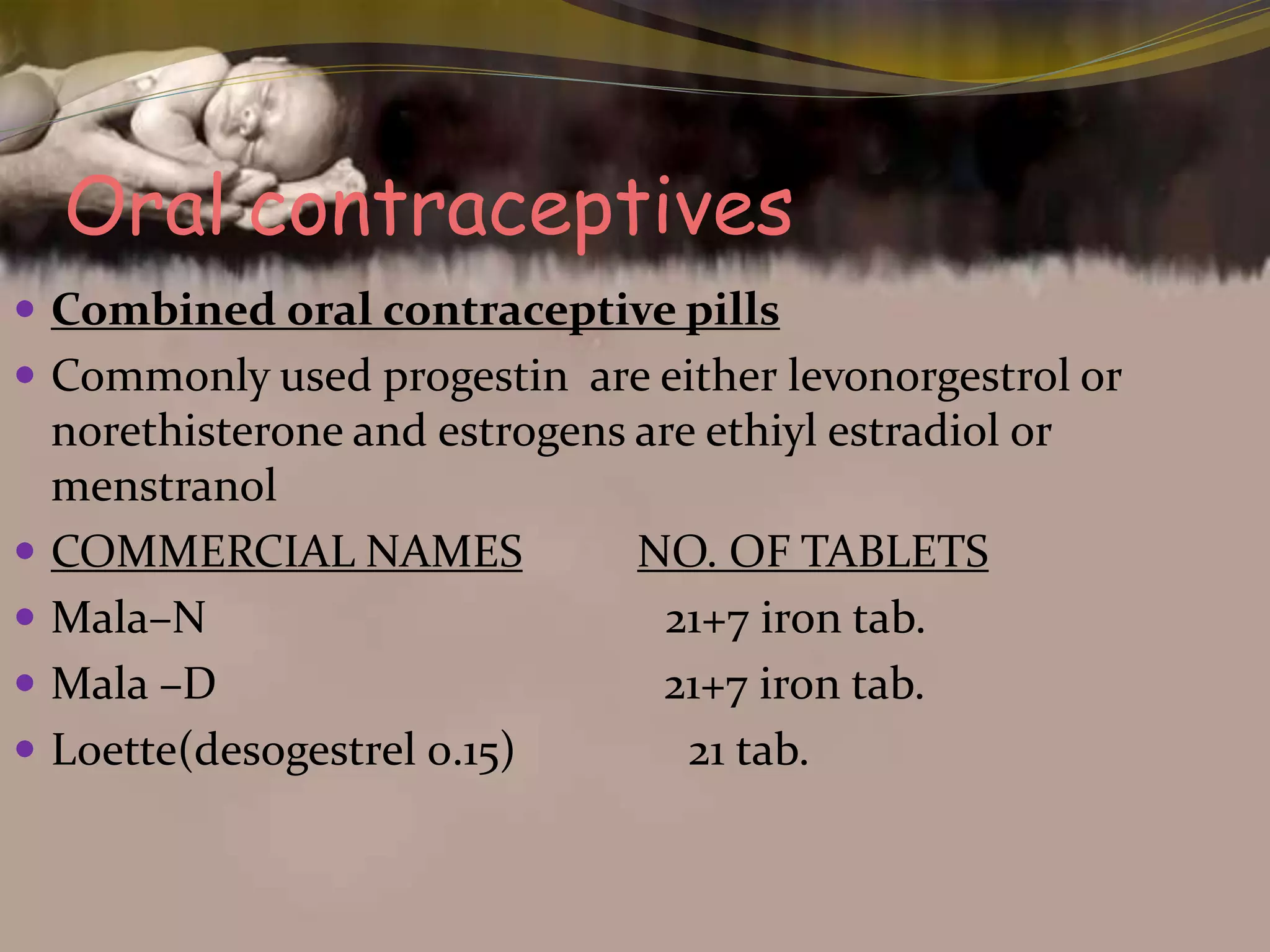
Oral contraceptives
 Combined oral contraceptive pills
 Commonly used progestin are either levonorgestrol or
norethisterone and estrogens are ethiyl estradiol or
menstranol
 COMMERCIAL NAMES NO. OF TABLETS
 Mala–N 21+7 iron tab.
 Mala –D 21+7 iron tab.
 Loette(desogestrel 0.15) 21 tab.
TYPES
Monophasic biphasic triphasic
Monophasic:
 fixed doses of both estrogen and progesterone
throughout 21 day cycle.
Biphasic:
 constant amount of estrogen throughout cycle BUT
increased amount of progestin during the last 11 days .
 Triphasic:
 Varies level of estrogen and progesterone. Closely
mimic natural cycle, reducing breakthrough bleeding
(bleeding outside the normal menstrual flow)
contraindications
ABSOLUTE:
Circulatory diseases
Severe HTN
Angina,ischemic heart dis.
Liver disease
Tumors
Pregnancy
breast cancer,breast feeding.
 RELATIVE:
 Age>40 yrs.
 Smoker, history of jaundice
 Diabetes
benefits
 contraceptive benefits:
 Protection against unwanted pregnancy
 Convenient to use.
 Non-contraceptives benefits:
 Regulation of menstrual cycle
 Reduction of dysmenorrhea
 Protection against PID, fibroids, ovarian cysts, chances
of cancer.
Side effects
 Dizziness
 Nausea
 Weight gain
 Headache
 Breast tenderness
 vaginal infection
 Mild HPN
 Depression
 increase blood clotting
Progesterone only pills
 Also known as “Minipill”.
 Contains just progesterone or progesterone hormone.
 Causing plug of mucus in the neck of cervix
block the entry of the sperm.
Example: levonorgesrol 75 µg, desogestrel 75 µg
advantages
 No side effect on breast feeding or lactation
 May be prescribed in patient having diabetes, HTN ,
smoking etc.
 Reduce risk of PID
 DISADVANTAGES
 Acne, mastalgia, headache
Long acting contraceptives
 These are more suitable for women who do not want
to pregnant again or for few years.
THESE ARE:
 CONTRACEPTIVE INJECTIONS
 IMPLANTS
 PATCHES
CONTRACEPTIVE INJECTIONS
( DEPOPROVERA & NORISTERET)
 Contain progesterone hormone .
 Prevents ovulation.
 Commonly used as Depomedroxyl progesterone
acetate (DMPA) administered on deltoid muscle
within 5 days of cycle.
 DOSE: 150 mg
 Provide protection for 3 months .
Contraceptive implants
 It is a small device placed under the skin
 Contains progesterone hormone .
 Works in a similar way to injection
 Contains 3 ketodesogestrel
 Releases hormone about 60 mcg, gradually reduced to
30 mcg per day over year.
 Inhibts ovulation.
 Lasts for 3 years.
 NORPLANT – II
 NORPLANT- II
 Two rods of 4cm long. Each rod containing 75 mg of
levonorgestrel releases 50 mcg per day.

Emergency contraceptives
 Used whithin 72 hrs ,ovulation is either prevented or
delayed. It may be in form of : hormones, IUD,
antiprogesterone
 INDICATIONS
 Unprotected intercourse
 Condom rupture
 Sexual assault
HORMONES:
MORNING AFTER PILLS:
It preventing conception in case of accidental
intercourse.
drugs used ethinyl oestradiol 2.5mg,
premarin(conjugated oestrogen) 15 mg.
Drug is taken orally twice daily for 5 days.
Emergency contraceptives
Levonorgesterel 0.75 mg stat and after 12 hrs.
Ethinyl oestradiol 50 µg + norgesterel
0.25 mg
2 tab stat and 2 after 12 hours
Conjugated oestrogen 15 mg BD× 5 days
Thinyl oestradiol 2.5 mg BD 5 days
Mifepristone 10 mg single dose
Copper IUDs Insertion within 5 days
DRUG DOSE
PERMANENT STERLISATION
ÖVASECTOMY
Ö TUBECTOMY
TUBECTOMY
STERILIZATION
It is most effective method its failure rate is 1/2000 so in
this there is permanent termination .
VASECTOMY :
Small incision made on each side of scrotum vas
deferens is then cut and tied , cauterized or plugged .
Blocking the passage of spermatozoa.
Does not interfere with production of sperms but does
not pass beyond vas deferens .
Very effective after 3 months of procedure
Permanent and safe
No apparent long term risks .
 DISADVANTAGES:
Slightly uncomfortable due slightly pain and swelling
after 2-3 days of the of the procedure .
Bleeding may result in the hematoma in scrotum .
TUBECTOMY :
It is one of the operative procedure where resection of
a both segment of both fallopian tubes is done to
achieve permanent sterilization
The approach may be :
Abdominally
Vaginally
 ABDOMINAL
Ω CONVENTIONAL MINILAPROTOMY
Ω CONVENTIONAL:
In which a loop is made by holding the tube by Allis forceps in
such a way that the major part of loop consists mainly of isthmus
and ampullary part of tube . the loop is ligated with catgut and is
cut .
MINILAPROTOMY:
When the tubectomy is done through small
abdominal incision along with some device .
VAGINAL LIGATION :
Tubectomy through vaginal route may be done along
with vaginal plastic operation or on isolation .
COMPLICATION :
Ectopic pregnancy
Menstrual irregularities
Loss of libido
Infection
Family planning

Family planning

  • 1.
    Presented by :Neethu liza jose Msc nursing first year Apollo college of nursing
  • 2.
    INTRODUCTION Family planning isthe term given for pre-pregnancy planning and action to delay, prevent or actualize a pregnancy. DEFINITION: Family planning is a way of thinking and living that is adopted voluntarily, upon the bases of knowledge, attitude and responsible decision by individuals and couples in order to promote the health and welfare of family group and thus contribute effectively to the social development of country -B T BASVANTHAPPA
  • 3.
    OBJECTIVES ( WHO )“the use of a range of methods of a fertility regulation to help individuals or couples attain certain objectives:  avoid unwanted birth.  bring about wanted birth.  Produce a change in the no. of children born.  Regulate the intervals between pregnancies.  Control time at which birth occur.”
  • 4.
    No. of pregnanci es Proper timing Proper spacing Elements offamily planning 3 important elements in family planning:
  • 5.
    Benefits Benefits to Mother Reduce the health risk  Below 20y, And above 35 y. At risk of developing complications during pregnancy. physical strain of child bearing.  reduce number of maternal death.  reduce the risk of ovarian cysts.
  • 6.
    Health Benefits toChildren: Ensures better chance of survival at birth.  Promote better childhood nutrition.  Promote physical growth and development.  Prevent birth defects.
  • 7.
    Health Benefits toFather  Allows father to keep a constant balance between their physical, mental, social well –being. Increase father sense of respect because he is able to provide the type of education and home environment.
  • 8.
    Benefits to WholeFamily Health  Benefits to Whole Family Health - help the family enjoy the better kind of life.
  • 9.
    TYPES OF FAMILYPLANNING Natural family planning Barrier family planning Permanent/surgical family planning
  • 10.
    INTRODUCTION OF NATURAL FAMILYPLANNING  No introduction of chemical of foreign material into the body.  Practice may be due to religious belief, “natural” way is best for them.  Effectiveness varies greatly, depends on couples ability to refrain from having intercourse on fertile days.  Failure Rates: about 25% Poses no risk to fetus
  • 11.
    NATURAL FAMILY PLANNING Rhythm(Calendar) method Basal Body Temperature (BBT) Ovulation or Cervical Mucus Method Symptothermal method Coitus Interruptus Lactation amennorhea
  • 12.
     The rhythmmethod, also called the fertility awareness method, is a form of pregnancy prevention where couples calculate a woman's fertile time using a calendar .  Abstaining from coitus on the days of menstrual cycle when a woman is most likely to conceive (3 or 4 days before until 3 or 4 days after ovulation). Woman keeps a diary of 6 menstrual cycles. RHYTHM (Calendar) METHOD
  • 13.
     This methodmay be used by women whose menstrual cycles are always between 26 and 32 days in length .  To calculate:  18 from shortest cycle documented –11 from longest cycle = represents her last fertile day.  Example: If she has 6 menstrual cycles ranging from 25 to 29 days, fertile period would be from 7 th day (25- 18) to the 18 th day (29-11). To avoid pregnancy, avoid coitus/use contraceptive during those days.
  • 14.
  • 15.
    . Basal BodyTemperature (BBT)  Identifying fertile and infertile period of a woman’s cycle by daily taking and recording of the rise in body temperature during and after ovulation.  Just before ovulation, a woman’s BBT falls about 0.5ºF At time of ovulation, her BBT rises a full degree (influence of progesterone). This higher level is maintained the rest of menstrual cycle.
  • 16.
    DISADVATAGES  NOT reliablemethod: of birth control, especially for women with irregular cycles. Plus, outside factors, such as a lack of sleep, can cause a woman’s temperature to vary.
  • 17.
     Cervical mucusis a fluid produced by small glands near the cervix  This fluid changes throughout her cycle, from scant and sticky, to cloudy and thick, to slick and stringy.  Each of these types of mucus is related to the hormonal shifts that naturally occur during the menstrual cycle as her body prepares for and achieves ovulation. Cervical Mucus/Ovulation
  • 18.
    Right before ovulation,the mucus from the cervix changes from being cloudy and scanty to being clear and slippery. The consistency of ovulation mucus is like that of an egg white and it can be stretched between the fingers. It is the peak of her fertility.  After the ovulation, the mucus tends to dry up again. These are also safe days. Ideal Failure rate: 3%
  • 19.
    DISADVANTAGES  It isnot a particularly reliable method of birth control, especially for women with irregular cycles .  Remember that cervical mucus does not let you know when you will soon be ovulating, but sperm can live up to seven days inside the vagina. Any sperm deposited ahead of time can still impregnate the woman.
  • 20.
    Symptothermal Method  Combinesthe cervical mucus and BBT methods Watches temp. daily and analyzes cervical mucus daily.  Watch for midcycle abdominal pain Couple must abstain from intercourse until 3 days after rise in temp. or 4 th day after peak of mucus change.  More effective than BBT or CM method alone Ideal Failure rate: 2%
  • 21.
    COITUS INTERRUPTUS  Oneof oldest known methods of contraception Couple proceeds with coitus until the moment of ejaculation which Offers little protection.
  • 22.
    LACTATION AMENNORRHEA The lactationamenorrhea method (LAM) is a natural birth control technique based on the fact that lactation (breast milk production) causes amenorrhea (lack of menstruation).
  • 23.
    How it works: Breastfeedinginterferes with the release of the hormones needed to trigger ovulation. ADVANTAGES: Breastfeeding on demand improves health for mother and baby. Nothing to buy or use.
  • 24.
    DISADVANTAGES  an usethis method only for the first six months after birth or until the first menstrual period.  LAM does not provide protection against SEXUALLY TRANSMITTED INFECTIONS.
  • 25.
  • 26.
    BARRIER METHODS Condoms (maleand female) Spermicidal  Sponge  Diaphragm Cervical cap
  • 27.
    Male condoms:  Theseare made up of polyurethane or latex.  Silicon used now a days to produce semi dry pre- lubricated forms.  In India one particularly brand is widely marketed as ‘Nirodh’.  Spermicidal – coated with nonoxynol on inner and outer surfaces.
  • 28.
  • 29.
    ADVANTAGES:  Simple spacingmethod  No side effects  Easily available, safe & inexpensive  Protects against STDs  DISADVANTAGES Chances of slip off and tear off Allergic reaction to latex Failure rate: 16%
  • 30.
    Female condoms:  Itis a pouch made up of polyurethane which lines the vagina and also external genitalia.  It is 17 cm in length with one flexible polyurethane ring at each end. ADVANTAGES: Prevents STDs including HIV/AIDS Not damaged by oils and other chemicals
  • 32.
     DISADVANTAGES:  Highmotivation  Only women who can use diaphragms can use female condom Slippage occurs Expensive  Failure rate 21% with typical use and 5% with correct and consistent use.
  • 33.
    diaphragm  Most commonand easiest to fit and use .  Thin, nearly hemispherical dome made of rubber or latex material, with circular, covered metal spring at periphery (flat type and coil type)   External diameter of rim is size of diaphragm – 45 mm diameter rising in steps of 5 mm to 105mm (most common 60,65,70,75,80)
  • 34.
     The deviceis introduced up to 3 hrs. before intercourse and is to be kept for at least 6 hrs after intercourse. ADVANTAGES: cheap No gross medical side effects  Control of pregnancy in hands of woman Reasonably safe when properly used  Prevent spread of STDs though less effective than condom
  • 35.
  • 36.
    DISADVANTAGES:  Requires helpof doctor to measure the size required.  Need high motivation  Allergic reaction to rubber  Erosion  UTI’s
  • 37.
    SPERMICIDES  Available asvaginal foams ,gels ,creams ,tablets and suppositories.  contain surfactant like nonoxynol-9,benzalkonium chloride.  Alter the sperm surface membrane permeability resulting in killing of sperm.
  • 38.
  • 39.
    ADVANTAGES:  No instructionsby doctors or nurses  Easily available and easy to use  No gross medical side effects DISADVANTAGES  Failure rate high when used alone  Can increase spread of HIV infection by irritating vaginal and cervical mucosa Failure rate – 21% with typical use and 6%
  • 40.
    Vaginal contraceptive sponge (TODAY) Thesponge is a doughnut-shaped device made of soft foam coated with spermicide. Made up of polyurethane with 1gm of nonoxynol-9 as a spermicide. It releases spermicide during coitus, absorbs ejaculate and blocks the entrance of cervical canal. To use the sponge, it must be moistened with water. Once inserted in the vagina, it covers the cervix and blocks sperm from entering the uterus.
  • 41.
    DISADVANTAGES  May getbroken  difficult removal  High pregnancy rate  Allergic reactions  Vaginal dryness, soreness  May damage vaginal epithelium  increase risk of HIV transmission
  • 42.
    INTRAUTERINE DEVICES  IntrauterineDevice The IUD is a small, T-shaped, plastic device that is inserted and left inside the uterus to prevent pregnancy.
  • 43.
  • 44.
    First generation  Non-medicatedmade up of polyethylene.  Different shapes and sizes  LIPPE’S LOOP  Double ‘s’ shaped device , made up of polyethylene material.  Non- toxic, non-tissue reactive and extremely durable.  Small amount of barium sulphate is also added for radiological examination  Available in 4 sizes A,B,C,D
  • 45.
    Second generation  Madeup of metal Cu  Earlier devices Cu-7 , Cu-T 200  Newer devices T copper 220 C ,T copper 380 C ,nova T  multiload devices:  ML-Cu 250  ML-Cu 375
  • 46.
    Third generation  Hormonesreleasing IUD  PROGESTASTERT :  Most commonly used T shaped device filled with 38 mg progesterone  Effective for 1 year  LNG- mirena  Mirena (levonorgestrel-releasing intrauterine device) is a form of birth control that is indicated for intrauterine contraception for up to 5 years and Releases 20 µg of levonorgestrol.  Effective for 5 years.
  • 47.
    SIDE EFFECTS Amenorrhea  Intermenstrualbleeding and spotting Abdominal/pelvic pain  Ovarian cysts  Headache/migraine  Acne  depressed/altered mood.
  • 48.
    ADVANTAGES OF IUD Safe  effective , Reversible  Long action ,Inexpensive  DISADVANTAGES  Heavy bleeding and pain  Pelvic inflammatory diseases  Ectopic pregnancy  May come out accidently if not properly inserted.
  • 49.
    CONTRAINDICATION History of PID Abnormalshaped uterus Ectopic pregnancy Menorrhagia
  • 50.
  • 51.
    HORMONAL CONTRACEPTIVES  Withhormonal birth control , a women takes hormones similar to those her body makes naturally .  Hormonal contraceptives are mostly for female sex steroids.
  • 52.
    Oral contraceptives  Combinedoral contraceptive pills  Commonly used progestin are either levonorgestrol or norethisterone and estrogens are ethiyl estradiol or menstranol  COMMERCIAL NAMES NO. OF TABLETS  Mala–N 21+7 iron tab.  Mala –D 21+7 iron tab.  Loette(desogestrel 0.15) 21 tab.
  • 53.
    TYPES Monophasic biphasic triphasic Monophasic: fixed doses of both estrogen and progesterone throughout 21 day cycle.
  • 54.
    Biphasic:  constant amountof estrogen throughout cycle BUT increased amount of progestin during the last 11 days .  Triphasic:  Varies level of estrogen and progesterone. Closely mimic natural cycle, reducing breakthrough bleeding (bleeding outside the normal menstrual flow)
  • 55.
    contraindications ABSOLUTE: Circulatory diseases Severe HTN Angina,ischemicheart dis. Liver disease Tumors Pregnancy breast cancer,breast feeding.
  • 56.
     RELATIVE:  Age>40yrs.  Smoker, history of jaundice  Diabetes
  • 57.
    benefits  contraceptive benefits: Protection against unwanted pregnancy  Convenient to use.  Non-contraceptives benefits:  Regulation of menstrual cycle  Reduction of dysmenorrhea  Protection against PID, fibroids, ovarian cysts, chances of cancer.
  • 58.
    Side effects  Dizziness Nausea  Weight gain  Headache  Breast tenderness  vaginal infection  Mild HPN  Depression  increase blood clotting
  • 59.
    Progesterone only pills Also known as “Minipill”.  Contains just progesterone or progesterone hormone.  Causing plug of mucus in the neck of cervix block the entry of the sperm. Example: levonorgesrol 75 µg, desogestrel 75 µg
  • 60.
    advantages  No sideeffect on breast feeding or lactation  May be prescribed in patient having diabetes, HTN , smoking etc.  Reduce risk of PID  DISADVANTAGES  Acne, mastalgia, headache
  • 61.
    Long acting contraceptives These are more suitable for women who do not want to pregnant again or for few years. THESE ARE:  CONTRACEPTIVE INJECTIONS  IMPLANTS  PATCHES
  • 62.
    CONTRACEPTIVE INJECTIONS ( DEPOPROVERA& NORISTERET)  Contain progesterone hormone .  Prevents ovulation.  Commonly used as Depomedroxyl progesterone acetate (DMPA) administered on deltoid muscle within 5 days of cycle.  DOSE: 150 mg  Provide protection for 3 months .
  • 63.
    Contraceptive implants  Itis a small device placed under the skin  Contains progesterone hormone .  Works in a similar way to injection  Contains 3 ketodesogestrel  Releases hormone about 60 mcg, gradually reduced to 30 mcg per day over year.  Inhibts ovulation.  Lasts for 3 years.  NORPLANT – II
  • 64.
     NORPLANT- II Two rods of 4cm long. Each rod containing 75 mg of levonorgestrel releases 50 mcg per day. 
  • 65.
    Emergency contraceptives  Usedwhithin 72 hrs ,ovulation is either prevented or delayed. It may be in form of : hormones, IUD, antiprogesterone  INDICATIONS  Unprotected intercourse  Condom rupture  Sexual assault
  • 66.
    HORMONES: MORNING AFTER PILLS: Itpreventing conception in case of accidental intercourse. drugs used ethinyl oestradiol 2.5mg, premarin(conjugated oestrogen) 15 mg. Drug is taken orally twice daily for 5 days.
  • 67.
    Emergency contraceptives Levonorgesterel 0.75mg stat and after 12 hrs. Ethinyl oestradiol 50 µg + norgesterel 0.25 mg 2 tab stat and 2 after 12 hours Conjugated oestrogen 15 mg BD× 5 days Thinyl oestradiol 2.5 mg BD 5 days Mifepristone 10 mg single dose Copper IUDs Insertion within 5 days DRUG DOSE
  • 68.
  • 69.
  • 70.
    STERILIZATION It is mosteffective method its failure rate is 1/2000 so in this there is permanent termination . VASECTOMY : Small incision made on each side of scrotum vas deferens is then cut and tied , cauterized or plugged . Blocking the passage of spermatozoa. Does not interfere with production of sperms but does not pass beyond vas deferens .
  • 71.
    Very effective after3 months of procedure Permanent and safe No apparent long term risks .  DISADVANTAGES: Slightly uncomfortable due slightly pain and swelling after 2-3 days of the of the procedure . Bleeding may result in the hematoma in scrotum .
  • 72.
    TUBECTOMY : It isone of the operative procedure where resection of a both segment of both fallopian tubes is done to achieve permanent sterilization The approach may be : Abdominally Vaginally
  • 73.
     ABDOMINAL Ω CONVENTIONALMINILAPROTOMY Ω CONVENTIONAL: In which a loop is made by holding the tube by Allis forceps in such a way that the major part of loop consists mainly of isthmus and ampullary part of tube . the loop is ligated with catgut and is cut .
  • 74.
    MINILAPROTOMY: When the tubectomyis done through small abdominal incision along with some device . VAGINAL LIGATION : Tubectomy through vaginal route may be done along with vaginal plastic operation or on isolation .
  • 75.
    COMPLICATION : Ectopic pregnancy Menstrualirregularities Loss of libido Infection

Editor's Notes