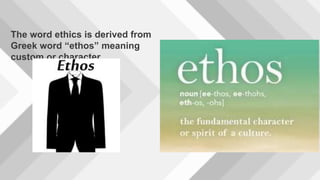
The word ethics is derived from
Greek word “ethos” meaning
custom or character
DEFINITION
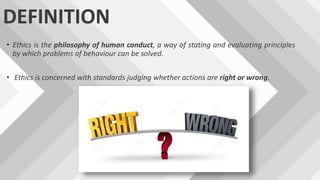
• Ethics is the philosophy of human conduct, a way of stating and evaluating principles
by which problems of behaviour can be solved.
• Ethics is concerned with standards judging whether actions are right or wrong.
DENTAL ETHICS
Dental ethics simply means moral duties and obligations of the dentists towards the
patients ,professional colleagues and to the society.
• It considers how we should act best in the light of our duties and obligations as moral
agents.
• Ethics deals with the choices we make and our actions in relation to those choices.
• It deals with choices made by both clinicians and patients.
HISTORY
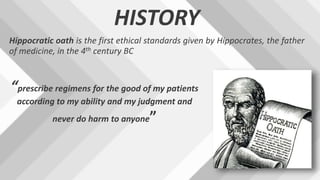
Hippocratic oath is the first ethical standards given by Hippocrates, the father
of medicine, in the 4th century BC
“prescribe regimens for the good of my patients
according to my ability and my judgment and
never do harm to anyone”
ETHICAL PRINCIPLES
1. to do no harm [ non-maleficence ]
2. to do good [ beneficence ]
3.respect the person
4.Justice
5.veracity or truthfulness
6.confidentiality
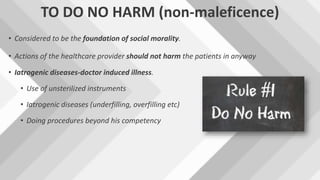
TO DO NO HARM (non-maleficence)
• Considered to be the foundation of social morality.
• Actions of the healthcare provider should not harm the patients in anyway
• Iatrogenic diseases-doctor induced illness.
• Use of unsterilized instruments
• Iatrogenic diseases (underfilling, overfilling etc)
• Doing procedures beyond his competency
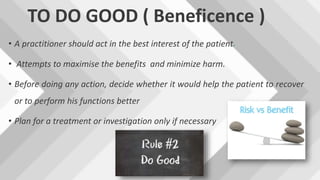
TO DO GOOD ( Beneficence )
• A practitioner should act in the best interest of the patient.
• Attempts to maximise the benefits and minimize harm.
• Before doing any action, decide whether it would help the patient to recover
or to perform his functions better
• Plan for a treatment or investigation only if necessary
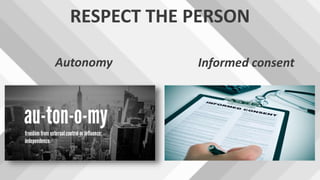
RESPECT THE PERSON
Autonomy Informed consent
AUTONOMY
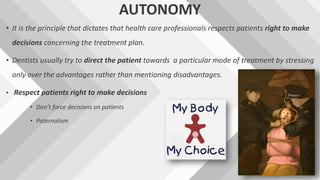
• It is the principle that dictates that health care professionals respects patients right to make
decisions concerning the treatment plan.
• Dentists usually try to direct the patient towards a particular mode of treatment by stressing
only over the advantages rather than mentioning disadvantages.
• Respect patients right to make decisions
• Don’t force decisions on patients
• Paternalism
INFORMED CONSENT
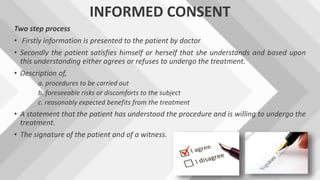
Two step process
• Firstly information is presented to the patient by doctor
• Secondly the patient satisfies himself or herself that she understands and based upon
this understanding either agrees or refuses to undergo the treatment.
• Description of,
a. procedures to be carried out
b. foreseeable risks or discomforts to the subject
c. reasonably expected benefits from the treatment
• A statement that the patient has understood the procedure and is willing to undergo the
treatment.
• The signature of the patient and of a witness.
JUSTICE
• Provide equal treatment to all without any prejudice
• Violation of justice
• Discrimination between patients based on caste, creed, socioeconomic status, health
condition
• Principle of justice is to protect the weak and to ensure equality in rights and
benefits, for both groups and individuals
TRUTHFULNESS
• The patient - doctor relationship is based on trust.
• Lying shows disrespect to the patient and threatens relationship.
• Patient expects the dentist/doctor to give true information about treatment and
prognosis
• Don’t:
• Hide treatment failures
• Give false information
CONFIDENTIALITY
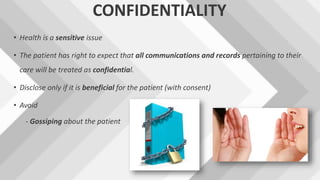
• Health is a sensitive issue
• The patient has right to expect that all communications and records pertaining to their
care will be treated as confidential.
• Disclose only if it is beneficial for the patient (with consent)
• Avoid
- Gossiping about the patient
EHICAL RULES FOR DENTISTS
[given by DCI]
• Duties of dentist towards patients
• Duties of dentists towards one another
• Duties of dentists towards the public
DUTIES OF DENTIST TOWARDS PATIENTS
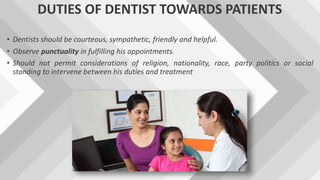
• Dentists should be courteous, sympathetic, friendly and helpful.
• Observe punctuality in fulfilling his appointments.
• Should not permit considerations of religion, nationality, race, party politics or social
standing to intervene between his duties and treatment
Duties of dentists towards one another
• Every dentist should cherish a proper pride in his / her colleagues and should not
disparage them with words or act.
• If a dentist is consulted by a patient of another dentist and the former finds that the
patient is suffering from previous faulty restoration , its the duty of the dentist to correct
the treatment at once with few comments as possible so as to avoid reflection on his
predecessor.
Duties of dentists towards the public
• Dentist should take leadership roles in the communities on matters
related to dental health.
UNETHICAL PRACTICES
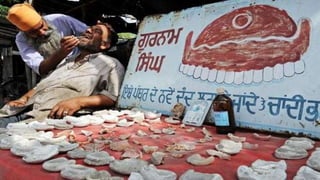
• Practicing by unregistered persons employed by the dentist.
• Signing a certificate issued for untrue, misleading and improper reasons.
• Direct or indirect advertising.
• Use of bogus diplomas.
• Undercharging for solicit patients.
NEED FOR RESEARCH ETHICS
“Many prominent medical researchers in
the 19th and 20th centuries conducted
experiments on patients without their
consent and with little if any concern for
the patients well-being”
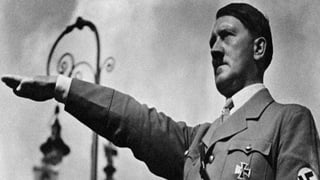
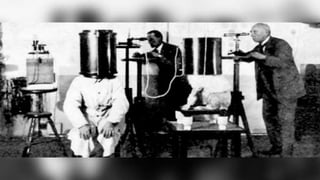
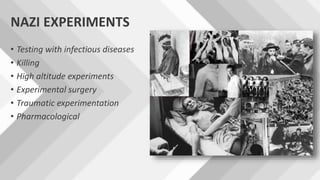
NAZI EXPERIMENTS
• Testing with infectious diseases
• Killing
• High altitude experiments
• Experimental surgery
• Traumatic experimentation
• Pharmacological
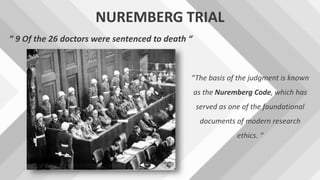
NUREMBERG TRIAL
“ 9 Of the 26 doctors were sentenced to death “
“The basis of the judgment is known
as the Nuremberg Code, which has
served as one of the foundational
documents of modern research
ethics. “
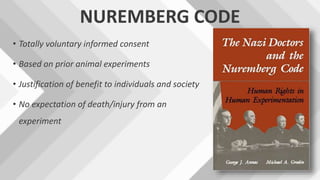
NUREMBERG CODE
• Totally voluntary informed consent
• Based on prior animal experiments
• Justification of benefit to individuals and society
• No expectation of death/injury from an
experiment
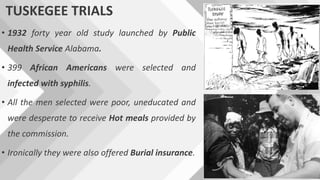
TUSKEGEE TRIALS
• 1932 forty year old study launched by Public
Health Service Alabama.
• 399 African Americans were selected and
infected with syphilis.
• All the men selected were poor, uneducated and
were desperate to receive Hot meals provided by
the commission.
• Ironically they were also offered Burial insurance.
BELMONT REPORT
•Beneficence
•Respect For Persons
•Justice
•Equal Moral Force
•Ethical Conflicts Expected
THE DECLARATION OF HELSINKI
• Declaration of Helsinki is a set of ethical principles regarding human
experimentation developed for the medical community by the World
Medical Association (WMA).
• It is widely regarded as the cornerstone document on human
research ethics
• Right to make informed decisions regarding participation in research
• Research should be based on a thorough knowledge of the scientific
background
• Careful assessment of risks and benefits
• Conducted by suitably trained investigators using approved protocols,
• Subject to independent ethical review
• Information regarding the study should be publicly available
• Experimental investigations should always be compared against the best
methods, but under certain circumstances a placebo or no treatment group
may be utilised
CONCLUSION
• Healthcare is not a business.
• Hence, adherence to a code of ethics is important for the continued
trust of the society in dentistry.
• Ethics is not a rule or cannot be forced on anyone………………………………
..…………………………………………………………....It has to be self cultivated.
Ethics in Dentistry and Research

Ethics in Dentistry and Research

  • 3.
    The word ethicsis derived from Greek word “ethos” meaning custom or character
  • 4.
    DEFINITION • Ethics isthe philosophy of human conduct, a way of stating and evaluating principles by which problems of behaviour can be solved. • Ethics is concerned with standards judging whether actions are right or wrong.
  • 5.
    DENTAL ETHICS Dental ethicssimply means moral duties and obligations of the dentists towards the patients ,professional colleagues and to the society. • It considers how we should act best in the light of our duties and obligations as moral agents. • Ethics deals with the choices we make and our actions in relation to those choices. • It deals with choices made by both clinicians and patients.
  • 7.
    HISTORY Hippocratic oath isthe first ethical standards given by Hippocrates, the father of medicine, in the 4th century BC “prescribe regimens for the good of my patients according to my ability and my judgment and never do harm to anyone”
  • 8.
    ETHICAL PRINCIPLES 1. todo no harm [ non-maleficence ] 2. to do good [ beneficence ] 3.respect the person 4.Justice 5.veracity or truthfulness 6.confidentiality
  • 10.
    TO DO NOHARM (non-maleficence) • Considered to be the foundation of social morality. • Actions of the healthcare provider should not harm the patients in anyway • Iatrogenic diseases-doctor induced illness. • Use of unsterilized instruments • Iatrogenic diseases (underfilling, overfilling etc) • Doing procedures beyond his competency
  • 11.
    TO DO GOOD( Beneficence ) • A practitioner should act in the best interest of the patient. • Attempts to maximise the benefits and minimize harm. • Before doing any action, decide whether it would help the patient to recover or to perform his functions better • Plan for a treatment or investigation only if necessary
  • 12.
  • 13.
    AUTONOMY • It isthe principle that dictates that health care professionals respects patients right to make decisions concerning the treatment plan. • Dentists usually try to direct the patient towards a particular mode of treatment by stressing only over the advantages rather than mentioning disadvantages. • Respect patients right to make decisions • Don’t force decisions on patients • Paternalism
  • 14.
    INFORMED CONSENT Two stepprocess • Firstly information is presented to the patient by doctor • Secondly the patient satisfies himself or herself that she understands and based upon this understanding either agrees or refuses to undergo the treatment. • Description of, a. procedures to be carried out b. foreseeable risks or discomforts to the subject c. reasonably expected benefits from the treatment • A statement that the patient has understood the procedure and is willing to undergo the treatment. • The signature of the patient and of a witness.
  • 15.
    JUSTICE • Provide equaltreatment to all without any prejudice • Violation of justice • Discrimination between patients based on caste, creed, socioeconomic status, health condition • Principle of justice is to protect the weak and to ensure equality in rights and benefits, for both groups and individuals
  • 16.
    TRUTHFULNESS • The patient- doctor relationship is based on trust. • Lying shows disrespect to the patient and threatens relationship. • Patient expects the dentist/doctor to give true information about treatment and prognosis • Don’t: • Hide treatment failures • Give false information
  • 17.
    CONFIDENTIALITY • Health isa sensitive issue • The patient has right to expect that all communications and records pertaining to their care will be treated as confidential. • Disclose only if it is beneficial for the patient (with consent) • Avoid - Gossiping about the patient
  • 18.
    EHICAL RULES FORDENTISTS [given by DCI] • Duties of dentist towards patients • Duties of dentists towards one another • Duties of dentists towards the public
  • 19.
    DUTIES OF DENTISTTOWARDS PATIENTS • Dentists should be courteous, sympathetic, friendly and helpful. • Observe punctuality in fulfilling his appointments. • Should not permit considerations of religion, nationality, race, party politics or social standing to intervene between his duties and treatment
  • 20.
    Duties of dentiststowards one another • Every dentist should cherish a proper pride in his / her colleagues and should not disparage them with words or act. • If a dentist is consulted by a patient of another dentist and the former finds that the patient is suffering from previous faulty restoration , its the duty of the dentist to correct the treatment at once with few comments as possible so as to avoid reflection on his predecessor.
  • 21.
    Duties of dentiststowards the public • Dentist should take leadership roles in the communities on matters related to dental health.
  • 23.
    UNETHICAL PRACTICES • Practicingby unregistered persons employed by the dentist. • Signing a certificate issued for untrue, misleading and improper reasons. • Direct or indirect advertising. • Use of bogus diplomas. • Undercharging for solicit patients.
  • 25.
    NEED FOR RESEARCHETHICS “Many prominent medical researchers in the 19th and 20th centuries conducted experiments on patients without their consent and with little if any concern for the patients well-being”
  • 31.
    NAZI EXPERIMENTS • Testingwith infectious diseases • Killing • High altitude experiments • Experimental surgery • Traumatic experimentation • Pharmacological
  • 32.
    NUREMBERG TRIAL “ 9Of the 26 doctors were sentenced to death “ “The basis of the judgment is known as the Nuremberg Code, which has served as one of the foundational documents of modern research ethics. “
  • 33.
    NUREMBERG CODE • Totallyvoluntary informed consent • Based on prior animal experiments • Justification of benefit to individuals and society • No expectation of death/injury from an experiment
  • 34.
    TUSKEGEE TRIALS • 1932forty year old study launched by Public Health Service Alabama. • 399 African Americans were selected and infected with syphilis. • All the men selected were poor, uneducated and were desperate to receive Hot meals provided by the commission. • Ironically they were also offered Burial insurance.
  • 35.
    BELMONT REPORT •Beneficence •Respect ForPersons •Justice •Equal Moral Force •Ethical Conflicts Expected
  • 37.
    THE DECLARATION OFHELSINKI • Declaration of Helsinki is a set of ethical principles regarding human experimentation developed for the medical community by the World Medical Association (WMA). • It is widely regarded as the cornerstone document on human research ethics
  • 38.
    • Right tomake informed decisions regarding participation in research • Research should be based on a thorough knowledge of the scientific background • Careful assessment of risks and benefits • Conducted by suitably trained investigators using approved protocols, • Subject to independent ethical review • Information regarding the study should be publicly available • Experimental investigations should always be compared against the best methods, but under certain circumstances a placebo or no treatment group may be utilised
  • 39.
    CONCLUSION • Healthcare isnot a business. • Hence, adherence to a code of ethics is important for the continued trust of the society in dentistry. • Ethics is not a rule or cannot be forced on anyone……………………………… ..…………………………………………………………....It has to be self cultivated.