National Iodine Deficiency
Disorder Control Programme
Introduction
•Iodine is an essential micronutrient.
•Deficiency of nutritional Iodine in the diet is
known as Iodine Deficiency Disorder.
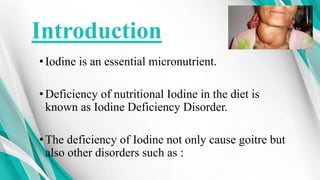
•The deficiency of Iodine not only cause goitre but
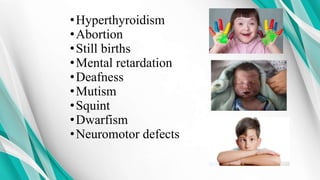
also other disorders such as :
•Hyperthyroidism
•Abortion
•Still births
•Mental retardation
•Deafness
•Mutism
•Squint
•Dwarfism
•Neuromotor defects
• Iodine deficiency disorder was a worldwide major public
health problem.
• As per the sources reviewed, globally, there are more
than 1.5 billion people are at risk of Iodine deficiency
disorder.
• The survey conducted by ICMR and medical institutes
have demonstrated that not even a single state or union
territories is free of Iodine deficiency disorder in India.
•The Government of India established the National
Goiter control programme in 1962.
•In August 1992, National Goiter control
programme was renamed as the National Iodine
Deficiency Disorder Control Programme with a
view to cover a wide spectrum of Iodine
deficiency disorder.
Aims
•To reduce the incidence of iodine deficiency disorder
:
a) Less than 10% among adult.
b) Less than 5% among childrens.
•To reduce prevalence of Iodine deficiency disorder
below 5% in the country.
•To ensure 100% coverage of consumption of Iodized
salt at the household level.
Objectives
•Assessing the magnitude of Iodine deficiency
disorder.
•Supplying iodized salt to the entire population.
•Assessing the impact of USI every 5 year.
•Laboratory monitoring of Iodized salt and Urinary
Iodine excretion.
•Health Education.
Strategies
1. IDD Survey
2. Establishment of IDD control cells
3. Establishment of IDD monitoring labs.
4. Training program
5. Production and distribution of iodized salt
6. Community level iodized salt testing
7. Incentive to ASHA for community level
awareness of iodized salt
8. Health education and publicity
9. Strengthening of central IDD control cell.
Activities
The following activities are conducted under the programme :
1. Iodization of salt :
a) The Government of India has initiated steps since 1983 for
universal iodization of edible salt in a phased manner.
b) The Government is providing subsidies to iodized salt
manufacturers @ Rs. 20/ MT
2. Notification for banning use of non - iodized salt :
a) By 2000, all the UTs and states excepts kerala had banned the
storage and sale of non-iodised salt.
b) Government stands firmly committed to universal iodization
of salt.
3. Establishment of iodine deficiency disorder control cell :
- Ministry of Health is providing 100% financial assistance to all
states and Union territories for the establishment of iodine
Deficiency Disorder control cell.
4. Monitoring and Reporting :
- Lab monitoring of National iodine deficiency disorder control
programme :
- It has 3 levels, they are :
a) Primary Level : Estimation of iodine in salt.
b) Secondary level : Estimation of urinary iodine content
c) Tertiary level : Neonatal monitoring for TSH.
5. Information, Education and communication activities :
a) Cash grants have been provided by the central
government to states and union Territories for IEC
activities.
Achievement
•Over the years, the Total Goitre Rate (TGR) is
reduced significantly in the entire country.
•An all time high production of iodated salt of 46
Lakh MT was recorded in 2000-01. By 2007-08,
the production increasea to 50 lakh MT.
•The policy of iodated salt production has been
liberalized to the private sectors.
•790 private manufacturers by the Salt
Commissioner have the annual production of 112
lakh tones for direct human consumption.
•One IDD Monitoring laboratory in all the states /
UTs has been sanctioned
Future plan
• To strengthen the IEC activities with focus on remote
rural, backward tribal areas as well as urban slums.
• To strengthen existing system of Iodine deficiency
disorder monitoring.
• To control the problem of Iodine deficiency disorder
through sustained reduction in it's prevalence.
Role of nurse in controlling Iodine
Deficiency Disorder
• To carry out assessment in the region which are
endemic in Iodine deficiency.
• To help in successful implementation of Intervention
being carried out to control deficiency.
• To identify weak links which are affecting successful
implementation of the programme.
•To create awareness in public regarding
seriousness of Iodine Deficiency Disorder.
•To launch health education campaigning to
create awareness.
Summary
• Introduction of National Iodine Deficiency Disorder Control Programme
• Aim of National Iodine Deficiency Disorder Control Programme
• Objective of National Iodine Deficiency Disorder Control Programme
• Strategies of National Iodine Deficiency Disorder Control Programme
• Activities of National Iodine Deficiency Disorder Control Programme
• Achievments of National Iodine Deficiency Disorder Control Programme
• Future plan of National Iodine Deficiency Disorder Control Programme
• Role of Nurse in controlling Iodine Deficiency Disorder.
Thank you

National iodine deficiency disorder control program

  • 1.
  • 2.
    Introduction •Iodine is anessential micronutrient. •Deficiency of nutritional Iodine in the diet is known as Iodine Deficiency Disorder. •The deficiency of Iodine not only cause goitre but also other disorders such as :
  • 3.
  • 4.
    • Iodine deficiencydisorder was a worldwide major public health problem. • As per the sources reviewed, globally, there are more than 1.5 billion people are at risk of Iodine deficiency disorder. • The survey conducted by ICMR and medical institutes have demonstrated that not even a single state or union territories is free of Iodine deficiency disorder in India.
  • 5.
    •The Government ofIndia established the National Goiter control programme in 1962. •In August 1992, National Goiter control programme was renamed as the National Iodine Deficiency Disorder Control Programme with a view to cover a wide spectrum of Iodine deficiency disorder.
  • 6.
    Aims •To reduce theincidence of iodine deficiency disorder : a) Less than 10% among adult. b) Less than 5% among childrens. •To reduce prevalence of Iodine deficiency disorder below 5% in the country. •To ensure 100% coverage of consumption of Iodized salt at the household level.
  • 7.
    Objectives •Assessing the magnitudeof Iodine deficiency disorder. •Supplying iodized salt to the entire population. •Assessing the impact of USI every 5 year. •Laboratory monitoring of Iodized salt and Urinary Iodine excretion. •Health Education.
  • 8.
    Strategies 1. IDD Survey 2.Establishment of IDD control cells 3. Establishment of IDD monitoring labs. 4. Training program 5. Production and distribution of iodized salt
  • 9.
    6. Community leveliodized salt testing 7. Incentive to ASHA for community level awareness of iodized salt 8. Health education and publicity 9. Strengthening of central IDD control cell.
  • 10.
    Activities The following activitiesare conducted under the programme : 1. Iodization of salt : a) The Government of India has initiated steps since 1983 for universal iodization of edible salt in a phased manner. b) The Government is providing subsidies to iodized salt manufacturers @ Rs. 20/ MT 2. Notification for banning use of non - iodized salt : a) By 2000, all the UTs and states excepts kerala had banned the storage and sale of non-iodised salt.
  • 11.
    b) Government standsfirmly committed to universal iodization of salt. 3. Establishment of iodine deficiency disorder control cell : - Ministry of Health is providing 100% financial assistance to all states and Union territories for the establishment of iodine Deficiency Disorder control cell. 4. Monitoring and Reporting : - Lab monitoring of National iodine deficiency disorder control programme :
  • 12.
    - It has3 levels, they are : a) Primary Level : Estimation of iodine in salt. b) Secondary level : Estimation of urinary iodine content c) Tertiary level : Neonatal monitoring for TSH. 5. Information, Education and communication activities : a) Cash grants have been provided by the central government to states and union Territories for IEC activities.
  • 13.
    Achievement •Over the years,the Total Goitre Rate (TGR) is reduced significantly in the entire country. •An all time high production of iodated salt of 46 Lakh MT was recorded in 2000-01. By 2007-08, the production increasea to 50 lakh MT.
  • 14.
    •The policy ofiodated salt production has been liberalized to the private sectors. •790 private manufacturers by the Salt Commissioner have the annual production of 112 lakh tones for direct human consumption. •One IDD Monitoring laboratory in all the states / UTs has been sanctioned
  • 15.
    Future plan • Tostrengthen the IEC activities with focus on remote rural, backward tribal areas as well as urban slums. • To strengthen existing system of Iodine deficiency disorder monitoring. • To control the problem of Iodine deficiency disorder through sustained reduction in it's prevalence.
  • 16.
    Role of nursein controlling Iodine Deficiency Disorder • To carry out assessment in the region which are endemic in Iodine deficiency. • To help in successful implementation of Intervention being carried out to control deficiency. • To identify weak links which are affecting successful implementation of the programme.
  • 17.
    •To create awarenessin public regarding seriousness of Iodine Deficiency Disorder. •To launch health education campaigning to create awareness.
  • 18.
    Summary • Introduction ofNational Iodine Deficiency Disorder Control Programme • Aim of National Iodine Deficiency Disorder Control Programme • Objective of National Iodine Deficiency Disorder Control Programme • Strategies of National Iodine Deficiency Disorder Control Programme • Activities of National Iodine Deficiency Disorder Control Programme • Achievments of National Iodine Deficiency Disorder Control Programme • Future plan of National Iodine Deficiency Disorder Control Programme • Role of Nurse in controlling Iodine Deficiency Disorder.
  • 19.