NUTRITIONAL
PROBLEMS
Neethu liza jose
Msc nursing
INTRODUCTION
• Nutrition is the selection
of foods and preparation of foods, and
their ingestion to be assimilated by the
body. By practicing a healthy diet, many
of the known health issues can be
avoided.The diet of an organism is what
it eats, which is largely determined by the
perceived palatability of foods.
• HEALTH – It is the state of complete
physical, mental and emotional well being and
not merely the absence of disease or
infirmity.
• NUTRIENTS – These are the
components of food that help to nourish the
body. The basic nutrients are CHO, proteins,
vitamins, lipids (fats), minerals and water.
• NUTRITIONAL STATUS – It is the
condition of the body as it relates to
consumption and utilization of food.
• Malnutrition – defined as a pathological state
resulting from a relative or absolute deficiency or
excess of one or more essential nutrients
• Undernutrition - condition that results when
insufficient food is consumed over an extended
period of time
• Overnutrition – pathological state resulting from
the consumption of excessive quantity of food over
an extended time
• Imbalance – pathological state resulting from
disproportion among essential nutrients with or
without the absolute deficiency of any nutrient
• Specific deficiency – pathological state resulting
from a relative or absolute lack of specific nutrients
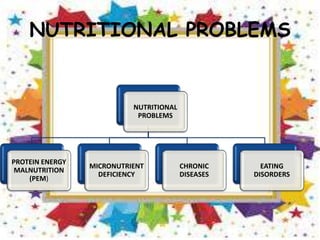
NUTRITIONAL PROBLEMS
NUTRITIONAL
PROBLEMS
PROTEIN ENERGY
MALNUTRITION
(PEM)
MICRONUTRIENT
DEFICIENCY
CHRONIC
DISEASES
EATING
DISORDERS
NUTRITION PROBLEMS IN INDIA
WHO IS AT RISK??
 PREGNANT WOMEN
 LACTATING WOMEN
 INFANTS
 PRESCHOOL CHILDREN
 ADOLESCENT GIRLS
 ELDERLY
.
Vijayaraghavan
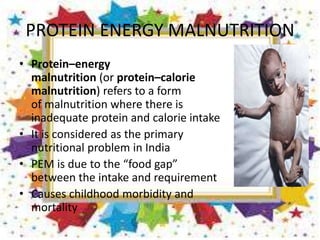
PROTEIN ENERGY MALNUTRITION
• Protein–energy
malnutrition (or protein–calorie
malnutrition) refers to a form
of malnutrition where there is
inadequate protein and calorie intake
• It is considered as the primary
nutritional problem in India
• PEM is due to the “food gap”
between the intake and requirement
• Causes childhood morbidity and
mortality
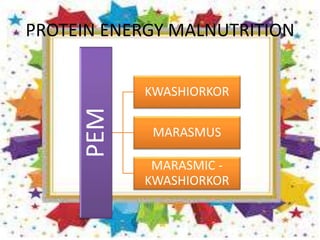
PROTEIN ENERGY MALNUTRITION
PEM KWASHIORKOR
MARASMUS
MARASMIC -
KWASHIORKOR
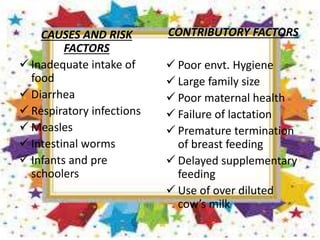
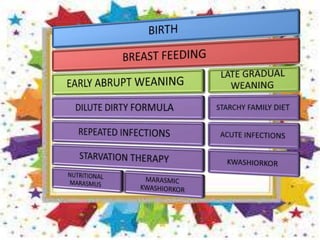
CAUSES AND RISK
FACTORS
 Inadequate intake of
food
 Diarrhea
 Respiratory infections
 Measles
 Intestinal worms
 Infants and pre
schoolers
CONTRIBUTORY FACTORS
 Poor envt. Hygiene
 Large family size
 Poor maternal health
 Failure of lactation
 Premature termination
of breast feeding
 Delayed supplementary
feeding
 Use of over diluted
cow’s milk
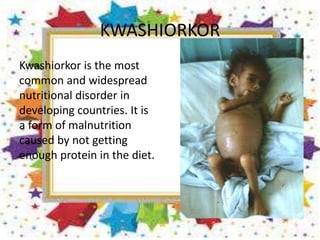
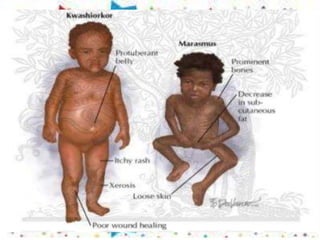
KWASHIORKOR
Kwashiorkor is the most
common and widespread
nutritional disorder in
developing countries. It is
a form of malnutrition
caused by not getting
enough protein in the diet.
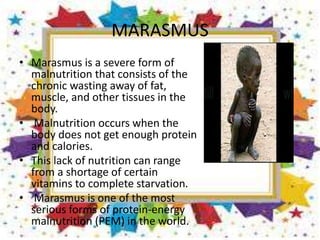
MARASMUS
• Marasmus is a severe form of
malnutrition that consists of the
chronic wasting away of fat,
muscle, and other tissues in the
body.
• Malnutrition occurs when the
body does not get enough protein
and calories.
• This lack of nutrition can range
from a shortage of certain
vitamins to complete starvation.
• Marasmus is one of the most
serious forms of protein-energy
malnutrition (PEM) in the world.
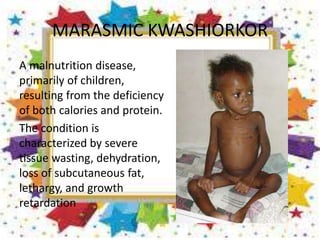
MARASMIC KWASHIORKOR
A malnutrition disease,
primarily of children,
resulting from the deficiency
of both calories and protein.
The condition is
characterized by severe
tissue wasting, dehydration,
loss of subcutaneous fat,
lethargy, and growth
retardation
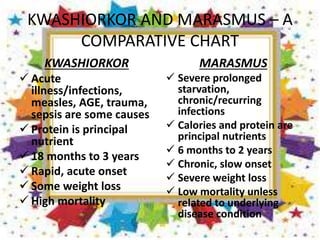
KWASHIORKOR AND MARASMUS – A
COMPARATIVE CHART
KWASHIORKOR
 Acute
illness/infections,
measles, AGE, trauma,
sepsis are some causes
 Protein is principal
nutrient
 18 months to 3 years
 Rapid, acute onset
 Some weight loss
 High mortality
MARASMUS
 Severe prolonged
starvation,
chronic/recurring
infections
 Calories and protein are
principal nutrients
 6 months to 2 years
 Chronic, slow onset
 Severe weight loss
 Low mortality unless
related to underlying
disease condition
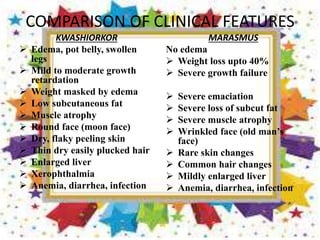
COMPARISON OF CLINICAL FEATURES
KWASHIORKOR
 Edema, pot belly, swollen
legs
 Mild to moderate growth
retardation
 Weight masked by edema
 Low subcutaneous fat
 Muscle atrophy
 Round face (moon face)
 Dry, flaky peeling skin
 Thin dry easily plucked hair
 Enlarged liver
 Xerophthalmia
 Anemia, diarrhea, infection
MARASMUS
No edema
 Weight loss upto 40%
 Severe growth failure
 Severe emaciation
 Severe loss of subcut fat
 Severe muscle atrophy
 Wrinkled face (old man’s
face)
 Rare skin changes
 Common hair changes
 Mildly enlarged liver
 Anemia, diarrhea, infection
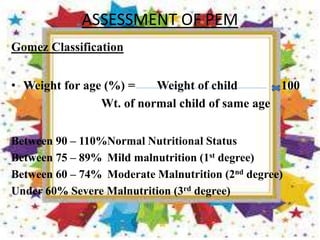
ASSESSMENT OF PEM
Gomez Classification
• Weight for age (%) = Weight of child 100
Wt. of normal child of same age
Between 90 – 110%Normal Nutritional Status
Between 75 – 89% Mild malnutrition (1st degree)
Between 60 – 74% Moderate Malnutrition (2nd degree)
Under 60% Severe Malnutrition (3rd degree)
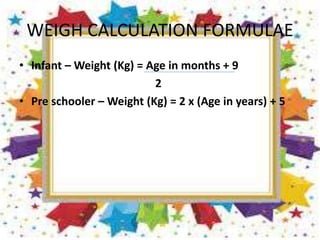
WEIGH CALCULATION FORMULAE
• Infant – Weight (Kg) = Age in months + 9
2
• Pre schooler – Weight (Kg) = 2 x (Age in years) + 5
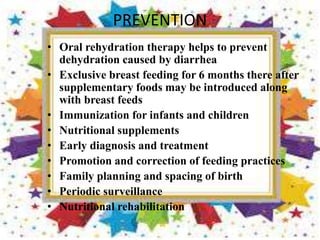
PREVENTION
• Oral rehydration therapy helps to prevent
dehydration caused by diarrhea
• Exclusive breast feeding for 6 months there after
supplementary foods may be introduced along
with breast feeds
• Immunization for infants and children
• Nutritional supplements
• Early diagnosis and treatment
• Promotion and correction of feeding practices
• Family planning and spacing of birth
• Periodic surveillance
• Nutritional rehabilitation
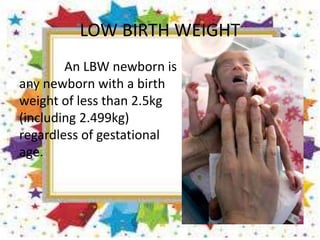
LOW BIRTH WEIGHT
An LBW newborn is
any newborn with a birth
weight of less than 2.5kg
(including 2.499kg)
regardless of gestational
age.
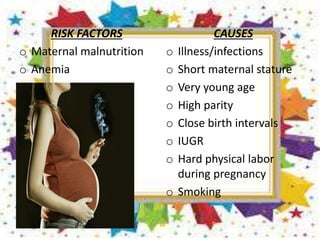
RISK FACTORS
o Maternal malnutrition
o Anemia
CAUSES
o Illness/infections
o Short maternal stature
o Very young age
o High parity
o Close birth intervals
o IUGR
o Hard physical labor
during pregnancy
o Smoking
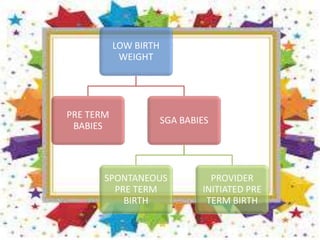
LOW BIRTH
WEIGHT
PRE TERM
BABIES
SGA BABIES
SPONTANEOUS
PRE TERM
BIRTH
PROVIDER
INITIATED PRE
TERM BIRTH
PREVENTION
• Identification of mothers at risk –
malnutrition, heavy work load, infections,
disease and high BP
• Increasing food intake of mother,
supplementary feeding, distribution of
iron and folic acid tablets
• Avoidance if smoking
• Improved sanitation methods
• Improving health and nutrition of young
girls
• Early detection and treatment of medical
disorders – DM HTN
• Controlling infections – UTI, rubella,
syphillis, malaria
MICRONUTRIENT
DEFICIENCY
VITAMIN A DEFICIENCY
Overweight and obesity are defined as
abnormal or excessive fat accumulation that
presents a risk to health. A crude population
measure of obesity is the body mass index
(BMI), a person’s weight (in kilograms)
divided by the square of his or her height (in
meters). A person with a BMI of 30 or more is
generally considered obese. A person with a
BMI equal to or more than 25 is considered
overweight.
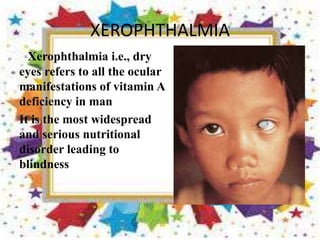
XEROPHTHALMIA
Xerophthalmia i.e., dry
eyes refers to all the ocular
manifestations of vitamin A
deficiency in man
It is the most widespread
and serious nutritional
disorder leading to
blindness
RISK FACTORS
 Poor SE status
 Faulty feeding practices
 Weaning
 PEM
 Infections
 1-3 years
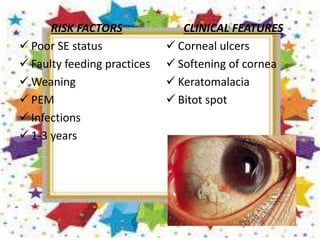
CLINICAL FEATURES
 Corneal ulcers
 Softening of cornea
 Keratomalacia
 Bitot spot
PREVENTION AND CONTROL
Administering large doses of vitamin A orally
on a periodic basis
Regular and adequate intake of vitamin A
Fortification of certain food with vitamin A –
sugar, salt, tea and skimmed milk
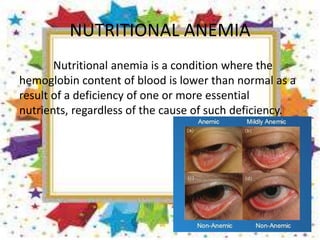
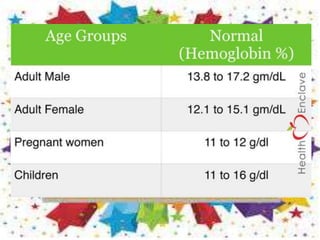
NUTRITIONAL ANEMIA
Nutritional anemia is a condition where the
hemoglobin content of blood is lower than normal as a
result of a deficiency of one or more essential
nutrients, regardless of the cause of such deficiency.
RISK FACTORS
 Infants and children
 Pregnant women
 Pre menopausal women
 Adolescent girls
 Older adults
 Alcoholism
 Chronic/ critically ill
 Excessive exercise
CAUSES
 Inadequate diet
 Insufficient intake of
iron
 Iron malabsorption
 Pregnancy
 Excessive menstrual
bleeding
 Hook worm infestation
 Malaria
 Close birth intervals
 GI bleed
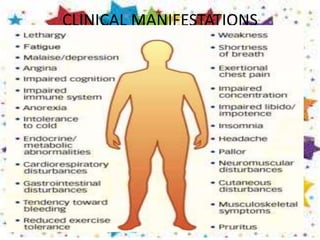
CLINICAL MANIFESTATIONS
EFFECTS OF ANEMIA
• Increases risk of maternal and fetal morbidity
and mortality
• Abortions, premature births, PPH, low birth
weight are associated with anemia during
pregnancy
PREGNANCY
PREVENTION
Estimation of Hb to assess degree of anemia
Blood transfusion in severe cases of anemia
(<8g/dL)
Iron and folic acid supplements
Food fortification with iron
Changing dietary habits
Control of parasites
Nutritional education and awareness
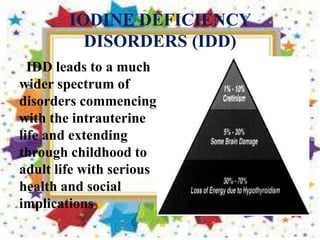
IODINE DEFICIENCY
DISORDERS (IDD)
IDD leads to a much
wider spectrum of
disorders commencing
with the intrauterine
life and extending
through childhood to
adult life with serious
health and social
implications
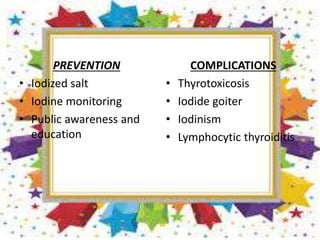
DISORDERS
 Goiter
 Hypothyroidism
 Subnormal intelligence
 Delayed motor milestones
 Mental deficiency
 Hearing defects
 Speech defects
 Mental retardation
 Neuromuscular weakness
 Endemic cretinism
 Intrauterine death
PREVENTION
• Iodized salt
• Iodine monitoring
• Public awareness and
education
COMPLICATIONS
• Thyrotoxicosis
• Iodide goiter
• Iodinism
• Lymphocytic thyroiditis
ENDEMIC FLUOROSIS
In many parts of the world where drinking
water contains excessive amounts of fluorine (3-
5mg/L), endemic fluorosis has been observed.
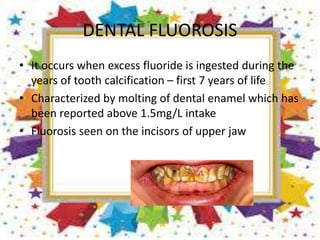
DENTAL FLUOROSIS
• It occurs when excess fluoride is ingested during the
years of tooth calcification – first 7 years of life
• Characterized by molting of dental enamel which has
been reported above 1.5mg/L intake
• Fluorosis seen on the incisors of upper jaw
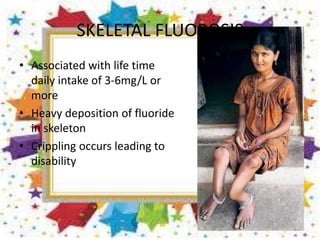
SKELETAL FLUOROSIS
• Associated with life time
daily intake of 3-6mg/L or
more
• Heavy deposition of fluoride
in skeleton
• Crippling occurs leading to
disability
PREVENTION
• Changing the water sources
• Chemical defluorination
• Preventing use of fluoridated toothpaste
• Fluoride supplements not prescribed for
children consuming fluoridated water
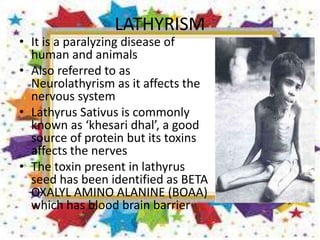
LATHYRISM
• It is a paralyzing disease of
human and animals
• Also referred to as
Neurolathyrism as it affects the
nervous system
• Lathyrus Sativus is commonly
known as ‘khesari dhal’, a good
source of protein but its toxins
affects the nerves
• The toxin present in lathyrus
seed has been identified as BETA
OXALYL AMINO ALANINE (BOAA)
which has blood brain barrier
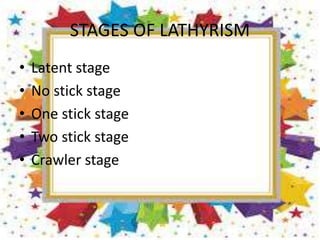
STAGES OF LATHYRISM
• Latent stage
• No stick stage
• One stick stage
• Two stick stage
• Crawler stage
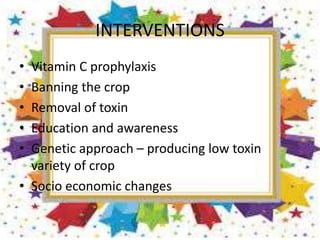
INTERVENTIONS
• Vitamin C prophylaxis
• Banning the crop
• Removal of toxin
• Education and awareness
• Genetic approach – producing low toxin
variety of crop
• Socio economic changes
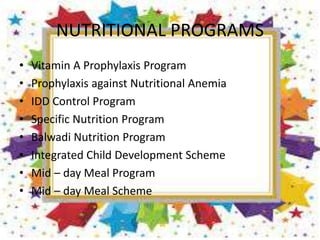
NUTRITIONAL PROGRAMS
• Vitamin A Prophylaxis Program
• Prophylaxis against Nutritional Anemia
• IDD Control Program
• Specific Nutrition Program
• Balwadi Nutrition Program
• Integrated Child Development Scheme
• Mid – day Meal Program
• Mid – day Meal Scheme
CHRONIC DISEASES
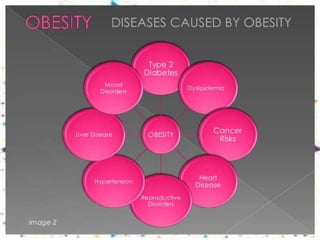
OBESITY
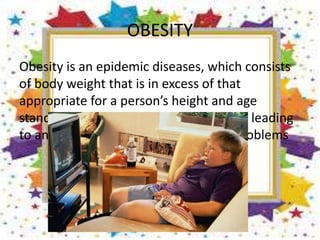
Obesity is an epidemic diseases, which consists
of body weight that is in excess of that
appropriate for a person’s height and age
standardized to account for differences, leading
to an increased risk to health related problems
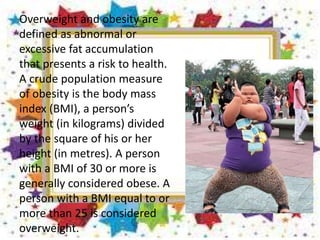
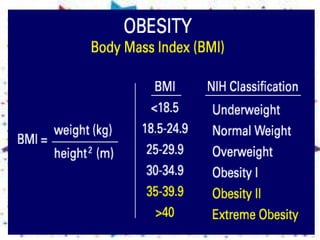
Overweight and obesity are
defined as abnormal or
excessive fat accumulation
that presents a risk to health.
A crude population measure
of obesity is the body mass
index (BMI), a person’s
weight (in kilograms) divided
by the square of his or her
height (in metres). A person
with a BMI of 30 or more is
generally considered obese. A
person with a BMI equal to or
more than 25 is considered
overweight.
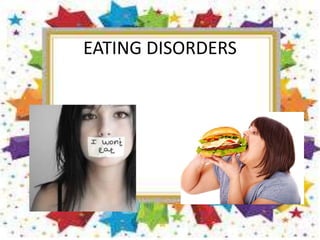
EATING DISORDERS
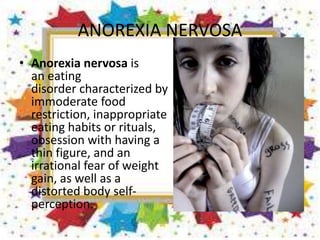
ANOREXIA NERVOSA
• Anorexia nervosa is
an eating
disorder characterized by
immoderate food
restriction, inappropriate
eating habits or rituals,
obsession with having a
thin figure, and an
irrational fear of weight
gain, as well as a
distorted body self-
perception.
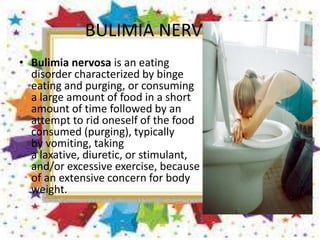
BULIMIA NERVOSA
• Bulimia nervosa is an eating
disorder characterized by binge
eating and purging, or consuming
a large amount of food in a short
amount of time followed by an
attempt to rid oneself of the food
consumed (purging), typically
by vomiting, taking
a laxative, diuretic, or stimulant,
and/or excessive exercise, because
of an extensive concern for body
weight.
CLINICAL MANIFESTATIONS
• Amenorrhea
• Obvious, rapid, dramatic weight
loss at least 15% under normal body
weight[
• May engage in frequent, strenuous,
or compulsive exercise
• Perception of self as overweight
despite being told by others they
are too thin
• Intolerance to cold and frequent
complaints of being cold. Body
• Bradycardia or tachycardia
• Depression: may frequently be in a sad, lethargic state
• Solitude: may avoid friends and family; becomes
withdrawn and secretive
• Swollen joints
• Abdominal distension
• Halitosis (from vomiting or starvation-induced ketosis)
• Dry hair and skin, as well as hair thinning
• Fatigue
• Rapid mood swings
Nutritional problems 2

Nutritional problems 2

  • 1.
  • 2.
    INTRODUCTION • Nutrition isthe selection of foods and preparation of foods, and their ingestion to be assimilated by the body. By practicing a healthy diet, many of the known health issues can be avoided.The diet of an organism is what it eats, which is largely determined by the perceived palatability of foods.
  • 3.
    • HEALTH –It is the state of complete physical, mental and emotional well being and not merely the absence of disease or infirmity. • NUTRIENTS – These are the components of food that help to nourish the body. The basic nutrients are CHO, proteins, vitamins, lipids (fats), minerals and water. • NUTRITIONAL STATUS – It is the condition of the body as it relates to consumption and utilization of food.
  • 4.
    • Malnutrition –defined as a pathological state resulting from a relative or absolute deficiency or excess of one or more essential nutrients • Undernutrition - condition that results when insufficient food is consumed over an extended period of time • Overnutrition – pathological state resulting from the consumption of excessive quantity of food over an extended time • Imbalance – pathological state resulting from disproportion among essential nutrients with or without the absolute deficiency of any nutrient • Specific deficiency – pathological state resulting from a relative or absolute lack of specific nutrients
  • 5.
  • 6.
    NUTRITION PROBLEMS ININDIA WHO IS AT RISK??  PREGNANT WOMEN  LACTATING WOMEN  INFANTS  PRESCHOOL CHILDREN  ADOLESCENT GIRLS  ELDERLY . Vijayaraghavan
  • 7.
    PROTEIN ENERGY MALNUTRITION •Protein–energy malnutrition (or protein–calorie malnutrition) refers to a form of malnutrition where there is inadequate protein and calorie intake • It is considered as the primary nutritional problem in India • PEM is due to the “food gap” between the intake and requirement • Causes childhood morbidity and mortality
  • 8.
    PROTEIN ENERGY MALNUTRITION PEMKWASHIORKOR MARASMUS MARASMIC - KWASHIORKOR
  • 9.
    CAUSES AND RISK FACTORS Inadequate intake of food  Diarrhea  Respiratory infections  Measles  Intestinal worms  Infants and pre schoolers CONTRIBUTORY FACTORS  Poor envt. Hygiene  Large family size  Poor maternal health  Failure of lactation  Premature termination of breast feeding  Delayed supplementary feeding  Use of over diluted cow’s milk
  • 10.
    KWASHIORKOR Kwashiorkor is themost common and widespread nutritional disorder in developing countries. It is a form of malnutrition caused by not getting enough protein in the diet.
  • 11.
    MARASMUS • Marasmus isa severe form of malnutrition that consists of the chronic wasting away of fat, muscle, and other tissues in the body. • Malnutrition occurs when the body does not get enough protein and calories. • This lack of nutrition can range from a shortage of certain vitamins to complete starvation. • Marasmus is one of the most serious forms of protein-energy malnutrition (PEM) in the world.
  • 12.
    MARASMIC KWASHIORKOR A malnutritiondisease, primarily of children, resulting from the deficiency of both calories and protein. The condition is characterized by severe tissue wasting, dehydration, loss of subcutaneous fat, lethargy, and growth retardation
  • 13.
    KWASHIORKOR AND MARASMUS– A COMPARATIVE CHART KWASHIORKOR  Acute illness/infections, measles, AGE, trauma, sepsis are some causes  Protein is principal nutrient  18 months to 3 years  Rapid, acute onset  Some weight loss  High mortality MARASMUS  Severe prolonged starvation, chronic/recurring infections  Calories and protein are principal nutrients  6 months to 2 years  Chronic, slow onset  Severe weight loss  Low mortality unless related to underlying disease condition
  • 15.
    COMPARISON OF CLINICALFEATURES KWASHIORKOR  Edema, pot belly, swollen legs  Mild to moderate growth retardation  Weight masked by edema  Low subcutaneous fat  Muscle atrophy  Round face (moon face)  Dry, flaky peeling skin  Thin dry easily plucked hair  Enlarged liver  Xerophthalmia  Anemia, diarrhea, infection MARASMUS No edema  Weight loss upto 40%  Severe growth failure  Severe emaciation  Severe loss of subcut fat  Severe muscle atrophy  Wrinkled face (old man’s face)  Rare skin changes  Common hair changes  Mildly enlarged liver  Anemia, diarrhea, infection
  • 17.
    ASSESSMENT OF PEM GomezClassification • Weight for age (%) = Weight of child 100 Wt. of normal child of same age Between 90 – 110%Normal Nutritional Status Between 75 – 89% Mild malnutrition (1st degree) Between 60 – 74% Moderate Malnutrition (2nd degree) Under 60% Severe Malnutrition (3rd degree)
  • 18.
    WEIGH CALCULATION FORMULAE •Infant – Weight (Kg) = Age in months + 9 2 • Pre schooler – Weight (Kg) = 2 x (Age in years) + 5
  • 19.
    PREVENTION • Oral rehydrationtherapy helps to prevent dehydration caused by diarrhea • Exclusive breast feeding for 6 months there after supplementary foods may be introduced along with breast feeds • Immunization for infants and children • Nutritional supplements • Early diagnosis and treatment • Promotion and correction of feeding practices • Family planning and spacing of birth • Periodic surveillance • Nutritional rehabilitation
  • 20.
    LOW BIRTH WEIGHT AnLBW newborn is any newborn with a birth weight of less than 2.5kg (including 2.499kg) regardless of gestational age.
  • 21.
    RISK FACTORS o Maternalmalnutrition o Anemia CAUSES o Illness/infections o Short maternal stature o Very young age o High parity o Close birth intervals o IUGR o Hard physical labor during pregnancy o Smoking
  • 22.
    LOW BIRTH WEIGHT PRE TERM BABIES SGABABIES SPONTANEOUS PRE TERM BIRTH PROVIDER INITIATED PRE TERM BIRTH
  • 23.
    PREVENTION • Identification ofmothers at risk – malnutrition, heavy work load, infections, disease and high BP • Increasing food intake of mother, supplementary feeding, distribution of iron and folic acid tablets • Avoidance if smoking • Improved sanitation methods • Improving health and nutrition of young girls • Early detection and treatment of medical disorders – DM HTN • Controlling infections – UTI, rubella, syphillis, malaria
  • 24.
  • 25.
    VITAMIN A DEFICIENCY Overweightand obesity are defined as abnormal or excessive fat accumulation that presents a risk to health. A crude population measure of obesity is the body mass index (BMI), a person’s weight (in kilograms) divided by the square of his or her height (in meters). A person with a BMI of 30 or more is generally considered obese. A person with a BMI equal to or more than 25 is considered overweight.
  • 26.
    XEROPHTHALMIA Xerophthalmia i.e., dry eyesrefers to all the ocular manifestations of vitamin A deficiency in man It is the most widespread and serious nutritional disorder leading to blindness
  • 27.
    RISK FACTORS  PoorSE status  Faulty feeding practices  Weaning  PEM  Infections  1-3 years CLINICAL FEATURES  Corneal ulcers  Softening of cornea  Keratomalacia  Bitot spot
  • 28.
    PREVENTION AND CONTROL Administeringlarge doses of vitamin A orally on a periodic basis Regular and adequate intake of vitamin A Fortification of certain food with vitamin A – sugar, salt, tea and skimmed milk
  • 29.
    NUTRITIONAL ANEMIA Nutritional anemiais a condition where the hemoglobin content of blood is lower than normal as a result of a deficiency of one or more essential nutrients, regardless of the cause of such deficiency.
  • 31.
    RISK FACTORS  Infantsand children  Pregnant women  Pre menopausal women  Adolescent girls  Older adults  Alcoholism  Chronic/ critically ill  Excessive exercise CAUSES  Inadequate diet  Insufficient intake of iron  Iron malabsorption  Pregnancy  Excessive menstrual bleeding  Hook worm infestation  Malaria  Close birth intervals  GI bleed
  • 32.
  • 33.
    EFFECTS OF ANEMIA •Increases risk of maternal and fetal morbidity and mortality • Abortions, premature births, PPH, low birth weight are associated with anemia during pregnancy PREGNANCY
  • 34.
    PREVENTION Estimation of Hbto assess degree of anemia Blood transfusion in severe cases of anemia (<8g/dL) Iron and folic acid supplements Food fortification with iron Changing dietary habits Control of parasites Nutritional education and awareness
  • 35.
    IODINE DEFICIENCY DISORDERS (IDD) IDDleads to a much wider spectrum of disorders commencing with the intrauterine life and extending through childhood to adult life with serious health and social implications
  • 36.
    DISORDERS  Goiter  Hypothyroidism Subnormal intelligence  Delayed motor milestones  Mental deficiency  Hearing defects  Speech defects  Mental retardation  Neuromuscular weakness  Endemic cretinism  Intrauterine death
  • 37.
    PREVENTION • Iodized salt •Iodine monitoring • Public awareness and education COMPLICATIONS • Thyrotoxicosis • Iodide goiter • Iodinism • Lymphocytic thyroiditis
  • 38.
    ENDEMIC FLUOROSIS In manyparts of the world where drinking water contains excessive amounts of fluorine (3- 5mg/L), endemic fluorosis has been observed.
  • 39.
    DENTAL FLUOROSIS • Itoccurs when excess fluoride is ingested during the years of tooth calcification – first 7 years of life • Characterized by molting of dental enamel which has been reported above 1.5mg/L intake • Fluorosis seen on the incisors of upper jaw
  • 40.
    SKELETAL FLUOROSIS • Associatedwith life time daily intake of 3-6mg/L or more • Heavy deposition of fluoride in skeleton • Crippling occurs leading to disability
  • 41.
    PREVENTION • Changing thewater sources • Chemical defluorination • Preventing use of fluoridated toothpaste • Fluoride supplements not prescribed for children consuming fluoridated water
  • 42.
    LATHYRISM • It isa paralyzing disease of human and animals • Also referred to as Neurolathyrism as it affects the nervous system • Lathyrus Sativus is commonly known as ‘khesari dhal’, a good source of protein but its toxins affects the nerves • The toxin present in lathyrus seed has been identified as BETA OXALYL AMINO ALANINE (BOAA) which has blood brain barrier
  • 43.
    STAGES OF LATHYRISM •Latent stage • No stick stage • One stick stage • Two stick stage • Crawler stage
  • 44.
    INTERVENTIONS • Vitamin Cprophylaxis • Banning the crop • Removal of toxin • Education and awareness • Genetic approach – producing low toxin variety of crop • Socio economic changes
  • 45.
    NUTRITIONAL PROGRAMS • VitaminA Prophylaxis Program • Prophylaxis against Nutritional Anemia • IDD Control Program • Specific Nutrition Program • Balwadi Nutrition Program • Integrated Child Development Scheme • Mid – day Meal Program • Mid – day Meal Scheme
  • 46.
  • 47.
    OBESITY Obesity is anepidemic diseases, which consists of body weight that is in excess of that appropriate for a person’s height and age standardized to account for differences, leading to an increased risk to health related problems
  • 48.
    Overweight and obesityare defined as abnormal or excessive fat accumulation that presents a risk to health. A crude population measure of obesity is the body mass index (BMI), a person’s weight (in kilograms) divided by the square of his or her height (in metres). A person with a BMI of 30 or more is generally considered obese. A person with a BMI equal to or more than 25 is considered overweight.
  • 51.
  • 52.
    ANOREXIA NERVOSA • Anorexianervosa is an eating disorder characterized by immoderate food restriction, inappropriate eating habits or rituals, obsession with having a thin figure, and an irrational fear of weight gain, as well as a distorted body self- perception.
  • 53.
    BULIMIA NERVOSA • Bulimianervosa is an eating disorder characterized by binge eating and purging, or consuming a large amount of food in a short amount of time followed by an attempt to rid oneself of the food consumed (purging), typically by vomiting, taking a laxative, diuretic, or stimulant, and/or excessive exercise, because of an extensive concern for body weight.
  • 54.
    CLINICAL MANIFESTATIONS • Amenorrhea •Obvious, rapid, dramatic weight loss at least 15% under normal body weight[ • May engage in frequent, strenuous, or compulsive exercise • Perception of self as overweight despite being told by others they are too thin • Intolerance to cold and frequent complaints of being cold. Body
  • 55.
    • Bradycardia ortachycardia • Depression: may frequently be in a sad, lethargic state • Solitude: may avoid friends and family; becomes withdrawn and secretive • Swollen joints • Abdominal distension • Halitosis (from vomiting or starvation-induced ketosis) • Dry hair and skin, as well as hair thinning • Fatigue • Rapid mood swings